









The following is a guets post written by Chris Corradino. The article appeared first on his website www.christography.com. All images and text are copyrighted and used with permission.
—-
Side by Side Image Comparison: Full Frame DSLR vs Micro Four-Thirds Mirrorless
January 06, 2015 in Gadgets and Gear
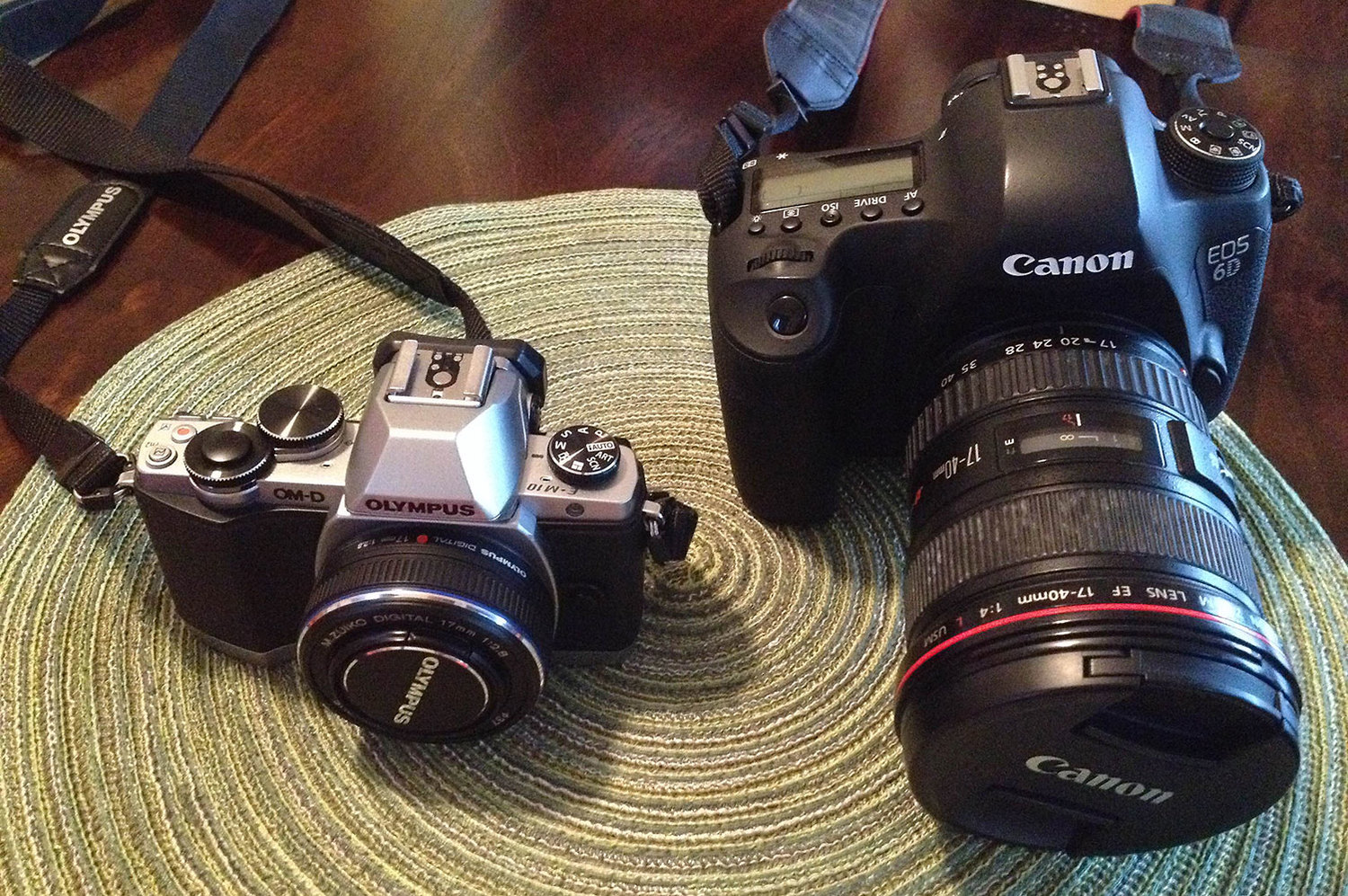
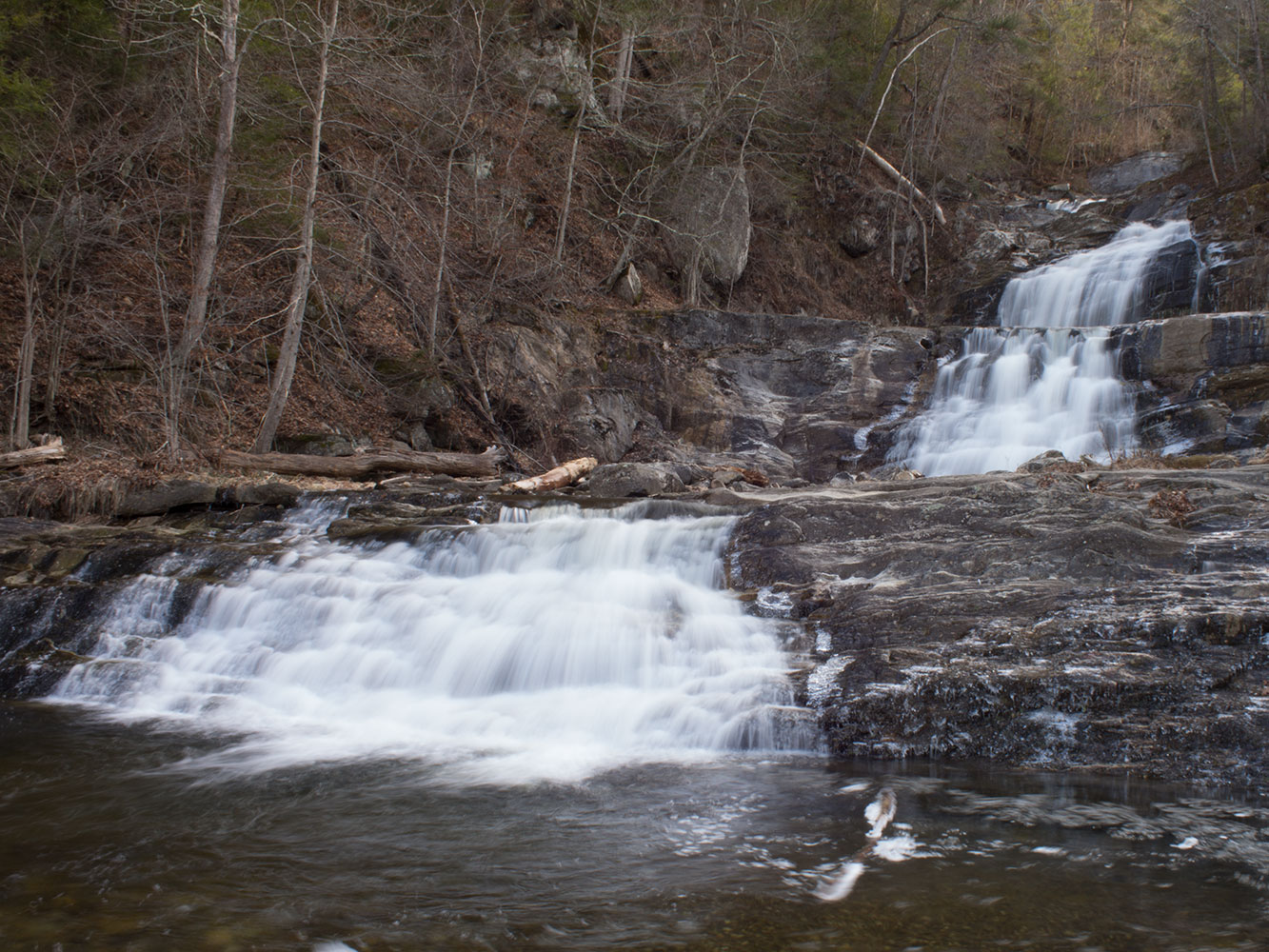
Yesterday, I posted this side by side comparison to Facebook as a simple test. One image was captured with a full frame DSLR and a professional quality lens totaling approximately $2400. The other was shot with a small mirrorless camera with a micro 4/3 sensor and a prime lens totaling $899. Both were captured in RAW on a tripod with the exact same camera settings and auto white balance. They were imported into Lightroom and were not sharpened or adjusted in any way, only saved for the web.
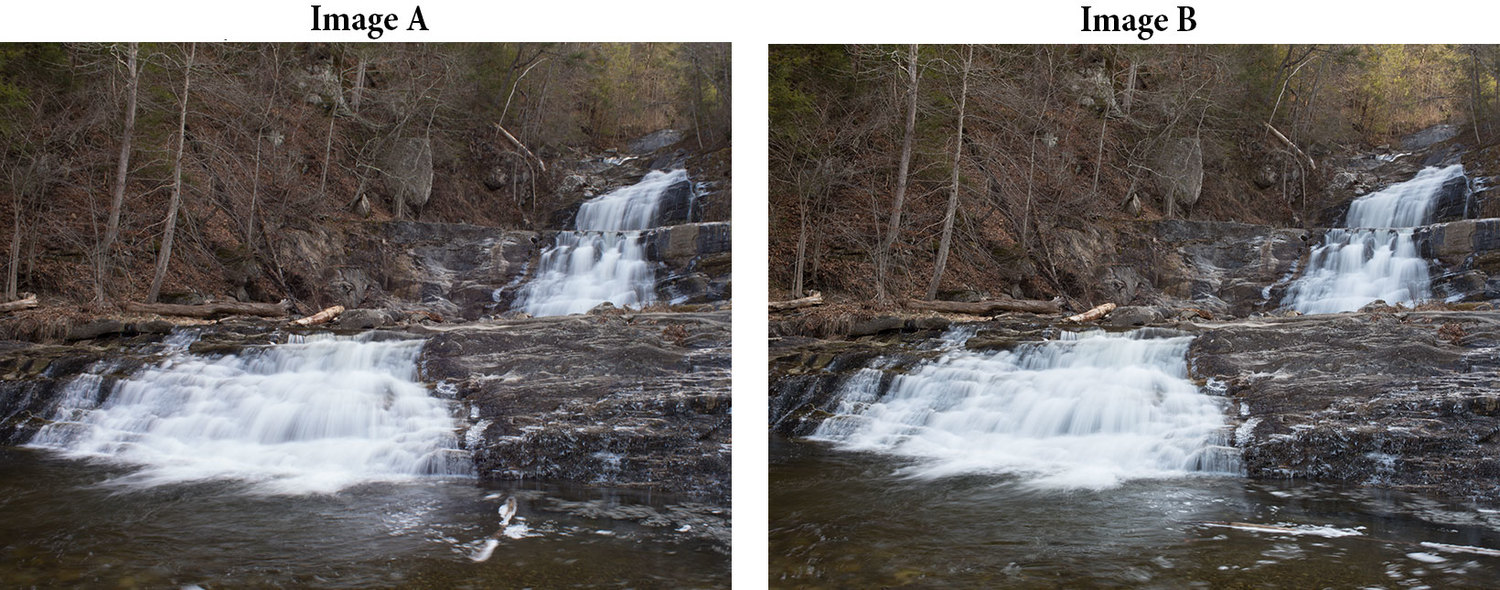
As you can see, the results were quite similar, making it quite challenging to determine which is which. This was further proven by the variety of guesses from the Twitter and FB communities. Some were able to see the difference, while others couldn’t. Now, I’ll reveal the camera types.
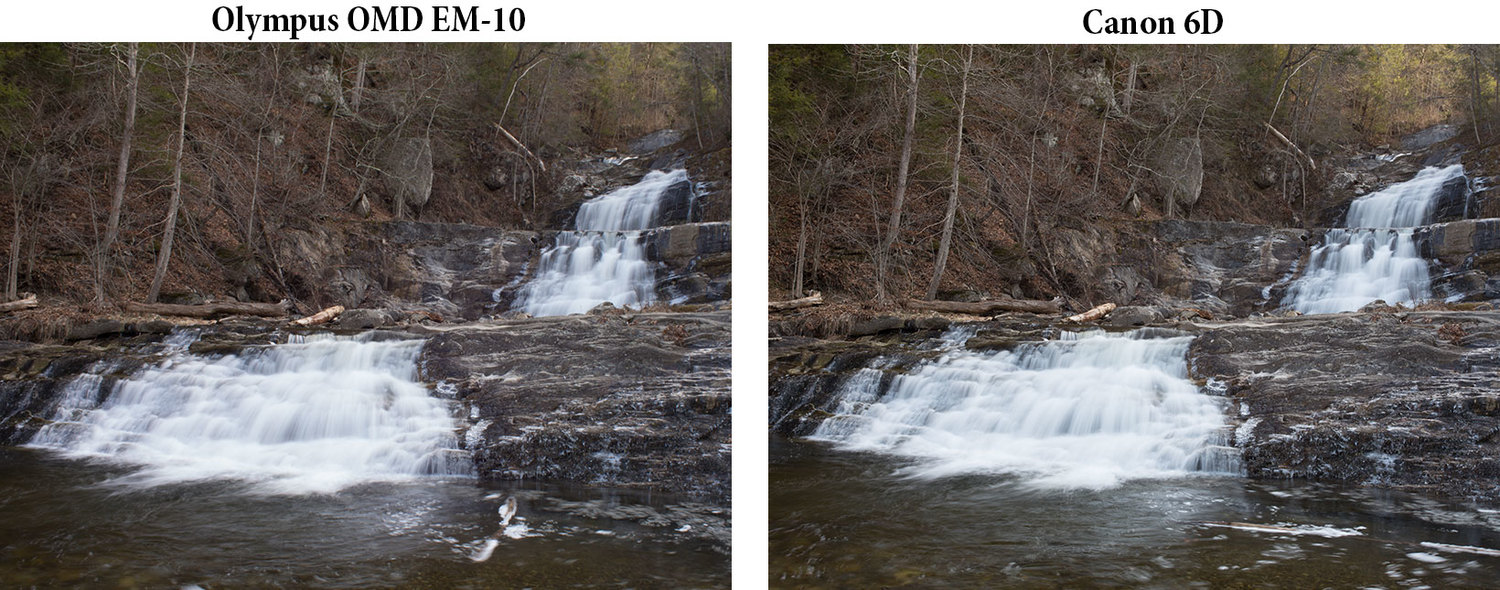
Do the results surprise you?
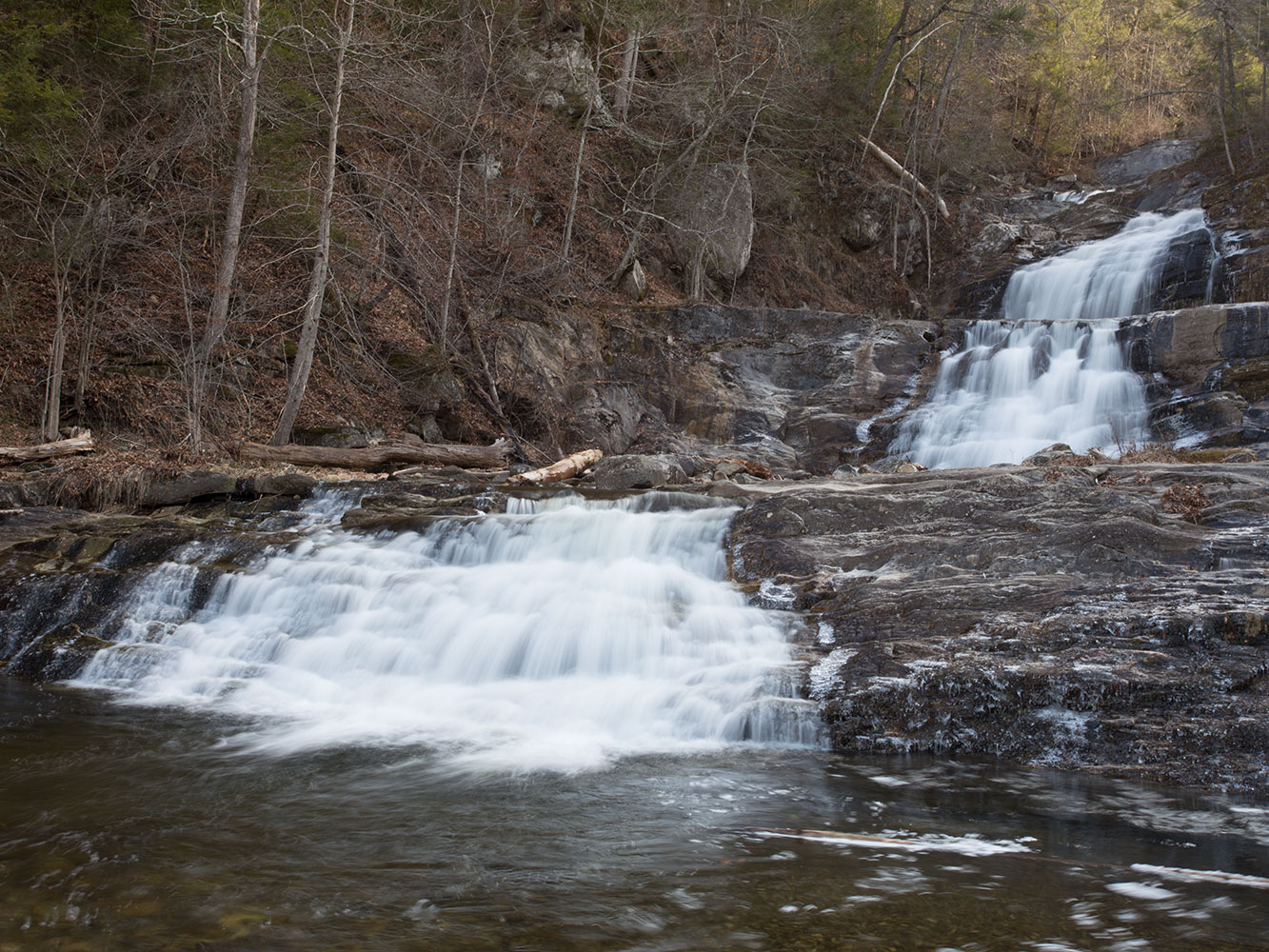
Here’s a larger view of each image.
My take on it
Considering that an entry level Olympus with a micro 4/3 sensor can actually compete with a full frame DSLR on image quality, I believe a major shift is coming to the industry sooner rather than later. Yes there will definitely be pixel-peepers who dispute that. This is not for them, but rather to help YOU find the best tool for your specific needs. Do you want to spend an extra $1500 and carry more weight or would you be better off with this alternative?
The images out of the mirrorless have more than enough resolution for publication, web, and print enlargements. Granted, the 6D definitely offers better detail at larger print sizes. Still, at a fraction of the weight and price, one has to really determine what their priorities are. For travel, scenic, everyday work, the OMD EM-10 has repeatedly proven its worth. In addition to the excellent files one can capture with it, the functionality is actually superior in my opinion with more focus points, EVF, to name a few. Having said that, I still reach for the DSLR for sports, wildlife, and aviation. I feel the AI Servo and instantaneous response are more conducive for high-speed situations. Yet with advances in mirrorless technology and a wider selection of available lenses, I do wonder how much longer that will be the case.
—-
Thanks Chris!
www.christography.com
294 Responses
Come on! Kit 17mm f2.8 vs an L lens? I guess using an oly 12-40 f2.8 would have made them pretty much indistinguishable then.
It is the weakest optically L zoom vs a prime.
Anyway, in this kind of shot and with such small images it will always be hard to guess.
Yes, but if you enlarge the pics on the bottom you can easily guess. Nowadays zooms can be better than primes (especially than THAT prime).
Comparing at that smaller web size is so pointless, there is no… point. Comparing the two larger images posted at the bottom of the article (which are still not very high resolution), I can see the Canon is easily better. But if you really wanted to show the quality of m43, why use such a poor lens like the 17mm f2.8?? So overall, this is a pretty embarrassing post and promotion for m43. (written by an m43 user)
Ditto, even the large (which are sized down quite a bit) shots posted below there is a big difference in resolution, no pixel peeping necessary. But I think that is nearly entirely due to the terrible 17/2.8. Use pretty much any other prime and the M43 combo would be just as sharp, or the 12-40 or 12-35. Heck, even the 12-32 would do better.
Problem is not about the difference in sharpness. Its about the difference in perception of the viewer.
For me the shots are obviously different. Guessing which is from Canon is pointless. Saying which is better is much easier and, unsurprisingly, it is the FF one.
Thing is though, you could also make a similar comparison with an MFT and… a smartphone. With actual shot people make: selfies, “what I’m eating now” etc – not some grey trees.
You add 1-2 art filters and voila. No selfie shooter will notice the difference in IQ. However, everyone will notice the difference in comfort. What’s the point of carrying a heavy MFT camera, when everyone has a smartphone… And you need a smartphone anyway to send your food picture to facebook.
Realistically speaking, between a FF DSLR and MFT there are 4 other “levels” of sacrificing IQ or comfort to get smaller form factor:
– crop DSLR in the same mount (same lenses)
– crop DSLR in another mount,
– FF mirrorless
– APS-C mirrorless
Maybe a margin of FF users makes the instant jump to MFT, but most won’t.
But at the same time some MFT users will decide to upgrade and will get a bigger sensor camera (with or without a mirror).
In fact I was wondering the same. I was asking myself if there was a problem on my Mac, since, according to the Admin, there should be no visible difference. I clearly see the difference, and if I had to purchase a camera after seing those images, I would have no doubts about which one is better. I think that this Corradino guy should choose better lenses or better pics for showing how “similar IQ” the images from these two cameras can have.
Important difference is in perception, not in IQ…
For Mr Corradino these shots are almost identical. So he is a perfect MFT client. Actually, I guess he could be equally happy with a Nikon 1 or even a compact.
For some people the difference is visible. For them this is still about a compromise between gear size and IQ.
Uh no… the DR and ISO performance of the Nikon 1 is a pretty big gap.
All I got out of this comparison was that I’d take that Canon F4 L-glass anyday over that plastic piece of mediocrity called the Oly 17mm f2.8.
Oh my… guess which camera test-thing… again…
News: DSLRs come with 2 sensor sizes.
APS-C is bigger than MFT, so it has better IQ. And you can use the same lenses (or at least similar, from the same manufacturer).
The difference would be *even smaller*.
And you know what? People are still buying the slightly bigger and A LOT more expensive FF bodies! Mind-blowing, isn’t it…?
I’ve been seeing ideas like ‘big change is coming’ for almost 5 years now. And you know what? In 2014 DSLRs were selling better than MILC. Not measured by volume (which is obvious), but by change of volume compared to 2013.
Also, from what I’ve heard, MFT share is dropping quickly. More competitors with larger sensors… As you’ve proven, larger sensors are obviously pointless :D.
But you’ll have to convince a lot of people…
Canon reported -14% yoy growth at 3Q14 for their camera segment and projected FY14 is -10%. not gonna benchmark Nikon and all the others, but camera industry as a whole is trending downwards… not up
I’ve never said the market is growing. It is not, as we all know.
I only said DSLRs look better when we look at the “change of volume”.
If you didn’t get it: I meant DSLRs sales dropped by less than MILCs.
change in yoy sales for Olympus is -4%… DSLR segment still looks bad in that comparison as well.
also, image quality means very little to broader market as long as it’s good enough. or maybe they think it blows but just don’t want to buy DSLR, whatever.
in the end, APSC offerings will likely struggle. FF / Med will always have a spot in industry, OEMs will charge accordingly to recoup sensor fabrication cost. can probably put older gen sensor in mirror less bodies to drive higher margins instead of developing new process for APSC product line. m43 and smaller will always be cheaper to manufacture because of the size differential as you stated.
Actually there is almost no difference now between the best M4/3 sensors and most APS-C ones.
It pays to actually know what you’re talking about before starting to talk.
So you should definitely learn a bit before replying. 😀
Assuming sensors are made by the same company (they are…) APS-C size difference (+50%) gives 2 obvious advantages:
~0.5 EV better noise performance,
~50% more pixels.
Is this a lot or not? That depends. For me the difference is significant.
And of course we already know that you can put a FF sensor into a PEN-sized body, which changes everything. Some people don’t carry many lenses – they might even be fine with a wide prime or two. For them the A7-based package is not much bigger than something based on OM-D.
Plus, some things don’t scale at all. Like flashes, light modifiers or even tripods.
And yet that’s not what real world results actually show.
This seems to be difficult for you. Why is that?
Slightly smaller? Did you see the 24-70mm f2.8 equiv that Fuji just put out for their APS-C mirrorless cameras? The thing is like 1.4 lbs… over double the weight and easily 1/3 bigger than the Panasonic 12-35mm. Its about double the weight of even the Oly 12-40. So no, lens tech is still bottlenecked by image circle in terms of size.
I can’t and won’t defend Fuji. I don’t know why this lens is so big. It should be smaller.
It is a 24-70/4 equivalent (not f/2.8). And it is heavier than Canon 24-70/4 (which is possibly sharper, better built and more resistant to humidity).
So this new Fuji zoom is simply to heavy.
It has little to do with image circle, which is more responsible for the size. And I don’t find this lens very big. It is fine for DX.
Comparing to small MFT lenses is pointless. They are often too small for comfortable holding and using.
Never heard of a lens being too small, though I can say that some bodies are too small (GM1). Which m43’s lens is too small? Panny’s 20mm?
The difference is still there I’d say, but the M43 sensor is good enough for what it does. Not sure if it’s the lens or not, the 6D picture obviously has better micro contrast and sharpness even at Facebook size.
However, I’d say the M43 photo can be easily pp-ed to achieve quite pleasing effect. So it comes down to a camera like 6D is indeed needed for such a job or one can simply carry a lighter camera with inferior lens and yet achieve something that’s close to a more expensive counterpart.
the fact is both images could have come from either camera, the difference isn’t enough to even care which is which.
Oh please. Even heavily compressed and low res. the difference is significant, as soon as you enlarge the image a bit. So much so that I think there is a problem with the m43 image (bad lens, back focus, or something similar: the image is NOT a good one)
yeah right.
The size comparison is a little wonky, too. They make pancake primes for larger format cameras, and large lenses for M4/3. The 17-40 L would be equivalent to a 34-80 MFT in terms of FoV. I guess the closest thing would be the Panasonic 12-35 (24-70) or Oly 12-40 pro (24-80). They’re still smaller and lighter than the 17-40, but closer to the size/weight of the Canon lens than they are to the 17 prime featured here, and they’re $100 MORE than the Canon.
The Ollie 17mm has the equivalent field of view to using a 34mm on a full frame, I imagine the Canon lens was set to 34mm to do that. We are not told what apertures were used because they need to be set for the same depth of field, and that will affect the exposure and detail. The Ollie 17mm is a f/1.8 but needs to be shut down to at least f/2.5 to keep it sharp so the Canon would need to be set to twice that for the same DoF but the shutter speeds need to be the same to get the same blur on the water, which means that have to have different ISO speeds, which means non-comparable noise levels; etc etc.
That 17mm is the 2.8 version, not exactly a great lens.
I was misinformed 😉
But it makes little difference to what I said above saving that the 17/F2.8 would need to be stopped down further to maybe f/3.5 or f/4
Personally I’d use the excellent clarity of the Panny 20/F1.7 for that shot, its firmware tells us it is a Leica 🙂
Disclaimer: I shoot both, FF (Nikon D800) and MFT (E-M1)
But all I can say: what a silly test. This is probably the easiest scene you can throw at any camera. Even a cheap little point & shoot can do this!
Let’s shoot at 6400 or 12800 ISO, shall we? Or let’s print the test as a 20×30 …
I shoot architecture for a living and even though I do use the E-M1 for some stuff, the D800 wipes the floor with the E-M1 when it comes to dynamic range. I can often shoot a scene with one shot using the D800 and retain shadows and highlight whereas the E-M1’s files will fall apart like nothing when they are tweaked some more.
I WISH I could shoot everything with the E-M1. The lenses are spectacular. But it’s just silly and naive to assume, the little Olympus can do what one of the best sensors on the planet can do.
Ok cos my GH4 can actually operate at a higher ISO than our D600, and both have 13EV dynamic range, so does the E-M1 for that matter but won’t be publishable at telephone number ISOs. Whereas the D600 produces glorious pictures in daylight, it won’t actually AF when it gets dark. Realistic top ISO for the D600 say ISO800 whereas we routinely shoot the GH4 at ISO12800 or higher in low light, it’s noise is acceptable because what noise there is looks like grainy fast film rather than speckled.
The 4/3 sensor is good for prints to at least A2 size or larger (A2 is 16.5×23.4-in aka Poster size), so yes the full frame will print larger or can be used to crop and enlarge more. I really cannot remember the last time we printed anything bigger than 8×10 though. I rarely have to tweak the image at all.
“the D800 wipes the floor with the E-M1 when it comes to dynamic range”
No offense but I highly doubt that. Better, no surprise. But “wipes the floor” – come on, now. Let’s not exaggerate claims.
My Sony A6000 with a Sony 50mm 1.8 will kick buttt. No touch screen.
http://snapsort.com/compare/Olympus-OM-D-E-M10-vs-Sony-Alpha-A6000
You knew you were going to draw fire with a post like this. People with full frame cameras have to come to grips with the reality of Micro 4/3’s or similar on their own. Many of them are not ready to deal with the fact that our “little” cameras do 95% of what the full frame units do with glorious quality to boot. Somehow it undermines what they think they know and it seems to anger them. I know because this WAS me but like the HOARDS of people eBaying all their big Canikon gear I have moved on as well. If you shoot sports or iso 1909268954 very often then fine but aside from that the train is beginning to leave the station.
I do fancy I can see more detail from the Canon, and for some reason it
has produced more DoF: the 17mm does have to be shut down to keep its
image sharp edge to edge, the Panny 20mm it is not.
That 17mm is NOT the f1.8 Oly… its the f2.8 which is a pretty lackluster lens at any f-stop.
There are a lot of things wrong with this, but just to focus on three things: 1. you could repeat this experiment with a $100 EPL1 from eBay and get the same result. 2 The entire point of photography is to *not* to look like other stuff, that is, to make indistinguishable things. 3. The whole point of a tool for professional is work is that it is an extension of your creative self, not a mechanical measuring stick.
Here’s an example: frozen food is indistinguishable from regular food, and non organic food tastes and looks like organic. So just eat frozen food on a stick.
Yep. But the non organic food as huge amount of cancer causing pestiside residues specially if it’s apples, pears or american berries. So it’s not the same thing. Web image sizes are one things. Full size is another. m43 is good for most things the biggest problem is lack of high quality zooms that are reasonable priced. There is like 3 good zoom lenses in the general use category , pana 12-35, oly 12-40 , oly 40-150, And no good macro lens yet. Oly macro is not quite enough.
No good macro lens? There are 2 stellar ones. They are the reason I bought m43 in the first place, and they are as good as any macro lens on the market. I would like a longer one(200mm eq) also though.
Only fool can’t tell differences in the sample photos. Look at the tree branches, the full frame is more vivid, the M43 is much less smooth and less defined.
I’d also lay blame on the fact that the Oly was shot using the VERY meh 17mm f2.8 plastic-fantastic pancake lens. Its a pretty crap lens.
Exactly, that 17mm 2.8 isn’t exactly an L lens equivalent. The E-M10 (as all latest generation m43 camera’s) can do better than this with another lens.
I shoot with the em10. I think my flickr itself proves that having the right lenses on it makes glorious images https://www.flickr.com/photos/yannick_khong/
15mm 1.7 looks like a great performer.
It’s a great great great lens. always on my em10. makes it look gorgeous! https://www.flickr.com/photos/yannick_khong/15938445131/in/set-72157649583456182
Agreed – I’ve just sold my 5D3 after using the E-M10 for a month or two and I know theres a difference, the full frame’s IQ is much much better – but its not always just about the image, its about the pleasure of taking the image and for me the weigth – after all I’d leave the 5D3 at home because I didn’t want to lug it round, but would take the E-M10 all over the place, so which is better? The camera with me or th ebetter one at home?
start investing in primes 😀 I can assure you that em10 with the right lenses is glorious https://www.flickr.com/photos/yannick_khong/
The E-M10 was using a 17mm prime which looks soft compared to the zoom on the Canon.
was it the 2.8? cuz the 1.8 is apparently good… but I went for the leica 15 1.7 and that one just kills
It could also be due to the whole lighting conditions when the shot was taken…
We can’t see the sky in the 2 pictures, but my guess is that the sun is present on the Canon shot, and not on the Olympus’ one…
So what happens when M4/3 becomes the camera system that is not needed and is overkill. What happens when software makes overpriced lenses obsolete? What happens when the one inch sensor equals larger sensors. it will never end. Hey look at these
http://www.flickriver.com/groups/canong5/pool/interesting/
some of these look better than Micro 4/3 and full frame. It’s not because of the sensor size, it’s because the photographers are out shooting instead of comparing images in la la land on the interwebzzzz
What happens? Admin starts a site called 1-inchRumors.com and we move to that system. I’m guessing the vast majority here already has made the move from a larger system to m43’s not the other way around and many are likely willing to switch again to an even more compact system if it can deliver the goods.
I have D7000 and Nikon V1, E-M1 is definitely Goldilocks 🙂
Comparing the flat RAW files proves nothing. Owning both a Sony A7 and Olympus E-PL5, I can tell you straight away that as soon as you start pulling up shadows and pulling down highlights, you can easily tell which is the M43 sensor.
everything about MFT seems very exciting to me, but what about the crop factor difference, can someone please explain it to me? I shoot video. My favorite full frame lens is 50mm.
So in order to get the same look I will have to shoot at 50mm on MFT, but would only get half of the image? Alternately I could step back and get a “similar” image or get a 25mm MFT lens and again get a “smiliar” but not same image?
I have a question for the poster, how did he manipulate the images in his post to look very similar? Did he simply crop the Full Frame while shooting both at 17mm?
I wish someone could do a good comparison of untouched images, for example:
17mm full frame + 17mm MFT + 34mm full frame + 17mm MFT “stepped back”
i’m guessing, since the poster said that the images are not adjusted in any way then the tests above are MFT17mm + FF 34mm
Interesting comparison. I own a E-M10 and a full frame Nikon D600 and the difference in terms of image quality is there, but it is way smaller than I’ve expected before I bought the E-M10. Most importand is to invest in good lenses.
Here are two comparisons I’ve made, first a ISO comparison between the D600 and the E-M10:
https://www.flickr.com/photos/97718299@N06/sets/72157649034483470/
And a comparison between the D600 and the E-M1 under real world conditions:
https://www.flickr.com/photos/97718299@N06/sets/72157646555698953/
Thanks for the pictures, but to me (and a friend) the difference was negligent and can be “corrected” in post process so there isn’t difference.
My advice to everyone:
Just get a good lenses and don’t care about the sensor, otherwise you will always be unhappy. You would be unhappy thinking how someone has bigger sensor, or then unhappy seeing how a smaller sensor gets equivalent photos denying benefits to carry a bigger camera.
Instead, spend time learning compositions, flashes and camera functions. As those gives far better results than any sensor.
I would prefer to include more factors into a format comparison, ofcourse there is more then the usual comparison criteria.
DX0 is enough, that or shooting brick walls and watching Tony Northrup reviews how FF is better than m4/3 or anything else.
shooting brick walls hehe awesome…it only depends if you really need and use the advantages…but most people dont need it. I can use a large sensor if i really want to use its way of rendering. the other factors can easily satisfy me in mft .
This is an idiotic article. First problem: you let people on Facebook be the judges. 99% of Facebook users think a phone camera selfie taken through a dirty mirror is a great picture. Second problem: after Facebook’s brutal compression even an iPhone picture would look like the 6D. Silly.
And still today 99% of the photos are distributed to others via Facebook…. There are the family members, there are the friends, there are the business contacts….
If your photo fails in Facebook, it fails as well as it would be on best quality print hanging on your bedroom wall.
The light isn’t exactly the same in both moments–that’s the most meaningful difference between the frames that I can tell. It’s the sun on the yellow-green leaves in the upper right that shows the change, though the difference trickles through the whole scene; there’s just a little more / better direct sun in the Canon shot. It could just as easily have been the Olympus shot.
Either way, the empty premise of the “article” borders on click-bait. The author presents a relative parity over only a *tiny* envelope of shooting circumstances and photographic styles or goals, but suggests that this minute overlap bears far deeper implications. It doesn’t. Where can m4/3 replace 135? In this *one* circumstance. Maybe. (And frankly, for this sort of frame, presented and sized as the author has, a recent smartphone might just as well replace them both.) But were any of us to compare portraits or macros with distinct depth-of-field needs or (as the author acknowledges) sports or action or event or concert photography, the strong differences, strengths, weaknesses of each system would be obvious and staggeringly apparent.
Sorry: this article just doesn’t say much meaningful about anything, at all. You’re welcome, 43rumors-and-advertisers, for my clicks–they were very much a gift, here.
Unbelievable that someone in 2015 still thinks, really, to compare two massively downsized images would be to compare two cameras, even if both did look similar enough, which they don’t. It’s just as unbelievable that webmasters think such poor attempts at bending reality were meaningful and that they spread such nonsense. These are the publications that have been giving the Four Thirds community a bad name since the E-1 came out. Honest MFT users must be ashamed to read something like that.
Yea, we m43s users are better than this.
It is not about ‘comparison’ or ‘equivalence’, it is about ‘luddite’. Here’s another one: http://blog.micahmedia.com/2014/10/07/equivalence-is-more-equal-than-you-think/
Blogs are about tech, photography is about art: M43 has good reasons to stay and no photographer can say, M43 is unable to make great pics. All systems have its limits, if only the best suffice go with a Phase One.
Photography isn’t about art. There is art and there is photography. Some people make art via photography, some people photographs the art others make. And then there are those who just makes photographs without art in it.
One of the worst ideas is to believe that photography is about art.
lol, even a 1 inch sensor camera will give the same result. What a lame comparison. Still trying to justify your m 4/3 purchased huh?
Make a night photo comparision…at 100%
If you want i have many theater photos comparison. I use MFT and FF (the same cameras listed above). No way. Many times the em10 produce better files. Why? Because using a very light and cheap prime lens, i could use the em10 at 1, 1 1/2 stop ISO faster than the 6D. I have the 85mm 1.2 on canon, but i cannot use it at f1.2.. the DOF is too narrow. So i have to close to f2.8. On em10 i use leica 25mm f1.4 and mzuiko 75mm f1.8 both at maximum aperture.. with usable DOF (the same that i have with the f2.8 on the 6D), but 1 or 2 stop faster than the 6D. And leica 25mm f1.4 costs 1/4 of the price of the canon 85mm f1.2. And what about the weight… 1.5kg of lens against 250g!
So…. Show us the comparison LINKS. Because I’ve owned both a 6D and a GX7 and I’m ready to add some picks to refute everything you just wrote!
Em10 has better sensor than GX7!
EXACTLY, You’re full of it. You’re blowing smoke. I have 6D flickr pics, M43 flickr pics… Now, show us these pics!
I’m not at home until tonight and i don’t use flickr for my works. But i’m not comparing the best result that i could have with the em10, with the best result i could have with the 6D. If u READ what i have wrote, u read i’m comparing the result in the SAME situation, so u could have better quality with the mft system. could you say that a 6400/8000 iso from the 6D is far away better than 2500/3200 iso taken with the em10 (justifying 2000$ more than mft system)?
Yes it IS! Because the 6D is a beast at at low light focusing with its single cross type! Plus the fact that it’s a full frame sensor and can pus iso’s into the 100000 range!
M43 shows Noise at 200, depending on the situation… Do you REALLY want to go there?
I’m going to have much fun tonight… Do you want to bet you are going to make many mistakes??? I’m going to upload 10pics.. You have two choice.. mft or FF. I won’t tell you how many mft pics or ff pics will be (maybe i will upload only FF pics, maybe only MFT pics, maybe 50% and 50%, maybe 3 MFT and 7 FF… who knows?). I bet you aren’t going to guess for every 10 pics from which camera they came.
Please when you place them somewhere, post the link as fresh to top so its easy to find, and if you are kind, send a link to Admin too so he can consider posting it as well. 🙂
I really hope you do really good trick with choosing what photos you use.
As I sold my A7 for E-M1 and before that I sold 5D Mk II for A7. Today I get better quality photos with E-M1 than I got with Canon or Sony. Add there the IBIS and lenses, size and all and nothing can beat Olympus! Only thing that is downside is that some people look like I am holding a toy camera when it fits almost to pocket!
I’ve got a better idea. I’m going to take some weeks to create a html game… a quiz. So everyone who think to see difference between MFT, APS-C, FF and also iPhone, could see that it’s quite impossible to do. Many many pics, chosen randomly and a final score. Good idea. When the game is finished, i’m going to send the link to the admin. I’m going to choose the better pics i can use, asking to other photographers too to collect every single format, brand (Olympus, Canon, Nikon, Fuji, Sony) and situations (sport, theater, portraits, nature). Reading many comments here, there are many people that won’t have any difficulties to score 10/10… Will see!
Sure, it’s going to be a clean comparison, based on open and acceptable criteria… For example, ff pics will be cropped to one quarter the size. If you see no differences, why do you still shoot a Canon? No, don’t answer, that’d be the Xanax talking.
Why i’m using canon? Because i bought it with my VAT number. And for some stupid laws here in italy, if i’m going to sell before 5 years, i have to lose much money! Although pay many taxes. So i hold it. Easy. And i need a second body. So i have to sell it, losing money to buy a new camera? Are you terrified to make many errors :-)?
To night i will post some pics… and.. i have a challenge for you!!!! Try to guess for every single pic, which camera i used!!! I’m going to remove every exif data and resized at the same dimension!
Do you accept the challenge??? Or you have fear to not be able to recognize the differences between the two cameras?
How can I find you on Flickr?
Stop asking .
Is War Time now , battle first .
I hope you are joking..
I’m on my phone, but here’s a link to some of my photos:
http://flickrhivemind.net/User/REP96st/Interesting
I haven’t updated in a long time, but I myself can clearly see what I shot with my 6D compared to my 43 kit.
EM10 is better in what sense ?
No way .
It’s matter of taste !
Here are two tricks for you: the Canon has an ISO dial, try it. Another trick: if the 85 1.2’s dof is too narrow, buy a slower lens and the size will fall back.
Caono 6D weight is the double of the em10.. although if i buy a smaller lens. This is one trick. And no FF f1.4 lens is 250g!!!!
The Voigtlander Nokton Classic 35mm f/1.4 weights 200 grams.
Yes, with no AF motor… So i have to consider 50g manual cctv lens that i could use on MFT?
well, adding AF would probably increased its weight from 200 g to our desired 250 grams 😀
Voight 40/1.4 is even lighter
of course MFT has advantage for very small lenses… but what’s the use of using 50g lens if camera weights 400 grams?
Sony 50/1.4 and Pentax 50/1.4 are DSLR FF lenses just below your 250 grams mark, CaNikon versions are slightly heavier
FF Body + lens = 1050g!
MTF Body + lens = 550g!
MTF Body + 3 lens = 1050g!
That’s all for me.
Bit of gym perhaps?
I travelled Iceland by bike and tent. I brought with me a MFT camera (em10) and 4 lens (14,25,45 and 75). Try to bring the same FF gear. A FF body + 28,50,85 and 150mm on your shoulders 12h per day for 3 weeks. Oh.. don’t forget you don’t have just the photography gear with you, but many other things. So saving some kilos is a big deal!
Never mind if you need to raise the ISO, a larger sensor still gives you more quality. Look at the
pics in this test: the Canon is clearly crisper and more detailed, even
at this very small size. This is the magnification ratio at work. There
is more to larger sensors than ISO, DR and other geeky numbers.
Plus, Olympus relies heavily on software correction, which bums up many things.
This
noob tester should have used a prime such as the 35/2 IS, smaller and
better than the awful 17-40: the difference would be even larger. But
you have an 85/1.2, so you should know all this.
i have a challenge for you. Tonight i’m going to upload same pics taken in the same show, in the same theater. Some taken with em10 and faster aperture, and lower iso. Other with smaller aperture (all at 2.8) and hight iso. (1 or 1 1/2 stop iso difference). Are you going to guess for every single pic the camera i used? Are you going to accept the challenge? Right now, everyone has fail the challenge. Let’s make talk to the fact and not to technical specifications? Yes.. it’s crisp.. but what kind of lens are they using???? A L lens on a Canon and a lens kit on a MFT!!! The 17mm 2.8! NOT THE 17mm f1.8 THAT IS FAR AWAY BETTER!!!!! And cost less than 17.40 canon !!!!!! READ!!! PLEASE! They didn’t use 18-55 3,5-5.6 lens kit (impossible on a FF)! but a L lens!
“Accept the challenge”? LOL put up those pics if you like, it’s always interesting. I am open minded.
Tonight i’m gonna upload them. No exif data and resized at the same dimension.
Did you notice that they used a L lens on the 6D and a kit lens on MFT? There are two 17mm lens. a 2.8 and a 1.8. The 1.8 is better!!!!!! But they used the 2.8 that is a kit lens! Not a premium lens as Olympus reclaimed.
Sad that you as well as other rabid 43 fanboys keep talking about “size” and “weight”, when the REAL topic is about Image Quality.
But, whatever floats your boat. STILL WAITING for these comparison pics!
Talking about size and weight is not off topic… if you read the whole article… So please read it… the REAL topic is if worth to pay 2000$ more than a mft system and have an heavier gear! And tonight i’m going to have much fun reading your answer. As i told you before, but i see u can’t read(!!) tonight i’m going to upload! I’m not at home right now! CAN U READ THIS?
It’s not 2000$ more… In fact, FF can be cheaper than M43, it depends what you buy. Example: Nocticron + EM-1 vs 85/1.8 + 610D. Universal 3.5/5.6 zoom vs Olympus “pro” 2.8 zoom. Indeed, the more lenses you buy, the more you save with FF.
The crux is, you probably compare the Nocticron to a Canon 85/1.2 L. Simple physics says that’s wrong.
FF could be cheaper than a mft… wait.. are you kidding? A mft level entry body like a em10 costs 550$. A FF level entry like 6D cost 1500$. Cheaper??????? WFT? With 1500$ i could buy em10 body and Top pro lens 12-40 f2.8. Or 2 premium prime lens. The pro solution em1 costs 1200$, the pro solution in ff (5DkIII) costs 2500$. Which FF body could be cheaper than a mft body?
There is nothing pro about m43… Even the very best is terrible at focussing, for example, and relies heavily on software correction.
The size advantage is there because there are not many FF lenses, which are slow enough as to have a m43 equivalent. I have never seen, say, a 90mm F3.6 lens.
Smaller size is useful, no doubt, but inferior products must have inferior prices.
90mm 3.6??? A 45mm 1.8 is a fstop 1.8!!!! Change ONLY DOF!!! Not the light that light up the sensor!!! And if you read my first post, this is an advantage for me. I’m able to shoot with f1.8 and have an usable DOF!!! Shooting with f1.8 many time you have too narrowed DOF! But the light catched is the same!!! Or maybe next time i buy a exposimeter i have to choose from MFT exposimeter and FF exposimeter??? DOF in not ALL!!! Here seems that photography is all about DOF!!!! DOF DOF DOF DOF! Not the light that i can catch. Try to make same pic at 1.8 on both camera.. and wow effect.. you have the same pics with the same exposure. You don’t close aperture about 2 stops on FF!! Please.. stop saying shit! I don’t want super narrowed DOF. DOF is not all!
E-M5 + 12-40mm costs only 1199€ some places.
E-M1 + 12-40mm costs 1699€ some places (typical is 1999€).
And now there are even offers that E-M1 + 12-40 Pro + 40-150mm Pro that costs 2599€. That is a hugely cheap deal!
why noctiron (one of the best lens.. overpriced) vs an economic 85 1.8 and not the 85 1.4? Take the Oly 45 f1.8 that is a very good lens that cost 250euro! So compare Em1 + 45 1.8 vs 610D + 85 1.8.
Olympus 45mm f/1.8 costs only 129€ in some places. Sometimes you can get it in sale for 99€! (Black model only, silver usually costs that 199-249€)
With FF you need more lenses, while with 4/3 you get less.
Like in this year you only need to own a three Olympus lenses. 7-14mm, 12-40mm and 40-150mm + TC14.
That is so small and light and cheap that it beats any FF set you build to get a same range. Remember, all Olympus lenses are f/2.8. Then add there this year coming 300mm f/4 and you need to have a huge deep pockets to get anything similar as anything same for FF at same range costs 2-3 (or more!) times more!
Really? How much is a 600 F8 for full frame? And a 24-80 F5.6? Who sold you that stuff?
And with a slower lens, i have to increase ISO… comparing the iso that i could use on a MFT using the same DOF on both camera! So.. useless tricks man.
Where’s the trick to get rid of the bulk and weight?
FF simply has no advantage in this scenario.
Use a slower lens, it’s still better.
You only repeat what you already wrote. This does not answer my question.
It does, read it again. Hint: slower lenses are smaller. But a smartphone is probably all you need.
Nothing will until you buy a photography book and learn that slower lenses are smaller and cheaper.
Slowly people start getting this, that 4/3 sensor size was designed by Olympus based the analyze of photographers most common settings. Very very rarely photographers use apertures below f/4-8 because they get way too narrow depth of field for their use. Almost only reason to use the wider aperture is to keep shutter speed up to freeze motion but get unsharp subject.
And that is where 4/3 hits, you can use all lenses wide open as they are sharp from start to end. And at f/2.8 they offer enough depth of field for rare situations but even in then in many situations f/3.5-4 is required with 4/3 format to get enough depth of field even for it.
Then take subject even further and you have the normal problem as with any format, there is too much cropping space around the subject = wasted space. So you get a short tele lens and again you have the same problem that you have too shallow depth of field so you are again stopping lens down.
Why 4/3 format wins again as you get always 2-3 stops benefit for faster shutter speed or lower ISO for same depth of field or you can combine it somehow (like 1 stop lower ISO, 1-2 stops faster shutter speed) and get same quality.
Sad thing is many has not shot with large format. There you had almost always widest usable aperture around f8-11 and commonly used f/16-22 range to get something in sharp. Why f/32 and f/64 (or even f/128) are very common apertures there.
I have old studio flashes designed for large format camera, their guide number is 220. At the lowest power (1/8) the flashes are way too powerful to use with 4/3 camera or even with FF. Because flashes being at full about 10 meters from the subject, you are there with f/22 and couple stops ND filter at lowest ISO. Try to find out a space to set flashes, control the light produced by those and then get a shallow depth of field LOL.
Flashes designed to be used with f/64-128 means they have power to freeze motion.
Take a 4/3 camera and you can use weakest flashes for same exposure where FF requires twice more power or gives twice less flash cycles.
Yawn. Isn’t it past your bedtime?
apsc, m43, ff, etc… are not comparable. FF are better in high ISO, low light, etc..
But who cares, i only have an GX7 and only one lens CV17.5mm and that’s a lot enough for me! I really don’t need an FF or apsc.
It’s a little like saying that my SUV can go as fast as any sports car. Luckily I’m saved by the speed limit…
I’ve just completed a comparison between my Sony A7r with Sony FE 55mm 1.8 lens (stopped down to F9), and my Panasonic FZ1000.
The difference is negligible outdoors, though I’m sure indoors (lower light) would be different.
Post processing with DXO to get maximum IQ, is the key for me though.
J
Now 43rumors has really sunken to low, troll bait levels.
This post is really sad. If anything, this speaks very negatively about defenders of the system. To stoop so low to try and compare the two cameras is simply Pathetic. I’ve owned a Canon 6D and compared to M43, it’s laughably not even CLOSE!
Shame for posting this misleading post, admin… Shame.
Typical MrALLCAPS post. If the comparison would not have done with an Olympus (but with a Fuji), his post would have been completely different. There is nothing wrong with the article. For normal monitor display and print sizes up to A2 you won’t see significant differences. And if one really detects the minuscule differences and goes for a FF camera, the price, he needs to pay is huge: cost, size, and weight. No advantages of the EVF in case of the DSLR.
totally agree with MrAllCAPS, totally ridicolous comparison. I’m actually getting out of M43: lenses way to expensive and worst of all the noise – even at the lowest ISO Settings is inacceptable for me. Cudos to Nikon for the 810, now that is a great camera!
price is not the same. i would invest more in lens than bodies camera.
Most people can tell the difference right away. The pic from Canon 6D is obviously more crisp and has more detail. These M43 vs FF or APS-C comparison tests have been done numerous times in the past, but this has to be one of the worst. Are you kidding me? Even if that Canon lens is one of the lower grade L lenses, how could you compare that to the Oly 17mm 2.8 lens? That alone screams out crappy test already. Even a Canon 1Dx can get beaten by an inferior camera that uses a more superior lens. Using the Oly 12-40 2.8 PRO would make much more sense.
So to answer Corradino’s question above, the results don’t surprise me as much as the poor choice of lens used on the Oly in that comparison, plus the poor choice of scene for the comparison was also a surprise. If the purpose of this test is to scare off people from switching to M43, I would like to say what a marvelous job you did, bravo.
But I just want to say that, a camera is a just a tool for an artist to express his or her view of our world. FF, APS-C, and M43 cameras are all just different tools for our arts. The most important thing is how we use that tool and how that tool fits into our style. Come on guys, its 2015, we shouldn’t still be stuck in the old days when people still think the better car is the car with the bigger engine.
Interesting comparison, but we’ve seen this proof all along here. Let me summarize the takeaway:
Micro four thirds is as good or better than full frame, because sensor size is not what’s important.
At the same time, micro four thirds is vastly superior to 1″ systems such as the Nikon 1, because sensor size matters.
And simply because of the self-evident superiority, we will never see similar test results for comparisons between micro four thirds and 1″.
Good one.
hahaha.
Is it well known Raist from DPR who is creeping up from his hole after being so wrong concerning micro 4/3 with his “smart” predictions?
Not sure what an attempt at a personal attack has to do with his point – but I don’t know about that. I have been quite quite correct a bout 4/3rds, m4/3rds. Maybe you have a severe misconception of me. I think both the EM-1 and GX7 are great cameras.
And I don’t write with aliases, so that was written by someone else.
The results aren’t that surprising. First, we are comparing resized down images. Second, I can tell the Canon is doing better here even at this size. So you get a bunch of people out there who can’t tell. Alright.
But one of them clearly looks better to me and it ain’t Olympus.
Note: not saying that you can’t do good work on an E_m10 but I just find these comparisons very misleading.
How exactly do you see the canon ‘doing better’ in these examples? Given that the lack of DOF in the canon shot means most of the image is out of focus, I struggle to understand how you think the 6D image looks better at these sizes?
Actually scrap that – you’re right, the Canon image looks much better I had them the wrong way around
Well, there you go. I really call all this comparison angst the m4/3rds complex. People who like 4/3rds, m/43rds simply can’t accept that there are other bigger sensor options that do better IQ in general, while not seeing that m4/3rds can be fine for many photographic endeavors anyway, and it’s always all pros and cons.
Besides, Canon FF cameras have fallen behind in sensor tech- a more fair comparison would be Nikon/Sony since both use the latest Sony tech.
If people who like using m4/3rds accepted that and simply moved on with their camera to take photographs, they would be much better photographs (this not directed at you, just said in general).
That legend about Canon falling behind is a cleverly crafted marketing story… Practical experience suggests that there are minor differences in specific conditions, which sometimes favour N and sometimes favour C. We are talking about small differences anyway.
Hey, it’s m43 rumors here… Polemic is good for web traffic, and useless talks are sometimes fun 😉
Can’t wait for other comparisons pics from Luca (see below) 🙂
Not in general, because I (and probably others too) do accept that there are better / bigger sensors. I just don’t need to own anything bigger / better, because what I own is just fine.
(But…… in this comparison the E-M10 could have done better with another lens 😉 )
That bad is the Oly? I think the photographer did something wrong, it’s too blurry, there isnt a point of sharpness in the photo.
We could have used Pentax Q for that comparison. And, Pentax Q has affordable and compact constant aperture f/2.8 telezoom.
With this particular scene, you could’ve used advanced compact camera with a tiny sensor and get very similar results as well. At web resolution, you could probably get the same results with one of the top smartphones as well. Pointless.
Leaving aside the Facebook Jury (sigh), at this size these pictures could have been taken with a smartphone. Useless comparision.
The fun factor, the experience of shooting is never taken into consideration.
+1
I admit I have no experience with DSLR (I have with SLR), but I really appreciate the 2 direct control dials of my E-M10, EVF, touchscreen, and the portability of the system.
Maybe the quality could be better with another camera system, but for my budget, my uses, and as you said “fun factor” and “experience of shooting”, I’m totally satisfied…
To me those are really important factors.
Image quality is there, for what I need, well even my customers are happy with the results, but the most important thing is (to me) to feel happy when taking photos, be it for an assignment or just for passion.
That’s why I keep saying that I feel like I’m doing it in the better way when using a rangefinder, despite the costs, the lack of AF.
It’s just personal, but really important when choosing or using a system.
Exactly, what this post is proving is that to web-publish a low-res small sized picture taken under bright lightning conditions, there is no no need to buy an expensive and heavy full frame camera.
Quite many of us already knew that though 🙂 (and you are right, at that size and under these lighting conditions, I could quite possibly also prove that my iPhone is as good as a full frame camera)
Now if I click on the last two images (a bit higher res but still not very high) and view on the cheap monitor from my office, the difference is already quite obvious. Open the full size image on a Retina iMac and there will be no competition …
Doesn’t mean micro 4/3 is bad (I definitely like what Olympus is doing), but when the article says “an entry level Olympus with a micro 4/3 sensor can actually compete with a full frame DSLR on image quality”, it is plain delusion.
Each task needs its tool, that’s it.
I can easily do fine art with m43 as well with a full frame, I do some estate photography with my m43 gear, I use it at concerts in theaters and since now it let me “stand out” from people using DSLRs, perhaps because of its different background rendering, or just because of the double depth of field.
I know I could have done the same things with a different format, perhaps better in some cases, for sure better for pixel peepers, but thanks God usually people look at the whole image, at the subject, and not at the single petal of a flower in a garden next to the building behind the subject 🙂
When asked for assignement, I always ask what the customer needs to do with the files, and act properly.
Yesterday I stumbled on a blog, where someone was listing solutions to free space in iPhone smartphones. He wrote that given the high quality of pictures, iPhone has replaced the point&shoot cameras, and with the right app it can be better than a DSLR.
Sure.
Then there’s that woman who asked me: I tried to get my Instagram pictures printed, but they’re horrible!
Marco while I agree with your remark about the advantage of the DOF advantage . its a 2 sided aspect and also a very subjective one.But I dont see how more dof can make you stand more out vs larger format sensors in situations like theatre or concert scenarios , as the object isolation in these cases are commonly much better handled due to the nature of the bigger format. Or maybe I understand you just wrong, the extra dof giving more headroom in possible focus errors
There is no dof advantage to smaller sensors because they have more noise…
deeper dof can give certain advantges, why you start about noise.
Need deeper DOF? Stop down that lens. Need speed too? Raise the ISO. Gotcha? FF simply allows more headroom. Many don’t need it, of course.
you so wise, applause
Stupid, really. Compare the Olympus with the Sony RX100 and I guess that you will come to the same conclusion: The little Sony fares well against the Olympus m43 (under many conditions).
Yes, you can do that comparison. You can do all kind of camera comparisons. It shows indeed how well they fare against each other, which might provide information about which camera to choose. Why is that stupid?
Indeed. And that is why in time, I will probably replace all my m43 gear for a small camera that can do it all. The freedom of no choice and only one camera to drag around.
I have to agree that its not to much difference these days btween MFT and FF. And as previos commentator said, the fun factor is important, and as is how easy it is to bring a MFT camera.
Here is a comparison bwtween Em5 + nokton 42.5 & 5d mkii + Sigma 85mm both wideopen.
http://www.mtyskfoto.se/wp-content/uploads/2013/08/nokton-sigma-asdsd.jpg
Why is this guy using the worst m43 lens available. You have to actively go out of your way to find this lens that Olympus cannot give away.
Put the 12-40 on and watch and weep.
if the worst lens is the lens that gives the worst sharpness, then you are only interested in one single factor
Optics superiority playing big role to triumph image quality of a format especially for m4/3 that rely heavily on optics to shine .
We can’t apply the same mentality as FF or APSC ( pair with kit lens ) as the sensors are much better than m4/3 .
Only by selected certain lenses is the only way to get the best from the format & unfortunately this 17mm F2.8 is not in the list .
it depends if you are a photographer or laboratory grade pixelpeeper Yun.Sure some photographers actually really need the best in IQ but I am certain most dont.
the 17-40mm is not sharp either in the corners.
but the biggest problem of m43 still remains the small sensor.
Only at the wide end. At the FL shot here, around 35mm I would guess, the 17-40mm is plenty sharp, even the corners.
That is right, mine at 40mm is very good even wide open.
If you are going to do a comparison like this I would like to see the Panny 7-14mm on an EM1 compared to a Canon 16-35mm f/4 IS.
(Or appropriate primes head to head,)
Now, that would tell me what’s up.
The full frame is superior, especially when you start pullin up shadow detail in post and pulling down highlights from the RAW files, which is no secret. DUH.
I have to say though, that my MFT gear with primes and some of the new pro zooms is really, really good tech in a small package…but to compare is interesting for understanding and silly at the same time. It just goes round in circles.
Thats it. And a shot like that above at F 1.8 or 2.0 would show a little advantage for mFT, I suppose.
It ist always the question of the right tool for a specific situation.
If the shot shows an advantage for mft, the photog cecked up.
I totally agree that these kinds of comparisons aren’t all that useful as all of these cameras now outperform 95% of uses. The useful comparison is not between cameras but between a camera’s capabilities and the user’s needs. Once I got to a 1Ds Mark II, I no longer needed anything better. My highest ISO needed is 3200, and my largest prints are A2. MFT has surpassed that standard. Ditched FF and not looking over my shoulder.
FWIW, everywhere except dead center, my 7-14 on GX7 trashes my old 17-40 on 1Ds Mark II.
Well…I own the Canon 16-35mm f/4 IS and the 7-14mm Panny.
The panny won’t trash that lens..ANYWHERE? (I had a zeiss 21mm f/2.8 …my farvorite lens..which I sold after acquiring the new 16-35 f/4L IS).
There is just more there in the capture…it makes you not want to give up those files. That being said..I agree with EVERYTHING that you say. I have a 10-lens FF set up and a 10-lens MFT set up….and after just getting the Nocticron and the Olympus 40-150mm w/TC1.4 Kit ….I am thinking of selling off all of my FF gear…I am trying to adjust my head to that. I do put prints in galleries..and you still can’t go large with MFT…but the new Oly shift sensor may break that wide open…we shall see!!!
Its all good.
And then you woke up and you were already 12. Children should not be allowed to drive cars.
I suggest you to read these http://www.stevehuffphoto.com/2012/05/21/the-olympus-om-d-e-m5-sensor-can-you-save-an-under-exposed-shot-yes/
http://www.stevehuffphoto.com/2012/05/31/saving-an-olympus-om-d-e-m5-file-part-2-blown-highlight-recovery/
http://www.thewanderinglensman.com/2014/10/how-good-is-e-m1s-sensor-how-about.html
If you manage to underexpose with E-M1 over 4 stops, you do not deserve to use any camera! Specially a camera that has a EVF like E-M1 and overexposure and underexposure live warning system (best from any camera as Sony/Panasonic zebras are terrible compared to Olympus) that gives you few stops more for recover in either ends.
M43 cameras can today deliver exact same results as any DSLR if you know anything about post processing RAW files and handling the camera in the first place. In quick situations E-M1 like camera will crush any DSLR as it doesn’t fail, it requires photographer to fail.
What is this mystical 17-40mm?
“Truth” said that OP should have used Olympus 12-40mm that beats many Canon L lenses in sharpness, contrast and colors.
Poor bloke, people really sticking the boot in 🙂
In good light, the disadvantage with small sensors is nearly nil, while in low light the advantage of a big sensor immense!
Most of my photography is done with Nikon 1 cameras, whose sensors are close to a forth of a m43 sensor in physical size, which in turn is a fourth of a full frame. The number of pixels is not that important, but really small pixels, say 20MP on a 1″ sensor, then the demands on the quality of the lenses rises rapidly!
You can take very decent photos with small sensors and fast lenses, in good light, and if you decrease the file size from, say 18MP to 10, you get rid of most noise problems, but the same tricks can be used with a modern medium format camera, to take excellent photos at ISO 104,000, with not even a slightest hint of noise.
The D750 has practically no noise up to ISO 32,000, even in fairly low light, even if you pixel peek. Not quite possible with a m43, not even our E-M5!
Low resolution examples, as those in this article, tell us nothing, except the well-known fact, that under certain conditions, even the tiniest sensor can do just as well as the biggest!
A fair comparison would be a full res m43 photo v.s. a scaled down ff photo.
But to be honest this is not telling me anything new and has been done to death. So boring.
A full comparision is to maintain the magnification. 1:1 vs 1:4 (m43 is half the height and half the width, or as said 1/4 of the size). The digital image file doesn’t have a physical size, it only has a resolution. And resolution as such has not any physical size. When people open 100% zooming a image file, it gets a physical size that is mapped to display own pixel pitch and that doesn’t take in calculations that the image actually has been captured with different magnification.
So if you preview a FF image in 100%, then you need to view m43 image in 50%
If you preview m43 image in 100%, then you need 400% zoom for FF.
Suddenly you have identical image qualities with same ISO.
And suddenly you find out your pusher has been conning you, and you are attached to a breathing machine…
Actually, I think a fair comparison would be if they processed them in LR to look good because if you can sharpen and match FF then it doesn’t matter. The comparison shouldn’t always be what comes out of the camera, but what comes out of basic post processing like LR (or Adobe RAW).
if you think that m43 can compete you should try another hobby……
knitting maybe.
sure for noobs and amateurs m43 is good enough for 10x15cm prints and facebook images.
but such people don´t need a FF camera to begin with.
Apparently, you have know clue about the IQ of m4/3. At least up to prints in A2 size one would be hard pressed to see any significant difference. And since that is the case, the lower weight and much better portability of any m4/3 system simply blows any FF DSLR system away.
I saw a few prints out of M43 and they were awful, very digital, very artifact-y. No doubt, the photographers were to blame…
I regular print 100cmx75cm off m43 RAW. And they are perfekt sharp. Even if you stand in front of it.
Obviously you don’t know what your are talking about. Or the photographers were absolut amateurs.
No doubt. Bad post can ruin the best RAW files. Helps if you know what a 3-stage sharpening workflow is.
We’ve all seen a few prints.
I have seen quite a lot and I can confirm that. Of course, some noobs will say they print 10 metres by 10. Why break their dreams? 🙂
WOW why don’t we generalize….if the person knows what they are doing you can make and print GREAT images form MFT! I sell prints in galleries and I sell MFT prints ALL THE TIME…and unless you are a SUPER SUPER SUPER pixel peeper…you would never know 11×19″ and under and actually…you may not be able to tell…. There’s artists and then there’s hacks.
Agreed. My A2 landscape prints from MFT (and my previous 16MP 1Ds Mark II) are sharp and detailed. There are NatGeo pros happily making poster-size prints from MFT files. I wouldn’t need more than 16MP unless I started routinely printing for sale at A1 and larger, and at that point I’d want at least 36MP. In the meantime, I’ve got a new Panosaurus pano head (just $100!) for stitching together >100MP images.
The fact that you use the term ‘noobs’ disqualifies your comment from any serious consideration.
Are you the referee of serious consideration?
I just printed about 120 photos, mostly 4″ × 6″ and 8″ × 10″. You could tell when the 8×10s were from a 2/3″ sensor (and mostly just because of poor noise reduction algorithms), but there was no difference between my 4/3 and my girlfriend’s APS-C, with the GX1 still holding up nicely at ISO 3200.
On the 4×6 prints, the iPhone shots often looked just as good (and sometimes better, due to the perceptual sharpness of having deeper depth of field) as any of the larger sensor cameras.
So to conclude, my guess is that you’ve never actually printed larger than 10×15 cm (4″x6″) or do not know how to process your images for print.
http://i.imgur.com/tn0B67R.jpg
Isn’t it just funny how a 3-years old E-M5 gets on tie in low-light situation with top dogs like D800 and D4 while in good light it even gets couple stops benefit, beating those? (Nikon top model is D3x actually).
Hey, don’t touch amateurs, some are really good. Those good shots rarely use m43, which leaves us with noobs using it…
In the light of Chris’s article and the comments here and the fact that I use both m4/3 and ‘full-frame’ for my work, I decided to do my own comparison between my Olympus OM-D E-M10 + m.Zuiko 25mm f/1.8 lens and my Nikon Df + Sigma 50mm f/1.4 ART lens. (At f4 & ISO 200) I make no comment other than to offer the link to my post, which contains four raw files (two Olympus – two Nikon) that you can download to see for yourselves.
Link to post is here – http://www.soundimageplus.com/soundimageplus/2015/1/7/comparison-between-olympus-m43-and-nikon-full-frame
Decide for yourselves what the differences or similarities are and whether they make a difference to what you choose to use.
I see a DOF difference, because a 25mm at f4 is very different from a 50mm at f4. And that’s about it. Thanks for this!
The Gretsch looks great by the way.
Slow news day.
With that said, I must say I’ve never liked Canon colors.
The post raises two issues, one technical and the other religious. Most full frame flak men think that every picture they take is better than anything that could possibly be shot on a smaller sensor for any reason—a false religion. To say that FourThirds is the worst and be enthused about one-inch is hypocrisy. Fact is, full frame is overkill quite a lot of the time. On the technical end, high mega-pixel counts are important for very large, professional prints. I have not printed larger than 9 x 13, more commonly at 8 x 10, and the sharpness of the 45mm portrait is top shelf in those medium sizes, so the put-down that the format lives and dies at 4×6 is crap flak too. Much hay is also made that the only important exposure values are the poor-light scenarios (PLS) where you need clean 6400 ISO. Untrue. If you are interested, and I tend not to be, the PLS photos you can get with a fast lens and 3200 ISO are more on the amazing side than sadly sufficient. In a pinch, you can shoot 6400 ISO RAW and use DXO to clean up the noise. PLS shots are not the mainstay of photography by any means, merely marginal to my very old habits. In the film days, we “pushed” the 400 ASA to 800 and 1600 ASA processing for PLS photos and called it good on what? Full frame! So all this arrogance that calls me a boob is just name calling. APS-C and FourThirds sensors cover 97 percent of the exposure value table equally well and with aplomb, for a lot less money and my beautiful photos make a clever photographer out of me because my eye is well trained and I know how to use my camera. Are you a full frame flak man, or an honest photographer?
The only issue that I see worth raising here is that this picture would be easy to capture with a phone, too. It’s not a difficult image to capture. It’s not one that requires elevated ISO, or a bunch of dynamic range, the colors are dull, it’s a bad picture of an ugly scene that most image capturing devices in the modern world will capture pretty equally.
These comparisons always have a pretty clear agenda. They pick a situation to suit what they’re trying to prove, and then act like it proves something.
I will take you to lots of shooting situations that I regularly go to where my D3s will do far better than any m4/3 cameras you bring out. I could also take you to situations where my GF5 will match the D3s. They’re tools. You’re right about the religion part, though. There are lots of people that would bring their hammer to trim branches, if photographers were switched over to do landscaping.
He specifically said he didn’t do any editing. While the light is dull, the image does have some potentially.
Most of the landscape images that blow your mind have likely been processed to within an inch of their life…
I am familiar with shooting landscapes. And again, it was an ugly scene. Nothing was going to turn it pretty.
I can see agreement. Agenda on both sides, yes. Crummy example photo, yes. There are some optical things a large sensor can do that APS-C and FourThirds cannot, yes, but it depends on whether you care. There are many photographic scenarios even a small sensor can handle well, making FourThirds overkill in those respects, yes. I have thought long and hard about a one-inch, fixed lens, reasonably fast-aperture gizmo for those too. The place where the MicroFourThirds camera shines is that for the cost of a full frame body, you can have a camera and several lenses. Another neat trick: if I don’t need a fast aperture prime outdoors, I can head out with a half-decent zoom mounted on the camera (12-50mm) and the 40-150mm in my PANTS POCKET. I cannot think of any 300mm glass in the full frame world that that does not require a medium size bag. The game is always about trade-offs. Non-pros like me want the best they can get for a price. 6x the outlay for (say) 2x the camera system does not seem like a good deal. I have pictures to shoot today, don’t want to miss, and the decision seems much more economical than waiting around for lenses I cannot yet afford.
You’re right about everything here. These discussions are definitely silly. There are advantages and disadvantages to every system. I am already invested in a Nikon FF camera, and I shoot in low light situations a ton. That said, I haven’t actually done it professionally in a few years. If I ever get back in, it will be a side job, not my main. For that reason, if I was starting new, with how I use cameras today – even considering the amount of low light pictures I take, I’d have an awfully hard time buying a Nikon FF over an E-M5 I can get for $380 used from B&H. I’d still be able to fit in a couple great lenses before the cost of say a D750, and use a flash.
A lot less money? Have you seen the price of a noctivron? And the price of a Canon 85/1.8? M43 is priced like superior systems, this is the crux.
But in everything except DOF and aperture, the Nocticron is a better lens. Much sharper wide open than an 85/1.8. You need to stop down the Canon for better results.
Just use a lens that gets you 9/10s of the way there at a lower price like the 45/1.8 if you can’t stomach the Nocticron’s pricing.
Or use a lens like the 75/1.8 that will require you to shoot slightly different, but will again deliver comparable results (including DOF) to the 85/1.8, but with higher resolution for a little more money.
The formats are not literally identical, as you know, so trying to chase equivalence exactly will likely be a losing battle.
Well the Nocticron may be better in theory but I doubt it delivers better results than an 85/1.8 stopped down to 2.4 or more. You see, the sensor makes a difference, and larger sensors are more tolerant than smaller ones.
Plus, the Nocticron has high distortion (6%) and it relies on software correction, which cannot be good. The bad af will break shots of moving subjects, too.
A (proper) comparison might be academically interesting.
Where do you get 6% distortion? Are you thinking of the Panasonic 15/1.7 instead? Because the Nocticron (according to DXO) only has 0.3% distortion, so essentially none.
And you are correct that an 85/1.8 stopped down to f2.4 will likely perform as well, you’ve now also negated the image quality benefits of full-frame in terms of signal-to-noise ratio, since you are 2 stops behind…
Correct, distortion seems low. I would need to try myself to be sure though, I don’t trust those “reviews”, particularly dxo.
Still, the Canon gets me af tracking, better image (probably – surely) because of the magnification factor, a mechanical focus ring and a *much* smaller price. In the end, I get more keepers. The lens is also rather small.
The point is still the same: the price / quality ratio is mad, my money is not going there anytime soon.
Nocticron does better results in real world shooting than the Canon, even if you stop Canon down to 5.6.
The sensor doesn’t make the difference Canon and Nikon (and Sony) has very hard time to overcome the 16Mpix in m4/3 bodies.
And software correction can do AMAZING things, what no optics can. Example: http://www.extremetech.com/wp-content/uploads/2012/10/Smart-Deblur-building-before-after.png
There you can see on left the original image, blurry shot and on right you can see rebuild one with software.
Olympus example does that with E-M1 to oversample the images after f11 to overcome circle of confusion, resulting very sharp images without softness in them that comes with DSLR. Why E-M1 allows to use even smallest f/22 aperture without sacrificing image quality.
Do same with DSLR 35mm and you get very bad looking image that is so soft that it is unusable.
A optical distortion correction causes softer image, but when we don’t optically correct distortion, we get sharper high resolution image that can be processed via software to do correction, giving better results than doing optical correction in the first place.
Sorry, I don’t buy for one second any software can turn the photo on the left into the one on the right without additional info to reference. More like the other way around.
Yawn. No. But you have a vivid imagination…
i am sorry but i dont belive that picture. its like those “before/after” shots you see in ads, its false advertising.
diffraction is loss of reslolution, its scales with sensor size so f22 on mft is the same as f44 on Full frame. plus full frame sensors are less dense than mft, so you can stop further doen before the airy disk becomes larger than one pixel.
my source http://www.cambridgeincolour.com/tutorials/diffraction-photography.htm
Are you a superior photographer?
The m4/3 format can do very fine 24×24″ (that is 11Mpix) high quality portraits that are tack sharp. And if someone doesn’t get what is the size, it is 60x60cm. And you can make even bigger, 44×44″ and that is 112x112cm!
https://www.youtube.com/watch?v=elevkKw7T4M
And what’s the guy in the red favorite mirror less camera? I think it’s a Fuji…
“Fact is, full frame is overkill quite a lot of the time”
Then by the exact same token, micro 4/3 is overkill quite a lot of the time.
And I wanted world peace!
He said jehovah
must be something religious
lots of faces are turning into red
(can be corrected in post)
As soon as I saw this today I knew it was going to stir up something.
yes, it’s a great post.
Well, you are “sharp”.
They both look like crappy snapshots to me. My guess is a good smartphone would produce a similar shot.
For a sensor to produce a usable image, it has to get enough light and not too much contrast.
Within that “comfort envelope”, pretty much any sensor can deliver usable images. The better image will be the one shot through a better lens, no matter what size the sensors.
The main advantage of a larger sensor is that it can produce usable images when there’s less light and/or more contrast – a wider “comfort envelope”.
I agree with the author’s main conclusion – that micro 4/3 system’s sensors “comfort envelope” is wide enough for many shooting scenarios.
(Aside from light levels and DR, a “comfort envelope” for the entire camera system can include things like the thinnest attainable DOF and resolution – but again, the micro 4/3 system provides enough capability for many common scenarios).
I also agree that the higher price of FF gear only makes sense when the photographer needs to step outside of the micro 4/3 “comfort envelope”.
The Canon looks drastically better – sharper, more microcontrast, better colours – but the lens on the Olympus looks badly decentered or out of focus.
I would be hard pressed to take an image that looked as bad as the 2nd in those conditions with my GX1. Maybe he didn’t turn the IBIS off when he had it on the tripod?
i blame the olympus 17mm f2.8, it never was a stellar lens
This is a bad way to compare 2 cameras. Both cameras are way more capable than these photos. My issues with the comparison
• Cropping it so small doesn’t show enough detail
• E-m10 photo is blurry and looks like it was handheld
• Scene is dull and without very much color to compare
Resizing, not cropping.
Cropping is that you take the full resolution image and then you select a small proportion of it. Like you have full resolution of 1920×1080 and then you select 640×480 resolution proportion some where of the area.
Resizing is that you take the 1920×1080 resolution and then you recalculate it so it becomes 640×480 size having a smaller resolution but same angle of view.
Yes the scene is dull, but it is perfect lighting to shoot. But still it is very clear which one is Canon, as Canon cameras captures keeps too low color temperatures giving much more warmth to images than others. While looking the photos, from experience I can say that Olympus has almost perfect colors while Canon has captured something that is like 800-1000 kelvin too warm. It is like shooting with E-M1 with the “Keep warm colors” option enabled.
I still don’t know how, but Olympus E-M1 manages to get 99.9% of the time white balance correctly, even when there are mixed lights it just manages to get how human eye does see things.
resize yes, but I’m not entirely wrong if you want to get nitpicky, I know for a fact that the 6D has a 2:3 ratio and the e-m10 is 4:3, So it was indeed cropped, and resized to a very small size.
The biggest issue I have with the samples is that the e-m10 is blurry, which it shouldn’t be unless it was handheld.
And, you can’t blame the color temp on the camera in these photos though, There are absolutely no shooting details attached to the exif data. For all we know the color could have been changed in post, as with sharpening etc.
I do agree though, every olympus camera I have has been very accurate with auto wb, The E-M1 is my favorite camera to shoot with.
Apparently I missed the part about not being adjusted, so you are correct, Color is more accurate on the e-m10
The problem is that even when you set the color temperature same, Canon produce warm photos. And if you don’t want that, you need to edit the Canon files and remote the warmth with other ways than using color temperature settings.
That color temperature thing is THE thing that Canon users loves, that what it does to skin tones as it gives everyone a artificial suntan, even when the photographer has specifically selected that the light should be pure white.
And thats why olympus added the “keep warm colors” setting that many olympus fan hates because then olympus camera does same thing as canon and doesn’t give correct light color.
Time to bed now, genius…
Yeah, I agree.
omd em5 is a better choice than this em10
To my eyes these results seem a little strange. The Canon image is marginally better; but my 14-150 on my E-M5 will produce better results than the lens fitted to the E-M10, perhaps I’m doing something wrong.
Don’t you mean perhaps the author is doing something wrong? (Because he is).
I agree, I just exported some foliage shots taken with my old 14-140, and they are noticeably sharper with better contrast than whatever 17mm lens he used. Even in boring light.
Please run another comparison like this one. Except, don’t tell us which camera took which shot, and strip the camera information from the EXIF data so we can’t peek. Give the pundits a week to offer up their opinions, then let us know which camera took which picture. I expect the results would be amusing
Ehm, with these pics the results would have been veeery boring, as everybody guessed which camera’s pics they were immediately. The difference is too big. In fact, so big that many here think there was a problem in the m43 equipment, or the lens was a very wrong one for the test.
Boring images, taken in good light, any camera can do this. What are we supposed to be impressed with?
This proves what, that we can compare two shots (that most Cameras could make) with each other and see that they are so similar that we could not justify the extra expense for one over the other. So we should just use our Cell Phones and not buy a Camera …
A smaller Sensor will buy you a longer Zoom (and a smaller, lighter, less expensive Camera), and a larger Sensor will buy you a shallower DOF (and a few more ‘Pro Features’, along with better low light performance, and a bigger selection of more expensive and heavier Lenses, all more rugged).
If you NEED what FF delivers you’d be hard pressed to squeeze it out of a smaller Sensor, and if you can’t afford to invest thousands of dollars in, what is for you, a ‘fleeting hobby’ then a Camera for a few hundred, or your Cell Phone, is good enough.
Neither Physics nor the size of one’s Wallet are changed by this Article. The Pros are not dropping FF today (or next month) anymore than the Amateurs are going FF tomorrow.
The way Tech. is going next year’s 1 inch Sensor, on a m4/3 Mount, will make more sense than buying an old DSLR from a half dozen years ago (that still sells for more than a few K).
That would have been a better tact for this Article to take, not the OLD and tired M43 / APSC vs. FF debate. If the bigger stuff were not better you could be certain that no one would pay extra for it.
Further down a reader posts his comparison between 2 primes, the Sigma 50mm art and the Olympus 25mm f1.8. His comparison is a lot more revealing for 2 reasons:
He uses 2 16mp cameras, 2 prime lenses and both stopped to f4 (ie not one wide open and the other stopped down). Of course there are DoF differences, but the diminutive 25mm seems to resolve as well as the Art lens on these 16mp bodies.
link to his page:
http://www.soundimageplus.com/soundimageplus/2015/1/7/comparison-between-olympus-m43-and-nikon-full-frame
Both at same F, same ISO, different focal length? It is a pointless comparison… No, I am not telling you why, you need to figure it out yourself.
You are not telling me why because you clearly don’t have a clue… But please so ramble on 🙂
Nothing more enjoyable than watching a shill squirm.
So sunny boy cannot figure it out? What a surprise…
so deep, so meaningful… You are obviously a smart person who knows many things, secret things…
Or, you are a shill sowing confusion in an attempt to find some meaning in this cold world 🙂
Sunny boy does not understand, sunny boy gets angry… Tsk tsk.
How many children do you have? That wasn’t me. This is me… I thought I was your Sunny Boy?!?!
You sure are one of the sunniest boys in the forum…
Thankyou, you made my day!
Isnt it amazing how a FF Df costing $2800 plus a sigma art lens costing $950 for a grand total of $3750.00 (BH photo) stopped down could barely show anymore detail than a $599 body plus a $399 lens… For a grand total of $1000.
Makes a statement really.
What, that guy? -PASS. That dude wants to be in some company’s pocket so bad, he Never gives you a straight answer. And if you disagree with him, he deletes your post, without even giving you a proper answer!
I wouldnt even give him a click to his site.
Why wouldn’t he compare the primes wide open, or even at an equivalent level? More B.S. from him, I’m afraid….
Same F, same ISO, different focal length. I wonder why the comparison guys are often the most ignorant.
This is a remarkably weak and flawed comparison. The E-M10 can do a lot better. Doing comparisons from Lightroom files is definitely not the best way to show the best of (both) sensors. Repeat it in Capture One Pro or DXO and you’ll see what the E-M10 can deliver (Lightroom has rubbish demosaicing). The current 16 MP m43 sensors are simply outstanding. Up to a size A2 print it’s impossible to distinguish the result from a full frame sensor.
Look, I’m a M43 guy, but this comparison is ridiculous. A different size sensor is going to offer you a different aesthetic, regardless if image resolution and sharpness are a match between systems.
If you’re in photography and don’t know this very basic fact, you’ve got issues.
So, if you WANT the look of a larger sensor you…I don’t know…buy a camera that has a larger sensor? If you don’t, and you like the value/features M43 offers, go for that.
WHO THE FCUK CARES EXCEPT PEOPLE THAT APPARENTLY NEED RANDOM AFFIRMATIONS ON THE INTERNET THAT THEY OWN A GREAT CAMERA!?
The most interesting picture in this article is the picture of the two cameras.
6D looks better, but the shadow areas are darker. Could just be the file rendering. It’s also an older camera. However, I’ve done EP5 next to Sony A7 since I have both. I don’t see that much of a difference at lower ISO. I mean, it’s there no doubt…the DR is definetly better but context is everything. If not for my love of shallow DOF I could care less.
If only there were a way to darken shadows after taking the images. Some sort of processing that could be done …
Oh well. I guess it’s back to the drawing board for m4/3.
(Also, the figure of speech is “Couldn’t care less.” Think about it.)
I did think about it. I got the humor.
Did anyone who commented actually read the entire post? From the last
paragraph… “The images out of the mirrorless have more than enough
resolution for
publication, web, and print enlargements. Granted, the 6D definitely
offers better detail at larger print sizes.”
So those of you who took Chris Corradino to task, he agrees with you. Or rather, you’re agreeing with him.
Personally,
I sometimes use my D800 and sometimes my GX7, EM5, or GR V. It depends
on my intended use. Which is Chris’ point. Now that we all agree, can
we please calm down a little??
We already knew this. Everyone has been saying this for YEARS. We didn’t need another sensationalist article comparing m43 to FF, especially not one done with such poor images.
Go read any celebrity gossip, sports news or anything in that similar manner. 90% of the time they are talking about the same crap with different wording. Sad, but that’s how media works. Most of the journalist, blogger, specialist la la la you name it, just like that talking tommy cat app, repeat words in a different pitch.
Just filter the stuff yourself.
You compared a prime lens vs a zoom? Were you purposefully trying to perform an absolutely biased test?
The Canon 17-40mm lens isn’t the sharpest lens around, but it is still much sharper than the Olympus 17mm f2.8 prime, which is the least sharp native M4/3 lens there is. It is a prime designed for compact size and not for high IQ.
The canon pancake 40mm f2.8 prime was also designed to be compact! How hard would it be to compare it against the 20mm Panasonic. I agree with lone striker about the bias of this test comparing prime to zoom.
A better comparison is the reasonably priced Panny (actually Leica in the firmware) 20mm f/1.7
Also a compact pancake but razor sharp edge to edge (f/2) with extraordinary clarity, very accurate focus if a hair slow moving (not ultrasonic motors)
Often found glued to the front of Olympus M43 bodies.
Or the popular Ollie 25mm
But do note the Canon 17-40 is a cheap “consumer/entry-level” lens
An absolute useless case.
Let’s compare the capabilities between cameras with a photo clearly taken within the capabilities of both cameras. …. derp
Let’s add some sun and more range of light. Let’s turn that light down. Let’s see how IS becomes totally useless for low-light high tele sports. Let’s compare SELLING images from either to istock. There will be a clear winner there. (and I’m a 43 user for years)
Nice one 🙂
Ok, it’s winter and we don’t got sun. What do we do now? Get a day job?
Do you remember 35mm film?
We couldn’t do winter photography except at midday if bright and sunny (and ultra-fast ISO800 film was, crepe)
bad studies are worse than no studies at all.
I think your conclusion is correct but misleading. What we are mainly seeing here is that a under certain conditions a 22mp camera shows slightly more detail than a 16mp one. Nothing new, no real suprises. Throw a Nikon D810 into the mix and say an old used 12mp camera and would be slightly more interesting; but only slightly more interesting because like you do point out there are many other facets to image quality and other things that differentiate mirrorless and DSLRs that people need to work out before they buy a camera or change system.
We use a GH4 and a full frame D600, there are things the GH4 can do better than the D600. The D600 produces glorious scenic photos but so can the GH4. The D600 cannot AF when you cannot see through the optical viewfinder, that means nearing dusk (about 2:30pm here in winter); the GH4 can shoot by candle light.
A nice new long lens for the D600 costs £3,500 ouch!
Sure mirrorless does have some advantages over DSLRs other than simply being smaller. AF accuracy for one thing (so long as it’s not moving fast) and as you say seeing in the dark. I think it’s fair to say that telephoto options are v limited for mirrorless on the whole vs DSLRs though. £3500? Tamron 150-600 for example costs £900 when last checked!
Instead of meaningless drivel, try this: have two identical photos made by a pro (= one who knows how to achieve the highest “quality” from any camera) same framing, same technical parameters, including subject magnification, using a 4/3 and a FF camera. Pick comparable lenses (say, Pana/Leica 25 for 4/3 and 50 mm Canon EF for FF.) Have both pic printed twice: one set at the same linear enlargement (10x or similar) so the 4/3 pic will be smaller, and the second set at the same size (for instance both pictures 11×16 inch or larger.) Hang both sets of pictures on the wall and “live” with them for a few weeks. Satan dwells in details, and often it is the je ne sais quoi quality, stuff not evident at first, that makes a camera “better.”
And I bet that you’ll pick one set over another.. Just be honest!
11×16 is really not a challenge. Only at really large print over 24×36 and close viewing distance difference between d800 and m43 is visible, it’s not big, but can tell which is wich. Of course using only good lenses on both.
Large prints are intended as wall hanging not close viewing. The highest dpi (generally 300dpi) is used for postcard size at close reading distance and there you’re limited by the printer: you are not testing the camera.
The size or a printable photo is related to its number of pixels not sensor format. It’s to do with viewing distance and dpi.
The 16MP can easily print larger than A2 for posters intended for viewing across a street at 100-150dpi, so can an 18MP full frame. Not much difference really.
Is this a joke?
Even an iphone 6 can take that picture and not many people will be able to tell the difference from all three.
Try another test with shallow depth of field and another one with low light shooting. You’ll quickly see how easily the m43 camera will struggle.
This has to be a joke article or something.
Low light is not always in favor of ff DSLR, depends if your subjects allow really thin dof or you have to stop down a bit. For example if you shoot off at f2.8 and m43 at f1.4, m43 will have slightly cleaner files at same shutter speed, since high I so advantage of ff is roughly 1.5 stops.
FF can also shoot at f/1.4. Sony a7s at f/1.4 with ISO100,000+ is still clean while m43 + f/1.4 and even 3200 will be quite noisy.
A7s at f/1.4 might be “clean” (although I have never found much point for super high ISO, they all look crap to me) but it would be a clean blur of OOF bits. Less DOF is not always a bad thing. I can shoot f1.4 and get more stuff in focus on m43 than I can on APS-C or FF. So for a lot of situations that’s make it a winner.
You clealry didn’t read what I wrote.
Actually current M43 at IS025,600 are acceptable for publication whereas DSLR over ISO800 generally are not.
Yes the A7S’s native range is ISO100-102,400: one reason it has such a wide range is it is only 12MP
The max ISO25,600 on M43 is not extension but can shoot all the way there, with 16MP (which is optimum for IQ and dynamic range for 4/3 sensor)
Then the question becomes who wants shallow DOF all the time?
A voigtlander 17mm 0.95 would give all the DOF most people would want and still be far lighter and cheaper.
You do know that you can actually stop down, right? Most fast primes don’t have fixed aperture.
Far lighter and cheaper than what?
The Canon 35/2 IS is half the price (600 USD less) and 200g (7 oz) lighter than the Voigtlaender 17/0.95. It comes with USM autofocus and stabilization. It focuses down to 1:4, the same as the Voigt. It does not suffer from ring bokeh and various aberrations at large apertures.
These lenses are optically equivalent, when mounted on a Canon FF and a M43, respectively.
Another great example of what is wrong with this format.
Remind me not to buy a Voitlander.
The Voitlander is not an OEM M43 lens as the Canon is for its camera system: wrong comparison, you’re comparing apples to bicycles.
But I would pit the Panny 20/F1.7 against that Canon for image clarity
If you want shallow DoF then use a longer lens. A 800mm f/8 has a DoF of something like 15mm at 3 metres focus length. Is that shallow enough?
To me a shallow DoF is a fault.
Actually m4/3rds camera are not actually worse in low light if you are not shooting from a tripod. M4/3rds cameras tend to focus more reliably in low light. With the 6d or other FF cameras when you combine low light with a very narrow DOF from shooting wide open the camera will struggle to focus correctly, if it can focus at all. For instance, I used to have 5dMkIII and it was blind luck getting focus in low-light with my 24mm f/1.4 lens. One shot in ten would hit focus if I was lucky. I could fix it by going to f/2.8, but then I would have to raise my ISO and therefore lose the advantage that I had over m4/3rds from having a larger sensor. I actually tested the E-M5 side-by-side with the 5D3 at the same aperture and similar angle of view in my living room at night, and the E-M5 was able to get focus on about twice as much stuff in the room as the 5D3, and when I reviewed the shots the E-M5 had actually nailed focus about 3 times more often than the 5D3. In addition the overall IQ when focus was correct was barely noticeable side-by-side, and not at all when viewed independently.
Don’t get me wrong, I am not saying FF is worse in low light, just that it isn’t really “better”.
Also, I can only think of a few FF lenses with a shallow DOF advantage that is actually noticeable over available m4/3rds lenses, and those same FF lenses are just as noticeably advantaged over all other FF lenses. Also only one of the DOF advantages FF lenses is under 400mm focal length, the Canon 85mm f/1.2, and then only at f/1.2.
In low light the M43 will actually do rather better than the Canon.
M43 has this incredible ability to actually function in low light, even to AF by starlight.
If you want to shoot a “romantic candle-lit dinner” then you want something like the Panny GM1.
Why do you want shallow depth of field? When I started doing photography in the 50s, shallow DoF was a problem and most undesirable, lenses were designed to maximise DoF. If you wanted a soft out of focus look then you smeared butter on a filter. Bokeh would have been considered a serious fault back then.
If you want to take pictures for the web then both cameras are overkill.
If you want to take consistent A4 or A3 prints and don’t like cost or weight take the m43 but the 17/1.8 25/1.8 or 12-40 zoom would be better. If you consistently print A3 and bigger then the 35 sensor is better. Just common sense. But don’t expect the 35mm to always supply double the size in prints. Or shallower DOF for all occasions .
Anyway this demonstrates very clearly the the total light guys who visit here talk absolute and utter crap.
I print A2 all the time using m43 files. It’s fine. You are at the risk of rubbing your noise in the picture if you can tell the differences between that and full frame.
I do a few of A3 size and find them completely satisfactory. I don’t have A2 capability so I don’t know, that’s why I mentioned only A3 and A4. I use them a lot. I have epson T50 with Rihac pigment inks and epson xp950 with Rihac dye inks. Both using custom profiles on Ilford paper. From what I have heard from others and yourself A2 should not be a problem. But the choice of lens would be starting to get critical, its characteristics would need to be part of the required image. Or conversely actually make it..
Total light gathered bull shiiit is like a cult for idiots. I swear they drink kool aid and chant full frame mantras around a big DSLR. It’s so rediculously overstated and taken out of context as to make it laughable. Proof is in the pics and prints. Funny non of those guys who make those arguments ever have any prints on hand, but plenty of specs written down.
Really, you need to learn the basics. No surprise you are angrily ranting about, and rudely to boot.
You have to learn so much… After that.. is speaking someone that don’t have the courage to use his name… blah.. stupid troll! After that this is my last post in this discussion. With ignorant is impossible to speak. Bye bye.
Don care much bout the comparison above, we all know very well the capability of both cameras, pros cons etc…
The comparison above jus create some unnecessary argument.