








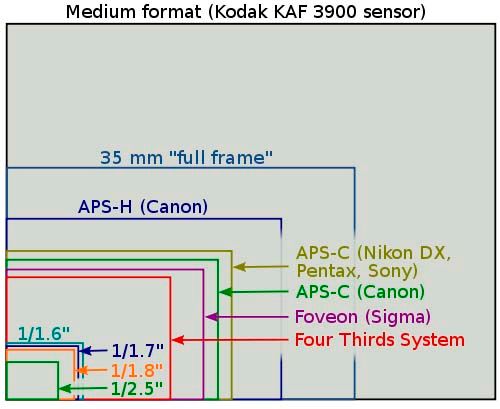
Make no mistake! We can be pretty sure Olympus and Panasonic will not launch any new system with larger sensor in the near future. There is still a lot to do in the m43 world to defend the primacy also against the future Canon mirrorless system. But the Full Frame battle just restarted after a long time of silence. Today Canon announced the Canon 5dmarkIII ($3500 at Amazon) and Nikon announced the Nikon D800 and D800E a couple of weeks ago.
So just for fun I made a short list of advantages and disadvantages of a hypothetical “Macro Four Thirds” system with FF sensor 🙂
PROS:
– Currently only Leica are offering a Full Frame digital mirrorless system. But the [shoplink 22857 ebay]Leica M9 is incredibly expensive (Click here)[/shoplink] and there is plenty of room below that price range.
– You could make Full Frame lenses backwards compatible to the m43 system. One lens to rule them all 🙂 -> Disadvantage the lens would be bigger
– Marketing: It gives a kind of magical and professional aura if you can offer a Full Frame system. Sounds stupid but it is not. I know of many people that buy new and more expensive cameras just to feel like a “hero”.
CONS:
– It’s expensive to build up a new system. And Panasonic/Olympus have limited resources.
– Also the service has to be improved to satisfy the professional needs.
– The profit margin is larger on small sensor systems than on Full Frame camera systems.
– Lenses would be bigger and one of the main advantages (size!) over the FF DSRL market would be less visible.
Now it’s up to you to let us know what you would do:
[poll id=”123″]
My two cent: 99% of us don’t need Full Frame. If you need absolute image quality for special work like studio photography or big prints than it may be better for you to go medium format. Or if you want that nice 3D depth of field feeling than buy a camera like my [shoplink 28309 ebay]Mamiya 7[/shoplink].
230 Responses
I would buy a FF compact cam with 35/2.0 fixed prime 🙂 for less than 2000$/€
I would not buy a 35mm mirrorless system.
Why the heck do peeps keep insisting 35mm is full frame, it’s what it is, 35mm.
35mm is tiny compared to “Medium Format”.
You are correct, but get over it. 35mm has been one of the most popular and well-known film formats of the 20th century. EVERYBODY, even soccer moms and dads know this format. Nikon and Canon dSLRs started with cropped 35mm sensors with the same mount and now we’re returning to the era of full-frame 35mm format again.
Most people say “full frame” because it’s short for what they’re really thinking “35mm full frame.” Now if “medium format” was used by millions, then you are more justified in getting on your soapbox and complaining about how everybody is using the wrong terminology. 🙂
I don’t care, Full Frame isn’t what it implies. There are bigger formats which are just as current as 35mm.
To stop at full frame one is insinuating that there is no larger format.
“Full Frame” has never insinuated that there aren’t larger formats. Why are you so sensitive about it?
FF has always been used in conjunction with 35mm film, and has never been used for larger formats like “Medium Format” or “Large Format”.
You’ll just have to get over it. (seriously). It’s a term that allows everyone to have a reference point for film or sensor size comparisons. Just because a lot of current sensors are smaller doesn’t make the term any less useful.
I go with Digi Fan, Full Frame is a nonentity, my E-P2 is a Full Frame camera as it happens, unless I shoot at 6×6 or one of the other options away from it’s native 4×3, as I am not using the whole sensor. An it’s not a question of sensitivity, it’s a question of logic having used 6×6 & 6×4.5 for many years before digital. I also have to disagree with your comment, there have been far too many instances where 35mm has been directly classed as full frame.
Full frame?
http://affordablehousinginstitute.org/blogs/us/wp-content/uploads/inconceivable_means_02.jpg
+1!!! A compact fixed lens 35mm sensor mirrorless with 35mm EFL! Now we’re talking! An x100 on steroids…
I’d buy a mirrorless FF camera just to be able to use my Minolta legacy glass to its full potential. I would not be interested in a FF camera with a DSLR-like mount.
+1
Old lenses at their nominal focal length would be the only reason for an enthusiast to buy FF. For a pro, depends on a situation.
As for myself, my amateur needs are very well served by m4/3. I’m not interested in camera-lens combo that costs as much as a car, takes up half of rucksack and weighs several kilos.
Me too, when i take a look a my old OM10 film camera, i wonder why no one can do such a small digital 35mm camera. It’s so difficult to put a FF sensor in the place of the film, add some electronic around, and a small yet powerful battery ? No need of zillion pixel in a armored vehicule. The digital OM is roughtly the same size of an om10, only thinner, but it’s a small 4/3 sensor. Fuji make a all new system, but instead of a 35mm, it an Apsc sensor, but the camera and lenses are not really smaller.
The only reason we have “Full Frame” digital, is because of the throwback to film cameras – Nikon has old lenses that work on new full frame bodies.
It is completely stupid to design a new system based on a “Full Frame” sensor. There is no other reason for that sensor size. Well, apart from being able to use Nikon/Canon’s sensors instead of designing your own… but appart from that, it is a completely arbitrary size.
In this day and age with so many (new) formats now, I think it’s time to call 35mm just what it always has been, 35mm.
It is NOT “full frame” at all.
All dedicated lenses are full frame on their own format.
Maybe it’s time to label the lenses according to their field of view on their format. That would make it much easier to know what type of lens a lens is.
I’m all done with this full frame shit.
You are absolutely correct, albeit based on a proposed definition that you confuse for a hard and established fact.
Walk into any photography store, ask for full frames and see who wins, your common sens or http://en.wikipedia.org/wiki/Catachresis
You’re right, the size is arbitrary, but a bigger sensor can be useful. When I was in Yellowstone last fall I found myself constantly wanting both wide angle and telephoto shots of the same subject, e.g. a buffalo close-up and a herd of buffalo. Switching lenses can be disruptive, so having an extra body is very useful. So if you’re going to have an extra body, why not one that’s specialized?
Mirrorless cameras make an extra body much more manageable by shrinking the added bulk. You could build a kit around two GX1 size bodies and two or three lenses and have it not be any bigger or heavier than a single dslr/zoom combo.
You could also get more use out of high-end lenses, where a wide-angle on one body could be a normal lens on the other. Two bodies and three lenses could be much cheaper and more flexible than the equivalent one body and five lenses for example.
market demand for full frame is shrinking…
@ Admin
remember this? http://www.43rumors.com/change-of-market-share-between-2006-and-2008/ how right you were in your 2009 and 2010 predictions 😀
Oh I absolutely forgot that 🙂
You’re mixing market demand for FF with market demand for companies in general. Nikon/Canon are losing share, but they make much more compacts and APS-C cameras than FF cameras.
Logically I would say they’re losing more APS-C and compact sales to things like mirrorless than FF, as FF offers things that compacts and APS-C or mirrorless (currently) does not. I guess we’ll see, but pre-orders are through the roof for these new FF cameras.
What do you think about the round sensors? It could revive m43 a lot, isn’t it?
I’d buy a FF mirrorless camera just to be able to use my Minolta legacy glass to its full potential. I would not be interested in a FF camera with a DSLR-like mount like Nikon F, Canon EF(-S), Pentax K etc.
Plus one !
I want a FF mirrorless camera, on having a shorter register than all legacy lenses and one allowing me to use all that beautiful rangefinder lenses I have. It doesn’t need to fifer zooms, only nice little primes. We would get to use our wide angle lenses at their nominal value and we would have more possibilities to play with DOF.
Well a 35mm mirrorless that can replace a 35mm DSLR is interresting if it is as fast as the DSLR in focussing etc.
I will never buy such a system since it will be pretty expensive, maybe more expensive as the DSLR variant. If you want a lens register that is smaller than DSLR the lenses will be exhorbitantly expensive especially wides.
When I NEED 35mm or bigger I rent the stuff, much much much cheaper from a business point of view and allways the latest available.
I was allways a Canon guy but nowadays I use the Nikons when I rent stuff, more consistent userinterface model to model (High end/Pro that is).
Unfortunately, that old legacy glass will not live up to the image (pun intended) you fondly remember from its film days. The fact is that digital receives light in a much different way than film, and without going too technical, film-era glass will yield a significantly observable corner softness and vignetting. The wider the angle glass, the worse the edges of the image get.
Telephoto lenses are less susceptible to the effect, and the longer the lens, the less observable the image degradation.
The other way to reduce the effect is to use a smaller sensor. Of course, you’ll get a focal-length multiplier, but corner-to-corner sharpness will be better.
Finding out what lens’ work well is half the fun 😛
But really, these days unless you’re talking about range finder lens’ with very short flange back distances (especially wides), film lens’ work just fine with digital sensors. I have several in fact.
A lot of people will be adapting SLR lens’ with a mirrorless FF camera, and those should be just fine in most circumstances.
Streetprice of D800: 2800 euro. Suggested retail of 5D mk3: 3500 euro.
My interest in full frame stops just there.
+1
with the price of 5D mk3 (body only), you can get the 5D mk2 + 24105 kit. And for that amount of money you still don’t get a articulate LCD.
I will be using FF , MF, whatever format when they have no mirror and useful live view. Be it Sony, Fuji, Nikon, X, Y or Z.
This isn’t an Olympus/Panasonic territory. I am interested in useful tools and have absolutely no “brand loyalty”. I am just an average consumer when it comes to these brands.
+ 9
Same, it is the electronic viewfinder that I want, and a 1:1 aspect ratio, and sharp fast glass in primes…. Bring it on… I don’t really care who makes it.. Just as long as it is quality…
The 5D3 had to be one of the most dull cameras ever! The D800 uses its sensor size to good effect and offers resolution levels not available elsewhere that justify and differentiate it. Both are unnecessarily heavy and large for most photography though. MFT is a much more interesting place to be (and invest in lenses).
Admin- so when can you update us on the new Panny lenses and cameras for 2012????? Many thanks!
Nobody really need such a high number of pixels it will just clog your HDD.
The 5D Mk3 is deceiving because instead of pushing the advantage of having a light FF they have added not so useful features which only adds to the weight 850gr for the 5D2 against 950gr for the 5D3, that is a 12% increase. And it doesn’t even have an articulated LCD like the D60 !
I can’t understand that they make a video capable cam without that.
Too bad that Canon is still increasing the camera’s size. It should have been the other way around : a 700gr full frame, light enough to go hiking and travelling all day.
Agree re weight. Canon have really screwed up on this whereas at least Nikon have slimmed the D800 a little. If you print big (A2) then 36mp can be useful – hard drives are getting bigger faster than megapixels!!
Having said that, 700g plus lenses is not light enough to go hiking all day!! That’s why we have MFT.
So bigger & heavier is NOT the way to go???
**Canikon scratching its head**
A lot of people and reviewers agreed that the 5D mkII’s build quality was sub par. Even dpreview mentioned that the new all mag alloy body of the mkIII is “finally” a welcome feature. At the cost of weighing more though.
I’m all for light weight bodies, but I think Canon needs to compete with their main competitor the D700/D800 not with mirrorless cameras with this 5d mkIII. This market segment demands a solid camera.
Not only more demanding on HDD but you will need to have a powerful whole configuration (processor, RAM, graphic card) to post process 36 Mpix files ! My computer that has 3.2 GHz Processor with 4 Go DDR2 and an average graphic card (it was good 4 years ago) is already laging behind when doing some PP with color effex on my 12 MPix GH1 files…..with 36 Mpix I can take a coffee while computing…
And all those pixels for posting on web size, or printing on a crap newspaper 😉
Isn’t Canon rumored to release a lesser full frame? Maybe that will be lighter. Maybe that is why there was a price increase, to make way for a cheaper model.
That would be more intriguing to me than either the Mark III or D700/D800. Strip out the studio only features, but keep the sensor and engine.
Well I disagree here. In FF country, with such big lenses 100-150 grams is not that important. Does it matter if you have 2,9 instead of 3 kg in your bag? I don’t think so. Or even 2800 gram vs 3000. The lenses stay the same size anyway.
Once FF gets mirrorless, the bodies will become much lighter. The lenses also, but not as much.
Not having an articulated screen does not seem very smart indeed.
But that seems to be the case with many companies: sometimes it seems they leave out things that are so obvious, that it turns people off big time. Liek Samsung with no EVF on the NX200. Not even possible. That one is beyond believe and I rarely say it, but here it is: it seems stupid.
Yes this is a yawn, but i think IQ is better.
The D800 uses its sensor size to full effect? How? By introducing tons of noise and color banding at low ISOs in exchange for resolution Nikkor lenses can’t keep up with?
Look at the image samples here:
http://fakechuckwestfall.wordpress.com/2012/02/09/the-nikon-d800-is-fucked/
http://fakechuckwestfall.wordpress.com/2012/02/07/nikon-d800-vs-canon-eos-1dx-image-quality/
It’s all about the bokeh. Bigger sensor = better bokeh.
Forget it. Brighter and better lens = better bokeh.
MFT has already 3 (three) models of F0.95 lenses. As far as I know no current consumer FF digital camera systems has even 1 piece of F0.95 fullframe lens, except the non-affordable Leica M.
it’s true for the brightness, but unfortunately you get F2 bokeh only in FF terms….
so for the initial question:
YES!!!!
bokeh is lens dependent, you mean dof
f/2 is pretty a good value for decent out of focus background, especially at longer focal lenghts. values like 1.2 or 0.95 add more to the bokeh character rather then the dof, which is only subtle.
Depth of field at f0.95 in m43 = f1.9 on FF. So Voigtländer 25mm f0.95(800€) provides the same background blur capability as the Canon 50mm f1.8(100€). So technically just considering the ability to offer background blur and NOT light gathering, there are many even better lenses for FF.
+1
True, but given you are keen to make a price comparison you should include the body too:
GH2+CV0.95 = $1600
5d3+50f1.8=$3600
How about 5D classic + 50 1.8 = 1200$
“How about 5D classic + 50 1.8 = 1200$”
5D1 does not have video.
And it is out f production, however I’ve read that the 5D will remain in the line of Canon products and it can be had for around 2000$, even less here (1880 and given the changing rate which compensate for the VAT it corresponds more or less to the same amount in terms of US$)
you can’t just consider the blur aspect without the light gathering, especially when you include the price of both lenses. its a very unfair comparison that way.
So you want to spend thousands and thousands of dollars to make sure thing are prettier when they AREN’T in focus. Seems silly.
You can PP creamier bokeh for a heck of a lot less than buying FF kit.
I’d be more concerned with sharp, good contrast, good color for the subject of the photo, something you can’t PP.
This is so dumb, bokeh quality have nothing to do with max aperture. Hassy zeiss mf lenses for exemple, beats any voigtlander bokeh, especially 0,95 m43 one wich exibit quite a lot of CA and a softness in in focus area (at max aperture) that dim the contrast between in and out of focus.
I don’t even know why i’m responding to a guy that take voigtlander m43 fast lense as a reference thought …
you forget bokeh is a subjective aspect in an image, you can’t use a scale from “ugly” to “beautiful”, I know many people do that, but they ignore the fact its a matter of taste
Please, I don’t want to argue about what’s ugly and what’s beautiful, but ca fringe and softness is a technical issue, you can feel this is something interesting, but first it’s an incident ( that you can find in many cheap lens ). That what happen when you push boundaries too far. M43 is not about shallow dof, deal with it.
How much bokeh is enough?
The you have advice to. 😀
How long is a piece of string?! F1.8 is currently where it’s at in mft with the brilliant compromise offered by the Oly 45 and Panny 20. F1.4 offers more flexibility but I don’t want the greater size and cost of the Panny 25mm.
What I wanted to say is that sometimes crazy thin DOF FF offers is counterproductive. If I can’t have the whole face of my subject in focus, then I don’t want such DOF.
it can be very 3D, if executed in a good way, but we have a camp of both-eyes-plus-the-nose-needs-to-be-in-focus-too
Is bokeh a quantity?
DOF is :).
… a quality, not a quantity…
Too much simplified…
A bigger sensor will give a smaller depht of field, if you take a photo with the same field of view and aperture. Bokeh depends also from the background quality, distance from camera to subject and from subject to backgroud. Add the light angle and quality and, last but not least, the lens design and quality – not all 85mm lenses give the same “bokeh” from the same spot with the same settings…
Bokeh is also something more of a personal taste than a measureable subject. That “creamy” bokeh, which seems to be the popular desireable way to go now, is of course easier to get with longer focal lengths and larger apertures, together meaning shallower DOF.
But back to the first question… what about an FF mirrorless camera…
If Sony won’t make one, I can see no-one doing it in near future. I was hoping Fuji (after getting Oly and that way getting into mFT) would aim resources that way, but not now…
Some advantages anyway:
1. No mirror – no mirror slap. Steadier, quieter camera, less shake.
2. EVF. Compared to Leica – more exact focusing and framing. But tell that to Leica-fans… Yes, I have used different rangefinder cameras, but don’t have one now.
3. Ability to focus and frame with all focal lengts from a fisheye to super teles, as far as they can be mounted to the camera correctly.(Back focus lenghts etc).
4. The body will not need to be too much larger than larger PENs… Lenses would be larger, at least if they are fast ones.
But… Maybe Canon will do one with compatibility to EOS -lenses… I doubt that anyway. Nikon… not shortly. Sony? Fuji – missed the point. Should have gone there already, with lens compatibility to mFT-bodies through an adapter. Maybe Samsung…
Cheers
Jouko
Absolutely WRONG!!!!!!!!!
Bigger sensor is NOT better bokeh, it’s shallower DoF.
Only amateur starters think that bigger sensor = better bokeh.
Bokeh is a value of individual lenses. One 50mm 1.8 can have horrible bokeh and another 50mm 1.8 magnificent.
Bokeh is a word for describing the quality of the out of focus areas.
And bokeh is a subjective item.
You’re confusing bokeh with DOF and blur.
Bokeh has nothing to do w/ sensor size, but the *quality* of blur,
IOW how the blur is looking. And that is a lens property only.
Sensor size only affects DOF, having better DOF control, w/ the possibility of a shallower DOF.
Yeah but you need a blur to start with to get bokeh 😉 (partially joking).
larger formats will always have an advantage with bokeh, becuase they can get more blur at any given situation. When the situation isn’t giving enough blur with smaller formats, bokeh is next to non-existant (large subjects, or really wide lens’).
While I agree bokeh isn’t the same as depth of field, and shallower depth of field != better bokeh, the more depth of field control you have, the more potential you have for good bokeh, the rest is down to the optics.
Yes , I can afford ff mirrorless but not in crazy prices ! If I have to pay such pricing then it have to be nothing but superior or outclass the rest in it’s class .
I still feel that M4/3 can be further improve in it’s IQ & it’s matter of time to see it .
The 3rd generation of sensors should able to prove it ! That’s why I really eager to know Pana’s so called very highend camera’s status .
Speaking by video enthusiast, I can say about other pros and cons, M43 are less expensive than FF and with the same goals you have a longer focal length equivalent to 35 mm (less expensive), a greater depth of field compared to FF , but less of a compact, lighter and more versatile.
The ideal choice for Videomaker
Actually Leica M mount FF lenses are smaller than MFT ones. Of course they are manual… but I feel that it is quite possible to make small AF lenses for FF mirrorless cameras.
So why don’t they? I think it’s a case of size/quality/AF – pick two for FF. Mft gives you all three.
Hmmm… Sony has a really big interest in making small lenses for their small bodies, but even they (and even for APS-C!) haven’t managed to do that.
How do you think that it would be easier for FF?
Pentax make really small lenses. Their pancakes are good and work for 35mm sensor size, Samsung too make small pancake for their aps-c nx, so it’s possible. But not for sony. I don’t buy a nex system because of that. The boby is very smal, sensor and screen are good, but lenses are such big ugly things 🙁
Plus one ! That is what we need a good digital back for our wonderful legacy lenses. And small new AF primes.
+1, that is why most visitors here like more olympus than panasonic..
Omox, I have 5 Leica M last generation lenses and only one is a little bit smaller than equivalent MFT lenses, though much heavier. Others are definitely bigger and much heavier.
Now that’s what I call investing in lenses!! (I am just jealous)
Yeah and those Leica lenses are all manual focus. Figure in a motor and OIS and they will not be tiny anymore.
A manual focus 35mm mirrorless has almost no user base and would certainly not be of any profit to the mfrs.
My Leica lenses are bigger and heavier too, but that is because I chose them one stop faster than the Zeiss Contax G lenses. The Zeiss lenses are just as light and small as the new Olympus primes !
Contax g lense are not much bigger than leica m lense, and have AF.
Nope, a motor in the body drives the focussing ring of these Contax G lenses. Camera and lens together are capable of AF, the lens alone is not.
The most possible intelligent step would be to make ultra bright quality AF lenses at affordable price (F1.4, but better F1.2 or even faster) and urban legends like “MFT doesn’t have shallow DOF” would be busted once and for all.
Instead of switching on FF, obviously.
+1. In fact I can’t see why an AF f1 prime lens range is not possible although cost will become an issue.
Urban legend? F1.2 on Fourthirds, would correspond to F2.4 on FF DOF, still not sufficient (for me)… there are many zooms with real f2.8 in FF land…
those 0.95 primes are tempint though, even better would be 0.6 or 0.7 primes
This is bullshit, dear mr. Ru Elpster.
Using the SAME lens you have even S-H-A-L-L-O-V-E-R on MFT bodies than on original Full frame ones. By example, using my Auto Revuenon 55/F1.4 on G3 with M42 adapter gives you ***shallover*** depth of field than the one on the original RevueFlex 35mm SLR!
The catch is that the FOV is smaller as well so you compare oranges to apples.
But the idea is that what really counts beside aperture is the object and focus distance.
The statement “F2.4 on FF DOF still not sufficient for me” is meaningless as doubling the focus distance the DOF decreases 4 times…
Rülpser? Eeew!
“Urban legend? F1.2 on Fourthirds, would correspond to F2.4 on FF DOF”
Plain wrong.
For DOF (and DOF only), F1.2 on 4/3 equals F2.0 on FF, given the same FOV.
There’s a 2 stop difference, not double the F# value!
But that said, F1.2 is F1.2 for everything else, like exposure and shutter speed…
Ok, so instead of buying 1 body that weights more and is bigger, you’d buy 1 or more lens’ that weights more and is bigger?
If it was even possible.
Considering Olympus was the only one to provide f2.0 zooms, which was only 1 stop better than FF f/2.8 zooms. And they were larger, heavier, and more expensive than the FF alternatives. Could you imagine how big/heavy/exensive a f/1.4 zoom would be? Or as you suggest a f/1.0 lens?
Or if you’re just talking about primes.
Let’s look at the price, weight, size of the 3rd party 50mm, 25mm, 17mm f/0.95 lens’.
Again, they’re bigger, heavier, and (much) more expensive than the equivalent FF lens’. They’re handy to have as an option, but is this really the “most intelligent” way of doing things?
If we’re talking theoretical here, wouldn’t a smaller/lighter FF body be better? Afterall, then you could use these smaller, lighter, cheaper FF primes on the slightly larger/heavier FF body. Your overall camera bag probably would be lighter. The difference would obviously scale with how many lens’ you have.
If pannasonic and oly will be technically ahead 1-2 years to competition I don´t need bigger senzor..
but when I look at 3years old 5DmII it´s still IQ is still 2-3years ahead the gh2.. so dear panny I like the compactnes and I like the lenses..but you must invent something that will “change the game” look at fuji x pro , aps-c is fine for me but I want this technology in GH2 body with full video functions
Well, there have been rumours of a “Super 43” system (34,6*26 mm?).
I’d buy ff, Otherwise impossible to get 3d depth at wider FL,
And who said that ff lens are bigger?
You have many ff pancakes wich are faster and similar in size to m43 or Nikon 1
“Many FF pancakes similar in size and faster”? Not sure about that if you want AF. Which are you thinking about?
“You have many ff pancakes wich are faster and similar in size to m43 or Nikon 1”
Name one…
The Trollaton 28mm f0.5 – 10x5x13mm 14grammes maybe? ;->
No motor in it. Vignettes heavily.
Konica hexanon 40mm f1.8 to name one
Then you should visit the DPR Olympus DSLR talk, and search for 3D.
You’ll find that the earlier Olympus camera’s had very much 3D look even in wide angle. The kodak sensor attributed to this look. So 35mm is absolutely not necessary for the effect.
Sure, we would all like to use our legacy FF glass, but the sheer volume of the consumer market is where the money is, and new FF systems will simply be too costly. A larger driver will be the massive volume of newish APS-C PDAF glass that is orphaned by MILCs – this is the deadweight which is holding back faster growth in adoption of the new technology.
The manufacturers that can come up with fully functioning electronic adapters for using these lenses will accelerate the adoption rate for m43/NEX/NX. Metabones have done it for EOS to NEX, and hopefully they can do it for m43. If Olympus can indeed electronically adapt E-x glass to m43 most of the whiners who clog this site will feel much better.
Nah, there is no way a full function FF MILC will ever sell in the volume that m43/NEX/NX is going to achieve. If Canon don’t join the party by September, they are going to be in serious trouble within a few years.
Metabones is MANUAL FOCUS ONLY.
Even the 43rds to m43rds adapter is better in that regard there is slow AF possible.
Only if AF is included it will be a huge success.
You are right of course,
Should have made the distinction between automatic aperture control and autofocus. If an adapter could go the whole 9 yards then all those hanging on to their DSLRs would be much more easily tempted. This is what Olympus keep suggesting they are trying to do with a 43 to m43 adapter.
Sony has an adapter for using their alpha mount aps-c glass on a nex body. It does effectively turn the MILC into an SLT, but it does support PDAF as a result.
I’ll buy full a frame outfit when I can afford a porter to carry it for me. I go hill walking with the 35mm equivalent of 14 to 600mm without any gaps plus a macro. There is no way I’d be doing that with full frame.
Ditto, although I don’t do macro. 14 days in the Andes with the FF equivalent would be zero fun. Porters don’t help when you want to quickly reach for that 600mm either….
I cant believe that there is nobody out there who would like to use the full field ov view of (for example) a 35mm f1.2 rangefinder lens on a MILC, instead of the cropeed back to 50mm view.
I guess times has changed, and I do really think that 35mm is on it’s way out (allthough it will never fully disappear), but yeah for enthousiasts 35mm will die in the future.
35mm will become even more expensive as smaller formats become better and thus more popular, look at the 5Dmk3 what an exhorbitantly high price €3300,-,3000pounds, crazy. The 5D is the enthousiast camera not the PRO version.
So retail prices will be higher since there will be a very slow turnover of stock.
35mm DSLR is going the way of the 120mm film and it’s Digital heirs.
Only interresting for specialty area’s.
In my transition to digital with the Nikon D100 in 2001, I still believed that a “real” camera was full frame, and that I was tolerating APS-C sized sensors until Nikon could deliver a full-frame camera I could afford. But I slowly came to appreciate that APS-C delivered all of the quality I needed. I changed my mind about full frame as the weight of a DX system on my back (much less full frame) started to feel oppressive and micro 4/3 IQ became competitive with APS-C (the benefits of “live view” in micro 4/3 came as a pleasant surprise). I’ve now transitioned to a full micro 4/3 system and look forward to the new cameras and lenses coming to market. And I’m having a ball using my legacy Nikon AIS lenses on my E-P2s via a Voigtlander adapter. Manual focus on the E-P2 is easier and more accurate than on any Nikon body I’ve ever owned.
Until there’s some new method of producing low cost FF sensor with decent result, we can be sure the price of FF camera system will be outside most of photography enthusiast economy, thus negating the need for Panasonic or Olympus to produce FF camera. The only other company that capable to produce FF camera system outside Canon and Nikon will be Sony and Pentax. Sony to show others that they can, Pentax for another moves to wooing other to buy their company 🙂 While Leica also could produce FF camera they’re no longer sell camera for photography sake but merely for lifestyle gadget reason, so it doesn’t matter wether Leica produce small or big sensor camera there always be someone who willing to buy Leica product for just the proudness of owning things with red circle mark 🙂
Strike Pentax they don’t have the R&D money to deliver a Q, an APS-C, a 645 AND a 35mm system.
All need contemperary lenses.
FF is dead IMO, as mainstream camera systems go.
D800 is the best confirmation of that IMO: squarely a niche camera. 5D3, body pre-orders now at $3500, is in the same league of niche cameras.
I also do not see much advantages in the FF. Except the better sensitivity of the larger sensor – but APS-C already has more than “good enough” sensors. For example, shallow DOF to me is a hindrance, because even minor AF error leads to OOF subject. Background separation I have also seen rarely to be effective: uneven mess of colors ruins the composition just as good as, say, a tree branch growing out of ear. One still has to do a bit of leg work to ensure that the background is OK – shallow DOF doesn’t magically removes the problem.
You set me up, LOL! How about a full frame system like the rangefinders of old. Somebody can build it, Sony an make the film (sensor), and Voigtlander can supply the lenses. It’s not that hard now that sensor technology has taken huge leaps forward. The ONLY reason APSC sensors were developed was because of the lack of technology. They made suburb cameras for decades with small lenses. Did they forget how? No! Fuji proved with the X100 (of course not full frame) that if we build it they (buyers) will come! I loved my Contax G2 and would buy a digital version today I it existed. Even with the old lenses. Just my opinion–a working pro with more than 10,000 published photos to my name.
…and you want us to get off your lawn, right?
same for me. I’d like to have a digital Kodak Retina.
Micro Four Thirds is ALREADY full frame! The sensor is the FULL Four Thirds frame size!
There’s nothing magical about the “nostalgia-format” 36x24mm frame size that makes it any “fuller” than anything else. (If it were, then would the Leaf 53.7×40.3mm sensor be “super-full”?)
There’s a range of sensor sizes and pixel counts available, and each has advantages and disadvantages. That’s all there is to it.
If you’re trying to ask, “Should somebody make an EVF camera with a larger sensor?” then ask that. Don’t confuse the issue with archaic notions of “fullness.”
yes you are right, it’s visible on admins chart posted above
Haha we must have been writing at the same time.
+1
Very good point Ranger9, the discussion and thinking should not be tainted by misleading archaic “standards”. Compared to Medium Format “FF” is not even half…
An interesting point you make Duchemin, when you consider 35mm was 35mm (unless it was in a Pen), but what is MF? is it 6×6 or 6×4.5, just to put a spanner in the works…..
+1, See my reactions at the top.
Shallow depth of field is an “artistic choice” massively over used just for the sake of it. Look at any of the BBC’s latest drama programmes, people look like cardboard cutouts devoid of placement within their environment. Lot’s of twenty somethings straight out of Uni thinking they should use their “big sensor” effect at all times.
shallow depth is never over used in tv or cinema productions. That only happens by the fanatic videographers who switched to consumer gear with big sensors, its like those people were frustrated not being able to use shallow dof effects on small sensor videocams before, and now are totally obsessed with it. Dont get me wrong, I love shallow dof…especially if you can pull it off with subjects at distances outside the close focus or macro range.
FYI you already own a full frame. I own a Pen and its a full frame 4/3 camera. The only time it is not full frame is when I shoot in square format then its not full frame. Easy.
Also who cares about the latest and greatest Canon or Nikon. The 4/3 cameras already proved that they can (with hack) produce superior video quality to Canon or Nikon and for stills only serious landscape photographers need such a camera as the Nikon D800 and that’s only if they plan on printing very large and very details prints.
Who need to look at 36mp files on Flickr anyways.
.
How about a 35 x 35 mm square sensor that takes the leica M mount lenses…. Sweet idea in my opinion…
Not really. As the diagonal of 35×35 would be 49.5mm instead of the 43.3mm of 24×36, you may expect considerably vignetting.
I think Len ment a square sensor that utilises the full potential of a FF image circle. That sensor would be 30mmx30mm
I second a square format digital camera.
The first company to bring such a camera will set itself apart from the crowd. FF being $3000 and up for body only is a pro/niche market.
Square format if done by m43 sensor needs be roughly 16mmx16mm to cover the image circle of 18mmx13,5mm 43sensor.
Costs for such bodies can be in range of $400 to $1000 depending on modularity.
Besides the the millions of Hipstamatic/Instagram users that made square cool again it’s a format pretty much left for dead but used to be popular in Polaroid 4×4 and 6×6 and the latter remained a professional standard for long time.
Oly should build that hipstahugger cam for all the art filter lovers. Throw in Bluetooth and WIFI and they’d have an instant market carved out.
Forget FF. I would love to have a dedicated 4×4 cam.
@ Admin – What about Super 4/3s?
I would benefit from having an 24×36 sensor camera. On the other hand, considering weight of a system, I hesitate.
There are vague rumors that Sony is planning an Nex-9 with 24×36 sensor.
For PanOly to enter that business? No, not a good idea: It requires hefty investments in R&D on camera and lenses. The success being very unsure. Pana has clearly stated they will not.
There are CaNikon, Sony, Leica. They have not only 24×36 sensors, they have lenses. For theese four, the step to create a 24×36 mirrorless is much smaller. The risk is less as they already have 24×36 customers
Do we need 24×36 sensors? Very many serious/pro/enthusiast photographers say so! For me, it is about weight and to some extent cost I am in m43. Would I buy into 24×36 DSLR today, there are always many 2nd hand lenses and cameras, doesn’t have to be that expensive. A 24×36 mirrorless that can use existing lenses would be of interest to many
(I used 24×36 instead of industy standard FF just to prevent all you Olympistas and Panasonians from having another heart attack 🙂 )
The problem if Nikon or Cannon used their existing lens the camera would be the same size, the only change would be exchanging the mirror and prism for a electronic viewfinder and a different PDAF system. The space the mirror took up will have to be left vacant, it is needed for the lens to work. As far as a small “rangefinder” the market will be small, the camera not very versatile, and will be very very expensive. The Fuji Xpro1 will be it with its smaller sensor, and the Lieca M9 with its high price; the big two are two big to make a system that will not sell in high enough volume for them.
Some how I do not see either of them doing 24 x36 EVIL, that until the electronic viewfinders get a little better. I expect to see however augmented optical viewfinders on DSLRs, in their next generation of “FF” cameras; in 2 or 3 more years. There just isn’t much of an upside for them in making one, at this time. Most of their “FF” DSLR buyers want more of the same, and will not switch to a totally new system with new lens etc; without real good reason.
One of the benefits of the 35mm format are the wide ranges of lenses offered by Nikon and Canon. This will help ensure that professionals will use 35mm (e.g. if they want a perspective control lens).
The larger formats, with their 80MP sensors will also continue to have an appeal to a niche market including landscape and fine art photographers.
I think there is a limited but possibly viable market for a live view mirrorless camera with 35mm format, simply because of the wide range of new and second hand prime lenses made for the Leica M mount. However, I suspect that the problem may be rather less straightforward than placing the D800 sensor in a NEX type body: there will probably be a need for some arrangement of micro lenses on the sensor and customisable lens corrections, in order to get good results with many of the lenses.
With the m43 format I think the aim should be to provide enthusiasts with a system with a wide range of lenses as a smaller and cheaper alternative to 35mm. A broad system will be important in order to persuade people to buy into a camera system rather than just using the cameras on their ‘phones.
Sorry, but if I were purely chasing IQ I would be hitting the MF sensors. The 645D is relatively affordable (for this class of camera) and handles well.
If I were on a more realistic budget, I’d just shoot the Fuji/Mamiya 645/6×6 gear I already have. Film is still higher resolution than digital…
Have you shot FF?
When I was in training (6 months in a graphic design studio), I got to work with a D700, it was… 3-4 years ago… I already had my E-30…
Well my point is, there is no common measure, argue all you want, FF is expensive and big, and most users don’t need it, but for controlled shots, nothing matches it.
It’s not as unreliable as medium format, much easier to use, especially DOF control, it’s fast and well matured, and it is here to stay a couple more years. And there is a huge gap between FT mFT and FF. There’s a gap between FT and APS-C, but, yes mFT is smaller, the best camera is the one you have with you, the less intruding and so on and so on.
But if pros stick to FF it’s simply because even between a K-5 or a D7000 and a dated D700 or 5D MKII there’s a huge gap, and if you manipulate raw files, have to shoot an event, mainly action, you will see the difference.
FF gives that much of an advantage.
Now the debate FF vs APS-C vs mFT is irrelevant. APS-C mft, well APS-C, is more conventional, one stop HI advantage, mFT is smaller lighter, that’s consumer perspective and that’s well and fine.
FF has not only been developed to keep compatibility, (they could have played with flange distance, and adjust for a bigger or smaller sensor, and still be compatible, well would have taken some efforts and probably some lenses would not have worked) but it has because it is with the technology they had (silicon semi-conductors), the optimum balance they struck for IQ and performances, because you cannot beat the laws of physics.
Just like MF, FF is aimed at professionals, it has a purpose, professionals, who need to print big, shoot action, low light and studio work, need reliable gear, that will be updated because anyway it is a business investment: buy, amortize, renew and they need to stay on top, because, either A) they overuse their equipment, and it wears out, or B) they work in a field where creativity is primordial and so they look to push further the limits in order to discover/create new things.
If something had come up in digital tech was so much of a game changer, Canon and Nikon would have adopted and made it the leading system as soon as possible. They just cannot afford to lose the edge for the professionals and they can sustain different techs and systems.
Now for personal use, my E-30 suits me perfectly, although, I wish I had not to wait until I have enough cash to get a whole new system in 2 or 3 years time, cause I don’t want to just buy a body and a lens, and anyway, I’ll see by then.
But I mean I read this and that about FF and so on… Sometimes, got to be realistic. Now I also think, why compare anything with it… I print (A3) 40x30cm with the E-30 and manage to pull out color images with carefully exposed ISO 1600 (A4 only) and from what I see the new sensor (16MP) takes it one stop further. So seriously, who cares if it compares to FF or not?
PS: English not being my native language, I apologize in advance for any inappropriate wording.
Well I think shortly their will be less and less Pro’s to use a 35mm camera as their main every day camera.
35mm will stay but as a niche and maybe Canon and Nikon keep selling them. It might be that Sony, due to it wanting to show it’s prestige, keep on making them as well, but Sony is having a very hard time in 35mm format. The reason for this is that most agencies are leasing Canon/Nikon stuff directly from the source. Both companies have a very good Profssional service network. Sony doesn’t have this on the same level.
The smaller formats (43 and APS) allready have sufficient IQ, for tabloids and huge posters, to make 35mm mute.
Except for sport events, or musical shows, or live action in general…
When you see the output of D700 or D3s, ISO 3200 looks almost like a base ISO on a 43 cam, ok I’m exaggerating, but not much, you can actually print full size on a D3S at ISO 3200. Probably a well exposed 6400 as well, and a bit smaller at 12800.
But lenses in 35 mm need less complex design and resolving power to actually resolve more than smaller mounts for smaller sensors, and if sensors keep evolving, well glass for now is another limiter, and as you pull ISO image softens, except on big sensors, you keep enough resolving power to pull nice textures and accurate colors. More photons in general is better.
So indeed I see where you’re coming from, but for difficult conditions of work, until there’s a real game changer, 35 might remain around for a while. I might be wrong, but still, if talking about pros…
After I agree, the pool of 35mm shooters will decrease as smaller sensors systems improve and broaden.
Plus, even if you’re a serious enthusiast, and it is only my opinion, but, there’s no point getting a FF, it is much more intruding, costly, heavy, and DOF requires more careful control… I shoot for my own leisure, not for hassle =).
Enthusiast, or “pro”-like I would say, getting on 35 is more of a luxury than a real need.
I hardly see even nature shooters having speed problems with a 7D or street photographers not enjoying a much less bulkier and scary package like the mft, which used with mft lenses now has quite a stunningly fast autofocus.
Admin: I could buy a Mamiya7, but I am allergic to fumes in the darkroom. This spoils the pleasure for me.
Have no problem with allergy in the digital lightroom!
post intended to land higher… after someone mentioning the “death of FF”
FF mirrorless would be great. But it would be a new mount and years of waiting for all of the lenses that we want. I’m tired of playing the waiting game. Nikon and Canon have a mature line of FF SLR lenses, and m43 has a pretty mature set of lenses, so I’ll stick with these formats until a mirrorless FF has about two dozen lens choices five years after announcement. 🙂
FF has a lot of advantage over m4/3s. Only “disadvantage” is size and weight. But then m4/3 wasnt meant to replace FF, its simply different system.
Actually lens for FF can be small, when its mirrorless, just take a look on Leica M lens (older or less complex designs .. Noctilux isnt best example :D). Its cause flange focal distance is much shorter, thus designs can be smaller. Regular dSLR lens are big for few reasons.
1) its SLR (or SLT, doesnt matter)
2) it has IS and AF (Leica M has neither of these)
3) its over-complicated (Leica M designs are consisting usually just from few elements)
AF system of mirrorless doesnt eat up that much space, so lens could be smaller. Complexity of design is up to manufacturer. And IS for mirrorless is probably best if done Olympus way. I think that especially after OM-D this system will shine a bit more..
Sony managed to get IBIS (SSS for them) even with full-frame, so its possible.
If you want a compact camera that shoots FF, shoot with film. There are countless cameras to fill that criteria. 🙂 Konica-Hexar anyone?
What annoys me is the lens size. Leica can make a smaller lens for its full frame camera, but others can not. Its not just the AF. They also “need” image stabilization, power zooms and whatever is coming. Is that why my PL 25mm 1.4 is much bigger than a 50mm Leica M? With a tiny senosor it reallys hould be smaller. And it has no VR or power zoom…
Other than that I like my GX1. Just wish I could get better bokeh and quiet shutter.
Sony should make a mirrorless FF SRT-D. And then we’d have the perfect camera for our legacy Rokkors. 🙂
I’d be more interested in knowing if Sigma was willing to jump in the m43 ship full time with m43 camera equipped with a Foveon sensor.
The few samples that I’ve seen for Foveon equipped cameras are pretty good at base ISO. It seems capable of delivering FF IQ with so much smaller file sizes. I think foveon has a future but it needs to marketed much more.
I would love to have a FF mirrorless but will probably never buy one. To me it could be an idea system for still life, product, food, landscape, architecture and maybe portrait.
On the plus side, there is potential for more accurate and flexible focus, articulated screen (and remote screen and a very short register distance which could allow use of almost any lens ever made (with in-camera adjustment for coverage circle.
On the downside, the camera would be expensive, lenses would be more so, but the increased quality is something only I would see on the computer screen. It might make a small difference in print quality, but not anything most viewers would see, and I’m not likely to live long enough to see displays that can fully display today’s image quality.
As to legacy lenses, very few of them offer the kind of corner performance we expect today — what’s the point of spending $3,500 or more on a camera to make pictures with soft corners. And anyone who follows product announcements knows what first-quality modern digital lenses cost.
For blurring backgrounds, software offers far more control than trying to do it in-camera, and bokeh is more a function of lens design than sensor size.
I expect the quality of mid-size cameras (4/3 and APS) to improve to the level of today’s FF within a year or so — maybe the latest models are already there — while the cost of building a FF system goes through the roof as camera makers try to beat the quality of their own smaller systems.
So for me it’s a nice dream, but it’s not likely to happen.
OLYMPUS SHOULD INVEST IN THE E-SYSTEM AND MAKE A FULL FRAME!!! Its essencial!! Olympus is light years away from nikon an canon because it doesn’t have a FF!!! Stop with the m4/3 nonsense!!
Never will they do it.
See reasons allready mentioned in this thread.
Going (I think you mean) 35mm would be suicide.
Sorry, but you don’t come across as very bright, by not mentioning your explanation.
+1
Clearly mft is their future…
No player can dance around in Nikon/Canon territory.
They have the know how (top of the art Phase detect AF, metering, huge array of lenses…), the network, the supporting (infra)structure, and years of experience dealing in the pro domain granted them absolute trust…
Who’s going to invest in FF gear from a system with unknown future, you’d need pretty much a game changer to succeed, like pulling out something 3 times better AND at the same price… and well there’s not much to improve on current FF. It’s just a mature system…
A well performing mft is a game changer…
I got the opportunity from a friend to shoot with an E-PL2 on the street with a 20mm pancake, it’s just so pleasant. People don’t look at you like you’re going to literally shoot them, it’s not tiring, is fun, in daylight IQ is really good, it’s a breath. AND THAT IS THE GAME CHANGER.
When they do catch up with current gen APSC-DSLR, and maybe the E-M5 promises that, then, for leisure, you get a mft, you’re all set, for 90% of hobbyists.
are you hearing/reading what you are saying?
Warning: You are entering CaNikonist Troll zone!
😉
@Admin : The profit margin is actually bigger on FF systems, it is the the total profit that is smaller.
Large sensor = large lenses. Not for me
not so sure. Think of Kodak Retina or Minolta CL, or, or, or….
All the old rangefinders, I really liked them.
I have FF gear as well as m43. I need FF gear for event shooting. I also use it for landscapes. In all honestly the 16megapixel 43 sensors are fine for a wide range of scenarios. Photographic considerations are much more important. Heck, some of my best shots have been taken with an LX5/3.
Where’s the Doh! button?
I don’t agree re the profit margin argument. I think it is the other way around: The profit margin is larager for a FF camera than for a smaller sensor camera. There is much less competition in the FF area, and the unit price is higher.
Small, cheap DSLR kits are very competitively priced (due to competition), and there is a very low profit margin.
Mirrorless cameras have probably had a better profit margin so far, but with the larger competition, expect that it will decrease going forward.
A 135 sized sensor costs (at minimum) 4x a 4/3’s sensor, and the sensor is the single greatest expense in a digital camera.
Do you have a ball park figure for the cost of an FF sensor?
A 35mm (FX) sensor is 2.4 times larger in area size of an APS-C (DX) sensor.
Due to manufacturing cost of the larger dye and it’s lower yield of the resulting sensor, expect the total cost difference to be something in ballpark 5-10 times more:
2^^2.4 = 5x
exp(2.4) = 11x
A 35mm sensor is a large piece of silicon with several processing steps, but Sony seems to have a very solid production line, hence the somewhat attractive cost of the latest Nikon D800 camera.
The lenses would be less telecentric too. We would lose the corner-to-corner sharpness FourThirds and Micro FourThirds is known for. But if they do make telecentric lens lenses for full frame, they would be enormous in size.
Almost telecentric construction is dead end and Olympus has learned from it. That’s why Zuiko Digital lenses never went bellow F2 and over-engineered SHG glass is huge and heavy as 135 format lenses except for long FL.
MFT users expect very fast and compact primes – this solution requires a software correction or/and optical correction on a sensor. No one cares when it’s done automatically and there is no visible loss on the image quality.
“…this solution requires a software correction or/and optical correction on a sensor. No one cares when it’s done automatically and there is no visible loss on the image quality.”
No?
And where should the true details that are actually LOST due to corner softness, vignetting, distortion and CA be revived from?
What is not captured through the lens, is no longer there!
I for one, do not want flawed Coke-bottles totally dependent on reconstructing the picture in sw, by means of smearing, faux sharpening, artifacts and false details. True IQ is dependent on quality optics. Go figure.
Right. But then, what IQ do you strive for?
Current lenses on mft, well not all, provide more than enough detail given the imager’s size.
Leica M series is based around less complex design and HQ glass.
I can live with the lens not being top of the art in term of absolute resolving power per mm square.
Who’s actually printing bigger than A3 (~ 40x30cm) as an enthusiast, hobbyist, or casual amateur photographer?
I guess very few… and mft consortium knows that.
Then mft is not oriented toward the fashion/sport/poster industry.
It’s mainly consumer grade or “semi-pro” (a concept I never understood… I guess it means advanced enthusiasts… cause anyway, you can’t go half pro, you invest or not) with different level of built quality. And it does a very nice job, it’s promising as well.
Google Lucy-Richardson deconvolution. It might be educational.
Yes, I guess that’s what behind the beta-version of the blur elimination method showcased by Adobe a little while ago, supposedly to be embedded in coming versions of PS. But this will apply more to blur caused by camera shake, where a pixel spread-out pattern can be analyzed and traced, as opposed to small details heavily blurred or even gone due to lousy optics. The Lucy-Richardson deconvolution can only do so much, and is dependent on some specific motion reltated and visible pixel patterns to begin with. You know, if the fine hairs on a butterfly wing tip was never captured by the lens in the first place, no iterative algorithm can bring them back in post.
Are you starting to argue *for* sloppy lens designs now, all of a sudden? I’ll rather stick to my SHGs, thank you. Now go tell the manufacturers that! 😉
No, no sloppy design, you know what I meant, mFT is not going to compete with top level, I just wish they improve the glass quality make simpler designs, and correct with software what can be, to keep it small, mFT is cool for not being intrusive, I’d like to see it evolve that way, but I doubt it will ever reach SHG performances…
Assuming, for the sake of the argument, comparable sensor technology, FF has about one and a half stops advantage over 4/3. This advantage is bought by incurring some disadavantages, such as bigger size, more weight, and higher price.
Not being a professional photographer, the trade-off for me is clear.
I do not need FF.
Yet I must admit I was very much impressed by some D800 sample shots.
+1 Agree
But, for the sake of argument.
Low light actual difference is higher than a stop, I think. As light level decreases the difference increase, that’s why studio shot tests are rarely relevant.
From experience, I’d say, my E-30 limit for well resolved images is ISO 800, if well exposed, compared with the D700, same generation, I reckon would get you full size prints at ISO 3200. So after I don’t know about new gen cameras, maybe the gap narrowed, but there was clearly 2 stops more. At ISO 6400, the D700 outputs images you could print full size, with careful processing, just texture softens. At ISO 1600 on an E-30 you would get noise… and noise reduction would not only soften texture, it would be outright destructive.
The new Canon is coming in at $3500. For that I would buy the OMD $1300 with 12-50 lens, and a GH2 $1200 with 14-140mm lens. Now I still have $1000 to get the 45mm ($300) and then lecia 25mm f1.4 lens ($600). That comes in still less than the Canon with out a lens. Also comes in weighing less than the new Canon which is 950g body only.
When I want something of Higher quality I turn to my Pentacon 6 film. This will be good until all the kodak film dries up.
Your format comparison diagram is for 4:3 aspect ratio. The sizes are very different when you switch to 16:9, where Full Frame cameras have to crop in significantly, while mult-aspect M4/3 sensors like the one found in the Panasonic GH-2 actually uses a wider imaging area.
M4/3 also have a big DOF advantage, where you can shoot in low light at something like f/1.4 with ISO 800, where you would be forced to shoot at f/2.8 with ISO 3200 using a Full Frame sensor camera to achieve the SAME DOF and SAME exposure. M4/3 has a 2 stop DOF advantage when shooting in low light.
I switched to M9 for shallower DOF. It’s delicious .. especially with the Noctilux. Having said that.. sometimes Larger DOF is a good thing. I thoroughly enjoy it but not sure if I can justify all the $$$. I just want my lenses to be at their native focal length and would consider a different FF mirrorless.. not interested in DSLR styling though. I really miss the 7-14 🙂
Speaking of “being at native focal length” does not make any sense. All lenses are always used at their native focal lengths. It’s just that they give different fields of view on different sensor (or film) sizes. There is nothing canonical about 24x36mm². The field of view a f=50mm lens gives on 6x7cm² or on mFT is just as “native” as on 24x36mm², despite it being a wide angle in the first case, a portrait tele in the second, and a somewhat boring standard lens in the third.
You may, however, want to exploit the full image circle of your legacy lenses, as you’ve paid a buck (and carry a ton) for that being as large as it is.
the one person who introduced the word “full frame” as substitute for the 24x36mm format deserves a serious asskick. It makes the format sound as the ONE format, which it is not.
+ 😀
Totally agree. It is perhaps a nice anecdotic coincidence that Oskar Barnack, who gave us the format that some manufacturers now dare to denote as “FF”, actually had very much the same design objectives that give us even smaller sensor formats today. Suffering from asthma, he had troubles moving the heavy equipment that an enthusiast had to carry those days. Hence, he decided to drastically reduce frame size (and replaced plates by -at the times- seriously inferior film), weighing portability higher than quality. Sounds familiar to us mFT shooters, doesn’t it?
Guys, pleeeease!
Just make a small comparison.
You keep saying that e.g. Oly 75/F1.8 has just F3.5 DOF in FF terms.
But don’t forget that this is valid just if using 150mm lens on FF. However you will not find any lenses faster than F3.5 anyway on 150mm – speaking about affordable size and price. (Can you imagine how big an F1.8/150mm is?)
But the “equivalent” 75/1.8 is four times brighter!!!
So I cannot see such a big advantage of FF unless you are rich and have a big bag for camera and accessories…
I can think of some lenses from film days being close to 150mm(135mm/2), but I don’t know how much they cost years ago.
But you are right, these lenses are not small or light.
Yeah actually, if you buy FF, I don’t why why you’d buy cheap lenses. F2 and 2.8 exist at 150mm.
And 1.8 is just a third of a stop faster than, a f2, and 1.3 than f2.8
The DOF argument brought above though really is the main point.
Then I think alike about the system, FF is just a question of print size. That’s it, a need to meet industry’s print standards, and enable pros in the most difficult conditions.
It does not make sense for other shooters.
I think there is a future for a FF mirrorless. Sure, it will be a niche product, but a smaller camera with lower price will certainly be of interest to many people, while today we only have the overpriced M9.
Oh, yes, and I did it first! 🙂
Thread hijack: http://cargocollective.com/iovokitangra/Snima-Iris-concept-camera
Heck, nice stuff, again, a niche as you said, but that’s really cool. The layout is really interesting. Thanks for sharing!
FF (35mm) sensors are mass-produced, so relatively up-to-date, reliable and inexpensive (vs MF)
There is clearly a market for a M9 clone at less than 1/2 the Leica price.
The lens technology is proven for a mirrorless/rangefinder FF format.
Benefits:
A bit smaller than APS-C SLRs, but easy to optimize ergonomics and packaging of battery etc.
Better than APS-C IQ
Better low-light performance
Easy to adapt legacy glass
somewhat compact optimal “kit” lens relatively easy to design: f24-135 F4 (see canon F15-F70 for APS-C)
Easy to optimize for video (no disadvantages vs 5d mk III of F800)
Only questions:
How to maximize AF performance (technology nearly there; EM-5)
Best solution for IS (in-body like EM-5 probably best to allow use of legacy glass)
Very nice!
Full Frame is getting to be irrelevant. I don’t see FF being used by anyone except hobbyists, in a few years. Just like Large Format (4×5, 8×10, etc) Full Frame Digital will still be with us, but it won’t be a Pro format.
The world is changing … Bigger isn’t always Better.
I just got back from a trip.
We used a Canon 7d and brought 2 lenses, an external flash and a (heavy!) tripod.
I would gladly replace this camera with a mirrorless FF system that was slightly smaller!
The size of quality lenses would still limit the system a bit, but the whole system would be light and compact enough to lug around all day.
I still need a pocketable mFT option (painted black, and silent)
AND a waterproof mFT camera (Please Panasonic.. a mFT replacement for my TS3 would be fantastic)
35mm will not become irrelevant
The future should be:
MF & larger/custom sizes: for professional studio and landscape work
Portable Mirrorless FF system: for professional/enthusiast journalism/travel/video
Pocketable mFT system (rangefinder style, slightly smaller than GH2): Street photography, lighter travel, video
Fixed-zoom waterproof mFT: Adventure travel, sports, family events etc.
Phone cameras
Prediction (wish?): APS-C and point-and-shoot sensor sizes GONE
The Pentax K-01 is 24% lighter than Pentax K-5 and uses the same lenses + special made lenses.
It has no eye-level VF which is a showstopper to me. But conceptually it is possible to create a mirrorless version of a DSLR that is lighter.
The same can be done with a 24×36 sensor DSLR camera.
The body is lighter. Not the lens. They can make some lens that will utilize the extra back space available, but so far they have not.
A new type of sensor will be needed to deal with the wide angles of light and range of light that different lens bring to the sensor. Cant wait to see it. Even on the APC nex cameras there seems to be some real problems with some lens.
I’d rather have a global shutter m4/3
I would like to see a MFT camera with a sensor with no filter in front of it with image quality that “truly” rivales current APS-C DSLR’s. I want to keep it small, just like it is! Let the companies put all of their R&D into that and then we are talkin!!!!!!!!
i wish someone made a cheaper leica m9 with the rangefinder and all. even a larger crop sensor like m8 would be great. just put a damn rangefinder in it and let me focus with that.
I believe that the best option for a FF is to put a good sensor inside a CONTAX G2. One of the best cameras ever made. Great lenses, small and fast, with good AF. I wonder why there is no a digital version of this camera…
the closest you are getting to that is the new Fuji XPro1…Damn close!
OM-4’s mention of a square sensor using micro 4/3 lenses reminded me of the reason I got into this format in the first place. I’ve used every format from 35mm to view cameras as need dictated, but my favorites were the square format rolleis, hasselblads, and bronicas. So practical: compose, capture, and format later, using the full image circle of the lens — and no turning cameras sideways for ‘portrait’ etc. I never cared for composing with eye-level viewfinders of any kind, and put off getting into digital because I didn’t want to be forced to use an imitation 35mm slr. So I bought the first digital camera I saw with a flexible viewing system — the panasonic G1. I didn’t have great expectations of it, but it surprised me. It can make very good prints, even to the eye of one used to large format photography, and it’s the closest thing to a square sensor on the market.
It annoys me that, with a new imaging system that can be any shape at all, we have to stick with what Canon and Nikon dictate. I hope Panasonic and Olympus with continue to show at least a little more imagination.
Canon and Nikon didn’t have anything to do with standardizing 24x36mm. Leica’s Oskar Barnack used a double cine film frame (18×24) to arrive at the 24×36 frame for the first Leica camera. He did this over 100 years ago.
I hope after global shutter come can also sensor make more free when the not is mechanical limit, so we will few full multi aspect sensor from 9:16 to 1:1.
I’ll support the single focal length fixed lens thing. Unfortunately I’d like to see a normal lens and I’m afraid majority would prefer 35 mm or 40 mm maybe.
There should be room below a M9 and lenses could actually be small, look at old rangefinders.
And Leica lenses do not need to be big, ther exist smaller ones.
My favourite: 50/2.
Equip your FT or µFT camera with an SHG Zuiko lens such as the 14-35 2.0, the 35-100 2.0 or the 150 2.0 and you will quickly find out that there is nothing – apart from a shallower depth of field – 35mm will give you. Far from it: Lenses delivering a stellar IQ as the aforementioned lenses (including fantastic sharpness throughout the frame) will have to be huge, heavy and extremely expensive for a 35mm sensor.
Thank you very much.
In the future, 35mm will be just for some specialists and braggarts.
FF is dead to most of you on this forum. It’s dead to many amateurs and consumers, but the pros will continue to use it. It will remain the professional choice for decades to come.
You guys have a lot of insecurities for continually getting hung up on your tiny format cameras. I mainly use APS-C mirrorless and don’t get caught up in the FF debate. I also had the EM-D on preorder but decided to cancel. Yes, there is a definite difference between FF and smaller formats. A very REAL difference, but APS-C is fine for me. Plus, I really enjoy the size and weight difference. The caveat is I also own digital MF and have the D800E coming (LOL), but those are for when I need exceptional IQ which isn’t my daily routine. Just enjoy your cameras and don’t get into a measurement fight. Life’s too short. This new OMD camera looks great. The GH-3 has a lot of potential too.
In summary, there is a HUGE difference in IQ, but not everyone needs it. Just like not everyone needs 8-12 fps. Don’t deny the advantages. Just enjoy what you have that fits your needs.
You’re not the only one here thinking this KIND of way.
But I see a lot of people everywhere, specially on DPR, talking about FF, and gear and such… and if so many actually owned FF, well Canon and Nikon sales should be through the roof by now. Seriously.
In anyway, just curious, why did not you go ahead with the E-M5? You behave like an early adopter, and a (take no offense, no sarcasm) wealthy one at that. I mean MF and FF are expensive, what held you back on the E-M5?
A feature? The expected IQ? Af system?
1. Certainly, FF and m43 have different niches, so I do not think FF is a threat for m43 per se. However, Panasonic does do perpetual stupid marketing moves (GF2, GF3, G3, GX1), not to say about Oly on verge, so the threat here is Sony’s mirrorless (at least at the moment).
2. I would reformulate your request as whether Panasonic/Olympus should enter the FF market, or not.
If they used FF Canon mount it could make a lot of sense (they do not have to develop their own lenses), taking to account their lead over competitors in the (video) image processing and sensor design (just imagine GH3 with 21 MP FF). Though I do not know how it is possible from the Canon’s copyright prospective.
However, even if this step is passed, they shall provide a FF sensor. I am not so big expert in semiconductor industry, but do not think it is easy to keep both FF and 43 sensor facilities. So they probably should buy it from one its bloody enemy, which does not seem to be realistic.
3. Potential of m43 can be boosted further (even qualitatively) if they used round sensors. It could be a small revolution in flexibility (and partly in resolution).
And watch round pictures on the round screens, yeaahhh 🙂 !
i Am so WTF with this question LOL… if m43. will really release a full frame body and adopt the 43 lense that will be great… cuz up to now the imporvement of m43 lens to m43body is not capable enough to power the 43 lens…
but im always satisfied with the end result of the 43 sensor… good day to all…
Until FF NEX-9 kills everything, I’ll be with M43. D800E might be a great camera, though.
NEX and E-mount, so we can use NEX lens on a FF camera by E-mount.?
But rumors say Sony come by A99 so is FF soon.
No, don’t rush into NEX-9. Wait until NEX-11 or NEX-12 because they’ll be even more super-awesome. Better yet, I hear the NEX-17 will be really great, and the NEX-21 will be absolutely amazing.
Nothing worth taking pictures of will happen between now and then, so there’s no reason not to wait until the super-perfect camera of your dreams comes onto the market.
Yeah! Yeah! Lets all wait together and show the manufactures they ain’t givin’ what we want. I’ll find an old box brownie and use that.
Of course Lytro will change EVERYTHING.
Made my day. =)
Oh, wait, you forgot, FF Lytro.
FF Foveon Lytro, or go home!
I think I will stick with m43. Its there nkw where I hoped it would be 1.5yr ago when I bought D7000.
If Canikon or anyone else ever makes a FF mirorless they are gonna have to rebuild all of their lenses if they want to sell cameras to people who need IQ and a smaller package.
They are at the point where their lenses are huge. Still using the old unimaginative designs…
They just didnt think the small camera market was ever returning. And invested all that work into pro and pro looking gear and clunky plastic cameras and lenses
I would consider a FF if they make a hit camera like this:
Rangefinder styled body with 1:1 full image circle sensor
Screw drive for AF lenses, CDAF optimised
Small FF lenses like they used to be
0,85x OLED 2000×2000 EVF
IMO that should be the next Leica. That would be worth dreaming for.
And price it like a private jet plane… (sorry, just joking)
The only thing lacking with MFT IMVHO is the ability to get narrow DoF and keep the framing. A 50mm f1.4 is a nice thing on a full frame camera and gives much scope for DoF control and creativity and you just don’t get the same from a 25mm f1.4 or even the f0.95 I own unless you change your framing by reducing the camera to subject distance and then it’s a different picture.
you should adapt to the different situation: smaller sensor,shorter FL…ofcourse it gives less DOF. Try a 50mm instead, yes you need more distance but the longer FL gives narrower DOF in return.If you do alot of people photography, a 85 to 105 mm might be interesting too.
Err, thanks but I do know that there are ways around the DoF but as I said (and I think you missed my point) it’s then a different picture.
One thing that people forget is that to get Leica quality on FF you need Leica quality, the absolute top, and therefore expensive. And even then Leica is not competitive at extreme focal ranges and high ISO.
If you don’t believe me look at comparative tests in blogs. In fact the resolution advantage is vanishing, and so it was for the 5D II. Improvements in sensor have been much faster. Fuji might have chosen a FF sensor and instead chose a cropped one.
In mirrorless a shorter register allows to shrink lenses in the normal to wide range, but if your sensor is too big you will always have fuzzy edges when going wide. Because of shorter distance to flange, the incidence of rays on the sensor will be too shallow.
Olympus made a very deliberate, calculated choice about 10 years ago when they selected the 43rds sensor size. They proceeded to build a whole system around that choice. Now, when sensor technology is finally validating their path by providing sensors that are closing in on reaching the resolving capabilities of their lenses and the combination is closing the gap on providing top quality in a more compact system, and their system of lenses and support gear is becoming extensive, why on earth do people suggest they they go with a larger sensor? Their strategy is finally coming to fruition.
Puzzled….
Hmmm, looking at the sensor sizes, there is a huge gap between 35mm and MF. I wonder if there is room for a sensor in between 35mm and MF… it would be a light MF (smaller and cheaper lenses), yet higher MP/quality than 35mm. Tricky.
Z@Leica S2. 😉
I voted Yes, but I really meant Maybe. It will depend on lenses, focus and EVF quality, and price/performance. As already noted the price of a Leica M9 is a huge barrier for most. Other than Leica, Sony is the most likely to do so at this time. But, it will probably need to be based on their Alpha lenses & sensors, since the E-mount lenses probably won’t cover a full frame sensor; though the E-mount will fit a full frame sensor, since it is larger in diameter than the M-mount.
So until then, I am probably going to stay with m43. Though, if M43 was to get a good 24mp sensor, and a few more high quality wide angle prime lenses, there would be no need for full frame at all.
PaulB
So, I guess there is not a lot to talk about until we start seeing E-M5 RAW output and reviews? I mean, otherwise, I am really wondering why this was even a post on 43rumors and why there are 200+ comments.
Ummmm… full frame? Yeah, I thought the whole point of m4/3 was that we could have a smaller system.
I would think the new omd sensor has to be a bit bigger because of the new ibis. if you correct that much the sensor has to be bigger or the image would fall outside the sensor
When launching a new mount, several new lenses needs to accompanying,
such is the case for Fujifilm with their X-Pro1:
X Mount Lenses at launch:
– 18mm f/2.0 pancake
– 35mm f/1.4
– 60mm f/2.4 Macro
These are the lenses coming in fall of 2012:
– 14mm f/2.8
– 18-72mm f/4.0 with IS
These are the lenses coming in 2013:
– 28mm f/2.8 pancake
– 23mm f/2.0
– 72-200mm f/4.0 IS
– 12-24mm f/4.0 IS
(http://www.focus-numerique.com/fujifilm-pro1-optiques-accessoires-gestation-news-3004.html)
Sometimes we also hear some overwintering film enthusiast, eager to see the old lenses behave in angle of view similar to original on his/hers own old film cameras.
However, it’s most likely a bad idea, even reusing old ill performing manual lenses made for film onto modern camera bodies, such as the Nikon D800 and Canon EOS-5D.
At least, when paying such a large amount of money for a 35mm sensor camera body, match it with a modern coated lens with AF. Furthermore, the Canon lens mount has already such a short register, that most of the old manual lenses will easily adapt. Of course, the Leica M is the exception.
Actually, what’s in it with FX/FF at all? Doesn’t Canon and Nikon cut this market for themselves already? At least with respect to DSLR.
What’s left? Maybe a mirrorless FX/FF camera, but that again would require a new lens mount and a portfolio of new lenses. The most likely candidates here are Pentax/Ricoh & Sony. I guess Sony is one of the vendors, that actually can provide the broadest selection of sensors for a 24x36mm venture.
‘Classic’ SMC Takumars, Zuiko OM lenses, Minolta MD lenses are all manual focus, and there are many of those around that have very good coatings, even to modern standards. Also, many of those have been in production till the late 90s at least.
Vignetting is however a serious issue with classic film lenses, regardless of age, especially so with wider angle lenses, and wide-angle lenses is usually where ‘old film users’ start craving for their old film lenses.
So, the thing that such photographers want to gain from using legacy glass on a modern full-frame digital body isn’t going to work as well as they hope in many cases, but, if you understand what to expect and what to try, it can work really really well.
Not all applications need auto-focus, and critical focus using magnified live-view is as accurate as it gets, comparable to using a ground-glass and magnifying loupe on a large-format camera, and totally beyond what you can do with an unaided viewfinder on any (D)SLR.
Last but not least, the Canon EOS bodies need physical modifications in order to be able to mount Minolta MD manual focus lenses (or you need to modify the lenses, but that is no option when also using them on other cameras).
That’s true, both Canon and Sigma (the latter which more and less copied the Canon mount) have 44 mm flange focal distance, making them the easiest adaptable DSLRs apart from Four Thirds. Minolta and Konica I think had the shortest ‘FFD’, according to http://en.wikipedia.org/wiki/Lens_mount
Actually, RICOH should be the most suitable vendor in providing an exchangeable module for FF/FX with their camera. They actually already has started by providing support for Leica M lenses, albeit the sensor still is only APS-C though. Just get a 24x36mm sensor, and roll out adpaters for all the ‘Classic’ DLSR mounts…
-Realistic or just a pipe dream?
You’d need a sensor that doesn’t care too much about angle of incidence. I think Fuji is currently the only one who has the technology to do that relatively well for a relatively affordable price.
But as long as you keep to the ‘tele side’ of things, this is far less of a problem, and such a module for the Ricoh system could work pretty well.
@ admin
Just to let you know there’s an updated Wiki picture showing sensor sizes on:
http://en.wikipedia.org/wiki/File:Sensor_sizes_overlaid_inside_-_updated.svg
This wiki image is only missing the newest Canon G1X size, however here that is:
http://2.s.img-dpreview.com/previews/canong1x/images/Sensorsizes.png?v=1375
The G1X sensor is so close in size to 4/3’s as to be indistinguishable. I suspect that the extra fraction of a millimeter is only there so that Canon can say “our sensor is bigger than 4/3’s” and just barely get away with it.
right now sensor size appears important, and it is indeed useful for focus separation for in-situ photographers. But mFT seems to be being advantaged by ultra fast lenses which are have a tendency to erode this advantage, I describe lenses that so far FF has not been able to access.
For all the rest, processing will displace the important features of noise performance and dynamic range, while still beholding of compactness for body and lenses.
Processing is the future, not sensor size.
Use a 64 Mpix fullframe and make a centered 50% crop.
You get /exactly/ the same image that you get out of a 16 Mpix 4/3 with the same lens attached.
Now, a 4/3 camera is lighter and possibly faster. So, if you anyway make crops, you could use a 4/3 camera and make 8 images. Possibly you get more out of it 😉
Ok, it is admitted, for landscape and other wide angle high resolution photos fullframe is better.
Peter
‘it is admitted, for landscape and other wide angle high resolution photos fullframe is better’
UWA lenses are really so difficult that this is a lens dependent decision. You could choose a Canon 24/1.4 prime and be right, or a 16-35 and be less happy.
Correct me please if I’m wrong,
Isn’t Leica Full Frame ?
Isn’t Leica Lenses small ?
Why can’t we physically make small lenses because of the larger format when Leica makes it without a problem ?
I’ll be happy with Leica size full frame that is cheaper
yes and yes.
But did you ask yourself if they were autofocus, auto-aperture. There are any number of film era lenses that can be fitted to various FF bodies, myself I’m rather fond of Contax on my 5D. Likewise these lenses are compact compared to today’s AF lenses but not as easy or as quick to use.
It is the same with camera bodies, usually larger size means more utility options, hence full spec FF bodies are huge, low utility bodies like M9 are compact. Full spec 4/3rds bodies are big, low utility 4/3rds bodies like EPL1 are tiny.