









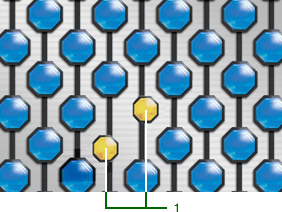
 As you all now fast autofocus is one of the main advantage of classic DSLR cameras. This because a phase detection focus usually works faster than contrast autofocus. But with the release of the F300EXR


You can find more information on Fujifilms website: http://www.fujifilm.com/products/digital_cameras/f/finepix_f300exr/features/
“Hybrid Auto Focus System NEW!
One of the disadvantages of longer zoom compacts is relatively slow auto focusing. Typical compacts rely on Contrast Detection, which works by fixing the focus by searching for contrast differentials. Some expensive cameras, including many DSLRs, use two focusing systems in tandem to improve the time taken to auto focus. Phase Detection AF works by dividing the incoming light into pairs of images and calculating the phase difference to find if the object is in front focus or back focus position. Contrast AF is generally better in low-lit scenes, while Phase Detection AF is extremely responsive in good light. Having both systems on one camera is perfect. The FinePix F300EXR uses both Contrast AF and Phase Detection AF to offer auto focus speeds as good as, or sometimes better than expensive DSLRs. To achieve the incredible AF speed of 0.158*1 seconds, Fujifilm engineers placed pairs of phase detection sensors on the EXR sensor, which work exactly like external sensors on DSLRs. The FinePix F300EXR automatically selects the optimum focus system, by measuring the amount of light or contrast in the scene. The benefit for the photographer is immediate and obvious: an almost instantaneous capture of the subject in the viewfinder, with no missed shots or subjects half out-of-frame.”
Hurry up Panasonic! There is way to catch up the DSLR autofocus speed! 🙂
24 Responses
Where is the Super CCD Micro Four Thirds Camera? My dream.
All of that is merely a blah, hot air.
No explanations at all about how the sensor can divide the incoming light w/o any additional optical tools.
Look at the image – there is no dividing. The sensor just have several photocells that work only for phase detection. So the gap must be reduced by software (like bad pixels in 4/3 cameras are).
The panasonic contrast based af is already as performant as phase detection af in entry level Dale …
The panasonic contrast based af is already as performant as phase detection af in entry level Dslr …
Respect Fuji!
What a brilliant idea!! WOW!!!
DSLRs is dead.
(it’s only a matter of time now)
@aaa:
you are not qoite right.
The phase detection essentially means that the light coming from the same elementary source is DIVIDED OPTICALLY into 2 beams and the phase of these beams is compared – in a way similar to contrast detection.
And i simply cannot see how Fuji can do this WITHOUT partially covering the main sensor.
I think the so-called phase detection á la Fuji is merely a fast contrast detection using dedicated pixels. As Panasonic already has fast 4 channel readout sensors the difference woon’t be such huge anyway.
Yes, they can be doing true phase detection on the main sensor.
The principle of phase detection requires that the sensor examine light rays from two opposite edges of the lens. When the lens is correctly focused, the patterns of image details from both edges will be “in phase” (lined up with each other.) If the lens is out of focus, the patterns will be displaced relative to each other.
Having the sensor see the opposite edges of the lens requires some kind of prism over adjacent sensor elements, so one element looks one way and the other looks the opposite way. In principle it’s no different from the “split-image rangefinder” on the focusing screens of old manual-focus SLRs. This had two flat prisms in the center of the screen, which diverged the view so the eye could look through the opposite edges, allowing it to judge whether details were in phase (lined up) or out of phase (split.)
DSLRs do the same thing using an array of sensors with tiny prisms over them. They see out the lens via a secondary mirror hinged onto the back of the main reflex mirror. There even have been cameras (the Contax G1 and G2) which used phase detection sensors that did NOT work through the lens; they saw the subject through separate windows in the camera body.
It seems clear that what Fuji has done is to put some elements on the main sensor with tiny prisms over them, and use these elements as a phase-detection array. None of this is “breakthrough” technology. Fuji already has been putting different kinds of sensors on the same array (for their “extended range” technology with high-sensitivity and low-sensitivity elements.) And everyone already puts microlenses over their sensor sites; making some of these “microprisms” instead of microlenses is not too much of a stretch. Doing it all precisely enough to work is an impressive feat, but there’s nothing implausible about the basic method.
Assuming it DOES work (which we don’t actually know) this WOULD provide genuine advantages over even the best contrast detection AF. Here’s why:
As noted above, phase-detect works by comparing two views of the subject and measuring the displacement of image details. The amount and direction of displacement gives a clue to HOW FAR the system is out of focus, and WHICH DIRECTION the lens needs to be moved to achieve correct focus. This is the key advantage of phase detection over contrast detection — it knows which way and how much to move the lens.
This is especially important in follow-focusing a moving object — a contrast-detect system has no way of knowing whether the subject has moved closer or farther, while a phase-detect system does.
One important DISadvantage of phase-detect AF is that it is sensitive to what type of lens is in front of the sensor. If the lens’ maximum aperture is too “slow” (too small) the prisms just give the sensor a view of the inside of the lens barrel, rather than of the subject! This is why phase detect usually works better with wide-aperture lenses. It will be interesting to see how much Fuji has had to compromise this in order to work with the small apertures typical of “superzoom” cameras.
Hey, ranger9,
Something is wrong here.
The prism for splitting the ray should be much bigger than a single pixel, otherwise you cannot focus on an area bigger than one pixel. Moreover, if the prism had just an elementary pisel size the phase detection array woud be even smaller, composed by very tiny, subpixel-sized elementary sensors.
This makes no sense!
That’s why I don’t believe that there is a true phase-detection there.
We are yet to see the reviews but I hope Fuji succeeds in making this work. If mirrorless camera makers implement this into their new models, it’s going to be a huge breakthrough.
Could existing 4/3 lenses be somehow made to use phase detect autofocus on mirrorless bodies?
Miroslav says: Could existing 4/3 lenses be somehow made to use phase detect autofocus on mirrorless bodies?
That’s the beauty of such a system if it works – you don’t need to have PDAF lenses on m4/3 bodies. CDAF lenses work for CDAF situations, and the sensor does the PDAF in PDAF situations and controls the lens AF accordingly.
Definitely exciting times we live in from a camera technology point of view. We’re seeing revolution, not simply evolution.
Being able to AF off the face of the sensor is a very important step for the future of DSLRs.
It would mean AF with the mirror up while videoing. It would also improve AF performance when sequence shooting because the AF would be in real time, off the sensor face.
Ultimately, the future DLSRs could keep a conventional prism instead of using an EVF, or have quicker AF with an EVF.
A year or so ago, I’m sure I read a rumour about Nikon bringing in this tech. Indeed, Nikon rumours says the upcoming D90 replacement can AF while videoing. Will it use something similar? Will the new E-5 use this type of AF system?
If this works there is little point keeping the mirror and OVF. I love my GH1 Evf and they will get much better yet.
Well, just hope that not something important was at that position, because now the sensor cannot see that thing anymore.
I wouldn’t film Lawrence of Arabia with such a sensor, that is all. Imagine the extreme long shots in the desert where people are just mere specks in the image: Sometimes they are there, then they’re gone, then they’re back…
Nikon has a patten for phase detection on sensor also. http://www.google.com/patents?id=qJvIAAAAEBAJ
so this might indicate (and the non showing of Fuji in m43s) that fuji and nikon are going to be working on the same mount for there EVIL system.
and if you think the G2 or GF1 has AF speed and ability of an entry level DSLR, I think you are more than slightly off the mark with that statement.
and @Brod1er & omox
There will always be a point to a true OVF. no mater how good EVFs get you can only sample life with digital, to see it as it is, requires an OVF.
this is not to say i am not looking forward to using a EVFs.
Sry the above link is for sonys patent for on sensor phase detection
nikonrumors talks about it here http://nikonrumors.com/2009/11/05/nikon-patents-for-this-week-nikon-evil-camera-again.aspx
kesztió says:
Hey, ranger9,
Something is wrong here.
The prism for splitting the ray should be much bigger than a single pixel, otherwise you cannot focus on an area bigger than one pixel.
You’re right that there have to be multiple pixels looking at each set of edge rays from the lens. But there’s no reason these pixels can’t be separated, each with a little prism on top of it. The software that makes the system work would have to collect the images from all the “left-looking” AF pixels and all the images from the “right-looking” AF pixels, assemble their output into patterns, and then compare the phase of the patterns. It’s not really much different from the way the Contax G2 worked, except that the AF pixel array is distributed around the sensor rather than being placed behind separate windows on the camera body.
Of course I’m just guessing that this is how it works, but it shows that the principle isn’t impossible.
Re newsed1’s comment, I had the same recollection: I thought recalled reading earlier in the year that someone else (Nikon?) had obtained a patent on off-the-sensor phase detect AF. So I wonder if Fuji has thought of a different technology for implementing it, or if some technology trading is going on…?
I’ve read that this is common practice in the Japanese photographic industry: “We’ll let you use our patent for X if you’ll let us use your patent for Y.”
Nice find ItsaChis, I’m posting it in the mirrorless forum: http://mirrorlessforum.com/other-camera-systems/2156-fujifilm-hybrid-af-system-phase-detection-af.html
The so Fuji have do is, skip over (R-pixel) and work together at difference micro lens, but the so Fuji can do is in EXR sensor.
But i think introduction a new pixel in sensor for quick AF is needy in mirrorless.
I just wonder how many “focus points” fuji is going to put into thier sensor, the more points the better, but the more points the more software coverup they’ll have to do.
Remember, with phase detect you need more sensors, you can’t just move around the focus point like contrast detect. I’m moving more and more away from focus and recompose, I much prefer having a focus point to just stick where I want it.
Just a thought….
@ranger9,
definitely not, it’s too late to “separate” the ray on the sensor’s surface. the optical mechanism for this separation sould occur BEFORE the sensor, therefore the optical mechanism for doing this should be placed somewhere before the main sensor.
This means shielding a part of the main sensor.
Now Fuji has released the new FUJI S2800. A camera with attractive features in a compact body.
As long as it doesn’t work in low light, its use is limited. Maybe it can help with daylight sports/wildlife?
Got to give it to Fuji, pixel grids at 45 degrees angle, different types of pixels, 3D cameras and viewers and now this. They are innovative. Too bad they rarely deliver in the execution.