









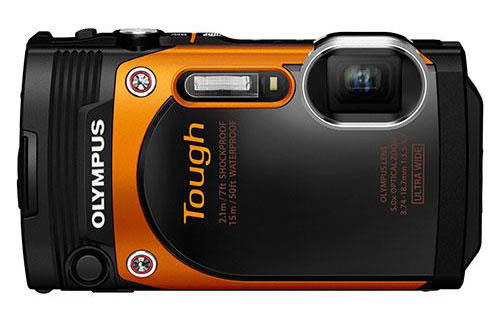
Image via Digicameinfo.
Everything got leaked and there is little unknown yet. On February 5 Olympus will announce a bunch of new products and a new firmware update for the E-M1:
– E-M5II
– New accessories for the E-M5II (HLD-6P and HLD-8G grip and a new FL-LM3 flash).
– E-M1 firmware update (info Digicameinfo)
– 8mm f/1.8 fisheye lens.
– 14-150mm f/4.0-5.6 II
– TG-860 in orange, black, white (Image on top)
As usual you can follow the 43rumors live blogging on February 5 at 5-6am London time!
–
For sources: Sources can send me anonymous info at 43rumors@gmail.com (create a fake gmail account) or via contact form you see on the right sidebar. Thanks!
For readers: Don’t miss any news. Join our group on facebook and follow our tweets.
Rumors classification explained (FT= FourThirds):
FT1=1-20% chance the rumor is correct
FT2=21-40% chance the rumor is correct
FT3=41-60% chance the rumor is correct
FT4=61-80% chance the rumor is correct
FT5=81-99% chance the rumor is correct
97 Responses
Video improvements in E-M1!
Nope.
Drat!
Not even 25p for us Europeans?
real focus peaking please.
How is the peaking not real?
By that E-M1 lightens or darkens the view and then applies black or white edges to contrasty areas (focused). Instead going like example Sony does by highlighting contrasty areas with bright color that you can really easily see.
Now look at that what Sony does.
https://www.youtube.com/watch?v=eC4lZWHDE58
And Panasonic has little similar thing but same problem as Olympus,, it isn’t visible well enough:
https://www.youtube.com/watch?v=Qtid_mBKN2E
I use focus peaking a bit with my GM1 and I have that same issue (I think). I can barely see the highlights to check if I’m focused on what I need or not, it causes me to miss focus quite a bit in manual focusing. That Sony video looks pretty amazing, that definitely needs to be pulled into M 4/3s
So no TG-3 successor?
Yeah. This site said that it would be announced a little while afo
What happened to the 7-14mm lens?
Its on the front of my camera..and it’s oh so compact and made by Panasonic!!!! 🙂
It just zooms wrong direction, it is as well a slow one and isn’t build so sturdy as Olympus Pro line is (but rubber/plastic can be better than metal considering how close dangerous places ultra-wide angle objectives are placed..)
Mine is waiting to be sold because of the purple dots issue. Love/hate that lens..
Man, get a UV filter, cut a small circle of it and then glue it with hotglue or gelatine back of the objective rear lens. There you have 100% fix to purple dots for Olympus bodies.
No thank you, I prefer to sell it to a friend 🙂
So would I…. one reason why I didn’t get it was it was made by Panasonic and they have the style to zoom in otherway around as I think.
I usually leave it at 7mm, relying on my RicohGR for the 28mm angle of view if I need it, and on the 12mm Olympus if I need a faster shutter speed and its width is enough.
In a hour I have an assignment (I’ll read your long reply later), and the Panasonic would be perfect under certain light conditions: if I’ll see those purple spots and flares I’ll leave it in the bag and use the 12mm instead.
It was announced quite a while ago…
> E-M1 firmware update
I want that 40mp mode for my E-M1!
No.
What? You don’t want or Nawt doesn’t want?
No, it won’t happen.
And reason is?
I can only guess, but I’m thinking about the different sensor and different mechanical parts that allow the sensor to move by just that pixel.
Not to mention the more logical reason: to make Em5 II more appealing to customers.
If the sensor is the same as on E-M5 and E-M10, then no problems.
CPU is the same as with E-M10 and E-M1 so no problems there.
And E-M1 IBIS is capable to ½ pixel shifting as well, it is just about programming CPU to do the stiching.
And E-M5 II would appeal very many just with lower price (vs even competitors too!) and small size + the different swivel screen.
Just make there a 200-300€ price difference between E-M1 and E-M5 II and neither one is killing other sales.
If E-M5 II is done better one than E-M1 expect to handle 4/3 objectives, then E-M1 sales are already gone and it is dead in the water next 12-18 months before Olympus brings E-M1 II, what again makes E-M5 II sales look bad if the prices are not clearly different, or E-M1 II doesn’t sell well enough if its not radically better than E-M5 II and E-M1.
It is now better to upgrade E-M1 to match E-M5 II that would be a cheaper body, delay the E-M1 II release and even time out E-M1 II to come out with E-M10 II and E-M5 III in 18-20 months.
There is no logic that E-M1 would not get features, as we don’t have information from E-M5 II to create the new information. All what we can do is just wish and guess.
While I don’t discuss the technical points you mentioned (too lazy to check and I trust you), your logic of how is better to upgrade is the logic of the customer: the Company logic is always that of making money first. Some wishes might become true, but I’m not holding my breath.
If company wants to make money with three different models (E-M1, E-M5 II and E-M10) then it needs to make those three to be sold with good purposes.
And that doesn’t happen if one of the products is released so that it is cheaper or same priced that has all the new features what the best model doesn’t get for next 18-20 months.
It is sawing the branch you are sitting at.
If Olympus wants to sell E-M5 II and continue selling E-M1, it needs to keep E-M1 as the better model (4/3 objective support, but bigger with a grip, C-AF+Trk feature) with couple features but then get the new model to be same level but cheaper but missing the few features.
E-M5 II would be smaller. GREAT
Would not have 4/3 support. Who needs it and not yet got E-M1?
Doesn’t have the PDAF for video and C-AF focusing (tracking). OK.
Both have Wifi, same EVF, same image quality, same battery, same features (live composite, live time, live bulb etc) and same sensor shift and video.
E-M5 II would not be worse than E-M1, but E-M1 would not be worse than E-M5 II, instead it would have couple extra features that some people would not need and they get E-M5 II instead.
The most simple answer I can give you is that there will always be early adopters buying the new product.
Look at the posts in these fora (43rumors, SAR, Canon and so on): everytime a new model is announced it seems the new Messiah is coming. Then specs are leaked and nobody, nobody is happy.
Em5II has same EVF as Em1: if it had a worst EVF people would complain and say that it’s not an upgrade. Has wifi, as every new camera today. Does not have the handling of Em1 simply because Em1 is the best option for those wanting to use 4/3 glass (or those like me who prefer a better grip and buttons layout – no, I hav never liked the optional grip on my Em5).
It’s simply the 3rd option for a m43 user looking for an Olympus camera, as different options are Sony a7, a7r and a7s: they aim at different customers.
The difference with Sony A7, A7r and A7s is that they are basically same first get body, that got now upgraded with A7 II for second gen body.
They have different sensor so each of those give different image and video quality. But all share same EVF, battery etc.
With Olympus E-M10, E-M5 II and E-M1 they have basically same sensor (16Mpix) but just one is manufactured by Panasonic to give the PDAF. But quality wise there isn’t difference (we can go and pixel peep to see that 1-5% difference) by the sensor that isn’t done by the software (TruePic VII). And now all three has same processor, implifying they all do same image enhance (rebuilding counter circle of confusion, CA etc etc).
E-M1 is targeted for those who need 4/3 objective support and gets the C-AF+Trk. Those are really its only benefit.
And it should survive one year (if not over) with that benefit against E-M5 II, that rumor say gets much better video, much better image quality for still scenery and any otherway be identical but smaller.
Is E-M5 II targeted to videographers and E-M1 for legacy 4/3 owners? The legacy 4/3 objectives works well with E-M5 II. Focusing can be just little slower, but if you want fast focusing for sports or wildlife, then sell now 4/3 objectives and buy 40-150mm and 12-40mm f/2.8 Pro objectives as those two cover basically everything you can have on 4/3 objectives for such fast subjects where fast focus speed matters.
That means PDAF isn’t really even needed anymore. A E-M1 C-AF that will be same with E-M5 II, if not even better on new model (its always possible) is already so good that you can shoot sport with it.
The PDAF feature is great when shooting with the C-AF+Trk function on video, as it makes even smoother the video focusing (that is already very smooth with C-AF).
So E-M1 has likely nothing to give for video. Only thing that I can think now is that E-M1 has the 1:1 cropping mode in video where with push of a button you crop the 1920×1080 pixel area from any part of the sensor and then push of a button you jump back to full sensor read out.
https://vimeo.com/85757221
If E-M5 II doesn’t get that feature, then E-M1 has small edge on that, but if E-M1 doesn’t get framerate and bitrate update and E-M5 II gets those, it isn’t giving benefits that many videographer would think “Do I want sometimes do 1:1 crop and otherwise shoot with lower video quality?”
Using the existing parts in E-M5 II makes it much cheaper for Olympus to manufacture and work with. But that means as well they can’t charge same prices as E-M1 or E-M5 was at the start, as they were new products with new parts and features.
And that is the huge benefit what Olympus can do, lower the E-M5 II body price so E-M5 owners can clearly see the benefit to invest some money to it and get better functions, but not invest so much money that they would get E-M1 with same features but some of the other (PDAF, Grip).
If E-M1 gets update via firmware, and I would need to do the decision in the store to buy a either E-M5 II or E-M1, it would be very though decision. As I love the small size of E-M5, but I dislike the rumored fully articulated screen (I like the tilting one, unless it is like Sony model has). I love the grip in E-M1 but its not that I would so much miss it as the grip for E-M5 gives many of its benefits and I could live with it if I can save couple hundreds at start.
I don’t need anymore 4/3 support (PDAF) so it would be a gimmick feature for me now on. Image quality being same (expect E-M5 sensor requiring less work on astrophotography). And if both have sensor shift, it would be very hard choice. Both would be viable options at that moment. And at that moment the price would be the ruling one.
Reasons to get E-M5 II then:
– Possibility to go very small size as no grip
– Lower price for body
Reasons to get E-M1 then:
– Ergonomics great without hassle
If m4/3 mount idea was to allow make camera smaller, and that is the huge benefit when traveling as we can just unmount objective from body, stick both to different pockets and its ultra light package. But with E-M1 its harder to do as the grip takes space from pocket.
Later on I would need to buy a external grip, that I can choose when to leave at home, or when to leave to camera bag.
Now if E-M1 doesn’t get the new rumored features at all (no video or sensor shift features) and E-M5 II gets the E-M1 features:
Reason to get E-M5 II then:
– Much better video (70% countries 50Hz powergrid reason, small improvement to quality 24 -> 77 Mbits)
– Clever sensor shift for landscape, architecture and studio work and why not even to macro photography, if situation allows.
– Small size and weight
– Lower price for body
Reason to get E-M1 (non-upgraded) then:
– Ergonomics great without hassle
? lower price for body
Why I would get E-M1?
Even if the E-M5 II body would cost 1399€ and E-M1 1199€, I would go E-M5 II. Even if I would need to buy a external grip for E-M5 II, I would go for it.
There would not be a single reason to get E-M1 at all.
Even if I would not ever press the Rec button, E-M1 would not have a single thing that would give me valid point to get it. Unless it goes that E-M5 II costs 1599€ and E-M1 price drops to 599€ and even then I would go to E-M5 II as that price cap I can easily get with the benefits E-M5 II rumored sensor shift offers.
If anyone would ask from me what OM-D model they should get, I would say from first hand “Get E-M5 II” if they need the features, otherwise get the E-M10 for the lower price. I would never recommend E-M1 to anyone. Even for E-30 or E-5 shooter I would just say “Sell your 4/3 objectives, invest to E-M5 II + 12-40mm Pro and 40-150mm Pro”. As after that jump, E-M1 successor PDAF is feature that isn’t required and if it would be better model than E-M5 II, it would be better later jump from that to E-M1 successor.
But if E-M1 gets the features, I would say “You have two choices, either buy the E-M1 body and continue shooting, or buy E-M5 II with 12-40mm Pro and later get the 40-150mm Pro”. Anyways Olympus gets money, a loyal customer that later can sell 4/3 objectives or buy a E-M1 successor if it has PDAF.
It would be a very hard decision to customer to choose, as the decision would be about their current gear and their future possibilities instead the specs of the current models other being superior and other being inferior.
If E-M1 gets video features, but not rumored sensor-shift feature, it can keep E-M1 sales up and if the E-M1 is lower price than E-M5 II then, many would buy it instead E-M5 II as many doesn’t do landscape, architecture or product photography on tripod with long exposures, in environment where weather allows it.
It would drop E-M5 II sales lower than E-M1. And if even E-M10 gets the video features, heck, so cheap body without weather proofing that why buy E-M5 II?
The problem what Nokia had before Windows Phone was having too wide variety in their models. They had over 30 Symbian smartphones and 50+ “dumb phones” with Symbian. And it was about Symbian (OS) + S30, S40, S50, S60, S70, S80, S90 software platform (+GUI). And not just to make it difficulty like that for developers and customers, the software platform had own versions too. So the customer and developer was forced to choose from 4 Symbian versions, combined with variety of seven (7) software platforms and each having 1-3 versions. No try to get or make a software for that.
And then you had those dozens of phones, each one having different hardware. Oh you wanted FM radio? Okay, these 8 models have it. You want bluetooth? These 15 models have it. You want MicroSD slot? These 3 have it. You want that charging plug? These three are on these and these models. You want a D-pad? These and these have it.
And then Nokia had these crazy model numbers, 5120, 5250, 5610….. and all were totally different phones and not even same line as you could think.
Then someone at Nokia got through the idea that four-digit model numbers were confusing and too much variety was not good for sales. So they made huge news about that they will drop the model digits to three (210, 510, 610 etc) and then have E- line for enterprice, N- line for multimedia/enthusiast and one other line for basic things, with one number (E7, N7, N9 etc).
Well what they had at end? 525, 625, 628, 721, 822, 502, 510, 1020, 1250, 1520 etc. Again all with so small different changes that you don’t know what is what. And Microsoft continues the same thing.
If you make the customer decision harder, offering more choices, they end up to paradox of choice where nothing what they choose is good.
For customers the choice needs to be simple and easy to do. Give them 2-3 choices and do not distribute features between models so if they want/need feature X and Y, they need to buy two or leave without a another.
The decision needs to be then that “Okay, then I buy that more expensive model and I have everything” or “Okay, I don’t have money so I take that one”. But not so “Okay, I have money only to one, and I only want one, so…. ”
http://www.ted.com/talks/barry_schwartz_on_the_paradox_of_choice
The decision needs to be like working with kids. You don’t ask from 5 year old what she/he wants to eat. With one you can deal somehow, but if you have 2-3 kids from 4-7 years old then you are in big trouble because you spend time them making decisions and they have hard time and in the end they likely get upset because they didn’t get what they wanted.
Instead you just give them two options, “Do you take vanilla or strawberry ice-cream?” “Do you want a milk or water?”.
Why E-M5 II having features A, B, E, F and E-M1 having A, B, G, H. is just a bad thing as customer needs to make a choice from multiple variants. And when they have though choice to make, they hesitate and they seek easier decision option = competitors models.
And if competitor has same situation, customer is more confused and easily leave the store without buying anything or then returns with complaint or later on when doing in future new decision, they choose a competitor.
Why Apple is successful because they have kept it stupid simple.
You get every year a new upgraded model, you make decision do you buy new model or not.
Now since iPhone 5, they have C and S model. and with iPhone 6 they have iPhone 6 or iPhone 6 Plus. But same time they have now then older models as well available for lower price. What makes it more difficulty to customers to choose. Like you walk in store with iPhone 4 and you ask to see newer models. Easy to choose from memory, is it 16, 32, 64 or 128 model. But choose between three generation and couple variants and paradox is ready.
For company to make money, decision making needs to be easy to customer so that only thing really needs to be checked is the price range. Customers live its about paying bills, getting paid and spending money now or in future. Make it easy to just compare do they spend now 599€ or 899€ and can they do it. Throw there options that they need to choose between versions because there isn’t one that has all the needed features and its paradox.
There are rumors that the IBIS on E-M5II got some improvements. That also might have something to do with the sensor-shift exposure mode. I would not rule out the possibility that the last gen 5-axis IBIS lacked the necessary capabilities to make this feature reliable. We know it could move the sensor at subpixel steps. But could it move it by precise amount in precise direction? We’re talking about 2 microns here. There’s no need for absolute precision thought if there’s a feedback loop and the camera can read the exact position of the sensor. But that feedback loop is probably not necessary for IBIS to perform its primary function, since this is a reactive system (ie. based on motion sensors input, it tells the sensor how to move, not where to move and at which angle to position itself). That is of course pure speculation.
As for the price, from what is known, there will be around ~$200-300 difference between each tier. Not at launch obviously, but once novelty tax dissipates and street prices balance themselves.
And I do agree that E-M1 should get some E-M5II features through firmware updates. And it might actually make sense for Olympus as well. The market outlook is not rosy right now, and it’s probably gonna be harder for smaller players to justify fast iteration (developing cost for a new product is not pocket change). Sony replaced A7 with a new model after just a year. That is just insane. Companies constantly push new products, and people still buy less and less. I’d say fast iteration will just hurt them. Would I buy a Sony camera knowing it will be obsolete next year and its resale value will tank? I’d have serious doubts.
On the other hand. Would I buy an advanced camera from Olympus knowing that it will get feature updates for next 2 years or so? Sure, sounds like a sweet deal. Whether that will be the case remains to be seen, but once the precedent is set… (and so far Olympus does a good job on that front).
The E-M1 IBIS is accurate enough to do the shift, otherwise you would not get the IBIS to work properly. The questions are more likely in other things like is there hardware that does the stitching or can the CPU (TruePic VII) handle it. Same question is about video, can the CPU in E-M1 be programmed to do the required higher bitrate encoding or change the framerate or is there own dedicated chip to do it?
Like what you said about Sony releasing new models so quickly, that is the problem for many. Either you go the Canon way, where you rotate 4-5 year old sensor that is already lost to others (same can’t be said to E-M5 sensor, used by E-M10 etc). Only pixel peepers and geeks who doesn’t care about photos but just that they have the latest model whines about the sensor.
Or Olympus could do the Fuji way, releasing half-baked models that is missing features and has even physical buttons that doesn’t do anything at release time. Then later Fuji needs to issue batch of firmware upgrades to start adding functions that were missing and polish features that were not implemented. While Olympus does the otherway, it release camera finished as possible and then firmware fixes things or adds some features if required.
Cameras can’t be like smartphones, we can’t get a once a year new model that adds some new hardware that year older model doesn’t have just because.
For sake of Olympus, I have hope alive for that they have managed to design a head their IBIS and CPU to correspond the next model upgrades. As no company starts a new model design after the current one is pushed out of the factory, there are multiple ones in line waiting electronics and software to be improved.
Like with E-M1 it has dual TruePic VII processors, instead one VI what E-M5 has. I don’t even know does E-M10 have dual or just one? Do E-M5 II have dual CPU as well or does it get just one?
It is rumored that E-M5 II has improved IBIS, that is very lously said as E-M1 IBIS was improved already from E-M5. So is the IBIS improved from the E-M5 or from E-M1?
What makes it interesting is that Olympus has said that E-M1 IBIS has 5 stop benefit, E-M5 having 4 stops. And now rumored IBIS on E-M5 II is said to be 5 stops. That would mean the IBIS is same what E-M1 has.
So what if E-M5 II has same IBIS, same TruePic VII (dual-CPU), same EVF but old sensor from E-M5 (or same as E-M10 has)?
What I am expecting otherwise is that Olympus would give it a TruePIc VIII (v8) if it would be so much better, or it would then tell that its improved IBIS to 5.5-6 stops or otherwise improved from E-M1 IBIS. And that there is a new encoder for video etc so there is hardware difference for video.
That would place a rest to many E-M1 minds knowing that it isn’t just “Nah, we just want to sell E-M5 II and never update your firmware while your camera would handle it!”.
If Olympus updates E-M1 to have the IBIS “trick” and video bitrate and framerates, it can be sure that I get their E-M1 II model once it hits stores. As then I can be sure that they don’t try to trick later with E-M5 III or similar thing and E-M5 II owners can be happy as well.
ps. Lets not forget E-M10 owners… hopefully they get some love as well 😉
So think about it, what if Olympus keeps E-M1 as #1 model with same features as E-M5 II but with 4/3 support and higher price. E-M5 II replaces the E-M5 and is cheaper and smaller than E-M1. And then E-M10 gets updated video features (that all would have) but have just the 3-axis IBIS?
Olympus would just start selling a lot more cameras for video shooters too. How many would buy E-M1 instead E-M5 II because grip, weight and PDAF? Some, but either one would not steal sales from the other. If E-M1 doesn’t get updates, its dead model.
Why to buy it when you get same image quality from E-M5 II, much better video (25fps etc), handy sensor shift, screen for video, smaller size and weight? Even if E-M5 II would cost 200-300€ MORE than E-M1, the E-M1 would not sell anymore. Dead in the water.
So what Olympus would do with E-M1 until E-M1 II comes?
I wish that E-M1 gets the sensor shift stitching for higher resolution and then gets the new higher bitrate for video and new framerates.
But! I do believe the E-M1 gets a new video framerate options and a possible new higher video bitrate (24Mbits -> 77Mbits)
IF E-M1 would get both, it would keep E-M1 very highly regarded model for long time, E-M5 II would not need to shy next to it and could have a lower body price as it would be smaller model. Together E-M5 II and E-M1 would build a very great combination, while E-M10 would be great as well for entry-level option, and then have E-M5 as the cheapest for sold out line (it is still awesome camera).
Of course as photographer who use E-M1 as main camera, I wish both features comes, but I would be very fine with the video features too as it is just a bonus. The sensor shift stitching would be just one reason to leave more often A7r at home for landscape work (long exposures, if it allows long exposure usage) and for product photography.
Why would people buy the EM5II then? I gues the only firm upgrade for EM1 is for enhanced compatibility with the new 7-14. New bitrates for video is the max i dream about but i don’t believe they will do it, i hope i’m wrong…
I’d wager the e-m1 gets 24 fps but not 40mp since that may not be just software. Later this year E-m1 II with a new sensor with similar 40 mp mode, new shutter, improved tracking and maybe 4k is announced.
It is possible that E-M1 gets just the new framerates. That would be good update as well as long there is 25fps. As 23,97fps is nothing needed but 25fps is needed for electricity grid reasons.
Of course 50fps and 60fps options would be nice as well to get little slowmotion done now and then.
Why? To get it 20-30% cheaper, no 4/3 objective support and smaller body. Otherwise similar functions.
Why You would buy a E-M1 instead E-M5 II? Do you want to grip? Do you want the PDAF for 4/3 objectives or C-AF+Trk? If so, then pay more.
Of course this is the believe E-M5 II will become around 900€ as body only, being 200-300€ cheaper than E-M1 body.
If I would not have a E-M1 but like E-M5, I would go to E-M5 II and save money, buy a external battery grip to cases where I need larger grip and sell 4/3 objectives.
As now with 40-150mm Pro with TC I don’t see much sense to own any 4/3 objectives. Of course 50-200mm f/2.8-3.5 is still awesome but its not at all as awesome that new Pro zoom would not be better choice.
Why E-M5 II should be a better model than E-M1? To kill E-M1 sales for next 12-18 months? E-M1 with updates would not threaten the E-M5 II as it would be still cheaper and smaller. Many E-M5 owner doesn’t like E-M1 because its size.
I would like to see an e-m10 feature update as well.
Since that is an entry level model, I would not expect that. But it would be nice and welcomed.
I guess based on the amount of rumors so far Panasonic isn’t planning on showing up at all 🙁
I’m not so sure about that. Panasonic has a habit of keeping their releases quiet.
Olympus needs to justify the price difference between the EM1 and the EM5II
My guess is that they will enable 4K and the 40MP
That would not make sense.
E-M1 can’t have ½ of the good features and then E-M5 II with the other ½ of the good features. As that would demand you would need to buy a two bodies to get both features.
The good product model stepping is that there is A, B and C model. A has all the features from the B and C, B has all features of the C and C has some of the cool features. That way customer makes a decision to buy a model he can afford and what meets needs. If the customer needs later features that are on higher model, customer can re-sell the current lower level model and buy a higher end model.
Now if the E-M5 II would get a 77Mbits bitrate, a set of frame rates and sensorshift and then the E-M1 would get a 4K and sensorshift, it would make E-M5 II still somewhat better in other areas, unless E-M1 gets as well the same functions but has the benefit for 4k too.
But you probably meant that?
The E-M1 isn’t about ‘features’.
It’s about better sealing, tougher, longer lasting shutter, faster flash sync, better ergonomics , pro support and reliability.
I suggest you look at the high end cameras from the past which didn’t have the cutting edge technology but had the reliability and toughness that professionals wanted.
Only people on forums like this worry about the latest ‘features’ for their toys
And if you look the rumor of E-M5 II (until Olympus release specs) it will have same features as E-M1. Same sealing, as tough, longer lasting shutter, faster flash sync, better ergonomics (smaller size + grip), pro support and reliability.
Like why you would buy ever E-M1 when E-M5 II would be by all ways same or better? No reasons whats so ever.
The E-M1 is about features. WiFi, EVF, PDAF. Those are the reasons how E-M1 was sold over E-M5. Walk to Olympus sale person and ask why you should get E-M1 over E-M5 and you got those listed.
Now with what rumors say, walk over Olympus sales person and as why you should buy E-M1. Do you know what you get as answer? “If you have 4/3 objectives, they focus fast on this”. And why you would have those, and yet not updated to E-M1 already? You are not going to buy those these days and get E-M1 for that, when E-M5 II is out and 12-40 and 40-150mm Pro objectives are as well. No, you get E-M5 II even if it is more expensive and you leave E-M1 to shelf to collect dust.
Haha yes, but believe me, Oly will attach enough new features by the time the E-M1II is announced in the next 6-12 months, to torment even new owners of the E-M5II. They’ve been clever that way, lately.
You forgot about TG-4 and SH-2.
Would like more infos on the TG-4 as well. I only found on digicam-info that oly registered a trademark for “TG-4” in Russia. http://digicame-info.com/2015/01/tg-4.html
Maybe they integrated the tilting screen from TG-850. Very useful thing. They need to use Sony 1″ sensor, even with slow lens instead though.
A larger sensor would be nice, but very, very unlikely. I’d love to see a 2/3″, or at least a 1/1.7″ sensor (1″ might not be physically possible in a tough cam, and 1/1.7 is used in Stylus 1) – but I don’t think it’s in the cards. Here’s why.
In recent months, all companies that carry tough cams (Ricoh, Nikon, Canon, Fujifilm, whoever else I missed) introduced new models with very minor upgrades. I mean, *minor*. We’re talking new body colors and fixed-up logos. Not even a new scene mode.
Well, the leaked images of TG-860 are visually identical to TG-850, which leads me to believe Olympus is going to do the same thing.
I’d love for Olympus to prove me wrong, of course. After all, “toughcams” are one of the very few segments that didn’t give ground to smartphones, so it makes sense to focus on them – and the other two segments (superzooms and enthusiast cams) saw major innovation.
Oh, I am SURE TG-860 is just a minor upgrade over TG-850. I was not talking about TG-860, or even TG-4 – I was talking about what they need to resume sales, and it is something like TG-10 or TG-1000, with Sony 1″ sensor. And of course it is possible to do in tough form, with folded optics – of course not f/2 of TG-1/2/3 or f/1.8 of RX100 and G7X. But something like f/2.8-f/4 zoom is totally possible, although the front element would not be in the center like on TG-1/2/3 but has to be in the corner like most tough cameras. And dark lens on the bigger sensor is still better than very bright lens on a small sensor, because of dynamic range and ability to be used in bright sunlight of the beach or mountain slope (where cameras like this are used) without ND filters.
Well, I’m not an expert in folding optics, but if you’re starting at the current f:2-f:4.9 and doubling the diagonal of the sensor while keeping the thickness of the tube, you’d get something like f/4-f/9.8, no? (Sorry, I can’t see how the position of the front element would affect things).
Position of the front element in the corner allows more space for the lens. Unlike with regular cameras where lens zooms out of the body, in tough cams they put mirror or prism behind the front group, and the rest of the lens elements are positioned perpendicular to the optical axis of the front elements, extending into the body. It is OK if the diameter of the front element is bigger. For 1″ sensor and f/4 at 100mm equivalent, you only need 9.25mm diameter of the front element, and all inner elements are of course smaller. Easily doable in a TG-3-like body IMHO. The 8mm x 13mm sensor itself should be placed at the bottom of the camera, with 8mm side in the fore-aft direction.
The 9.25mm (which you calculated by dividing 100 mm by 2.7 and by 4) is only one of the many factors that affect the final thickness.
First off, it’s a zoom. Zooms need to be significantly thicker (up to 2 times thicker) than primes to get the same field of view.
Second, there’s the 45 degrees prism (or a mirror), that has to be about as thick as it is wide, and about as wide as that front element.
Third, there are things like motors that have to be next to, or even surround the individual lens elements, again making the optical assembly thicker.
Which (probably) explains why the TG-1/3 bodies are significantly thicker than the bodies of the slower TG-xxx.
I wouldn’t be surprised if a fixed-focal-length 100mm F/4 could be done. But a 25-100mm f:2.8-F/4 zoom in a 30mm thick rugged body? I’m not saying it’s impossible, but I’d be *very* surprised to see one.
I guess I wouldn’t mind a lens that sticks out – slightly. A 4-5mm lens bezel sticking out of that 30mm body is okay, but a 10mm bezel would be a deal breaker for me.
Thicker? The front element only needs to big as big as to project the biggest aperture. Motors fit over tiny internal focusing elements. BTW, we have seem f/1.8-2.8 24-100 equivalent (G7X), with at least twice the glass of the proposed 25-100/2.8-4. It is not huge by any means. Now reduce it by the factor of 2, fix the front group, put a mirror behind that front group… there is not much left there.
If we reduce G7X’s lens by 2, the image circle will be reduced by the same amount. It will cover a 1/2.3″ sensor, but not much more.
Also, G7x’s objective tube (the cylinder that sticks out of the camera) looks to be about 47mm in diameter. Its front element, instead of being 13mm in diameter (36.8/2.8=13.14), is 23mm.
Or take Olympus XZ-2 (a fast zoom that covers a 1/1.7″ sensor) has a tube that’s 29mm thick. Look at any “walkabout” zoom that covers focal lenses from wide to short telephoto – they are always significantly thicker than focal length suggests they should be.
Another example – Olympus 12-60mm f:2.8 zoom lens. Using the same estimate (60/2.8), its front element should be just 21mm in diameter. However, in reality it’s 58mm.
Look, I honestly don’t know why, exactly, zoom lenses’ front elements and assembly tubes are so much thicker than their focal ratio suggests they should be, but it’s a fact of life.
No, “If we reduce G7X’s lens by 2” and keep image circle the same, f-number will increase by sqrt(2)=1.41, or 1 stop. Hence f/1.8-f/2.8 lens will be f/2.5-f/4 lens.
But if you try to “keep image circle the same”, you won’t be able to just scale down the lens design by 2. The design will have to be completely reworked, and (if zooms currently on the market are any indication), still too thick to fit sideways into a 30mm body.
Look, I’m not an optical engineer. I never tried designing a zoom lens. Perhaps you’re right – but from what’s available on the market today, it seems highly unlikely.
Have you seen the insides of a modern lens? For example, take Olympus 12-50 for a sensor twice as big. The inner elements have the diameter of a pencil. In fact, it is simply necessary for fast CDAF – heavy elements cannot be accelerated and decelerated quickly.
“Have you seen the insides of a modern lens?”
— Exactly! That’s what I was referring to. You’re right, the focusing group is usually narrow (though it’s surrounded by the focusing and IS motors’ assemblies, not just by air).
But, aside from that, look at the designs of the “walkabout” zooms (the ones that go from wide angle to close telephoto). The diameter of the front element is always 2-3 times wider than what the FL/FR suggests it should be. And it’s not just the front element, the entire front *group* of elements is wide (and closely packed together, so the 45 degrees prism has to be behind the entire group, not just the front element).
In a toughcam, the body would have to be thick enough to fit both the front group of elements and the 45 degrees prism, which would add at least 2/3 the diameter of the front group’s rear element.
Look at the front element of your glass. If you see ANYTHING but a hole (aperture fully opened) through any part of your front element, this part is WASTED. If light from behind of the lens cannot get to your eye though that part of the glass, it cannot get to the sensor through that part of the glass either – light is symmetrical that way. 🙂 And if it can, it means that aperture is wider.
I suspect in some cases manufacturers make front elements bigger than they need to be for cosmetic reasons.
“Look at the front element of your glass. If you see ANYTHING but a hole […] that part is WASTED”
I don’t see how this can be right. Suppose, you have a “perfect” lens (the front element fully utilized). Let’s say it has a 60 degrees angle of view. Say, you look at the front element from a point in front of the camera, but outside that angle of view. What do you expect to see through the glass? I certainly expect to see the inner walls of the objective.
“I suspect in some cases manufacturers make front elements bigger than they need to be for cosmetic reasons.”
Sorry, I don’t see how this can be right either. Remember that lens I mentioned, Olympus 12-60mm f:2.8? Since 60/2.8 = 21, its front element should be just 21mm in diameter, right? However, in reality it’s 58mm. Three times wider than it needs to be. Both the weight and the cost of a lens grow as a cube of its size – so it’s *nine times* the weight and nine times the cost of a 21mm element. Look at any other “walkabout” zoom lens – the front element is always 2-3 times wider than FL/FR suggests.
There’s simply no way this could be done just “for cosmetic reasons”. It doesn’t make sense economically. There’s lots of competition in the camera market. A company that would try to gouge the price by 300% “for cosmetic reasons”, would be out of business within a year.
I do not propose to look at the glass outside its field of the view.
I think you’re confusing the size of the front element with the size of the entrance pupil. While they may be the same in simple optical systems, they are certainly not the same in complex zoom lenses.
Real size of entrance pupil have nothing to do with f-number and FL, FL/F-n is APPARENT size of entrance pupil as seen from the front of the camera. Which must be covered by the front element apparently. But look from the border of the field of view – if you see insides of the camera through some part of the front element (with aperture fully opened), that means that the ray of light going from the same point (your eye) hits that same inside part of the lens instead of a sensor.
Not quite. The exit pupil is the image of the aperture opening, as seen from the front.
Now, about the “wasted” glass: Notice that as you look into the objective from different angles, you can view the entrance pupil through different parts of the front element. (This will move the image of your eye within the frame). The only parts of the front element that are not used, are the ones through which you can’t see the entrance pupil, *no matter from what angle you’re looking*.
Also, there is no such thing as Olympus 12-60 f/2.8. There is 12-60/2.8-4. Also, filter size is not the same as diameter of the front element. Also, for retrofocus lenses it is not the same.
“There’s no such thing as Olympus 12-60 f/2.8”
There are the 12-40 f:2.8 (mirrorless), and 12-60 f:2.8 (DSLR). For both of them, the front element is much larger than what the FL/FR dictates.
http://www.bhphotovideo.com/c/product/1003635-REG/olympus_v314060bu000_m_zuiko_digital_ed.html
http://www.bhphotovideo.com/c/product/527565-REG/Olympus_261014_12_60mm_f_2_8_4_ED_SWD.html
Which means the front element should be 40/2.8=14mm.
“Also, filter size is not the same as diameter of the front element.”
Filter sizes are 62mm for the 12-40 f:2.8 (mirrorless), and 72mm for the 12-60 f:2.8-4 (retrofocal).
Front element sizes are 60mm (mirrorless) and 58mm (DSLR).
I measured the diameter of the front element from the lenses’ images. The sizes should be within a mm or so (here’s my source for the image I used to measure the mirrorless version):
http://www.photozone.de/m43/862_oly1240
“Also, for retrofocus lenses it is not the same.”
One of these lenses is for DSLR, another for a mirrorless system.
Same thing goes for the Panasonic LX100: The front element “should be” 34mm / 2.8 = 10mm, while in reality it’s 27mm.
Again, there is no 12-60 f/2.8, there is only 12-60/2.8-4.
There is a 12-40 f/2.8. Mirrorless. And a 12-60 f:2.8-4, DSLR. Both have front elements three times wider than FL/FR.
What happened to the 7-14?
The administrator spent two days talking about the ECG-2. It’s not listed as being at CP+, so when will this highly touted Arca-Swiss compatible L-plate be announced ??
I believe this is a third party accessory.
8mm 1.8 FE. Darn. Hoped it would be rectilinial.
As fisheye I would not buy it. Rectilinear would have been a dream prime and very serious reason to many go and buy m4/3 system for astronomy. Looks like the Olympus 12mm f/2 still stay #1 astronomy lens for m4/3 while Sigma 18-35mm f/1.8 is for APS-C.
Olympus sales will be down in 2015
Probably not as much as Canon and Nikon 😉
So far, they have been profitable, unlike any other camera company. If you even want to consider Olympus a camera company.
No firmware for the “flagship” Pen, E-P5? I guess it wasn’t expensive enough at a grand to warrant continued upgrades.
For that I hope they will release the framerate upgrade later. Great camera, just for people who doesn’t work so much with it.
From the photographs of the E-M5II it looks like it has a fully articulated LCD. If this is true and Olympus goes this direction I may switch from Panasonic. Unless Panasonic comes out with good in body 5 axis image stabilization. Either way it would be nice to have choices.
I hope the E-M1 firmware update is for the video. My wish list for the update: 24fps, 30fps, and 60fps frame rates all at 1920 x 1080p resolution, 77 mbps bit rate, and video-optimized autofocus algorithm. The sensor shift 40MP can stay with E-M5 II. Video is more important to me.
I know Olympus is reserving the 4K (3840 x 2160) for the OM-D E-M II that will be released within 2 years.
OM-D E-M1 II…. what a mouthful. Would be nice if it would be then “OM-D E-M1n”
Why leave it there too? E-M1 has the tethering functionality, highly same IBIS (E-M1 IBIS is 5-stops by Olympus, rumor is that E-M5 II IBIS is 5-stops) and same CPU (TruePic VII, E-M1 has even two of those instead one, so interesting to know does E-M5 II have two as well?).
If Olympus can do such a amazing thing to update E-M1 to same video quality and same rumored sensor shift thing, E-M1 will survive well a side (or above) E-M5 II and people will still buy well E-M5 II because small size.
Look at reply from O at the top & know that won’t be happening. Sorry.
I hope the firmware update allows for fully electronic shutter in stills mode. Even if it’s 1/10 sec. global exposure time that will still be very useful (use it all the time on my GX7).
That would put me over the edge to get an E-M1.
Does the E-M5II use the same E-M1 battery? (BLN-1)
Hopefully, and hopefully the next E-M1 does the same.
Let’s say that you want to take a picture of a distant tree. You have several options: take a picture, move closer and then take a picture, move farther away and then take a picture, move sideways and then take a picture, or not take a picture at all (thereby working against your own intentions) Change the perspective or not? That’s a choice you have to make. The tree itself doesn’t move around, so there’s plenty of time to think about your options. But let’s consider this: change the focal length before taking the picture. This gives us the following options: take a picture, zoom in and take a picture, zoom out and take a picture, move closer and then take a picture, move closer and then zoom in and take a picture, move closer and then zoom out and take a picture, move farther away and then take a picture, move farther away and then zoom in and take a picture, move farther away and then zoom out and take a picture, move sideways and then take a picture, move sideways and then zoom in and take a picture, move sideways and then zoom out and take a picture, not take a picture at all (thereby working against your own intentions). What to choose? This is a question only you, the photographer, can answer for yourself.
Fascinating! Please tell us more!
Yes,Don’t stop now!
Fully transferable shares in ownership are yet another basic
characteristic of the business corporation that distinguishes the
corporation from the partnership and various other standard-form legal
entities. Transferability permits the firm to conduct business
uninterruptedly as the identity of its owners changes, thus avoiding the
complications of member withdrawal that are common among, for example,
partnerships, cooperatives, and mutuals. This in turn enhances the
liquidity of shareholders’ interests and makes it easier for
shareholders to construct and maintain diversified investment
portfolios.
Fully transferable shares do not necessarily mean freely
tradable shares. Even if shares are transferable, they may not be
tradable without restriction in public markets, but rather just
transferable among limited groups of individuals or with the approval of
the current share holders or of the corporation. Free tradability
maximizes the liquidity of shareholdings and the ability of shareholders
to diversify their investments. It also gives the firm maximal
flexibility in raising capital. For these reasons, all jurisdictions
provide for free tradability for at least one class of corporation.
However, free tradability can also make it difficult to maintain
negotiated arrangements for sharing control and participating in
management. Consequently, all jurisdictions also provide mechanisms for
restricting transferability. Sometimes this is done by means of a
separate statute, while other jurisdictions simply provide for
restraints on transferability as an option under a general corporation
statute.
I shall soon be quite dead at last in spite of all. Perhaps next month. Then it will be the month of April or of May. For the year is still young, a thousand little signs tell me so. Perhaps I am wrong, perhaps I shall survive Saint John the Baptist’s Day and even the Fourteenth of July, festival of freedom. Indeed I would not put it past me to pant on to the Transfiguration, not to speak of the Assumption. But I do not think so, I do not think I am wrong in saying that these rejoicings will take place in my absence this year. I have that feeling, I have had it now for some days, and I credit it. But in what does it differ from those that have abused me ever since I was born? No, that is the kind of bait I do not rise to any more, my need for prettiness is gone. I could die today, if I wished, merely by making a little effort, if I could wish, if I could make an effort. But it is just as well to let my self die quietly, without rushing things: Something must have changed. I will not weigh upon the balance any more, one way or the other. I shall be neutral and inert. No difficulty there.
Throes are the only trouble, I must be on my guard against throes. But I am less given to them now, since coming here. Of course I still have my little fits of impatience, from time to time. I must be on my guard against them, for the next fortnight or three weeks. Without exaggeration to be sure, quietly crying and laughing, without working myself up into a state. Yes, I shall be natural at last, I shall suffer more, then less, without drawing any conclusions, I shall pay less heed to myself, I shall be neither hot nor cold any more, I shall be tepid, I shall die tepid, without enthusiasm. I shall not watch myself die, that would spoil everything. Have I watched myself live? Have I ever complained? Then why rejoice now? I am content, necessarily, but not to the point of clapping my hands.
This is hardly the proper forum for your navel gazing, psycho babble. This is a camera forum. Take it elsewhere.
Hahahahahahahaha! I am a god! I direct your every movement, you have no free will! You understand? Hahahahaha! Moahahahahahahaha!
Tell me what to do you stupid God!