









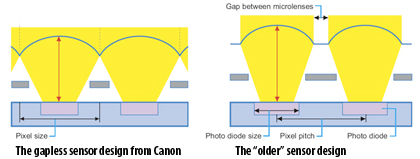
Finally we received a small but very good info from trusted sources about the next Panasonic sensor. The new sensor will have gapless Micro-lenses.
Canon has been the first to deliver such a sensor with the Canon 50DCanon 50D
Canon 50D
Canon 50D
Canon 50D
Canon 50D
Canon 50D
Canon 50D
Canon 50D
Canon 50D
Canon 50D

(and lately with the Canon 7D
The Panasonic sensor is ready for mass-production so it is very likely that we will see that sensor inside the new GH2 (launch to be expected late September at Photokina). We didn’t get any further details yet but the info we post here today came from our very best sources!
Good news!
16 Responses
A really good news!
I want the GH2! No matter how expensive it will be.
great news, good to see Panasonic not resting on their laurels
“Noise levels are expected to be 1 to 1.5 stops better in the high ISO range” is what I like to hear.
I was always bad at mathematics. 😉
Could this mean 1600 ISO is very good and 3200 are okay?
Hmmm … BSI-CMOS + Gapless lens + global shutter …. hmmm .. GH2 pwnage?
I went to DXOMark and put 550D and 5D MarkII in comparison with GH1… apparently GH1 ISO’s are ‘pessimist’ while canon ones are ‘optimistic’ … meaning … at GH1 ISO 800 sensitivity is very similar to canons ISO 1600 … quite funny…
now … make it BSI (almost 1 stop gain) and gapless lens (1 to 1.5 stops) – i think the gain will not be the addition of both – and one shall expect roughly 2 stops of gain? that would be awesome …
Let’s wait to see… maybe GH2 won’t be a GH1 with just ‘unlocked’ firmware (and some faster internals) and a G2 touchscreen….
i think iso1600 is already now more than usable with the GH1:
http://datenkeule.de/dl.php?file=file1277326721P1030932.jpg
The gain between the 40D and the 50D was probably about 1/4th of a stop or less according to dxomark. Every small improvement is welcome, but don’t expect 1-2 f-stops gain.
Actually, the GH1 is already very good. Almost like the Canon 7D. So with a few small improvements (1/3rd of a stop) the GH2 will match the best APS sensors around.
(Note that most GH1 reviews tested the first models. Those had a sensor manufactured in the old factory that gave rather poor results. Models since late last year have improved a lot, and that’s the one tested by dxomark. It can also be seen reviewed in focus-numerique.com).
@oluv – that does look really good for ISO 1600. Can you share the settings you used for that image? I can’t get anywhere near that quality noise from my GH1 at ISO 1600.
Weird. The Canon 50D was one of Canon’s worst lemon, for the ISO gain is so low and IQ at lower ISO is just horrible.
Another marketing hype, same as Fuji’s EXR or many backlit sensors. If Panasonic don’t deliver something useful this time, future of m4/3 and 4/3 won’t be as bright as we thought it would.
Ok, better low light capabilities are coming from 4/3. A sensor noise is not big issue for me, unless the character is grain-like (and modern Live MOS sensors produce organic noise without banding). More important factor is that you loosing dynamic range with high sensitivity. So better dynamic range will be appreciated too. Give us usable ISO range up to 1600/3200, add few F1.4 – F2.0 sharp lenses even wide open in a compact package and the 4/3 will be competitive as top cameras in the class.
Oluv, the noise is good because the scene of your photo is bright, and its light dominates the noise. Try ISO 1600 in the dark and you’ll understand our complaints.
It keeps getting better for m4/3 and mirrorless. I just hope all the new Panasonic and Olympus models get that sensor, not just GH2.
As for lenses, I agree with Michael completely. Fast lenses would further enhance system’s competitiveness and it wouldn’t have to rely as much on ISO in low light .
To get 1 to 1.5 stops improvement from gapless microlenses the gap has to be pretty big on the current sensors. Canon managed to keep noise levels about the same from 40D to 50D in spite of a 50% increase in pixels, but part of that advantage was caused by better noise reduction.
If Panasonic go to 14MP then a slight improvement in high Iso is what I’d expect, certainly less than half a stop at pixel level, and somewhat more if you consider the whole image at a certain size.
Maybe that sensor: http://www.dpreview.com/news/0705/07051401/panasoicrobustsensor.asp come now from Panasonic?
Link problem, try dpreview home page, date 2007 May 14.
Yes, better high iso, but surely in a more megapixel sensor, so no real advantage, except the “my sensor is bigger than yours” commercial ads 😉