








[shoplink 17163]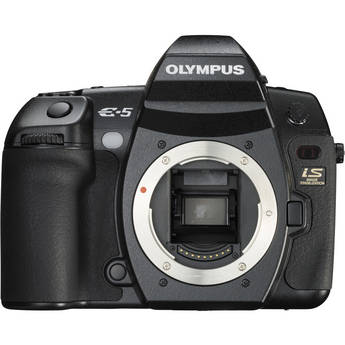 [/shoplink]
Image on top: The current [shoplink 17163]Olympus E-5[/shoplink].
Just got that short info from a 43urmors reader that had a private talk with an Olympus manager. The manager told him the E-5 successor will be announced in about one year. It will feature a new generation sensor (also not the same of the current [shoplink 29074]Olympus E-M5[/shoplink]). He also added that they are working on a prototype with larger sensor size. he didn’t specify the exact size.
—
For sources: Sources can send me anonymous info at 43rumors@gmail.com (create a fake gmail account) or via contact form you see on the right sidebar. Thanks!
For readers: Don’t miss any news. Join our group on facebook and follow our tweets.
—
Rumors classification explained (FT= FourThirds):
FT1=1-20% chance the rumor is correct
FT2=21-40% chance the rumor is correct
FT3=41-60% chance the rumor is correct
FT4=61-80% chance the rumor is correct
FT5=81-99% chance the rumor is correct
123 Responses
maybe its with a multi aspect sensor like the GH2?
if they use an aps-c sensor, like the 24 mpx sensor of sony, they could do virtually every possible aspect ratio up to square-shaped pictures (maybe with a slight crop).
or, if the lens allows it, just the full aps-c picture, with a bit more wide angle than normal 4/3 lenses allow. I’m just thinking about the 7-14…
Dream on. Oh, and did I tell you I heard there was a full frame OM coming with an EOS mount!!!!
Featuring Panasonic sensor? 😉
With Fuji’s hybrid VF technology
I heard it had AF technology from Nikon too.
Funny… but we know they will be making Zuiko glass for Sony as part of the partnership, so what if they launch a new cam with Sony FF sensor and adopt the E-mount?
Oh Tron, you spoiled the fun
Actually we don’t know that (but maybe you somehow do)
Amateur Photographer indicated that the lens exchange was mainly for P&S cameras.
If true, I stand corrected and fully retract!
And anti-gravity neckstrap lugs. And a flux capacitor.
And it is a convertible that has transformer similar capability that walk side by side with you, jump to your hand when you need to take photo. With a built-in high-level artificial intelligence that can read your mind.
It can also carry your camera bag and change lens for you. If it likes you, it will follow you home for free.
88 fps? takes u back to get the shot you missed!
FF with body size of RX1, interchageable lens capacility, the shape of OM, using Sony 24mp A99 FF sensor, capacble ot turning it int 43 and m43 with lens adapter to use existing 43 + m43 lens and change the FF into 43 exposureable area (its about half of FF anyway).
All these while making FF lens for the new line up using the same mount as Sony so that the lens can be shared with Sony Alpha system (economies of scale).
… and maybe, just maybe … with global shutter and its newly patented EVF technology.
Could be multi-aspect. Why not.
I don’t believe a single word.
+ 1
A true multi aspect sensor from 4:5 down to 16:9 would be sweet. I don’t understand the commonality of the 2:3 aspect ratio. It’s unpleasant for horizontal prints, and wrong for vertical prints. The digital age is THE opportunity to optimize sensors within the image circle and to be free of some useless 35 mm legacy. Only Panasonic understood this with the GH1 and 2.
Indeed, I wish manufacturers of MFT and APS-C cameras would release such multi-aspect sensors (at least offer 5:4 and 3:2). A lot of the lenses image circle goes unused in 3:2.
Would be nice if it as a new sensor, not sure I believe the larger part of itas being anywhere 40% true. Interesting doing a check on my lenses with the current E5. I would only need a larger body for my tele photos sizes for the telephoto I use, which is nearly completely at 200 and 284..
This is what we hoped the OM would be.
We?
One year future talk?!
non sense.
Remember, that Oct ’13 is the 10 years anniversary of 4/3. Something must be done.
But in Japan, someone responded: “will do nothing”. I’m convinced.
It’s going to have an APS-C sensor and will be called SLT-E7 ;). You read it here first :D!
How credible is this, Admin? To change sensor size would require a whole new lens system, a huge expenses, and a year out is a year too long to deprive current 4/3’s users of the vastly improved E-M5 sensor. Just doesn’t make sense to me.
Any word on an E-xxx successor, or possibly something between the size of the E-xxx and E-xx? If they produced that with E-M5 sensor maybe then I’d consider today’s rumor as a possible longer term plan. Without it, 4/3’s lens users remain stranded.
Excuse my ignorance, but how does this work with the current 43 lenses?
You get to pay for a bigger sensor, but use only a standard 43-crop. They could implement a multiformat function that would use different crops from the, but multiformat isn’t that convenient for an OVF.
This is one of the most unlikely rumors I’ve read in a while. Timeframe, sensor size etc is all wrong.
Good. If some rumors are true than all the 4/3 lenses are designed for a (slightly) bigger sensor. The mount can also have al slightly bigger sensor.
One more chapter of “the never ending history”
I would like to hear something about OMD-PRO since I´ve been little dissapointed by the GH3
Why so? Max shutter speed?
I could see Oly releasing a competitor to Sony’s RX1, sensible enough move in my mind but… a different (you’d think larger) sensor for the E-5 successor is surely pure drivel?
Does any one know if it is possible – at all – to use FT lenses on a larger sensor?
Any lens of any system could be used in front of larger sensor than intended.
Vignetting and geometric distortions just start to increase something like exponentially when increasing size of captured image and other aberrations do same for resolution outside image center.
yes I think most 43 lenses can handle a larger sensor, and its been proven on a few. The original statements (which there are few) include the patent material which allowed a diagonal of 25mm, which would mean a 300sq mm sensor, or just a tad shy of Canon APSC 327sq mm.
A kit lens was tried on a Pentax camera, of course it had no electrical connections and had to be pre focused on a 43 body, but even wide open it didnt do badly on a 1.5x sensor in 3×2 format, no serious vignetting (probably competes with some pentax lenses which always seem to suck). The image circle of others was looked at by Jay Turberville too,the 50/2 had an image circle beyond 40mm.
I think the proposition largely depends on which lens you might be talking about, and how large a sensor you mean.
Me too .
News for OMD Pro .
When I worked at a now defunct camera store we had just about every camera and popular lens available. I tried using some of my 4/3 lenses on a D700 one day. The 50mm F2 covered the whole image circle and was still sharp arc rosa the frame. Most of my zooms had extreme vignetting but the 35-100 F2 covered most of the frame after 40mm or so. So the GH1/2 sized sensor would be welcome. I still haven’t converted to m4/3 because I have a lot of HG and SHG lenses that have trouble focusing quickly. My E30 has failed and I’m hesitant to send it in for repair as I can find used ones for around $350. Argh.
My dream since several years:
Olympus camera (E-5 size) with 3 sensors and a way to split light towards each sensor.
Could perhaps be done due to the small sensor size, harder for FF, and would be killer.
+1 it’s alo my dream. One for B & W, one for High Iso and one for High Res.
All in one cam! Changable with one push on a button.
That ship has sailed….
Larger sensor could mean multi aspect one or slightly larger since a lot of higher quality 43 lenses cover more area than 43 sensor size, but a year from now… who will buy it?
Olympus really screwed FT, more than the competition ever could.
If they had released 2 new cameras with OMD tech, updated few lenses to SWD and released cheap 300mm f4 lens, they’d have a killer system with little investment, at least as a stop gap until they fixed AF with mirrorless, but no – they had to abandon and alienate their user base in favor of a shitty small system with overpriced lenses.
The current E-5 successor rumors are:
– there WILL be an E-5 successor
– this camera will NOT be equipped with the E-M5 sensor
– the new sensor will either be a further development of the E-M5 sensor or PERHAPS totally different in size. but change of size is not confirmed until now!
Nothing is confirmed
That’s why it’s called a “Rumour”.. 😉
A year from now? That’s a long time for concrete information. A new sensor makes sense, a larger one does not. It contradicts Oly’s philosophy and would require a lot of resources. Perhaps it’s a square sensor?
I would LOVE to see a square sensor!
I’d love to see a round sensor.
No coverage by existing lenses for any of those :(.
Didn’t know the GH2 could not use m43 lenses, what a pity!
Every Lens would cover a round sensor…
this is blabla and it shouldn´t be talked about
nonsense talk!
I think it’s safe to assume this is a fake. The Four Thirds lenses do not cover an image circle bigger than the Four Thirds format. Unless of course the new sensor is like the GH2 sensor with multiple aspects.
May be it’s Super 35???? MFT-Lenses cover it.
What if they used a larger sensor and increased the throat depth to create a larger image circle. Grnated it would not be strictly 4/3rds but would mean our lenses would not become obsolete overnight.
If you mean moving lens farther from sensor that’s what extension tubes do along with screwing the focusing distance range.
If they increased the distance between the lens and the sensor, the lens would no longer focus to infinity.
It is possible that there will be an E-5 successor by End 2013.
Yawn.
“Full-frame” 4/3″ 26×34.6 mm ( 17.3×2=34.60 … 13×2=26 ). Diagonal = 42.1 mm. (?!?)
Or something like that: http://i49.tinypic.com/2j5s1e.jpg 20x15mm
maybe the larger sensor enables improved stabilisation during exteme camera shake movements, especially for video?
+1
The saga continues………………
The saga rumbles on and on. We can’t wait a year. Some of us may never live to see it.
I think statistically considering the amount of readers here, that might actually be true. So which one of us will it be that get’s hit by a bus ?
18,5×18,5 mm sensor would be nice
A camera introduced after one year from now will have a new sensor. True. There simply is no high level manager in Olympus who would say things like that, be they true or false. Some “local” people working at an Olympus dealer might start guessing the future after a bier or two… FT 0.
-p-
E-M5’s sensor is last years design (probably year old considering time needed for final design of camera) and Olympus would be stupid to go back to endlessly sticking to many years old sensors if newer tech is available.
So new sensor for camera year from now is only sense making and has good change of being correct.
But the important part is definitely factors of how much most managers really know about details of future product plan, how little they can say, and how much got stuck along the way in translations etc to level where someone might tell something maybe heard from someone who read it elsewhere etc.
Guaranteed possibly even maybe, probably not, horoscope class reliability…
Though it might win end of the world predictions.
(if anyone missed them there was something like hundred end of the worlds around Y2K)
Sound logical. To step away from that tiny sensor. If they wanna compete it should at least be apsc.
In that case the sensor should have 16,5 mm by 22 mm, it has then an area of 363 mm2 to compare with an aps-c sensor that has an area of 370 mm2.
another year? This is a bad call, put the em-5 sensor in the e5 and they will sell enough to justify it.
Haters gonna hate….. Remember, it’s just some rumors. Don’t get all “this is bullsh*t” about some rumor that the admin got hold of and posted for you to see. He even stated that it’s a very loose rumor (FT2).
However; it’s exciting news, and I believe Olympus got lots of projects on their hands now…, lets just hope they get them finished and to market soon.
whishes;
* working PDAF on mirrorless (Lots of zuiko glass would appreciate that).
* focuspeaking on OMD, E-PL5, etc and new cameras.
* 35-100 f2 given as a gift to me from Olympus as a sign of good faith…
Funny, sometimes I get critics because I don’t post all rumors I get even if they are rated as FT or FT3. And than I gets critics when I decide to post them 🙂
This is a rumor-side – not only a “news”-side – so: let the rumors free! 🙂
Maybe Sony will give them a cheap to make APS-C and Oly will use it on 43/m43 mount and. All it multi aspect 1:1
That would be cheaper than making a custom sensor. Or is it.. (for Sony)
I am waiting for the global shutter dude whine. Or did I miss it already?
Could you possible have a less credible sounding post? “Some guy who reads my site says he talked to another guy from olympus, and I know it’s almost impossible to happen but he said they might be getting a bigger sensor but can’t tell me anything about it…”
I know this is just a rumors site, but come on! It just looks bad.
It’s going to be a medium format sensor, that way the can truely get full value for the lens glass as the sensor will be larger than the lens 🙂
oh BTW, in theory it is possible to enlarge the image as the 4/3 lenses are very close to telecentric. It’s much easier to alter the light path when the incidenting angle is more consistent, so in theory they can just widen the incoming light again to cover a larger sensor size.
Not that I believe any of it… I’d rather think it’s just a mis translation between sensor physical-size and sensor megapixel-count. (or perhaps size as in just a few millimetres for the different aspec ratio thing)
There’s always hoping they’ve finally listened to me and decided to make a round sensor to use the entire image circle. 🙂
Olympus does have a patent on technology for such a setup, so who knows.
I agree that this is likely a mistranslation of larger pixel count rather than larger physical size. I can’t see them going with a new sensor size given all of the time and effort they have put into the current lenses. A larger pixel count would be easy as the E-5 sensor is now a generation or two behind what is in the current E-M5 and the 4/3 and m4/3 use the same physical size sensors. I imagine that in a year we will have even higher pixel count sensors 🙂
Let’s be honest. After PK 2012 ther are only two formats facing each other, mirrorless cropped and dSLR FF, Sony even found a synthesis of both.
So some ambitious mirrolress companies also are tempted by ‘cheap’ FF. It’s all there is. One could also be tempted by multiformat. The only problem is that for each format you must issue the proper lenses, so it is an investment, although I suspect much less than in the past.
Backed by Sony Oly could go FF? IMHO that is the only way to go pro today. m4/3 does all the rest quite well, so why change it?
That is exactly right. Everyone is misreading this. It is not a larger-sized sensor. It will be 43 with MORE MEGAPIXELS.
The original rumor found on dpreview.com didn’t fail so far. The E-PM2 and E-PL5 are here with the new EM-5 sensor and the (still awaited) EP-5 can still be announced any time soon with a revolutionary EVF. More, the E-5 sucessor should come on Q3/13 only and bring a new 4/3s sensor made by Sony with more Megapixels. Most probably it’ll feature on-sensor PDAF that will make many FF users get very jealous, but it never said a bigger or FF sensor.. That’s just a distortion from the original chat with a Olympus sales rep in Japan (not a manager)…
I somewhat doubt the E-P5 will have this ‘revolutionary viewfinder’. For all I know this viewfinder and related technology will appear either in a ‘pro OM-D’ or an EVF based E-x replacement. The E-P5 is said to have an EVF, but I’d be surprised if that wasn’t an updated VF2 like model similar to what the E-M5 has.
My understanding is that Olympus has 2 parallel projects for an E-x replacement, one based on a classic OVF and traditional (D)SLR design, and one that uses an EVF and doesn’t follow the traditional (D)SLR design. Both exist as a prototype. Their current ‘study’ on how to best support 4/3 lenses is based on evaluating the experiences with prototypes of both ‘projects’. If the ‘revolutionary’ EVF technology and related AF technology does turn out to be a good enough replacement, then an OVF version will never appear.
But then, I don’t know the exact specs of the E-P5, but I do know the prototypes I mentioned do exist.
So supprisingly fast fantastic speculation spreads, about split beam sensors, etc. etc. All because one little rumor…
In best case we do get a replacement for the E-5 though…
If you refer to my comment, in my understanding there is a difference between “dream” and “speculation”, but this might just be me, others are are more laissez faire with words.
Perhaps all that is meant by bigger sensor is more MGP than current 16 MGP sensors …. you know 20mgp maybe. Sounds mor reasonable than anything else to me
Naw, it wont be bigger (unless it is multi aspect)… But it wont be bigger… Why? Because they share their technology with m43rds.
The goal is to merge the systems, it always has been. Until then they will release at least 1 43rds DSLR with current technology.
Actually I found the focus peaking and 4:2:2 news very intersting, locked in this version of the camera… but unlocked in a professional model E-7?
I suspect we will hear about it officially sooner than next year.
Bigger size sensor may be possible if they remove the mirror, the camera itself wouldn’t be any smaller though because the sensor would have to be further from the lens. It sounds feasible.
Being totally ignorant in physics and camera design, I thought the same: same sensor, smaller lenses in mirrorless. Same FT lenses in mirrorless, larger sensor. If this logic contradicts physics, let physicists have their say!
That doesn’t really work.
Fourthirds lenses are designed to be further away from the sensor (focal plane) and will at that distance produce an image circle that covers a 4/3″ type sensor. Removing the mirror just turns the space between lens and sensor into an empty space, but will not ‘magically’ cause the lens to produce a bigger image circle.
That doesn’t mean the ‘bigger sensor’ is totally impossible, but it requires additional optics between the lens and the sensor.
Iirc Olympus does have a patent on an implementation of this, so in that sense it is indeed possible, but it does come with a penalty. If you want to use a lens that produces an image circle for a 4/3″ sensor but have it cover a 135 type sensor, you’ll essentially have to magnify the image by a factor 2, which also doubles the focal length (not ‘equivalent’ but real) and that results in 2 stops less light from your lens, so your nice 35-100/2.0 will with such optics become a 70-200/4.0 (and no, again not talking equivalence, it will be a true 70-200/4.0 with those additional optics).
I honestly do not see the point in this. Sure, it will make a few dimwits who ‘need’ a ‘full-frame’ sensor happy, but technically the gains from such a solution are actually not even zero, but negative because those extra optics will reduce quality.
(and no, not suggesting everyone who wants or needs a ‘full-frame’ is a dimwit, there can be very good reasons to want or need that, but those who do not understand that such a sensor will not get you any gains when only using ‘crop’ lenses, regardless of the exact solution, does not at all understand how optics work)
crop? why not use a ‘native’ sensor? less heat production, smaller, and you do not lose anything whatsoever when only using ‘crop’ lenses
magnify? means ‘spreading out the light’, and that will not help you either.
So bottomline, yes, technically it can be done, but it doesn’t help.
Now… Olympus also has a patent for a way to use a ‘full-frame’ lens on a (micro) fourthirds camera while retaining the ‘original field of view’ of that lens. This is a much more interesting possibility because it actually gets you something:
– legacy lenses can be used for the field of view they were designed for
– you gain 2 stops of light due to focal length reduction, a 50/2.0 will become a 25/1.0 due to the optics between the lens and the sensor
Thank you. But then the question remains what are Oly talking about – and what have they been talking about for some two years now?
What Olympus is talking about… thats a good question 🙂
But what do you mean specifically? Other then this rumor (which contradicts some things I’m hearing from people at Olympus, but agrees with other things) I don’t think they have been rumored to talk about larger then 4/3″ type sensors much in the last 2 1/2 years.
However, ‘larger sensor’ can mean a lot. Some people have been pointing at a square ‘multi-aspect’ sensor, which would still totally fit within the image circle of 4/3 and m4/3 lenses. Another use for a somewhat larger sensor that has been pointed at is for the image stabilizer. Those are some ways to use a somewhat larger sensor without requiring a bigger image circle. While both are truly useful, they aren’t ways to get the kind of advantages people often associate with bigger sensors (better dynamic range, lower noise etc).
“Olympus also has a patent for a way to use a ‘full-frame’ lens on a (micro) fourthirds camera while retaining the ‘original field of view’ of that lens. This is a much more interesting possibility because it actually gets you something:
– legacy lenses can be used for the field of view they were designed for
– you gain 2 stops of light due to focal length reduction, a 50/2.0 will become a 25/1.0 due to the optics between the lens and the sensor”
I think this “patent” is already used for the ZD 35-100, a focal reducer, there has been alot of discussions about this on Dpreview, but Olympus never officially confirmed that rumor.
Ulli, while that patent indeed involves a reducer, the 35-100/2.0 isn’t using the patented technology, even if it does use a focal reducer (which is claimed by some, but never confirmed).
Adding a specific reducer to a lens isn’t really new. Having something that sits between camera and lens and is very much not part of the lens but may be part of the camera however is somewhat new.
What some claim Olympus did with the 35-100 works for one lens. The patented ‘technology’ works for every lens that fits the adapter or camera. If such a thing is actually worthy of a patent is debatable, but functionally it is clearly different from a lens with integrated reducer.
Btw, I find the claims about the 35-100/2.0 dubious. Its not significantly more difficult to design a 35-100/2.0 instead of a 70-200/4.0 + 0.5x reducer, as a matter of fact, providing the very high quality of this lens with a reducer based setup may be more difficult then with a more straigtforward design.
Hi Bart, interesting stuff, forgive my total lack of knowledge about this, but the patent sounds like an universal focal reducer to me then. I think alot of people, believing that Olympus used a 70-200 design plus FR, wondered why the 2.0 zoom was not a native 35-100 design instead. In theory, the zd 35-100 should have been something like f/1.4 35-100, and Olympus probably decided to limit it to f/2 electronically. I have used the 35-100 and tried the “trick” to unlock the 1.4 by disconnecting the electronic contact, by which the aperture should magicly open to 1.4. Unfortunately i didn’t see any difference in the test shots/exposure so I wonder about that still.btw, is it true that the FR keeps the rendering character of the lens intact regarding to dof? If yes, it would mean that the zd maintains the native DOF of the 2.8 70-200 design…when i look at the modelshots i did with the zd 35-100, I tend to believe that….in contradiction what i said about the unlocking
Hi Ulli, yes, calling it a generic focal reducer seems totally appropriate.
With regards to DOF it doesn’t matter if you take a 35-100/2.0 or a 70-200/4.0 with 0.5x reducer, either way you’ll end up with the exact same magnification, entrance pupil and subject distance, so for any point in the scene the resulting COC in the image should also be the same. This however assumes that all optics are perfect, which they aren’t.
This also ignores what DOF really is, the perception of what is reasonably in focus in an image. This perception is based on the peak sharpness of an image, not on the theoretical peak sharpness of the medium. An interesting consequence of this is that introducing aberrations that make a lens less sharp will increase the perceived DOF, or put differently, when comparing the results of 2 lenses with identical focal length and aperture on the same camera, the lens that renders the sharpest image will show a somewhat more shallow DOF (provided there is enough detail in the subject matter).
This effect of peak sharpness on perception of DOF resulted in some funny confusion and controversy in the second half of the 19th century when Dallmeyer patented something called ‘diffusion of focus’ and introduced his ‘diffusion of focus portrait lens’. He was totally wrong with regards to what was happening, but nicely demonstrated how peak sharpness and perception of what is reasonably in focus are related.
I think the FR was always bunk, it was first applied to the 14-35, until people began looking at lens constructs and figured it to be complete bullshit. A parallel course was also set for the 35-100/2, said to be a ‘standard design 70-200/4 with a FR fitted on the end, then people began to question that too. One particular individual tore into that and wouldnt let go, I think his wife was a lens designer but without the bent on crapping on Olympus.
When you looked at Olympus history in lenses they never built such a FF lens, whatever 35-100/2 is it was designed and built that way from the get-go. The whole scheme was meant to diminish Olympus as a lens builder and designer, rather like the rest of the BS that floated around on all things Olympus, and to an extent still does
Indeed, they never had such a lens to begin with.
they didn’t need a manufactured 70-200 as starting point, just the design of it. That was mentioned in the DP threads too.
Ulli, that would be possible, but logically it makes little sense to go this way and it would be really seriously difficult to provide the high optical quality of the 35-100 in that way.
Anyway, also see my other reply, a befriended optician took a closer look at the formula, and immediately noted that the rear group isn’t a reducing group, which simply means that it cannot be a 70-200 with a reducer stuck in its back.
He also pointed out how the 35-100 has similarities to the old 35-80 OM mount zoom, in fact the rear group seems identical in design.
As noted, there may be some truth in it being designed initially as an f1.4 lens, but it isn’t restricted by its aperture stop, but by the size of some of its elements. It looks like the front and rear groups don’t restrict the aperture but rather elements in the middle of the lens do. This makes the lens bigger then needed for its aperture and focal length.
Bart yes i read your prev comment about it already, it makes me just wonder what the impact on IQ would be if the mid section of the optics were not limited in size, as you say. Just worse at edge areas or worse for the whole image? I remember reading somewhere that Olympus long time ago said that beyond
f/2 they could not guarantee high IQ level for the 43 system.
Well, a befriended optician just did have a look at the lens design, and did some simple ray-tracing by hand.
The rear group of the 35-100 is most definitely not a reducing group.
Additionally, the aperture is restricted to f2 by the size of some of the elements.
so the conclusion would be, that f/2 zooms for (m)43, will always be huge? Its weird that they about match the sizes for the equiv fl zooms in 24×36 format. Maybe the speed advantage(while keeping size down) is only possible with fixed fl lenses, like the zd 150mm f/2 (if you compare the size with with a f/2.8 300mm)?
No, that conclusion doesn’t follow.
The front and rear groups of the lens seem large enough for an f1.4 lens, but some elements in the middle of the lens limit the aperture to f2. So there may be some truth in it initially being an f1.4 lens in design which was then limited to f2, but not by means of electronically closing the aperture.
It should most definitely be possible to make a smaller f2 35-100, tho at f2 it will never be really small.
yes I realise that too, but still,I would be curious how a mFT 35-100 f/2 Oly design would look like, wouldn’t you Bart? 🙂
Ulli, yes I’d most definitely like to see such a lens.
If it had a full frame sensor that was crop 4/3 aspect ratio and would also be mirriorless that would be all I would use in the studio for my portraits.
I don’t believe anything said. Too long off for a real conversation.
But if I were to dream the perfect sensor would be square at maximum size 18mm x 18mm or larger if it could hold it. Then crop if you need to, but I do like the square!
This gets rid of vertical grips, problems with IS in vertical and other problems. Should be done by now!
Just wondering, how will a E-5 successor compete with Nikon D600 or Canon 6D, not much difference in price and weight now. E-620 successor will make more sense then.
You could use a teleconverter type lens arrangement to increase the image circle of the lenses, but you’d do so by losing light, so the advantage of the larger sensor would be lost by attempting to image a larger circle.
What is the biggest area the m4/3 lens can cover? What’s the biggest possible sensor to use with the m4/3 mount? Considering multi-aspect.
I guess much of the point of an E-5 successor is to make the native 4/3 Zuikos compatible by means of PDAF. But many of those lenses do have baffles within their construction, designed for the original 4:3 aspect ratio exclusively (their purpose is minimizing stray light and flare thrown by the lens). Baffles will sort of negate the use of a multiaspect sensor, as they will actually cut off surplus light going outside the native 4/3 aspect ratio. Thus, as the whole point w/ the PDAF compatibility is utilizing the native 4/3 lenses, having a multiaspect sensor is kinda moot. So, by “larger” they mean MP, not physical size.
Olympus should consider bringing OM lenses back and developing FF mirrorless
Isn’t the old OM mount the same size as the FT mount?
No – different bayonett and different flange distance
To add to the mystery or plot, I’d consider two other elements:
– when commenting about a new camera to come, presumably a 4/3 one, an Oly manager mentioned that it should be smaller than the E-5
– Recently DPR changed the dSLR 4/3 forum in 4/3 forum. People wondered why.
Both snippets seem to point to a 4/3 camera with EVF, and without mirror. Lack of mirror of course, and EVF allows limited multiformat, the way GH2 did.
The main problem however is still how to implement PDAF for past lenses.
An EVF based 4/3 camera is a possibility that should not be dismissed indeed, but in that case it does beg the question, why not use a m4/3 mount instead.
It does also depend also on how they intend to solve the AF issue, there are a few ways to accomplish that, and not all of those are PDAF based.
An EVF based 4/3 camera might use SLT alike technology, in which case it still needs to reserve the room for the mirror box, and will most likely not be able to use a m4/3 mount. If however it is an ‘on-sensor’ solution, the mirror box can go, and a m4/3 mount would be possible and turn it into a much more desirable camera, because it can also make use of the range of primes for the m4/3 mount.
I think the four-third and m43 format is turning into a liability to Olympus and Panasonic. Don’t get me wrong, it is a great format in terms of getting the best combination in terms of picture quality vs size and all that…
But why must these companies ONLY make cameras of 4/3 and m43 sized sensor?
Canon, Nikon, Sony and Pentax are free to make cameras of any sized sensor… CX, 1.5″, APS-C, APS-H, FF, MF, etc… They may not succeed in all these formats, but they are free to give it a try…
Why must Olympus and Panasonic be chained to the 4/3 format and not be able to try anything else? I am not saying they should abandon the format. No doubt is a successful format, but what’s wrong with giving consumers and themselves choices?
When they go into the highly competitive battleground of digital camera manufacturers which such a chain around their neck… well they just have to try that much harder.
Consumers have choice. They can choose from a variety of products from a variety of manufacturers. It isnt Olympus or Panasonics job to provide all the choice in the market, but to offer different choices to the market.
Personally I think them staying away from APSC is a good idea, and FF mirrorless is a waste of money. However giving a bit more choice in other ways would be nice, such as an ultra compact 43rds sensor, fixed prime lens camera (fast lens) for those who want it (ala RX1) but smaller lens thanks to the smaller sensor… oh yeah, and cheaper.
Choice is about being different, the more open mount standards of 43rds, the sensor format and size, gives us a huge choice.
Actually, Jack, both Olympus and Panasonic also make cameras with different format sensors, just not with sensors bigger then the 4/3″ type, but plenty with smaller sizes.
While every company is ‘free’ to try, trying itself isn’t exactly free, introducing a system and ensuring sufficient accessories exist to make it viable can be a major investment.
When your starting point is 35mm film, then you can easily downscale to smaller sensors while using the same mount and lenses, making this a relatively affordable option since you don’t have to introduce a full complement of lenses for the smaller sensor immediately. However, the other way around, going from for example 4/3″ format to 135 format means you have to also introduce a full complement of matching lenses immediately.
The EM-5 was a superb and nice surprise from Olympus that changed totally the m43s landscape. I’m sure they will not let us down when introducing the E-5 successor next year. But it also seems FF is again the format attracting the attention from enthusiasts thanks to the lower-cost bodies like Canon 6D and Nikon D600. Panasonic and Fuji comments on FF just confirm it as well. Olympus will continue to develop (or merge) 43s and m43s, but I bet on a smarter move in the next couple years to address this low-cost FF niche. Develop a competitive FF body and superior lens range around Sony’s Alpha format. Beyond continued support to the excellent range of Zuiko’s 43s lens, that’s the only upscale “FF move” to be endorsed by Sony. I doubt they will drain new R&D resources with all mounts both companies have so far (Alpha, E, 43s, m43s, etc). They should try to complement each other instead, otherwise, what’s the point on their joint venture?
test