









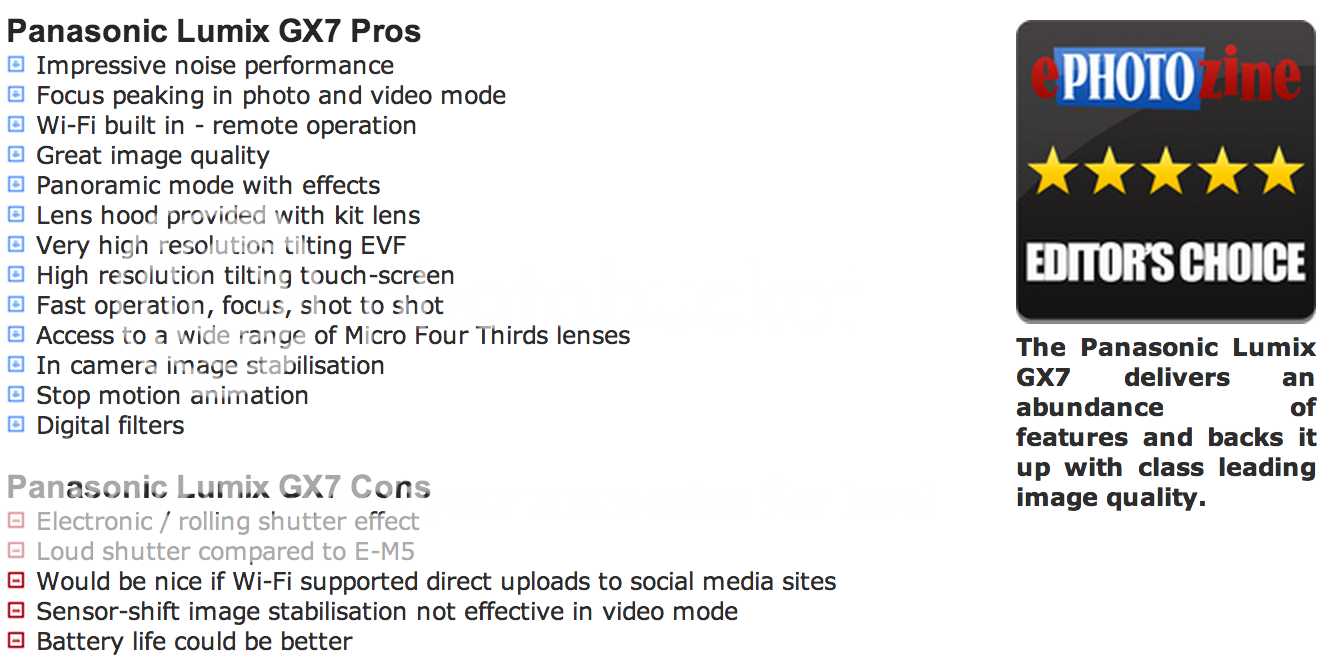
And finally the first Panasonic GX7 review has been posted at ePhotozine (Click here). They also posted the first RAW files (but how the heck open them?). The conclusion is:
The Panasonic Lumix GX7 introduces a truly unique experience thanks to the tilting electronic viewfinder, and with a new sensor the camera delivers excellent image quality, with particularly impressive noise performance beating the previous class leader at high ISO settings.
Great cam. Let’s hope the new E-M1 has some surprise we are not aware of yet. Otherwise it’s the Panasonic that will that run as best new MFT camera.
GX7 preorder list (Click on store name to open the GX7 price, specs and preorder page):
Silver GX7 body at Amazon US, BHphoto, Adorama, Samys, Henrys and Wex Deutschland, Wex UK ,and Amazon JP.
Silver GX7 with 14-42mm lens at Amazon, BHphoto, Adorama, Samys, Henrys and Wex Deutschland, WexUK.
Black GX7 body at Henrys, Wex Deutschland, Wex UK and Amazon Japan.
Black GX7 with 14-42mm lens at Henrys, Wex Deutschland, Wex UK.
Black GX7 with 20mm lens at Henrys, Wex UK and Amazon Japan.
Silver GX7 with 20mm lens at Henrys, Wex UK and Amazon Japan.
173 Responses
Raw ISO files:
http://www.techradar.com/us/reviews/cameras-and-camcorders/cameras/digital-slrs-hybrids/panasonic-gx7-1168602/review/4#articleContent
. Doesn’t the ¨loud¨ shutter issue get nullified by the Silent Mode ?
Besides that point the review was solid and to the point, it’s nice to see reviews slowly appear with positive conclusions, it seems the GX7 IS THE REAL DEAL. I’m sure the new OMD will be better, but the GX7 isn’t supposed to compete with that camera, they’re aimed at different types of consumers. I personally see no appeal in the high end OMD, I have no 4/3 lenses, I loathe big DSLRs and have no need for such a best of a camera either, so, TO ME, the GX7 is the best MFT camera (in my consumer demographic). The $900 for the GX7 is about the limit I’m willing to pay for a M4/3 camera, anything beyond that should be spent on lenses, so the E-M1 is way out of my league.
BTW, when is Olympus supposed to come up with new E-PLs and E-PMs models ?
Didnt they just release the e-pm2 and e-pl5 this year? isnt there only new camera for the rest of the year the em-5 successor?
They released them in September last year, that makes them almost 1 year old, the E-Pl3 was released June 2011 so that corroborates the 1 year cycle (no wonder m4/3 bodies loose so much value, for those few who care at least), so all in all we’re pretty close to the end of the P-M2 and PL-5 cycle as well. Although with the introduction of the E-Pl6 (a slightly improved E-PL5) maybe they’ll wait until beginning next year, which IMO is kinda dumb because they’ll loose their chance to sell intro level cameras at Christmas and will be left with the uber-expensive E-P5 and E-M1, which no doubt will help very little to improve their profit margins by themselves. Moving EXCLUSIVELY upwards in the mirrrorless market is a mistake IMO, they still need to penetrate the market at the base level, they only need to do Marketing in the West, that’s all. They try to apply the same strategies as they do in Asia (female consumers, mostly) whereas in the West they need to emphasize the tech specs and virtues of m4/3 to the male audience.
I don’t believe Olympus should upgrade the E-PM2 or E-PL5 until there is a legitimate reason to do so. This accelerated cycle for upgraded cameras has lead to poorly executed cameras with little differentiation, and rapid depreciation. What features would you want from an E-PM3 or E-PL7 that the current models don’t already have?
Not the same!
Like the GX1, they’re both P&S bodies with clip-on EVFs. It’s okay in a pinch (I have a GX1 and LVF2), but clearly none are in the same league with cameras with integrated EVFs.
Still, they are not P&S.
“The $900 for the GX7 is about the limit I’m willing to pay for a M4/3 camera,”
Unfortunately, it is $1000, although given that NEX-6 is a direct competitor, body only should be $600-650 now.
” anything beyond that should be spent on lenses, so the E-M1 is way out of my league.”
Isn’t the $1500 price just a rumor at this point?
“BTW, when is Olympus supposed to come up with new E-PLs and E-PMs models ?”
They just came up with E-PL6 a few months ago, not available in the US though.
I see your point, and the GX7 seems to be a likeable camera. On the other hand, when talking about lenses, there’s still the problem that many of the existing MFT lenses are either too slow or too mediocre or both, often too expensive to boot, and that there is not a single decent telephoto lens beyond 150mm. That, and the fact that I do own some lenses for the FT mount, will make the coming MFT flagship the first serious MFT camera for me, even if I really do like the concept and the design of the GX7.
Solution: http://www.rainbowimaging.biz
RAW file comparison:
GX7 at ISO-25600
http://mos.techradar.com/art/cameras/SensitivityTable/Panasonic/Panasonic%20GX7%20Sensitivity%20Table/RAW/Panasonic%20GX7__i25600_.jpg
E-P5 at ISO-25600
http://mos.techradar.com/art/cameras/SensitivityTable/Olympus/Olympus%20E-P5%20Sensitivity%20Table/RAW/Olympus%20E-P5_i25600.jpg
The GX7 has more chromatic noise but retains noticeably more detail.
More detail than what?
One of my earlier posts is not showing up somehow.
Here is the same scene with the E-P5:
http://www.techradar.com/us/reviews/cameras-and-camcorders/cameras/digital-slrs-hybrids/olympus-pen-e-p5-1150234/review/7#articleContent
Thanks…..I will take a look at these when I am at my computer!
Doesn’t look to me like a trustworthy test. The Panasonic file isn’t noise-reduced at all, while the Olympus file is massively noise-reduced, whatever they say about being RAW or not. That would already account for the detail difference, but then the Panasonic file even shows a smaller field of view and thereby enlarges detail more than the Olympus. Sorry, I fear the comparison isn’t really worth the while…
EP-5 are just JPEG files and I mean the JPEGs out of the cam. I did an extenseive comparison and this was clear alomost immediately. My EPL5 has not nearly got that kind of clean images 🙂 They made an error.
Just use the GH3 as a comparison as it has the same sensor as the EP5. Now, the way techradar compares means that it is still not clear. You can see the exposure on teh GX7 is somewaht different (seems a bit underexposed) compared to GH3 or G6. Also: the distance to the objects is somewhat different and it is not helpfull. Still it seem very clear that the GX7 is clearly better than G6. G6 is much noisier at higher ISO. But also compared to GH3, althought the difference is much smaller I think the GX7 beats it by may be 1/3 of a stop or so. Would have been nice if they would have kept things identical so we could be sure.
Also, when I look at the colours especially of the woolly balls (for knitting) the colours on the GX7 seems more natural. In the red, somehting strange is going on in the GH3 one on the lefthand side. Somehting I also note once every while with my EPL5. The GX7 does not seem to do that. But it is al preliminary of course.
Agree
I think that the file from e-p5 is not a RAW file.
They must have some mistake.
Yup … they goofed. I am looking at the page again and I am pretty sure they linked the same set of jpeg files twice (both in the jpeg and the raw section)
Darn it !
http://www.techradar.com/us/reviews/cameras-and-camcorders/cameras/digital-slrs-hybrids/olympus-pen-e-p5-1150234/review/7#article-comments
I know there is a contingent on here who will see superiority in the GX7 image, because they want there to be, but the difference is just sad.
Theres also a contingency who admit seeing it. Equally sad
Theres also a contingency who wont admit seeing it. Equally sad
“particularly impressive noise performance beating the previous class leader at high ISO settings”
If confirmed, this is great news!
The conclusion “noise performance beating the previous class leader at high ISO settings” is inconsistent with the content which seems to indicate (at least for relevant ISO (1600 and 3200) that the EMS is at least on par… and considering the OMD has been out for 1 year, as good as the GX7 is, well really, this isn’t earth shattering. I’ll buy it to upgrade my GX1 but it is worth keeping a cool head on all the hype.
“The ISO range goes from ISO200 to ISO25600, and the lowest ISO setting can be extended to ISO125. Compared to the Olympus OM-D E-M5, the GX7 images at ISO125 and ISO200 show smoother results, with slightly less grain visible, although the E-M5 shows more fine detail. Noise results at ISO400, ISO800, and ISO1600 are very similar, however with the E-M5 retaining slightly more fine detail. This is the case at ISO3200, where noise results are very similar, although there is a slightly higher level of noise in mid greys from the GX7. Again at ISO6400 results are very similar, with both cameras smudging detail. At ISO12800 image quality from the E-M5 deteriorates, and at ISO25600 the images from the GX7 show better results”
Thank you for this quote. You are perfectly right: probably the two cameras are hitting against the same technological wall. The sensors have more or less the same SNR, and the rest is processing.
What is new must be sold and therefore the advertising lines. But if a camera is ‘class leading’ and another is class leading, which is ‘class class leading’? Those expressions make no sense at all – LOL.
Yep. I wish the companies spent less money on marketing hyping their product and presenting facts as this remains a great cam…
well at least the megapixel race is over, which is a good thing.
The camera you just recently picked up, is no more “Class Leading”.. Get over it, it can still take nice, overhead sniping pics that you love to take.
Stop coming here in these posts, trying to justify your recent purchase.. its cool, the EM-5 is still a nice camera, take pictures.
Ehm. how do you spell 5-axis IBIS?
And you are, Sir?…
🙂
Ehm. how do you spell 5-axis IBIS?
And you are, Sir?…
🙂
Ehm. how do you spell 5-axis IBIS?
And you are, Sir?…
🙂
Ehm. how do you spell 5-axis IBIS?
And you are, Sir?…
🙂
I really don’t understand why so high ISO questions are relevant… 99,9% of pictures I see on M43 Flickr stream are shot in sunny days! In my case, I use mostly short and fast lenses (12 to 28mm) and even in dark conditions I never go over 800 ISO 1/30s.
IMHO the most important is the capacity of the new sensor to manage the amplitude between high and low light : the Dynamic Range. And untill now it’s the most difficult for little sensors as M43 are.
High ISO allows you to use faster shutter speeds. If you shot at ISO 3200 instead of ISO 800 your 1/30s shutter speed would instead be 1/120s. If you have anything moving in your picture, it wouldn’t come out as blurry.
There are plenty of times I use high ISO during cloudy days to get shutter speeds of 1/2000-1/4000 in order to minimize motion blur.
Thanks for the photographic lesson, but I will keep my slow speeds when shooting 🙂
If you have seen those night-scape shots with beautiful milky way showing up – these shots were usually done at iso 6400 or higher. That’s the only way to make sure the startrails don’t smear and that there is enough light to capture all of them in a shorter exposure.
Hummm… there’s a best option : the tripod
Tripod makes no difference when the world is moving…
Please read properly the comments. He was speaking about short exposures
It is you who needs to go back and read properly. S was saying that using high ISO and a short exposure helps to prevent the states from becoming blurry or trailed as they would in a longer exposure. A tripod well only help to keep the camera stay, it won’t stop the stars from moving. That is why astrophotography uses higher ISOs, and wider apertures with the shutter speed being an important factor in getting the result you are after, be it sharp stars or trails.
Ugh…please comprehend what I said, and the person you were responding to: “That’s the only way to make sure the startrails don’t smear and that there is enough light to capture all of them in a shorter exposure.” I literally mean that the WORLD is moving, and therefore so it your tripod. High ISO is helpful to capture this image to keep shutter speeds short enough to prevent smearing. High ISO is where the conversation started and the scenario outlined in the post you were responding to is not relieved from requiring high ISO by using a long shutter speed or by using a tripod (which I’m sure the poster is already using).
I definitely agree: there are some arguments for high-ISO (as seen in the comments below) but for the very most photographic situations µFT has a more than accurate output. I never use higher ISO than 1600 which is fine with the e-m5. For me much more important was the much more higher dynamic range they offer with the new sensors. So I see only little limitations compared to bigger sensors right know. If I want to play more with depth of fields (which I can also do well with my 25mm Voigtländer by the way) or do sports with super-high shutter speed or at least consider myself to be a pro-milky-way-photographer, I should use a FF-camera.
Asa always: no one can tell you where you should look at in a camera. hence the enormous choice we have. For some, the iPhone is good enough. Other still love their Fuji F30.
However: if you want to shoot sports indoors (especially), the high ISO is badly needed even with a very fast lens. If you want to shoot anything in less than ideal situations that moves, high ISO is nice to say the least.
So ti depends. I shoot lightning, I shoot tornado’s whenever I get a chance. Aurora borealis and noctilucent clouds.
Also. in the Netherlands we are already so far to the North (about 53 degrees) that winters become really dark. The sun is so low, that the best light can be described as a long morning from 12-14 o’clcok. 5 days a week (work) it is noght when I arrive and night when I leave to home…The snow helps, but some winters there is not so much of it. In short: in winter I badly need higher ISO!!
I fyou live in sotuhern europe or the USA (bar Alaska) and especially closer to the equator, you do not have this additional problem I think.
Geko: All cameras are compromises. Most every camera these days needs to do a lot of different things well. High ISO shooting is just one of those things.
Even if you don’t need it, you would rather buy a camera that is capable of doing it.
RAW file comparison:
GX7 at ISO-25600 –> http://tinyurl.com/jwlklmy
E-P5 at ISO-25600 –> http://tinyurl.com/jvft9gh
(The GX7 has more chromatic noise but seems to retain noticeably more detail at those levels)
The 14-140mm review is even more impressive.
http://www.ephotozine.com/article/panasonic-lumix-g-vario-14-140mm-f-3-5-5-6-lens-review-22632
Well Steve, that is a significant improvement over the original 14-140, especially in corner sharpness and at both wide and max telephoto settings but also improvements in center sharpness at all tested focal lengths. (I compared against their original 14-140 tests). Smaller, lighter, well controlled CA (at least when used on Panasonic bodies). I had the original with my old GH1. The original was nice but not great, with soft corners and reduced sharpness at telephoto and wideangle. This new one looks like it would make a great street lens. Also has the latest Power OIS instead of Mega OIS for improved stabilization. Only real shortcoming is that it is more expensive, but probably worth it for the improvements in Image Quality.
Wow that looks even better than actual zooom lenses (40-150mm etc)
WOW!…that looks totally off topic!
Thanks for pointing me to this. If this test is accurate, then this lens is good enough to stay permanently on my camera – fantastically consistent performance, with no major vices at all. Extraordinary.
” Class leading image quality ”
I want that camera & have pre order it .
” Class leading image quality ”
That is the words I’m waiting to hear .
I want that camera & have preorder it
Me too, I waited years for these words to replace my camera.
Use these words to make art out of it and sell it for class leading cams!
Compared to their recent review of the E-P5 the GX7 looks like its a stop worse in high iso. Although the exposure of both tests seem to be more in favor to the E-P5. Im actually dissapointed, I hope this is only because it’s not a final production model.
http://mos.techradar.com/art/cameras/SensitivityTable/Olympus/Olympus%20E-P5%20Sensitivity%20Table/RAW/Olympus%20E-P5_i1600.jpg
http://mos.techradar.com/art/cameras/SensitivityTable/Panasonic/Panasonic%20GX7%20Sensitivity%20Table/RAW/Panasonic%20GX7__i1600_.jpg
These are the RAW samples FYI
I don’t understand their review. The noise levels of the raw files from GX7 are a lot worse than that of E-P5. If that’s because of the v0.3 firmware, then it’s not fair to GX7 and it’s pointless to show them. Besides, how did they develop the raw file? Is there any raw developer that is supporting GX7 already?
Sorry, but look at the Oly “RAW” files on techradar and then again on those on dpreview. Say: EPM2. Even without it it is very easy to tell that these are not unprocessed RAW files. I have the EPL5 and the images, fortunately, are not nearly as clean. Someone has cleaned up these images and with it, as can be expected, the detail.
Best to compare the GH3 samples as GH3 uses the exact same sensor as EP5. There seems to be little difference and indeed, at the highest ISO (in the range where no one cares actually, but anyways) the GX7 does seem to do a better job.
Terrible as ussual I will not buy I will sell all my lenses a d just back to canin after the gh3
What don’t you like about the GH3?
Just curious.
To noisy the colors are terrible like all panasonic very very poor low light performance
The m4/3 models using the newer sensors are basically on par with Canon’s current aps-c sensors. Canon is due for a henerational leap in sensor quality, and they need it.
Thanks. I bought my GH3 based on my good experience with a couple of GH2s. All three are used principally for video, and have done well in low-light videoing, using such lenses as the Pany 14mm, Oly 45 and 75. The new Sigma 60mm also does well. As far as stills are concerned, I don’t expect them to compete with the top dSLRs, especially full frame, so it’s not an issue for me. If I’m just going to shoot primarily stills, I will grab my OM-D (because it’s smaller, among other reasons). I just sold a nice Sony A77 due to lack of use, but, of course, it offered great stills.
Hmmm… comprehensive review of the GH3 just posted on Imaging Resource doesn’t seem to agree with you…
Don’t feed the trolls!
Will it fit under your bridge?
Weren’t you gonna do that weeks ago?and what stellar canon model are you yonna get? Cause the 20mp 70d is already noisier than an em5
+100
Don’t get me started on the colour noise and softness from the 70D. Look at that hideous noise.
http://web.canon.jp/imaging/eosd/samples/eos70d/downloads/04.jpg
http://web.canon.jp/imaging/eosd/samples/eos70d/downloads/08.jpg
Canon should let Sony make their sensors for the 7D II.
WHY is the IBIS not effective in video mode… WHY
otherwise instabuy… grrr.. almost the perfect camera
panasonic will probably enable the ibis in video thru a firmware update later. well, hopefully they will, to maximize the camera’s features..
Hera, Panasonic IBIS patent:
http://translate.google.com/translate?sl=ja&tl=en&js=n&prev=_t&hl=ja&ie=UTF-8&u=http%3A%2F%2Fegami.blog.so-net.ne.jp%2F2012-04-16&act=url
If you are good at these tech, you find out why Panasonic can’t add the effective IBIS on movie.
+1
2-axis ibis really isn’t suitable for video. They don’t have it enabled because of poor performance. I doubt that they’ll be able to sort this out in firmware.
True..the IBIS on my EPL5 is nice in stills and completely worthless in movies. You seem to need 5-axis (or some vastly superior 2-axis version if possible) to get a steady movieshot. Oly is far aherad here and it has to do with them and there endoscopes. panny does mnot make these, so technical knowledge really does help and is not easily replicated.
This is not be a production model yet so I don’t see why they reviews until they have them. Previews fine. But from pre production model
Gx7 Raw are still noisier after 400 this could change on production model. To me a lumix gh3 shooter their is no clear winner.
The gx7 way better video mode codecs(then the ep5,not nex system) don’t even have to see it that’s just a lumix given, better grip, has view finder that moves nice battery/tripod attachment point. Some type of ibis which has they have not explained much other then saying ibis. The best wifi mode on a camera right now well maybe tied with the go pro since update
EP5 5 axis ibis this is huge huge for photo and video especially since it works with non native lenses. Especially for video, attachable mic attachment, for $240 more a more bulky but bigger better viewfinder. As of per production better raw noise performance. Ep5 has the bulb mode that allowes you to build a shot.
If raw noise gets better in production model I still think its close. Just depends on which features suit you more. I am very torn I want the ep5 ibis, mic attachment and bigger viewfinder for video but I know the gx7 wifi and video codec will be better. The ep5 bulb building shot will be huge for my style of stills, but the remote wifi if anything like the gh3 can be just as useful. The new nex7 is said to have wifi and 5axis ibis and bigger viewfinder as much as I would hate greeting a Sony I will have to wait.
Exactly…somebody left a comment at ephotozine regarding firmware used for the review. No response untill now.
All GX7 preview/reviews used a firmware smaller then version V0.5.
So where the heck did they got a production firmware?
Even the review is quite positiv, looking at the sample pictures….I would not buy the GX7. Missing details…colors not accurate….WB OFF
For me the best (pre)review about the cam was released on youtube (ralfsfotobude)
I’ll wait and see…untill then by G3 is still taking pictures 🙂
Scientists aren’t even sure if individuals see colour exactly the same way so someone’s slightly off white balance could be someone’s perfect white balance…
Another thing ALL micro four thirds cameras give you the tools to quickly and easily adjust your white balance on the fly as you shoot to suit your taste…
In some multi white balance scenes it can be quite tasteful and useful for composition that the white balance isn’t ” human eye” accurate across the whole of the scene…
The jpegs out of the GX7 look like CRAP compared to the year-old + OMD. The Panasonic makes a nice physical package..but Oly is the hands-down winner with the image processing if Panasonic is struggling to keep up.
Actually, it is really easy to measure white balance by placing colors on a reference chart. Color is a very much individual taste, but hitting the cameras white balance will give you the best average saturation of all the colors, which allows for more flexibility during post processing. Not that it matters, since RAW retains all the information and few people post process jpgs.
The best compositional white balance is done out in the field while you are shooting…
Adjusting the white balance at home on the computer some weeks later after you had been shooting on the day in a multitude of white balance scenarios is just as dumb as a artist painting a watercolour from a photograph.
In the meantime while your cooped up “adjusting” is fixing/ rescuing the white balance I’m either marketing my business or spending time with my family 🙂
You can use FastStone Viewer to open Panasonic’s GX7 RAW files.
Yeah, though not perfectly, I think. If you turn off auto white balance in the settings, it seems like the program can’t read the default WB settings from the GX7 correctly.
I also tried UFRaw, which can open the files but with a little strange contrast.
So then I opened the raw file with a hex editor and changed the two occurances of “GX7” in the metadata to “GX1” and then the Adobe DNG Converter accepted it, but couldn’t make a proper DNG file – the whole picture was magenta. o.o
Capture One 6 was now able to open the file, though, but I guess it also corrects any problems with contrast or white balance in the case that it can’t read the GX7 raw format 100% accurate.
Oh, I didn’t notice the “use camera white balance option, if possible” option in the FastStone settings. If I enable it (and have “automatic white balance” disabled), FastStone correctly displays the color for the raw file that I changed to identify as the GX1 in the metadata. The original raw files still have wrong colors, though.
Be patient fellas. Wait for full reviews of the production models and think carefully whether the review makes sense or if it is self contradictory. Usually the “verdict” the reviews of the image quality are based on the jpegs not RAW unless it is specifically mentioned. If you don’t know the exact DETAILS of the shots like what version of firmware, what lens was used, aperture, shutter speed, base NR, base sharpening,… you won’t know what you’re comparing. Different sites use different test criteria plus the sample variations of preproduction models are all over the place.
Extremely interesting performance data:
“Shutter Response 0.05″
Excellent.
“Wide – Focus / Shutter Response 0.175
Full zoom – Focus / Shutter Response 0.175″
Is it with 14-42 II? Fantastic.
“Panasonic 20mm f/1.7 II ASPH. 0.5″
Here is the proof that it is not as fast as other lenses.
“Switch on Time to Taking a Photo 1.1
Shot to Shot without Flash 0.4
Shot to Shot with Flash 1.0″
All good.
“Continuous Shooting – JPEG
(shots before slow down) 5.3fps (63 shots)”
“Although unfortunately the Panasonic 20mm f/1.7 II lens was not as quick at focusing.”
Not decisive, but disappointing to hear.
I think they are referring to the AF system of the lens.
I am waiting on something earth shattering…this is not it…look at the ISO 3200 image…lots of noise…call me when the noise is gone and the detail retained
U will need new camera cuz panasonic s ks
Could you recommend me a good clean camera then? I have a a77 and a nikon d7100, both noisier than em5 and gh3 at 3200 and up. So what do you recommend?
noise ninja.
People, just stop being idiots for a moment. Or better 2-4 weeks – when we might have at least beta quality GX7 support in RAW converters.
All the images we have now are either OOC JPEGs or hacked RAWs.
That is also why WB is off: GX7 WB information is simply not supported yet. Ditto noise and moire of the new – as of yet unsupported – sensor.
Why oh Why no IBIS for Video !?!?
Many cameras with IBIS turn them off for video, Olympus did on all their models until recently. I’m not sure why, but the IBIS mechanism might produce too much heat for extended use, or it might produce too much noise that will be picked up by the microphones, or the result might simply not look good.
After reading just disadvantages, nothing new, so GX7 is winner for me. If louder shutter is same like in GF3, it’s ok for me, I like it.
The built-in image stabilizer only provided a one stop advantage with the new 20mm Panasonic lens???
My thoughts as well. Probably a stupid comment by the reviewer. Even old E-PL1 has two stop IBIS, while all other PENs should compensate three stops.
Well, this is the first time ever that Panasonic uses a sensor-shift image stabilizer. They have no experience in that field, so it’s expectable that it won’t be very effective at the outset.
Not true!
They use this tech for camcorders.
Just fanboys here just check the new nex 7 specs + new nex ff coming fuji ….. And evenpentax. M43 is dead just old ppl. Use it asian girls also this system is fail
Okay, I’m an old person, and yes, part of the reason I use M43 is that I get tired carrying around heavy cameras and lenses. You know what? Someday YOU will be old too (if you’re lucky) so,don’t laugh!
You are right ! 🙂
To be fair, NEX aren’t heavy.
Link to examples of your photos please so we can see your superior images.
I’m waiting with baited breath.
Hmmm. I’m not going to sweat image quality with non-final firmware… overall it seems to be roughly on par with the E-M 5 and that’s good enough for me. But… the shutter is noisier than the E-M 5’s (silent mode isn’t a total answer since it limits ISO to 3200) and IBIS performance apparently is well short of of the Olympus standard. Kind of makes me question if I’ll be really gaining anything over my E-M 5 aside from built-in WiFi… wondering if I should cancel my preorder… oh, well, still plenty of time to decide that, since I’ll be surprised if Panasonic delivers on time!
From what I am seeing this “new” camera has nothing on the OMD in the image quality/processing arena. The GX7 is a sexy package…but there is no useful image-quality advancement over the Oly’s.
I see no reason to just keep shooting with the OMD…I own a GX1,too…and the images compared to my OMD (jpeg and Raw), always seem a bit anemic. I know that is not scientific…just my experience.
Compare with GH3. Not that it changes your opinion a whole lot, but at least we are comparing RAw with RAw here and GH3 = Sony sensor. At higher ISO’s especially above 12800 the GX7 edges ahead when we look at noise etc.
Idepends on what you shoot, but 1/8000s shutterspeed seems nice. THE EVF seems very nice with true adobe RGB colours. The tilting EVF it self: nice. It is smaller, more compact. With IBIS, OLy lenses become more usable while my 20 mm 1.7 will likely not band on it as it does on my EPL5 at higher ISO. Butdepend son how well it works (IBIS). IBIS+ no more PF: that is new to me. Video IQ is in a complete other department too. No comparison with OMD, it is way ahead.
Som ethings, like Focuspeaking are very nice for MF lenses. Sweeppanorame can be nice for landscapes etc. Inbody HDR: another gimmick may be, but can be nice aswell.
An important thing we do not know is the DR. I see no reason why it would not be better than Oly’s sensor. GH2 had 11.6 eV and at least the noise etc on this cam is much better than on my GH2. The enhancements made in the sensor and in the mirrors are said to affect DR too. If they gain one stop, they are slightly better than Oly.
Oly has Weathersealing. that is a huge advantage to me! But other than that I can see people chosing this over OMD or NEX6/7. If you already have such a cam, I would probably not switch either.
“the shutter is noisier than the E-M 5’s (silent mode isn’t a total answer since it limits ISO to 3200)”
Not only that, but also artifacts in moving objects.
” and IBIS performance apparently is well short of of the Olympus standard.”
1 stop of stabilization (see review) vs 3-4 stops for Oly (claims of 5 stops are exaggerated in my opinion).
” Kind of makes me question if I’ll be really gaining anything over my E-M 5 aside from built-in WiFi…”
You can get WiFi in E-M5 with an EyeFi card, but why? More like losing – weather sealing and 5-axis IBIS.
” wondering if I should cancel my preorder… ”
You have preordered GX7 having E-M5? You have a bad case of GAS my friend. Unless you are a sports shooter and need PDAF, the next worthy upgrade of E-M5 will MAYBE be in 5 years or so, with GOOD (not like Sigma now) filterless multilayer sensor with global electronic shutter. GX7 is not even close to that.
What you gain compared to E-M5 is a different form factor which will suit some people. You also get Panasonic’s AF which IMO is somewhat easier to configure and work slightly better on moving subjects.
You also get Panasonic’s menusystem and control which I find better than the Olympus one. Of course you loose a lot too like battery grip, weather sealing and better IBIS, it all depends on which features are motst important.
I selected the E-M5 over GH3 (mainly because of size and IBIS), I’m not sure I’d select the E-M5 over GX7 though. But then on the other hand, the new E-M1 is probably launched by the time the GX7 is available in the stores and then we can have the discussion again…
I don’t think the Olympus claim of 5 stops for IBIS is necessarily an exaggeration. I have taken very sharp shots at night at 12mm 200 ISO with an exposure time of 1.3 seconds – hand held.
If you take the old rule of thumb for the slowest shutter speed for hand holding as being the reciprocal of the lens focal length, then 12mm should be 1/12 as the slowest shutter speed.
To get that shutter speed I would have needed ISO 3200 – ie four stops faster. As I am not even sure I couldn’t do better than 1.3 seconds, 5 stops might well be possible, and if not for me personally, then almost certainly for someone with steadier hands than I.
“If you take the old rule of thumb for the slowest shutter speed for hand holding as being the reciprocal of the lens focal length, then 12mm should be 1/12 as the slowest shutter speed.”
The old rule of thumb was made for 35mm, so it would be 1/24s.
But it also was made for old unsharp lenses/films, about 1000 lines per picture height. On a modern sensor with a good lens, you would hope for 2000-4000 lines, so reduce exposure time further by the factor of 2 to 4, requiring for the 12mm at most 1/50s of exposure handheld, if not 1/70.
Of course with all those high-res sensor and lenses, plus rising importance of video, a good IBIS is more important than ever, and in-lens OIS not stabilizing for rotational movement (or translational – but this one important for small subjects only) does not cut it anymore.
In that case, I would have needed ISO 12800, which is 7 stops.
So Olympus’ claim of 5 stops is conservative! 😉
Id like to see that wonderful photo. I don’t believe you for one second. ..1.3 seconds…ja!
Seeing is believing: http://www.solidfiles.com/d/84ce68c89d/
Check the Exif data.
And a 100% crop from the original just to show it’s adequately sharp: http://www.solidfiles.com/d/2806e4d04b/
But what about Dr? Noise reduction okay, but Dr should also be on par with em5. Because Sony will show later this year that Panasonic is still one generation behind.
And loose all details
Wow im impressed no Canon Aps can touch this as usual. Canon is cannot for me !
Just look at some outdoor pictures shot with a Canon entry-level DSLR. Colors are perfect, the brightness and sunny day atmosphere are perfectly captured.
Now look at some outdoor pictures shot with a Panasonic or even a Sony (even the pictures from the review). The pictures are lifeless and appear to be shot on a cloudy day instead of a sunny day. And you can’t fix this in Lightroom, I tried.
There is really no competition between Canon and Panasonic.
And this is coming from a former NEX-5n and RX100 owner !
There is truth to what you are saying…(I own a GX1, OMD and a Canon 5DIII), but I believe that the images out of my OMD (I only shoot raw), are a cut above the Panasonic sensors. They are not at the level of my Canon…but very solid. There is something very “flat” going on with the Pany images…they are kind of anemic or something….I agree.
You must be doing something wrong, and/or learn how to use Lightroom.
Yes, lightroom can do a lot.
Sony files are lifeless? That’s a new one.
“Just look at some outdoor pictures shot with a Canon entry-level DSLR. Colors are perfect, the brightness and sunny day atmosphere are perfectly captured.
Now look at some outdoor pictures shot with a Panasonic or even a Sony (even the pictures from the review). The pictures are lifeless and appear to be shot on a cloudy day instead of a sunny day.”
What you meant to say is that your Canon has poor dynamic range so you always shoot in in high contrast mode, while Sony sensors can make details in shadows actually visible even on a sunny day, just like Canon can do only on a cloudy day.
“And you can’t fix this in Lightroom, I tried.”
Try harder, it is called contrast. 🙂 You don’t have to do it in Lightroom either, all cameras have contrast setting and high-contrast modes premade for you.
probably just jpeg engine. Pretty sure you make it just as u like in lightroom, its real easy
Why cost Panasonic Batteries always a fortune? And really mad: I was owning the G1, Gh1 and now the Gh2, all this cameras use different batteries, means when you need to buy a spare batterie you need with each camera a new investment. And let us remember a batterie for the GH2 did cost 1 year ago still100 bucks! In opposite, the Olympus E-1 , e-3, e-5 When you bought a battery for the E-1 in 2003 you could still use this battery in the E-5 !
Yes, well Olympus batteries are not cheap either. And alway sthe same tech means that they will never get any better. Paansonic GH3 battery gets you vastly more pics than the GH2 battery gave you. So it is not always just a downside.
Oly batteris: 49 euro for my EPL5! 1150mAh. So I bought two OEMs from POland, 1600 mAH (remains to be seen if they actually are 1600 mAh, but okey) and these costed me 20 euro or so. For both, including shipping costs. I also bought OEM batteries for my GH2. Also not expensive at all (I think 13 euro or something similar) and they are okey. Not as good as the originila but there is not much in it. Only anoying thing is that the cam will not show battery status. I have two spares now and I think that is inexpensive and enough.
You always knew they’d use the same sensor!
I’d wager the next 3 cameras from Olympus will use the same sensor from the EM-5.
The details have to be there in the first place.
About high ISO comparison:
– The difference between GX7 amd EM5 is so small it will not be noticed in real photography
– High ISO used to be crucial a few years ago but today all enthusiast/pro cameras handles this excellent – not much to discuss.
– Personally I prefer some noise and more detail over in camera smudging
RAW is NOT a neutral read out from the sensor. It includes in camera processing. The code is more important than the sensor.
GX7 looks a great camera – but maybe too late….
I can’t open the images in Lightroom so bit pointless posting up RAWs
Yea… I’m not sure this would warrant an upgrade if you already have an OM-D or E-P5 or more recent Panasonics. Photo wise, stick with what you have, I doubt you’d see any real difference,if any, if you know what you’re doing. I’m sure the new Panasonic sensor is just as fine as the Olympus. 1/8000 shutter isn’t worth $900, get an ND filter for a few bucks or stop down the aperture. Other than that, the external camera design will be the main deciding factor. All the other stuff is just little nuances that you may favor.
If you’re doing a huge upgrade from an older model or starting new, then yea, maybe look into the GX7 or the Olympus models, new or near future. If you’re into video I’m sure the Panasonic’s will favor you.
Other than that, really it’s basically Panasonic-Video/photography or Olympus-photography and occasional non-hardcore videography (minus 24fps or 60fps).
“wouldn’t* warrant an upgrade”
Oh, and remember the Olympus has in body video stabilization for any lens.
Panasonic…No.
unless focus peaking a big deal (which it is for a few of us) other than that, sure u are right, no need to jump or feel bad about not having the latest. Feel good
theypaiduszine loves everything they review and gives everything 4-4.5 stars.
Iso-test Pictures: very strange colors…
The best is that: Pros: Lens hood provided with kit lens 😉
What is with all those people pondering if this is worth “upgrading” from an E-M5?! Your camera is just one year old, why would you need to consider updating if it’s not for the Wi-Fi? It seems like many think this is the big question – “is it worth replacing my OM-D?” I think that’s ridiculous for a top-class camera that is just one year old. Why do you think you’re supposed to make comparisons for upgrading reasons when the camera to upgrade is not deprecated in any way or any feature or spec? (Again, besides the Wi-Fi, but not everyone needs that.) And why assume that Panasonic is targeting E-M5 users?
If the GX7 is not significantly different to the E-M5, that is not a reason to complain – neither about the GX7 nor the E-M5.
The GX7 has a much different feel/shape than the EM5. Just as much people that like the EM-5, there are those thatprefer a range finder-styled body like a Fuji or the GX7.
There are still a large group of GF1 users, mostly professionals that were waiting for this camera. They liked the EM5, but didn’t like the ergonomics or the small, rubbery button feel.
Panasonic made thus camera with them in mind. I expect them to sell a lot of these, along with the 20mm… its the return of the GF1 and the whole mft discussion all over again..
Well, if all you need in a camera is style/location of viewfinder, then E-M5 is different. Otherwise, it is a direct obvious competition.
Unfortunately, it’s not a true GX1 upgrade – it’s 40% heavier and somewhat larger. As such, it’s a huge hit from the point of view of lightweight backpacking and seriously diminishes the benefit of m/43 (if you don’t take lenses into account, of course).
Only an insane person can say something like this. You sir, what you need is a compact.
So I have a package that weighs 1700 grams with my lenses and now it becoems 1800 grams? And that defeats the purpose of mFTs? Not to me.
You obviously haven’t met any lightweight (nor ultra lightweight) backpackers. Shedding 40% weight means you carry 6kg instead of 10kg. Only by being consequent in picking the lightest equipment you can get to the state were moving fast is comparatively effortless rather than heavy work. Don’t get me even started about high-altitude trekking… Even taking into account lenses (a kit and 20mm), it’s 650 vs 500g. 150g is about 1000 calories, almost a half of day’s rations. I have considered compacts, but the like of XZ-2 or LX-7 are not that much lighter (300-350g) and image quality is considerably worse, not to mention being a much worse investment. It seems I will be carrying my GX1 for a long time to come.
I can imagine the Panasonic marketing department being really worred about their drop in sales to ultra-light backpackers – it may drive them into bankruptcy!
If going light is such a high priority, why are you carrying a camera at all?
I mean, if size & weight is larger than NEX despite the bigger sensor (including FF in the future), and every new Panasonic camera is bigger than its predecessor, what are the advantages of m43? Currently its a better line of lenses, but it’s changing and if the rumored CZ 16-80 f/2.8-4 and 50-135 f/2.8 will really see the light of day in September, I will consider switching.
I thought the popularity of GF1 showed there is a niche market for such cameras, even if most customers want DSLR-esque design and “reassuring weight”, whatever it is.
+1
The GX7 is a very attractive camera in appearance so it will probably be in the running for someone looking to acquire a current sensor tech camera with a viewfinder. However, in no way is it an ‘upgrade’ over an OM-D, it’s just an alternative.
I personally tend to buy a camera and use it until there is a very significant reason to buy something else. My previous camera I used for close on 20 years before I bought something else.
Better would be to upgrade with good lenses – so Olympus, give us some nice zooms 😉
Yet, 90% of the posters in here are negative about the camera.. Hahahahaha!!!! I tell my friends how much of a joke it is here.. the bias against panasonic is so bad here, its on pathetic levels!
This site even gets joked upon in groups on flickr and DP REVIEW! That speaks Volume of the opinions stated here! I myself find it Hilarious reading some of the comments! I’m gonna start reposting some of the more ridiculous, negative comments on flickr, dpr and mu-43 for jokes!
Keep ‘Em Coming! They’re entertaining in other forums!! Hahaha!
??
I haven’t counted the number of positive vs negative comments about the GX7. But it is definitely not 90% negative in this forum — one would need to be lacking in arguments to come up with *that* claim…
—
I’m happy with my OM-D. And I find a lot to like about the GX-7. Right now, I don’t feel an urgency to upgrade. That may change, of course :-). If so, I will wait until the GX-7 and the new Oly have been thoroughly tested and evaluated in serious tests.
—
Some things I’m curious about with the new cameras are low light AF, tracking AF, boot time (I’ve lost some pics due to a little long boot time on the OM-D), etc.
In summary: I find a lot to like about the GX-7, and will of course also consider new Olys. Maybe I’ll stick with my E-M5 one more generation. I find the forum relatively balanced wrt the number of positive and negative fanboyish (or: childish?) claims. Which is as boring as those of the “trolls”.
This forum is as balanced as a triple meat bacon hamburger with a diet soda
Will Leica sell it at 3x the price?
Leica don’t sell mFT at any price
That’s very easy to work-around: glue the lens in place. And 4x the price. Done.
But they do sell various Panasonics at grossly inflated prices. This one looks like made for it, not with the 20mm, but with the Leica-branded 25/1.4, and maybe with the Leica-branded 45mm/2.8 macro too.
RW2 files can be opened fine with Faststone Image Viewer.
It even gets the WB correctly.
Hope they add IBIS to video. I have been waiting for a M43 camera with focus peaking and IBIS during video. Could be a firmware update or hack later.
canikon better even pentax panasonic color suk
suk color even better pentax canikon panisonic
Yes because we can reeeeeally trust your amazing intelligent opinion based on your great grammar
“The electronic viewfinder […] isn’t as fast at updating as the OLED viewfinders as used in the G6 and GH3.”
…strange. What are refresh rates on G6 and GH3?
That would be a major downer if GX7 has 60fps refresh rate.
GX7 has a differnt type of EVF, same tech as used in the G1 where each point display all colors, but only R, G or B at a time which I’d guess slow down the real refresh rate somewhat.
Of course it slows down real refresh rate, exactly by the factor of 3.
What might suck incredibly. Say nominal refresh rate is 240 fps. 240/3 = 80fps. 80 is better than 60, but not as good as 120. And IMO 120 is about where should be the minimum.
You assume that it’s a direct correlation between sensor output rate and EVF refresh rate, but that’s not neccessarily true. I’d of course like to see high refreh rates, but other factors like blackout time and delay is much more important than the refresh rate IMO, at least when the rate is past 50-60 Hz.
@peevee: The change in real refresh rate don’t have to be 3, actually it could be the same. Panasonic could drive the GX7 viewfinder at a rate that would refresh all three channels at the same rate as the GH3 viewfinder. I don’t know what they actually do, but it’s probably dependent on the spec of the display. They could also sample R, G and B from different frames which would mean that the “real” rate is somewhere between the rate of the display and the sample rate from the sensor, a bit like interlaced video. It would also explain why you can get tearing on these type of viewfinders.
Omd vf better than gh3 fact. So vf in gx7 sucks 🙂
The review lacks resolution charts.
Though I typically use them to see how bad AA is is.
Found them:
http://www.techradar.com/reviews/cameras-and-camcorders/cameras/digital-slrs-hybrids/panasonic-gx7-1168602/review/2#null
It is part of TechRadar’s hands on preview:
http://www.techradar.com/reviews/cameras-and-camcorders/cameras/digital-slrs-hybrids/panasonic-gx7-1168602/review/review
OOC JPEGs seem to be OK, bur RAWs have pretty heavy discoloration. Will see how ACR would handle that.
Wonder if Panasonic would add (possible?) support for sensor shift stabilization for video in future firmware updates???? I’m definitely getting the GX7 once it reach 950 street price to replace my 3 years old GH1, which my SC is close to 100K already. with sensor showing more and more vertical bending line on iso1600 onward.
Even if Panasonic did add that via a firmware update, it is never going to be even close to what Olympus’ 5 axis IBIS can do.
And we all now that what Hollywood and the video pros want is ibis.
yet better than nothing at all!
It may not be better than E-M5 (just different), but for me at least the ergonomics of OM-D were not perfect and I was not willing to pay the asking price for it as ergos are the primary selection factor for me. GX1 *looks* like it would suit me much better, so I will probably purchase it once they start shipping it and some better reviews are out (and when someone confirms that the new 20mm doesn’t cause banding on oly’s bodies). Nobody expects you to dump your E-M5 or E-P5 for it, but for those of us who don’t have it, it’s a very interesting alternative.
Now, I wish that GF1/GX1 concept (smallest possible weight and size with sensible amount of controls), which sold me to m4/3 because of it’s trekking/travel benefits, will be revived by either pana or oly…