









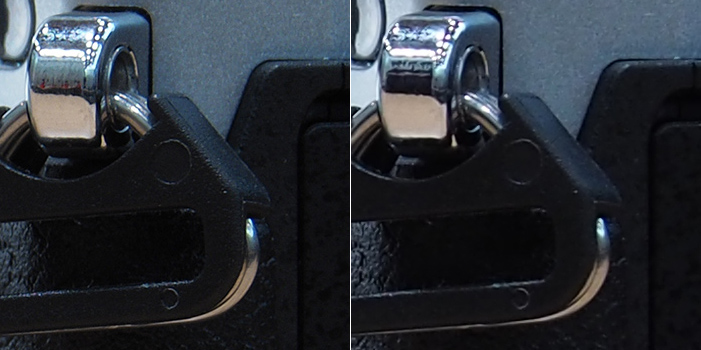
Dicahub posted that interesting comparison between the 40MP and 16MP images shot with the E-M5II:
The image on the top shows the 40mp original image downsampled to 16mp (on the left). It get’s compared with the the “normal” 16MP shot you see on the right.
The image below goes the other way around: shows the 40mp original image (on the left). It get’s compared with the the “upsampled” 16MP to 40MP shot you see on the right.
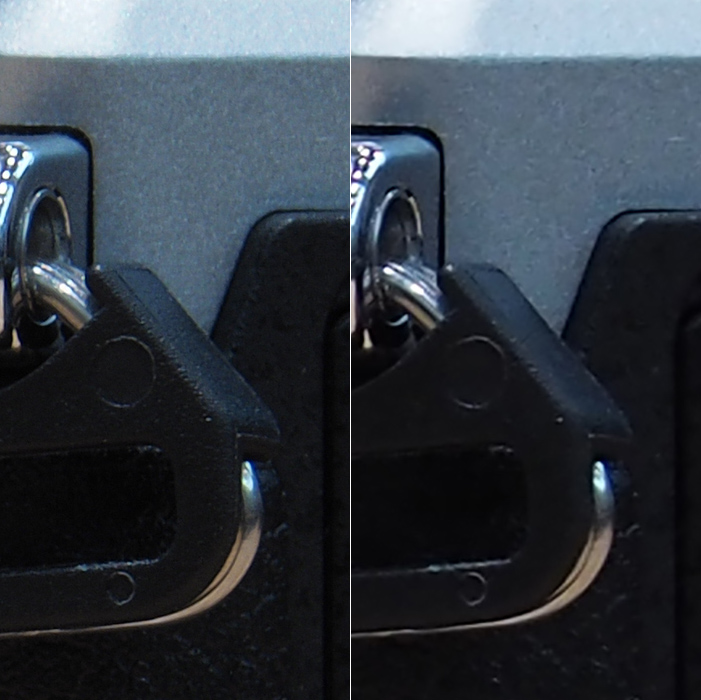
The original full size images can be found on Flickr.
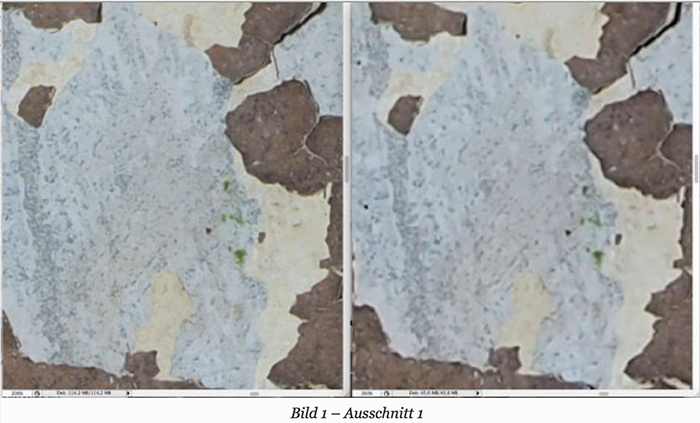
And also the German site SystemKameraForum posted a couple of images like that crop comparison:
Preorders (if you preorder through those links you will support 43rumors…thanks!):
E-M5II in Black at Amazon, Adorama, BHphoto and GetOlympus.
E-M5II in Silver at Amazon, Adorama, BHphoto and GetOlympus.
E-M5II In Europe at AmazonUK, Jessops, WexUK, Namencolor.
14-150mm II lens at Adorama, BHphoto and GetOlympus.
FL-LM3 Flash at Amazon, Adorama, BHphoto and GetOlympus.
Olympus ECG-2 External Metal Grip at Amazon, Adorama, BHphoto and GetOlympus.
Olympus HLD-6P Battery Grip at Amazon, Adorama, BHphoto and GetOlympus.
HLD-8g at Amazon, Adorama, BHphoto and GetOlympus.
E-P16 eyecup at Amazon, Adorama, BHphoto and GetOlympus.
HLD-8G and HLD-6P kit at Amazon, Adorama, BHphoto and GetOlympus.
Full leather case at Amazon, Adorama and GetOlympus.
Olympus PT-EP13 Underwater Housing at Amazon, Adorama, BHphoto and GetOlympus.
Olympus Stylus Tough TG-860 at Adorama, BHphoto and GetOlympus.
112 Responses
These look really good. If I had a better justification then “I can shoot landscapes with much more detail when I’m hiking”….
I thought that once. After a while I ditched my film compact SLR and its heavy lenses and got an auto-zoom 35mm compact that slipped into a pocket. Btw 35mm is a compact film size (not full frame, that’s 10×14-in)
Hiking: never carry anything heavy that you don’t need.
A lot of FF DSLR are only 18Mp, m43 is a lot smaller body and lens to haul. You can get the same quality of picture, just won’t print the size of a house. Who prints pictures?
Dinosaurs like me! 🙂 ok, not that often, given the cost and the lack of space in the house, but I still think that a printed photo has finally come to life.
The low MP FF cameras tend to be specialist tools for ultra high ISO like the A7s or specialist sports models like the D4. Most FF cameras fit into the 23-46mp range and Canon has a 50mp on the way with rumoours of Sony doing the same.
No, the smaller sensor will give you worse pictures, even with superexpensive lenses. This is a known fact, but I like to cross the ts for the hapless readers.
My GAS already expired 🙂
And what about that 7-14/2.8 huh?
😉
Different story: I need a better wide angle lens than Pana 7-14, and the Olympus guy I talked to months ago assured me that it will stand the Pro label written on the lens. 😉
About the stacked pics: a good thing to show off some landscape and still life shots to pixel peepers, but I am a little bit sceptical about 1-RAW workflow of files on Lightroom (need a plug in?) 2-people who asked me so far for products/food photos usually don’t want to “play” with the file: they want the finished picture: I can take a macro if I need a close up or an enlargment of a detail.
Good to see this option, but I think few people will really use it.
Different thing for those into video: the upgrade looks interesting (but I don’t shoot video).
Don’t be so sure that a faster Ollie will be better glass than a Panny, that has not been so in the past.
For example the relatively cheap Panny 14/F2.5 has glass as good as the best, beating the nearest Ollie and equalling the best Nikkor; from £120 used 😀
Lens speed is not so important when we have ability to shoot at telephone number ISO. If you must have bokeh then stand closer.
I never wrote that the MZuiko7-14mm will be better than the Panasonic sibling because of it’s wider aperture.
I simply wrote that I need a better wide angle lens, better than the Panasonic 7-14mm.
Its main issue is the exagerate purple and green fringing at borders, and the purple spots issue next to light sources (be it the sun or artificial lights or candles). On Olympus bodies these flaws are hardy solved in post production, and not always I can turn a photo in B&W.
Actually, for estate photography this is a problem, at least to me: not always I have control over light sources.
For that kind of photography I usually stop the lens down to f5.6 and use a tripod.
I’ve only very rarely noticed purple/green fringing with my 7-14, but I’ve never had an Olympus body. It’s weird how even though these systems are supposed to be completely compatible, things like this push people toward one brand or the other anyway. I guess it’s a good thing that you’re getting your own 7-14 that’s made to specifically work with Oly bodies. I wonder if that will cause any issues on Panny bodies…
I imagine this is caused by the lack of some in camera correction that takes on in Pana bodies. It’s not a surprise, but I wished it was lesser noticeable in Oly cameras.
Another strange behaviour is that of the 25mm PanaLeica: if mounted on Olympus bodies it rattles like a snake when focusing under bright light on bright areas and shadow areas.
PanaLeica25mm purple fringing is normal for such a wide aperture lens. Even M mount Summiluces suffer from it.
Perhaps a better coating is what 7-14mm would need, let’s see how the MZuiko will be.
Then I misunderstood your comment, my apologies.
We may have a slight language translation problem.
The later Ollie bodies do have the Panny lenses in their lookup table (database). This I know. The old bodies such as E-PL1 can have newer Panny lenses added to the lookup table by updating the lens through the Ollie body. And vice versa; Ollie lenses on Panny. Use the “Joint Update Service” here
http://av.jpn.support.panasonic.com/support/global/cs/dsc/download/fts/
This enables in-camera lens correction.
The better lenses such as the Leica models need no correction and don’t fringe. I have myself successfully realigned the objective lens in my 100-300 which has sharpened it up rather nicely. Fringing is worst with extra-long lenses.
Zoom lenses are always compromised, to get a better lens we have to use a prime; this may apply to you fringing problem.
I’ve yet to notice the Ollie PRO matching the non-PZ X-lenses, certainly not the Leicas. Going back fifty years, Ollies lenses were favoured for fashion/glamour photography because they were slightly soft and warm. I do not hold out much hope that the promised Ollie wide angle zoom will be better than the current Leica-designed Panny 7-14 X-lens. In performance tests that cheap and “nasty” Panny 14-42 kit lens out-performs all the other zoom lenses in its length except the non-PZ X-lenses and the PRO-label, the Ollie 14-42ED comes bottom of the class. Go figure.
Go on Flickr and spot just how many Ollie backs are fitted with Panny lenses.
This is like christmas for us (few) who scan negatives with SLR.
Theatering and 63mp RAW-files…
That’s a really good point!
Just think if Olympus had built this technology into the “Air Clip” — you’d have an easy-to-use basis for a high-quality multi-format film scanner…
Very good idea.
I have used the 12-50 on an E-M5 to scan slides and that seems to resolve the film grain so I don’t think you need a higher res. Think this was Provia 100:
http://i1351.photobucket.com/albums/p794/An0nemu5/Forum/BBridge%20grain%20scan_zpsonsjmiex.jpg
Negatives and slides from SLR perhaps?
Using a digital camera rather than a scanner?
Just wondering because a decent scanner can do things like multiple passes and stupid resolution like 3600dpi
looks good but the subject could be better, you know with some small detail thats not textures…
As I have said, difference between 16Mpix and 36Mpix is negligent when using full frame. And it can be seen here as well.
To get difference really be worth, it is required to be 2x enlargement, meaning 16Mpix needs to become a 64Mpix. And that is why the RAW 63Mpix will be required to get that visible different.
Jump from 16Mpix to 20Mpix or 24Mpix would be non-existing, other than just as a number and illusion. And far more important before going up to 64Mpix, is good optics. But because Olympus has already great optics and now this sensor shift tech, the quality difference is there because it isn’t just about optics anymore but color mapping as well.
And consider this, 36Mpix -> 50Mpix is nothing in 35mm format. Nothing. It should be 36Mpix -> 144Mpix to see a difference and to get the difference. But we are then talking so high resolution photos that there is no sense ever shoot in full size. Just like with Olympus, 16Mpix is far more than enough for most prints and usages.
Preach it.
‘negligent’ should be negligible.
Not criticising.
whops…. 😀
And how did that happen…
Amen.
Depends what you’re doing with the file. If you are printing large then you would definitely be able to appreciate the difference. If you’re just posting online then the only useful aspect of this feature would be the ability to do drastic crops and still retain good resolution.
Or you’d get better acuity if you knew what you were doing when you downsized.
Printing large with 16Mpix isn’t a problem. I could take that 63Mpix RAW file as with that I can get something. 40Mpix JPEG I would use to just get better colors and avoid moire etc.
Study after study shows that you need a 15-20% gain in resolution for the majority of people to see a gain. The 16mp Olympus cameras would need to be 21mp to show that level of difference. The gain from 36mp to 50mp is 18%, by the way.
What about optics? How many current lenses can resolve 50MP on FF or 21 on 4/3? My rough estimate: zero.
Your rough estimate would be wrong. I haven’t really gotten around to trying to figure out m4/3 lens limits, but in full frame we’ve got plenty of lenses that’ll resolve 100 lppm.
Back in 2003 I did a long set of tests and calculations about APS. I concluded that we’d be fine with good lenses out through about 24mp, and that even with better lenses, above 24mp APS might not really produce visible benefits.
There are a huge number of variables at play, by the way. It’s not just the lens, but we have a second optical system atop the sensor itself. Then we have demosaic and output properties that come into play, as well. You’re looking at this message on a screen that probably has the following orientation of rectangular “pixels”
RGBRGBRGBRGB…
RGBRGBRGBRGB…
If you’re looking at a digital camera image on that display, it was produced with square “pixels” that were:
RGRGRGRGRGRG…
GBGBGBGBGBGB…
Thing is, if you don’t take ALL of the variables into account, you can’t actually predict where the breakover point is for usable benefit.
My guess is that we can go to 100mp on full frame easily and still see benefits out of most good lenses. m4/3 is a little tougher, because the lenses already have to be designed to higher standards for the smaller sensor size. I’ve never really tried to nail down just how much higher that is in practice.
Thanks for the explanation. However, if we look at it at the most simplistic level, 100 lpmm gives us a resolving power of 5 microns at the focal plane. Demosaicing and sensor optics would not make this figure any smaller. Furthermore, there is only so much optical glass can do, so I doubt future lenses will be significantly better.
The point is, 50mp on FF gives a pixel pitch of just a little more than 4 microns (120 lpmm). 100mp would reduce this to 2.9 microns (roughly 170 lpmm).
Please explain the discrepancy.
I was under the impression you would still gain some resolution with more megapixels, just not possibly the full amount.
For instance a poor lens on 16mp sensor may resolve 4mp and on 64mp sensor it would still resolve double (8mp).
As this was just ‘an impression’ I’d be interested to know if I’m totally wrong.
I am not an optical engineer, but common sense dictates that the whole system would be as strong as its weakest link. Thus, given “infinite” resolution on the sensor side (e.g. in the case of fine grain emulsion) the amount of detail is limited by the optics. I don’t see why digital sensors would behave differently.
On a side note, I assume you are referring to the “Mpix” measure used by DXO labs. I’m not sure that their methods are perfectly sound.
The formula would be something akin to:
1 / Resolution = ( 1 / Lens_Resolution ) + ( 1 / Sensor_Resolution ) + (
1 / AAFilter_Resolution ) + ( 1 / ImagingASIC_Resolution )
So, yes, resolution is dependent upon a CHAIN of elements, but it’s not exactly “as strong as its weakest link.” The weakest link will certainly influence resolution, though.
DX0 values are only comparable by in same format. As they do the conversions. You can’t compare DXO statics example m4/3 to APS-C or 35mm directly.
You may gain resolution. You will absolutely gain sampling.
Diffraction is a very good example of where those two things are important to understand. Diffraction is robbing you of expected resolution gains. Higher sampling is showing you the diffraction more accurately (and in some cases, moving us from not resolving it well to resolving it well).
The issue of “resolution” is really, really tricky. Most people don’t understand MTF, which is one of the ways we describe what a lens is doing. MTF, unfortunately, is a stand-in for resolution, as it really measures contrast, and some specific kinds of contrast, at that.
Did you remember that lp stands for “line pair”?
Yes, I did.
It is as well easier when you have short distance to sensor as light is easier to get sharper beam than if the distance would be longer.
It is same effect as with prisms.
http://www.sott.net/image/s7/142773/full/Prism.jpg
Now if you make a large sensor and you want same field of view, you need to place it further and you need larger pixels.
If you make small sensor, you need to make smaller pixels and place the sensor closer and you get same field of view.
So now if we add extension rings, we get longer distance. If we use teleconverter, we need to slow down the light again and refocus it.
Not if you print at the same size as with a larger sensor, because you will have to magnify the small sensor further.
I know all about magnification. Thank you.
Welcome. My feeling is that you know nothing at all, given the things you write and the pics you don’t post.
We will see benefits in MTF because total MTF is MTF(Sensor)*MTF(lens). Zeiss has documents for download showing measurements which prove that. The 100mp are usually only achieved at certain apertures, not affected by diffraction or chromatic aberrations. You would need a diffraction limited lens at f4 to get to 100MP resolution. There are FF lenses achieving that (My guesses are Otus, 135 APO, 300/2.8 and 400/2.8 and some others). But beyond a certain aperture you are limited by diffraction no matter how sharp the lens and wide open CAs take their toll.
Quite a few actually. Pre WWII lenses could only do about 40 line pairs. 80’s and 90’s glass from Canon, Minolta and Nikon…a good 140-180. More than enough such that you can still see advantages with higher MP’s. Plus, you loose about 40% of that anyway to mount and optical variances. 50 is probably more like a true 30.
http://i1351.photobucket.com/albums/p794/An0nemu5/Forum/Rezzzz_zpsalbf5rvr.jpg
And that is a FF lens from about 1987 on an E-M1. The Enlarged bit is a 100% crop. Still don’t think I have found it’s optical limit.
I would guess any of the Olympus Pro lenses would give you a noticeable visible benefit, the 40-150/2.8 in particular.
Yes… I can see the gain in those crops.
But please show me the studies that presents people to really see visual difference from 1m viewing distance when they look a 30×20″…
Sure human eye can spot “only” ~530 pixel per inch from 20″ distance, that is about 50cm. Now step back two times further and it is now just 265 PPI and step again two times further and it is just 132 PPI
Making a larger print makes depth of field shallower and image less sharp. Larger the print goes, shallower depth of field and you really don’t need high resolution to out of focus areas. And larger the print, further you need to look at it.
Or how about photos in computer screens? The most common resolution today is 1366×768 pixels with about 20% usage. You can throw as high resolution photos you want but you never ever get them see more details.
And how many has 10-bit display or even higher?
How many has color calibrated display to see colors, gradients and such correctly?
And how many has a HDR display to see contrast correctly?
We can make a 150x112cm size print from 16Mpix (4:3) and it looks just very sharp and greatly detailed
Then we can make same size print from opposite wall but from 36Mpix and it looks as well amazingly sharp and great.
And you can’t see the difference while standing between them in normal viewing distance (that is 2m meters for that size of prints). The DPI is just 80 vs 125 and when the print is made well (not the avarage or top home/office photo printer) it is very very small difference. You can even enlarge the 16Mpix by two without such a detail loss, but get little more sharpness for print.
But we are not shooting test charts, but photographs. Unless you of course photograph test charts.
This is written on computer display that has 157PPI (4k). I can get 1:1 over a A3 (297 × 420 mm or 11.7 × 16.5 inches) so I can easily view a print of the normally largest I would order as print on an wall, still looking great!
And that is just 157 DPI (DPI is for printers, PPI is for square pixels, pixels are easier to spot than dots) on 28″ (71cm) diagonal size, that will be viewed from 1-2 meter distance. And that is just a 8Mpix.
I am not photographing test charts, text or such things. It is very difficulty to spot the difference.
Example:
http://www.thewanderinglensman.com/2014/02/the-practical-difference-part-2-between.html
https://www.youtube.com/watch?v=QyrOo4DafL4#t=151
https://www.youtube.com/watch?v=7VHuY4cIrSk#t=134
https://www.youtube.com/watch?v=elevkKw7T4M#t=33
The difference before going to 2x is negligent unless you start heavily crop and really max out everything pixel peeping everything.
Even today the most important thing is the content, not the pixels.
You only need required level, and when you anyways exceed that required level, there is no benefits to add more as its useless.
The depth of field only changes if you vary the print size and fail to adjust the viewing distance. It will be the same, instead, at constant magnification (print size / viewing distance). As usual, there are no free lunches with small sensors, except price (and we haven’t even got that with m43, but this is a different story).
I hadn’t seen that short film before. It was really delightful, thanks for posting. And the point is well taken, that resolution, and equipment, have basically nothing to do with art. Some of us are just gearheads, though, and we find the stuff fun.
Well folks, those of us stuck at 16MP- feel good about yourself. Nothing to see here.
Nothing of import said here.
Terrible ain’t it, it’s like being stuck with a 62Mp full frame.
That’s not true and you are definitely blind. The 40 mp is clearly better in terms of resolution and noise. Just another troll like MrALLCRAP.
Can I watch 16mp files on 24* 4k monitor?
I mean such resolution, and low pixel density, will they pop?
Resolution of 16mp (4608×3456) is much higher than your precious 4K (3840×2160).
Ok Ty, I just pre ordered one of these new precious 4k IPS Dell’s P2415Q.
Can’t think why, that high a resolution needs to be blown up to over A2/poster-size to be seen properly. A monitor that size will just induce a pain in the neck. That size is intended to be viewed from across a street.
If you’re viewing at normal monitor arms length then there’s really no need to jam the pixels so close together.
A normal HD monitor will happily down-sample on the fly.
What is needed for photo work is a good monitor. Go over their specs with a fine tooth comb, dynamic range is possibly more important.than pixel count.
LOL, seriously a 24″ monitor? You must not do much multitasking. Ivan is excited to have a nice new monitor on the way, but go ahead and crap all over it, and keep using your little laptop monitor.
Correct. 🙂
One has to zoom in to “100%” to see actual resolution but you won’t peek at pixels until you go further still.
If you downsample to output, you get higher acuity. If that’s what you mean by “pop,” then yes. But the more you downsample, the more acuity gain you should see. So the 40mp file should look better than the 16mp file in terms of edge acuity.
Cool. As I am really enjoying the crispness and details of 2K resolution on my 10 inch iPad Air 2, 4K on 24 inch should probably give same wow effect I expect, with low pixel density .
Why stop there? Get that new 5K iMac, images on that really pop.
I would like too…but it’s way out of my budget atm.
As someone who take product images used for both online web shops and in print (magazines and even posters), every little bit of detail and resolution increase is great. I think this will make my product shots crisper and I will be able to enlarge them more then using my org e-m5. Happy days 🙂
I have tried to open the 64Mpix raw file provided by IR (still life scene) with RawTherapee and it look soft: I think that the reason why Olympus need a special plugin for the 64Mpix raw development is because it really requires some special processing the get the max out of it.
I can in any case confirm that by resizing the 64Mpix extracted tif file to 36Mpix and adding a bit of sharpening the results are very good if compared with the D810: perfect detail, no oversharpening halos (as the ones visible in the 40Mpix jpg) and no moirè on the green part of the bottle label or in the red swatch.
I think/hope we will be pleasantly surprised when the 64Mpix raw file will be officially supported in ACR with the proper dedicated process. Very very nice. 🙂
I would like to see the difference between this and the software solution photoacute. That would be interesting.
Give me 8 RAWs (taken with the mechanical shutter), I’ll give you an answer.
A question I’d like to have answered is whether the electronic shutter significantly degrades dynamic range (as in the GH4/GX7/GM1/A7s which all decrease colour depth to have a faster readout and decrease rolling shutter effects) or not (as in the GH3 which has almost the same dynamic range, albeit with quite pronounced rolling shutter effects).
First pass observation: yes, but in a weird way. Dynamic range is reduced, but noise is low. That seems like a contraction, but the multi-sampling is helping with the noise propagation.
You meant contradiction, right?
Thanks, it’s obvious that it does use decreased colour depth for multi-samples, if only to make the read time faster, with little adverse effect as the multi-sampling helps get back at least part of the dynamic range.
I meant in “normal” mode.
Dynamic range isn’t lower but higher because true colors by each pixel and it makes flatter more accurate colors.
Define dynamic range please.
As Thom as put it before me, yes.
An electronic shutter always results in in higher readout noise, and higher noise brings a typical direct consequence: less shadow detail, thus less PSNR (which translates to IQ).
OTOH, since they are supersampling (getting multiple reads for the same pixels) that noise gets cancelled by the averaging of frames.
So, in simple numbers, 4X the resolution would need 4x the exposure, for similar per pixel IQ. But we have 8x the exposure right? So we have netted a 1EV advantage to cancel out the readout noise increase. Is it (not)enough? I really don’t know, but looking at the results, I wouldn’t be surprised is it ends up even.
The moral of the story doesn’t get far from this: You get similar PER/PIXEL IQ at twice the resolution. Isn’t technology great?
Higher IQ per pixel as each pixel is multi-sampled by every color (RGB). It isn’t adding more pixels alone but sampling by colors too.
If look carefully it’s not quite like that. It would be true for a 16MP output because indeed every pixel would be sampled for all colors. Twice in fact.
But since they induced half-pixel shifts, not every half-pixel is sampled on all channels. That would mean a 2EV advantage (4x the exposure with RGRB sampling). In practice, you only gain 1EV from 8 exposures.
That goes to counter act the increased readout noise.
This however is a very simplified approach. The demosaicing implementation has a decisive role in this, as some people have found by inspecting the sharpness of the 63GB RAW.
Why should electronic readout result in higher readout noice?
More circuits operating (electronic shutter) = more sensor readout noise.
” (as in the GH4/GX7/GM1/A7s which all decrease colour depth to have a faster readout and decrease rolling shutter effects) ”
As far as I know that does not apply to the GX7, which has slower rolling shutter.
I’m a little confused by “The image below goes the other way around: shows the 40mp original image (on the left). It get’s compared with the the “upsampled” 16MP to 40MP shot you see on the right.” Can someone please explain what the unsampled 16 to 40 mp shot means?
scaled up
Some people insist that the smaller image must be scaled up to the size of the larger image and other people insist that the larger image must be scaled down to the size of the larger image, 43 did both to avoid people asking why it was not done; thus it is asked why it was done …
aha, thanks for the explanations
I suppose some might be enormously interested in highly detailed, aliasing-free rendition of static subjects. As to myself, I am hard pressed to think of anything more boring. I find 16MP more than enough for what I shoot, but each to his own.
What I really want to see is whether many serious product photographers will jump at the E-M5II. My guess: no. They will rather stick to FF despite the false colour issues.
I shoot reproductions of art work, mostly combinig 3 to 6 shots stitching with Autopano Pro. I will now buy the E-M5 II for that, and use it in combination with the sharp FT 50 mm Macro. I made comparisons this morning with the high res imaging-resource files of the E-M5 II and the files of the Sigma DP, which I upscaled with PhotoZoom Pro 5. The IQ of the E-M5 II file is clearly a lot better. In theory the new High Res function of the E-M5 II acts similar as a 16 + 16 Mpix Foveon sensor!
Yes, architectural photography is famous for being boring! And half of the boring artists I know shoot static subjects… To each his own indeed.
A lot of creative people heavily work on their pics in PP. Perspective correction lowers the sharpness, cropping eats your resolution.
If you start with a 63mp image with low noise, you have plenty of ‘headroom’ for PP and still end up with a decent resolution. Not very useful for family snaps or wedding pictures, but useful for a lot of photographers still..
Hope I didn’t bore you too much!
As a product photographer who already uses m43rds for a host of reasons I am very excited about this.
The elimination of moire, reduction of shadow noise and addition of detail make this a huge boost. Never mind 40mp, reduce to 28mp and provide images to clients full of detail and artifact free.
If you are not shooting large prints, will not do a lot of post processing, and do not need to do any extreme cropping, 16Mp is more than enough for you.
Larger than 5ft (1.5m)?
Yes! Try to imagine what viewing distance you need to watch a photo that big.
Yes. At least from 1m. And quality is awesome.
Like consider this: take a full frame from 16Mpix m4/3 and print it in size where one pixel is one square millimeter. Now you have 4.6×3.4 meters size photo where each pixel is 1x1mm size. To view that photo well, you need to step to about 5 meter distance. And that photo is impressive….
Heck, many does very huge (1.5m) prints from 8-12Mpix with awesome details.
Here is an old PDF from Hasselblad that explains multi-shot (for their 200+MP Cameras that use Sensor Shift Technology).
http://www.hasselbladusa.com/media/1664002/perfectshape.pdf
It shows the sort of photos one would take with such a camera, I am not sure they are either “exciting” or “boring”, would it be better if the photo were of a blank space. This guy gets $ for his Photos.
“Sensor Shift” is the “poor-man’s high MP Sensor replacement” that enables extra details to be recorded under certain circumstances (limited or no motion being one). The in-camera Algorithm is not as complicated and accurate as some expensive PC Programs that use far more than 8 photos to create a higher resolution image.
It only took a Firmware mod. to add this ‘trick’ into the Camera but I suspect it is a ‘gimmick’ that will be more popular than 3D.
Like 3D, time will tell; will this still be the next great thing in a few years or will Sensors simply be so huge (and binable) that Sensor-Shift seemed a desperate move. We will see.
Poooop….
Bad comparison. Transitions indeed look sharper but it’s not easy to tell if there are new details recovered in superres sample.
No point to compare 40MP with upsampled 16MP pictures. If you compare 40MP with upsampled 4MP pictures, you get even better result.
The comparison makes sense because both pictures were from the same camera using the same sensor. A 40Mp image from a point and shoot sized sensor will be much worse than a 4Mp image from a full frame sensor. The point of this comparison is to show that there is indeed a difference between 40Mp and 16Mp for this camera only. Other cameras in the past have been able to create high megapixel counts with no (or even worse) image quality than native resolution.
Everyone knows the 40MP picture made by the new tech should be better than 16MP picture. Otherwise what is the point for the new tech? I think it makes more sense to compare high resolution pictures with ones made by real 40MP sensors.
That’s the whole point. In the past, all the high megapixel “upconverting” and smart high resolution, etc… yielded very little gain, so a 40MP picture wouldn’t really look any better than a 16MP picture. This is one of the rare times that processing a 40MP image from a 16MP sensor actually yielded an improvement.
I.e. look at Sony’s “smart” digital zoom in their RX cameras. They claim they can digital zoom (i.e. crop) an image and then upconvert it back to the original resolution without much loss in data due to their smart algorithms that recognize edges and fills in the blanks. In lab tests of controlled shapes, it was pretty impressive. In real life images, it pretty much looked like a digitally zoomed in image.
Look at Panasonic’s new iZoom. It goes up to 90x Zoom and the transition from digital to optical zoom can not be seen:
https://www.youtube.com/watch?v=RUmrfjAhVrw&index=19&list=PLWa6uO3ZUweAsW8l7JLCmKfkGU1M9_ewS
I have used a 32* benq and a 27* Nec, which I sold recently.
I found 24* to be just perfect for my taste.
I apologize if that came across as a criticism of your choice, it was meant to be a criticism of the guy criticizing your choice. jefrs claims that you would have to view a 24″ monitor from across the street. That’s insane.
24″ is a great size for a monitor. On my desk at work, one of my 3 monitors is 24″ haha.
This extra detail could be useful for macro photography of static objects.
Next in camera focus stacking….
I’m waiting for someone to release a light field camera specifically for macro – everything in focus, always.
Shhhh…. You wake up the unicorns…
Everyone knows photo must be with lots of bokeyh!
Shhhh….
From what I hear, you don’t even need a camera anymore – just digital zoom with the iPhone and you’re done!
That’s a long way off! And, to my mind, it would take some of the fun out of it. For me, the meticulous attention to detail is a big part of what makes macro enjoyable.
There’s still plenty of attention to detail in the composition and subject matter. For me, the most annoying part of macro is either having to focus stack or deal with diffraction after f/11 with a m4/3 -sized sensor. Being able to position the subject any way I want and not worry about focus would be fantastic. Also, if you can just shoot at f/2, you don’t have to worry about having a portable sun to illuminate your subject 🙂
with macro diffraction kicks in much more early, than f11. Although all systems suffer from this, not like d800 and f22 will be much better.
I really don’t notice the diffraction that much at f/11 with my Panasonic-Leica 45 & GX7. f/8 is a touch better, but f/11 seems to be the best compromise between getting stuff in focus and loss of sharpness. Agreed, a larger sensor definitely has an advantage in this case. Not worth it to invest in a whole other ILC system just for macro, but I would consider a Lytro dedicated macro camera if it wasn’t unreasonably expensive (and didn’t suck :))
Yes, I agree. This has just about sold the E-M5 II to me. It would also be very good for high resolution focus stacking. Your subject has to be pretty still for focus stacking. The very high quality JPEGs would be ideal.
I’m surprised Olympus haven’t already developed in camera focus stacking for OM-D series. I’m sure putting in programmable focus stacking would simple be software, and could easily be added to firmware.
Dpreview has a comparometer up with the E-M5 Mark II. Seems like at least to my eyes and for their test pattern that the old E-M5 they used was unusually sharper most times compared to the E-M5 MII and the E-M1 which was the worst of all. Just seems curious that the older E-M5 appears sharper in this test and others I’ve seen. Of course there is real-world but the E-M1 doesn’t seem to fare well.
LOL you, I’m using a rather large colour calibrated desktop monitor but it’s only little more than HD, the next one up for lotsa money is the Samsung 4k.
24-in is small compared to poster size, about 3-ft by 4-ft, even a 12Mp can print that size and 16Mp can print larger still. Imaging sitting 30-in away from a 6-ft screen, then imagine trying to use it for work.
Something that size is intended to be viewed from across a road, not desktop distance.