








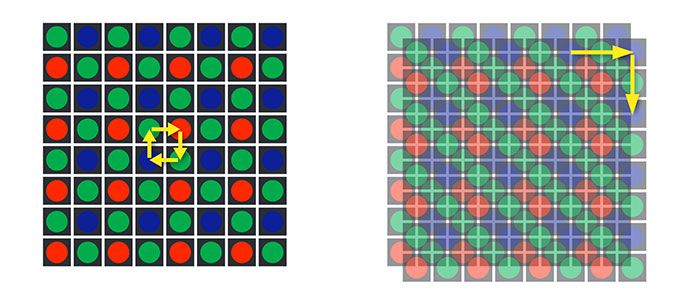
The Pixel shift tech from the Hasselblad H5D-200c. Something similar is coming from Olympus.
I am 95% sure that the latest info on the E-M5II are correct. The camera will be announced in early February and so far it’s rumored to have one single main fetaure: The camera has a 16 Megapixel sensor that can shoot up to 40 Megapixel by shifting the sensor (in up to 8 frames of single shots).
For the rest the camera didn’t change a lot from the previous E-M5 model:
Same E-M5 16MP sensor
Update processor (improves slightly the IQ)
No PDAF
Smaller design changes
Improved 5 axis stabilization
Based on those early and still incomplete rumors I ask you:
[poll id=”262″]
263 Responses
If it can deliver 1080p footage as good as the GH3/GH4 then I will definitely be buying one because of IBIS/EVF.
Without 4K it is DOA also for movies. All the competition will have 4K in at least one model, next year.
Yup. Olympus is looking too much like Canon with this lack of progression. It has been years since the original E-M5 debuted and this is all they can offer as an upgrade?Same sensor, same AF… I’m sure video will also be unchanged as Olympus has proven to disappoint time and time again. Even after all the recent 4K rumors and claims from management to dedicate efforts to video, we probably still won’t get 1080p at 24fps. This will be one of the saddest updates in recent times.
Actually, Canon has made nice innovations recently. Anti flicker, dual pixel af, remote shooting with a mobile phone, some excellent lenses… One thing are internet experts, one thing is reality.
Don’t forget the wildly popular EOS-M.
This is simply not true. I make a living from m43 cameras filming at 1080p and I imagine I will happily for the next 2-3 years. If the Mark 2 delivers decent 1080p and video controls a lot of film makers will buy one because the IBIS makes it an extremely handy tool to have in your box.
No significant improve. No. I won’t buy it. Why i need to replace an old em5 or a em10 with this one? Same sensor. em10 is already smaller. IBIS is already very very good and the best on market. Em10 has already a better processor than the original EM5.
I’m waiting for the first reviews and prices and then I’ll decide between EM5II and EM1. I was quite sure I would buy the EM1 in the beginning of 2015….but now I have to take patience.
The answer is No
I might have bought it if it had PDAF for FT lenses – and if I hadn’t just bought an E-M1. Before I’m going to sell my E-M1 for some other camera, something really big must happen. Actually, I expect to use the E-M1 about as long as I used the E-30, which was more than five years…
I will not buy it if these rumors are true. I have an EM1 and an EPL 6. I just can’t see buying a camera with a sensor that old. I will wait to see if an EM1II with a NEW SENSOR and sensor shift is on the horizon. There is a lot of completion out there…it’s heavy.. I am surprised that Olympus is releasing the EM5 with a sensor that old in the current market. It’s disappointing if true.
I meant “a lot of competition out there”. Damn spell check. LOL.
That is a huge disappointment on this EM5 successor .
After 3 years of wait still with this ageing 16 MP sensor .
I don’t see this EM5 successor going to be a hit as the previous EM5 in 2011 .
Not even stand a chance !
Not interested in a dying system, which still sells at premium prices.
Yet still interested enough to come here AND make a snarky comment…..
Obviously you are, because you’re reading this website and commenting. Liar.
Nobody is forcing you to buy Canon.
The em5 original is great in sharpness for print and with this new even better for large print. Can’t wait to see what’s inside….
22% voted for OMD full-frame camera…This means that a lot of MFT users or possible clients really don’t like the MFT system. If they want a full-frame camera there are a lot of models from Canon, Nikon and Sony.
http://photobyandrei.wordpress.com/
Yes, but perhaps they like the feature set and design of the OM-D cameras and cannot quite find the full mixture in existing full-frame cameras? So far, only one full-frame camera exists which comes close, the Sony A7II, and that’s only because they finally managed to include a decent sensor-based stabilizer.
Sony’s ibis is not decent…its better than nothing but not decent.
IBIS effectiveness is inversely proportional to the sensor size.
That’s the point, they don’t want Canon, Nikon or Sony FF because those companies suck. They want a Olympus FF.
Just look at the other companies: Canon cannot innovate but only rehash the same rubbish and cannot even make articulated screens or decent wifi, Nikon has no QA and everything from them could have serious flaws (Oil, white spots, faulty AF, etc.) and Sony treats cameras as a fashion accessory with horrible ergonomics, missing functionality and crap lenses.
Oly cameras are designed to be used by a photographer and people know that if Oly made a FF they would beat everyone else with superior ergonomics, awesome lenses and a camera that is a joy to use.
Not to mention that outside of Sony nobody has a FF mirrorless and in this day and age I certainly wouldn’t buy a FF mirrorbox clunker anymore. Sorry, but the good implemented EVF of my Oly mirrrorless has spoiled me and chimping just sucks.
When Olympus has chosen the path of FT/MFT they’ve stated why they took that decision instead of going digital FF. I doubt that Olympus has the financial means to build a mirrorless FF system from scratch. Olympus hasn’t the financial power of Sony. I’m afraid that those FF rumors will be to Olympus fans what the same rumors are for Pentax ones…
I think its an insecurity thing, fearing that if olympus isn’t competing with “full frame”, its going to lose the competition. Unfortunately many don’t see the m43 as a system alternative to other formats… but a “cropped”system from what SHOULD BE a “full frame”. Fuji X and m43 is its own format – the lenses are designed specifically for the format. No cropping is happening.
If sharp 40MP images are available handheld and allow me to crop aggressively if required then I would consider definitely. If it’s only really worth using in static subject, well lit and tripod conditions maybe not and I’ll wait and pickup a cheap e-M1 when available and consign my e-m5 to backup duty.
Since image stacking for resolution and noise can be done in software now, then if you really needed it you would have already been doing it. Why would someone see that as a reason to upgrade now unless they had more money than brains?
The Nikon D800 – D810 gets you this resolution now. The whole smaller argument is lost when one needs a tripod. A Em5 + Tripod is quite a bit larger than a D810.
It’s time to hop on the 4k video wagon. Olympus is trying to hold out but they need to get their ass in gear and compete with Panasonic. The GH4 is the serious front runner now. I’m still more inclined to get the GH4.
At least Oly did not take 5 year to come out with a cam we do not need, Canon took 5 years to disappoint their users (largely). So..kuddo’s to Oly!
You mean 7DM2 ?
Yes , they ( Oly & Canon ) can shake their hands together .
Canon have no interest to compete , they make cameras mainly aimed for it’s own fans .
Like for those like to stay in it’s fairy tale .
Yes the 7DM2….a very good cam of course and the same is true fro the 5DMKII, but offering so little after relatively so many years…
That’s Canon. They never innovate they just rehash the same old and stay behind the competition because the sheep buy their rubbish anyway.
You need to change your name to “Mr. Negative energy” lighten up Francis. Everything you write makes me want to slit my wrists. We are only talking about electronics. No need to act like there is a war going on.
E-M1 was quite an upgrade to the E-M5 so the current known specs of this E-M5 II fail to impress.
Hopefully, there’s still a surprise until the camera is released.
Yes…hopefully we do not have ALL the info about this camera. Let’s hope for surprises.
PDAF: Since Sony has PDAF in a midrange body, Olympus must add that feature too. In E-M10 II and E-M5 II. This is state of the art.
40MP: What is the benefit of sensor shift? I had it already in a casio camera, years ago. 10MP sensor and my movements were shifting it. Nice feature for nightshots. But rendering/stacking in camera was not that good as what a PC could do. So what is the benefit of 40MP pictures OOC??
Think i will drop that E-M5II and wait for E-M1II.
Your reasoning is flawed.
On-sensor PDAF with Sony is to finally fix the laggy AF NEX cameras have been notorious for the last 4 years with some tracking abilities (still has a high failure rate).
PDAF with Olympus is mostly for 43 DSLR lens support with the added bonus of extra tracking AF abilities. Single shot AF was already mastered by Panasonic years before (and refined later on) and Olympus caught up a year later with the launch of the EP3/EPL3/EPM1 and has been refining it ever since.
But outside of the Nikon 1 system, no mirrorless system is really that good with tracking AF. On-sensor PDAF helps but it’s not a silver bullet and not a match to the best DSLR PDAF systems. More R&D has to be done for mirrorless and state of the art is not good enough here.
The A6000 has very good C-AF. It has very good sensor, very good movieshooting, almost everything is good or very good. Main problem still are the lenses..still. But A6000 is very tempting for quite a few buyers. I guess a G8 panny this year with DFD must be the alternative to many people. Video is excellent too of course…Unlike Oly.
The A6000 has horrible ergonomics and lenses.
So far sony has always sucked at lenses and I don’t see that to change. And what good is a system with crap lenses?
No new sensor, no buy
Exactly .
In the analog days… you could buy a new camera and still use the same film.
I think a camera is more than just a sensor.
Even so, the processing of an old sensor’s output can be developed to reach new levels of performance, so the same sensor doesn’t always mean the same results.
Not that I need a new camera myself, but I’m still interested to see the reviews of this e-m5II.
Problem with your post is that old E-M5 is one of the worst camera that I have tested so far (I mean from an ergonomy point of you).
So yes they can use old sensor but ergonomy has to be improved signicifantly otherwise it’s a no buy for me.
References to film are irrelevant.
You can have better processing with RAW already.
I won’t buy it because I’m happy with the one I have (E-m10)
So far it looks like it will be just like E-M10 but with sensor shift resolution gimmick and battery grip option.
Hardly very exciting…
and 2 more axis IBIS, and weather sealing, and battery grip option, and accesory port…
I´ll buy it if it does the 40MP in RAW. If this is jpeg only it´s not very useful to me…Having followed Olympus for a couple years now, i doubt that this is available in RAW, they´ve always been very proud of their jpeg only features like Art Filters and stuff…
Good point…I hadn’t considered that a possIbility. You could be correct.
I mainly shot my E-1 in jpeg—it had the best jpeg of the time.
It wouldn’t bother me if it was a jpeg. If you are going to shoot for jumbo print enlargements, the scenario will be mostly under control anyways.
I hope Olympus doesn’t use this feature to compete for market share.
This feature it’s like key-stoning, it’s not for everyone. I basically take portraits and I won’t be able to use it. So basically I would have the same camera. Plus I have two E-M5, and I am very satisfied with the IQ, I am not going to switch because of one feature.
I would switch if I could get:
3 layer color sensor, or a perfect white balance hybrid technology (i waste a lot of time fine tuning white balance), or Kodachrome color profile, ( a real one with same exposure latitude and tone curve), low real iso, or a sensor capable of modifying local sensitivity within the image to increase dynamic range. These are real tools that make an impact on image quality. Putting a camera on a tripod and wait to take 8 pictures to get 40 mp sounds ridiculous.
Please one more thing, leave the friggin 1/8000s shutter for all the cameras.
You are my hero man.
I too have many troubles fine tuning white balance. Above all I do not like Sony sensor image processing at all (orange/yellow/magenta shift).
Olympus E-PL1 or my good old E-PL2 produce superior color images. Sadly they are too much DR underpowered.
Kodachrome, kodachrome Olympus please give us back that look.
Anyway if E-M5II does not change buttons feel then it’s not a machine for me.
Cheers
My favourite camera with best color rendition was E-P1, specially reds are rendered beautifully when sun goes down. I have the feeling that Olympus has shared with Sony their color rendition, I have been checking some Sony cameras within Photoshop using the eyedropper and they are more than close to Olympus color and they used to be as bad as Canon.
i was asking for a Kodachrome simulation and someone mentioned Exposure 6, so i am using that one now.
I wonder if it could be done with the colour creator… If “colour profiles” could be saved/edited on the PC and shared on the net, I’m sure it would expand the possibilities…
Of course many things can be done with PP, but I prefer to spend time with my camera than with my computer 🙂
Are u serious? Do you think you are getting a Kodachrome color with that? Ok let me give you an example:
Let’s get an Olympus, Canon and Sony cameras. Let’s shoot the ColorChecker target. Edit the images under Photoshop. Just hoping the whitebalance is the same in all of them, hue shifts are big enough to see what is CANON, SONY and OLYMPUS. You get a red hue of 340 degrees with Canon, 10 degrees with Olympus and 15 degrees with Sony (this an example), same for the rest of colors, and we are not taking into account different levels of saturation for every color patch that every manufacturer picks. Now let’s talk about the tone curve and dynamic range. Every camera has a different one. Apply the Kodachrome filter. Do you get it? I was working in a Kodachrome DCP color profile for Lightroom and believe me, it’s more than a filter. You need to shoot a individually measured Kodachrome slide with the camera, then you have to create a color matrix for that and then color correct every color patch, you have to adjust the dynamic range to get the same exposure latitude, it’s a lot of work and then you are not close enough because DCP color profiles suck! Don’t forget to shoot with a fixed color temperature, 5300K. That’s basically what I would like to get from Olympus. A real Kodachrome 64 perfect emulation! It would be even better to get a emulation of Kodachrome of 1940,50,60 ,etc… That’s the type of work I am talking about and in my opinion Olympus is the only manufacturer that can do that.
its still a simulation after all. Even if Olympus could or anyone that makes a profile. Kodachrome is so hard because the the whole film develop process was unique and very dificult to imitate even for a fanatic film process geek(one usa guy did it by analying the chemicals used for KC) KC is imo compareable with the famout tecnicolor procede, which made the saturated colors and other typical looks possible. In digital processing its ofcourse easier to manipulate, but to come up with a profile might be hard since every photo might require adjustments anyway
And I bet if people had internet back then they would dissect the issue and say that this lens or that lens is not optimal for perfect KC look!
The whole discussion on color film types is moot, now.
They are all just software filters with nostalgic and catchy names today.
For new gen photographers they don’t mean squat, other that they like it or not on the screen.
with all respect but Kodacrome deserves the fame it has imo, even when all we have now is simulation, it ineresting to adjust the preset to fine tune. Some people are very skilled in makin a custom look in color. Last time i tried to get a 4×5 KC film, only to find out that nobody cando the specific developing anymore.
If you guys buy an xrite target, you can shoot it with your camera, then download the free xrite passport and make a profile. It works particularly well with Lightroom.
Do not expect miracles, you won’t get a Canon sensor, but you will see a remarkable improvement.
Oly shifted the scale (for their 3200 ISO to look as good as APS-C 1600 ISO). Olys 200 ISO = real 100 ISO.
This is only a buy if the video recording options are finally expanded. There are several of us waiting to see if Olympus finally steps it up for video.
Don’t bet on it .
Cause it just not going to happen .
I’m not betting one way or the other. If they do, it’s a buy. If they don’t, I upgrade from the GH2 to the GH4.
think so too if the video section has been updated,the complainers who were wishing for the upgrade in frame and bit rates for the OMD line can proof it was really needed for them (though they actually just could have switched to Panasonic) and but the new model.
I’m looking at upgrading from the GH2. It will either be Olympus for the 5 axis IS or the GH4.
I won’t buy until I see some images and video samples.
Admin, has Olympus beefed up the grip?
Olympus chase the shrinking “I take photo only” market!
No, I don’t need it.
“Skip” approved .
So, how much does Panasonic pay you for this anti-Olympus campaign?
You definitely wrong on me . I’m more on specs to justify a camera if worth of upgrade .
Oly as per it’s track record just not good enough this time .
They come up EM5 in 2011 that really impress in m4/3 world but can’t do further afterthat ( if rumors are right ) .
If they keep the grip small artificially to sell more grips and if the price is close to 7DMarkII, then this is a big NO NO for me. My smaller NEX cameras have more comfortable grip then my EM5.
I have two NEX cameras and I will mostly pick my E-M5—but I would still like a better grip!
Here ya go!
http://www.jbcameradesigns.com/products/premium-wood-grip-for-olympus-om-d-e-m5
My E-M1 is serving me just fine and will continue to do so for a few years. So, no, I do not intend to purchase an E-M5II.
No new sensor, no buy.
Must have new sensor with improved image quality for me to buy.
That make sense .
“No Buy” Approve .
Maybe I am being a bit slow on the uptake, but I thought the sensor shift thingy ws there to improve mage quality?
may have improvement but is minor I bet . Only a new generation sensor can guarantee true & pure improvement in image quality .
The E-M1 is simply too good compared to this. A mark 2 will be a smash hit 3 years after the first one. One more stop high ISO capability and its perfect. Actually waiting for a digital XA with full frame sensor
Failing to innovate is bad, particularly when a product is far from ripe, and mirrorless are far from ripe still. Not buying, even at half price.
ehhm question; you ever tried a mirrorless? It seems some are already ripe.
Some photographers (fortunately) have higher requirements. Mirrorless is ok if small and cheap, but the shortcomings are not worth high prices.
fortunately i am not one of those
And how is this not innovating? First consumer system camera with a sensor shift technology…
You sound extremely unimpressed with EM5 successor .
Green light for “No Buy” .
I can only answer when all specs are officialy revealed
“On Hold” not approved .
Must decide buy or not base on whatever is FT5 .
somehow if find FT5 not convincing anymore, do you?
Let’s assume it is .
This site likely to miss out something that less important but unlikely to went wrong under FT5 this time .
So buy or no buy ?
as i said i wait before i answer this Yun lol
Come on . .. .
Don’t need to be too serious .
Buy because you love Oly , no way to put you apart from OMD .
No buy because you are not happy with the specs , you expect more , you want to see more option available .
It simple as that .
i think that description applies more to you, i am not into that tech that much as you, i am more into photography, simple as that
Definitely not.
I am surprised at the amount of don’t buy. The good side of the coming feature is that it made me think If I really need a Sony A7, since I am certainly quite happy with 16Mpx, and might use 40Mpx only for some landscapes,So perhaps I’ll play the game of lagging technology, and price is like the E-M5 is now.
Implementation of course is essential.
Like you I’ve been tempted by the A7 for landscapes. I am interested to see what this new technology will yield in real world applications. For me particularly I am interested to see if it will provide a noticeable gain for night photography. If it can match the capability of the full frame sensor at night I will be very surprised, pleasantly so but still surprised.
I am sure that you can do the same things by software. However if the camera is v. fast it’s a considerable time saving.
Seen your pics, I am amazed that you waste time writing nonsense here, instead of going out and learning the basics.
Seems you are them same troll of yesterday changing names. Poor sod, get a life.
Really, go out and learn. Click click click. Your folio is ridiculously bad, as much as you are rude and opinionated.
LOL … 🙂
You, PUNK, are the rudest person ever to post here. Your opinionated tripe fills nearly half of every thread. Whereas Amalric does post his pictures publicly, you have never showed us anything, although you have been challenged MANY TIMES to put up or STFU. You have never shown us one of your illustrative photos.
Pictures, you cannot show, but your moronic opinions never cease. So until you can show us your wonderful photography, just STFU.
You’re wrong. He doesn’t fill nearly half of every thread. I contribute a lot, too.
And… ?
Another internet expert.
If I would buy the E-M5 II depends on more specs than what is known. I can mention better EVF, improved buttons and much more
Had it included PDAF 4/3 glass compatibility I would probably swap out my E-M1 for it. Since it doesn’t I’m not interested.
By the way, something that would have made buying any OM-D, like my E-M1, much more of a no-brainer, was CUSTOMIZABLE AUTO-ISO (focal length multiplier, fastest/slowest shutter speed) and EXPOSURE CORRECTION (+/-) IN “M” MODE WITH AUTO-ISO. Both are things which should long since be a matter of course for a semi pro/pro camera that aims to have a complete feature set. (Things that ought to be added by firmware for a camera like the E-M1, too.)
they could release SDK, you could download different versions of software and customize and modify EVERYTHING
The E-M5II still has a lot of things/improvements to offer:
-better ergonomics (2×2 dial would be nice)
-hi-res EVF
-improved 5-axis IBIS
-81AF system (or sth new if they didnt implemented PDAF?)
-hi-res rear LCD
-WiFi
-the 40MP trick…
-improvements in video
I would welcome: faster flash sync (1/250th even for external flashes), reliable C-AF, longer battery life, better buttons (placement).
If your old EM5 breaks down you will be happy for his younger brother 🙂
And maybe if it’s not got all the improvements everyone wants Oly will make it a bit cheaper too!
Although now I’m thinking about the old lens-hood & lens-bag thing 🙁
isnt the max flash sync alsready at 1/250?
the 1/200th for external flash only, the 1/250th is for “internal” flash, the one paired with E-M5 kit
oh yes i remember now
Can anybody explain, why is this?
I’ll stick to my G3 for another year and perhaps buy 1 or 2 lenses.
A better lens will improve my photo’s more then a new sensor.
Besides I’m the limiting factor not the camera.
No .
G3 sensor is 2 generation backwards .
It can’t do much even with decent optics .
Get a GX1 , you will see the different .
The G3 and GX1 use the same sensor. As do the G5, G6 and GF6 more or less.
I think that optics are more important than sensors. In good light there isn’t that much between sensor generations at base ISO.
Yes , you are right .
Sufficient lighting at base ISO , can’t really see much different among all the cameras you mention except for GX7 & GM .
imo you cant see any differnce with any camera in iso performance if you use your photos at scaled screen resolutions. not even with dinosaurs dslr cameras
I’m not sure on this one but I think likely .
G3, GX1 and GF6 use the same sensor, but the G5 and G6 use the sensor from GH2. Not that it matters much, because the IQ is very similar.
Sorry, but this is BS.
Don’t tell him what to do, you bully.
These Fotos are taken with a G3! All too bad…?
https://www.google.de/search?q=sean+archer+G3&client=firefox-a&hs=2I1&rls=org.mozilla:de:official&channel=fflb&tbm=isch&tbo=u&source=univ&sa=X&ei=N0OUVKLTIIX0Op6BgYgI&ved=0CCIQsAQ&biw=1536&bih=731
Fotograf and lenses make a picture.
I never say is bad but it can be improve very much if you shoot with latest generation sensor .
I owed both GX1 & GX7 , so I pretty sure about it .
you cant improve photos the way he meant it ,with even a sensor from the futute yun
Explain further more .
I don’t get you .
I don’t detail the photos but it’s quite nice in my i phone .
he was talking about improving how to make a photo better, even with older stuff but with getting the right lens(at least thats how i read his comment)
Getting the right lens ?
Do we have many lenses to select for portraits in m4/3 ?
Oh … I forgot third party lenses .
nevermind Yun
Heh, pics of those chicks would come out good on a Polaroid camera
you ever tried a polaroid? lol
i think his auggestion is much better one
One generation behind , I admit yes but not 2 generation behind .
I think you are more familiar with Oly , i give you an examples
EP3 to EM5 to EM1
I dont think old generation sensors are as bad as you claim Yun, this is where we differ alot.
are not as bad i mean
But is behind .
That already a big deal .
you think as a specs geek, not as a photographer
gx1 and g3 have the same exact sensor…
They may come from same generation but GX1 is better if I’m not wrong .
The G series just like GF never get the top / best sensor from Pana .
The lens and the photographer have far more impact on the image than the sensor (or film) has. That’s why so many great photos have been taken throughout the history of photography.
Yes , more impact but not on DR & Color depth .
But are those things really that important from an aesthetic standpoint? Surely the aesthetics of photography is what matters?
No video improvements at all? Must be a joke.
Who knows. There will be improvements for sure.
Those are just rumours. Relax, we will know in February.
Well if such a trusted source as Mr Who knows for sure that there will be improvements – I’m happy again. Thanks for soothing out my fears. Could you ask Mr Who about some more details on what these improvements could be.
You’re a funny guy! Keep up the good work! 🙂
ad 4K and the voting “would you buy the E-M5II” will look different
The sensor-shifting trick is something I’d probably use only occasionally, if at all, but I’ll still probably spring for an E-M 5 II just to get the “family” improvements that have arrived since the original model: WiFi (for sure), tethered shooting (I hope), focus peaking (maybe) etc. The E-M 10 isn’t quite enough camera for me and the E-M 1 is a bit too much, so an updated E-M 5 would be right in the Goldilocks zone. And is it too much to hope for an eyepiece frame that will stay on this time? 🙂
Since when did the weight of a camera become such a huge, huge issue?
Weight is an issue for anything that has to be carried around for an extended amount of time. How much of an issue it is depends on many factors, but I’ve never seen it being referred to as “huge, huge”.
Seems like the #1 issue for m43 weaklings.
Unlikely. All m43 users I know are professional weight lifters.
I do 16 oz curls after 5PM..
and a non issue indeed for machos lol
I had an injury that makes it painful to carry a heavy camera. The MFT is light enough to use with a shoulder strap.
That same injury has weakened my arms, so a wrist strap is not an option for a DSLR.
Weight and size have been issues from the earliest days.
If they can shift the sensor, take multiple shots and make a composite image, what’s to stop them taking several shots at slightly different focal points and making a composite image from that?
Could you get greater depth of field (e.g. for macro photography), or maybe shallower depth of field for narrower aperture lenses?
Just a thought…
That would be in-camera focus stacking. Good idea! (= greater depth of field; shallower depth of field won’t be possible that way.)
Interestingly, the Olympus E-330 already used to have what was called focus bracketing, the first step towards focus stacking. Nobody knows why they dropped it again for later cameras.
This is better done in software, as it can be VERY expensive computationally, especially if you do it right and use lots of shots.
If it’s really the same sensor then it’s the same camera. Everything else is just a nice-to-have (at best) or gimmick (at worst). Will wait and see what they actually announce but my initial thought is I’ll be quite comfortable skipping this generation.
No, it’s not necessarily the same camera. Let’s say you would put the sensor from a Nikon D810 in a Coolpix P340 style body. Would the camera be the same?
I would buy it if it have better low light performance
No, because this week I “upgraded” from my E-M5 to an E-M10. The E-M10 has everything I missed in my E-M5:
– MySets on the mode dial (I really missed that daily since I have and use it on my other cameras)
– Built-in flash (don’t use it much, but really nice to have a small flash built in)
– Antishock 0
– CA correction if I want to make JPEGs
This makes the E-M10 the absolutely perfect camera for me. I personally don’t see differences in 3/5 axis IBIS and I don’t miss weather sealing (but I’ll keep my E-M5 anyway).
+1, same feelings although I haven’t yet purchased the E-M10. Olympus has gotten to be really hit or miss with their releases: E-M5, E-M1 and E-M10 all hits, but the E-P5, E-PL7 and now this warmed over E-M5 II with 3-year old sensor (have they become the new Canon?) and no on-sensor PDAF (even some cellphones have this now, along with 4K video) are definite misses.
Adding an EVF on a PEN looks like a sore thumb sticking up, that defeated the purpose of a small body. At least a VF-3 quality EVF should be built in the E-PL7 for the price it commands. I would have upgraded.
I like the clip on EVF because it can be rotated up.
No PDAF?
What the hell Oly is thinking?
Sony and Fuji (and now Samsung) marketing made it into a mirrorless gimmick of the day: releasing any camera without it right now (esp in the price bracket of E-M5) is plain stupid.
ISO performance are enough for me (GX7). But now, if em5 mk2 can shoot 40mp with shifting sensor, that’s nice for landscape shots. But what about dynamics? that’s important, right?
a 40MP HDR should be possible
Faster processor -> faster focussing ?
camera is about 20% and lens is 80% of time to focus. faster processor would be more important for PDAF.
Also for tracking.
The LACK of an E-M1 style grip is a BIG minus. So I’ll have to spend money to get a RRS ( http://www.reallyrightstuff.com/s.nl/it.A/id.2244/.f ) grip 🙁 But the Sensor Shift technology is a plus for Table-Top product shots 🙂 I see this as a Short-Term solution, as soon as a Sensor Shift E-M-1 arrives, into the dumpster the E-M5II goes.
For the E-M5, instead of the RRS grip, you could buy the HLD-6, which I think is a really ingenious solution. But regarding the E-M5II, if the rumors come true, it’s design will be significantly different from the original E-M5, so I wouldn’t expect either the same small E-M5 style grip or the same type of battery holder/grip.
My IQ is higher than room temperature. Whet would I want to buy the $300.00 HLD -6 with-out Arca-Swiss computability, when I can buy a RRS for $180.00 that does have Arca-Swiss compatibility? I do expect that RRS will have a NEW Design L-plate/grip for the E-M5II.
BTW I thought it was obvious that I used a either a Tripod or Camera Stand when I mentioned Table-Top product photography.
Why are you so concerned about a grip if you are using it on a tripod?
i heard it alot on usa forums, must be an american thing.
Yes, it was, but it isn’t obvious that either the design of a camera’s grip or “Arca-Swiss compatibility” should be crucial for table-top photography or using a tripod. Personal needs and preferences are diverse; while I do not question yours at all and I believe my IQ to be sufficiently above zero, too, my clairvoyant skills aren’t sufficient to guess everyone’s personal preferences 😉
Table-Top photography often requires a Tilt & Shift lens or Focus Stacking, therefore the need for a Tripod or Camera Stand. Arca-Swiss compatible heads are common. RRS, Kirk Enterprises and Acratech in the US, Giottos in China, Photo Clam in Korea, etc.
I thought that this as common knowledge 😉 😉
Yes, all of that is common knowledge, and I cannot see having written anything that would hint at me not having that knowledge. It is still quite obscure, though, how that is supposed to relate to the shape of the built-in grip of the E-M5 and possibly E-M5II, which is the issue you were complaining about in the first place, and which is the subject I commented on.
J&B, Fotodiox, and others make grips that range from 1/3 to 1/4 the price of the (admittedly very nice) RRS grip.
Do they work with Arca-Swiss style heads ?? When you run a business, Return On Investment is much more important than low price.
Yep. Fotodiox makes an L-grip. The JB unit is sort of a wooden HLD-6 landscape attachment w/out buttons. Both have a 1/4-20 socket in the bottom. I have a plastic version of the JB, and I find that it makes quite a difference to the handling. I also have an ARCA style plate pretty much permanently attached to it.
http://www.jbcameradesigns.com/products/premium-wood-grip-for-olympus-om-d-e-m5
http://www.fotodioxpro.com/fotodiox-pro-all-metal-black-camera-hand-grip-for-olympus-om-d-e-m5-mirrorless-digital-camera-with-battery-access.html
Here’s an ARCA compatible L-Bracket with grip on eBay. Probably functional, but not fancy:
http://www.ebay.com/itm/like/271590822596?lpid=82
I Googled fotodiox and could find NO L-brackets. Poor web design on fotodiox’s parts. Thanks for the link.
I normally shot in Portrait orientation so an L-brackets work best for me. Where did you find the plastic version, I didn’t see it on their site. BTW Engineering plastics are strong and light, I’m surprised that more photo-gear companies don’t use them.
I seldom buy anything on ebay.
I was slightly confused as to what you were getting at.
The product on eBay is also available through Amazon. The actual grip looks kinda horrific, IMHO, but it does have batter access, and has an ARCA QR rail. Fully modular, like the RRS product, and reviews make it sound reasonably well made. The Fotodiox and JB products do not have ARCA rails.
http://www.amazon.com/Lb-em5l-Release-L-plate-Bracket-Olympus/dp/B00NTWJ7ZK
If super resolution is all you’re after, PhotoAcute Studio is quite good. I even made E-300 shots look good with it :-). Problem is that its more workflow that to learn.
If it gets more of the interface elements from E-M1{0}, I’d think about it. Otherwise, super resolution in software will be ok for me.
Take the current E-M1, add a larger, faster, higher res EVF, add a sensor with a bit better ISO performance and get rid of the long exposure noise, improve the 5 Axis IS, add this 40 Megapixel shift thing, faster newer processor, faster response time when pressing buttons (My E-M1 often ignores my ISO button press when I press it right after a shot), improve the AF tracking, and I will but it!
I’m happy with my E-M1. I’ll wait to see what the E-M1 II offers. 🙂
I might be interested if they offer a kit that has a lens I want. I already have the 12-50, and the “body only” prices from Olympus are discouraging since they give such a big discount for buying a lens kit. At only say $100 off for body only, I won’t upgrade.
What about a new kit lens, lets say the 12-50/2.8-4.0?
VOTE NO! I’d rather use FILM than to even be in the same room as an m4/3 camera. At least film is full frame!
What size film? Clearly not 35mm as it a small format film.
Small format is full frame as well.
That’s your loss.my 4/3 sensor can outperform my 135 film cameras. The full size posters that I had made show this. And even 110 is full frame, just a smaller frame. You are just another example of someone more interested in a spec sheet, instead of real world results.
i wonder how a stamped sized sensor can outperform a 35 mm film or FF sensor ;)… The one performant FT sensor is the GH4 in comparison to the competitors in digital camera world :D…. Then if your pictures are outperforming most of 35mm film or APS-C or FF sensor it’s just because of your skills and not at all your camera :p
IQ, DR, Color Depth, Low Light Performant are four technical specs which affect the results of a well composed picture and FT often lacks at them :p in comparison to APS-C or FF camera regardless of photographer skills ;)… If you still outperform the 35mm film then u worth ur Master title 😉
Instead of wondering, try to educate yourself.
I have used my E-M5 to digitise colour slides. You can make out the film grain easily, even though the aspect ratio difference means you are only using part of the sensor. And just to add to that, I was using the 12-50mm to do it. The process captures all that the slides have easily.
A current M4/3 sensor handily outperforms 35mm film.
Nah, 35mm is 1/7.2 frame.
geeez the arrogance people sometimes get when they are using film,
Hhaha. i like your trolling.
No, but I am not planning to buy a new camera body.
If it has tether or wifi control with a good SDK it might be a good replacement for a E 3, I use for product shoots.
I do not think the EM 5 II is much of an upgrade but just a refresh, so unless it has a specific feature you need so not upgrade, buy glass.
The Meg pixels would to go to over 22 for it to be a significant improvement. I will have wait an see about pixel shift, but I am sure it will lead to significant improvements down the road, if it works.
Flash
good to read someone using the E-3 still, its a great camera imo, and did some great sessions with the awesome Davon Kim on it.
There’s a fairly good chance I will get the E-M5 replacement, but not for the pixel-shift technology. I love my E-P5, but have to take the viewfinder off when I am using radio triggers. The E-M1 is too big and too expensive for my tastes, and the E-M5 (now discontinued) and the E-M10 don’t have the greatest viewfinders and they lack some features I am looking for. I am looking forward to seeing what Olympus come up with.
Yeah, love my E-P5 as well- but it’s my last PEN camera.
I voted NO because, at least for my uses, I do not see a reason to upgrade from my EM-5…I am not even considering the EM-1. The original OM-D its a close to perfect fit for me 🙂
Same here. Also when I look at the E-M5 I cannot but see a rare balance of function and form. A camera that still outweighs my abilities, Perhaps some of us are getting wiser, and putting GAS under control.
Being lactose intolerant, I’m all too familiar with gas. Good for you that you have it under control!
This poll has been RIGGED by SONY
no FF sensor, no buy
The real professionals use MF.
I voted no because i have an GX7 and enough for my tastes
Will there be focus peaking? I really like it on my GM1. And there was hope the feature would be added to the E-M5 (I) by firmware update…
Well, should it feature a CDAF based C-AF hat works good or better than the one of the Panny GH4, I definitely will buy it. Otherwise, no.
Why get micro sensor when you can get fuji? Make no sense. Fuji small, micro small. Fuji better iq. Easy peasy. Wife have gx7 I have xe1 difference is crazy obvious unless outside in sunny shine.
Makes sense that you must be feeling crazy Superior to your wife.
i dont think you dare to tell your wife that her camera sucks
Except that you are wrong. Either you have no idea how to use the GX7 or you’re trolling. Here is the EM-10 vs. the XT-1 at 3200ISO RAW 100% crop samples. Enjoy that “crazy obvious” difference:
https://farm3.staticflickr.com/2909/14393408821_0e60a78d22_o.jpg
Thanks for sharing. The Oly pictures seem to have a tad more noise, but they are significantly sharper and the color gradations appear more precise.
Likely she / he use kit lenses for the test .
GX7 need to pair with decent optics in order to get the best from the format .
The major high-ISO difference is that Fuji has chroma noise filtering applied already on RAW level, which can make Fuji images look cleaner under certain preconditions, but if files of both cameras are processed with similarly effective noise reduction (either by choosing similarly effective JPEG options in-camera or by effectively using the RAW converter’s NR features), the Fuji’s advantage is minimal.
You’d think having both cameras in house I would have tested that extensively and I have. Software in post production closes the gap (especially if you don’t process the fuji) but the difference is still vast.
Yes, I’d think so, but if your results show a “vast” difference you must have been doing something wrong. Not even the friend who very accurately assesses his gear and who switched from an E-M5 to a Fuji says so.
(Nevertheless, it was a more than stupid idea to delete your post. This site’s reputation won’t become any better by exerting censorship.)
– No PDAF
– No 4K
?!?!?!?!?!?1ß11
I have no, as in zero, none, nada, need for 40 MP images. I could use better AF, better DR, lower ISO settings, less noise. But not more MP.
You do get better DR since the noise can be averaged from 8 different shots.
No, you don’t.
These will be 8 identically exposed shots, just shifted.
DR (and noise) comes from the information pixels record. 8 copies of the same information give you nothing new.
The idea behind this feature is somehow similar to HDR. With HDR you variate what a pixel records by changing exposure. The result has more DR, but is not sharper. 🙂
With sensor shifting you get more information for the whole frame, but not for single pixels. You get more details, but the same DR and noise.
I think you do.
Ok.
1) Take any RAW file.
2) Make few copies.
3) Combine them in a HDR software.
Does the resulting picture have more DR? Should it?
“make few copies” ? that does not make 40mp image. I’m sure you know the relationship between noise and DR
Think about an image in 3D:
a) 2D is “parallel” to the image sensor – this is the resolution.
b) the extra 1D is “perpendicular” to the sensor – this is the per pixel info (noise, DR, colors)
(a) and (b) are independent.
With HDR you work with (b). With sensor-shift you work with (a).
Now the idea behind copying:
You can make an HDR picture with 3 differently exposed images. This way you combine 3 different sets of information in one picture. You get more “true” DR.
But you can also take a single RAW, develop it 3 times with different compensations and make a HDR from the resulting set. You get NO extra information, because you started with a single exposure. You simply inflate the effective range – something you can also do in normal post-processing.
“no extra information” ,16mp to 40mp? So clearly it’s not the same.
“No extra information” in the exposure info. Shift gives you information about resolution (2D I’ve mentioned earlier).
Per pixel data (noise, DR, colors) is a different thing.
As for the “shift” technology – yes, I actually know something, but that’s unimportant.
Read about the Hasselblad implementation. It has been covered in some articles. You can also check sample images.
You’ll see the result is an identical picture in terms of exposure, colors and so on. It’s just sharper.
I never said “exposure info”. I’ve been talking about pixel itself. You ignored my comment, my ” noise vs DR relationship” remark.
No, you tell me. i already have an idea, i just want to know yours.
“You’ll see the result is an identical picture in terms of exposure, colors and so on. It’s just sharper.” That comment alone shows that you are clueless what i’ve been talking about.
Anyway, just leave it like that.
My idea… hmm…
I’ve checked your activity via disqus. It seems you specialize in causing a stir in political topics and you might have came here by mistake…
Taking that into account, I find continuing this argument pointless.
The Hasselblad implementation of sensor shift is documented on the web – including samples. Anyone can check them if he wants to learn something (instead of simply trying to offend other people).
Merry Christmas.
Yes, i still do think you would gain DR in that technology due to light fall on surface increment.
Best macro oriented camera; micro 4/3 is not for portraits.
It is if you use the 75mm.
Or the 60mm or the 45mms, or the 42.5mms….
Lucky Ulli is taking a deep nap otherwise surely you are in fire over such remark .
This is the first Olympus M43 that I am interested in! 🙂
Awesome stuff!
As a macro photographer, this camera is very interesting to me. If the implementation is good, I might even go mostly m4/3.
I don’t have an E-M5 to upgrade from so it’s not a problem to me. I was put off moving to m4/3 for a while by things I know are probably minor issues to other people, like the shutter shock problem. It’s an issue to me because it occurs in the crucial shutter speed region I use for my tripod field images. But with the 0 second anti-shock feature, Olympus seem to be addressing it. My main hope is that Olympus implement a proper EFC shutter, that needs no pre-cocking of the shutter at all. I got a Canon 40D just after it came out and the EFC in live view mode was a revelation. I’ve got shots that would have been impossible without it. Often in field situations your tripod is on unstable ground or vegetation, so no matter how good your tripod is, it depends on what it’s standing. So an absolutely vibration free exposure is real help.
If this high resolution implementation works it would be the perfect solution to me. I could only get that sort of resolution with something still. It would mean I wouldn’t have to think about the possibility of getting FF option or a higher megapixel APS-C camera just for higher resolution. I expect this solution to only work for still subjects. But as this would not just suit macro photographers, but landscape photographers, product photographers etc, it has a lot of potential. This is why though, I think it needs a good shutter implementation to really take advantage of it.
I think the lack of PDAF is a slight disappointment. However, I still don’t understand the sniping about the sensor. It really put m4/3 on par with most APS-C sensors. The newer 24mp APS-C sensors have bit more resolution etc, but that’s about it. They have never really overtaken the old 16mp Sony sensor in terms of general performance, and that is what the 16mp E-M5 sensor is based on. It is not inferior enough in anyway to any APS-C sensor to make a real world difference. It is just bragging rights for armchair experts i.e. my camera beats your on this number.
The Sony 16 Mp 4/3″ sensor is not based on the old 16 Mp APS-C sensor. It’s the same generation of sensor as the 24 Mp APS-C sensor that first appeared in NEX-7 and A77. And basically, if you take that sensor and crop it to 4/3″ size, you get 16 Mp, so the pixel size is the same.
Yet if you compare photos on Dpreview or any other comparison site, at per pixel level i.e. not resampling for resolution i.e. reducing the 24mp to 16mp, the E-M5 sensor is clearly better than the 24mp sensor, which has more chroma noise – at per pixel level.
No, it is not. Seriously, why people believe in such fairy tales? Why would Sony give Olympus a sensor better than what they use themselves? 😮
http://www.dxomark.com/Cameras/Compare/Side-by-side/Sony-A6000-versus-Nikon-D5300-versus-Olympus-OM-D-E-M5___942_919_793
(“screen” graphs, obviously)
What happened here is: you got fooled by the ISO number. Olympus cheats by a full stop :], while most other manufacturers try to be slightly more honest and don’t exceed 20-40% EV.
Firstly you clearly didn’t read my comment. I added the clear caveats, of at per pixel level i.e. not with the 24mp resampled to 16mp. Also the response was to a comment that specifically mentioned the NEX-7 and A77, not the slightly newer versions of the 24mp sensor you linked to on DXOmark.
DXOmark takes into account a number of factors. My comments were not about resolution, but were clearly about direct comparisons of images at sites like DPreview, of per pixel level comparisons. This is not how DXOmark do their comparisons.
What’s more if you compare cameras with the Sony 16mp APS-C sensor to the the E-M5, even according to DXOmark the numbers become more marginal. Yet when you compare actual images i.e. Sony APS-C 16mp sensored cameras to the E-M5, the differences are so marginal, that you can’t actually see any difference.
Photographers who say my cameras got a better number than yours, clearly have no photographic ability, and they’re armchair braggers. A good photographer works within the limits of their camera, and the marginal differences between the 4/3 sized sensor, and the APS-C sensor in the real world, are not significant when it comes to actual photography.
Oh my… Maybe I was to optimistic, so again: slowly, in points…
1) DxOmark compares sensors both resampled and not (so: “pixel level”). The latter is called “screen” and I’ve pointed that earlier.
2) I’m comparing to A6000 because it is technologically similar to M5. 16 MP APS-C is a totally different sensor.
3) When you compare pictures with the same nominal ISO, you will get the impression that Olympus has lower noise. That’s because their nominal ISO is inflated to levels unknown before. Nominal ISO200 for M5 is ISO100 (that’s why there is no nominal ISO100).
Nominal ISO200 for D5300 or A6000 is around ISO160.
So if you compare these cameras at the same ISO (the one shown by the camera), Olympus will have less pixel noise.
Read my original comment, I have no more to say. You have not addressed, or contradicted anything I said. This is what is known as specious argument i.e. superficially plausible but on closer inspection, fallacious. Your convoluted argument does not in anyway shape or form address my initial points.
Do you actually take photographs?
1) You said that – when comparing photos – M5 has less color noise. I addressed that by explaining, that Olympus uses highly imprecise ISO scale. To make comparison more realistic, you’d have to choose M5’s shots at 1EV higher ISO (i.e. M5’s ISO200 vs D5200 ISO100). And the pixel noise will magically become similar.
2) Comparing noise at pixel level is informative, but – in the end – not very useful. You’re taking a photo with the whole sensor and APS-C simply is bigger. It will always have an advantage. Is this difference relevant? For most people – no. But it still exists and that’s what we’re talking about.
3) Your last argument is just silly. I’ll even quote it:
“photographers who say my cameras got a better number than yours, clearly have no photographic ability”
This is the traditional last stand for smaller sensor defense, i.e. “a good photographer can make great pictures with anything”.
I suggest you dump your beloved MFT and choose a smartphone instead. Until that happens, use your HUGE MFT sensor and I’ll use my even bigger APS-C. And hopefully no one has a stroke because he bought the wrong body.
1. Olympus is not inflating their ISO. It’s a common misunderstanding, and has to do with how ISO numbers are measured by DxO. Read for example this post on DPReview: http://www.dpreview.com/forums/post/40922530
2. MFT sensor is indeed huge compared to mobile cameras, and the difference between MFT and APS-C is relatively minor. Area-wise, Nikon APS/MFT/typical mobile = 20/14/1 = 1.4/1/0.07. And there is certainly nothing wrong with using mobile for professional photography, especially when trying to capture human interactions.
3. In addition, many practical situations require large depth of field, so having a large sensor is not always an advantage. This is something to consider when FF or MF is an option.
So hold your horses please, a photographer’s ability is certainly far more important than the difference between MFT and APS-C.
I answered the poll that I wouldn’t buy, but it’s mostly because I already own an MFT camera. The additional features do not give enough reason to upgrade, but it looks like it will an awesome camera anyway. Quite possibly it will be the ultimate tool in landscape photography. The resolution is now similar to typical full-frame cameras. So is the dynamic range, because it samples more light in the shadows. The weight and size advantage are already quite compelling when packing for a hike.
I´m following this rumor for some time and find it very interesting how it has come from “a completely different camera” to “small design changes with little new features”. Eager to see where this ends….
yes the rumors are as reliable as women’s gossip
Well that’s some sexist bullcr*p.
hey that was 8 days ago
If they reduce the sensor data of eight 16Mpx shots to one 40Mpx picture, we could expect a resolution that probably exceeds by far the capabillity of a D800s with an Otus-Lens. I definetly love it!
Probably we´ll have to wait for a E-M1II to get the 40Mpx-sensor shift and PDAF in one camera, but I´d like to have those 40Mpx now and not in two years or later…
Sad the E-M5II won´t have PDAF cause I´d need that for my four FT-Toppro-Zooms. But depending on the motif of the picture, the 40Mpx would be awesome for some of my big gallery prints (120x120cm and bigger).
For me, that feature is a killer-application and I´ll definetly be an early adopter of the E-M5II… 🙂
zzzzzzzzzzzzzzzzzzzzzzzzzzzzzzzzzzzzzzzzzzzzzzzzzzzzzzzzzzz
16MP Sensor is one thing….there could be other improvements?!
Sony uses in A7 special micro lenses http://www.photoscala.de/grafik/2013/a7R_gapless.jpg that enable more light gathering in the cornes. That could be a usefull improvement for a state of the art 16MP Sensor.
Not that interested if the only things it offers over the MkI is high res and slightly improved IBIS. Was hoping for time lapse. Looks like used/recon E-M1 could be my next camera.
The implementation of this feature has to be top notch. Anyone can do multiple shots and stitch PP. Not worth blowing serious cash just so it can be done in camera. Olympus needs a new sensor- and fast.