









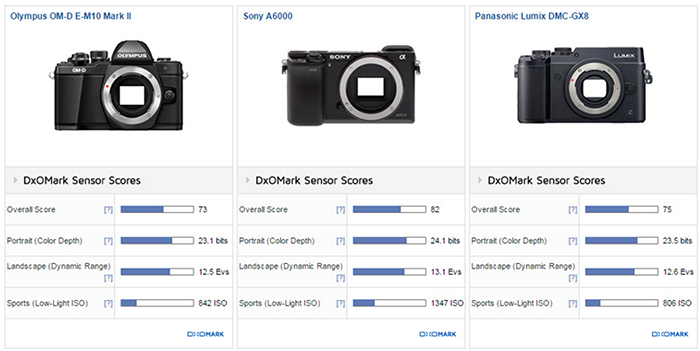
DxOmark (Click here) tested the E-M10II sensor and there is not surprise at all. The sensor is the same as the one used on the E-M1 and E-M5II:
With the addition of the vaunted 5-axis stabilization (albeit a modified version), an improved high-res viewfinder and some worthwhile tweaks to the handling, including the useful AF targeting pad, the E-M10 II no longer feels like a entry-level model. Combined with an accessible price and a sensor performance that’s similar to the mid-range E-M5 II which in turn is close to the very best 4/3 format sensors there’s little doubt the E-M10 II is an attractive option and solid choice.
32 Responses
“DxOmark (Click here) tested the E-M10II sensor and there is not surprise at all. The sensor is the same as the one used on the E-M1 and E-M5II:”
Sorry, must be a typo. It isn’t the same sensor as the E-M1 as it a Panasonic one while the others are Sony.
Yup.
Anyone who trust DxO’s flawed test are fools. They don’t even rate the camera with lens, only the sensor. Yet they talk about ibis… They’re a joke.
The sensor is the raw material. If the lens is important, and you test with the lens then all you have is data for a specific sensor/lens combination which is probably less use from a general POV than what they produce at the moment.
DxO’s tests are not really flawed – they are just one way of measuring the equipment, and to be fair to them even they are careful not to draw any real conclusions and merely provide the data so the public can draw theirs. The problem is too many people either put too much faith in these tests as some sort of bible, or they spout total BS based on numbers they don’t really understand.
As noted a camera’s performance is more than just the sensor as lens used and processing have a lot to do with the pictures you will get. Personally rather than DXO sensor scores I am more interested in the image quality, resolution and noise. For action or wildlife photography I am more interested in higher resolution for enlargements and good high ISO performance with low noise. If resolution stays high at higher ISOs and noise is low then I don’t have to buy a very expensive heavy tele lens to get good results and I can be satisfied with a very compact combo for travel and always have it with me.
While DXO’s tests of the GX8 sensor show very little difference with those used on 16 MP 43 sensor cameras the recent Popular Photography Tests on GX8 of higher resolution and very low noise at high ISO tell quite a different story.
Exactly what was expected.
The interesting thing will be the next gen sensors, coming next year. How far is APS-C going and can FT get any closer.
Time will tell 🙂
Why would m43 get any closer? Given the same pixel technology it will always be about 1 stop worse (which isn’t much in most situations)
1 Stop worse? No way, more than that… Fuji’s APS-C sensor wipes the floor with any M43 sensor.
But, there are pros and cons to every system…
Have you seen any tests reporting that the difference between spec and m43 is substantially more that one stop?
The example admin copy-pasted above shows a bit more than that, presumably due to the slightly larger pixel size in the a6000.
As you know, comparing Fuji sensors is a bit of a problem bc of the differences in demosaicing, but just arranging the CFA differently on the same Sony sensor isn’t doing any magic.
(There is no such thing as a μ4/3 sensor. The mount and lenses account for the μ. The sensor is just 4/3…) As for wiping the floor, the large pixels on the 16-megapixel APS-C sensor give the EXR a slight ISO/DR advantage over the 16-megapixel 4/3 sensor, half a stop. Sales are down this year on the Fuji system, not a good surprise to me.
The Exmor R, 42.4 megapixel Full Frame sensor, stacked, BSI, copper interconnects, embedded RAM and all—now there’s a floor wiper. The only problem is, the A7R system is pricey, the Zeiss lenses in particular.
My guess is, we will see Exmor R, minus the branding, all the same BSI tech, in the E-M1MkII 20 megapixel. After you concede double resolution and one stop of ISO, you walk away with an fantastic deal in the form of a μ4/3 system. Professional Grade and High Grade Enthusiast are not, after all, meant to be the same animal, though the coverage possible on the latter leaves just a margin to charge 4x-8x dollars on the former.
Either way, we’ve got plenty of astounding—never had it so good.
“As for wiping the floor, the large pixels on the 16-megapixel APS-C sensor give the EXR a slight ISO/DR advantage over the 16-megapixel 4/3 sensor, half a stop.”
no such thing as an EXR sensor (anymore). And it’s more than 1/2 stop
“Sales are down this year on the Fuji system”
and where did you get this data from? overall cameras are down, due to decline in compacts
And the new BSI Sony Full Frame sensor is Exmor R, as you said. No stacking there.
what I meant wasn’t so much the pure performance.
Sure,Samsung introduced BSI tu APS-C (and Sony to Full Frame) and the Nikons D7200 has some huge dynamic range.
And fuji got some older sensor design, but with improved manufacturing, new color filter array and the addition of ospdaf.
Meanwhile oly has two sensors: the EM1s (from panasonic) which has pdaf but has way to much dark current noise (and is behind in noise generally) and the EM5s (Sony), which is a bit better but has no pdaf
What they need is ONE sensor. Better overall (resolution, noise, dynamic range), but also feature wise. (for example the NX1 has not only pdaf, but cross type points!)
Their tests about GX8 are flawed, any raw comparison I made yield 1/3 stops better noise and DR than what they say.
They have to cheat to keep up their metric. But it will be more and more worse with further sensor developement. We will see how they rated the sensor for the GH5/EM1II next year 🙂
Then how can you explain this? They even state that GH4 at ISO 6400 is a little bit better in comparison to GX8:
http://www.dxomark.com/Cameras/Compare/Side-by-side/Panasonic-Lumix-DMC-GX8-versus-Panasonic-Lumix-DMC-GH4___1041_943
The truth is another story, just look at the sample. If you are a non believer, do you own test.
“Then how can you explain this? ”
perhaps you are no good at taking low light photos…? 🙂
Problem is many reviews take a normal-lit scene and whack the ISO to 6400 and make conclusions from that. I would argue that the light dial at the top, or the weave of the cloth at the bottom, the GH4 is slightly better.
What you are comparing is shadow recovery at 6400 and that is a different beast – a camera can have more noise but more resolution and because the mugs are not normalised in exposure it is hard to see which is better.
Same thing in low light levels.
What is this supposed to show? Can we exclude baked in NR in raw? The exposure seems slightly different, a little brighter in the right image.
It’s supposed to show the truth, the image on the left is cleaner with less noise and more detail. DXO scores says both images should look the same and they don’t!
S/N ratio over ISO is very close in the DXO measurement curves. I have to agree with DXOs measurement. Both are extremely similar. In the brighter areas I see an advantage in the GH4 picture in the darker parts the other way round. But overall I see them on par.
I don’t see them equal, and I personally own the GH4.
I won’t argue against that. It is just that the samples above are too close for me to favour any camera.
‘The truth’?
Your opinion maybe.
I see the GH4 image as being cleaner or if not cleaner ‘more agreeable’ in the lighter areas. That’s the problem with noise – all noise is not equal.
1/3 of a stop is a lot of improvement. Where would this come from? Same sensor tech, no BSI, and the pixels are smaller.
is the same sensor of em10?
No matter how it perform , it still a 2012 sensor .
Overdue & can’t make true impact in ISO & DR .
m43 badly need a fresh sensor to make the entire system remain competitive .
Pity the new launched 20MP sensor still far from the desire standard .
Sad that you can’t even recognize that the sensor is from 2015, but using the same 16Mpix pixel count and core design. Improved version, improved manufacturing and yet Yun feels bad because he can’t get diffraction sooner than at f/7.2!
is it? (improved manufacturing etc.) And where to get those infos?
I am sure he pulled it right out of his ass.
Mass production does not work like this, nobody redesigns mass market products for no reason, without clear marketing advantage.
“No matter how it perform , bla bla bla”
Exactly the same structure as “I am not racist, but bla bla bla”
Facepalm
m43 needs double sensor from RX100Mk4 etc. Would be 40mpix stacked BSI, just right to safely beat 2015 FF crop for tele and macro applications, and match for landscapes in decent light. 16mpix FSI is so 2009.
Same early 2012 sensor, nothing to see here, move on.