









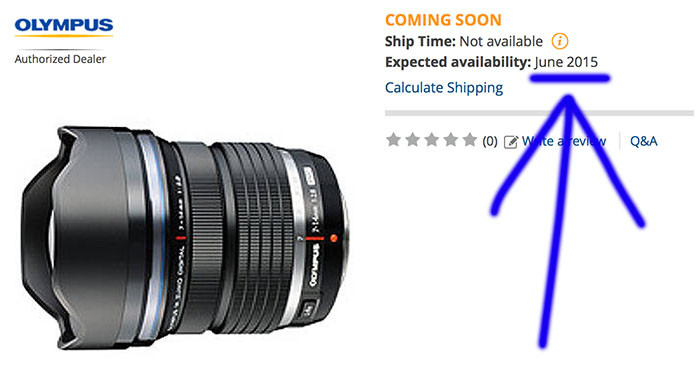
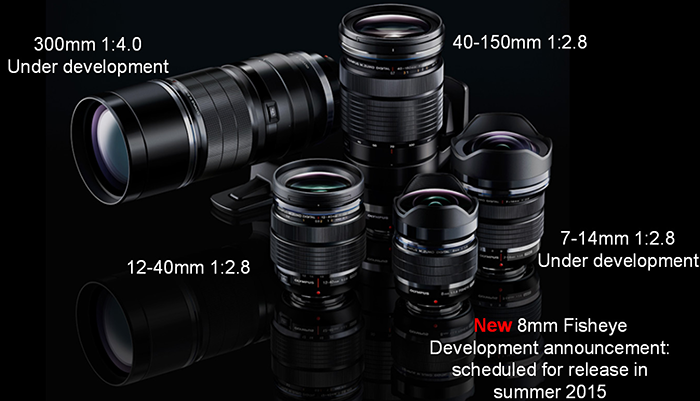
The 7-14mm PRO lens from Olympus will ship in June according to BHphoto (Click here). This means we can expect it to be announced officially by Olympus sometimes in May. There is yet no availability info for the other new PRO lensese, the 300mm f/4.0 (here on BH) and the 8mm Fisheye PRO lens.
Here is a roundup of news around the new 7-14mm lens:
First impressions by tester Pen And Tell:
– Compared to the Four Thirds version lens the new MFT version is again much smaller and lighter.
– Autofocus is very fast and silent
– Focus wheel runs very smooth
– Close focus is impressive. I’ts 2cm from the end of the lens.
– Bokeh is very good
– No flare issues
7-14mm lens on the Four Thirds Group Matching Simulator page (Click here).
And some images:

101 Responses
I don’t understand why Olympus would make a 7-12mm and an 8mm, unless of course the fish eye is much cheaper than the ultra wide zoom lens. Either way, I don’t think I can sure any pro lens from Olympus.
It’s a 7-14. And why shouldn’t they make a fisheye too. Fisheyes rule and its a totally different lens. And what the hell does “sure any pro lens” mean anyhow?
Typo. Meant to say buy
Rectilinear lenses and fisheye are totally different, 8mm fisheye will have much wider fov covered
2.8 is not fast enough for mft sensors.
Please go back to stamp collecting…..
Stamp collecting would be too complicated.
what are stamps? you old?
What you get on the back of your hand to re-enter a night club.
huh
You owned.
thanks man
haha well it’s 5.6 on full frame so not fast at all. I have a real 2.8 (speedbooster) on gh4 and it’s just enough for most shots.
As far as “fast” goes it is f/2.8, knuckledragger. As far as d.o.f., it is f/5.6.
Well people debate about that but fuck it. 2.8 is nothing special. I need that wide zoom with 1.5 or 1.8. Nikon mount so I can speedboost it.
Here HERE!
Not with that tiny noisy sensor. But go ahead, buy this.
Of course not, but some like being scammed. Why deprive them of this pleasure?
One important fact about the new lens in regards to flare resistance: the front element retracts (!) as you zoom in to make full use of the lens hood. This was reported in a subsequent post on pen and tell alongside with the new centrepinch lens caps for the 8mm and 7-14mm.
The existing filter holder for the old 7-14 4/3 lens can be adapted and works on the new 7-14 m4/3 without shading so that 100x150mm filters (not sure about the size) can be used.
Even though I have Oly bodies, I am going to hang tight with my 7-14 Panasonic f/4. It’s a great little lens and much smaller than the new Olympus. Maybe I will consider it in a year or so when the price comes down a bit.
The lens that I am really anticipating is the 300mm. I just can’t wait for that to hit the street!
Oly is finally rounding out MFT at the long end.
Olympus has dragged there feet on the 300mm for over a year. I would say this has some affect on sales with Oly m43 bodies. I myself have canceled my order of a second M1/Grip and the 300mm from B&H.
If your going to build a pro camera the company better have the optics the customer wants asap.
“No one remembers a late delivery, only a bad one.” – Dennis Dimbleby Bagley
…Eh….I am patient…. MFT ROCKS….So I use what I have and look forward to some things that I want….don’t mind waiting.
I have 10 “L”lenses from fisheye to 280mm on my Canon FF…but when it comes to the big hi-IQ teles…I don not have $20,000 to drop! …so this little Oly 300mm will be pretty rockin for a MUCH more affordable price and give me more reach…especially with the 1.4X attached!!!!! Can’t wait.
In your balanced opinion, how does the glass compare? Is the L glass worth it’s hefty premium or is only the different sensor size in certain applications of advantage?
Hmmmm…that is a question without a simple answer…
Very complicated…one of the main factors there is what is you end use?
One of my favorite FF lenses isn’t even an “L”, or Canon..It the Sigma 50mm f/1.4 Art.
https://farm3.staticflickr.com/2944/15145944468_267f0c0f11_o_d.jpg
The large prints from that lens are just stunning…as is peeping the image files when I nail a photo.
But I have a lot more fun shooting with my M1 and get results far better than anything that I need to post on the web…..
Agree, the E-M1 really has a fun factor to it. And the output is sufficient for all but billboard prints.
I have seen A2 prints from the E-M5 II in high res vs. E-M1 and unless you went really close to the prints, the difference was not really noticeable.
Much more interested in the fish-eye myself. Here’s hoping it’s gonna be at least as good as Samyang 7.5mm, but with better resistance to flare.
And the price…what the heck is taking them so long to tell us how much I’m going to spend on this darn lens.
Maybe they’re still lurking on the forums, checking how many people get excited about this. The more excitement, the more overpriced it will be.
Olympus 9-18/4.0-5.6 is $700, Panasonic 7-14/4.0 is $950, so expect this to be at least $1200. $1500 if people are still gonna rave about every single rumor regarding this lens.
🙂
Only one thing missing unfortunately: a filter thread…
As per my post below, there is a filter adapter without any vignetting or shading for the 7-14mm which allows 100x150mm filters (one) to be attached
Filter holder from helgesuess.com (check hardware)
Threaded filters with that front element would produce major vignetting.
I don’t recall any ultra wide angle lenses with a filter thread.
The new Nokton has a 72mm thread and I would think that the Kowa has one, too
I am sure this is a lovely lens. It must be so lovely in fact, that it is beyond price. Telling us how much it costs is totally unnecessary because whatever it is, we are going to pay for it. Polo, anyone?
There’s nothing to debate here, man. the light gathered is still f/2.8, whatever the sensor size you put it in front of. As Poopyhead just stated, it’s depth of field that is affected by sensor size, not the light passing through the optics. A common misunderstanding, frankly.
Please help us understand that misunderstanding. Are you smarter than poopyhead?
quote (source:http://admiringlight.com/blog/full-frame-equivalence-and-why-it-doesnt-matter/) : a full frame sensor is four times larger in area than a Micro 4/3 sensor. Therefore, if the f-stops are the same, and thus the intensity of the light is the same (and the exposure is the same), then the full frame camera will be using four times the total amount of light to make the image because it’s got four times the total area. For the smaller sensor to have the same total amount of light, they need two stops faster aperture or two stops lower ISO with a longer shutter speed. This is why, often, it’s said that full frame sensors will have two stops better ISO performance over a Micro 4/3 sensor.However, this doesn’t work completely linearly in the real world, as smaller sensors are more light efficient than larger ones, and it is also dependent on sensor technology being identical. If you look at the DxO Mark sensor comparison, you will see that if you compare the Olympus OM-D E-M5 with the Nikon D600 and the Canon 5D Mark III (both of which are full frame sensors), they measure roughly 1 2/3 stops better in ISO performance. Not two like you’d expect. You may be thinking ‘that’s close enough, but it speaks to the further point:
Compare different sensor generations and everything breaks down, though advocates of this equivalence never use the equivalence when comparing full frame sensors of different generations. The OM-D E-M5 is only about a half a stop behind the Canon 5D and just over one stop behind the 5D Mark II…a camera that was current only 9 months ago. (See chart above).
My whole point here is that the total light argument implies a direct 2x or 4x improvement in image quality with ISO. However, this is really only true for approximating how one sensor design may scale with size, but is terrible as a blanket equivalence based on sensor size alone due to the changing of technologies over time and differnent sensor construction even among cameras of the same generation.
For me, the typical situation for the 7-14 needs as much DOF as possible. If I use F4 a FF-sensor cam needs to step down to F8 to get the same DOF and this means 4 times longer exposure or two steps higher ISO. There is no advantage for FF in the typical wide angle situation.
For me, F2.8 for the 7-14 is not worth a much higher price, more weight and bigger size. I’m happy with the pana lens.
The weather-sealing is probably not an advantage for you, either.
@Faramir: I often read such discussions with a smile. My dear you make the same mistake as most of the guys who do not have specialized knowledge about optics and physics.
The total incident of light captured by a sensor does not depend on
the sensor size! You may ask why not?
A camera lens is nothing else than a very complex hand lens. It focuses light from an object on virtual image area (=sensor). If the sensor is larger the light from an object needs to be less strong focussed, if the sensor is smaller the light from the object is stronger focussed. An extreme example is a strong hand lens that focuses the light in just a small dot so that you could inflame something with the light beam. Light is that comes from the object so a larger sensor cannot “produce” more light. That is the reason why you will get the same exposure time with a FF camera or with a small sensor camera if you are taking the same picture (same object) with the same aperture. A better lens (better transmission / larger aperture) can bring more light onto the sensor.
Another thing is the signal to noise ratio (S/N). In general it depends in the sensor size. The FF sensor has an advantage in the S/N in comparison to smaller sensors but on the other hand there are much more parameters that have an impact on the S/N as well like a shorter exposure time, better signal processing, faster signal processing, better sensor design and other. So for example a faster lens and better signal processing on a mFT camera may compensate the advantage from another camera with a larger sensor. But in
addition you will get the advantage from shorter exposure time with the faster lens.
Last autumn a did a trip to Morocco. With my EM1 and EM5 I was
able to take a lot of pictures in almost perfect quality out of the tour bus while bumping over bad off-road tracks. We had two other travellers in our group with FF cameras, one with a Nikon the other with a Sony and our tour guide had a 5DMarkIII. But they all could not get usable pictures out of the bus due to lack of such a great IS like the one from Oly and under the shakings from the bus they also could not hold their heavier body/lens systems as still as I could hold my light body with the great 1.8/75 attached.
Next time if you about to start discussing this topic please remember the “lens focus” effect and you will not anymore insist that a FF sensor gets 4x the light than a mFT sensor because it is 4 times larger.
I love it when nincs like you patronise the rest of us.
You got that backwards: DoF is a function of entrance pupil size. At the same AFOV and focal ratio, the entrance pupil is larger for a larger sensor, hence shallower DoF for larger sensors. And more photons, don’t forget more photons.
If you want wide and fast, get a Voigtländer Nokton 10.5mm f0.95.
But we don’t know when it ships.
Hopefully in the summer, like all the other M4/3 Voigts.
Do we have a price yet or what?
or what
The Olympus 7-14mm f/4.0 lens for Four-Thirds was US$1799.99, so this one will likely be just a bit less, given that the maximum aperture is larger. I’d be really surprised if it will be less than US$1399.99.
or what
Not buy it is what.
I guess 1399.00.
I need it in May for the trip and it would come in June. Plan B: Sigma 10-20.
MFT has without a doubt has one of the most interesting and robust lens arsenals of any format. And they are for the most part competitively priced. Especially compared to the Sony FE format.
I really hope the near future will see a small leap in sensor improvement. I can’t imagine Oly and Panasonic are so committed to developing all these pro-quality lenses if camera body improvements were not in the pipeline.
Start to shop Sony/Zeiss FE lenses and you will start to appreciate the offerings from Olympus and Panasonic. Zeiss lenses are ridiculously expensive. You have to pay 2K for a fast standard zoom, over 2.2K for a “pro” telephoto. And their extended kit lens, the 24-240 f3.5-6.3 is a whopping 1K, and is poorly reviews so far.
Compare that to Oly’s standard zoom that can be had for $800 on most days, their pro tele at $1300 and their extended zoom kit at $500-600.
I’m still fairly new to photography…but why on earth would someone ever want to focus at 2cm with a 7-14mm super wide angle lens? If you need to get that much in your frame…back up 2cm?
Wide angle stuff is often most dramatic when the foreground image is extremely close.
Ah, ok, that makes sense. I’ll have to try some shots like that with my Panny 7-14! I had always thought of SWA lenses as being used for things like real estate (to get a full room in view) or a shot down the street (to get both sides of the street) or architecture etc. It sounds interesting to put a subject right in the center super close 🙂
Maybe not “right in the center”: I would suggest on a side to show some emphasis on foreground in contrast with the background…
a.k.a: taking advantage of perspective distortion.
Rather dumb question, to take photos of course. It’s up to your creativity to use the possibilities of gear.
Pretty sure it wasn’t a dumb question…just a dumb person asking it 😉
Well, perhaps mistook the tone here. Close focusing with uwa lens can create rather unique looks and they will stand out. Especially considering no fixed lens camera or a phone will be capable doing anything similar. This lens can do a lot, I really like how much flexibility Olympus adding. 40-150f2.8 same, can cover quite a bit more different situations than rather standard and boring Panasonic 35-100
Why? It gives you great creative choices. Also, with the f5.6 aperture you do not have to worry about nasty washed out backgrounds!
To those of you who know the technical stuff..would such a lens be a good idea if one wants to get into architecture and interiors? or should I go with a prime, and perhaps a tilt shift one? Thanks 🙂
T/S lenses are best choice of course, but this will do well for sure without breaking the bank. Just get cheap body like e-m10 or old e-m5. Judging from 2 pro zooms already released I have zero doubt’s this one will be stellar too. Olympus will also be really amazing if you want to skip tripod as much as possible
A T/S lens would be better, but m43 system lacks of them..
I can’t wait to use this 7-14mm in high res mode for interiors.
Maximum use of system!
There are no T/S lenses for µ4/3, so you have to correct for parallels, etc… in software. Get an E-M5II, shoot in hires, and then you have plenty of pixels for performing corrections.
Actually, there is. The 24mm f/3.5 ED AS UMC Tilt/Shift from Samyang/Rokinon/.. is also availlable in MFT mount.
I missed that one. Still, not as useful a focal length on µ4/3 as a 12 would be. Too bad the Samyang/Rokinon 12 in Nikon is a fisheye, otherwise one could use the Fotodiox T/S adapter with it.
A wide angle zoom like this can be really handy for quite a bit of architectural photography. The only catch would be if the lens had some sort of complex distortion (wavy, etc) that would be very difficult to correct in software. As Olympus is calling this a pro lens, I would think that it would be well corrected (digitally, as with all m43 lens) for straight lines and that. You can even correct small amounts of perspective in software without it being too detrimental to the image.
For tilt/shift and architecture, m43 really doesn’t have a good solution. You’d need at least a 12mm with tilt and shift capabilities for interiors and I don’t believe that exists at this time. To compete with Canon’s 17mm full frame t/s lens, you’d need a 8.5mm. Using legacy lenses with some sort of a t/s adapter doesn’t really help either as 35mm lenses generally aren’t anywhere near that wide.
Unfortunately, the best options for architecture with t/s lenses are pretty much all expensive and full frame.
Pictures of lens, lens cap and Helge Suess filter holder in preproduction stage:
http://pen-and-tell.blogspot.co.uk/2015/03/hands-on-7-14-f28-pro-zweiter-teil.html?m=1
The lenscap for the 8mm fisheye has a similar construction. Here shown the 7-14mm. Pictures from pen and tell as per link above
From the bottom it looks like the cover to a disposal coffee cup. 🙂
Dual use: while you take pictures, you can’t spill your coffee
For landscape and architecture do you really need a wide lens? With free and good software for panoramas available today I use fast standard primes (with little or no distortion) and then stitch. I see no reason to pay – and pay a lot – for a slow wide zoom with distortion, etc.
Yes, you do need it. Panos are a compromise, and there are lots of places where you can’t set up a tripod where a UWA is a godsend.
“Panos are a compromise”. Can you explain in what way they are a compromise? When made from prime lenses that are immensely better in optical terms than wide zooms? On the contrary, wide zooms are a compromise – with worse optical properties, slower, softer. As for tripods, I personally have never used one – thanks to Olympus and Pentax in-body stabilization.
Sure. They take longer, they require more work in post, although its almost painless in PS CC. Objects moving cause problems. In short, the same sorts of issues that are problems for the E-M5II’s HiRes mode. If you don’t use a tripod for a pano, you won’t get the best results, although of course decent results are possible. But a tripod and a proper pano head are required in order to deal with parallax issues that don’t come up with a UWA. Trying to make a publication ready images of an interior without a tripod and pano head is just not possible due to parallax errors.
Don’t get me wrong, I love panos, and use them. But they aren’t a panacea. And the Olympus wide zooms are stellar. There were pros who picked up 4/3’s back in the day just so they could use the 7-14/4. I expect that the new 7-14 will be nearly as good, modulo software correction which will be part of the design. Of course, it too will be a compromise, just like everything. Both panos and UWAs are tools in the kit, not religions to follow without question.
OK, this makes sense. No doubt, Olympus wide zooms are good. But I was talking about landscapes and architecture where pictures from better lenses make better panos. And concerning PP, it is equally necessary in architecture shot by superwide lenses with those linear incongruities. I usually have no problem stitching a good-looking panorama of a cathedral or other larger building from good separate photos. Whereas the single picture from a wide-zoom lens will always be softer and will often display lines that are unrealistic, misplaced or simply ugly. I have had a fish-eye lens and I have the Zuiko 11-22mm – so I know what problems can be encountered with wider lenses. Less so with panoramas.
I think we can both agree that what we really need is a 12 Shift, analogous to this: http://www.mir.com.my/rb/photography/hardwares/classics/olympusom1n2/shared/zuiko/htmls/24mmSHIFT.htm
With other methods (correcting UWA/Pano) we’re making compromises that users of other (cough cough Canon, Nikon) aren’t asked to.
A big +1 on the shift lens, In fact a wide one, say 9-10mm for architecture, and a longer one, around 35mm for product pics would be fantastic. Maybe Oly will turn their attention to this kind of lens once they have completed their 7-300mm pro lens line-up (+ fisheye)…
As much as I wish for this, I think it unlikely. Olympus has put keystone correction into the camera, so I suspect that they want us to use WA and UWA and correct in camera via software.
Well yes, you could be right about that. Maybe Voigtländer might see this as a niche they could fill. No AF wouldn’t be an issue for a TS lens. There was a prototype based on the Voigtländer 15mm Heliar about 18 months ago that didn’t seem to make it to market, rumour article here http://www.43rumors.com/big-shift-lens-is-actually-a-voigtlander-lens/
As much as I want TS lenses for the system, I don’t think anyone is really going to make one within the next 2 years. The reason why TS lenses are MF only is because there is no way to focus a TS except for manually since the POF is tilted and shifted. The main reason for a Pro TS lens would be uncompromised architectural photos instead of software manipulation.
Keystone correction is pretty good. While it saves a lot of time, it does lose pixels towards the top. It’s about as much of a compromise as a stitched pano. For 360 flat panos, this lens will be excellent and I’m hoping it will trump the older Olympus lenses just like the 12-40 and the 40-150. The Olympus zooms are sharper than some of its older m43 primes like the 12/2, 17/1.8, and 45/1.8. Sharpness isn’t everything though.
I wouldn’t say that ultrawides are best for landscapes – panoramas are probably preferable. Architecture is a lot more difficult to frame without seeing in camera, since the perspective distortion (not lens distortion) is a huge factor in this kind of photography.
Personally I think the best use for ultrawides is to Get Close. Ideally in a scene with moving objects. Makes for very interesting photography that is impossible to capture any other way.
Clouds, water and other things move between shots, so yes, you do need a wide lens.
You can’t do near-far shots this way. You might be able to capture mountains in the background but the rocks and flowers at your feet are not going to make it into the photo and won’t be in focus. An ultrawide can get 3ft to infinity in focus. An interesting background with an interesting foreground makes a great photo. One of the nice things about an ultrawide is it can capture the moment in one photo that your eyes could not when at the scene.
Of course you need wide. Yet another who thinks Fast primes are the be all and end all. They’re not. What you gonna do with that 1.8 for depth of field, stop down? Not so fast now. F7.1 usually so I don’t care if my lens is slooow for landscapes. Stitching is one way and if it works for you that’s great but you’re still not going to get the same exaggerated perspective unless you use a wide.
Great! Finally a reasonably priced pro f5.6 lens. I have never heard of any professional wanting to shoot a wide angle at any aperture smaller than that.
You know what they say, a troll a day keeps the doctor away. Troll On Brotha! 🙂
Hehe, yeah. Given that the vast, vast majority of shots taken with the Nikon 14-24mm f2.8 on Flickr are taken between f7.1 and f16, maybe this Olympus is too fast?
Maybe the Olympus will actually be usable at f2.8
😉
This is the next lens I’m going to purchase. Come on already Olympus!
If the 12-40 and 40-150 are anything to go by, this will be a stunner and find its way into my bag.
Gonna be expensive… but then again, you gotta pay some, to get some.
Are there any measurements available for the lens? What I need is the diameter of the sun shader and length of lens from mount to top of the glass.
Pro?????………LOL
Sorry i forgot that the price is pro…..LOL.
I can’t wait for this lens to come. I’m hoping pricing is going to be under the $2k mark. So far the rest of the Pro lens line has been excellent and if the 7-14 Pro is as uncompromising as the rest of the line, it will make for an excellent ultra wide zoom.
$1499 seems to a number olympus likes, the 40-150 is a total game changer, I’d expect nothing less with the 8 & 7-14 lens, I’ve almost purchased a Panasonic 7-14, which is also a great lens, I will be comparing before i buy
At first I thought the 40-150 was going to be a joke. However, the more I read up on it and take a look at the images myself. Well- I’m pretty impressed.
I got the Lumix version of the 7-14mm f/4. And I use it on my GH4. It is a good lens. But when it comes in lowlight. Its really really bad. So one extra stop should be a lot better for MFT system 🙂
I just bought the almighty 14mm Rokinon 2.8 for my A7- 200 bucks. for M43 I sold the 9-18. Good lens actually. I just didnt’ like the contrast and not wide enough. I have high hopes for this olympus offering but- I’d be looking for fairly low distortion. I have no problem spending big bucks on this lens. In fact, I would prefer spending it on M43 than FF given the utility of the form factor for UWA. We shall see.