








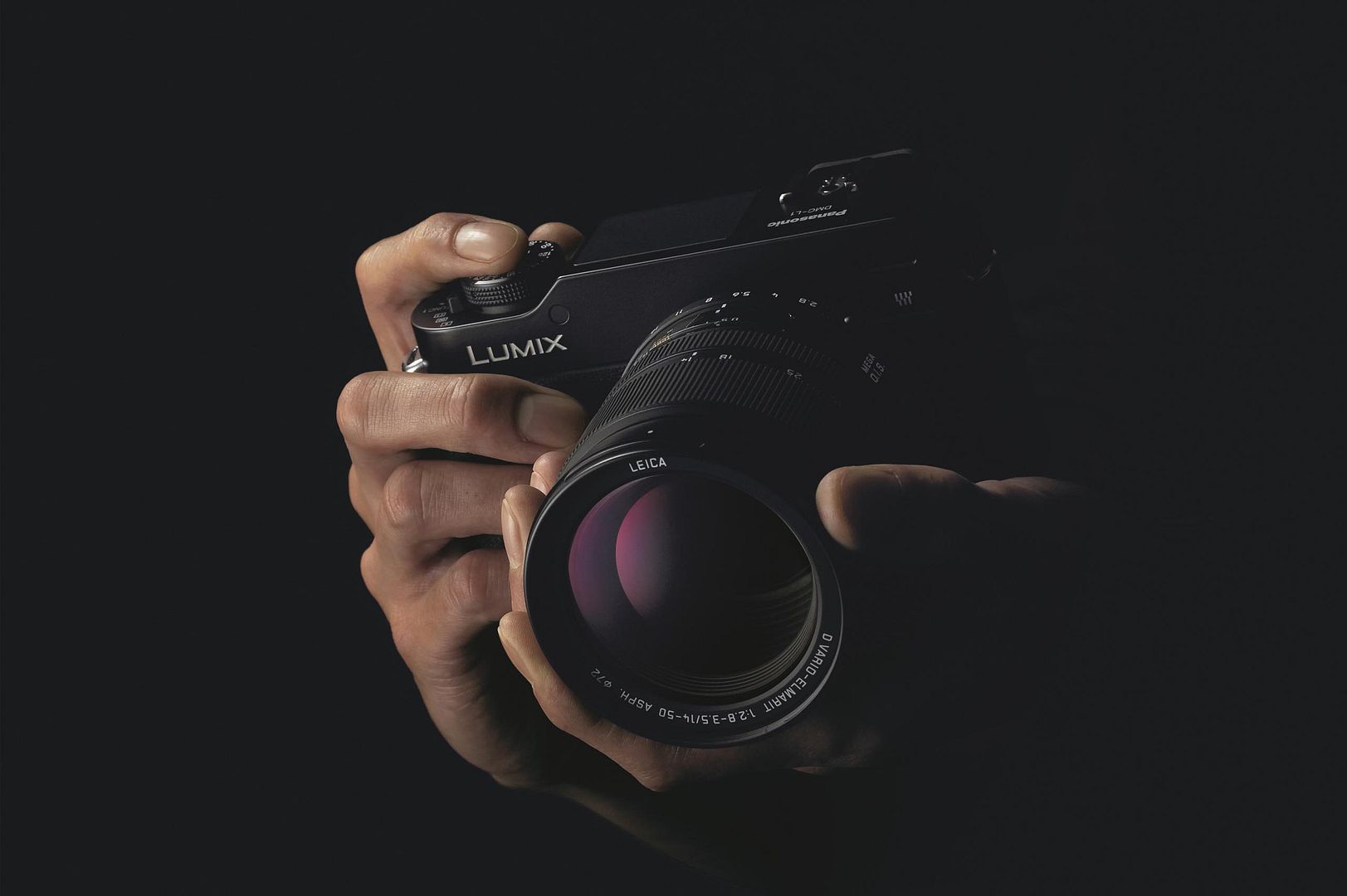
Some camera almost do not need an introduction. The Panasonic DMC-L1 is one of the few cameras that managed to create that “WOW” reaction the day it has been announced (Feb 26, 2006). It was a unique Four Thirds DSLR camera. Panasonic had the courage to make a DSLR look like a Rangefinder
It shared many components with the Olympus E-330 (lens mount, mirror box, auto focus and auto exposure sensors).the DMC-L1 does not have an additional small live view CCD on the top of the viewfinder chamber (you can just make out where it should be below), so only has one live view mode. Disappointingly this means that in normal viewfinder mode you’re actually looking through a half-mirror with a dimmer view for no actual gain.
Image courtesy: Dpreview.
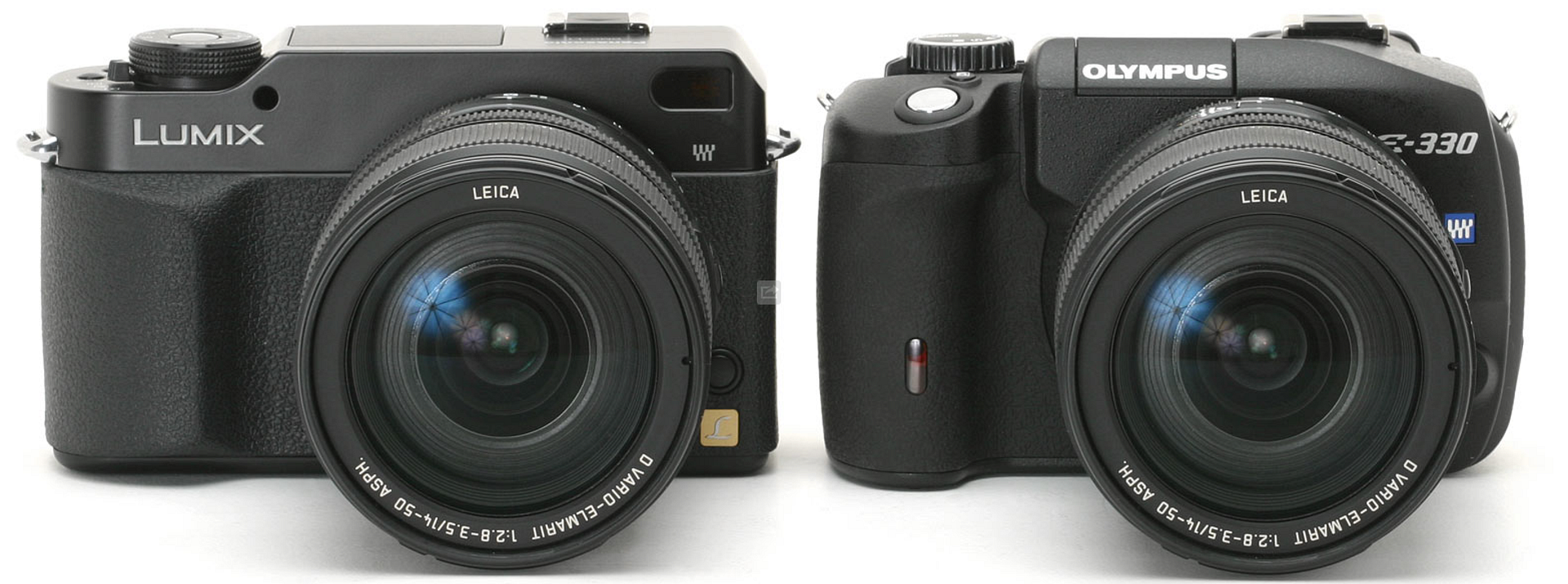
The L1 has an optical porro finder which uses a four mirrors (one sideways swinging) to bend light from the lens to the viewfinder eyepiece. This unusual design was first seen in the E-330, and as this is the same optical system it provides the L1 with the same compact layout. Unfortunately just like the E-330 the L1’s viewfinder view is very small compared to other digital SLR’s, it’s also darker than you would expect.
Too bad Panasonic quietly quit from the Four Thirds system. Would have been nice to see a follow up of the L1!
Photographyblog, Luminous Landscape, CameraLabs, Photographic Central and Dpreview.
44 Responses
the Panasonic look timeless, especially when compared to the Olympus
The L1 looked better, had a better kit zoom and better user interface, but it was an E-330 inside and the E-330 had better live view implementation. The E-330 was a revolutionary camera and in many ways the “prototype” for the mirrorless models that followed.
Big, heavy, overpriced with mediocre tech…
Hey, at least the GX7 won’t be big and heavy! 😉
Can you tell me how big and heavy GX-7 is?
You can’t, can you?
The L1 with battery weighs 606g the huge humongous almost immovable lol Gh3 weighs in at 550g
You jest, but thats about what the people here think
@Charles
wasn’t over priced at the time, it came with well regarded Leica kit lens, a good build and usability.
The Leica version was maybe a bit overpriced (+1000 euro extra)…but just a bit 🙂
The L1 + 14-50 was priced at $1999 at launch way overpriced and overrated .Crap VF small and dark poor AF along with all its live view issues memory plays tricks on ll of us lol
I’m pretty sure you could find the L1 at £1100 online once it began shipping and then around £800 in late 2007 / early 2008….
It was launched here UK at £1500 which was rather over the top the fact that prices of gear fall in the long term {or short for that matter GH3 cost me £1200 Dec 2012 by March 2013 it had fallen by £300 } doesn’t change the launch prices. It was not a very good camera even when new compared to the typically cheaper competition
http://www.trustedreviews.com/Panasonic-DMC-L1_Digital-Camera_review found online for £1150 similar price to the Canon EOS 400D at the time.
that review price was in 2011 years after it came out the often rapid depreciation doesn’t change the initial price.
the date of the review is wrong it has a comment from 4 years ago and it’s being compared to the 600D, I remember it being in a bricks and mortar shop for about £800 in early 2008 just before I bought my first L10.
The initial price was ambitious but I don’t remember it being listed anywhere for the price or near the mentioned on the dpreview launch article (who were not keen on anything Panasonic in the beginning).
The launch price is mentioned on every site that mentions the L1 arrival , google is your friend lol.The L1 came out in 2006 considering its many flaws a substantial price drop by 2008 does not seem at all surprising.
i have the FotoMagazin 2008 buying guide magazine here, and it lists the L1 at 1500 euros, and the Leicaversion at 2500 euro, both with the same vario-elmarit lens
That’s not true. It was the best technology at the time and still takes great photos. You know nothing. You don’t own the camera. I do own it.
It was a piece of crap when it came out with multiple flaws here is a list to help you remember the good old days…
Small and dark viewfinder view
Auto-focus in live view requires display freeze and mirror flip down / up
Image processing algorithm not ‘crisp’ in appearance
Live view becomes dark in low light / DOF preview
Shutter release delay in live view
Image parameter adjustments don’t offer enough latitude of change
Auto focus provides just three focus points
No record review delete / cancel
Some dials are too easily knocked (metering mode, drive mode, focus mode)
Lack of status LCD can mean shorter battery life
Artifacts in SilkyPix images from RAW
RF interference artifacts
Size / weight
Price, competition
Hey, admin you should mention that also some of the text is courtesy of dpreview!. I never used a L1, but it looks very sexy indeed.
The L-10 came after the L1, I still use mine (I have two) nearly everyday and I’m on 300,000 shutter actuations for them each and have never had a problem with them 🙂
The L-10 in live view mode was really the fore runner of Micro Four Thirds…
my 1st FT camera was the E-300, which was the first RF style body in the FT range.As a left eye photographer I find this design an disadvantage because I cant use my right eye for overviewing the scene while busy with composing/shooting. The magnification was very poor. For me, the E-1 remains the best in design and built quality and ergonomics. Olympus should come with an E-1 style body with EVF and integrated MFT compabitility.
Despite its flaws, the L1 is a handsome camera. Hopefully the GX7 will retain similarly timeless good looks in a more refined and better handling package.
The porno, aehm, porro finder was introduced with the E-300, not E-330…
But Olympus use porro finger first in PenF.
and a porro finder was used in many cameras from the 1940s onwards
moderated again
I will add Disquis in Autumn on the new redeisgned 43rumors.
The sideways flipping mirror and the porro prism predate the E-330 and L1 by a few decades, and were first seen in the PEN F. That was also the first SLR that looked and mostly handled like a rangefinder.
I have the L1, it’s a pretty unique camera.
Surely not the top-tech for the times, but had a special feel, probably matched only by X-pro1.
Sadly, i don’t have the 25 summilux, probably the perfect companion for the L1.
That new Leica eith slow lens. Whatever its called… Should have been a modern reincarnation of this Panasonic.
Oh well maybe 3yrs after Panasinc releases their new version…
From a functionality-oriented rather than a design-specific view, I’d say the E-330 is the real classic here 😉
It was the world’s first and to this day stays Olympus’ one and only camera that achieves fast phase detection autofocus with all lenses in live view mode.
More than that, it was the world’s first DSLR with a tiltable display – a feature that, in the meantime, has been adopted by most manufacturers for at least some of their DSLRs.
Of all things, Panasonic left out these two features, which were the most important innovations Olympus had introduced with the E-330 (in addition to Live View as such).
Make an E-330 with current technology and a better finder, I’d buy it right away…
I agree that the E-330 was an innovative camera. I bought one at closeout for only about $300 and used it happily for 4 years. I took it to Nepal, other parts of Asia, Greece, etc., and it never once gave me any problems. But it did have two big disadvantages: it was big and bulky, an the porro viewfinder was dim. I’m older and am perfectly glad to be using the smaller micro 4/3 now.
Picked up a near mint one for just over £200 last year. build is superb as are Raw images processed through LR4 – far more detailed than on my E330. Just wish there was a nice range of fast small primes to go with it.
I too have the L1; the RAWs processed through LR3 are excellent quality; nicely detailed and crisp, yet with very nice total rendition. LR3/4 noise processing engine gives the L1 at least one extra stop of usable ISO, comparable to the 12MP generation of m43 sensors. Funny I checked DXO recently and the old 10MP sensor gets roughly the same scores as the 16MP GX1 sensor. Yes, it’s 6MP difference and 6 years difference, but still about the same score.
And yes, too bad Oly and Pany never came through with any wide angle primes, unlike the current m43 primes. The lack of reasonably fast primes for 43rd made it a still-born system IMHO.
Which in my opinion is all you need. The camera takes great pics with the 14-50mm. The only thing you have to worry about is when the sun goes down.
Actually it is 7.5 mp – even better. Great camera.
Funny, I was just shooting with the 14-50mm lens in my GX1 today! The L-1 is a collectors item and the Leica lens that comes with it is a added bonus.
The GX7 I’m hoping will look exactly the same. The L-1 has style. It is a brick though. I call it the “Tank”.
I wish Panasonic will bring back the aperture ring on the lens. I so want to head to Fuji for that option.
I was also on Flickr today and seen some great stills from a GH3, so if the GX7 is even close or better to that, we’ll have a winner!
Interesting camera but pity is on my early time .
Perhaps I should thinking to keep my GX like all the people did for the L1 .
Now the GX7 is everyone’s hope to acheive that golden era ( GF1 ) again .
waiting to know secret of GX7 ,leaked from Taiwanese 😉
Sorry the E-330 was not the first camera to have this mirror configuration, it was the E-300. I also remember that the L1 came at the same time of the E-300. the E-330 came later.
I remember this because I had an E-300 at the time!
You didn’t mention the manual aperture and shutter speed controls, predating the Fuji X series by years. On the other hand, all the other great tech comes from the true pioneer, the E-330: the first live view DSLR, and the only one with fast phase detect AF for years, until the current Sony models. What’s more, it had brilliant IQ – exceptional colour, and the best DR of any Oly until the OM-D. The L1 had the same excellent sensor, but without Oly’s excellent colour processing. It did apparently have a lighter AA filter though, for greater resolution and detail. I found it to be a surprisingly large, boxy and bulky camera though, especially with its kit lens. The E-330 was smaller, lighter and more rounded. I still have one and still use it and enjoy it – it continues to produce excellent images at normal ISOs.
The L1 was a great camera for two reasons, the color rendition and the fact that the phase focus mechanism allowed use of manual lens. The Olys did not have this even if they shared the same camera box, and the only other camera that use phase detection (and allow manual lens focus confirmation) was the L10.
This means you focus until the green light comes on and you continue to frame the scene. Otherwise on the Pannys and Olys you have to pop up the magnifier and carefully focus while its jumping around then you either unload the 10x magnifier or you shoot the pix. This means you lose time and have extra things to do.
Its like you learn mmy mind! You appear to grasp so much approximately this, such
as you wrote the ebook in it or something. I feel that you just could do with some p.c.
to power thee message home a little bit, but instyead of that, that is wonderful blog.
A great read. I’ll certainly be back.