









[shoplink 52509 ebay]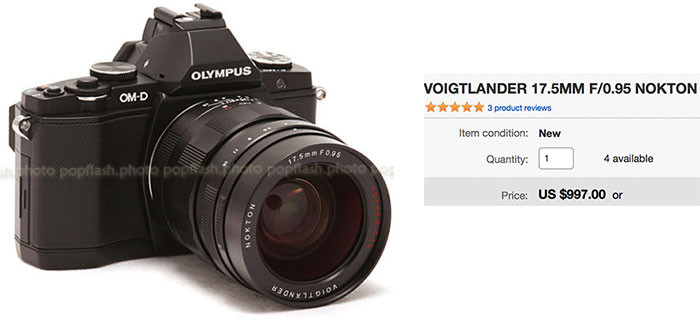 [/shoplink]
You save $150 on the Nokton 17,5mm f/0.95 lens sold at [shoplink 52509 ebay]Popflash on eBay US (Click here)[/shoplink]. They also sell one single [shoplink 52510 ebay]25mm Nokton for $849 only (Click here)[/shoplink].
30 Responses
17.5mm F0.95 lens on m43 has similar DOF/Bokeh with a F3 35mm lens on FF.
Who told you that formula? It’s equivalent to exactly 35mm f/1.9, nothing else. Both figures are multiplied by 2.
But the lens speed, aka f-number, is not equivalent. That is why you raise the ISO on the FF to get that equivalent picture…
Right, and after raising your ISO by two stops, the wonderful FF sensor performs exactly like the smaller 43rds sensor… SO equivalence trolls are only good at making large, heavy and expensive FF cameras perform like an EPM2
Well, you wont find a FF sensor that is as clean at ISO 6400 as the E-PM2 is at 1600, so the 2 stop advantage is only in theory. Once in a while I would like shallower DOF, but the size benefit of an E-M5 with a 45mm lens outweighs that a million times.
Well, if I were completely honest vs the D4, D4s, D610, D800 (not at 100%) etc, and I am sure the D5 the two stops is pretty close to the point of being neither here nor there… BUt generally Canon’s sensors and sony’s use of their own sensor dont manage to maintain the full 2 stops… So really it is not a very clear benchmark and certainly no way to attack a high end lens.
so in conclusion the 2 stop advantage of FF doesn’t really apply if you use F0.95 to shoot on this lens, (comparing to using a F1.8 prime on FF)
The two stop difference applies in theory. So when you use an f0.95 lens vs an f1.8 lens there is no advantage in theory. In reality it is very lens and body dependent.
If you get a Sigma 35mm f/1.4, you could in theory get about 2/3 stop advantage with FF. Maby Leica has something faster?
Right, as a rule of thumb that’s true. If you have the same aperture numbers, FF roughly has a 2-stop advantage (in either pixel-level noise or pixel count or a combination of both). If you have equivalent apertures, FF doesn’t have that advantage anymore.
They are equivalent, if you compare equivalent ISO, as Mr. Lincoln already said. Even if it doesn’t always work out exactly like that, 4x ISO for the FF camera is always a good rule-of-thumb approximation for getting roughly the same quality.
The speed (f-number) is not equivalent. A f/10 lens on 8×10 format is a slow lens even if it gathers the same amount of light as a f/1.4 lens on FF.
17.5mm on mft is equivalent to 35mm on FF as they RESULT in the same AOV, a 9mm aperture on mFT is equivalent to a 18mm aperture on FF as they RESULT in the same lens speed.
AOV, f-number, DOF are all RESULTS of the physical properties of your camera/lens, FL, sensor size, aperture diameter etc.
AOV does not RESULT in f-number or DOF
f-number does not RESULT in AOV or DOF
DOF does not RESULT in AOV or f-number
(sorry about the “screaming”, its only meant as underline)
For the question of equivalence it does not really matter what measurement results from what other measurement, from what physical relationship.
If looking for equivalence of two camera-lens-combinations is supposed to mean to find the specifications and shooting parameters so that the cameras will produce as similar as possible images under as similar as possible conditions, then the rule of thumb between FT and FF is always: same shutter speed, factor 2 for focal length, factor 2 for F-stop, factor 4 for ISO. Changing any part of it will, by tendency, cause the two images to become less alike.
You can deviate from that rule only if you define equivalence to mean something different, but what else can equivalence be supposed to mean?
I understand that, but there is no point in reinventing the meaning of f-number when equivalence is explainable like it is.
A FF camera with 2x the FL of a mFT camera will produce a similar image with the same aperture diameter, the same focus distance, the same shutter speed and 4x the ISO. These are the camera settings.
Technically f-number is not a setting, its a result of your setting. When I twist the aperture ring on my VL, its mechanically connected to the aperture blades. When I have set it to the position I want, ,the lens barrel will show me the resulting speed so I can calculate exposure (back in the days anyway). Historically correct, DOF is not calculated using f-number either, but as you can rewrite FL and aperture diameter to f-number, you will find formulas for DOF using f-number as it is more easily available.
Anyway, the settings can be said to be equivalent in terms of final image, as they will RESULT in the same final image.
As for individual RESULTS:
Resulting AOV is the same, so FL setting is equivalent in terms of AOV (in combination with sensor size, but thats not really a setting)
Resulting DOF is the same, so the FL, aperture diameter and focus distance settings are equivalent in terms of DOF
Resulting lens speed is NOT the same, so the FL and aperture diameter an not equivalent in terms of LENS SPEED
When saying f2 is equivalent to f4, we are talking of lens speed, thats what the resulting f-number is, and its not equivalent when talking about “equivalence”.
100mm with 50mm aperture diameter (f2) on FF and 50mm on mFT:
Equivalent aperture diameter in terms of resulting lens speed(f-number) is 25mm|
Equivalent aperture diameter in terms of resulting DOF is 50mm.
Equivalence is all about details, and you will find endlessly long articles about it. But when it comes to “equivalent aperture” details are suddenly overlooked and set aside for convenience, that is why you get endless discussion where one says f2=f4 and the otherone saying f2=f2..only the last one is correct as when you say the f-word we ar talking about the RESULTING speed. Would you ever do the same with the RESULTING AOV?
xAOV=yAOV in terms of DOF ,that is possible as DOF depend on so many other things, but that is technically what is done when saying f-a = f-b in terms of DOF, as they are individual results. A certain DOF can result in any f-number, it just depend on the other settings.
Cheers
Most of what you say is true and obiously so, but we continue to disagree in the concept of equivalence. Equivalence is about the image. The RESULT which it is all about is the image, not some physical properties of a lens. If those were meant, we wouldn’t need to say ‘equivalent’, we would say ‘equal’. You seem to mix both concepts up, which is why you say “f2=f4” and “f2=f2”, which is, of course, wrong in the first case and stupid in the second.But f2 is equivalent to f4 under the circumstances we’re discussing here.
Back to the RESULTS, where your mistake is easily shown. You correctly name AOF, which is a property of the image. You correctly name DOF, which is a property of the image as well. Then you name lens speed, which isn’t. It’s just a technical requirement for getting the image we want.
The individual RESULTS of equivalent camera/lens settings like DOF, AOV etc. are equal, not equivalent (as you say I guess). The individual result of lens speed is not equal.
I see it like this:
Result-giver + result-giver(equivalent) = EQUAL result
For equivalence, its the combination of total light gathered, area and multiplying of collected light (ISO) that result in equal noise/brightness, not the “resulting lens speed”.
After all, an f2 lens on a 1/10″ sensor can easily focus in good light, but the “equivalent” f380 lens on 8×10 wont stand a chance.
The problem IMO is that “aperture” is used for both lens speed and aperture diameter, but f-number is JUST lens speed.
50mm FL on FF with 25mm aperture diameter are equivalent in terms of DOF, total light, diffraction etc to a 25mm FL on mFT with a 25mm aperture diameter. The resulting speed though, will not be equal.
Cheers
I guess we could agree as far as that goes 🙂
Thank you hubertus, so it is a 35mm F1.9. But the Nikon NIKKOR 35mm F1.8 is only $500 now on b&h. I think the Nokton is way overpriced. Should just buy the nikon, and oh it has AF.
The purpose of superfast MFT lenses is not to be as cheap (or as small and light, for that matter) as a comparable FF lens. The purpose it to at least offer MFT camera users the same options as a quite-fast FF lens, even if such a lens will become somewhat bigger and more expensive than the FF lens. For me, buying and carrying a 35mm f/1.88 Nikkor PLUS a FF Nikon DSLR in addition to my existing MFT gear isn’t really an option.
If you’re trying to play equivalence troll, at least get your math straight.
Yeah, you’d think m43 trolls would have an easier time at it than sensors with other crop factors since they only need to double or half the values as necessary. But it seems they’re not even competent enough to do that anymore…
Some people just run out of fingers after…
ONE… ONE… ONE… ONE…
Great deal on a fantastic lens!
If you’ve been hesitating… just get one!
Nearly bought this last weekend, but I have the 17mm f1.8… so I bought the 40-150 f2.8 🙂
…
I like woody’s face!
Superb lens, my favorite 4/3 lens even though I have most of the top Oly an Panaleica lenses, and also the Voight 42.5 f0.95. Aside form normal photography isolating the subject with 4/3 cameras and also from video, these f0.95 lenses are extremely good for long exposure photography. I use a 15 stop filter from SinghRay, which is dark black, to get 1 to 4 minutes exposure during daylight at f5.6 to f11 aperture. When I set this lense to f 0.95, it allows me to achieve precise composition and focus with this extremely dark filter on the lens, thanks also to the EVF of my Oly cameras. Try that with a DSLR, you can’t, unless you unscrew the filter to compose and focus each shot, a pain in the neck.
Haven’t tried DSLR but have tried the EV -4 low light auto focusing on A7s using a F4 zoom, i am shocked. But yeah, F0.95 lens on 43 is still faster than F4 on FF, so it must be a great lens.
i have this lens also (it’s my only one now) and it’s a real pleasure!
The VL 17.5, 40-150 PRO, 7-14 PRO and the E-M5 Mark II leaves a hole i my heart the size of a $5,000 bill
I sold this lens and have regretted it every single day since, especially after the E-M5 Mark II came with focus peaking during video 🙁