









Preorder links to the two new MFT lenses:
Panasonic-Leica 100-400mm lens at Amazon, Adorama, BHphoto and Panasonic. In EU at WexUK.
Olympus 300mm f/4.0 PRO lens at Amazon, Adorama, BHphoto, GetOlympus. In EU at Amazon DE. WexUK.
–
SLRgear posted the full review of the new Olympus 300mm PRO lens and writes:
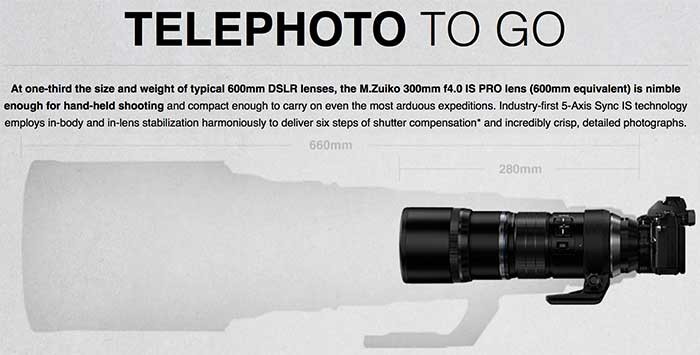
The Olympus 300mm ƒ/4 Pro is one heck of a lens. Simply put. After a long time in development — it was announced as “in-development” back at CP+ in 2014 — the biggest, brightest supertelephoto lens of the Micro Four Thirds system is, well, not so “big” after all, physically at least. An impressive feat of engineering, the folks at Olympus have managed to shrink down a 600mm-equivalent supertelephoto lens, with a constant, relatively bright ƒ/4 aperture and image stabilization into a remarkably small, comfortable, hand-holdable, weather-sealed lens.
Like Olympus’ other Zuiko Pro lenses, image quality from the 300mm ƒ/4 is thoroughly impressive on all fronts: excellent sharpness and all-around wonderful optical qualities with little to no distortion, aberrations or vignetting. What’s even more impressive is the lens’ stunning image stabilization. Combining lens-based and body-based I.S., the Olympus 300mm ƒ/4 Pro lets you capture handheld images down to shockingly slow shutter speeds. All this, plus impressive close-focusing capabilities, make the Olympus 300mm ƒ/4 Pro a stunning lens for the professional and advanced photographer looking for a top-notch wildlife, sports, stage performance and close-up lens no matter the weather or lighting conditions. It may be pricey, but this is one of the best lenses Olympus has made thus far.
73 Responses
The MTF’s are even better than the Pany/Leica Zoom (which is no slouch). Apparently the bokeh suffers like with my 40-150mm Pro….but I guess we just can’t have it all! LOL!
We can safely say that the new lens blows away the 75-300mm. WOW.
I wonder why this 300mm lens has to be bigger than the equivalent Canon or Nikon?
Perhaps the image circle on this lens is huge so that the MFT sensor can just use the sweetspot.
That fact is a little disappointing….but then..there is the new Pany/Leica Zoom to choose.
Good stuff for the system overall anyway you slice it. (except for he prices. 🙂
Yeah, I agree that the bokeh looks a bit busy on a few shots.
Yeah…doesn’t look like the bokeh from my Canon 85mm f/1.2 on my FF!!! LOL!
My Oly 40-150mm Pro is super-sharp..but the bokeh is just not what I would like. Great lens..absolutely…but if I need creamy/dreamy it rarely gives that. It would appear that this new lens is the same…You know that designers were well aware of it…but to get “the sharpest lens Olympus has ever made” (well..except for certain undisclosed situations with shutter shock on many of their camera bodies! LOL!), the bokeh had to suffer. I have this with other newer lenses that I own..it isn’t just olympus. My Canon 70-200mm f.2.8L IS is similar…Sharp as hell…but …..
Blame those aspherical elements they now put in everything. Sharpness is ugly.
I think it’s almost exactly the same size at the Canon 300mm f/4. The spec weight is higher but I think most of that is the difference between Oly giving the mass with the tripod mount and Canon giving it without. The mass isn’t a problem per se but IMO this lens needs the battery grip to be on the camera.
Well….I bet it’s better-made than that “particular”Canon lens…its a really old design.
Not really understand the shutter shock issue discuss in SLR gears. They got shutter shock with EM-1 mounted on the most steady tripod with or without IS, but one of the staff was able to get 100% sharp pictures testing it handheld from 1/1000s to 1/8s with dual IS turned on. What gives? Did the shutter shock disappear when someone handheld the camera? Not disrespect to the SLR gears’ reviewers, didn’t they find the results a bit strange? Why didn’t they use a remote trigger in their smartphone instead of using the 12sec delay timer on the camera?
“What gives?”
The tripod, probably.
The human body in contact with a camera can actually absorb and reduce the effects of high frequency vibrations.
I was thinking about a similar explanation as yours, but our hands can’t be that effective as absorber to reduce the high Freq ringing in the shutter buried deep inside the camera?
I posted this two articles back:
“Many years ago when people shot with film, a well regarded Japanese
wildlife photographer said the conventional-wisdom that you should use a
tripod to ensure critical sharpness at normal shutter speeds was wrong.
He
said you should only use a tripod to support and steady the weight of
the lens and that you should still hold the camera body and lens as you
would normally without the tripod, the reason being that he had found
through experience that the human body tended to dampen and absorb the
high-frequency vibrations caused by the mirror, shutter and aperture
mechanisms.”
And that is true.
Using body stabilisation can have the tail wagging the dog and make ‘shutter shock’ worse (imo it isn’t the shutter, it’s a vibration ‘node’) and Olympus do warn against using IBIS on a tripod, whereas using lens-stabilisation aids framing the shot with an extra-long lens even on a tripod.
Using an extra-long mounted on a fluid-damped head and cradling the camera back seems to produce the best results for me, with lens-IS (OIS) on. With an undamped extra-long lens using the E-M5ii with body-IS on is second best but better than no-IS on the tripod; with these extra-long lenses using one of the heavier backs like the GH4 seems to help counter-balance too.
So yes, holding the camera back dampens some vibrations even on the tripod. Why use a tripod? – a lot of extra-long lenses are so heavy it is difficult to keep them trained on the subject without a tripod.
Would using electronic shutter give better results on a normal tripod? Since there is no no actual impact from closing th shutter in the camera. Also, with a remote shutter control via mobile app
SS seems to show up randomly and at speeds around 1/120s. Could just be the handheld shots were above or below these speeds, or it may have been they used the electronic shutter when handholding.
They got 100% sharp photos at around 1/120s handheld with IS. No mention of it using electronic shutter or otherwise. Maybe you could be right about using electronic silent mode.
Good thing newer mft cameras have electronic shutter, will probably get rid of the shutter shock.
I can’t say that I’ve ever seen shutter shock with the E-M1, GH4, or GX8.
Then again, I’ve abused my Olympus 12-40mm f/2.8 and it never broke.
I have really bad luck.
“the folks at Olympus have managed to shrink down a 600mm-equivalent supertelephoto lens,”
What a load of BS! See, That statement was just stupid to make.
To put it correctly, “the folks at Olympus have managed to build a fantastically great 300mm supertelephoto lens”.
The “review” blurb reads like an Olympus press release. To claim it was an “impressive feat of engineering” to “shrink down a 600mm-equivalent supertelephoto lens…” is silly. Every 300mm lens is 600mm equivalent on a micro 4/3 camera, and this is about average weight for the 300mm f4 lenses out there–regardless of format–and significantly more than the Nikon PF lens. And it’s appx 3 times the weight of the old 75mm-300mm f4.8-6.7 zoom Olympus already had in its lineup. Of course, the latter is a slower lens, but it is a 600mm equivalent lens on this system.
For sure best stabilization system in the world,coupled with close focusing, make it best telephoto for shooting at butterflies handheld from ground level; evn more if coupled with on camer focus bracketing and stacking like in Omd em5 mark2/em1
This is still stupid. Take a 300mm from any manufacturer and adapt it to m43 and you will have the same range for lower cost. If you get a Canon mount one and an active adapter, you can even have AF (albeit slower) and IS.
Something may be stupid but likely not the lens. Having done exactly what you suggest — take a Canon 300mm f/4 and use an adapter — I can assure you that you are absolutely and completely wrong. You also don’t have to take my word for this. There are plenty of videos from others who have tried the same thing and reached the same conclusion. One was actually posted earlier on this site. Essentially FF lenses can’t keep up with the m43 sensors and image quality is along the lines of what you might get with the Oly 75-300mm consumer lens. However, you get that result at the price of a lens that is significantly larger and heavier than the consumer lens, though you do gain weather sealing and a brighter lens.
To be fair Full name stated you will have the same range for lower cost, not that you have flawless/ better image quality. I will also have to disagree with your remarks about FF lenses not being able to keep up, If you use the better ones they will deliver plenty. Cleary seen in this comparison that the 300 F4 IS isn’t really that sharp 😉 , 8ppix on f5.6 vs 19 for the 300 2.8@2.8 , at F4 the 300 F4 fares really bad (3-4ppix or so), so it’s pretty understandable you get along the 75-300 results, since that one is 6 max and 3-4ppix on the long end on an Em1
http://www.dxomark.com/Lenses/Compare/Side-by-side/Canon-EF-300mm-F28L-IS-II-USM-on-Canon-EOS-760D-versus-EF300mmf-4L-IS-USM-on-Canon-EOS-760D-versus-Olympus-MZUIKO-DIGITAL-ED-75-300mm-F48-67-II-on-Olympus-OM-D-E-M1__400_1011_263_1011_1110_909
Having no or slow autofocus isn’t really comparable but to some who can cope with manual focus you can find some nice glass for example the old canon FD 300 2.8 , 500 4.5 , which both can be found between 700 and 1900 dollars (depending on quality of lens and country the sellers are in). You get similar reach with the 300 2.8 and with the 500 have 2.77778 times the pixels on your bird.
Don’t get me started on that DxO site.
dsc09 is right. I normally rent Nikon for long tele but those lenses on an E-M1 can’t keep up. Maybe for non moving subjects etc but mostly it doesn’t work. If it did I wouldn’t be renting the combo’s from Nikon.
And what you suggest to do is maybe a solution for amateurs anyway.
I need to get back with results, there are no reruns in the real world!
That might be. I have not tested higher end primes from other systems. I will agree that my old Tokina 100-300 F4 minolta mount is very soft when adapted to my m43 cameras – of course I bought that for $300 used, in it’s defense.
I have a considerable investment in m43 (including the nocticron, the panasonic 35-100 2.8, PL 25 etc), but I am starting to feel that I am paying more for similar quality with this system than if I went with another system. It seems the small sensor, makes it much more expensive to make lenses that work well with them – and probably partially, due to low sales, they can’t sell as low as Canon/Nikon is able to.
I have to wonder if a Canon 400 f5.6 on a 50MP camera will yield better results for teleshooting than a 300f4 on an Olympus camera. Will it weigh more, yes. Is the lens slower, yes, but with full frame you have a lot to work with in terms of low light advantage etc.
PS: Your dig was a bit uncalled for.
“It seems the small sensor, makes it much more expensive to make lenses that work well”
More likely it is the fact that Canon and Nikon have economies of scale that enable them to sell at a lower price point. If Canon sold in the quantities that Oly do then the prices would probably be much closer.
“, but with full frame you have a lot to work with in terms of low light advantage etc.”
Odd, because when the E-M5 came out there were several sites that showed it was equal to, or slightly superior to, the Canon 5DII regards shadow detail and noise. And later comparisons of the E-M1 to 5DIII and Nikon D800 showed the differences were for most situations very small.
Now, if you want to lug around a set-up that is significantly heavier in order to realise those minor differences then please go ahead. For myself, I don’t really care. The only reason I still have a DSLR rig is because of the tracking AF.
The E-M5 is practically equal to Canon 35mm 5D(nr.x)
For better quality you have to go to Nikon or Sony, Nikon if you do work with non stationary subjects.
Yes, the dig was uncalled for. My apologies. I just get frustrated with the idea that a 300mm lens should have a light path which is shorter than 300mm.
Honestly the big issue for this lens isn’t the size or weight, those are what you’d expect, it’s that not a ton of people will pay for a lens with a the FOV of a 600mm FF lens. For most applications other than birding that focal length will be too long. This is the reason that, from a practical standpoint, comparing it to a FF 600mm f/4 is about right.
This lens has better image quality, better stabilization, and faster AF. If you are willing to compromise on all of those things for a lower price, the choice is yours! You are your own human being. 🙂
Yes it is stupid. If you take a lens from any manufacturer and adapt it you lose all the automatic functions on the lens. If you add in the Metabones active adaptor to a Canon EF, you get a more expensive lens with lesser glassware and degraded functions
It wouldn’t be more expensive though. It would still be cheaper, and you could use the same lens on a Canon camera if you own or plan to own one.
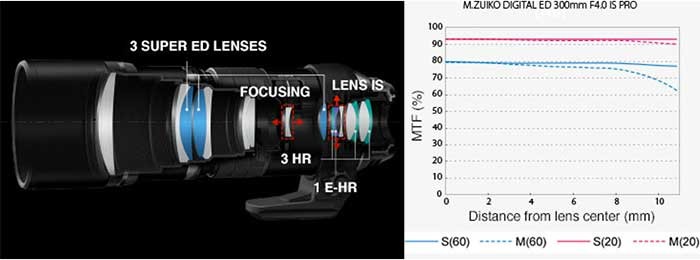
If you look at the MTF charts this lens is decidedly superior to the Oly 300mm f/2.8, which has been a very highly regarded lens. That is quite a feat.
For those complaining about the mass of the lens, in my experience, and up to a point, it’s easier to hold long telephoto lenses steady if they weigh more. It took me a while to be able to hold the Oly 75-300mm steady coming from the Canon L telephotos. It just takes more to move a heavier lens. The Oly consumer lens is so light it just flies all over the place. Even now, I find it difficult to hold steady consistently. But for this lens or the Panny 100-400mm, or likely any telephoto lens, I think you want to add the battery grip to the camera. Helps to balance the rig.
It is not easy to hold the 2kg 4/3 Bigma, so the 1.5kg Ollie 300mm will not be a lot of fun neither.
Holding an extra-long lens is an art, you have to learn to hold it still like a rifle, waving it around is no good at all.
Putting the grip on the E-M5ii just makes it bulky and uncomfortable to hold, with a big lens you are mostly holding the lens at CofG, and the bigger it is, the more tiring it becomes.
Looks like a great lens, but less impressive if compared to a 400mm on an APS-C sensor (also about 600mm FF equivalent). Waiting for the 100-400 reviews – who would have guessed that Leica would be cheaper – even if slower, not me!
Are you sure about that?
Canon 400mm f5.6 on APS-C
http://slrgear.com/reviews/zproducts/canon400f56/1blur-t.gif
Oly 300mm f/4
http://slrgear.com/reviews/zproducts/olympus300f4m/1blur-t.gif
Looks to me like its no contest which is better. Just not in the expected way!
You can bump yourself up to the $7000 400mm f4 DO if you want to get results that are still not as good.
http://slrgear.com/reviews/zproducts/canon400f4is2/1blur-t.gif
I was talking mainly about the size advantage – will you be able to see the difference (for the price)? The Canon is awfully good and can be had for under a $1000 used. Don’t mean to be negative, but … Personally, I’d like an updated 60mm macro lens, one without the ridiculous focus limiting switch – my hands are just too big for that fiddly little twirly thing.
Well that says it all, and make your post/comment totally ridiculous.
If you don’t have the experience, don’t judge, because it makes you look stupid for those that do know what they are talking about.
Yes, you sound ridiculous. The OLY 300mm is about the same length and is actually heavier than the Canon 400mm f5.6 L (both about 600mm FF equiv – 300mm on m43 and 400mm on APS-C.). Yes, it’s an f/4 and has IS, but it’s also TWICE as expensive ($1250 vs $2500 new @ B&H). It’ll be interesting to see how the new Fuji 100-400 stacks up size wise – could be smaller since it’s actually designed to cover the APS-C sensor, not FF. They won’t do it, but I wonder what Canon/Nikon could do if they ever decided to make a pro quality super telephoto for crop bodies. You don’t get ALOT more reach with a m43 as opposed to an APS-C – price and size matter. Priced for pros – are there that many pro sports/wildlife photographers using m43? IMHO – this is a fail on Oly’s part. Tamron / Sigma – you out there? How about some native sized m43 lenses at a decent price?
In my view, comparing this to an equiv FF camera/lens is a marketing gimmick (why not compare it to 4×5 view camera – just as silly) – better to compare to what the vast majority of people actually use – APS-C. They need to do better if they’re going to convince folks to dump the mirror slappers for telephoto work.
It’s a real pity I’m not interested in birds. There used to be a time when I bought nice optics for the sake of it (mind not at these prices), but I learned from my mistakes. Still have that 75mm collecting cobwebs in the dark. Great review though.
I’ll take it off your hands and put it to good use 😉 I’ll definitely end up buying one, hopefully this year. Although I’m not sure I’ll end up upgrading to em II this year or not.
I am honestly disappointed by the bokeh that is often nervous. It is almost identical to the bokeh on the 40-150 f2.8…..Otherwise: impressive…..but bokeh seems very important for such a lens. At least it is to me.
You’ve not used an extra-long lens have you. These lenses have a very shallow DoF which they try their hardest to design out, the object of the exercise is to get as sharp an image as possible, bokeh is therefore considered a fault.
If you want bokeh, use a portrait lens.
Bokeh is considered a fault? That doesn’t even make any sense, thats like saying “the amount if sharpness is considered a fault”.
What are you on about?
All lenses have bokeh. Even my $2 close-up lenses have bokeh. My mirror lens has bokeh. My 100mm f2.8 macro lens has bokeh. Bokeh refers to the parts that are out of focus. It is the subjective assessment of bokeh that people rant over.
I don’t care what others consider…I consider a smooth background with a sharp subject pretty much a golden combination. I understnad with mFTs and F4 it is a bit more difficult but I have the Panny 35-100 f2.8 which has a very nice bokeh and have seen the 40-150 Oly f2.8 which (like I said) has the same characteristics as this 300 F4. And I prefer the Panny which btw isn’t anything less sharp than the Oly.
Of course not. Bokeh is fine, and it is physically limited too. As you say, extra long lenses have shallow DoF. The larger the sensor, the shallower it is (provided you use the same aperture of course). If you want more in focus you have to go to an aperture that gives wider DoF(but this requires more light).
Certainly it can cause difficulties for instance in macro, where you need to do focus stacking, but in most cases, unless you run at maximum aperture and a large sensor camera, that bird or person you want in there will likely be fine. If you shoot nature and want everything in focus you typically don’t use a long tele, but if you do, you put it on a tripod take the aperture down, and shoot at a slower shutter speed/higher iso).
The one complaint I have seen with the Olympus is that the Bokeh is “busy”. You can look at examples, probably elsewhere in this discussion. The problem isn’t that it isn’t out of focus, but that the quality of the out of focus – the rendering, is not creamy and nice.
I agree, another reason to go for the pana-leica. These 2 Olympus pro lenses are impressive but the bokeh so “spiky” is definitely a issue.
Yes. It seems to be one of the side-effects of achieving ultra-high resolution.
It’s hard to get creamy bokeh when you need to make the very most of every one of your photosites the way we do on smaller high-density sensors.
It’s part of why my 6×7 Koni Omega looks so glorious, despite having a ho-hum 4-element 90mm/f3.5 modified Tessar.
“constant, relatively bright ƒ/4 aperture”
—
Managing to make it constant is a feat indeed.
A good example of marketing running out of superlatives to use.
Or rather, the marketing is run by parrots
I wonder if the focal length is constant also.
Definitely interested to see more samples that showcase the quality of the bokeh with natural backgrounds shot at f4 and at different but specified focus distances. The resolution looks great … better than the SLR Gear blur index seems to indicate. Why are they testing this on a GX1 anyway? They should at least use an Olympus body E-M5 or later since AA filter effects are virtually null on Oly bodies 2012 and on.
I’m just waiting for DxO to rate the lens very poorly or refuse to rate it at all. Holding off until 2018 wouldn’t be a surprise, though.
I don’t understand why a lot of people and reviewers compare this lens to the 600mm f4 ff. Physically and optically, it is a 300 f4 and should be compared to siblings or to a 600 f8 ff to be fair. I suddenly find it awfully expensive for a 300mm f4
You don’t understand?
OM Zuiko 600mm f6.5 – 4 degree angle of view
Nikon AF-S FX NIKKOR 600mm f/4G ED – 4°10′ angle of view
M.Zuiko Digital ED 300/4 IS PRO – 4.1 degree angle of view.
See any similarities there?
If you think the Zuiko is pretty expensive for a 4° lens, the Nikon might be more to your taste at $10,000
He understands pretty well. Both deliver the same AOV, but not the same image due to differences in DOF and S/N ratio at the same f-stop (reflected in twice the aperture diameter of the FF lens). If I wouldn’t earn my living with wildlife and sports photography, I would go with the Oly, too, very clear for me. If I did however and wanted to get fine art prints at large sizes, the better noise performance and DOF control I have with FF would make me accepting the larger bulk and weight. However, that’s me, everybody has to decide for themselves.
With 6 stops of IS there should be next to no need whatsoever to use ISOs high enough to detract from image quality. The S/N red herring is only relevant to Trolls.
I have only checked 4 images, and in those Ian Flemming used ISOs from 320 to 1600 and they could be printed at large sizes as commercial prints with no problem. http://www.ianflemingphotography.com/#!olympus-300-mm-f4/c1xcj
On Amazon US the D7200 is $1096 and the E-M1 is $1099.
How much better did you say the S/N ratio was again?
If I shoot a moving subject, I need a minimum shutter speed. So 6 stops doesn’t help you that much in this case if 1/1000 or shorter is required. S/N ratio gives you about 2 stops on FF cameras and about 1 for APSC. However, as we talk about a 600/4 FF lens(!) your point about the D7200 is moot. This S/N thing is certainly not a troll-thing, especially if you shoot wildlife at dusk or dawn, where you are very fast at higher ISOs combined with higher shutter-speed or sports indoors. So calling everyone directly a troll who thinks this important just shows your ignorance and fanboyism. ISO 1600 is oftentimes too much with m43 for me for large prints. When shooting weddings, I try to stay around 1600-3200 maximum with D750 or A7rii as I don’t like the noise taking away detail. But again, personal preference.
A D800 is $2,859 A Nikon AF-S FX NIKKOR 600mm f/4G ED is $9,394. For a total of $12,253
Saying $3600 worth of equipment can’t match $12253 worth is being a Troll.
Post a photo you have taken with a 600mm or greater lens on FF of a moving subject, after dusk with a shutter speed of 1/1000 or greater and I will apologise unreservedly.
It is not about price here. Nobody says you can’t get a good image with m43. If I were a professional wildlife/sports photographer, I would go with the expensive and heavy FF. It is Olympus, showcasing the lens directly against a 600/4, as seen here on this site in the composed image and advertising it as an alternative with awesome IQ and much cheaper, leading to the original comment above. So as this lead to the comments here calling us trolls is ridiculous. It is easy to google images of wildlife photographers having high shutter speeds, so what is so special about this? Do you think you can take images of BIF at 1/50s at dawn?
I don’t agree with you – end of.
I think people miss the point. The point is: if you used a 300mm F4 full frame or APSC lens on m43 through an adapter, WHAT would it compare to?
Thus, if this lens, all other things like performance being equal, is larger than even an APSC 300mm F4 lens, the size is not worth it… especially for a smaller sensor!
For comparison, the Sigma 300mm F2.8 FULL FRAME weighs at 2.4 kg (no OIS but a full frame lens that is a stop brighter).
The Canon EF 300mm F/4L weighs in at 1.2 kg FULL FRAME (this is L glass, has OIS and weighs LESS!).
Canon EF 300mm F/2.8L IS USM weighs in at 2.6 kg for FULL FRAME (is one stop brighter, has OIS and is weather sealed).
Nikon AF-S NIKKOR 300mm f/4E PF ED VR weighs in at 0.8 kg for FULL FRAME LENS (has OIS).
The price varies and you would have to carefully check performance on a m43 sensor, but ALL of the above 300mm lenses would give you the same 600mm “equivalence” on m43 through an adapter… some would be brighter!
When full frame lenses at 300mm, and more so APSC lenses, can be made lighter and or cheaper, you have to wonder what you are getting from the Olympus 300mm. Or why a native m43 lens cannot be made lighter than a full frame lens? Can you tell me?
The optical performance of the Olympus 300mm would have to be stunning and the OIS almost magical to make it all worth to me. I will wait for reviews and then decide… meanwhile I think I will just add the 40-150mm to my primes and do without a 300mm.
I have an OM Zuiko 300mm f4.5 which I use on my E-M1 using an adapter. It ‘only’ weighs 1080g, but only has 6 elements – not 17! (The Nikkor must be plastic)
Trouble is, it’s AF speed is infinite, it’s image quality is mediocre and it has no intrinsic IS and it’s not weather-sealed.
I think I get the point.
Yes, agreed. My point was not that using adapters is good, but to demonstrate that the Olympus 300mm should be compared to other 300mm designs… plus, I wonder how lenses like the Nikon and others can be made so relatively light, because it follows that if you made NATIVE m43 versions they could be even smaller.
I’d much more prefer native m43 versions of such lenses.
I am also wondering about the Nikon and will research its reviews, but even aside from the Nikon, the other designs also produce lighter lenses.
Finally, if the Olympus 300mm beats like for like image quality of the other lenses on m43, it may actually be worth the weight and price, but for me it will take a while to work this out.
I am not stressed about any of this as m43 is my backup system and I can afford to wait for things to sort themselves out.
The Oly is a great quality lens and the price is reflecting that.
I still think it’s expensive for a 300mm F4.
For that $10,000 you also get a 900mm F4 with a Nikon DX.
Nobody ever thinks anything made by Olympus isn’t too expensive. Buy the Nikon then, it’s obviously a tremendous bargain.
I mainly use the wider aperture for one of the old-school reasons – getting a faster shutter speed. When I am using my DSLR rig if I could use my telephoto at f4 with the DOF of f8 I would be one happy bunny.
So in that respect, yes the 300mm f4 on MFT can be compared to the 600mm f4 on FF.
You could use higher ISO, couldn’t you?
I could, yes, but there comes a point that it is better to use a wider aperture.
But that doesn’t negate my point.
Agreed, they need to convince the vast majority of amateur (most are) wildlife photographers (birders especially) who now largely shoot APS-C bodies (from what I’ve seen anyway) that there is an real advantage to going m43 for telephoto work. They were never in the market for a full frame camera and 600mm lens anyway. So, why would they dump, for instance, a Canon 70d and the 400mm f5.6 L for an EM1 w/ 300mm pro (both 4° AOV)? The Olympus is better in many regards, but is it that much better? The body is smaller, but the lens isn’t really (actually heavier) and I could probably buy the 70d and 400 for the price of just the Oly 300. You have to get them in the tent first and this just ain’t it. I’m sure this will appeal to many, but ………. I don’t see it expanding the m43 user base.
As usually the Olympus lens are tack sharp across the frame. Panny 100-400mm, like 12-35 and 35-100mm, has inferior IQ at the corner… not as sharp as Olympus PRO.
But $1800 price is hard to beat. Guess it’s a choice to everyone.
“Panny 100-400mm, like 12-35 and 35-100mm, has inferior IQ at the corner” – based on what?
I wonder what you guys think about the theory that the more glass elements a lens has, the less “pop” (depth rendering) the picture shows. See http://yannickkhong.com/blog/2015/11/14/is-m43-flat-the-side-by-side-comparisons
Now the new 300mm lens has 17 elements – much more than any of the tested lenses in the linked article. I wonder if the results would be “flattish” more than justified by the focal length alone.
P.S. I personally had a hard time to discern the different depth rendering in that article.