









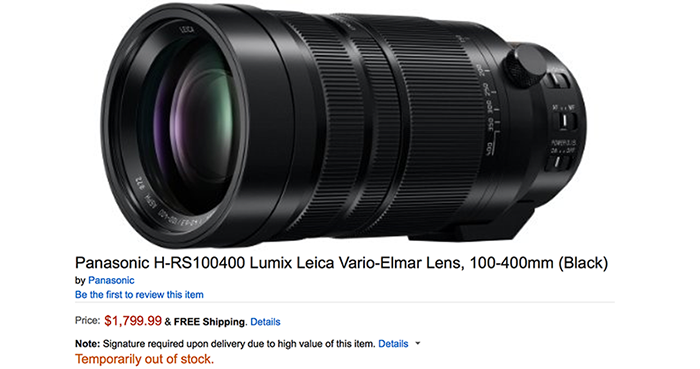
You can now preorder the new Panasonic 100-400mm Leica MFT lens at Amazon US (Click here). As you know also the Olympus 300mm PRO lens at Amazon US (Click here)!
Product Description
Panasonic LUMIX Mirrorless Micro Four Thirds lenses deliver a no-compromise approach to optical performance for modern interchangeable camera enthusiasts. As an optical partner of legendary LEICA Lenses, the LUMIX *100-400mm F4.0-6.3 Lens features the highest standards of detail and sharpness. Built for the outdoors, this lens features a splash and dustproof design when mounted on a compatible LUMIX G Mirrorless camera. With Dual I.S. (Image Stabilization) compatibility you’ll shoot with unprecedented hand-held stability. Make the switch from bulky DSLRs to the smaller, lighter, more compact Mirrorless Micro Four Thirds system cameras and lenses from Panasonic LUMIX. (*200-800mm 35mm Camera Lens Equivalent)
Thanks Zapa!
71 Responses
Let the price debates begin.
Why debate? They’re two different lenses for two different kinds of shooters, both of which will likely be spectacular.
” both of which will likely be spectacular.”
How do you know? Neither Pana 35-100/2.8 nor 100-300 are anywhere close to spectacular at long end. And f/6.3 is already noticeably diffracting in m43.
For example:
http://www.lenstip.com/upload3/4293_roz.png
As you can see, diffraction is starting to reduce resolution even on 12mpix sensor (in this test) on f/5.6 already, f/6.3 is even deeper, there is no way it will even reach 70 lpmm on MTF50 due to diffraction.
He didn’t say “I know both will be spectacular”
Why wouldn’t you use the 35-100mm chart?
http://www.lenstip.com/upload3/3831_roz_centr.jpg
The one that shows performance improvement at 100mm up to f5.6…
Or perhaps the extremely consistent performance of the Panasonic Leica 14-150mm, the only PanaLeica-branded zoom for 4/3 sensors available to date?
http://www.photozone.de/olympus–four-thirds-lens-tests/455-leica_14150_3856?start=1
http://www.photozone.de/images/8Reviews/lenses/leica_14150_3556/mtf.gif
Why do you use 14-150 which is not especially sharp lens to begin with, and has 5.6 as a fastest aperture at the long end anyway? It is simply not diffraction-limited, it has other problems.
Funny how all the reviews of the 14-150 suggest that it is in fact a very sharp lens? Perhaps they used a different lens for their testing? Remember, those numbers are from a 10MP camera…
And the Canon 7D II sees diffraction at the same aperture when paired with the 100-400mm 4.5-5.6. Why not fuss over it, too?
The Canon is 5.6 at the long end, not 6.3, giving it the edge in diffraction to begin with. And I assume you are talking about 4/3 crop of the sensor, because for the full APS-C diffraction softening is shifted by ~half a stop or so (say, you need 640mm equivalent FL in this case, not 800mm-e, then you can use the full sensor in the Canon, and anywhere below 800mm eq you will use bigger part of the sensor than the full 4/3 sensor with the same 100-400 lens).
Obvious troll. Diffraction is only really an issue on f11 and higher, and 35-100mm is spectacularly sharp for a zoom.
Diffraction on m43 _starts_ (does not matter that f/5.6 on m43 is bad, just a little less good) to degrade sharpness even on f/5.6 (at least on sharp lenses, where other problems do not make even f/4 sharpness low), and 35-100 is not “spectacularly sharp” on the long end at f/2.8 (and edges even at f/4).
Judging from the above the FZ1000 28-400mm f2.8-4 with 1″ sensor should do quite well in comparison with most tele zoom lenses on m4/3 and cost only $600 currently. I am assuming that for 1″ sensor that diffraction reduces resolution at aperature past F4
For the 20MP 1″ sensors, their diffraction limit is about f4.5
For 16MP 4/3″ sensors, it’s approximately f7.1.
But diffraction really isn’t the only indicator of image quality, obviously…
It is 25-400 EQUIVALENT, not real 400mm (9.1-146/2.8-4 real). You’ll need to crop FZ1000’s “400mm” end 2x to have the same reach as 400mm on m43, and then it is not the same at all.
Fuji X-S1 and Canon G3x are closer competitors among the fixed lens cameras.
The 35-100 is very sharp on the long end. I agree on the 100-300 though. It gets pretty soft (and I hear there are a lot of sample variations on it)
35-100 is only sharp at 100mm when stopped to f/4 in the center and all the way to f/5.6 on the edges:
http://www.lenstip.com/upload3/3831_roz_centr.jpg
http://www.lenstip.com/upload3/3832_roz_brzeg.jpg
Resolution/sharpness degradation towards smaller apertures is not necessarily caused by diffraction alone. It is not unusual that two similar lenses degrade differently. Compare the M.Zuiko 60mm f/2.8 Macro against the Zuiko 50mm f/2 Macro, and you will notice that the 50mm can be stopped down to nearly f/11 before it degrades as badly as the 60mm already does at f/8. (While, in reality, the 60mm is still perfectly good at f/8 and the 50mm at f/10 or f/11, too.)
A specific MTF diagram that shows a specific degradation toward smaller aperture therefore does not evidentially show the effects of diffraction for the format.
Where can you compare the lenses tested ON THE SAME CAMERA? And what causes degradation other then diffraction?
BTW, diffraction is different for different aperture shapes, the more closed aperture differs from circular shape, the bigger will be effects of diffraction.
I own both lenses (50mm and 60mm), so I can compare, and because of the results I won’t sell the older one any time soon (the newer is better wide-open, though, and needed for focus bracketing because Four Thirds lenses aren’t supported for that). Both have similar diaphragm shapes (7 blades, hardly rounded; if of one of the two has a more rounded aperture, it’s the 60mm). What is it that causes the differences in degradation? I have no idea for an answer, except “something in the optical formula”…
Yeah that’s the part a lot of people seem to be failing to grasp. Great to have the choice and hopefully both turn out a decent tracking AF performance too. But Oly need to take a good hard look at that launch price (in my own opinion anyway!)
Have you seen the continuous comparisons between the oly and panny? Price will be compared regardless if it’s a different lens for different purposes, from reading on here people seem to be choosing their lens based on price instead of purpose.
People who want/need the Oly, but don’t like its price tag will say this should’ve been the Oly’s Price, that it’s better and more versatile at a cheaper cost yada yada yada, you get the point 😉
Better than expected. Sure it is pricey for a relatively slow lens, but I am guessing the optics will be great. I might have to sell my 100-300 and get this. I will wait for reviews of this and the oly 300 f2.8 though. That will likely cost more, but maybe worth saving up for it.
I agree with you, this lens looks very promising and the price is justified in my opinion
I was referring to price debates between the Oly and Panny 😉
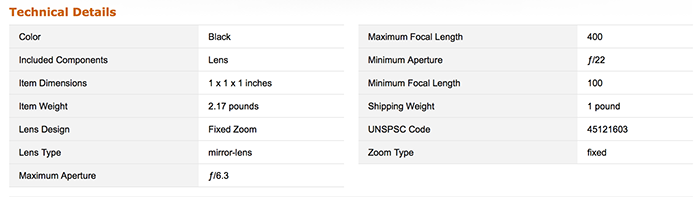
Oly’s extreme portable 300mm is having 27lb weight, according to its own ads, and this Pany lens has 1lb shipping weight. WTF
This is some sort of a leak from inside Amazon, I think, because:
1. The data not fully filled (thus the 1lbs weight and 1 x 1 x 1 dimensions)
2. You can’t find the product pages by normal means: the lenses – 100-400mm and 300mm – are not showing up in the search results.
Some helpful guy/gal from Amazon was kind enough to leak the links IMO.
an obvious typo, its 2,7 lbs aka 1,2 kg
we all know that. the pt is no one on both sides is doing proof-reading.
Price will probably drop under $1500 by year end. This lens plus the 40-150mm F2.8 would make an amazingly versatile wildlife kit.
150/2.8, with 1.4x tele (210/4), cropped to 400mm (simply engage “2x
teleconverter” in the Oly camera for 420/8, or digital zoom in a pana
camera for smoother crop), is approximately equivalent to f/6.3 anyway
(in terms of total light and noise in the picture). Very little point in
having this lens _if you already have 40-150/2.8_, the teleconverter is
cheaper and smaller in your bag.
Too bad Oly does not have x1.7 or x2 teleconverters to fully use the spectacular central resolution of some of its lenses.
This definitely puts the price within reach, especially considering the perfect body to mount it to (GX8) is usually under $1K. I am betting the optics are stellar. Interested in how this lens stabilizes with the GX8’s hybrid system compared to Oly IBIS and how quickly the aperture ramps when zooming.
Now that’s more like it!
Yep, I’ll be going Panasonic. It should be fine on my Em1.
In the end who cares whom makes the lenses if they are optically good, have fast AF and are priced reasonably!
Panasonic does UV filtering on the sensor while Olympus does it on the lens. So a Panasonic lens on an Olympus bodies will show more PF and it is not automatically corrected.
I highly doubt your comment about the lack of UV filtration on the Olympus cameras, but even if true, how expensive may it be for anybody to put an extra UV filter on the lens, any lens?
Eno, it is true. This is why the Panasonic 7-14mm shows “purple flare” on Olympus sensors. And also why people use a rear filter modification with a Wratten 2A gel (heavy UV filter), and like magic the purple flare disappears on Olympus bodies.
As you say, a strong UV filter would be a simple way to get around it, especially since this lens has conventional filter threads, unlike the 7-14mm.
This is only anecdotal evidence. It sounds really strange.
If you have a problem when not using a UV filter, and you don’t have the problem when using a UV filter, that’s not so much anecdote as science. You’ve got a hypothesis, you test it, you record the results, and you form a conclusion.
I can link to a number of posts of people who have tested this if you don’t want to take my word for it.
Well I found it with google and the explanation are somewhat more elaborate.
http://alanwatsonforster.org/writing/mft-purple.html
The explanation is that the sensor filters have different cut of frequencies. Nobody claims olympus is missing sensor filters.
For a varity of reasons; only use pana lenses on pana bodies and vice versa. 😉
Olympus is “missing” sensor filters that cut out a specific frequency of light – as any filter does. That’s not a problem for Olympus users who exclusively use Olympus lenses, because Olympus lenses put the “missing” filtration range (390-430 nm) into the lens coatings, instead of the sensor.
Panasonic, on the other hand, filters out those frequencies on the sensor, instead of with the lens coatings.
Neither approach is better or worse than the other. They are simply different.
The Panasonic 7-14 is a pretty old lens.
Eh nope.
Whats that small turning knob for?
Switch from landscape to portrait.
Yes, rotating the tripod foot.
Have Panasonic stated the number and shape of the blades in the diaphragm? At f/6.3 max aperture (at 400mm) and being used at essentially a 2x crop from probably a bit of a distance to the subject, I’d be concerned about how messy the backgrounds will look from this lens. Hopefully that’s been addressed as much as possible in the design though? And please tell me the hood is longer than it looks?!
The hood does seem shallow and I question how much it can limit flare.
That’s the issue with a zoom, you need to size the hood for the wide angle.
That said, coatings these days are much more critical than hoods in limiting flare.
The issue is that Panasonic lenses seem to be more prone to flare than most other lenses. Panasonic doesn’t seem to have a very good lens coating. A shallow hood will not help and may have an impact on contrast..
“Panasonic lenses seem to be more prone to flare than most other lenses”
You do mean when fitted on a Olympus body, right? Because flare and CA is controlled and fixed on lumix bodies in camera.
And let’s be honest, we’ve seen lenses with large petal shaped hoods, showing flare. You cant stop all of it, especially when it’s the lens job to let in light.
Flare is not corrected with software, how could it be? It’s essentially random and causes huge loss of image information that can’t be reconstructed.
Purple fringing / chromatic aberration, on the other hand, is fixed for Panasonic lenses on the E-M1, at least. It’s geometrically simple and easy to fix automatically, even with no built-in correction, using software like LR.
The purple flare issue on Olympus bodies has to do with Olympus’ on-sensor UV filter. Extensive write-up here: http://alanwatsonforster.org/writing/mft-purple.html
But this is much less of an issue with a telephoto zoom because the degree of the field of view barely changes (compared to a normal zoom for example).
There is no hood on the pic
Hood not extended.
http://ecx.images-amazon.com/images/I/81a2sk2PmTL._SL1500_.jpg
Hood extended
http://ecx.images-amazon.com/images/I/816w%2B0TLhsL._SL1500_.jpg
yeah exactly. That doesn’t look very long. Perhaps it “telescopes”?
Yes, it does telescope.
It’s a Panny/Leica lens, I doubt they half-assed this lens.
It has 9 round blades.
thanks (i was curious!). should be pretty decent then?
So there is no availability date listed yet ?
End of March.
The Leica DG Vario-Elmar 100-400 f / 4-6.3 ASPH. is available in March 2016 for an estimated retail price of 1699 euros.
Where did you see that ? Isn’t it for the Oly ?
I guess Amazon only sends you half the lens at a time? Item weight 2.17lb, shipping weight 1lb?
I think it is more impressive that it somehow folds down to 1x1x1 inch.
Will be shipped in installments, assembly and gluing are required after receiving…
You know that refers to the size of the box right?
Now the Amazon link is dead: “We’re sorry. The Web address you entered is not a functioning page on our site”
“mirror-lens”? That sounds ugly, like those old 500mm telescope-like lenses that produced odd effects.