









UPDATE: You can now preorder the new Olympus 300mm f/4.0 PRO lens on Amazon US (Click here).
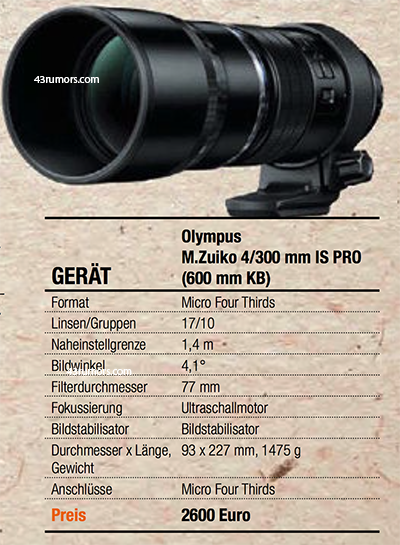
A readers sent me that image and the specs of the Olympus 300mm PRO lens that will be announced on January 6th. Don’t know where he got them (some German magazine or store brochure). Specs:
- 300mm f/4.0 IS PRO (600mm equivalent)
- 17 lenses in 10 groups
- 140cm close focusing distance
- 77mm filter
- 93x227mm, 1475g
- In lens stabilization (up to 6 stops!)
- weather sealed
- Price: 2600 Euro
- Shipment in March
The text I received from the source also says:
- The Olympus lens weights 4-5 kilo less than comparable 600mm FF equivalent lenses like the [shoplink 57342 ebay]Canon 600mm IS USM[/shoplink]. On Amazon the Canon sells for $11,500 (but the Canon FF lens gathers more light as it’s designed for FF cameras).
- Another advantage of the new Olympus lens is the stabilization system which is said to be best of the world.
Stay tuned on 43rumors. Follow the live announcement on January 6 at 6am London time here on 43rumors.com
—
For sources: Sources can send me anonymous info at 43rumors@gmail.com (create a fake gmail account) or via contact form you see on the right sidebar. Thanks!
To get notified on all upcoming news and rumors be sure to subscribe on 43rumors here:
RSS feed: http://www.43rumors.com/feed/
Facebook: https://www.facebook.com/43rumors
Twitter: https://twitter.com/43rumors
GooglePlus: https://plus.google.com/+43rumors/posts
Rumors classification explained (FT= FourThirds):
FT1=1-20% chance the rumor is correct
FT2=21-40% chance the rumor is correct
FT3=41-60% chance the rumor is correct
FT4=61-80% chance the rumor is correct
FT5=81-99% chance the rumor is correct
246 Responses
“The Olympus lens weights 3-4 kilo less than comparable 300mm f/4.0 lenses from other companies”
No it doesn’t.
I guess what admin referred to is 3-4 kg lighter than a comparable viewing angle e.g. 600mm F4.
Now since the existence of smart adapters, we can adapt lenses from other formats with AF and a comparison, in particular optical performance and AF speed for tracking, will be interesting for price conscious buyers, who want to explore the extreme telephoto world.
I’m sure that this lens has some qualities that don’t directly appear on the test charts.
Even that doesnt compute. The Nikon new 300/4 on a D7200 just to take an example; in the hi-speed crop mode gives a similar VOF.
weights more than Canon 300 4 IS…. Looks like a horrible fail at this pricing
Horrible win when it hits olympus “refurbished”…..
In the US Oly refurb are still expensive, often just 10-20% off new and still way more expensive than grey imports from Hong Kong and Japan.
Besides, Tamron SP 150-600 for FF is only $1000 and gets you better results on any FF camera.
And the Canon 300mm f4 is only $1,300. Look, I get that the Oly has the field of view of 600mm… but the construction is EXACTLY a 300mm F4 lens like this Canon is, it is not the same type of construction as an actual 600mm lens. just like my point and shoot 200mm equiv. field of view ain’t the same thing as my Panasonic 35-100mm f2.8. That price is absolutely ridiculous.
Ouch. That seems a bit heavy and expensive.
Unfortunately it’s heavier than the Canon EF 300mm f/4 (that is 1.2 kgs)
And i know lots of you will say “It’s worth the price”, but none of you will buy this lens. Period.
Wouldn’t it make sense if people that can afford it would consider it if they feel like they need it. Period?
Same magazine has the Papasonic specs too:
20 elements in 13 groups
close focus distance: 1.3m
filter thread: 72mm
size: 83x172mm
weight: 985g
I have ro say: probably going with Panasonic this round!
edit: listed weight for the Oly is with tripodmount attached. Without it is 1270g
Price?
Source?
“same magazine”
I can tell you it’s called Colorfoto. I have it roo and it lists both lenses
Just upload the images in this thread!
I just went through the January edition of ColorFoto and there is no detailed information for this lens. I am not sure where he got the information.
2/2016
no. if it’s that important to you, buy the magazine – they have to live of something too. Admin gonna post it tomorrow anyway I guess
Joke of the day; do you see the 43rumors source on the printed page?
Here are the images from the magazine
I just went through the January edition of ColorFoto and there is no detailed information for this lens.
2/2016 page 8
Abit expensive isnt?
but with the 6stops of IS. I wonder how good it will be when combine with IBIS. will we have 10stops…
Haha, only you wish :D. 10 stops will provide less than 1 sec shutter speed 😀
“but the Canon FF lens gathers more light as it’s designed for FF cameras” – yup, it does. but proportionally more, as it has 600mm, not 300. so it’s 600/4, not 300/4
I’m not too worried about it. I have scheduled a surgery in February to remove and sell my kidney. This should cover the cost of it by March….
I told you…GAS
Nikon 300/4 PF VR, full frame lens, with image stabilization, only 755 g…
And $2000.
That picture looks so fake 😀
Twice the weight and higher price compared to Nikon 300/4E. It’s like they want so many sales so they could count them using only their fingers. On one hand.
Woah!
Today’s word is: Inventory.
This is starting to remind me of four thirds, and the huge amount of unsold Olympus lenses, that everyone said “are the best”, yet nobody buys them…
I see a huge refurbished sale coming soon after…
Yeah, unfortunately Olympus no longer gives us Canadians a refurbished option.
Don’t they just sell them through places like Henry’s in Canada, rather than directly?
I don’t get why people are disappointed. It’s fov is equivalent to 600mm FF, of course it’s large and expensive! I really wonder why people compare it to 300mm FF lenses. Aren’t we doing equivalent focal lengths for super tele or what?
Any FF 300/4 is equivalent to 600/8 when put on top of 4/3 sensor, it is just the 4/3 camera will ignore 3/4th of the light gathered by the lens an FF camera would capture. FF 300mm should be bigger and heavier because of this need to capture 4 times more light and distribute it more or less evenly over 4 times bigger surface area.
0/10
To the product management of this lens, or to the people who don’t understand equivalency?
I thought you were trolling, honestly. I’m still unconvinced by your arguments. I’ve skimmed over some article for “aperture equivalence”, and they all talk about how “total light” is bigger for FF lenses, and that’s why m43 f4 would be f8 on FF … Yet, the light intensity for a m43 f4 is the same as the light intensity for a f4 designed for FF. Also your argument:
> Any FF 300/4 is equivalent to 600/8 when put on top of 4/3 sensor, it is
just the 4/3 camera will ignore 3/4th of the light gathered by the lens
an FF camera would capture
seems just wrong to me. Sure, the 43 sensor “loses” light because it’s smaller than an FF sensor. But the amount of light that hits the actual sensor surface is be the same as if the sensor was FF! If you were only considering the 43 surface area in your FF sensor, you wouldn’t say “this part of the surface only receives light equivalent to an f8 lens”. So why should the aperture be f8 in 43? Doesn’t make sense.
I doubt I’ll ever understand this, but you may try to convince me. However, if you are trolling, please don’t waste my time.
It only makes sense in the narrowest view where it works. .. however their own argument makes a f2f camera perform worse than a m43 camera as an f8 lens requires 2 stops higher iso… which leaves worse iq in the larger sensor camera.
2 stops higher ISO in FF is the same as m43 if sensor technology is the same. FF ISO 400 looks similar as m43 ISO 100 in terms of noise, because shot noise does not depend on ISO as strange it may sound, it only depends on total light captured, for the same scene brightness and final picture brightness raising ISO by the factor of 4 means cutting shutter speed by the factor of 4, cutting light captured by the factor of 4, raising relative noise level by the factor of 2 (shot noise is proportional to sqare root of number of photons).
sorry for my bad english:
no, that is wrong.
iso Performance, w.m. low noise, sensor size does NOT matter.
sensor technolgie is the only thing that matters, not the size.
take a full Frame sensor, crop a 43 Picture.
same noise.
take a ff sensor with 80 megapixel and the gx8 sensor (20 mp)
some noise Level.
take a bsi senor and a non bmi sensor, same size:
the bmi sensor will have less noise.
take the sony 20mp 1´´ bsi sensor and the sensor off a Canon 5d (ff, 12mp)
the fullframe sensor will have more noise.
when u compare sensors with different sizes, look at the pixeldensity, and not at the size.
For the same fstop, shutter speed and ISO, sampled to the same number of pixels (or equal number MP) for the same output size you have a 2 stop higher S/N ratio with FF, but also shallower DOF.
yes, but this is because of the Pixel density and not because of the sensor size.
the sensor size does not matter.
and whem you put a 200mm f2.8 on a ff camera or on a 43 camera, you have the same dof.
you cannot calkulate with the field of view. only the focal lengh matter.
sorry for my english
Sensor size plays the role here. Take a 25mm at f2 ISO200 and compare to 50mm f2 Iso 200 on FF. You have the same light intensity per area (f-stop) but a four times larger area with FF, giving you more light leading to a larger signal and therefore S/N ratio. But DOF is different (more shallow). In the DOF equations (same distance, FOV) you have the circle of confusion coming into the formula which is taken different for different sensor sizes.
sorry, thats wrong. light does not behave like water.
ist light!
of course, its differrent when u using 25mm or 50mm. and there is your mistake.
u put a 25mm on a 43 camera (field of view 50mm) and compare ist to a 50mm lens on a ff camera. (field of view 50mm)
and now u compare different lenses like same focal lenses.
the field of view is not constant!
Take both to be 25mm then. Doesn’t change the fact that you have higher S/N ratio with the larger sensor for the same f-stop and shutter speed + ISO. The thing that changes now on FF is DOF if your subject distance is the same but focal length changes. The water analogy is often used when talking about things like this, see here for example: luminous-landscape. com/dxomark-camera-sensor/ (was free until recently).
“sensor technolgie is the only thing that matters, not the size.”
Wrong. You think that Pana FZ200 with f/2.8 lens is the same as D4s with f/2.8 lens? Wrong, wrong, wrong. That Pana gets noise even at base ISO100, about the same as D4s at ISO3200, in full conformance with PHYSICS. Learn it.
peevee,
you must look on the Pixel density and not at the sensor size.
thats why the Nikon has lower nosie than the fz200 and not because the Nikon has a bigger sensor.
bigger sensor —–> lower noise: is wrong.
again, crop a full Frame sensor Picture to a smaller size. the noise will be the same.
For total light calculations, including shot noise it produces in the final picture, pixel density does not matter. Total area multiplied by intensity per area. It could be one big pixel, or no pixel at all but just a piece of paper for example.
300mm is 300mm ist 300mm. ist easy.
take a full Frame Camera with a 300mm lens und crop 43 sensor size out.
your field of view is 600mm, but the lens is 300mm.
the f stop is on the lens, f4 is f4 is f4, no matter if it is a 43 sensor, aps c or fullframe.
This is correct.
YES! LOL!
Don’t skim, just read the DPR article, it explains everything in detail. Although there is really nothing to explain, total light captured in a given amount of time is equal to light intensity multiplied by capture surface.
Higher blur if out of focus areas is just a consequence of that – that extra blur is caused by all that extra light captured from out of focus areas, which is obviously not focused on the sensor either.
Because it’s the sensor that makes it a 600mm equivalent. Optically, this lens isn’t remotely similar to a true 600mm. It’s a 300mm lens, and should be priced accordingly.
> a true 600mm.
What that supposed to mean?
Or is it the continuation of the full frame trolling? AKA “the true photographic format”?
Sigma has a 150-600 lens for a grand: http://www.bhphotovideo.com/bnh/controller/home?O=&sku=1082154&gclid=CjwKEAiA5Ji0BRC5huTCyOTR3wISJACH4Bx4PhbaaPTDTRUfbCe5P6aHkcYpd-vjxbjXvW8QU4xFfxoCPNzw_wcB&Q=&ap=y&m=Y&is=REG&A=details
Yow.
In terms of physics it’s a 300mm lens. Same amount of glass , metal and plastic to build it. It is NOT a 600mm lens…no matter what the equivalency.
I thought you and others here know that we (on all crop formats) shoot/use equivalent FLs. I dont know how you but when I want to shoot with 50mm FL (FF EQ) I grab my 25mm Summilux F1.4.
So yes, this lens is 300mm/F4 but from effective FL point of view it is definitely 600mm/F4 (DOF = F8). With 300mm/F4 FF lens on FF body I get only a half of Oly’s reach.
Not just dof but total amount of light is like f/8 on FF. It is just compressed onto a 4 times smaller image circle, producing f/4 intensity (but again, only at 1/4th of the area).
yes, of course, but a Canon 600mm lens is huge and way harder to build and should cost tons more. (oh…wait…it does cost tons more. LOL!!)
This Olympus lens is the same size of smaller than a Nikon or Canon 300mm lens. Do you just ignore that 300mm is on the side of this lens?
LOL!
Ridiculous pricing, and even more ridiculous to compare it to the Canon 600mm.
“The Olympus lens weights 4-5 kilo less than comparable 600mm FF equivalent lenses like the Canon 600mm IS USM”
It is not comparable. It is comparable to 600/8 mirror lenses which are much lighter and at least 10 times cheaper (but MF).
http://www.ebay.com/itm/Sigma-600mm-F8-Mirror-Lens-for-Fujica-X-Mount-35mm-Cameras-Tested-Guaranteed-/141863883145?hash=item2107bf1189:g:IY0AAOSwt6ZWVe9K
Or one for a Sony which is AF.
This one is for Sony:
http://www.ebay.com/itm/Sigma-Minolta-A-Sony-600mm-F8-Mirror-Telephoto-MC-Lens-Caps-Hood-600-8-/252230993141?hash=item3aba2384f5:g:vT4AAOSwDNdVnAI1
and still MF. Which one do you mean?
Minolta AF / Sony Reflex 500mm f/8, which is an autofocus lens.
500, not 600, but close.
Mhmm 500mm f4 vs 600mmf4 from Canon. A massive price difference that would fit this lens.
So close enough but worth a serious premium…
huh?
Indeed.
Ah sorry, meant the Sony or Minolta Reflex AF 500mm f/8… But obviously only 500mm. But AF is possible.
Of course it is possible, just not available in 600mm $100 lenses.
Considering that lens is the only AF mirror lens mass produced some might have doubted it was possible. They are still cheap however and considerably smaller / lighter. When new they were around $599 from memory.
Always these same stupid comments. Regarding field of view and exposure this one is obviously equivalent to a 600/4 lens in the 35mm format. When it comes to depth of field it is correct that you gain two stops and can compare it to a 600/8 lens.
Again, in terms of total light and everything else which comes out of it, including shot noise and blur from OOF areas of the scene, it is equivalent to 600/8 on 4 times bigger sensor.
This “total light” of yours is just some imaginary mumbo-jumbo you can talk about until you turn blue.
The fact is that a 300mm m43 equals a 600mm for a 35mm system. And f/4 is f/4 for whatever system. Noise level etc is a result of chip type/size and electronics, it has nothing to do with the lens.
Just accept it and go get yourself a life.
“This “total light” of yours is just some imaginary mumbo-jumbo”
Are you thick? It is physics.
Obviously it’s physics. Maybe you should go back and study some physics. If the light meter says the exposure should be 1/125s f/4 – that setting is valid for whichever lens and film or chip format you have. There is no conversion factor for “total light”. None whatsoever.
Exposure SHOULD BE for what ISO? For 100? What about 400? Because on FF 400 looks like 100 on m43.
For any given constant ISO, obviously. If you can’t even grasp the basic consepts of exposure I don’t really undersand what you are doing here.
And again – the looks of the different formats for different ISO settings have nothing to do with the optics. None whatsoever.
ISO is not constant, it is just a multiplier between given exposure and brightness of the final pic.
The ISO value originaly was a measure of the light sensitivity of the film. The same value is also used to describe the light sensitivity of the chip in digital cameras.
The light sensitivity of a film is not changeable (you can push it a little during development), while the light sensitivity of the chip can be adjusted over a wide range. This can be set manually to a constant value, or it can be left to the camera to set this automatically. Like when you select the green point-and-shoot symbol on your camera and leave everything to the automatic.
Whatever you mention are all basics and mean absolutely nothing for the purpose of image quality. The same “light sensitivity” per sq mm but 4 times smaller area just catches 4 times fewer photons and produces 2 times lower SNR (2 times higher relative noise) as a result. Just physics. Learn it.
And this, as usual, has nothing whatsoever to do with the lens in question.
Do you even understand what you are writing? The light intensity – number of photons per sq mm – is of course the same whatever film of chip format you are using, given the same f-stop of the lens.
Just basic physics.
Yes, but there are 4 times more of those sq mm in an FF sensor, so 4 times more of captured photons, so 2 times higher SNR – just like in 4 times smaller ISO on the sensor of the same size. Don’t understand yet?
Ok professor, perhaps you should research what the “f” in “f/4” is for..?
To say “f/4 is f/4 for whatever system” is about as ignorant to physics you can get without breaking relativity..
Where to even begin…
Any basic beginners guide or training in photography will teach you that this f-stop number is the ration between the focal length of the lens and the aperture opening. So yes, f/4 will give you the same intensity of light for whichever lens or film or chip size you happen to use at the time.
If you know some real photographer you can ask /herhim to show you aa separate light meter. You will notice that it has three settings – ISO value, Exposure time and the Aperture f-stop. You select two of them and the third will be given according to the light available. There is no setting there for focal length or film/chip format, because it is irrelevant for measuring the light.
Go study some physics.
A mirror lens has fixed aperture, questionnable IQ and very specialized bokeh. While I am not crowning a lens I never even held, it is safe to say your comparison is wrong. Very wrong.
There is no need to stop down from f/8, even in brightest sunlight, with minimum focus distance so long as those lenses have. You’ll only increase diffraction.
This is a specialized lens. Six stops is insane. If the performance approaches this then definitely a winner for many situations. The Panny 100-400mm zoom is likely better for general wildlife but for birding my guess is this lens will have no peers in the 43 world. So if you aren’t a birder you likely won’t want or like this lens. The size and weight are all fine. Until you figure out a way to cheat physics, to some extent the performance of a lens depends on its weight and size, with heavier and larger lenses giving higher performance. Those complaining about the weight or size are just saying it’s a higher quality lens.
The bigger issue now is the Olympus body. Some people think and say that f/5.6 isn’t much different than f/4. With six stops of stabilization for some purposes perhaps not, but for BIFs or other moving subjects there is a huge difference in AF between a maximum aperture of f/4 and f/5.6 (and between f/2.8 and f/4 as well). With the 40-150mm lens I don’t notice much of a drop off from the Canon 1D, but I certainly do when using the Oly consumer zoom. Hopefully the next E-M1 will step it up in that department so the AF at f/4 is as good as it is at f/2.8 on the current E-M1. (I’m assuming this isn’t the case but of course I don’t know). But if I’m right, this lens may not be fully appreciated until a body with better C-AF shows up.
If you want to shoot wildlife that is alive, than a shutter speed of 1/10 in General is not helpfull to get sharp photos. I have used the 300/2.8 sometimes with 1/60 but in that case, the game must be absolutely calme, otherwise the Picture is unsharp.
Oh Olympus, will hardly reconsider if this provide better optical stablisation than the Pana Leica 100-400, but of course optically is another matter.
Looks like Oly is going to try and chase the dream and sell this as if it was 600mm. Good luck to them, but they are bringing a knife to a gunfight at that price. There are plenty of options to get to 600mm field of view equivalence using APS-C, and those options are cheaper. And those lenses are cheaper for precisely this reason: They TOO are not 600mm lenses, and neither is this.
A 25mm isn’t a 35mm. A 35mm isn’t an 85mm. Etc. I’m not sure I follow your argument. The 300 isn’t 600 but on m43 sensor the 300 would accomplish the same task (same field of view) as the 600. Olympus could design a 600mm lens but it would have the field of view of a 1200mm (on a 35 sensor). So…. There you go.
You do realize a pro caliber APS-C equivalent is in the 400-500mm range and f4 Canikon lenses at those focal lengths are between $5600 and 10K. Suddenly $2500 appears rather reasonable. Of course el cheapo lenses are available for APS-C but then those shouldn’t be referenced as a fair comparison to an upcoming pro grade lens for m4/3
This is plain ridiculous. Even being designed for 4x bigger sensor, Nikon’s 300mm F4 PF is 7cm smaller, 50% lighter, and less expensive!
Not all of us. But Olympus product management certainly seems so.
I guess they haven’t been too economical on dimensions.
Nevermind the image circle. It might be two different beasts.
Not really a tele kind of guy. .. but it all comes down to quality. You can buy a piece of crap for less money if you prefer.
For those who doubt want to run 2 systems they have this.
It’s a 300mm f/4 lens. Why on earth is he comparing it to a a Canon 600mm lens for price.
Compare it to a Canon 300mm f/4 lens.
Because the fov is the same as for a 600mm FF lens?
THAT DOES NOT MATTER. It’s still a 300mm lens., with an even smaller image circle than a FF 300mm.
A 300mm lens designed to perform as a 600mm lens on a high pixel density sensor.
A 300mm lens sold by the marketing team as a 600mm lens.
Tell me how it is made to perform as a 600mm lens other than cropping the center with a smaller sensor?
The sensor density is not higher than a 24MP APS-C.
I like micro 43 but let’s work with the facts.
Lenses made for higher density sensors have to be of a higher quality. This is why canon and Nikon have been updating a lot of their line. .. and guess what they are bigger and far more expensive. A lens is Not just the fl and aperture. Do you disagree?
Sigma makes primes that easily resolve modern sensors resolution, and yet priced around $800. Nikon CX 70-300 gives pretty sharp images at 800mm eqiv. on a much higher density sensor and its $1k.
m4/3 users can pay any price for their system and there is no problem with that. Leica users doin that for decades.
Yet sigma can sell their lenses (and do) to Nikon Pentax canon Sony which probably represents a significantly larger base of consumers.
Economies of scale play a large role In this. Wouldn’t you agree?
The Nikon is Best compared to the 75-300 zoom. Remember i compared the Olympus to the newest Nikon 300mm f4 and there was only a few hundred dollars difference.
Indeed it doesn’t matter if you want to build one, but it doesn’t look the same when you use it.
I agree….but pricing should be “mostly” based on the materials used. Not equivalency. I think what is also going on with the price here is Return On Investment. i.e. Olympus will not sell nearly as many of these as say Nikon or Canon would sell 300mm lenses. So…I am no business guy, but I suspect that fact enters into the marketing price of an item.
Yes, the price of a 300 4 shouldn’t be compared to a 600 4. But the materials, the tech, the hours, I don’t think they have been trying to bargain much on any of these. And yes, they will need some ROI.
Since when does field of view not matter? It is of extreme importance when deciding with what lens you are shooting.
but it needs that same amount of physical material as other 300mm lenses. That is the point. Of course for MFT for photo purposes you would buy this to have that particular field of view, (600mm). ..but for a MFT camera that calls for the same metal, glass and plastic as any other 300mm f/4 lens, (well there are obviously degrees of difference within any class of lenses). Format is for the most part irrelevant. This model also puts marketing hype, value aside.
I think that is the general point so many are making here today.
But, in the end Olympus can ask whatever they want for the lens, though.
@disqus_b0QW0LVvhM:disqus Who cares about the amount of metal/plastic/glass in the products?
300mm or 600mm, the cost for the materials are negligible.
Therefore it’s irrelevant if the they needed more or less material per lens.
They costs is defined by design, engineering, manufacturing, quality, quantity, marketing, demand, etc.
But for sure not how many kilos of raw material they need to produce it.
Agree. Bob thinks it is jewelry.
LOL! Very funny.
“300mm or 600mm, the cost for the materials are negligible.”
If you think the cost of creating a 150mm diameter fluorite element is negligible then there’s really no point in having a conversation.
Where did you find a 150mm fluorite element?
Yeah…that definitely enters into the price, too. As does the high quality IS.
Damn that’s a lot of money!
Sorry, I realize you are just making a point about a non-existing size. I have a 83mm fluorite element on my scope, $3,000. Size does matter.
The Canon 600 mm f/4 has one roughly 150mm diameter fluorite element as well as a slightly smaller one.
The physical material argument is nonsensical. The cost of the materials is negligible, it’s the complexity and processing required to manufacture the lens that determines most of the cost. Making integrated circuits with 10 micron features is fiendishly difficult but the resulting finished circuits are much smaller than ones made using a 20 micron process, By your metric the 10 micron chip should be cheaper. Guess why they aren’t.
If you want to compare the real cost of lens manufacture, just count the number of individual elements and work out the price per element.
“By your metric the 10 micron chip should be cheaper. Guess why they aren’t.”
I guess that explains why the cost of CPUs has been exponentially increasing with process generation…oh wait.
You guys are missing my point….
If a lens is 12 inches long and 3 inches wide and has 18 glass element in it…are you tellin me if I put his lens on a Canon FF camera and it gives me a 300mm equivalent image and it costs $1200….but if I take the exact same lens and put it on a MFT camera and it gives me a 600mm equivalent image (which it would) the it should cost $2600?
The lens should be the same price. See what I am trying to say?
A Canon 300mm lens with 18 glass elements in it should be about the same price as an Olympus 300mm Lens with 18 glass elements.
I guess that the Olympus IS is worth a $1400 premium! LOL
exactly, olympus is wasting its main advantage double-pricing its teles. I dont get why…
Of course it matters, stop bullshitting. The equivalence is a necessary evil to determine the fov for different formats. It works for every focal length and doesn’t magically stop working for tele photo just because you like it so.
Okay, what price should Olympus 7-14mm f/2.8 be? There is no equivalent on the crop format. So should we divide it as half of 14-30mm or something?
No equivalent to what on the crop format? What are you going on about?
So a Nikon CX 70-300 should be marketed as a 800mm and sold for 6000 Euro?
We are long past the point where lenses should no longer have been marketed by focal length, given how it is near meaningless without reference to the sensor size and there are such a large number of different sensor sizes in use these days.
Field of view should be used in it’s place as it’s a far more meaningful metric.
Why? How is that a more meaningful metric? Focal length is a physical characteristic of the lens, so is aperture. FOV is dependent on what format it is used on and thus NOT a characteristic of the lens.
You just answered your own question: “FOV is dependent on what format it is used”.
Your statement is also untrue. FOV is a characteristic of a lens. It is expressed in the image circle the lens projects. You won’t be able to take this 300/4, mount it on a FF body and get an equivalent a 15-16° field of view. FOV is listed in lens specifications along with focal length, I’m just saying it should be brought to prominence as it is intuitively more meaningful IMO.
Photographers only have an idea of the relationship of focal length to the resultant image through actual us of equipment. You give a non-photographer some lenses marked in mm and they likely won’t have a clue. if the lenses were marked in Angle Of View and they have even a rudimentary understanding of geometry they will be able to ‘get it’.
Astronomers use the angular resolution to describe telescopes, not the focal length.
Actually lets get real here:
D7200 plus 300mf4 is about $3200 at bh photo and the em5m2 plus this lens at 2600 dollars is about 3600.
Hardly chalk and cheese of you ask me. You get better reach with the oly and better iq with the Nikon. Crop the Nikon and the iq from the oly would probably edge out the Nikon.
Lens is priced fine.
E-M52 is not the equivalent of D7200. E-M1 barely is.
You have to be kidding me. Just get your hyperbole under control.
huh?
🙂
“… better iq with the Nikon”
Pure BS!!
Have you tested them side by side or is it just a delusional moment??
Can you clarify your problem? The Nikon with a 300mm lens would be about 500mm… so your bird or football player would be smaller. .. but overall the file would be cleaner etc. But once you crop in for the same framing any advantage would disappear and I suspect you may be a bit worse off.
Yeah, O.K. cool story bro. At that range, the Oly would be noise crazy.
You can always put the D7200 into 1.3x mode and get equivalent reach.
The better image quality is negligible, at least between my D7200, GH4, GX8, and E-M1.
Disagree AL – Olympus is pricing themselves out of reach. I would take that Nikon 7200/300 f4 combo EVERY day of the week compared to the Olympus. Sheesh, my old Canon 50D takes better pics than my E-M10 and the Canon RAW’s are more maleable in post to boot.
In my parts the Oly 40-150 2.8 is $1800.- CDN plus tax. This 300/4.0 at an estimated $3000.- CDN is just plain stupid. Current pricing on Canon 400/5.6 is $1350.- CDN and the wonderful new 100-400 II is about $2300.- CDN. No, they are not f/4.0 but there are other pro’s/con’s to each system. A 70D will run circles around any current m4/3 body and the 7d/ii would wipe the floor with them for sports/birding/etc… that you would want that long focal length for.
Personally, I have a fair chunk of change of investment tied up in my m4/3’s kit hoping it would replace my Canon kit. I DEFINITELY prefer carrying the m4/3’s kit around, just love love love the in body IS and it does have less noise at high ISO compared to the 50d (the banding machine at and above 3200!), but for taking pictures, I’m more and more using my antiquated 50D. Hoping I can make a case to continue using both systems as they each have their strong points. The Canon is just plain quick in everything it does, the E-M10 has that amazing IS. As with anything, YMMV.
…
Ha, had a feeling someone would bring up DXO but I didn’t think that quickly! Bring up DXO all you want, I own and currently use both the E-M10 and 50D. I see with my own eyes AND I use each camera – I click the shutter, turn the dials, experience their focusing first hand and look through their respective viewfinders. I respectfully ask, do you own and use each or are you just copy/pasting what you found online and don’t have any experience with? All lab tests look good until you enter the real world then all bets are off. Every person should have learned that by adulthood.
I will agree that the E-M10 has better high ISO noise than the 50D, is lighter to carry and the in body IS is a game changer, but for speed and quickness of operation, viewfinder, focus speed with moving subjects, quality of files at ‘normal’ ISO’s (the 50D still holds it’s own with modern RAW converters and noise reduction up to 2500ISO, at and above 3200 it’s bordering on useless), and 30 second long night exposures, the old 50D still beats it.
I also find the E-M10’s RAW’s more ‘thin’, they cannot be pushed around all that much before showing artifacts and they are more clinical looking. The 50D RAW’s are hardly state of the art but they can take more abuse and out of the box have a much more ‘organic’ look to my eyes, both in quality of image and grain.
Real world experience – my GF got me a paid gig shooting a dance and I thought I’d bring the E-M10 as on paper that would have been the better option – in body IS, good high ISO, have some fast 1.8 and 2.8 lenses. Good plan, and since money is involved you go with what’s best, right? Well, no more than 30 seconds into shooting I realize I made a HUGE mistake! Focus couldn’t keep up with the dancers. The 50D would have needed more attention in post at high ISO’s, yes, but it wouldn’t have a broken a sweat keeping up with dancers. Who’s right, me or DXO? Was still able to produce the images client wanted but the keeper ratio was easily the worse I’ve ever shot.
Might just be your experience with the canon raw… It takes me more time to adjust to different rates from various manufacturers.
DxO can be amusing. They have a $42,500, 80 MP Phase One camera back rated lower than a bunch of Sony and Nikon cameras.
Maybe they attached the Phase One back to a Holga to get their results?!?!LOL.
Canon users spotted!
Resolution is not tested in this context. On a balance of other results, yes the Phase One is behind with its CCD sensor tech from 10 years ago.
Oh IQ must be based on price, which is why you felt the need fi mention it.
Some hanger in you I see. Be happy with what is good for you while m43 doesn’t fit you all.
DxO only rates the sensor, really. That’s just another reason why they’re suspect.
In all fairness you have to take DxOMark with a grain of salt. They are widely inaccurate with many of their “assessments”.
‘run circles’, ‘wipe the floor’… ur over 60, right? you made me laugh, dude…
hey Karl,
Not sure what type of photography you shoot… but you reference quick so maybe sports.
I can’t agree with you on single focus or frame rates and while I don’t have time to check the 50D on dxo I suspect it won’t keep up. And that’s leaves caf for sports which I don’t have any comparison but am willing to concede.
Simply put a d7200 cropped to 16mp for extra reach will at best be par with a m43rds and native prime but I suspect will be a hair worse.
On the canon front I shot a commercial image for canon with the 6d (best sensor at the time) and took a series at the same time with the em5. You could barely tell the difference.
sorry, that is too much money for a 300mm F4.
On the other side of the fence if this was a German-Made Leica Lens..it would have a $6000 price tag on it. LOL!
yeah Leica is a good argument, when u talking about fair prices….
If we have bad G.A.S. pains we use the Leica lens price to rationalize/justify the purchase of the $2600 Olympus 300mm. LOL!
Actually I hope Al Tapia above is correct that we can subtract VAT and German import duty from the price .
We still do not have other-markets pricing yet.
¿2600€ for 300mm? Must be a joke…
2,600 euros in Germany. Subtract the Value Added Tax (VAT) and Import Duty and you get about $1,890.
But then we should do the same with any 300mm on market and still the Olympus will be very expensive. By asking for that huge amount of money, Olympus wastes the advantage of M43. I just don get it.
How many of those other 300mm work well through an adapter?
This one has weather-sealing, fast auto focus, and doesn’t require an adapter.
The Pana Leica 100-400?
Except it’s NOT F4!
That’s true.
Is that somehow a 300mm f/4.0 lens?
So far, none of the Leica-branded lenses that I’ve seen or used have weather-sealing.
I want to see the 100-400mm lens work, but I’d rather spend my money on the Sigma 50-500mm (Bigma) lens for Nikon.
300 was between 100 and 400 last time I checked. 50-500mm versus 200-800mm? It’s your choice.
You only wrote “The Pana Leica 100-400?”. I was supposed to guess at what you meant, since you didn’t write anything else about it?
You haven’t seen the image quality the lens delivers yet. maybe people will ‘get it’ when they do. According to Admin, people who have used the lens and seen the image quality are saying it is worth every penny.
I wonder if this will work with the Oly 1.4x teleconverter which I got with the 40-150 Pro lens! If they did have the sense to make this compatible, it would make this into a 420mm lens (840 Equiv). which opens up another level of focal length and adds more value to buying this – once it comes down in price a bit!
Yes. Oly 1.4x works on this new lens. That’s definite. Not in question.
The Olympus 1.4x does work with the 300mm.
Is there any more meaningless trope than ‘gathers more light’?
The Hubble telescope ‘gathers more light’ than most things but it’s shít at macro and I find it difficult to fit in the overhead locker when I fly.
Don’t know about you, but I find the Hubble is a bit above my budget 🙂
I once looked through a telescope of roughly the same aperture as Hubble. On bright objects it was a lot like looking at monochrome versions of actual images.
The telescopes doesn’t “see” colors, they are calculated and “estimated” actually via multiple exposures etc.
Depends on the CCD used (usually monochrome) and filters applied.
I’m well aware of that :-). It was still a rare privilege to look at various planetary nebulae and see detail that I had only seen before in images from research instruments.
Yes, there is, and that’s ignoring the “gathering the light” ability of a gear in photography.
Thank you! I’m getting sick of these comments about “amount of light”. A 4/3 sensor does not NEED as much light to create an equally exposed image all else being equal versus a full frame sensor. So who cares which gathers more light? Maximum aperture is all that really matters when it comes to judging light-gathering abilities.
And to all you DOF trolls: yes, you’ll only get half the BOKEH! when the same aperture on m43 versus full frame. If you’re more interested in what’s not in focus than what IS in focus, then I don’t know why you’re taking pictures in the first place!
All the FF gear I have seen actually gathers more heavy.
Every cropped sensor cam maker is about to release a long tele lens.
Here is Fuji’s rumored spec:
-XF100-400mm F4.5-5.6 OIS WR weight 1375g
-have 21 elements / 14 groups.
-it should cost around €1,800 and it will be announced on January 15.
If that is true..that is a pretty good comparison. It isn’t f/4 though.
Olympus should make similar but 150-400mm f4 PRO and compatible with 1.4x PRO
AND price it to 3500.
The price announcement has disappointed me. I won’t ever purchase this lens, if its truly price is 2600 Euro. In my opinion, 2000 US Dollar is the highest and most reasonable price for such a lens. Beyond that just go to the hell
You know what? If it was around 200, I might even consider buying two!
@ BdV: It was around 200 ($/€)????????? Are you kidding????. Who said around 200???? ( that I said above, if it was $2000 I am going to purchase it)
No, I am serious. I really would.
Ok, It is up to you. Whether you will be able to get the lens for 200 US Dollar or not, it is all the same to me . I don’t care about that hahahahaha. We wish, in beyond tomorrow, there will be an angel that give you such a lens for free when you arrive in heaven. hahahahaahha
wanna get such a lens for 200 US Dollar? He will be the only person in heaven who owns the lens hehehehehehe LOL
That’s strange! I don’t believe there has been an announcement yet with US$? Stop jumping the gun until the US price has been revealed. I have to wait for the AU price & that will likely come later, but I doubt I can afford it anyhow.
I didn’t say it that way; (there had been an announcement with US$). That I said above; If the final price is 2000 US Dollar, It will be the highest and most reasonable price for me (the price that I consider purchasing it ) Just my opinion .
Let’s remember Olympus itself made the same mistake with the FT 300mm f2.8. Even longer and pricier and noticeably heavier than FF 300mm f2.8 lenses.
IMHO premium MFT lenses shouldn’t be pricier than 1500€/$. Higher, it’s a hard pill to swallow!
Oh but it’s smaller and cheaper than 600mm f/4 so that makes it all better 😉
You don’t have to buy everything that is on offer.
Euro $2600 sounds too much for the system .
Although the lens did achieved Pro standard but the cameras are left too far behind Pro level .
The 16 MP sensor need to go asap ( please don’t come back ) & the 20 MP sensor need to
undergo mass refinements before can make full use of those Pro lenses .
Otherwise don’t expect big change in the imaging from the lens cause it will not going to happen .
Better hold the money for something else .
Were were your comments when Canon used for almost 7 years the same bloody 18 Mp sensor in their APSC cameras?
At least Panasonic improved the 16 Mp sensor twice.
From Gh2 to Gh3 there was an improvement in DR and noise.
From GH3 to GH4 they doubled the readout speed (for achieving 4K video recording and faster AF) and added another 30% better DR.
Actually the Gh3 sensor was the Sony sensor because faster readout Gh4 sensor wasn’t ready yet.
Who cares who made which of them, I was only stating the 16 Mp sensor was upgraded twice in newer cameras from the original one found in GH2.
And Olympus got new generations of the 16Mpix between E-M5 and E-M1, then again E-M5 II and E-M10 II.
I agree about the advances in DR between the GH2 and GH3 { i have owned all three cameras still have GH4} however where are you getting a 30% better DR between the GH3 and GH4? the difference between them regarding DR is a fraction of a stop . The noise performance in mFT has always been poor especially in the situations when it is need { murky low light} . Despite what some over keen fans claim the difference in noise between these three is well under half a stop. Luckily for me high ISO is unimportant
http://www.dxomark.com/Cameras/Compare/Side-by-side/Panasonic-Lumix-DMC-GH4-versus-Panasonic-Lumix-DMC-GH3-versus-Panasonic-Lumix-DMC-GH2___943_842_677
I quote this number from Panasonic press, 30% better DR translates in 0,3 stops of DR which is exactly what DXO states. As a reference one extra DR stop equals to double the dynamic range.
High-ISO is important to me, which is why, after much deliberation, I sold my GH4. Nice camera, but I wasn’t comfortable putting money into a system if there wasn’t a high-ISO option available.
“Were were your comments when Canon used for almost 8 years the same bloody 18 Mp sensor in their APSC cameras?”
This is an absurdly inaccurate claim. The Canon 18mp APS-C sensor was only introduced just over 6 years ago, and less than 4 years later Canon introduced the 20mp sensor on the Canon 70D.
In September 2016, the Canon 18 Mpix APS-C sensor is exactly 7 years old and it’s still used in several cameras like: 700D, 1200D, 100D etc.
The Canon 18mp APS-C sensor first debuted in the Canon 7D, which was announced on 1 September 2009, which was 6 years and 4 months ago. The Canon 7D was replaced in 2014 by the Canon 7D mkII with the 20mp sensor in September 2014. But the 20mp sensor first appeared in the 70D, a year earlier.
I think you need to go back to school with your arithmetic. The 18mp sensor will be 7 years old in September 2016. All recently introduced Canon APS-C DSLRs have either had 20mp or 24mp sensors. All the cameras you mention, have either been replaced or are due for replacement.
In plain English, the model in which the 18mp sensor was introduced was replaced 5 years afterwards.
“All the cameras you mention, have either been replaced or are due for replacement.” You contradict yourself, if some cameras are due to replacement it means they are still there and still use that old sensor. 🙂
Please explain in simple English how I have contradicted myself? All cameras currently on sale with 18mp sensors are old models, which are due for replacement at any time soon, or they have been replaced by newer models.
However, the important point is that your claim that the sensor is 8 years old, is clearly untrue and contrary to the facts. As the first camera which appeared with it, was only first announced 6 years and 4 months ago. What’s more the camera it was announced in, was replaced over a year ago. It is also a semi-pro body with a long product life cycle.
“due for replacement” means that they have not been replaced yet and are still on the market, thus still in use.
i.e. the E-M1 is due for replacement in the coming years = this does not mean that the E-M1 II is out yet but it is expected to replace the E-M1 in the coming years and the E-M1 continue to be Olympus’ flagship currently available on the market.
ergo, SteB1, you contradict yourself.
Moreover, the first statement by Eno was “almost 7 years” and not “8 years old” as you disingenuously claim, 6 years and 4 months (76 months) represents 90% of 7 years (84 months) and is therefore correct.
You have been shown to be dishonest and incapable of understanding plain english and/or having a problem with your arithmetic.
Happy new year!
Firstly, let’s get this very clear. @Eno has edited their comment after 20 hours, but only after I supplied the correct information.
When I quoted their comment, it was a direct copy and paste of their comment.
“Were were your comments when Canon used for almost 8 years the same bloody 18 Mp sensor in their APSC cameras?”
Self-evidently after being contradicted, they dishonestly edited their comment so it falsely appeared as if they had been correct. They altered their comment to fit what I stated. So it is you and @Eno that are being disingenuous, not me.
Secondly, you clearly have no understanding of logic or reason, and are using a well known logical fallacy, with is a known tactic of dishonest argument i.e. the straw man logical fallacy. In other words, you are arguing against a point I have never made. I have never claimed no Canon DSLR with an 18mp sensor was still on sale in the current line up. This would be necessary for you to have contradicted me, or for me to have contradicted myself.
I only stated “All the cameras you mention, have either been replaced or are due for replacement.” – which did not contradict anything I first stated. Making @Eno’s point false.
This is dishonest argument. I only stated to @Eno that “This is an absurdly inaccurate claim.”, which it provably was, as they originally stated “almost 8 years”. They only changed this after I gave the correct information.
This is the end of it. Nothing I have stated has been incorrect, contradictory, self-contradictory, dishonest, or logically fallacious. You have no genuine point, and you are twisting the facts to and try and prove yourself right.
chill, i was commenting on the basis of the first comment that apparently was edited.
i could not know it was edited, honest mistake! clearly no strawman involved here..
cant help you regarding your understanding of semantic though
best,
A7s uses 12MP sensor, do you think it’s bad too?
You sound like a broken record Yun, please try to write more constructive things and be more positive.. 🙂
Yes Yun….please start the new year off right and be happy. Enjoy creating photos!!!
too much whining…Camera companies have certain profit margins to make based on their market share. The quality of the product will end up determining it’s fate. If your wallet can’t handle it, guess whose fault that is? …Leica, Rolex and Bentley seem to still sell.
Same with whining about sensors…most have been plenty good to reproduce very good prints for the last couple years yet pixel peepers want more. Why are some people constantly looking to upgrade ? and some constantly comparing to FF…. sooo boring.
Lastly some cheese to go with your whine…smile and buy whatever you want or can afford, and don’t worry about other people…. My prediction…in ten years m43 for people that want small lenses and FF for the rest… with aps-c in the decline 😉 have a good New Year
Nicely put Earl. 🙂
The IS spec is probably a ‘Dual-IS’ performance, when used with latest-gen IBIS, currently E-M5II.
Price will be a reflection of build and optics, plus a small 10-20% ‘Olympus tax’ due to small sales volumes compared to Canikon. That’s acceptable. The only lens that they could put to market for $1500 would be a lesser lens.
Comparison with the new Nikon is inappropriate as the N is a DO lens, and the Oly would show a clean pair of heels on a demanding test bench like OLAF at lensrentals.
I am disappointed by the minimum focusing distance. The new Canon 100-400 has around 100cm, i expected better from the Oly.
This is a 600mm equivalent lens, to get very fast focusing some compromises had to be made.
This is a fanboy statement. It’s a 300mm lens.
No kidding. A 300 mm lens is a 300 mm lens is a 300 mm lens. If I want to 600 mm “equivalent” I can just crop images from my beautiful (and 1/3 the price) Nikon 300 m f/4 lens. Or ditch all the Nikon and Olympus crap and go Canon, which seems to be the only company that is making both good products and selling them at reasonable prices.
Having said all that, I did just buy a new EM-1. Go figure.
Same, just bought two of them and a GX8. I like m43’s but it is small primes and ‘fun’ that makes the system good. With these ‘pro zooms’ is where they completely loose me and where fanboys try to sit around and claim there is still some advantage.
Luckily after these two long lenses finally land hopefully things will go back to what this system is good at.
Not really…. Take a look at the resolution of (for example) a 45mm m.Zuiko and 50mm Nikkor 1.4. The Nikkor peaks at about 45 lines / mm (http://www.lenstip.com/279.4-Lens_review-Nikon_Nikkor_AF_50_mm_f_1.4D_Image_resolution.html) verses the Olympus that peaks at 75 lines / mm (http://www.lenstip.com/316.4-Lens_review-Olympus_M.Zuiko_Digital_45_mm_f_1.8_Image_resolution.html).
You will find that m43 lenses in general have higher resolution than the full frame lenses of the same focal length. As such, cropping the full frame to m43 size will probably give you lower resolution.
“Not really…. Take a look at the resolution of (for example) a 45mm m.Zuiko and 50mm Nikkor 1.4. The Nikkor peaks at about 45 lines / mm (http://www.lenstip.com/279.4-L… verses the Olympus that peaks at 75 lines / mm (http://www.lenstip.com/316.4-L….”
Those numbers are very highly dependent on the resolution of the sensor. To make a meaningful comparison you’d need to either measure the Nikkor lenses on the m43 body or compare the lenses using on optical bench like what LensRentals does.
No, it’s exactly 600mm equivalent in field of view. You have a stupid obsession about FF sensors, they are not the holy grail, they are just an intermediary size. Compared to Medium Format, FF are cropped sensors.
I’m not into brand fanboyism, and I was seriously considering this lens. However, if it is at this price it is over-priced and I don’t understand why it weighs nearly as much as the Canon 100-400mm f5.6L IS II, I’ll just have to get the Canon option. With my 70D the combination wouldn’t be much lighter.
A 400mm on APS-C has an equivalent FF focal length of 640mm. I was seriously considering the Olympus 300mm f4. But I can’t justify it if it costs this much and costs more than the Canon 100-400mm f5.6L IS II. Anyone wanting reach and pixel density will be using APS-C i.e. a Canon 7D mkII, Nikon D7200 etc, and 300mm lens on m4/3 is actually a shorter focal length than 400mm on Canon APS-C (1.6x crop factor).
This lens is for people who already invested in M4/3 system. As for it’s price…well it’s high, no argue here but I have a feeling we shall see it next year’s BF for 1999$.
Then there is the matter regarding image quality, I bet it will outcast all current zoom lenses.
Most manufacturers hope to attract new users to their system. Pricing your lenses well above the competition, is not a way to attract new users to your system. The nature and bird photographer market is huge, and m4/3 has many things going for it. However, to attract this niche to m4/3, you have to aggressively price your products.
1.4m is same minimum focusing distance as the the Nikon 300/4 PF and good standard for such a prime lens. High quality zooms usually can focus closer to their minimum focal length in cm, although the new Canon 100-400 is exceptional as it can focus beyond that as close as 98cm.
I’m going to buy it! As far as I know there is no other lens-camera combination available which offers same IQ, AF, size etc. and 600mm (840 with the TC 1.4) FOV. The price is fair considering the possibilities the lens offers (see above).
How about a Canon 300mm f/4 and a Smart Adapter? Costs less and opens possibilities for even longer telephotos right now, not sometime next year.
For professional people I guess it is a nice lens addition to the collection, however for the ‘normal’ consumers it is too pricey. But then again, for the ‘normal’ consumers the Panny 100-300mm will probably suffice.
Meanwhile, I modified a spotting scope that cost me 40€ new, 300mm, f/4.2, 70mm lens (although light gathering is more like f/5.6 due to internal aperture ring that I’m yet to remove) and it has some pretty decent centre resolution for my GH1 with 12MP (much better than 14-140mm at 140mm)… sure manual focus only… now…. it obviously won’t compare with this 300mm lens aside from the focal length :p
there is no such thing called professional people vs normal consumer to buy this lens, as said I am just a person who uses M43 system and I need this lens for my specific shooting or/and framing, yet mentioned about the Leica’s characteristics of this particular lens and optical stablizer from panasonic. Also the matter of focal length coverage.
Many people who paid for M8, M9 Leica system don’t have to be a PRO to shoot Leica manually. It is all about need.
“It is all about need” NO NO nobody needs this. It is all about want.
Some info also from a German magazine on the panny 100 400 :
”
– 20 lenses in 13 groups
– minimal focus distance: 1,3 m
– filter diameter : 72 mm
– dimensions : 172 mm long x 83 mm max diameter
– weight : 985 g.
Source : ColorFoto .
”
http://www.chassimages.com/forum/index.php/topic,238082.msg5715960.html#msg5715960
So the panny would be quite lighter and I hope also much cheaper !
Fuji 100-400 is 1375g according to leaked spec. The lens is almost 40% lighter and 200mm longer in 35mm equivalent focus length!
The Pana 100-400mm is much more interested than Fuji thanked to the advantage of 4/3 sensor.
Equivalency trolls. Coming out early out of the winter sleep?
I’m very disappointed if the Olympus 300mm f4 is going to sell for 2600 Euros. I’d been weighing up whether to go for a Canon 100-400mm f4.5-5.6 L IS II for my Canon system or get a m4/3 system with the Olympus 300mm f4. In fact I’d just settled on aiming for the Olympus 300mm. But not at this price, when I can get the Canon lens for much less. I need it for the coming year.
All this 600mm equivalency is self-kidology. Anyone using a Canon or Nikon system and who is interested in portability, reach and pixel density will be using APS-C such as the Canon 7D mkII. The simple fact is a 400mm lens on Canon APS-C has a FF equivalency of 640mm and a 300mm lens has an equivalent focal length of 480mm. This is what m4/3 is competing against.
Also according to the weight on this specs, the Canon 100-400mm L IS II only weighs 95g more. Even though my 70D or a 7D mkII weighs a bit more than an E-M1, it’s not enough to be the deciding factor. Olympus have just made my choice very easy.
I just cannot understand what Olympus are thinking if they believe that 2600 Euros is an acceptable price for a 300mm f4. The Pentax 300 f4 is a competitor. Currently SRS microsystems have the Pentax 300mm f4 at £639, (870 Euros). I could buy a Pentax K-3 II, a 300mm f4 and Pentax 100mm f2.8 macro for the same or less than this lens.
I’ve got no idea what Olympus have been smoking with this sort of pricing. It’s deliberate self-imposed obscurity. At a reasonable price this lens would give Olympus some serious punch in the portable outfit for birders and nature photographers. But not at this price.
So now citation is thrown out of the window and instead images that do not belong to you are claimed by smacking a 43rumors link on it????
How is your “content copyright” worth anything at all if you do the exact opposite???
Don’t get upset with the $2800 USD price tag, get upset with the time it took to get this lens to market!! Two new m43 bodies have been brought to market while Olympus dragged there feet. I like many had the funds last year for new gear hoping for the 300mm but ended up dumping that idea. I purchased the 90-250mm for my M1.
Epic fail by Olympus. I only use mft these days and love it. The main appeal is the smaller cameras and lenses. However this one is almost a joke. The new Nikon 300 f4 lens is only 750 grams and covers a fullframe sensor. The oly is twice as heavy even though it is made for a mft sensor. That totally destroys the purpose of mft. Sure the oly will be 600 mm equivalent, but so will the Nikon if mounted on a mft camera so they should have been able to make the lens much smaller.
So put the Nikon on the MFT body and take full advantage of that wonderful AF functionality!
It is is technologically possible to make a 300mm f4 MFT lens much lighter than a 300mm f4 FF lens, then I guess they aren’t doing so just to spite you.
Think before you write next time. Nikon has just proven that it is technically possible. Both lenses are 300 f4, on mft that is equivalent to 600 mm. However the Nikon is half the weight even though it covers a sensor that is much bigger. I love Olympus (use Em5 ii) and many of their lenses but this goes against everything MFT stands for when the full frame lens is half as big. Of course the Oly will focus better on MFT but that was not the question. Then question was if it was technically possible to make it smaller and Nikon has just done that.
For me this is very dissappointing since I love MFT for its smaller size, especially smaller lenses. MFT should have the ability to get better reach with much smaller lenses but if Oly makes their lenses twice as heavy as Nikon that advantage is lost.
The Nikon you refer to is, I presume, the 300MM F/4E PF ED VR.
All talk of cost or cost or size is almost irrelevant until you see comparative image tests and other factors like focus speeds. Most of the glass in lenses is for correcting aberration and distortions – you can make a 300mm f4 cheap as chips but its no good if the image quality sucks.
But it will be interesting to see if that lens truly supplants their other 300mm f4 for the more discerning photographer
One important thing is focusing speed of a lens. My Canon 300 f4L IS
focus speed is very slow, so is my 400 f5.6L…compared to my 200
f1.8L and 135 1f2L or a 300 f2.8L (which I tried but don’t own). My OLY
40-150 f2.8 has faster focusing speed than those first two lenses.
BTW…my 300 f4L is the least sharp of my Canon telephoto lenses. While
the OLY 300 f4 looks promising with possibly stellar optics and a
terrific IS, I do find the rumored price somewhat expensive.
It seems a lot of people here are not too impressed with predicted prices in regards to the specs rumoured for this lens. Me neither.
Now that Olympus and panny are attempting a higher quality native option for our telephoto needs, it’s yet another half-hearted attempt at this systems resume of technological features.
I don’t see these selling well at all.
Even if these lenses offer incredible iq.. The current bodies cannot deliver af on par with the current competition. I’m not going to mention anything regarding light gathering or fov equivalency as a issue since that record is thoroughly obliterated-**we know why we chose 4/3 & M4/3**
The only way I see these lenses ever selling:
Future bodies need to provide competitive C-af. The Em-1 should have been the first to provide that. Sadly, the phase detect included did NOT include A SINGLE CROSS-TYPE PHASE DETECT SENSOR!! I sincerely hope Olympus or anyone building a future m43 body will not fail again in this essential feature for any action oriented camera.
Also, Yun wants a new image sensor. 😉
Zippo…you’re right about the poor C-AF. As a newspaper pro, I can’t keep up with my Canikon buddies tracking football players, etc. I must use S-AF. Yes, it’s more challenging. But as you know, it’s not always the spectacular play, nor the least noisy image that’s published. Having used Canon for nearly 40 years, I rarely use it now, preferring the M43 by a long shot. First and foremost is the compactness and low-weight. My younger pro-buddies all have back and neck pain, as I used to have. No more. Lugging around 2 or 3 combos for a few hours is no joy. Secondly, if a picture has a strong emotional value, it will always get published. A dull, noiseless image doesn’t. While a 1DX or D4 will show slightly less noise in a full page shot, who cares ? Only a purist. I’ve had many ‘noisy’ pics published in NG, CNN, and many magazines… with both my Canon and OLY combos. Remember the essential: it’s the emotional value of the image. Unless you’re doing commercial.
Third: the OLY produces very sharp images right out of the camera. The processing engine is very good. I always needed Unsharp Masking with my Canon body-lens combos. I am getting sharper images, wide-open, with my OLY Pro lenses. Those who own them know. The 75 f1.8 is sharper than the 135 f2L. The 12-40 is sharper than the 16-35L. Both are less expensive and lighter too. The AWB is also better. So are the colors, in my opinion. And the IS has allowed me to get shots I otherwise would have missed. Yes, I do miss the shallower DOF and better C-AF of FF bodies. Yes, OLY should pull out all stops to nail that C-AF correctly…it’s biggest weakness. IMO, the projected cost of the new 300 f:4 may be justified IF this C-AF issue is resolved. It would sway alot more action pros. Other than action C-AF needs, the OLY gets the job done very well. And my neck and back thank me after every assignment.