









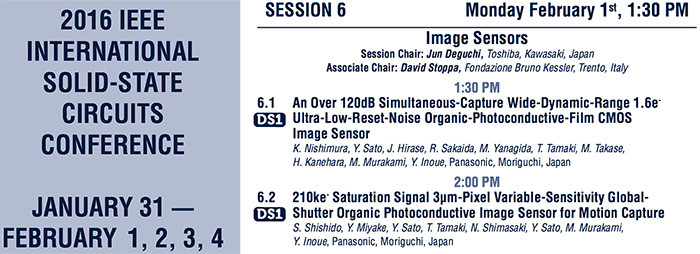
After a major press release two years ago Panasonic went quite silent about that new “organic sensor” technology. But we may hear more about it soon on the February 1st ISCC event. I am pretty certain that sensor technology will not make it in any of the upcoming 2016 MFT cameras. We probably have to wait til late 2017 or even 2018 before it gets ready for mass production.
26 Responses
Yun just got a woody!
I’ve to check in Urban Dictionary to know the meaning of woody!
That was my 1st thought! LOL!
I’m so happy for him.
As soon as I saw the title I checked the comments to see if Yun had commented…and you really gave me a laugh Jeff! 😛
A Yoody
Global shutter = gimme!
i feel more interest on Single-Photon-detect please look on PDF at 6.6.
Because if pany & fuji have no Organic Sensor,this tech will rule imaging semicondutor.
Panasonic is very slow in bringing research results into production esp for system camera. I won’t hold my breath over this one.
Rumors of unicorn sighted. Yun will be pleased.
Retooling a semiconductor fab for organic would have to happen yesterday for a 2018 launch. That would mean hundreds of millions of dollars invested via a public company, which we would have heard about. No, the technology is perhaps 5-6 years away, but more likely, not in my lifetime.
I’m so glad I didn’t buy the old one with only 88db of DR now that this one is shipping with 120db. But I may wait to buy until it surpasses 200.
that made my day!
Exciting technology once it makes it’s way into a product, but man that sounds like a boring-ass conference!
Everybody is working on carbon (what organic implies and requires) and nobody is delivering. Yawn. Where was it printed? Somebody said that pre-production samples were battery hungry, which would require body redesign to accommodate a heavier lithium cell. Ugh.
3-micron scale would make for a 25-megapixel FourThirds sensor. 9 square microns. 16 megapixels are on a 3.75 micron scale (14 square microns). I’m up for it. Wait and see. 2016 very unlikely.
What’s up with Sony regarding their carbon research? I cannot imagine that they have still to get a development program up and running. It looks rather more that they are watching and working silently.
Nikon was crowing about graphene a couple of years ago, which is funny, because they do not have a sensor program or a foundry.
In the meantime, I would be quite happy with some FourThirds BSI: a slight nudge in the pixel count without an increase in noise. I don’t like what the camera makers did with BSI on the pocket cameras, which was to push too hard on the resolution above 12 megapixels and sacrifice ISO.
Panasonic has FSI which could be even better. And dont forget micro color splitter. I hope we will see one of these tech in 2016.
The Smart Front Side Illumination and Micro ColorSplitter tweaks are in a conventional category because they deal with optical and fabrication trickery to wring the last little bit out of silicon photodiodes. The organic technologies are revolutionary because carbon photosensitivity breaks the limits by a far greater margin. Personally I think BSI has already won the manufacturing contest, so 2016 looks like year to bring the tweak to FourThirds. It won’t be huge, but it will be appreciated.
I really do not need more megapixels. 16 is fine. I could live even with 8 if it meant better low light performance with less noise. What do people need those megapixels for? Most of my hand held pictures do not achieve that kind of sharpness. Half of my lenses do not resolve up to 16 megapixels sharpness. I wish this marketing fad already died.
What I really need is better low light and less noise. More depth, better colors.
I don’t mean to sound whiny, I just don’t understand why 16 megapixels is too little for some people, outside niche fields.
It’s important for slideshow, zoom , panning, rotate the pic without issue, i.e in 4k slideshow
16 megapixels are plenty for any picture you can frame properly. If you have 36, 42, or 50, you can skip half a bag of lenses and crop in post. In μ4/3 land, however, you can afford the bag of lenses, so it is a moot point up to 150mm (same angle of view on 300mm FF). After that, you still need a rich uncle.
Everything is in order , suggested the next GX line camera likely to feature such sensor tech .
88 dbs DR from previous announcement go up to 120 dbs is huge achievement in m43 history
if true . A must have sensor camera in all kind of sense .
Let’s hope Pana can speed up the process to kick ass in the market .
i prefer on Single-Photon-Detect,please look on 6.6 in PDF file.
Organic was magic but SPD is excellent.
Help the math/science challenged: if the pixels are proportionally smaller does depth of field equivalence change too? So if pixels are 50% smaller, does DoF get one or two stops shallower with the same 4/3 sensor size?
No. DoF is proportional to subject distance and entrance pupil, which can also be expressed as magnification and aperture. Pixel size is immaterial.
There is no such thing as absolute DoF (or in other words, absolute DoF is always 0 as plane of focus is a PLANE). DoF is determined by minimum detail level you want to have in your “in focus” area, usually taken by default as 1000 lines per picture height (corresponding to about 1.5 Mpixels on 3:2 sensor). But if you want EVERY pixel in you high res sensor to represent a separate detail from all others, without blurring between then caused by diffraction, your DoF for this higher level of detail will obviously be much more shallow, and then yes, smaller pixels will cause shallow DoF (simply because the criteria of what is in focus and what is not will change).
DOF is dependent on reproduction size and viewing distance (when looking at these DOF calculators they usually assume a viewing distance equal to 2x the diagonal of the picture) – if you print bigger and view from the same distance then DOF effectively decreases: for an analogy think how many images look great on the camera LCD but on the larger computer screen at home look like missed focus.
In this respect, having more pixels tempts people to print bigger and so they have the impression more pixels changes the DOF