









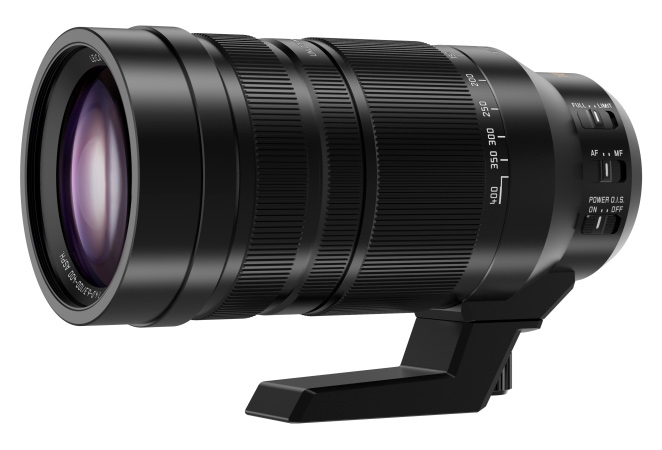
Our reader Redmosquite spotted an interesting video interview with Panasonic Sweden. It says:
“Panasonic 100-400mm info from Swedish photo fair, comes in late february, priced at 22-23000 SEK which in Sweden is about the same price as the GX8 + 12-35mm kit. another reference is the Panasonic Lecia Nocticron which cost 15000 SEK in Sweden, so It will be really expensive. “
Considering the [shoplink 56494 ebay]Nocticron price is around $1,600[/shoplink] it means the lens will cost around $2,500.
[poll id=”288″]
145 Responses
OUCH!
the Pana 100-300mm is a bargain at USD500 or so. 😉
For 2500 us$ you get a lot of things (GH4 + a Lumix f2.8 zoom + a good prime).
It is absolutely not acceptable for a zoom lens, unless they change the aperture to constant f2.8.
Nobody is going to buy the lens for that price.
You simply have no clue what you are saying. The 300 mm f2.8 Olympus 4/3 lens costs 7000 dollar officially. As most people over here they are unaware of what such lenses cost. I have Always figured a pricetag of 2000-2200 euro so that seems spot on. It is not so very difficult when you just take a peek at the competition. But it has to be very good at that price and that remains to be seen.
I know the factory costs are high, but the average consumer is poor.
This is not for an average consumer. They can get a 100-300 f4 f5.6/ However, I hope Panny comes with a 100-300 F4 lens for the average consumer or an 100-250 f2.8 to F4. With a TC. SOmething liek that. I understand for most the price is simply too much.
Nikon’s (full-frame) 400mm f/2.8 prime lens costs about $10,000, weighs 10 pounds, is more than a foot long, and has an objective lens about 6″ across. And it’s a PRIME LENS.
Given the smaller sensor size and the sensor being closer to the lens mount you could probably make a somewhat shorter and lighter lens than that – but it would still be HUGE.
Think about what the f-number means for a minute. It’s a measure of the effective size of the objective lens. A 400mm f/2.8 lens has to have an objective at least 400mm / 2.8 = 143mm in diameter – more than 5.5 inches.
I am sure that this will be a well made lens…(I own the Nocticron I paid $1200 from Tokyo, that I felt was worth that asking price)…but this is kind of amusing, if true.
The lens is for MFT…it is only f/6.3 at the long end. Let me repeat that. f/6.3!!!! $2500 is so inappropriate….If it was an f/4 or f/5.6 I could see that ….but no..not at f/6.3. The smaller sensor needs every advantage it can get to shoot at the lowest ISO possible to maintain image quality. I would not be paying $2500 to shoot at f/6.3. Not in this image format. Panasonic, you are getting a little carried away with the Leica branding, no??? 🙂
Hmmm…this could make my new Olympus lens that much more attractive. …but lets see what the actual price for the Oly 300mm, f/4 and for that matter the actually price of the Panny/Leica zoom. It’s all conjecture at this point.
1/3rd of a stop isn’t that big of a deal but I agree it doesn’t look good “on paper”.
Not only on paper. At f/6.3, you are already entering diffraction territory, more so on GX8, with it’s more packed sensor. This means the lens needs to deliver maximum performance wide open, because stopping down won’t help. And if stopping down to f/8 helps, that just means the image quality was actually pretty pedestrian at f/6.3 (that’s how cheap kit zooms behave).
For all premium MFT zooms, IQ at f/8 is actually worse than wide open. The optimal aperture seems to be f/4 (or wide open in some cases).
So yeah, f/6.3 on MFT is a very hard sell for a premium lens. It’s really not the same as on larger sensor systems.
Diffraction limiting means just that: ‘limiting’ in that it is offsetting any advantage of stopping down further. It does not mean the diffraction is actually causing a noticable reduction in resolution
If we are to assume £1500 GBP that’s roughly in-line with the 80-400 and 100-400 from Nikon and Canon respectively, but a huge step up from their own 100-300.
I can’t help but feel Panasonic have lost their way with their telephoto options, which is a shame as that’s where the biggest gains were to be found over a DSLR (or indeed other mirrorless systems) in terms of weight, size and cost.
Olympus have pretty much nailed it with their 40-150 2.8 / 300 f4 combo, we just need something a bit ‘in-between’ these Pro options and the consumer telephotos as there is one hell of gap now.
I think this is far too expensive, ridiculously so. This would make this lens more expensive than the Canon 100-400mm f/4.5-5.6L IS II. Not only does the Canon have an f5.6 maximum aperture, but it is fully weather proof, it’s quite compact for what it is, it takes a 1.4x teleconverter well and is recognized as having excellent performance with it, and generally it is regarded as the best lens of it’s type.
If Panasonic and Olympus are really going to sell their longer lenses at the prices that are being bandied about, they are just pricing themselves out of the market. m4/3 already has an uphill struggle convincing nature photographers that a m4/3 option is better, because DSLRs like the 7D mkII and D7200 have better AF on moving subjects. So in reality the m4/3 equivalents need to be aggressively priced to make considerable in roads into this market dominated by Canon and Nikon. It’s no good giving FF eqv focal lengths. Most people looking for reach use a crop sensor body, and 300mm on m4/3 is only a 400mm eqv on APS-C.
+1
The Canon 100-400 costs about 2100 Euro’s here in the Netherlands. The Panasonic GX8+12-35mm costs 1999 euro’s. This lens is going to be roughly the same price as the GX8+lens. So that’s 1999 Euro.
If the quality is good, I think it’s a good price. There is no reason this lens should be cheaper. There is also no reason m43 in general should be cheaper then comparable Canon stuff.
The basis of your logic is floored in so many ways.
You are looking at it as if people will sell their DSLR wildlife rig to buy this, but instead it is probably aimed at people who have a MFT camera for the compact nature of it but would like the chance to shoot major telephoto if they want to.
“he Canon have an f5.6 maximum aperture, but it is fully weather proof, it’s quite compact for what it is,”
‘Compact for what it is’ does not make it compact. Many people find the DSLR and Canon 100-400 prohibitive in size – this lens is far more attractive for that.
And this lens has f6.3 at 600mm equivalent and probably f5.6 at 400mm equivalent. Again a pretty good alternative
As someone who shoots wildlife most of my shots are not in tracking moving subjects but in quick, accurate focussing on a piece of action – one example is focusing on a kingfisher as it hits the water: tracking is not important, speed is. Or two foxes fighting.
I agree it needs to be competitively priced to attract people from DSLR but I am sure this lens is aimed more at people who (like me) own MFT for everyday stuff and have a Canon with 100-400 for telephoto/wildlife. If quality of optics are up to it, this could be the lens that makes me finally sell the Canon….maybe…
Unfortunately you fail to explain why my logic is flawed.
Let me explain briefly. I had the money put aside to buy an Olympus 300mm f4 and an Olympus m4/3 system, if this lens had come out in time. However, I also have a Canon system, and an immediate need for a long lens option, so I had to buy a Tamron 150-600mm and 70D for more immediate projects now. I thought I’d keep my powder dry for when the Olympus 300mm f4 and P/L 100-400mm comes out. I am tempted by the Canon 100-400mm L as I am mainly a macro photographer, and it has got a very good close focus. With my Canon 100mm L IS, I could take the vast majority of my photos with just 2 lenses.
I’d like a lightweight system. However, if these lenses are going to be more expensive that a Canon 100-400mm L IS II, then I might as well just get the Canon.
“Unfortunately you fail to explain why my logic is flawed.Or you sell ”
Didn’t I? I did in my first paragraph.
But it seems that the reason you bought the Canon is because the lens was not available in time – not price and not aperture. If the quality of the Olympus (or Panasonic) is the same as the Canon then the price difference is irrelevant because if size is a major attractant (and it sounds like it is) you sell the Canon gear and the cash you actually outlay is less than the price of the 100-400.
You’re making lots of mistaken assumptions, and it is not worth writing a very long post to undo all your mistaken presumptions.
However, let’s put this into perspective. Nikon has just bought out the 200-500mm f5.6. It seems to be a superb performer, and is a constant f5.6 aperture lens. It costs abotu $1400 or £1100. This puts the reported $2500 price tag of the P/L 100-400mm into perspective. Panasonic and Olympus are simply pricing themselves out of the market if they are going to charge these reported prices.
It will limit the appeal to those already well invested in the m4/3 system, and will not attract new users. This is a shame, because if m4/3 uses want new lenses and more competitive prices, they need bigger sales, and to make more in roads into the CaNikon market.
This is possible. The smaller size and hight pixel density of m4/3 potentially has great appeal to users of long lenses for nature photography, if they are competitive with the competition. Charging premium prices for these lenses won’t help to make any in roads into CaNikon sales.
“It will limit the appeal to those already well invested in the m4/3 system, and will not attract new users. ”
Which is what my point was, and is why Olympus felt the had to put IS into their 300mm.
I am also guessing it is why the price of the Oly is potentially so high – I recall reading a dilemma they had between pricing it low to attract new customers and risk losing loads because of low volume sales or pricing it based on realistic sales which drives the price up.
The Canon 100-400 MkII is £1800 and that does not seem to have harmed its sales, and am I correct to recall that Nikon’s profits are dropping which calls their pricing strategy overall into question. But they are in direct competition with Canon and it may be hurting them
But you also need to consider that you are comparing projected price of the Oly with the street price of the Nikon and two can often be quite different.
Another factor (and potentially more serious one) is that MFT still have a reputation a problem in being looked on as a ‘serious’ camera. So Oly know they are not gong to get the volume sales of Canon no matter how good or how cheap the lens is so why even pretend? MFTs currently have two problems: firstly the AF is not brilliant and secondly they have no high quality long telephoto – I am guessing it is easier to solve the lens problem that the AF problem. And I think that once people see they have a full range of high quality optics from wide angle to full telephoto people are more likely to bleed across to MFT. And this will be aimed at people new to the market not people like you or me who are looking to switch.
Walk into a camera shop and put on the counter a full system of the EM1, 12-40, 40-150, and 300mm and alongside the 5D3 with 17-55, 70-300 and 500mm. Then say which looks attractive for a general photographer. If you are specialist wildlife it is Canon all the way, but otherwise MFT makes a strong case.
For $2500 this lens will have to offer first rate optical performance in a very light package before I will buy one. I am hoping f6.3 was a design trade made so the lens could be much lighter than lenses like the 3 pound Canon 100-400.
Super telephoto lenses can be so large, heavy and expensive that buying the lens you want and a body to go with it even if it is not the same system you normally use could make sense. Panasonic is not just competing with the Olympus 300mm f4 here.
For about $2000 I could buy a Nikon V3 and the 70-300. The
combination only weighs a little over 2 pounds but has a 1 stop smaller
sensor. For me this is a real alternative to both the upcoming m43
telephotos. I am hoping the Panasonic lens will be under 2 pounds and
combined with the larger m43 sensor offer better image quality. But if
the Panasonic 100-400 weighs as much or more than the Nikon combination,
costs more and does not offer noticeably better image quality I may end
up buying the Nikon.
If I simply could not live without the extra 1/3 stop I could buy a Canon 100-400 and an APS-C body to go with it today for a little less than $2500. The 24MP sensor and cropping to 16MP would partially make up for he lower crop factor and I would get SLR autofocus. But the combination would weigh about 4.5 pounds which is heavier than would like. But for those that really want something faster than f6.3 this might make sense.
To each their own. To me, the Nikon lacks weathersealing, a good sensor (V3 sensor is much like the one in the G1 of 2009). It is not a Leica lens, but that has to be proven to be a real difference in reallife. For 500 dollar less I would never buy that combination at all.
While very subjective I have heard that the Leica weighs impressively little, which would be very nice. Can’t wait to get it, but I seriously have to think if I would use that lens enough to justify the costs. I tend to think though…
I am hoping you are right about the 100-400 being light and having very good optical quality. Staying with m43 would certainly be my first choice. But if the 100-400 end up being heavy or not living up to the Leica name there are alternatives.
Have any of the rumors mentioned weather proofing? While it is expected on a lens this expensive it is hard to accomplish on a telescoping zoom. This looks too small to be a fixed length zoom.
12-35 is not a fixed lens zoom and environmentally sealed..so..
The Nikon 1 system is interesting but currently none of their cameras offer video quality anywhere close to the class of Panasonic. If they can produce a 4K capable camera, then they might be a contender. However that camera would likely cost as much or more than a GH4, which would have a superior build quality, better stills…
The Canon combo may be a better value for the money, however, it will be very much larger and heavier, and again the video options will be significantly poorer than with Panasonic. If you don’t care about video than it’s a different game obviously.
Wow, that really sucks. But I had a feeling it was going to be over priced because of that Leica-badge. 2500 is too much for a f6.3 lens, no matter what the quality.Period. I’m hoping the Zuiko 300 will be 1800€ or under.
Just another lens I”ll only be able to dream about! 🙁
Oh well, 300mm f4 it is then 😀 I already have the x1.4 with my 40-150mm f2.8 so I am getting 420 (840) f5.6. I would like the zoom because sometimes you can’t walk back while stalking the subject, but I just can’t see myself using Panasonic lens with those controls on the lens being so near the actual mount… Like, who does that? I Hold my lens so that if I need to focus I can do it in split second and change to MF quick so normally you have it near the zoom/focus ring. Now plus the cost – I will stick with Olympus I guess
zooming is overrated 😛
Wow, that’s a lot of money for a 100mm/ f4.0….
one side
Lumix 100-400 f4-f6.3 = $2500
Other side
Olympus 300f4 + MC14 = Olympus 420 f5.6 = $350 + $????
The choice:
100-400 f4-f6.3 or 420 f5.6
for me f6.3 or f5.6 is the same
100-400 or 420 is not the same
with the Zuiko you also get a 300 f4 vs. 300 f5,6 (?) on the Pana.
Agree with Parker that a lot depends where the zoom hits f/5.6. A 300mm f/4 is way better than a 300mm f/5.6.
Comparable good quality lenses from Canon and Nikon (100-400mm) cost about the same(2000 euro’s or more).
Maybe this lens is going to be slightly slower(F6.3) on the long end…but it’s going to be lighter and it’s(equivalent compared to APS-C) reach is going to be longer.
It’s not realistic to expect a much lower price.
Nikon and Canon lenses cover FF not m43 and as such are harder to manufacture, cost more and have lower yields.
They are also faster and weatherproffed/tough.
I don’t care that they cover FF… For birding and for example air-shows(which I attend a lot) almost everybody uses APS-C(or in my case m43) because they want reach… The more reach the better. We want to take a picture of a bird’s head, and the pilot’s nose-hairs.
Also, I do not think they are harder to manufacture(and why should we even care?), miniaturization is often harder to do. It’s about the end result.
So if you put this lens on a GX8 or E-M1 and compare it to a Canon 7dII with the 100-400mm it would be very competitive in terms of IQ. But the 7dII combination is going to be huge, so I know what I’m going to pick.
(although I’m happy with my 100-300mm Pana on my E-m1, for me this is just a hobby, and 2000 euro’s is a lot of money for a lens ).
In a telephoto lens, covering a larger format at the same focal length is less demanding because the pixel density is less.
Are you sure the canikon telephoto zooms are weatherproof? I think some are some are not.
Newer sensors will increase in pixel density. The construction thin is not so clear. Scaling down reduces geometric aberrations, favouring smaller systems wide open. Aberrations need to be corrected on larger formats with a lot of effort. As diffraction sets in earlier on m43, it is important to extract peak performance before that.
If the Panasonic/Leica was f/5.6 at 400mm, as the others are, I would admit you have a point. But as it is f/6.3, I think you don’t.
I think there’s a psychological barrier we cross when the maximum aperture is > 5.6, but f/6.3 is only 1/3 stop slower.
Love the Pana fanboys “This lens will be cheaper, sharper, lighter and a zoom compared to the 300/4”.
Oops. No.
Good luck seeling that. Ridiculous price. Should be a grand less to make any sense.
It would make sense if the M43 sensors weren’t so darned terrible. The lens should be good, but you just can’t justify spending so much cash to then mount it on such a mediocre sensor. Unless Panasonic has some revolutionary sensor tech up its sleeve…
Everyone last week: I’ll get the Panasonic Zoom!
Everyone today: I’ll get the Olympus tele!
When Olympus price is announced: Never mind!
It’s great they’ve invested in quality. The last thing I need is another cheap telephoto option. Whatever premium the Leica branding adds to the price I’ve never regretted paying for it. The 15mm, 25mm and 42.5mm PL lenses are my favorite lenses on any system. It will be great to have that level of quality in the telephoto range.
The PL 25 is your favorite on any system? You probably haven’t tried many systems then…
I like the 15mm and the 42.5mm more than the 25mm but I was talking about the combination. Speaking of individual lenses I definitely prefer the 15mm and 42.5mm over the roughly equivalent Canon and Nikon lenses I’ve owned. Including the Canon L Series primes.
Don’t forget the PL 45mm 2.8. A lovely lens.
I have.
Please be less stupid, troll.
Despite earlier rumors citing lower figures, I feared as much. If the Zuiko 300mm f/4 will be as expensive as reported, too, then I’ll probably stay with the good old ZD 50-200 plus EC-14 and EC-20 for quite some time to come. My impression is that things will get better only if and when manufacturers like Sigma, Tamron and Tokina seriously start making lenses for mirrorless systems.
I have the Zuiko four-thirds 50-200, which I bought used before acquiring an M-1 body that gets it to focus quickly.
I am waiting patiently to see and try this telephoto zoom. Expected very high price tag will however probably justify my backup plan – buying used old stellar FT 50-200 + EC. Autofocus with my E-M1 should be “ok” (new 100-400 will not be too good for fast moving subjects as well, as it is relatively dim at the tele end).
I suspect it will be around $2000. Which, given the specialty usage and presumed quality, is a tough but fair price. This is a once in a 10-20 year type lens for the system. I can’t afford it or really justify it even if I could, but maybe I can rent it. It makes sense for Panasonic to try to cut margins on cameras, but it wouldn’t make much sense to cut margins on lenses like this. This is a lens you have to pay for.
Hopefully this lens is the last mistake they make for another 20 years. It’s going to be useless.
Wow! that’s steep for such a slow lens! I think I would get something like a Nikon D7100 and Tamron 150-600 for around $1800 instead for my long lens needs.
600mm x 1.5 does appeal (for an 135 Format equivalent of 900mm), even at f/6.3.
Make it D7200 and 200-500mm f/5.6 that is way sharper than tamron. Costs just under 2000 and you get second system that you can grow when you are selling m4/3 away!
Wait a minute, shouldn’t it be like this: 15,000 SEK ~= 1,600 EUR, which gives us approx. 1,600 USD in markets like the US, Japan, and Hong Kong?
HEY! How did admin come up with $2500? I come to $1700 USD.
Nocticron 15k SEK = $1700 but $1200 on Amazon.com
So 22k SEK is more like $1700 on Amazon US.
Sweden is very expensive.
Ah wait, $2500 for the click bait!
This..
Remember that prices in sweden include approx 25% tax….
And that in sweden they get paid about 2x more than americans…
More for what! Most middle class professional jobs pay about the same. The only thing I see different is min wage.
https://en.wikipedia.org/wiki/List_of_countries_by_average_wage
Country Gross income in 2012 USD (PPP)[3]
#1 United States 56,067
#2 Luxembourg 55,176
….
#14 Sweden 40,352
It was 2012. Now, with much more strong dollar, the difference is even higher. And taxes in the US are lower too, both income and sales vs VAT.
I’m gonna laugh so hard if they manage to ship it before Oly’s 300mm.
Hopefully the performance matches the price…
I am sure this is a lovely lens,with great reach and a price that is likely competitive. It is no doubt smaller and lighter than it’s FF counterparts. It is, however, too big and heavy for me.
Then it is as well too long and too fast for you too!
Yes, I realize the difficulties of building lenses at that FL, even for m4/3rds, but I have a weight and size limit for the stuff I am willing to lug around. This is over.
I can’t comment on the methodology of anticipating the price. Also the survey appeared to be closed by the time I arrived at this posting. However, as someone who owns several of the M4/3 “professional” lenses a price of $2,500 would far exceed what I would be willing to pay for such a lens. I hope others will find that it represents value for money at whatever its price. I will make a further assessment when it is actually introduced and priced.
Hoo boy.
This happens every single time. No one who writes these articles seems to understand that the same products have different prices in different parts of the world.
As everyone below has eloquently identified, this “$2500” price is the exact same price as the $1500-1800 that has been identified as the probable range in the past.
Nothing to see here folks, move along…
I hope so, but I also asked the question to a panasonic person at the “salon de la photo” in Paris last week end : she also told me launch in the first 2016 three monthes, and regarding the price, she said “expensive, more than 2000 €”.
A lot of photography equipment these days costs more in € than it does in $, though, due to the strong USD.
Even if it were 2000 €, I would still anticipate $1500-1800. But I am not in the market for this lens, so it doesn’t affect me at all.
Just about every camera or lens I have ever seen costs more in the EU and UK. Usually considerably more than the VAT alone would suggest. Some price gaps are huge the Olympus FT range of lenses had and still have major price differences . The 300mm F/2.8 SHG costs $2250 more in the UK
Value is not just about the price!
Price is not just about the value.
No worry. If the US price is too high, just hit the grey market. Next yr the $ will be even stronger.
Buying grey without warranty would not be a choice I would make on this lens.
Hardly a direct conversion to USD with international markups and taxes. No chance this lens is more that $1500-1600.
If this is actually $2500, most would not only buy the Oly 40-150 PRO + teleconvertor, but an Olympus body to go with it.
Hopefully, for everyone…sellers and buyers…that is a math error! 🙂
If this lens is designed for peak optical performance at 300 to 400 mm, it would be a welcome nature and birding lens. if it peaks at 100 mm and fades at 300-400 mm it would be just another no thank you zoom lens.
Like the 100-300 which peaks at 100 and fades at 150, unusable >250.
280ish and f7.1 and you’re 100-300 is sharp. For static objects
Try using English !
Says the man who’s name no one can pronounce
So you can neither write nor read ?
The price suggests an optical quality similar to or better than the new Olympus Zuiko Pro 300 mm f/4. If the Panasonic-Leica 100-400 mm beats or meets the image quality of the Zuiko at 300 mm you will see at least one of these new Panasonic-Leica 100-400 pointing at birds in the field.
Correct English is always preferable. It’s amazing how mobile OS substitutions have helped the lazy to the bottom of literacy.
Lazy grammar still doesn’t change the fact this lens is crap
Using the incorrect words would be lazy grammar?
Is my use of “280ish” that incomprehensible to you!? I apologize for my casual use of language in this forum 😛
I did use “you’re ” incorrectly. My sincere apology
It’s unlikely that Leica would have approved the use of their name on a lens design so poor.
This lens will only work for birding if you have a newer sensor that has a useable ISO of 99999999999~
Wrong, we are not talking about bats. The AF speed is more of a problem than the aperture.
You have valid points about af and live view lag.. I would love to get some x-type phase detect sensors on future m43 bodies. I’ve found the lag you’re talking about to be a hindrance for bif too. Taking those problems into account mf with the em1 is pretty good. Even for bats?
That’s why I am shooting D800E and D810. I’m waiting for an image sensor with smaller pixels in the center for super-cropping.
I was thinking that the focus limiter would help, but since the switch isn’t marked in terms of distance, I wonder how usable it will be.
Looks like the focus limit will have to be user configurable. That’s actually really great news, since it means that maybe we will have a software focus limiter on Panasonic bodies released through firmware once this lens comes out…
For a F6.3 lens it is just too slow for early morning and late evening wildlife photography. Even F4.0 is a little slow but doable. I am sure it will be a nice travel zoom when the light is good enough. I really wish this lens was a 100-300 F4.0 with an optional matching 1.4x TC.
Go home penny-Leica, you’re drunk.
so is sir spamalot
If you’re birding in a studio- with speed lights
Some serious trolling going on here…
I own a lot of 4/3 and m4/3. I want this system to succeed. This lens is an abomination. I’m trolling for the greater good ;p
I’m not a “lie in the wet ditch all day and night” wildlife photography, but I enjoy what I can do with a long lens during the day.
I often shoot my 100-300mm stopped down to f8 or f9 in order to get enough DoF and sharpen things up a bit. If it’s good wide open, I have no issues with 400mm @ f6.3. That’s 1/3 stop slower than f5.6 (i.e. ISO 1000 instead of ISO 800) and people are acting like it makes all the difference in the world.
Exactly!
I shoot my 100-300mm at f7.1 regardless, in order to maximize output.
100-400mm is a dream lens.
It’s a good thing that you don’t lie in a wet ditch at night…’cause you are not shooting bats or anything nocturnal with a f/6.3 lens…….:-)
…and if you buy this one…you will have to sleep in a ditch….as you will not have any motel money.
At that aperture it should be under $1000.
I get the feeling this is going to be cheap and this rumor is bs. The Leica branding is just there to price it higher than the 100-300.
Yeah, just like the Canon 100-400 4.5-5.6, right? That one sells for under $1000 all day long…
Oh, wait…
Well… the older version sells for $1,299 new on BH though. And it is faster than this Panny lens. Hopefully the Panny is both sharper and AF’s faster.
It’s 1/3 stop faster at the long end, and 1/3 stop slower at the short end. Obviously the long end matters more, but 1/3 stop doesn’t matter at all.
Again, more expensive than FULL FCKING FRAME and fasterCanon 100-400L! I will say it slowly to Panasonic – W…. T…. F….!
Again: GET A LIFE.
micro Four-Thirds is a full frame format.
Nobody call it that.
Anyone who knows the true meaning of full frame should.
What would you call Medium Format–a negative crop format?
Medium Format.
FF is simply commonly accepted term. Even YOUR know what it means. No point in getting your panties in a bunch.
Show me a full frame 200-800mm lens this portable and this affordable.
This portable? How do you know it is portable? And nobody makes f/13 lenses for FF.
This lens is NOT 200-800, it is 100-400, just covering quarter frame. Put ANY FF 100-400 on m43, and it will cover it and 4 times more area.
For example:
http://www.bhphotovideo.com/c/product/162616-USA/Canon_2577A002AA_100_400mm_f_4_5_5_6L_IS_USM.html
$1300, weather-sealed, with stabilization, covering 4 times bigger area. Any m43 lens without such coverage should be BELOW that.
That lens is on sale for $400 off, so $1700 normally. Which is what the Panasonic will cost in the US, give or take a hundred or so.
Seems totally reasonable.
It’s not F13. It may have DoF equivalent to an F13 lens on a 35mm format, but the ratio of focal length to entrance pupil size defines F number.
Also, full frame is a largely meaningless term outside of fisheye and adapted lenses. There are larger formats than 35mm after all.
It is not f/13 just as it is not 800mm. It is 400mm f/6.3 with 1/4 of coverage of FF 400mm lenses. Or 800 f/13 equivalent if adjusted for coverage, in terms of total light (and part of that total light coming from OOF area is scattered, which is the only reason for DoF).
The Canon EF 100-400 f/4.5-5.6L is a design from the analog age almost 20 years ago. It sells pretty cheap by now. We will see how it looks compared to the brand new Pana-Leica-Design.
Also it will be interesting to see how the F-stops change in the new Lens over the length of the zoom. I have heard, that it remains quite a while on F4.
I was talking about 100-400/4.5-5.6 IS USM, please note _IS_ – not the older film-era design.
Please don’t yell.
Hard not to at the pricing idiots who ruin their perfectly good companies and waste perfectly good engineering work.
1/3 stop is a meaningless difference and the newer Canon EF 100-400mm f/4.5-5.6L IS II is $2,200. The cheaper Canon is an old design with known issues and wouldn’t match the quality of the Leica branded 100-400mm.
How do you know it would not, especially on 50mpix bodies like 5Ds?
The older Canon resolves 36 LP/mm at 400 mm and the new 42 LP/mm whereas the Panasonic-Leica as well as the Zuiko Pro 300 are likely to resolve closer to 50 LP/mm.
Unlikely, at f/6.3 diffraction limiting is already below 50 lp/mm. And it is in the center wide open, corners at the tele end are not going to be anywhere close to that sharp wide open (no Pana lens is sharp in the corners wide open at the tele end, including 35-100).
Bla, bla.
I bet the real street price will be a little under $2000, say $1700-1800.
Quality is not measured in F-stops and lenses are not sold per kg.
Some people here think a high quality lens needs to be fast and a lens that is not fast can not produce sharp images. This is wrong. Especially in the M43 environment, it is desired to have the option to buy small high quality lenses.
We first have to wait for the lens to be released, look at the price and performance before everybody can make his own decision.
Exactly. A Zeiss Otus 55/1.4 costs 10x more than a Canon 50/1.4 and 100x more than some vintage MF 50/1.4 lenses. Not all 50/1.4 lenses cost the same. Maybe you don’t need a lens as highly corrected as an Otus, but some people are willing to pay the premium.
I am sure that this Panasonic lens is worth its price. I assume it is optically perfect.
But, just like the Olympus 75/1.8, I fear that the lens will be held back by the sensor performance. The 75/1.8 is optically PERFECT. Nevertheless, a cheaper lens on a larger sensor will look better, and that’s a shame.
Worse, I feel that MFT sensors are going backwards. This race to lower ISO noise (to win at DxO) is resulting in colorblind sensors. I liked the E-P2 sensor, despite the high noise. I cannot stand the E-M5/E-P5 sensor. Awful files. The E-M1 Panasonic sensor is a bit better, but still lightyears behind a Nikon D7200 or Sony A7.
My experience is that cheaper lenses are looking bad on any sensor. Even on my old Nikon D70 with 6MP, there was a huge difference between pictures I took with a great but heavy 80-200/F2.8 and a Nikon 28-200 which was still expensive but not good enough compared to the better lenses on the long or short end. There is no way to compensate that with a better sensor.
On the other hand, with a good lens, you can get good quality pictures on the cheapest sensors if you have good light. The better sensor makes the difference in some difficult light situations.
Carl Zeiss: “A chain is only as strong as its weakest link. This has particular relevance for photography and image quality.”
A high resolution sensor can not make up for a low resolution lens.
A high resolution lens can not make up for a low resolution sensor.
You need both to be of high resolution to produce a high resolution image: 90% x 90% = 81% but 90% x 50% = 45%
Odd. I’ve used all the M43 sensors since they’ve come onto the market, and find that if one cannot take incredible shots with, say, the GH4, then perhaps a different avocation than photography is in order.
I’ve been using the D7200 for months, along with the Panasonic GH4, GX8, and Olympus E-M1, plus the older Four-Thirds bodies.
The D7200 doesn’t seem to be light years ahead of any current micro Four-Thirds body, except in its ability to do wide angle shots more easily because of the sensor size.
Sound too expensive… but on the other hand, it’s a rumour, and we don’t know anything about the quality yet… nothing about the weight, etc..
So we will see.
February is not that far away…
It looks like pa asonic has adopted the recent Leica SL lenses looks and pricing.
2500k sounds waaaay to much for me.
$2500 seems a bit too high, more likely around $2200-$2300. My experience is that Swedish prices end up being about 10 times that of the price in USD. The price for the GX8 + 12-35 is 22 500 SEK from Panasonic’s Swedish website and $2200 from pansonic.com (before rebates). Lowest retailer price for the GX8 + 12-35 right now is about 20 000 SEK (19 499) and I’ve seen deals for around 17 499 SEK.
They also talk about deliveries of the lens starting in late February and the new function “post-focus” that will be available as a firmware update for G7, GX8 and FZ300 (the function is dependent on the depth-from-defocus algorithm) in about one month. The GH4 will receive the firmware later in the spring.
Now it comes in January and at USD 1500 ! 🙂 :
http://www.dpreview.com/forums/thread/3926157#forum-post-56778120