









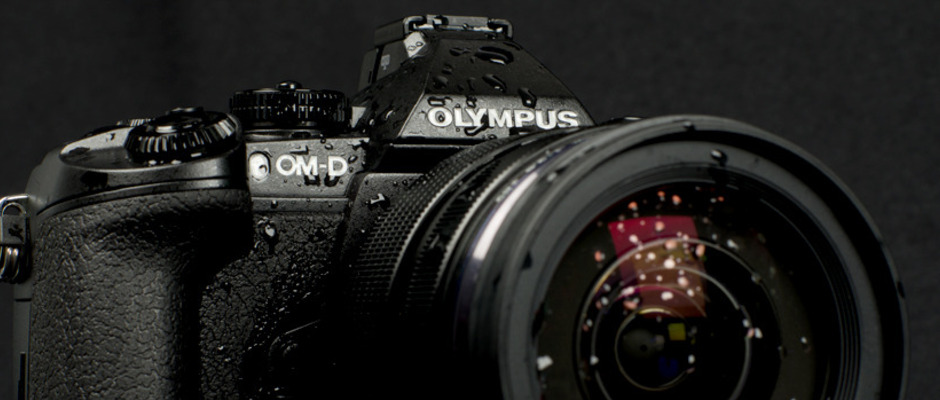
Image courtesy: Reviewed.com.
I just got this from an anonymous source:
“I asked what should be expected with the M1 II video, the Oly guy suggested that they will completely eliminate motion shifting in video recording. I asked does that mean they will bring global shutter to the camera, and he replied he doesn’t really know, as the Japan didn’t release anything in detail.”
Let’s hope the E-M1II will come soon and have global shutter…and 4K!
—
For sources: Sources can send me anonymous info at 43rumors@gmail.com (create a fake gmail account) or via contact form you see on the right sidebar. Thanks!
For readers: Don’t miss any news. Join our group on facebook and follow our tweets.
Rumors classification explained (FT= FourThirds):
FT1=1-20% chance the rumor is correct
FT2=21-40% chance the rumor is correct
FT3=41-60% chance the rumor is correct
FT4=61-80% chance the rumor is correct
FT5=81-99% chance the rumor is correct
63 Responses
There was a rumor a week or two ago that the EM-1 II would either be announced early in 2016 with the existing 24MP Sony sensor or later in the year with a different sensor. If the other sensor has a global shutter I hope they wait. I am not a video person but would really like an electronic shutter with fewer artifacts than the one in my GX7.
Well… 2016 is a Photokina year, which means that it’s not very likely that Olympus announces a new flag ship early in 2016.
There is no known 43 24MP sensor. There is a 20MP sensor by Sony, and probably another 20MP sensor by Panasonic.
You’re right. I was thinking of the 20MP Sony sensor.
And now that the mirrorless game is getting more serious I don’t think Sony will do its competitors the favor of developing a cutting-edge sensor in a format used almost exclusively by those competitors.
I think the opposite is also possible. Sony recently made their sensor department more independent, which to me sounds like they will actually have greater freedom regarding who they sell to. Basically, since sensors are such a good business atm (better than cameras), why shouldn’t Sony sell sensors to as many companies as possible? And fabricating a sensor in 43 format instead of APS-C isn’t that much of an overhead. The tech is probably similar to one of their APS-C sensor generations. Or otherwise, I don’t see why Oly can spec out a sensor that Sony should produce for them, If they pay good money for it, why not?
Yes, it’s possible that will happen. Didn’t seem like it to me in the last couple of years. Time will tell.
So with all the sensors they sell to Nikon does that mean they don’t regard Nikon as a rival ? Nobody considers buying a Nikon or a Sony ?
Or a Fuji or a Sony ? Or a Pentax and …
And the 1″ sensors they sell to Canon, Panasonic…
Realistically if they stopped selling sensors to rivals they’d probably wouldn’t have a sensor business for very long.
Sony does and will continue to sell sensors to competitors. But is seems a certain change in developing sensors for competitors or letting them use them first has occurred.
Whether Sony fully regards Nikon and Canon as competitors is a good question. In mirrorless, they certainly are not.
Or it could simply be a radically faster rolling shutter. Or a new and closer local buffer with parallel reading on the sensor.
As far as I see, this is all speculation.
“…completely eliminate motion shifting in video recording.”
no need to read anything mysterious or far fetched into that – improvement in stabilizing video with 5-axis IBIS is all it is likely.
I’d shift my bet more in the general direction of a faster readout. IS can’t fight rolling shutter, be it panning or subject motion.
The more or less officially whispered Multi-shot High Resolution mode upgrade to work for handheld shots also points in that direction.
Agreed. What I’d also like to know about the High Resolution mode is whether having a faster readout could not only enable hand held shooting but also eliminate more of the motion artefacts seen with moving subjects. Perhaps some form of buffered high speed readout?? Global shutter is not so likely, I think.
Ah yes, it is always difficult to get good info from “the Japan”.
If “E-M1II will come soon and have global shutter…and 4K”, I can’t wait for the Gh5 specs. 🙂
And also without rear dial issues; make it solid
Could care less about 4k, but if it has a global shutter with video raw id be very interested.
You won’t see RAW video, for you own sake stop dreaming 😛 . If you get similar video quality like in GH4 + global shutter + newer sensor you should be very thankful. 🙂
Neither do I. Just improve the coded, even keeping same bit rate is important. Like working with the compression and sharpness little bit and maybe the Movie-magnification feature to little better.
1080p is video that is more than enough and even 720p video is excellent in most usage. We are not recording videos for UHD televisions that we then look from 50cm distance at homes.
Global shutter means a fully electronic shuttter. While this has many advantages, there are also drawbacks. This can be seen for example in the degradation of the image quality when using the Sony A7r2 fully electronic shelter instead of an electronic first curtain and mechanical shutter.
I remain cautiosuly optimistic that the advancement in sensor technology has reached a point where a global shutter is now viable.
There are no inherent drawbacks using a fully electronic shutter (except for rolling shutter, obviously negated by global shutter). The image quality degradation has nothing to do with the e-shutter, and everything to do with Sony’s tuning and specific implementation.
Case in point – in the G6, GH3, and GX7, Panasonic prioritized pure image quality over rolling shutter artifacts with their electronic shutters. There was no different in the bit-rate or output quality from RAWs taken with the e-shutter compared to the mechanical shutter (both 12 bit, full dynamic range).
With the GM1, GH4, GF7, and G7, Panasonic was prioritizing readout speed in order to reduce rolling shutter and improve video quality. They did this by reducing the bit rate of the RAW output from 12 bit to 10 bit.
With the GX8’s new sensor, Panasonic has not had to make that compromise. The GX8 has the same readout speed as the GH4, but still has the full bit-rate, giving identical RAW quality.
Obviously it is more difficult to rapidly sample 42MP of data than 16MP or 20MP, so it is not fundamentally surprising that Sony would choose to bin their bit rate on the A7r II. But again, that’s specifically Sony’s choice, and is not extensible to other cameras on the market.
Thank you. This is very helpful info, specially the specifics of the different Panasonic cameras.
There are currently a few CMOS sensors with global shutter available and used in cameras, mostly scientific ones. All the examples I know of or have used personally have significantly higher read noise when running in global shutter mode. Not unusually high, but about a factor of two higher than with rolling shutter. In bright scenes with not too much contrast (on other words, when photon noise is dominating) this might be completely acceptable. It basically puts is back where we were maybe 4 or 6 years ago, which wasn’t terrible.
Relying on my readings, I have been of the impression that a CMOS sensor with global shutter has higher read noise than a CMOS sensor with rolling shutter. Is this read noise at a level that would put a CMOS sensor with the global shutter that would be close to a CCD sensor (with a global shutter)?
In the sensors I know the global-shutter read noise is about twice as high as the rolling-shutter one. So maybe 2.5 e- rms instead of 1.2. It’s difficult to compare to CCD sensors bc in the latter the read noise is strongly dependent on the read-out speed. That’s after all the primary reason why CCDs were abandoned in consumer cameras. But I have the impression that a current CMOS with global shutter may be as good as say the CCD in the D70 was. Maybe better.
Global shutter is not the same thing as the e-shutter. The A7rII does not have a global shutter – it still has a rolling shutter, hence the issues with lights.
The A7r2 indeed does not have global shutter but has an electronic shutter. Turbofrog below shows why the image quality of the A7r2 suffers when using the A7r2 fully electronic shutter. While global shutter is fully electronic shutter, an electronic shutter is not necessarily a global shutter.
I believe that is what Chris was saying (in a briefer description).
Agreed, as far as I understand “global” being the entire sensor captures the image i one bite, instead of scanning one line at a time. This means rolling shutter is not an issue on a global shutter. However, image quality does seem to be affected in many cameras, I’ve especially noticed this on the Lumix GM1 where bit-depth seems lower, and it become especially obvious when combining RAW images for HDR in software, where banding issues are obvious.
Assuming,if you had small sensor that it had 16 pixel,it does mean 4 x 4 pixel on wide and height ,if it is global shutter it must read out on same time from number 1,1 to number 4,4.(sequence by row,column)
Do you ever learn Matrix in Mathematics? pixel on top layer of sensor like Matrix.
if can do it we will call Global Shutter (image sensor)
I don’t think it’s global shutter, most likely some tech for faster readouts like the ones Sony used in their latest cameras.
Faster readouts can not guarantee “completely eliminate motion shifting”.
But some clever computing should: for example with 2 shots probably may be possible to compute motion changes and compute the correct frame. But I just speculating.
Second: it will elliminate it “only” in video, not in single shot => global shutter will eliminate also problems with electronic shutter in single shot. Not only video => no global shutter yet
Yeah, it will probably be a combination of several techs, be it hardware or software, but the elimination of motion shifting is just marketing lingo, otherwise they would say global shutter. And this looks just like what Sony said and as Olympus is kind of close to Sony lately on the sensor front, it’s likely to be a Sony sensor with some of the latest tech from Sony. Unless Olympus is all over video, something unlikely, for them it’s not worth to put global shutter and lose some DR and sensitivity and it will take some time yet to have global shutter sensors for photo cameras like that. I would be happy if they could but I think it’s highly unlikely to happen anytime soon.
yeah,you ‘re right.
Please search review on video-centric website.
A7RII still slow readout than GH4 but A7RII produce much framerate.
FT0 – faster full sensor readout yes, global shutter no.
Honestly the primary thing that will make me upgrade my E-M5: New meaningful sensor upgrade. The E-M5 MkI pretty much mostly has everything I wanted from µ4/3, everything else is just bells and whistles.
All of this seems to confirm some of the early rumors from mysterious “Simon”.
http://www.43rumors.com/ft3-olympus-e-mdr-rumors-has-18-megapixel-geomembrane-sensor/
Yes, Simon has come good with some nice details of coming gear. All of the newer rumours basically follow what Simon has already said.
Read the tea leaves, friends. Global shutter was easy on CCD, difficult and with trade-offs on plain CMOS. If there is any truth to the rumor, then there is no alternative but to assume that the E-M1MkII will debut the unannounced, stacked, BSI, Exmor R sensor (same tech Sony used in the 42.4 megapixel sensor used in the A7RII) in the FourThirds form factor. Resolution will not be 16mpx. I think 20mpx would be a nice balance between noise and resolution, but 24mpx might also be possible without degradation. We will have to wait and see. The camera cannot be the E-M5MkII, merely plus grip and PDAF cells for mount-adapted FourThirds lenses.
20MP would be just fine.
I find the 1″ sensor of the 20MP FZ-1000 to perform superbly.
A little more area of µ43 and the performance should be splendid. Add in an improved super resolution mode with sensor shifting and things will be just fine for me.
I tend to think 20mpx would be very nice too. Most of the one-inch sensors are 21mpx, yes? no? Just for even stevens sake, let’s just use 20mpx each. 225 / 20,000,000 works out to 11.25 microns square. 116 / 20,000,000 is 5.8 microns. 225 / 16,000,000 was 14.06 microns square. 864 / 42,400000 is 20.3 microns square (but with BSI also). The bigger the pixel, the lower the noise floor. There are, or soon will, be Exmor R versions of Full Frame, APS-C, FourThirds, and OneInch. Lalalala. Much as I like the sensor shift super resolution function for the time being, another idea attracts my attention. Normally, we start with a body and add a bunch of lenses, some of them handily out expensing a second body. So maybe there could be an argument to have two bodies, the main one for deep ISO at standard resolutions, and the part-time body for super high resolution at the cost of shallow ISO, say excellent ISO 1200, using BSI the same size as the OneInch pixel. A FourThirds sensor with 5.8 square micron pixels would have 38.8mpx. That is high enough resolution bazoombas for well-lit photography. What would be the effect on the ISO to bin three pixels at a time to equal 12.9 mpx? Could be get the same ISO 3200 we now enjoy? And put it all in one body? Or bin two at a time for 19.4 mpx, middle ISO? Bin(2) is 11.6 microns square. Bin(3) is 17.4, not far from the 20.3 on the full frame 42.4mpx, so maybe you could knock on the door of 6400 ISO. Jus’ thinkin’. I don’t think binning works as well as we may like, just yet.
Sony is on this path with the A7RII/A7SII.
What intrigues me is Pentax’s approach to sensor shift that eliminates color aliasing that greatly leverages its 24 MP in comparison to its Bayer competition.
Oly has a lot of talent, as does Panasonic but they still rely on Sony for the latest sensor tech.
The current Olympus approach to sensor shift also eliminates chroma aliasing. The super-res bin-it-all for ISO would still suffer. The super-res 38.8 would, however, not be restricted to completely static subject matter. Just the tripod.
I think there is a bit of smoke and mirror skulduggery in the manufacture of FourThirds sensors. The overly vocal majority believes that part numbers painted on the substrate identify the foundry. Under contractual arrangements, any foundry can paint the number you want visible in your parts bin. So, I do not think we have conclusive answers from all of the tight lips inside. Because of the silence, I have the minority belief (I am not alone) that ALL of the current crop of FourThirds sensors are actually manufactured by Sony. Sony has a lead on the stacked, BSI technique, I hope, that will soon surface in Olympus OM-D cameras and Sony’s line of APS-C cameras. It is already on sale in big, smaller, and tiny. Medium is coming.
The source said one thing, and admin made it about another thing. Faster sensor readout does not mean global shutter (although it’s getting there). The new 20MP Sony sensor has pretty fast readout speeds iirc, so maybe that’s what they are talking about.
Global shutter – I will believe it when I see it. It was first rumored on this site for the GH2.
Sorry but that is like FT1 rating, max FT2 as the Olympus representative doesn’t know what R&D team is cooking in the lab. Even Olympus USA Product Manager didn’t know about E-M5 II HR-mode before it was out, how can any random Olympus representative know about sensors and their features?
And when they even say “We don’t know, as they don’t tell us”, then it is definitely just FT1!
I remember all the Olympus flagship models from the E-3 forward: the E-5, the E-M5, the E-M1. All these were a disappointment in one form or another, though some had novel features. The greatest disappointment was always the sensor. The E-5 was a huge disappointment: very old, very weak sensor. The E-M5 had a good sensor but the E-PM2, a much less expensive camera, beat the E-M5 in ISO terms (see DXOMark). The E-M1 finally brought PDAF to mFT but proved to be even weaker than the E-M5 in ISO terms (see DXOMark) precisely because of the PDAF. What is more, the E-M1 was launched at an exorbitant price. For these reasons I did not buy the E-M1 for a long time – and I made the right decision. Now I have two practically new E-M1s, each bought for less than €700, a normal price. I am happy now that I can autofocus my FT lenses. But the problem I still have with the E-M1 is that, yes, yes, yes, it clearly has lower capacity in the ISO department than the miniature E-PM2!!! Some people here are trying to convince me that the E-M1 and the E-PM2 are practically the same ISO-wise. No, they are not! The E-PM2 beats the E-M1 – and DXOMark are absolutely right, they give the ratio as 932 x 757. Alright, not such a big thing. I will put my E-M1 – Sigma 150 2.8 combo in the bag at 5 p.m. instead of at 7 p.m. But somehow this is not the way it should be. Let’s hope the E-M1II will have the sensor Olympus users have been waiting for for so many years!
Damn, you just never stop talking about your EPM2s. I owned one. It’s a glorified point and shoot. DXO’s Iso rating does not imply nearly what you think.
Point and shoot!? The E-PM2 beats the hell out of modern Canons with larger sensors costing much, much more http://www.dxomark.com/Cameras/Compare/Side-by-side/Olympus-PEN-E-PM2-versus-Canon-EOS-70D-versus-Canon-EOS-7D-Mark-II___840_895_977 I do not understand what you are talking about.
I have EPM2 too. It’s prob the worst constructed consumer camera out there, maybe second only to Sony a3000. Olympus takes the same shutter used in EM5 etc and stuffs it into a much smaller, lighter, plastikier (misspelling on purpose) body, and makes the shutter shock much worse. Unlike Olympus, Panasonic actually designed and built an entirely new shutter mechanism when it released the small body camera GM1. Haven’t seen Oly doing this kind boneheaded engineering for a while since, which is a good thing.
Yes but with excellent small lenses like Pana 20mm 1.7, PanaLeica 25mm 1.4, Oly 45mm 1.8, etc. the E-PM2 goes into a larger pocket and has the same or better IQ as the E-M1. You can’t have it all, but I am happy to carry around 2 E-PM2s in this fashion, plus the E-M1 with a larger lens.
E-M1 is in reality better like E-PM2, because of two reasons:
– has newer processor => it handles high ISO way better (no “green” cast, more colors)
– has better DR (see the DxO mark graphs) => better handle noise in dark areas
It has really the best senzor in Olympus camera.
“The E-M1 finally brought PDAF to mFT but proved to be even weaker than the E-M5 in ISO terms (see DXOMark) precisely because of the PDAF. ”
The E-M1 is not weaker because of PD-AF. For one, the E-M5 (& E-PM2) uses a Sony sensor & the E-M1 (& is the only one that) uses a Panasonic sensor. They are constructed differently where the Sony has a better on chip noise reduction than the Panasonic does, but that doesn’t mean the Panasonic doesn’t perform well, but does require Dark Frame Subtraction with long exposures whereas the Sony sensor does OK without needing to use it (obviously DFS is still advisable for longer exposures).
Using sensor shift to eliminate camera moving rolling shutter….
Moving subject rolling shutter is different….
misleading,global shutter does mean capture/readout on same-time,no latency between top row pixel and bottom row pixel.
how to do? first i want relative switch/gate (solid state) can on/off on period.
look so hard,on CCD age it can do.
Agreed – title is misleading as there is no real suggestion of global shutter –
I speculate its more that the camera motion shifting trick using sensor to de-jello the cameras sideways movements.
With CMOS sensor for video the individual pixel sensor information is read out live and thus sequentially to the receiver path line by line. We could parallel some of this up like interleaving lines of receivers but this creates other issues… Fundamentally the method is very different to a CCD, With CCD’s photon charge is stored instantaneously on all all photo sites – we turn off the taps so to speak, stopping the all the sensors charge leaking away, we can then transfer the individual sensor stored charges to the readout path at will – usually between frames.
Camera moving rolling shutter?
What is that supposed to mean?
A camera is not only about its sensor, don’t get obsessed with DXOmark :/ The difference between 2 high end APS-C DSLR and a compact PEN E-PM2 is not about pixel peeping noise or dynamic. Very different cameras with different controls, different line-up of lenses with different rendering (DOF on APS-C) and different purposes…
Look at the thread of APS-C shooters in 7DII and you will see a lot of animal shooters with 200mm lenses, 300mm and more, try that with your screen on the E-PM2. In the meantime, it would be stupid to advice someone to do street photography with a bulky lens on a bulky DSLR instead, for instance, a compact micro 4/3.
Don’t get me wrong, Canon is late on the sensor department and it’s a great achievement to reach the same performance with a smaller sensor. Good for them. But it’s not (by far) the first reason someone would buy an E-PM2 instead of an APS-C DSLR…
I agree.
They can do it with IBIS to compense the time difference on capture, not forcely global shutter,
And please, please, PLEASE take a page from Nikon and Canon and use the same body as the E-M1. I have an $1800 underwater enclosure that needs to stick around for more than one generation.
You just nee to consider the price you paid a sunken cost…..pa ching!
Folks, I’ll be around all week!
I can’t wait to see, how good (better) is the Global Shutter sensor really in lowlight.