







THE RUMOR
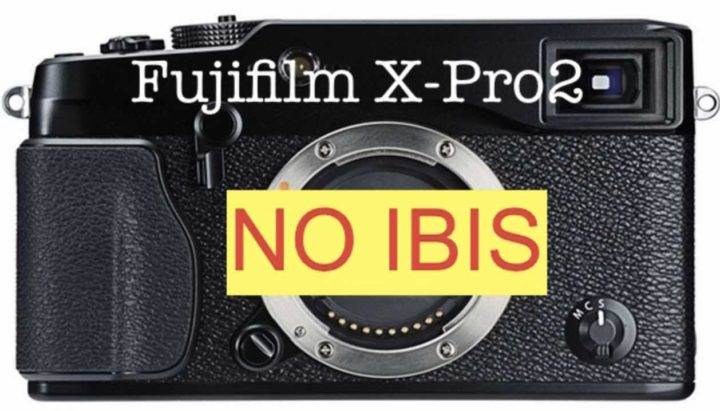
According to a trusted source, the Fujifilm X-Pro2 will not feature IBIS. For some this will be a bummer, for others not.
So let’s talk about it.
OIS Vs. IBIS
Canon & Nikon say that OIS is more effective than IBIS and delivers better images for several reasons.
1) Each lens is optimally tuned to achieve reliable correction.
2) OIS allows faster and more accurate AF & exposure metering, because the image comes already stabilized to the camera sensor (and advantage you’ll notice especially in low light).
3) OIS is more effective with long telephoto lenses
But also IBIS has some strong PROs
- if you often use slower non-stabilized lenses, IBIS is indeed a very useful feature. I’m thinking especially at old glass users, like the X-shooters from the “Old lenses for dummies” thread. They would suddenly have all their lenses stabilized.
- You pay for IBIS just one time, while you have to pay the OIS for each lens you get
Some say that IBIS also adds size and weight to the camera body… but well, OIS adds this size and weight to the lens.
These are just some Pros and Cons. A more in-depth comparison can be read at photographylife.
Oh…. and always keep in mind: both, OIS and IBIS, will only compensate the shakiness of your hands and NOT for the movements of your subject. For the latter, in bad light, you simply need fast lenses, and luckily Fuji has many nice ones to offer.
FINAL THOUGHTS
Over these years Fuji has built up a terrific OIS system (see this Canon Vs. Fuji OIS Video), arguably the best one you can get on the market. And if I had to choose between OIS and IBIS, I’d go for OIS. But, as always, there are several aspects to consider, and everybody will have a different answer according to the different needs. There is, as so often, no right or wrong answer.
That said… it seems that the market likes/needs cameras with the label “IBIS” (just like the label “weather sealing” is a strong selling point) and we all want Fuji to sell more cameras, right? So would it be time for Fuji to put that feature into their future X-cameras? What do you think?
stay tuned,
 Fuji X Forum, Facebook, RSS-feed and Twitter
Fujifilm X-Pro2 Rumored Specs
TRUSTED
– APS-C sensor (TS + AS + AS)
– 1/8000 of a second mechanical shutter speed (TS + AS)
– Joystick for quick AF-point slection (TS)
– Exposure Compensation Dial with “C” function for exp.comp from +5 to -5) – (TS)
– Combined ISO/Shutter dial, with little window on shutter dial to show ISO value (TS + SRP)
– coming late 2015 (TS + AS)
– delayed to 2016 (TS)
– Coming after CES (TS)
– Announcement on 15th Janaury 2016 (TS)
– weather sealed (TS)
– 4K video (TS + NeS)
– No 4K for the X-Pro2 in Jan. 15 (TS)
– Faster Processor EXR III (TS)
– No Tilt Screen (TS + AS)
– No IBIS (TS)
SOURCE RIGHT IN THE PAST
– Sync Speed faster than 1/180th (SRP)
– coming in January 2016 (SRP)
NEW / ANONYMOUS SOURCE
– ISO200-12800 (AS)
– 1/250 flash sync speed (AS)
– more than 200 AF points (2/3 are PDAF) – (AS)
– Hybrid EVF as X100T (AS)
– 24MP sensor (AS + AS) – More than 16MP (AS)
– about the same size of current X-PRO1 (NeS)
– dual SD card slot (NeS + AS + AS)
– tilt screen (AS)
– WiFi (AS)
– Price about 20% to 30% more expensive than the X-T1 (AS)
– Two X-PRO2 version, one 24MP APS-C and one 25-27 MP APS-X, compatible with XF/XC lenses (NeS + OS)
OTHER SITES
– coming September / October (OS + OS)– Non organic APS-C X-Trans sensor (OS)
– smaller than X-PRO1 (OS)
210 Responses
hmm… I dont understand the affirmation : “OIS allows faster and more accurate AF & exposure metering, because the image comes already stabilized to the camera sensor (and advantage you’ll notice especially in low light)”.
With IBIS, the support of sensor is moving, but the image is stabilized on the camera sensor too. Just have a look on mirrorless camera with IBIS : the EVF does not shake with IBIS activated and EVF is the image of the sensor…
I think the main drawback of IBIS is that sensor and rear-element of the lens might not be parallel.
I agree, that advantage of the OIS is something that comes from the EVF-less dSLR times. It doesn’t really apply in mirrorless nowdays.
That’s the thing I love most! µFT is marketing it’s system with “image side near telecentricity” and then they change the angle of the sensor.
Another drawback seems to be, that with very long lenses, the sensor must move further than it physically can. Probably one of the two reasons for the Olympus 300mm to get OIS
I never expected the X-Pro2 to have IBIS anyway. Would have been shocked if it had. So, nothing new.
Now, enough specs leaking, I want to see how the darn thing looks like! 😉
As I see it, none of the arguments for OIS over IBIS carry much weight
as long as Fuji keeps introducing/producing primes without OIS..
It would definitely be a great feature/option to have; it simply increases the shooting envelope to some situations you otherwise wouldn’t get a sharp image.
But yeah, enough with the specs. My X-E1 is falling apart ;).
Yes but the main benefit of Fuji is the lovely prime lenses. None of which have OIS.
You mean all those 5-axis stabilised m4/3Olympus bodies… Which were around before Sony ever did it?
I wasn’t expecting IBIS on Fuji cameras… but I always had a little hope.
It would add a huge value to the Fuji system, just imagine all the fast primes stabilized. People who think IBIS is a gimmick certainly didn’t try the Olympus 5 axis stabilization, its amazing, a real “virtual tripod”.
Yeah, the sharper images with low-shutter speeds that one can get with IBIS it’s something that’s just in our heads because of marketing…
Yes, that’s all classic trues, but that shouldn’t be an excuse for the technology not to move foward. If so, we shouldn’t be grateful for things like the amazing high-ISO performance of today digital cameras just because Henri Cartier Bresson used old 35mm grainy film.
Of course I use higher ISO values on situations like street photography with my X-Pro1. But I would also like to use lower ISOs for still subjects on low-light without having to carry a tripod. With the Olympus E-M5 I can shoot handheld at night with ISO200 or 400 at almost 1 second shutter speed and get a perfect night landscape shot. Really amazing tech and I wish I could do the same (and with better IQ) with Fuji cameras.
Exactly.
And by the way, forget about “French Fries” he’s just arguing for the sake of arguing.
I don’t think anyone was very interested in IBIS until Olympus came along and proved that it can work really, really well. I use both an Olympus and a Fuji, and I have to say that the Olympus generally gives sharper results in dim-light/low-shutter-speed situations even though most of my Fuji lenses have wider maximum apertures.
I know there’s no chance they’ll do this, but I wish Fuji would just suck it up and adopt IBIS so I wouldn’t have to go into every low-light situation wondering which camera would be the better compromise.
there was IBIS before Olympus made it “cool”. But yes, the Olympus implementation (EM5II) is probably the best on market right now.
If it really benefits you, depends on the subjects you shoot. If you do people IBIS is probably not important.
If you do non moving, IBIS can really benefit you, but then again: if I want maximum quality of non moving stuff, I will take a tripod.
Still: IBIS (with non of it’s drawbacks) would be cool!
Actually, about ALL I photograph are people, and I find IBIS very useful. Why: When shooting people at slow shutter speeds, your “blur risk” is divided about equally between subject movement and camera movement. If you can eliminate camera movement as a risk factor, you basically double your chances of getting a usably sharp photo. People engrossed in an activity will often hold still enough to get a sharp photo at even 1/8 sec, but it’s tough for me to hold a camera steady at that speed, so stabilization helps a lot.
1/8sec? either you are shooting extremely wide or you don’t shoot what many would consider people.
But if IBIS would benefit you that much, there should be nothing in your way to get a system that has it.
Like I say, when people are concentrating, they often stay surprisingly still.
Not a deal breaker by any means, but I for one would have welcomed the addition of IBIS.
Now I wait for the TS rumour that the X-Pro2 won’t have 1/8000 and not be weather sealed.
then I’m afraid I will disappoint you 🙁
A serious question. What does “Pro” mean to Fuji?
I suppose it initially simply meant not infringing Leica’s trademark for the name “X1”, while still using something that sounded like the “X100” and “X10” they already had.
Other than that, well, it’s basically their top model, so it will likely have all the features they offer without any compromises, and I imagine that will also include weather sealing.
If you keep scratching features off the list, we’re gonna end up with an X-Pro 1.001 in January.
1/8000 will come
LOL…really, I read you post and just started laughing. A great post. You made my day.
This debate between IBIS and OIS is meaningless. Cameras with IBIS are plainly better — having IBIS doesn’t prevent the use of OIS lenses, as the dual IS system of Panasonic shows. However, if you don’t have IBIS and your lens is non-OIS (as most primes are not), you are stuck and don’t have IS at tall. That’s why Sony added IBIS to the second generation of the A7 series cameras.
Agree 100%.
I agree 100% as well.
Well said.
100% agree
OIS + IBIS perform generally as the best of both (OIS most of the time).
And then you pay and carry both stabilization systems for similar performance.
Stabilization is really important for long focal lengths, and long focal lengths need OIS for optimum stabilization. Add to the mix that most of the time subjects are moving and you still need to use high-shutter speed… For stationary subjects, hold your breath, use a wall or a tripod and stabilization isn’t really needed, especially with fast primes…
I’d like a Fuji body with IBIS, but do I really need it ? Better high iso would be way more usefull.
I’d like a Fuji body with IBIS, but do I really need it ? Better high iso would be way more usefull.
That’s the thing. In theory (if there was no disadvantage), I would like it too. But to I need it? 1 in 100 shots at the best.
Furthermore Fuji does stabilisation for those lenses, that really profit from it. 120mm and 100-400mm will be perfect examples too
Absolutely right – just one small thing is wrong.
Sony didn’t add IBIS because of that.
Sony added IBIS because it’s a feature that can be sold to unknowing amateurs.
We had a long discussion about IBIS (and stabilisation in general) at our “Fototalk” last month. The thing to take away: the experience (and EXIFs) said, that stabilisation is mostly a thing for the head (and those looking for specs). About 90% of the photos will not benefit from it. Of course the lens selection could be a bit different etc.
I’ve just bought a 90mmf2 lens for my X-T1, my normal lens is the 18-135 which, at f5.6 with 5 stops of OIS should allow me to use a lower shutter speed when it’s necessary as that’s equivalent to f1.0 if you believe the numbers.
But, I would be prepared to pay more so that *every* XF lens comes with OIS no matter if it’s a prime or a zoom. OIS would make my f2 lens into an f0.35 equivalent lens in terms of usable shutter speed.
There are other considerations, the f2 gets more light onto the sensor for focusing and EVF image noise reduction at the same EV, but ultimately it’s about what happens while the shutter is open to capture the image.
Really sucks, a serious -2 for Xpro 2. The day that Fuji gets on it you will see the naysayers wondering how they ever got along without it, it’s that useful particularly in low light.
My concern now is better micro contrast in the focus point lots of the Fuji images at least mine lack micro contrast and they really need to work on this (think Leica Q, Olympus Em1, Sony A7Rii the big boys). I think the Xpro1 and Xe1 Xtrans was better at this than the Xtrans II. Please have a hands off feature with the noise reduction to get sharp detail rich raw files it’s a niche camera so don’t worry so much about noise reduction giving the Fuji files an HD look please.
Bummer! For years I hope now for an APSC camera with IBIS. Everyone that used an OMD will confirm that IBIS works like a charm in lowlight situations with fast primes. The OIS diskussion is mood when there are no stabilised fast primes from Fuji. And the release of the 16-55mm F2.8 without OIS is a dealbreaker for such a otherwhise great lens. Only IBIS would help to use such lenses handheld with 1/20s or 1/40s. To bad that Fuji is dumping this investment in the future of their system. It is a missed chance to establish make the existing lens lineup more usable.
“…when there are no stabilised fast primes from Fuji.”
Then take your business elsewhere.
Oh, wait, the number of fast, stabilized primes under 200mm from all other manufacturers combined can probably be counted on less than two hands.
Never mind.
IBIS was never a X-Pro Feature for me. Like tilt screen, or touch display. Let’s be honest: X-Pro is all about pure shooting experience and many that buy that camera are happy if it has LESS features.
To be honest: I am not one of those.
So the question is: will this mean OIS over IBIS for the whole next generation (2 years) or is there a possibility for IBIS in the X-T2 (or even a new model above it)
any hints Patrick?
Since sensor-based image stabilization means that the sensor position and potentially even angle with relationship to the lens and the light coming in is not what it was intended to be when the system was designed, I imagine Fujifilm will not be willing to accept that compromise in image quality, especially since many of their lenses are so sharp that it may actually make a more visible difference than on other systems. Besides, their in-lens stabilization technology is already amazing.
For me this falls into the ’tilt screen’ category – if you can do it, do it. If it’s not to everyone’s liking, fine, nothing ever is, and if you don’t like it you can decide not to use it. Make IBIS a feature that can be turned off and you’ve got the best of both worlds.
Gosh, I really hope they keep a tilt-screen off of the X-Pro line and save it for the XT line. For me, it would ruin the aesthetic appeal of the X-Pro (usefulness aside). Unless they can somehow keep down the bulkiness and chunkyness (or flimsiness) of a tilt-screen, I’d be happy without it. That just IMO, tough.
Two of the rumoured “non” features which may make the X-Pro2 worth skipping are the lack of IBIS and the fixed rear screen. If these two are true, the X-Pro2 will NOT be on my purchase list.
The most important is the IBIS. Yes, Fuji have great OIS with their zoom lenses but none of the prime lenses feature this. People like me who shoot using available light and therefore usually opt for primes, such as the 90mm/2, really would benefit from some kind of anti-shake (Sony have seen the wisdom of IBIS even if their lens strategy is abysmal). Even if OIS is better, that really isn’t any advantage if the prime lenses lack it.
Secondly, whereas some don’t see the value of a tilting screen, I do. It’s a great feature on the XT-1 and one that I think should be standard. Whilst many won’t use it often, it can be left un-tilted whilst you cant tilt a fixed rear screen… see?
Now, while I can (grudgingly) live without a tilt-able rear screen, I think a lack of IBIS is a real deal killer. I hope Fuji read this.
In theory OIS is less better in IQ compared with IBIS. The first generation of 70-200/2.8 VR is worse in IQ when compared with its predecessor that had no VR. It’s not difficult to understand since OIS requires an additional element in the lens. That thing remains there whether you need OIS or not. More is less ideal in this case.
So what? Second generation is better. Now that your “argument” is out of the way: OIS does not require more elements. But you have to calculate OIS into the optical cell. More thinking would have been ideal in this case.
I guess you must be misled by some information. That VR element never disappeared in today’s design. It’s just better so impact is smaller. Regardless, I have not yet seen any large aperture prime that has OIS or anything equivalent. But IBIS is something you can have for those lens.
http://www.nikon.com/about/technology/rd/core/software/vr_e/
Define “large aperture”. There’s the 42.5 1.2 Panasonic with built-in OIS and the 85 1.8 Batis with OIS. If 1.2 or 1.8 is not a large enough aperture…
For prime, 1.2/1.4 is what I refereed to. Normally f/1.8 beneath 100mm is not high end lens except for some brand. So it was a missing feature for f/1.8.
You’re mixing up things. The decision of camera companies to create f/1.8 cheapo lenses and make their highend designs f/1.2/1.4 does not mean that f/1.8 is not a large aperture. Compared to slowish 2.8 zooms, 1.8 is indeed a large aperture and a mere 2/3 stop difference from 1.4. Besides, I don’t see definite proof in lens design that the VR element remains the same. After all, the optical cell is usually improved anyways.
Compared with f/4, f/2.8 is fairly large too, in relative terms. In absolute terms, f/1.4 are much more difficult to design and produce than f/1.8, and f/1.2 more difficult than f/1.4. You can keep persuading yourself about these. I just don’t bother. I don’t choose a camera based on sharpness anymore.
So what does the aperture discussion now have to do with you not choosing a camera based on sharpness anymore?
If you are to argue, impression there with VR is plain simple. 70-200/2.8 VRII remained the same league in IQ and better than VR I when compared with 80-200/2.8 last gen that had no VR.
Aperture wise, just show me an apsc or FF f/1.4 lens that has VR or IS and then we keep discussing.
OIS is just inferior, swallow it.
Ah, so you discount micro four thirds, as it just fits your arguments. Tells a lot about you. Also, to say that the 80-200 has the same IQ as the 70-200 VR II is a joke. Sony fanboy I suppose?
So discussion helps improving IQ for you huh?
Discussion helps unmasking your lack of knowledge. Besides, you’ve repeatedly switched topics. How come?
Just to remind you that you reply on debating to decide which is better instead of facts. The ibis talk is there for a long time. Go do your homework.
You’re incompatible with a linear style of discussion, finally leaving the whole discussion altogether. Thanks.
I’m not paid to write technical paper on fujirumor. I had given you keywords to google. Don’t expect me to treat you like an elementary school teacher would.
Good thing you don’t get paid. Your customers would probably find them faulty, given the false information you provide here.
I find your lack of knowledge disturbing
srsly – I don’t get your point. I have tried both IBIS and OIS and IF one does decrease image quality, it’s mostly IBIS.
As initially stated, in theory. I am not saying I like what Sony offers these days.
I have lost you? What was your point again?
Because Marc Grinns argumentations sounds much more logical (and fits what I know about lens design too).
Arguing doesn’t make better image out of your camera. It is what it is.
X-T1 will be my last Fuji camera. I am done with it.
In a way I agree since I too sold off all my Fuji gear. However I am sure I will come back some day.
The system is just not very responsive. I prefer my D5500 over it any day.
I have that impression too. However I think it’s some sort of illusion. My Nikon needs to retract its mirror. It reacts faster but the total time it took is the same. Imaging-resources tests this and their results shows Fuji at least in on par. Sometimes you just have to get used to it, I guess. How fast the display reacts doesn’t represent how quickly your body is working.
He said he used Nikon…
Thanks Chris for stating the obvious.
He said he used D5500… Again this is obvious talk.
LOL. Thanks again. He will get it eventually!
I, too, converts from X-T1 to Nikon and settled down with Df for now. I understand and agree with what he said to some extend. Had experiences with A7 as well. Not too bothered to elaborate every thought but his impression is expected.
lol. If you had gotten the D750 or D810 I’d have said: yes, those are nice cameras. I enjoyed using them both. But Df? Really?
I had d810 along with df for 3 month. 80% of my favorite shots are from Df. It is much easier to get good results in post-processing.
Typical! And now you’re trying to cover your lack of intelligence by a joke.
So, you think I am just complaining not stating facts that the X-T1 is not very responsive?The responsiveness is slow even for street photography. I am not talking about sports photography.
WOW. you got that from my few words?
“No need for whiners like you”
No need for whom? Please elaborate?
Did I come to your place or contacted you and whined?
I agree. I use a XE2 for street and I would like to hear why it’s not responsive and slow. With the quick to acess dials and aperture changes, I just don’t see what you’re talking about being slow.
We change everything all the time. It’s life. Only stupid people don’t change their minds.
I took beautiful pictures with all the cameras i had, whatever the brand and technologies.
I was Canon, Sony….i will go for Fuji XPro-2 and after a few years, i will change again… 🙂
Well I give up Fuji only because it’s hard to push the color to get satisfying results under some conditions. Some shots is just gone for me.
What are you shooting, jpeg or raw? Day/night/both? What are the conditions you’re talking about, and what did you switch to that doesn’t cause these problems?
Just shoot raw, then the “problem” with colors is gone.
Then why Fuji? I can tune Df to look like Fuji but not backwards sometimes. I cannot push Fuji as much as I could with Df. Some shots won’t exist because of this.
please don’t. Or be productive. I know trolling can be fun, but cmon…
So in your world there is only black and white but nothing gray, right? That makes life easy.
Don’t let the door hit you on the way out
C’mon he’s joking. He loves Fuji. He ‘s just dissapointed…….. like me !
i am stunned how imaging companys can complain about camera sales dropping without seeing whats the problem. that right there is the problem. all these great primes but no ibis that would make them so much more usefull? no touchscreen = touchfocus. its so usefull and if you dont like it make a menue to disbale it. i dont think they will get any new customers with a 24mp apsc camera that cost about 1500-2000€ body only. no fullframe sensor, no ibis like sony oly, no tilt or full artiq. screen like pana and oly. i mean i like old cameras. have some 35mm minolta with lenses at home. but who in his right mind will buy a realy expensive x-pro2 laking so many usefull features. less is more? no it isnt. i will stick with my x-e2 and 6 lenses and just wait for a fuji thats worth upgrading for. if oly starts to make f1.0 and 1.2 like rumored, maybee i will switch to oly with ibis, arti. screen touchfocus in the future even though i prever fuji colours and body design.
SO let me get this straight, the lack of ibis and touch screens on cameras and not the fact that a camera phone is always with you, plus size, plus the fact that most camera phone pics only live on the phone and social media is the demise of traditional cameras? HM…
i think smartphones killed the market below 1000€ cameras. the market > 1000€ are people like us wondering if they should upgrade their exiting gear = fuji camera sales. 1500€ – 2000€ body only is a lot of money. the amount of people buying a new x-pro2 just 4 some more megapixel and a bit better af is minor. at least you never heard a person say: what touchscreen no i wont buy this or ibis: no dont want that, dealbreaker blablub
I’m sorry… What??
Look, camera sales aren’t judged by touch screens and ibis. If they were, Olympus would lead the WORLD in camera sales, and not struggling to make operating profit.
A lot also has to do with the big two and the investment most photographers made with them. Also, the media has pulled away as well as journalism. Video is now playing a part, to where you can now pull stills from.
It’s numerous things causing a drop in photography. It definitely not lack of tech or price.
My gosh….
ask yourself: why is sonys A7 so popular? nobody would buy a A7 for 3k just because of good dr and a small body.
why is sonys A7 so popular?
because of marketing and a lot of stupid people thinking image quality is about the body/sensor and not the lenses. It’s a hype, nothing more.
A7r2 with IBIS and Zeiss Batis 25/2 85/1.8 >> your theory 😉
thanks for proving my point 😉
nice try, umad?! 😉
why? Listing the Batis 85mm with 3% distortion and busy out of focus ares is an perfect example, that cameras seem more important than quality lenses for the mainstream today.
digitalrev super review of batis 85; steve huff also calls it amazing, matt granger = amazing lens, now camera store tv voted it the best lens 2015. so pls stop trolling its anoying.ty
digital rev, steve huff and matt granger – yeah those are probably the most capable reviewers out there o.O
Just download some raws and take a look, the lens has really ugly out of focus rendering and 3% distortion for a portrait lens is just WTF.
Take a look at admiringlights forum there are comparison pictures – the 56mm Fuji is the better portrait lens (against the Batis 85).
Zeiss fked up. Just like they got their asses kicked when doing Touit for Fuji. But now they have Sony, not Fuji, that suits them better.
The ok Zeiss lenses are still by far the best in the underdesigned E-Mount.
But why do I even bother – it seems you have no knowledge of optical design
your remind me of angryphotographer 🙂 ranting on and on, everybody is wrong only you are the expert
even your own source admiringlights contradicts your statement:
“It’s a longish cons list for a lens that I think is utterly fantastic, but overall, the complaints are minor. ”
fantatstic lens with minor complains –> omg zeiss totally fked up rofl…
The quote from admiringlight (comparing Batis and Fuji 56mm) is: ” To my eye, the Fuji 56mm shows the smoothest bokeh in this situation”
Furthermore on the Batis: ” It’s never ultra-creamy, but foliage can sometimes bring out the worst”
And this is exactly what you would see, if you where taking photos or at least looking at them.
Thanks for the angryphotographer comparison, at least he knows little – you know nothing Jon Favorite
you took the batis 85 as a example for a bad lens, but nobody except you thinks that the batis 85 is a bad lens
you took the batis 85 as an example for an outstanding lens, but it seems it’s not and many think (an measure) this way 😉
then how about posting some reviews that actually say that this is a bad lens = not a review that comes to the conclusion that the lens is fantastic like your first source admiringlight says.
Because of the Hype train and it’s Full Frame. Sony spends a lot of cash on marketing. And sadly, there are still a lot of suckers out there for anything sony on their electronics.
Don’t worry.. In 2 years, Sony will drop the A7 series like a bad habit, and start something new to sucker them in. Especially after Canikon takes mirrorless seriously.
Keep your dirty touch screen away from my X-Pro 2 😉
I’ve shot with IBIS cameras and non-IBIS cameras with or without OIS and frankly, both methodologies work pretty well. My favorite IBIS is Olympus’s 5-axis on its OMD EM5 (and newer) camera; it was so steady, it felt like you were holding a gyroscope. But there were also a few lenses that it didn’t work with where it would flip out and blur everything in confusion, so it was a real pain remembering to turn it off and on depending on the situation or the lens you were using.
The decision to not use IBIS is not a deal-breaker for me at all.
Interesting opinion in contrast to all the other posts here.
Out of curiosity, which problematic lenses are you referring to? In my experience, the effectiveness of IBIS does indeed vary by the lens used, but not to the point that it “flips out” or “blurs” anything. Not saying that it didn’t happen to you, just trying to assess why it would have.
There were two third-party lenses; I can’t remember one, but one was a Samyang fisheye lens, which might not suprise some people. IBIS went absolutely bezerk with it on, like it was having vertigo. Lenses like the Oly 9-18mm really benefited from IBIS though.
Oh my gosh, did the Olympus fan boys creep in here? Like seriously, do y’all really need a crutch like ibis in your camera?
There are pros and cons to every system, but to say you won’t purchase a camera for lack of ibis is laughable. I really think haters came here simply to complain, Knowing they won’t buy a Xpro2 in the first place.
If you need ibis that bad, I suggest you sell off all your Fujifilm gear, and use the cash on either Olympus (with lesser IQ) or Sony. You can also get flippity-floppity tilt screens too.
And whoever though Fuji was really going to add ibis to the XPro2… I got a Bridge in Brooklyn for sale…. WITH built in ibis.
I think it’s pretty hard to argue that IBIS is a bad thing. It’s not a deal breaker, but it would have been a major boon.
ever experienced shutter shock?
I am saying: it’s a really cool thing. But it’s (at the moment) absolutely no must have
The EM1 has shutter shock issues with ibis. Check Ming’s website, even though he’s a Fujifilm hater.
the EM5 is worse
there are very few “must haves.” A lens, and a medium for capturing light are must haves
I hope that all those saying, that they will now sell their Fuji stuff or won’t buy it, do just that (and with that leave Fujirumors.
Once this has happened, I think that eve productive discussion could happen here!
http://www.quickmeme.com/img/a1/a10aee37a7e56dbcefae95ef4429af4df37ca634aa792de7057101e662049c94.jpg
I doubt most of them have a Fuji or are even slightly interested at all in getting a Fuji.
Not really a surprise, the Fuji not having IBIS.
What I almost never see mentioned in this IBIS/OIS debate, is the advantage IBIS has over OIS in being able to correct rotational movements (a la 5-axis Olympus system). I would think depressing the shutter would mostly cause the camera to rotate around the lens axis, a movement OIS can’t compensate for.
the fifth axis is many important when doing close/macro work.
I know it’s easy to think that pressing the shutter would produce a perfect rotation, but in nearly every case: it’s not. And that’s why OIS works so fine in 99% of the cases.
True, any movement will consist of a superposition of movements along different axes, one of these being the rotation. The IBIS however has no limit to the direction of movement per se.
Let me ask a little different question: it seems obvious that everyone would prefer having IBIS as it helps many prime lenses (90mm lens comes to mind first).
But why do to think Fuji hadn’t implemented this?
– Is there any technological constraint or difficulty? It is not exactly a new technology and it doesn’t impact the cost or the weight of the camera body much, so I just wonder why they didn’t engineer this?
Of course it impacts the cost of the camera body. It’s not a software technology. You need hardware, you know. And the whole construction to move the sensor with magnetic force requires hardware and a certain effort in development&research.
Right, but as I mentioned it probably does not impact the cost and the weight MUCH. This isn’t the reason to not include IBIS in the high end camera.
I wonder if there is something else, possibly something that might require update of their current lenses with OIS.
Well, the price of the body might increase by 200-300$/€ which is quite a bit. I’d prefer not having to pay that extra money.
I think the talk about money is not really relevant.
Comparing a Fuji 50-140 with a Olympus 40-150 and a Fuji X-T1 with a Olympus EM1 we have two totally different concepts.
And both lenses are about the same price (one has OIS the other not) and same goes for the bodies (one has IBIS the other not)
Price will be, what the manufacturer thinks people are willing to pay.
Anyway: both OIS and IBIS have their pros.
I’d say for maximum performance OIS is still a bit ahead, but IBIS is more universal.
Personally I’d like to have IBIS, but it’s absolutely no deal breaker. And I think the X-Pro was never intended to have it
There are some drawbacks:
1. the body size increases.
2. the battery consumption increases
3. due to the moving parts it’s harder to get heat away from the sensor. This is the reason why both, 4K and IBIS are relatively new (the GH4 has 4K only and the EM1 with the same sensor has IBIS only)
4. getting heat away doesn’t only effect 4k, in theory you get more noise
5. the cost of the body increases
6. it’s possible to hurt the image quality. Shutter shock is one example
7. it seems that ibis is getting weaker the longer the focal length is. This is due to the possible distance the Sensor can be moved (and tilted)
there are 2 big plusses on the IBIS site:
1. you have it always with you (primes)
2. the 5th axes is only possible with IBIS. This is mostly important for close/makro stuff
“1. the body size increases.”
Possibly, but usually not markedly so. Body size also decreases over time as technology improves.
“2. the battery consumption increases”
This hasn’t really shown to be the case. Certainly not compared to OIS lenses.
“3. due to the moving parts it’s harder to get heat away from the sensor. This is the reason why both, 4K and IBIS are relatively new (the GH4 has 4K only and the EM1 with the same sensor has IBIS only)”
Relatively new yes. But this is only really an issue for 4K video on IBIS sensors, being that the Fuji will not have 4K this doesn’t seem an issue.
“4. getting heat away doesn’t only effect 4k, in theory you get more noise”
More so than not stabilising and having to increase ISO? Doubtful.
“5. the cost of the body increases”
They can sell it for more, but the actual cost is probably quite small. It becomes a unique selling point and therefore more chargeable, but that doesn’t impact the actual cost as much. There have been 3 major manufacturers that have sold IBIS cameras for a decade or more without increased cost over their competition.
“6. it’s possible to hurt the image quality. Shutter shock is one example”
Same with OIS.
“7. it seems that ibis is getting weaker the longer the focal length is. This is due to the possible distance the Sensor can be moved (and tilted)”
True, IBIS can’t be fully optimised for all focal lengths, but remains effective at all but to an increasingly lesser extent.
“there are 2 big plusses on the IBIS site:”
You missed a couple:
3. Can be used for video where regardless of how ‘fast’ your lens is or how ‘good’ your high ISO performance is, it is still very useful.
4. IBIS doesn’t preclude using OIS, or even combining with OIS to be more effective than either on their own.
5. While the body may be more expensive (because they can charge more if they wish) lenses can be less expensive.
6. Image quality is lesser impacted by IBIS than OIS.
8. IBIS gives IS to every existing lens. This means not having to ‘wait’ or ‘hope’ that a manufacturer decides to one day make the lens you want with IS. Take the 90mm, Fuji are unlikely to release a replacement any time soon with an IS version.
1. you*re probably not good at mechanics
2. you’re probably not good at maths
3. you’re probably not good at logic
4. you’re probably not good at reading
5. you’re probably not good at economics
6. you’re probably not good at understanding
7. finally!
about your points: it seems you have no idea about optical design, sensor design etc.
But why am I talking to a troll anyway?!
Not everyone, just those who because of their lack of technical knowledge and skill believe that the ‘latest thing’, in this case IBIS, is the panacea which will enable them to become a better photographer; without having to study the theory of photography and spend time learning how to use a camera correctly.
Some of the probable reasons Fuji’s optical designers/engineers haven’t implemented it are :-
1. It is almost impossible to obtain a truly plane parallel sensor unless it is rigidly fixed. This is vital when using such lenses as the 56 mm f1.2 and 90 mm f2, which are sharp across the frame at full aperture, without this becoming apparent due to the effect of an IBIS system not being truly plane parallel.
2. IBIS becomes more ineffective as the focal length increases. I have heard a focal length of 100 mm (on ‘full frame’) mentioned as the focal length at which the IBIS system starts to become ineffective.
3. Any vibration reduction system, IS/VR/OIS/IBIS etc., actually reduces sharpness when using shutter speeds shorter than 1/500 sec., as the shutter time is shorter than the time it takes the vibration system to work. This results in the shutter operating when the vibration system is still moving the lens elements.
4. Any vibration reduction system only reduces unsharpness due to camera motion. If the subject is moving, or you are moving yourself, it has no effect.
5. In wide angle lenses it can, note can, result in a poor optical performance. The classic case of this is the Nikon 16-35 mm f4 zoom lens.
6. I have known several excellent, amateur, landscape photographers who always use a tripod to obtain the best possible image quality, and regard any form of vibration reduction system as very much a second best option.
Hmmm… so wanting a feature that, when used judiciously, can provide a certain convenience, or enable you to capture a shot that you might not have pulled off without it, implies lack of skill and knowledge and a belief that said feature is cure-all. Check!
ad 2. “I have heard”
Is that your knowledge and skill speaking?
But let me get this straight: because a feature is not universally applicable, one shouldn’t bother with it at all?
ad 3. You do know that there is the option to engage IBIS upon half pressing the shutter so that the image is already completely stabilized before the shutter opens, don’t you?
Note to self: delete all images I took using IBIS, because no matter how well they turned out, knowledge dictates that they must be crap.
“2. IBIS becomes more ineffective as the focal length increases. I have heard a focal length of 100 mm (on ‘full frame’) mentioned as the focal length at which the IBIS system starts to become ineffective.”
No offence but you have never owned an IBIS camera then, try the olympus em1 or em5s2, that claim is FAR from true.
That said it isn’t the end of the world and I prefer Fuji regardless, but so much misinformation is spread in this debate (OISvsIBIS) from people who have never owned an IBIS camera.
“6. I have known several excellent, amateur, landscape photographers who always use a tripod to obtain the best possible image quality, and regard any form of vibration reduction system as very much a second best option.”
Agreed even with IBIS camera or OIS lens, I turn it off and use tripod for landscapes I want the absolute best IQ from.
it’s not 100mm and it doesn’t just stop working, but it get’s less efficient. The distance the IBIS can be moved is limited and long telephoto lenses are where this runs into problems. The Oly 300mm is said to have OIS due to this
Works just fine on other 300mm lenses (but as you say less effectively than perhaps some shorter FL’s).
The 300mm f/4 is said to have OIS as it will be a fairly niche product and they want it to appeal to all system users, not just Olympus users.
“ALL” system users, or all users of M43? Olympus added stability due to the fact that ibis is useless at the long end. At certain focal lengths, ibis is useless. But Olympus won’t tell you that. If it was, there would be ZERO stabilized lenses from Olympus.
But hey, don’t let me stop you from enjoying the kool-aid.
Fuji said there was no OIS in the 16-50/2.8 to maximize image quality, I would imagine that is the same reason they left it out of that amazingly sharp 90/2, probably less sharp (or much more expensive) with it.
Well, Fuji had a lot of trouble with AF as well and that’s not exactly new.
It’s completely reasonable to believe that OIS is superior to IBIS, but then actually put OIS in your lenses! Fuji only puts it in the zooms, whereas my impression is that many or most Fuji users are in it for the primes. This is schizophrenic.
All the Fuji shooters I know bought in for the primes, there aren’t many of us here though (australia) but the quality of the primes was the no 1 selling point and no OIS obviously for the people I know. The 90/2 with IBIS would be very nice.
It amazes me who comes out of the woodwork when rumours and specs get announced. If these people with only negative or comparable opinions actually spent their time improving their own skills as a “photographer” and I use that term lightly.. then maybe they wouldn’t have to rely on their camera doing everything for them all the time.. and when they don’t make good photographs then it’s quiet apparent that it was the cameras fault or the lens.. or the software…
If you cannot take a camera that has a sensor and the ability to control light and make a good image with it then well give up now.. please do us all a favour and give up.
What a lot of you ask for is such BS* you want a camera with all the bells and whistles, FF, IBIS, touch screen that rotates and brushes you teeth while you shoot.. like seriously. Get a reality check. If you are buying and spending this amount of money on gear then you should be able to use it to make great images.. if you are not then its not the camera or the lens.. its you.
The only reason Fujifilm implement these specs that are in no way compulsory to making an image is for the spec wars between companies to win over the hearts and minds of Plebs. I get why they do it.. I understand and even use some of these features.. but in no way are they 100% necessary in making good images. I for one who use to hate the idea of flip screens can vouch for its usage in certain situations.. but i would also be good without it. So I write Fujifilm a letter.
Dear Fujifilm,
I feel compelled to ask you for 4 things in your cameras.. I want great Dynamic Range first and foremost. I would like great High ISO performance. I would like a fast shutter system and lastly I would like amazing glass to go in front of all this.
Oh my bad Fuji, you already make this. Oh and you even have a bunch of extra features built into such a camera and you even improve it via firmware! Oh dam.. Maybe because you already do everything a camera needs to do you could organise my breakfast in the morning.. and brush my teeth with a touch screen that rotates around pluto and how about it hovers around and takes photos for me.. yeah I need all that stuff.. like now.
PS. I heard Sony was going to do it next week and then Olympus the next week after and then CaNikon the next week after that. So i need you to do all these things by like tomorrow so I can tell all my friends how excellent I am.
Seriously people… Heres the next feature your camera should have.. A decent “photographer” behind it.
It’s so refreshing to know that I’m not the only one who thinks as you do.
Well said!
So by your own admission, Fuji already makes everything you need in a camera. Yet you feel compelled to visit a gear rumor site of all places to berate those whose needs, wishes and/or preferences don’t match yours with the good ol’ platitudinal “real photographers don’t need them newfangled features!”.
It is indeed fascinating to see who comes out of the woodwork.
Sure I am interested in what the next evolution of fujifilm cameras are going to be. That’s why I come here. But the only things I am interesting in with new products is what they offer in light capturing.. Image quality, more DR, better noise; things that ACTUALLY matter. I also understand that cameras are more of a technological piece of equipment more now than ever and it’s pains me to see a manufacturer who knows how to capture light through their device have to kneel down before plebs who demand ridiculous specs from a camera or lens and carrying on about leaving the system because they don’t have something. And therefore make it hard for Fuji to make their system profitable and successful. How’s does Leica survive.. Being renowned for IQ in a minimalist format that is honestly more expensive and arguably not that much better in terms of IQ to Fujifilm but people aren’t crapping on about leaving Leica because “blah blah blah” but here fujifilm cope it from plebs who aren’t pleased with their gadget.
The conversation needs to change.. Not from not what more a camera can do in specs but how better a camera can make an image. That is what should be important
End of the day- I use my Fujis to make images not be some gadget that has this or that. I make my equipment accountable for making myself an income and that income comes from capturing light not having a touch screen.
Frankly, I’m stumped as to why you feel that your requirements are the only thing thats that matter and everyone else (including Fuji) should deem important.
If I’m a travel photographer who would really benefit from IBIS for shooting in low light locations where tripods are not practical/allowed/available? Does that earn me a scolding and a sweeping generalization as a gimmick-dependent kludge?
And did it ever occur to you that amateurs may have a different take on what are beneficial advancements in technology than you do? To them, a touch screen may represent a major jump in usability. And no, that does not mean that they have not been able to produce a decent image without such a feature.
Who are you to call those of a different persuasion “plebs” and their preferences “ridiculous specs” while the world should heed your demands instead?
Not sure why you take such offence mate. I’m merely highlighting that these specs are irrelevant in making a photograph.
Deal with it. Most people are agreeing with me.
So enjoy your travel photography and I hope not having IBIS doesn’t stop you from making good photographs.
Michael, it’s OK to be a luddite. When I am out on my sailboat, I have paper charts to go with my electronic charts. The difference between me and you is I don’t force everyone else to own both also.
This idea that there is only one way to do something, yours, is ridiculous.
There is a lot of art made in this world I don’t like, but unlike you, I would never tell the other artists to stop.
You don’t like all the features Fuji puts in a camera, just don’t use those features.
But I’m looking to replace a 10 year “system” (well I did replace the body with a newer one, used, off of craigslist a year ago) and if all I am going to get is what I already have then Fuji isn’t going to sell me anything.
I want to buy into a system that I feel will be around 10 years from now.
Not forcing a way of doing things at all.. Dave. Merely pointing out how negative people get over some silly feature (and I’ll have to repeat myself especially for yourself Dave..) “that isn’t necessary for making a photograph.”
Now either you can accept that fact which is true to its core or you don’t. Simple as that. I’m not going to force it upon you… Nor am I going to pester you about it or anyone else. Merely take it for what it is.. And enjoy doing what ever it is that you do Dave.
I will Michael, I will, personally I happen to rely on some technologies to help me fulfill my artistic vision.
And peace to you.
I should add…years ago while at a stop light, a drunk driver hit me…now years later, some parts of me don’t work that well anymore…maybe I move in the world different than you, but I don’t know you situation, I wish you would stop making grand assumptions about mine.
“I want to buy into a system that I feel will be around 10 years from now.”
Then don’t buy a Sony.
Yes, because Fuji only abandoned one mount this decade and Sony have abandoned… Oh wait that’s zero.
“I’m merely highlighting that these specs are irrelevant in making a photograph.”
Egotist tries to prove they are still important or somehow relevant.
Your comment about Leica brings to mind a conversation I overheard in a parking lot outside an Officemax store.
As a father and son walk from a store to their Mercedes, the 14 year old son says to his father.
“Dad, I finally have decided what my first camera will be, …a Leica, the M in silver”.
Dad says “Mmmmm”
“With 3 lenses” the son continues, “the Summilux-M 35mm f/1.4 ASPH in Silver, the Noctilux-M 50mm f/0.95 ASPH Lens in Black and the 21mm f/1.4 Summilux-M Aspherical Manual Focus Lens in Black”.
As Dad opens his car door he says, “Son, we will talk about this more when we get home.”
True story
*sigh* ‘real’ photographers don’t need more DR. See how you play what is important to you should be important to everyone and what you see as a ‘gadget’ others see as an important feature forward making images.
Believe it or not, the world doesn’t revolve around you not your opinions.
Trolling all the comments and forcing your opinion on everyone else’s comments.. I bet your a real treat at a party.
I’d give you +100 but could only give a +1 😀
Speechless…….
I am a supporter of IBIS…with Fuji’s fast primes, IBIS would be fantastic. Maybe IBIS will be in the X-T2, the X-T2 will be a bigger camera anyhow. One can only hope.
I should add…for some reason that completely escapes me, I have opinions regarding Fuji cameras that are completely opposite of 99.9% of those who post in this site. Have a nice day.
Some of us agree, at least regarding IBIS, I wonder how many of the ones who disagree have had cameras with it before, especially recent ones with 5 axis?
Honestly, I think they disagree because Fuji doesn’t have it, therefore it must be better without. Somehow, I don’t think they seem to understand that their OIS won’t stop working because they have IBIS.
Fuji won’t do it though, because the vast majority seem to believe they are better off without it.
“Price about 20% to 30% more expensive than the X-T1 (AS)”. As far as I see it, according to the rumors, if x-pro will feature a6000 sensor and pretty much no other serious improvements then I don’t see any justification for a price higher than $1199.
If you don’t see it, you are not an X-Pro type I guess 😉
Please explain. What is the justification for a higher price than $1199 for a basically redesigned x-pro 1(which now costs $799)/x100t with another cheap APS-C sensor?
You shouldn’t compare the price to an old model which paid of it’s R&D costs and was reduced to clear the stocks.
What you get is access to the Fuji lens selection. And you get the best Camera with Hybrid Viewfinder on the market (I read once, that that thing alone is about 3-400$)
You get better handling, better IQ, better everything – I’d say it’s worth the upgrade for all those, who make pictures and don’t just masturbate to specs.
But let’s play your game with one or two other camera: A7 to A7RII. You get a new Sensor for 2500$
I’ll take the new x200 with a new sensor and a new lens for $1299 please.
I don’t see a reason why the current rumored xpro2 as the specified feature should be more expensive than the x200 which will most likely be priced at same $1299 price as the older line. No lens and no really extra features.
I know you’re trying to educate them, but honestly they don’t care (hence the feigned ignorance, troll-like original post). I’m sure they know all of this.
Personally, I can’t wait. Give me an X-Pro with all the current Fuji functionality.
Ignorance? Lol . You are the ignorant one. Once again what is the justification for such high price if not much is changing with the exception of a cheap sensor.
Quite a lot, I imagine (and based on the rumor list) will be changing. Or have you not used an X-Pro 1?
I have played around with x-pro1 and personally I like the camera. I don’t mind the current $799 price and as far as it goes, give me no other improvements and only add the a6000 sensor and I’ll take it for $999. $1399 and up would to me be a deal breaker as I would just go with the current x100t as it’s a perfect little camera for my needs or with the improved x200 version which will most likely be more than enough in features and be cheaper and already have a lens on it.
All the rumors are just pointing to small incremental
improvements…certainly nothing that required a 4 year wait…and
nothing that supports a high price. And certainly nothing block-buster.
Firmware updates are just that, programmers catching-up with the to-do-list.
Your making a BIG deal out of getting an X-T1 in a X-Pro body, really THAT’S the BIG deal…
STOP THE PRESSES, Fuji puts a X-T1 in a X-Pro body.
Speak to us, holy prophet, you who exactly know how the X-Pro2 is right now… Tss tss tss.
That’s pretty much all they have done with all their bodies post X-Pro1, put the same stuff into new bodies with a new firmware to celebrate.
Yeah what research and development have been put into xpro 2 if it’s just using reused researched features from older versions which as you claim have been already paid off.
Oh, like Canon, Nikon, Olympus and the rest? Like, it’s only a big deal because Fujifilm is doing it? Wow, the Ignorance..
No it’s not a big deal only for Fuji. If you are an informed shopper then don’t get fooled by any company out there overpricing their products. I will definitely not pay more than $1299 for an xpro2 if it’s going to be similar to the current rumors and lack any serious punch. I might as well just stick to x100t and get it on the discount for under $1k or wait for x200 which will definitely be more than enough for me.
It’s wonderful to have options.
I would laugh myself to the death, when the X-Pro2 comes in a completely different modern form, and all those who were 100% sure that they know how it will be will scratch their heads. Does anyone really even assume that Fujifilm would simply take the X-Pro1, put a new sensor inside, make it a bit pretty and expect to sell some against the actual competition? This thing must be top in any way, and all new – would any DSLR professional photographer even think about using a X-Pro1 body with heavy professional zooms like the 50-140 for his work, and make the switch to the X? Com´on…
I’m not the one who claims that the rumors might be correct. Read my original comment.. Assuming the rumors are true then the price is not justified. And as the rumors are claiming nothing special is coming.
In the end you’re discussing rumors about rumors.
I am with you Seqlar…all the rumors are just pointing to small incremental improvements…certainly nothing that required a 4 year wait…and nothing that supports a high price. And certainly nothing block-buster. Does the emperor have no clothes?
Y’know, you don’t have to buy it…. Shocker, I know.
And your right, the way things are going…the X-Pro2 will not be making it into my bag. And that’s OK, I have cameras and lenses already.
Wait, did I miss something? Is the X-Pro2 already in the shops? So how do you know that it will be this sensor, and the only improvement. The A6000 AF with large coverage would also be a pretty improvement, and the 1/8000 mechanical shutter absolutely. You should wait with your judging, and in January we can say yes or no.
Well lets see…the Sony A6000 was announced Feb 2014…so this Jan 2015 the A6000 will be 2 years old…
HOLD THE PRESSES…Fuji puts a 2 year old sensor in their new flag-ship camera and calls it good.
Yep…I am shaking all over with excitement.
Jan 2016
So what is coming to the X-Pro2 that required a 4 year wait?
A6000 sensor and a joystick ?
Don’t know what is coming to the X-Pro2
But I can tell you what is coming to Fujirumors: a lot of trolls and haters – just take a look 😉
I asked me the same question..
Don’t worry about mad below. He’s just a forum bully!
They had to wait until they could buy the sensor from Sony.
Yes, no IBIS …. I have been saying it for a while that we do not need IBIS and OIS is better, see my previous posts! It adds weight, mechanical complexity, and there are a lot of lenses where you do not really need it.
I fully agree with the argument here that improving one’s photography skills is the holy grail, and compared to that, new feature in up-to-date cameras are mainly bells and whistles.
By-the-way, I have a friend who is into writing speeches and he’s extremely good at it, what kind of typewriter would you recommend him to buy?
Ok, now this is really disappointing. As I’ve said previously, I just want the new X-lineup to have parity with its direct competitors, nothing more and nothing less. IBIS would have been great for using with old glass. There are plenty of systems that combine both IBIS and lens OIS, I really don’t see why this is such a big ask. So what exactly have they f**king done to warrant a 4yr wait? They can’t just rely on our loyalty and take the piss out of us with this joke. I will wait and see what the XT2 brings, if anything, and then I will consider jumping ship. I never thought I’d say that, but I don’t tolerate complacency whilst the competition is pushing the envelope…
They waited for Sony to allow them to use a newer sensor (though not ‘new’).
Ibis is a very nice feature, in a way. I love what it does for certain images, however i hate what it does to photographers. The x system has turned quite a few of my digital snapping friends into real photographers, just by the shooting experience. Sony shooting friends still fire away hoping the camera will fix there own shortcomings while those on the fuji system knows that the camera will do its part as long as they do theirs.
Ibis simply doesnt fit in that philosophy.
if your sitting in a the bar at night outside with dim light and you want to take a shot handheld with your 35mm prime without pumping up iso to much then ibis is amazing. thats it.
photography should be about the image, not the fideling around with a camera thats hard to use. just because its harder to use doesnt mean its better and at the end of the day, if you have a great image, nobody gives a s…. if you used a sony or fuji to take it.
one other thing. i like fuji cameras because i come from 35mm film and for me there are much more easy to use then some nikon/sony/canon -> menue driving me crazy camera, i need dials with iso/shutter/apeture. so for me the fuji is the convenient solution
Most cameras have dials for aperture / shutter / ISO, do you need them to be printed on their dials?
What most here fail to realise is the biggest problem with IBIS: heat dissipation. With a sensor that can be moved there can be no metal parts spreading the heat to the rest of the camera body (effectively).
So if Fuji is still working on that organic sensor and their biggest problem is sensor overheating then that is your answer why Fuji will never do IBIS. Or do you want a fan in the X-Pro3?
I’d love IBIS, but if I need to choose between an organic sensor in X-Pro3 / X-T3 and IBIS I won’t hesitate one second to choose the former.
So…. You will go without it, because a future camera may not be able to have it, so ALL their cameras shouldn’t have it… Makes a whole lot of sense…
MdB, you’re annoying. Of course it would be great if today’s cameras could have it. But it doesn’t make a lot of sense for Fuji to invest lots of R&D into this when they probably won’t need it anymore in 2-3 years. If they could license the tech and use it only for this next generation I’d be all for it.
Considering your previous post made a lot of assumptions anyway, it is kind of rather pointless no?
But this goes back to my otherpost: “Fuji don’t have it, so it mustn’t need it / is better without it”.
You’re trying to put words in his mouth, the Blatant sign of a troll. He Simply said he would choose one over the other.
Not having a touch screen and ibis, didn’t stop the XT1 from being one of Fuji’s best selling cameras.
Ibis isn’t the game changer that fan boys claim it to be. And to think Fuji would implement it in the XPRO 2 is pure stupidity.
I could see it now… A hump on a rangefinder shaped XPRO 2, to house the ibis, and the whole of fujirumors in a uproar, except for the Olympus/Sony fanboys, who wouldn’t buy it anyway.
Correct, I made two assumptions. I never stated this as a fact, I simply wrote what I believe is the reason Fuji aren’t working on this.
Yeah, I believe Fuji isn’t stupid. So I think they have a good reason for not working on this when there are so many users asking for it. Since Fuji are usually known for listening to user feedback it would be weird if suddenly they just gave a sh*t for no good reason.
IBIS: Having it is better than not having it, period.
(unless you are a non-IBIS system fanboy and therefore it is better without, because they don’t have it, it ‘must’ be better).
Anything else written on the subject is pure stupidity.
actually your narrow minded statement is nothing but pure stupidity.
Every IBIS (Oly, Sony, Pentax) implementation has shown, that shutter shock is a real problem.
Furthermore getting heat away from the sensor is a problem with IBIS. But tha’t no problem – unless you care about noise
IBIS probably isn’t necessary for people shooting most current Fuji X lenses, but it could open up new opportunities for Fuji to make some other smaller non-stabilized lenses like the 35mm f2. It could also allow Fuji to get in on some of the things that Pentax and Olympus are doing with sensor shift and selectable AA filters.
For people shooting legacy glass, it would be a great improvement. I’ve used Fuji m42 lenses on a Pentax K-01 (with IBIS), and the IQ I got from them was outstanding.
Depending on what level of IBIS you’re looking for, size and weight doesn’t necessarily have to be an issue. I have a tiny Olympus EPM1 and even tinier Pentax Q, both with IBIS. Neither system works as well as something like what the EM1 or A7ii has, but they’re better than nothing when using non-stabilized lenses.
Funny to read that having IBIS is not a good thing now.
No 4K (nobody uses video, but could be a sign of old tech) -> now nobody cares, like no 4K is a good thing. What ‘s next? 16MP? It’s pretty sure that all Fuji cameras will use that ‘new sensor’ till 2020 …
Olympus is the top1 mirrorless camera sales, the main reason is that they have the best IBIS technology.
I cannot believe someone would say IBIS is not important.
Please borrow an Olympus camera, then connect the fixed focus lens with no OIS, you’ll know what I’m saying.
No IBIS for the Fujifilm X-Pro2 means that Fujifilm has been declared dead.
LOL, while on this post, several are just adamant that IBIS is terrible, and Fuji should never, NEVER, have it in their bodies…
Meanwhile…
Panasonic has released firmware updates for five Lumix G lenses,
adding support for the maker’s Dual IS technology. The feature was
introduced in the Lumix DMC-GX8 camera; with this update, a total of
eleven lenses are compatible with that model’s Dual IS system.
Panasonic’s Dual I.S system uses both the GX8’s body I.S and lens I.S
together for improved image stabilization, ‘achieving a more powerful
handshake correction,’ according to Panasonic.
Whooooaaaaa