







Will this be the ISO dial solution of the X-Pro2?
One of the big questions regarding the X-Pro2 is: will it have an ISO dial? Looking at the FR-Poll, it’s clear that most FR-readers would like one.
[poll id=”125″]
Well, it seems that Fuji listened one more time to our preferences (did you know they read us?), and will put an ISO dial on the X-Pro2… at least according to a source, who was right in the past.
But where will Fuji place it?
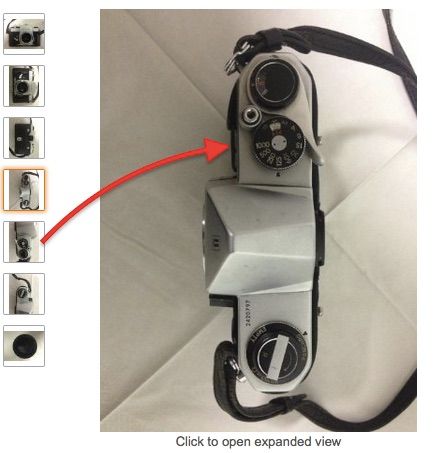
I asked the source, if Fuji chose the design solution of the Leica M6, with an angled dial. But it doesn’t seem so. The source said, the solution should look more like the one used for the Pentax Spotmatic camera.
If this is correct, this means there could be a little window on the Shutter dial, where you can see (and adjust) the ISO value. You can see it here… and I have to say that, if true, I actually much prefer it over the angled Leica M6 dial.
I tell you, it’s really hard to get on X-Pro2 rumors. But I’ll do my best, fire off some emails to trusted sources and see if they can confirm the shutter/ISO dial. In the meantime, take the grain of salt.
See the Pentax Spotmatic camera
stay tuned
 Fuji X Forum, Facebook, RSS-feed and Twitter


BIG US X SALE
XF Lenses
XF90mm (save $150): AmazonUS / BHphoto / Adorama / [shoplink 40099 ebay]eBay[/shoplink]
XF10-24mm (save $150): AmazonUS / BHphoto / Adorama / Pictureline /
XF14mm (save $150): AmazonUS / BHphoto / Adorama / Pictureline /
XF27mm (save $150): AmazonUS / BHphoto / Adorama / Pictureline /
XF35mmF1.4 (save $150): AmazonUS / BHphoto / Adorama / Pictureline /
XF60mm (save $150): AmazonUS / BHphoto / Adorama / Pictureline /
XF16mm (save $200): AmazonUS / BHphoto / Adorama / Pictureline / [shoplink 40100 ebay]eBay[/shoplink]
XF18mm (save $200): AmazonUS / BHphoto / Adorama / Pictureline /
XF23mm (save $200): AmazonUS / BHphoto / Adorama / Pictureline /
XF56mm (save $200): AmazonUS / BHphoto / Adorama / Pictureline /
XF16-55mm (save $200): AmazonUS / BHphoto / Adorama / Pictureline / [shoplink 40101 ebay]eBay[/shoplink]
XF50-140mm (save $200): AmazonUS / BHphoto / Adorama /
XF18-55mm (save $200): AmazonUS / BHphoto / Adorama / Pictureline /
XF18-135mm (save $200): AmazonUS / BHphoto / Adorama / Pictureline /
XF55-200mm (save $200): AmazonUS / BHphoto / Adorama / Pictureline /
XF 56mm APD (save $400): AmazonUS / BHphoto / Adorama / Pictureline /
X series Cameras
X-Pro1 + 23mm + 27mm (save $900): Adorama / BHphoto/ AmazonUS /
X-T1 (save $300): AmazonUS / BHphoto / Adorama / Pictureline /
X-T1 GS (save $300): AmazonUS / BHphoto / Adorama / Pictureline /
X-T1 + 18-55 (save $300): AmazonUS / BHphoto / Adorama
X-T1 + 18-135 (save $300): AmazonUS / BHphoto / Adorama / Pictureline
X100T (save $200): AmazonUS / BHphoto / Adorama / Pictureline /
X-T10 (save $100): AmazonUS / BHphoto / Adorama
X-T10 + 18-55 (save $100): AmazonUS / BHphoto / Adorama
X-T10 + 16-50 (save $100): AmazonUS / BHphoto / Adorama
X-T10 + 18-55 + 55-200 (save $400): AmazonUS / BHphoto / Adorama
X-T10 + 16-50 + 50-230 (save $300): AmazonUS / BHphoto / Adorama
X-E2 (save $100): AmazonUS / BHphoto / Adorama / Pictureline /
X-E2 + 18-55 (save $100): AmazonUS / BHphoto / Adorama / Pictureline
X30 (save $100): AmazonUS / BHphoto / Adorama / Pictureline /
X-A2 body or kit (save $50): AmazonUS
TRUSTED
– APS-C sensor (TS + AS + AS)
– 1/8000 of a second mechanical shutter speed (TS + AS)
– coming late 2015 (TS + AS)
– delayed to 2016 (TS)
– Coming after CES (TS)
– Announcement on 15th Janaury 2016 (TS)
– weather sealed (TS)
– 4K video (TS + NeS)
– Faster Processor EXR III (TS)
– No Tilt Screen (TS + AS)
SOURCE RIGHT IN THE PAST
– Combined ISO/Shutter dial, with little window on shutter dial to show ISO value
– Sync Speed faster than 1/180th (SRP)
– coming in January 2016 (SRP)
NEW / ANONYMOUS SOURCE
– ISO200-12800 (AS)
– 1/250 flash sync speed (AS)
– more than 200 AF points (2/3 are PDAF) – (AS)
– Hybrid EVF as X100T (AS)
– 24MP sensor (AS + AS) – More than 16MP (AS)
– about the same size of current X-PRO1 (NeS)
– dual SD card slot (NeS + AS + AS)
– tilt screen (AS)
– WiFi (AS)
– Price about 20% to 30% more expensive than the X-T1 (AS)
– Two X-PRO2 version, one 24MP APS-C and one 25-27 MP APS-X, compatible with XF/XC lenses (NeS + OS)
OTHER SITES
– coming September / October (OS + OS)– Non organic APS-C X-Trans sensor (OS)
– smaller than X-PRO1 (OS)
96 Responses
I am having some doubts if that would be as cool as it seems. With a digital camera you can change the ISO all the time, not just after loading the film, so we want it even easier than the one on the spotmatic.
My thoughts exactly. Doesn’t make much sense.
I don’t have an X-Pro 1 nor will I have an X-Pro 2 but I actually like the ISO dial of my X-T1. Just wish I could get rid of the locking mechanism.
An unlocked ISO dial or wheel should be fine IMO.
It doesn’t make sense any more!
Unless you shoot in ambient lighting and low light situations, and don’t want to always have to energize the camera and put your eye to the view finder to see the settings. The dials are why I bought Fuji
I shoot in low light conditions all the time. I’m a music photographer. Simple solution: use auto-iso.
Not to shoot photos? Dials? This is the hard truth: X photographers got into it because of nostalgia, not because X makes us better photographers, or because it is better.
It’s because it has dials.
Whee!
Not what he meant at all.
I can shoot quicker manually when I have dials.
Except: let’s be serious here.
1. Not every lens allows you to change the aperture on the lens. So what’s the Fujifilm advantage that isn’t addressed by other companies that ALSO have aperture rings on their lenses?
2. You need ambient light to even see the ISO dial. What’s the advantage?
3. In Manual or T exposure, you can’t tell what shutter speed the camera is actually set to anyway. You can only guess if you select 1/250 that it is that number. I can be anything around it because half and third stops aren’t labelled on the ring. T and A are exactly the same as every other unlabelled camera, relying on unlabelled dials. Where is the Fujifilm advantage?
It is because it has dials, not because those dials offer any advantage.
I know it’s kind of pointless talking to a “know it all” but here I go… If you know everything, why are you bothering commenting?
x. I know there are options to change the shutter speed to 1/3 stops, but I don’t really need to use them too often.
x. I don’t like looking at an LCD screen in daylight and I’ve always used the dial. Always.
x. Nearly all mostly use lenses have an aperture ring and I use them 100% of the time.
Just because it doesn’t suit the way you shoot makes you think that nobody uses or relies on them. I’m telling you that I use them all the time. So stop trying to guess how other people shoot. You’re trying to push your opinion as “this is the way it is”, which is pretty ignorant.
I think you are misreading me. “The dials are why I bought Fuji” as an explanation for understanding a camera’s settings is a poor explanation if its basic premise (to see all important camera settings), is debunked by the many corners cut in the design and creation of the camera interface.
x1 – I know you know that. But it still begs the question: why does the camera default to unlabelled dials? I would imagine that third or half stops on the exposure speed dial would make you even happier.
x2 – okay but you still have to use the EVF, through which every setting should be visible. I don’t get the problem.
x3 – It’s not about suiting my shooting style. It’s about design uniformity and not breaking Fujifilm’s own marketing language. If the interface which X fans congregate behind can be broken by Fujifilm’s own lenses, or exposure speed dial (unlabelled aperture, or no aperture ring), then what is the point?
I didn’t suggest that I know how you shoot. I didn’t suggest that I think no one uses or relies on X cameras or interfaces. No where did I do that. I am not a know-it-all. It’s your fallacy, not mine.
You suggested that _you know_ how I shoot. I asked questions which target _why_ people put blind belief behind the dials as they are designed. If you don’t realise the problems in this interface, that isn’t my problem. I’m glad you enjoy working with or against (whichever) a hodgepodge layout.
Edit: hit reply too soon.
I bought and use the tool because of the way that it works, which helps achieve the results I want. Is that so hard to understand?
I use the dials all of the time.
I don’t see why you think it is hard for me to understand what you’re saying. I understand it. I do. You are reading into this that I disregard your love and respect for the interface.
I am calling question to design missteps that break the basic tenet of: all basic functions visible and usable without accessing menus or unlabelled dials.
You, or I, or anyone, can enjoy a camera or other pieces of tech whilst realising there are serious problems with it. That’s normal.
Yes, okay, it seems the story is changing, but I’ll go with the flow. I see that you are now critiquing the design. Yep, that’s fine, but don’t assume others feel the same way.
Your original comment about nostalgia is not the case when it comes to many shooters like myself.
That was the original point, let’s not try to confuse each other.
The story has not changed. From the very first, I said nostalgia, which IS what catches the eye. If a person purchases a camera with dials expecting it to work as visually advertised and it does not because of the defaulting mentioned above, it doesn’t matter if the person still likes and uses the camera.
It _is_ a serious design issue.
As to it not being about nostalgia, you need to explain how: “I can shoot quicker manually when I have dials” is more apt than my criticism of the same system for lacking important manual functionality, for which the camera defaults to unlabelled dials?
Listen: I don’t care if you enjoy using the camera. That’s beside the point. The point is that the camera’s design is faulty. The point is that it could be much, much better. The point is that Fujifilm didn’t follow their own guidelines. And the point about being quicker with dials must either be demonstrably accurate, or demonstrably inaccurate.
And even if you’re keen on the camera lacking half-stops and defaulting to unlabelled dials, or lens apertures being there or not, it doesn’t mean that there isn’t a problem.
There’s an objective way to judge any design: does it do what it set out to do? Where does it fail? Where does it cause confusion?
As to nostalgia, I will argue again that, whether admitted it or not, it is the primary reason why the camera appeals to people. A person in the digital age had no precedence to say that they could use a camera faster with dials than without. Apart from Leica were no ILC digital options. And this forum isn’t overrun by Leica owners, so that’s not a concern.
The argument that operation is faster via dials was, prior to X ILCs complete conjecture. Which is fine. Afterward, sure, if you get on with the dials as they are, great. But when you have to find a half stop, you are forced to take extra steps.
Even if you were not forced to, you still would have to prove that you are faster and more reliably using a labelled aperture ring or labelled and perfectly one-third stop detented exposure speed dial, than you would be using unlabelled dials as per Canon/Nikon or whom ever else makes cameras in that fashion.
I am claiming that X cameras sell for nostalgia’s sake; that the current designs are form over function. And I’ve done my best to support that claim with objective questions that don’t rely on my experience. I hope that from my posts in this thread you can’t tell what sort of interface I prefer or use. That’s because I’m not writing about my personal experience. I’m writing about design problems that go against the tenets what the X _appears_ to be about.
You claim that you’re faster at using a camera with dials. Okay. That’s a subjective claim based on your affinity for the camera, but isn’t provable or disprovable. There is no way to objectively verify or disprove a subjective claim. I’m calling BS: as to how it pertains to changing basic full-stop parameters, and especially in half stops. The same goes for pre-focusing X lenses as a whole, not just the select lenses that _may_ have distance scales on them. Naturally, all of this must be done manually.
I don’t miss the dedicated dial form my x100t, I wouldn’t miss it from the X-Pro2. With auto-iso a dedicated dial seems a bit redundant for most situations.
Setting ISO is the single most aggravating thing on my X100 for me right now (alongside the viewfinder freeze when acquiring focus). I have lost quite a lot of shots to not being able to change ISO quickly. That flimsy rotary dial on the back is also very frustrating. Even on mini compact cameras like the Canon S95 have much better control dials.
It wouldn’t be quite so bad if the menu didn’t always pop up in the EVF instead of the LCD like on a DSLR. Not sure why there is no preference for it (and DSLR-style image review on the back LCD).
But it’s probably not quite as bad on the successors with the Q menu and all. The original X100 is really quirky in some respects.
x100t solves this by assigning the fn button near the shutter release to iso change. That is what I use.
That’s also one of the options you can assign to the fn button of the original X100.
However there is one aspect X100 fails when compared to the present version: once in manual mode and auto ISO you can’t use compensation (even if you rotate the dial it will not assume it – it’s a pity Fujifilm didn’t introduce it in time for the last firmware update they released for X100).
Ref this way to assign ISO to a sub-dial, I still have a Nikon FM2 film body with it and I’m sure on a digital camera it would be less effective and more time consuming that using fn button and rear control to navigate through the scale.
I also have ISO on the FN button, but it always pops up a menu, and that menu is in the EVF (in OVF mode, it at least just highlights the number instead, but the AF is a lot worse in OVF mode). You then have to use the fidgety controls at the back of the camera while still keeping your eye on the viewfinder and making sure not to scroll past the end of that menu. In the meantime, you don’t know what is happening in the scene you are trying to photograph because your viewfinder is covered by a menu and you can’t take your eye off it. If you accidentally lock in a wrong value or want to tweak it slightly, you have to re-open the menu, change, confirm, and so on.
Compared to a physical dial, be it DSLR-type one or a labeled Leica-style one like the X-T1 is using, that’s just ridiculously tedious and slow. Even a menu that always pops up on the back screen would be a godsend for me.
I’m surprised it doesn’t bother others as much, but I guess it’s because I work a lot in full manual.
A slimmer but wider ISO dial below the speed dial and protruding to the front of the camera may be a simple solution.
A stiff enough thumb wheel around the direction pad would be another possibility.
That would be useful for reviewing images but turning it with the eye to the finder is an awkward position. Either a labeled dial or just use the command dials that have served us very well with DSLRs.
…less than two months to the presentation… I think the hardware has already been designed almost completely, so this solution seems to be an expedient to put iso-dial in X-pro2 without changing the body shape.
Maybe Fuji really listens to consumer will… and that’s great!
I hope it will be succefull ’cause I WANT that dial on my X-pro2… 🙂
The hardware is definately ready, otherwise the images that came out of the aftermath of the Paris terrorism attack couldn’t have been made.
Prototype maybe ? Not a big deal to move a button, if the function stay the same.
Actually, a very big deal to move a button.
You’re kidding right?
Nope. There are plenty of prototypes in high-tech industry. Most of them use the same component in a different skin with different layout tested…
Fuji could test new hardware / software in a customized X-Pro1 skin for example (with new processor, sensor, 1/8000s SS button position…).
January is still rumour, and Magnum leaks might not be real X-Pro2…
i could live without the dedicated dial if they let me put it on one of the command dials when I’m shooting manual, it’s stupid that one of the dials is always doing nothing
They don’t even need the shutter dial (even though it so retro-cool). Just use one of the command dials as shutter, and the other as ISO. The aperture ring can stay.
Then crap, just take away all the darn dials and you’ll have a Sony. NOT
Then realise that all you care about is form. Fujifilm have created this monster that cares only about the look of the camera. There is no functional difference between the Sony and Fujifilm that make one better or worse than the other as picture takers. But in logical layout terms both are tremendously ham stringed by designs that either favour: all-for-one-customisation, or form-is-more-important-than-function.
Fuji fans call the Sony cameras Playstations. Stupid and wrong. Sony fans call Fuji cameras anachronistic and hipster.
…
A well designed auto ISO algorithm is more important than an ISO dial.
The better the auto ISO, the least we have to change the ISO manually.
Agreed.
Agreed. We are at the point where ISO is essentially meaningless. Auto ISO, with the ability to choose the aperture/ss manually while using EC is a great way to shoot.
I have to disagree. Auto ISO is linked to the metering mode used… so changing SS and aperture won’t change the exposure if AUTO ISO is selected. There are plenty of situations where a manual change of the ISO is necessary. Just because YOU never adjust your exposure manually, it does not mean that manual adjustments of the ISO are not needed.
Sorry, have to correct myself. I misread. with exposure compensation and AutoISO I agree with you.
When shooting any type of fast action in low light with long focal lengths where you need to stop down a lot to get decent depth of field, high ISO can still be an issue.
Besides, once you set a single variable relevant to exposure to auto (be it ISO, shutter speed, aperture, flash power, ND filter, or whatever applies), you relinquish control to the camera’s meter.
That can be a problem if
a) the camera’s meter is not perfect in your particular situation (happens even with the best cameras)
b) you need/want shot-to-shot consistency, or
c) parts of the equation are not under the camera’s control while it is metering, such as when using manual studio-type flash where the camera has no way to meter the actual final shot, when you are panning with a subject and so on.
Auto ISO is important and can be great in certain situations, but a camera that is aimed at professional use should also provide a great no-compromise experience for fully manual use.
Agreed
Now that we have exposure compensation with AutoISO, it has indeed become less of a concern.
No way, you’re still relying on the camera’s meter for that. I rather choose which exposure variable (aperture, shutter, or ISO) I want to change instead of having it automatically adjust the ISO for me.
Many of us want to control manual, and never use Auto for anything. The reason I chose Fuji rather than other camera brands IS the full manual control dials. This is what makes the Fuji brand different. In low light situations, I want full control of my ISO. hardly use Auto anything. I want to glance a that ISO dial without power applied. And I rarely use Auto ISO compensation.
Thanks for saying it. It’s the only camera out there that lets me do this with such ease.
I wish the exposure compensation dial on my X-Pro 1 would magically (or forcefully) become an ISO dial. There seems to be enough clicks too.
@LeFred “a well-designed auto ISO algorithm” – we already have that with the X-T1 don’t we ? In aperture priority it’s basically as simple as “stick to base ISO unless minimum shutter speed is not met, in which case increase ISO”, right ?
The M6 has an angled ISO dial? The only angled item on the M6 is the rewind crank. The ISO on the M6 is a dial on the back door flap.
This looks like a great solution that keeps the form form without introducing an ugly big dial that requires left-hand usage… EXCEPT… how do you change the ISO value with something like this? Will there be another ring at the bottom of the shutter speed dial?
(Personally I find this very exciting. I often shoot with flash so need to change ISO frequently as I turn the flash on and off depending on the light.)
form FACTOR, rather (of the X-Pro 2… and ultimately X100, I hope)
like they said above, it’s a lift-and-turn thing. For my analog camera’s it works OK, cos you have to set it once every 12/24/36 exposures at most.
For digital, mmm, not so.
With a properly implemented Auto-ISO function, one hardly needs to change anything nowadays.
After three years, finally we’re getting people to admit: it’s all about form.
Cosina/Voigtländer already does it better. As seen on cameraquest: https://cameraquest.com/jpg3/voigt_r3a_b.jpg
(you pull the dial up, and then rotate to set iso.)
That’s a great solution for film cameras where you only set the ISO once per roll, but if you want to change it more often, like many people do with digital, even a locking button like on the X-T 1 can be annoying.
Guess you’re right. I would just leave it set to AUTO myself, as that should work fine on modern digital cameras anyway. And in situations were you actually need to set the gain manually there is typically time to do that. (ie long exposures or studio/flash photography.)
Low light ambient lighting situations on location, and not shooting flash. I somtimes take the shot with more than one ISO (my shooting style), I won’t need to say “what if”. If shooting in the evening indoors during summer months and the ISO is changing rapidly from constant moving clouds through windows, the ISO dial is my friend indeed. I dont want to have my eye glued to the LCD and view finder, during portrait shooting. More time with composition and less time staring into the EVF or LCD. Just my two cents
I know many here like labeled dials for nostalgic reasons. I don’t really care. When I’m shooting my eye is looking through the finder or at the LCD so I can’t see the dials anyway.
To me the perfect camera would have four “dials”:
– Aperture ring. One of the reasons I love Fuji.
– EC dial like we have right now.
– Front (even better: “top”) and rear DSLR-style command dials for shutter speed and ISO. Pressing them switches between manual and auto mode. The current dials are way too slow for some shooting situations. Imho the basic four settings (aperture, SS, ISO, EC) shouldn’t ever require a change of hand or thumb position. DSLR-style dials also don’t accidentally change in your bag like “hard” dials do.
This is the right answer. It also solves the problem of having 2 dials for shutter speed (1 for full stop, 1 for 1/3 stop)
I just love the exposure compensation wheel on the back of my Canon. It’s super fast to steer with your thumb and I use it all the time. Sometimes I wish that Fuji would implement that as well, even though it’s not very retro or esthetic.
Funny, the big wheel in the back is why I don’t like Canon… Different folks different strokes.
I really like that dial on the Canons for image review. At least it has some proper resistance unlike my X100S where it turns by just looking at it…
But I still wouldn’t want to use it for changing basic exposure parameters. Too much thumb travel needed imho. That’s also why I would suggest a completely different way of changing AF points compared to what we have now. My solution would be much quicker and not need any change of finger positions.
Well the problem with the exposure compensation dial on top is that it is rather slow. To make 3 different exposures takes about 3 seconds or more if you change the wheel on top (Fuji). With the wheel in the back (Canon) you can make about 3 exposures in 1 second. Exposure comp is something that is needed in most every single shot if you want a perfect exposure, so it’s almost as important as auto focus speed. But what the H, the X-PRO is not about performance but style ;o)
Unfortunately a number of X lenses don’t have aperture rings. Wouldn’t it be great if they kept their interfaces pat, and in place across all lenses?
Anyway, I agree with you otherwise. The problem is a lot of people want their X cameras to react and handle exactly like dSLRs. So, we are left with atrociously broken interfaces.
That said, I’m one that hardly uses EC. I know that I’m not the only one, but I may be in the minority. Personally, I’d prefer an unlabelled dial for it.
EDIT: “DSLR-style dials also don’t accidentally change in your bag like “hard” dials do.”
Thank you. Why have voices like this been so damn quiet since the X-T1 launched? I complained endlessly about it in my hopelessly poorly written Hiking with the X-T1 article: http://ohm-image.net/opinion/photophile/hiking-with-the-fujifilm-x-t1.
More easily accidental dials are a bad thing.
Oh yeah, that would be awesome. I’m still hoping that one day they’ll at least let us use the focussing ring to change the aperture. Not as slick as a clicked ring but better than nothing. Works well on the X30 with the function ring.
I would also prefer an unmarked EC dial. Not for myself because I do like to use it. But for those people shooting all manually since they could assign other functions to it (like film simulation, drive mode, you name it).
Thanks, I’ll check out your article. I guess many people are very nostalgic and therefore will put up with the ergonomic and practical problems that the X-T1s dials have.
I love dials, but I have no patience for dials that accidentally change, and that default to regular digital controls when in between stops, etc., are necessary, not to mention basic design/market constraints that demand the creation of lenses that are so disconnected from what fanboys consider the basic X ethos that you literally have to use these dial-bristling cameras like any other digital camera.
Fujifilm could have done it the digital M way: every lens and camera has only a single interface that you can’t screw up and that is immediately recognisable to anyone and way, way more consistent. But they didn’t. They made a mess, but it’s a mess that fans don’t see. They just see the dials and go ‘wheeeeeeeeeeee!’
I personally dont mind if its a dial thats dedicated or not, I just want it on the right hand side of the camera.
Yuck, did you ever USE one of those lift-and-turn ISO dials? They were terrible! The numbers were small and hard to read, and it was hard to set in-between increments because the spacing was so close. It would be even worse on a modern digital camera, where you might expect an ISO range of 100 to 25,600 or so, with 1/3 step increments in between.
I’m with Peter: On a digital camera, ISO needs to be a primary control. Actually, I don’t care what kind of old-timey control they use to keep the nostalgists happy, as long as it also can be assigned to an input wheel… on my X-T10 I can change it by clicking and turning the front wheel, and that works pretty well.
Can’t be worse than nested dials with locks, that make it damn near impossible NOT to change settings beneath. The X-T1’s system is horrible for all but chopstick fingered teenage girls. Even my wife (all 50kg of her) has the hardest time turning the ISO dial without changing anything else.
If you’re going to nest, do it right. Speed be damned either way.
A window on the shutter speed dial is the right solution and one that was invented decades ago. The Fuji ST901 which I owned in the seventies and which – designwise – seems to be the direct inspiration for the X-T10 had such a window. Changing the ISO setting was done by lifting the knob and turning it, then release it. A very easy operation and a very visible result that does not require a separate dial.
High failure rate type of control. The dial is better
No failure rate at all. Has worked for decades. And it IS a dial … a dial WITHIN a dial.
ok cool. so it is a dial then. Just don’t want to have to send in my camera because the manual ISO wont work.
Why not a tiny LCD screen just for ISO number somewhere on the top and a dedicated control wheel?
OLED!
the dial is for a fast operation. that window seems to be as slow as going into menus. anyway, what we don’t want is smearing files. it’s kinda fool to make a really vintage and beautiful camera that produces ultra digital and soft files. X100 is way better for sharpness.
Shot a Pentax Spotmatic in the early 70s as a teenager. FYI – the Spotmatic had a “stop down” meter, the first SLR in the world with an onboard light meter. When you turned the meter on, you would set your shutter speed (with the dial), then rotate the aperture ring on the lens until a needle in the viewfinder centered. Of course, if you were dealing with small apertures, the viewfinder would dim down. No automation back then. You had to get to know your film, lighting conditions – and no chimping! The good old days – boy am I glad they are gone. We’ve come a long way. How many of you would have tolerated such hassles?
I still use my Canon AE-1. I loved shooting my friend’s 6×7…
Don’t dismiss the new generation just yet! 😉
Hi, as well as my xpro1 I shoot a c330, voigtlander bessa folder and a pinhole camera, I love photography in all its different flavours.
The iso dial on the pentax would be a nice edition on the xpro2. Cheers, Jon
This is not a viable solution. This is adequate when you only need to change ISO every time you change film, as was the case for these old cameras. For making changes while shooting it is not adequate.
A compound dial can work, but not if it works like this one.
Of course it’s a viable solution.
Nope.
Nope.
They could include an auto position on the physical dial.
They could make the selected ISO either a fixed value or a minimum, or a maximum. These different possibilities could be menu options.
A dedicated ISO dial like that example would be cool, but i’m not sure if a dedicated ISO dial is necessary in the x-pro2.. This is all for talk and speculation as I’m sure the final design and controls for the soon to be announced x-pro2 is probably finalized and set by now.
But, for fun, I would say I would design a designated ISO dial on the far left side to the side of the view finder. There is just enough room to insert one to the left side of the viewfinder end. It would be small and designed much like the rewind dial on a film Leica M3 (or MP, M6 or M7)… But, no actual ISO numbers on it, plain and maybe knurled texture and it would be just another control dial ( but on the left side of the camera to the outside of the viewfinder) to control ISO easily.. See ISO number change in the viewfinder and rear LCD(LED) screen to know what set to (just like current X-Pro1 and many other x cameras). I think that would suffice for quick access to ISO changing and keep it small and inconspicuous.. And if you wanted a quick Auto ISO setting, add a push button on the top center (with letter A on top) of the dial that locks down (and the dial rotation itself) when in A mode for auto ISO, push again to pop up the little button to release from A auto ISO mode and allow for free dial rotation to scroll up or down (ot more correctly scroll forward or back) the ISO value manually. This button would click lock like how the Panasonic and Olympus have on their mode dials, but not just lock dial down, but actually engage Auto ISO mode. I think that would look cool, maintain retro look and detail, and be pretty slick.
That is “a pretty cool solution” for Film cameras were you only use once at loading the Film.
No usefull solution for a digital camera..
It could work if it wasn’t a lift-to-turn dial, but simply a “two-story” dial with a small lever for the lower on like on the X-T10. The value could then be displayed via a window like the one above. Seems like a viable solution to me.
Hate a physical ISO dial anywhere on the camera. One of my greatest annoyances with X-T1.
I don’t like it, but I dislike even more the metering/drive mode dials that change settings at the smallest of bumps.
The ISO dial is a great idea, but elegant interpretation of that idea into practice is important. More buttons and more dials is not the best idea for cameras as small as the X-Pro 1 and X-T1.
Ah yes, thanks for reminding me of those awful dials. I had very high hopes for the X-T1 and almost ditched my Sony A7 for it. Fujifilm has workshops in my city where they let you use every camera and lens they make for a whole day and that was the day I began to hate the X-T1.
Many ditched their cameras for the dials. Its the selling point of the camera. Not specs. I own an A7s too. But the Fuji is my camera of choice. I spend less time glued to menus and the evf, and more with the subject and composition. I have menus with my 5dmkiii and Sony. Don’t have to worry about turning on the camera to verify the settings. Its right there in my face
How does that make sense? What menu items do you have to change all the time that require that many ridiculously easy to accidentally change dials and buttons?
I could easily say: I spend less time worrying about menus and just shooting since I don’t bother with anything but the basics: aperture and shutter speed, and in the odd case, ISO.
Again, you DO have to turn on X cameras to verify settings: 1. aperture rings do not exist on all lenses, and often they are unlabelled.
2. shutter speed can only be guessed at in M: is it really 1/250, or did you use the unlabelled dial to adjust it to a half or third stop, or even raise it by 1 1/3 stops? T mode? All unlabelled. A mode? Um…
3. WB?
These comparisons which cast other brands against Fujifilm fail to explain the many ways in which, due to non-universal design and a cost-cuttiing (exposure dial only doing full stops so that half must rely on unlabelled dials) Fuji lenses and cameras default to unlabelled settings.
In other words: the dials are just cool. They look cool. People ask you if you have a film camera. Cool, right? But there is no general advantage to any of them.
Fuji isn’t crazy. The ISO dial and the live histogram make the Fuji stand out.
ISO dial on M6 is on the back:
http://www.summilux.net/m_system/m6_4.jpg
Sure it’s on the back. The angled dial is the rewind lever.
But, I asked the source, if Fuji could have place the ISO dial there
last night i dreamt about the x-pro2
Wow…more speculation on the X-Pro2. Release the camera already people have been waiting f-o-r-e-v-e-r.
Whether they use dials or wheels, ISO better be easy to change. No more locking like X-T1. It’s the digital age and ISO is part of the exposure triangle. I should be able to change it easily as the other 2. Also, the shutter speed dial needs 1/3 stops.
I have an old Pentax film SLR similar to the Spotmatic and the mini ISO dial is really a pain to use. You have to push a microscopic button and turn the shutter speed dial while keeping that button depressed, which is really hard especially with one hand.
That said, it is a completely different use case than setting the ISO on a digital camera. With film you only change ISO at every new roll at the very maximum, but in reality you’ll probably keep the same ISO for your entire shooting session.
I hope the ISO dial in the X-Pro2 will avoid these pitfalls and those of the X-T1.
check out the new Pentax spring debut http://www.pentax.com/en/pentaxff/