









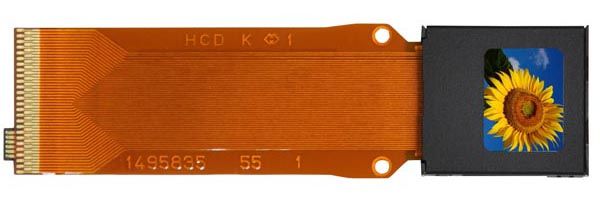
Last week I told you how two sources unveieled to me that Olympus would use the new generation Epson sensor on his next MFT camera. And today Epson issued a Press Release to confirm the start of the mass production. Here is the press release with specs:
TOKYO, Japan, January 22, 2013
Seiko Epson Corporation. (“Epson,” TSE: 6724) today announced that it has begun volume production of its latest Ultimicron panel These high-temperature polysilicon (HTPS) TFT color panels bring to life the electronic viewfinders used in mid-to high- end digital interchangeable lens system cameras. The new panel will be exhibited at Epson’s booth at CP + 2013 in Yokohama, Japan, from January 31 to February 3.
Measuring just 0.48 of an inch diagonally, the latest in the Ultimicron series offers XGA (1024 x 768) resolution in red, green and blue for a total of 2.36 megapixels. The new panel is equal in size to a 0.47-inch SVGA panel, but offers higher resolution. In addition, Epson has increased the surface luminance to 520 cd/m2, allowing photographers sufficient visibility in any environment, from the brightest sunlight to the darkness of evening.
The Ultimicron series is positioned to meet growing demand among camera enthusiasts of all levels and abilities for superb quality electronic viewfinders.
Advantages and features
- Compact
Small 0.48-inch diagonal screen contributes to compact, thin cameras - High resolution
High pixel density with XGA resolution (1024 x RGB x 768, 2.36 megapixels) - No color breakup
Use of a color filter ensures that it is not affected by the color breakup that can occur with fast-moving subjects and panning shots when using a field-sequential color system. - Bright
Achieves brightness of 520 cd / m 2
| Name | L3F04X-80300C |
|---|---|
| LCD type | TN mode, organic alignment layer |
| Color display system | Color filter (RGB stripe) |
| Effective pixels | 1024 x RGB x 768 (XGA) |
| Panel size (diagonal) | 0.48 inch (1.2 cm) |
| Pixel pitch | 9.6 μm (3.2 x RGB) x 9.6 μm |
| Color space | 92% of sRGB |
| Backlight | Yes |
| Surface luminance | 520 cd / m 2 |
| Displayable colors | Approx. 16.77 million colors |
The new Olympus camera is rumored to be on market on Spring!
—
P.S.: Olympus has a long history of making compact cameras with built-in rangefinders. Just check the super long list of [shoplink 36035 ebay]eBay auction on these cameras (Click here)[/shoplink]. Got some inspiration for the new digital PEN with EVF? 🙂
56 Responses
Epson sensor or EVF. Quite different
Hehe, admin made a typo, he is clearly talking about an EVF, not sensor.
1024×768=0.78 megapixels, NOT 2,36! 1 pixel = 3 dots.
for them every dot is one pixel!
The camera industry is using this misleading x RGB counting for their displays for years now and it of course causes misunderstandings.
Any other industries that are dealing with screens (phones, TV, monitors) are telling the full resolution so they count pixels, not dots. My Smartphone has a resolution of 1280×720 pixels, so 921.ooo Pixels. An up-to-date Camera dislay has a resolution of 720×480 which is 345.000 pixels. But the camera industry says the display counts 1036800 pixels (*RGB).
So customers think their (in the meantime) outdated camera display resolution is higher than the one of their brandnew smartphone display
I am looking out for an OMD-EM6 announcement.
So where’s the contrast?
Though all what I’ve found for Epson’s Ultimicron series is low 280:1 so it’s no wonder if they don’t want to advertise it.
Without that information brightness is meaningless because it’s easy to increase by having stronger (higher power draw) backlight which just means black becoming grey because of backlight leaking through.
Which is still equivalent to 8 stops, and close to the very best calibrated display setups, and way beyond the very best printing technology that is in common use.
Sure you can buy displays with a 1:10000 contrast ratio, but you won’t actually get that in any real-world situation once the display has been properly calibrated.
But viewfinders don’t compete with calibrated PC-displays – and they don’t need to be that accurate. EVFs compete with optical viewfinders with DR only limited by the eye and unlimited “refresh rate”.
That is true at first glance, but there is a subtle but relevant difference. OVFs show what is going to hit the sensor, EVFs show what the sensor is capturing. The dynamic range is already limited by that and ‘real-time’ processing.
Ambient light plays a much bigger role for a regular display then for an evf.
Additionally, contrast ratio for computer displays was once a relevant metric but has for years now been a mostly meaningless marketing argument.
Sure, more is better, at least in theory. In practise its only better if you can actually make use of it (requiring that there are no additional factors limiting this use)
While 10000:1 is BS, a modern IPS display can get 1000:1 without issues, whereas a modern PVA can get 2500:1.
280:1 is extremely low… Probably on the level of the first TN monitors a decade ago.
Sure, modern displays can get to 1000:1 or beyond in theory, and there are even situations where this can be measured. To get to this performance, you need to eliminate pretty much all ambient light.
Contrast ratio is the ratio between the highest and lowest luminosity a display can handle, but is a totally useless number if there is no visible difference between the lowest luminosity levels.
There is no standard for measuring contrast ratio so the numbers of different manufacturers aren’t actually comparable.
So I’m sorry but the contrast ratio of displays is a useless metric without also knowing the maximum luminosity of a display, and even then can only be achieved with proper content and by almost total lack of ambient light.
Comparing this to a display that is put in front of your eye is comparing apples and oranges.
Bart, no offense, but have you been living under a rock or something? It’s not “theory”, it’s practice. Contrast on modern monitors is stable (and has been for years) over the entire brightness range, which can easily span up to 400 nits.
Mind you, 400 nits is so insanely bright that it’s borderline too bright even in direct sunlight. 520 nits on this upcoming EVF is probably going to make you blind 😀
It is also very questionable what happens with the contrast in this EVF once the brightness goes down to 40-50 nits, which is what you’re going to need if you’re shooting in dark conditions. My guess is that it’s going to plummet dramatically, going from a declarative 280:1 to something like 50:1.
Hardcore fan of old compromise in everything tech, aren’t you?
About every modern LCD panel type has 1000:1 class STATIC contrast.
Besides cPVA with its real slow average response time (version of S-PVA without special frame buffering predictive RTC) also newest AMVA version of competing MVA-family reaches above 2000:1 contrast:
http://www.tftcentral.co.uk/reviews/dell_s2440l.htm
Last only 500:1 panels must have been some half dozen years ago and every real monitor has stable contrast ratio regardless of brightness because contrast ratio is feature of LCD panel, not backlight.
Garbages using panel blocking for lowering brightness should have never been counted as monitors but environmental crimes. (resources wasted for making them and always max power consumption)
In case of EVF displays I haven’t seen it measured anywhere if these small LCDs have actual brightness control of backlight instead of contrast destroying panel blocking.
While natively fastest liquid crystal type, also TN has 10ms class average response time without (~5ms with RTC) response time compensation, which is another unknown detail they don’t tell.
Also in monitors TN panels actually have only 6 bit colour channel depth meaning only 64 different values for colour channels and total of ~262k colours. Missing ~16.5M colours are done using spatial and temporal dithering. And typically they use words like this “approximate” to hide that in specifications.
Also sRGB is basically smallest minimum colour space they could decide back then and this doesn’t cover even that. Cameras themselves have lot larger colour space (shoe horned into either sRGB or AdobeRGB in OOC JPEGs) so it definitely won’t ever show what sensor is capable to capturing, no matter what kind colour management they use in producing live view image.
And that 92% coverage of sRGB is on lower end even for LCD monitors whose colours pace is affected by both backlight spectrum and colour filters of RGB dots.
So why should anyone have fixation with such tech?
Sure OLED tech isn’t perfect but it takes steps forward also in other things than just resolution.
Technically capable of 1000:1? sure. Can you actually distinguish between the lowest luminosity it can display and double that luminosity? (so a 1 stop difference in photography terms)? That depends on ambient light conditions and the brightness of the display. This plays much less of a role for an evf, so you actually can make use of the full luminosity range it provides instead of it being merely a potential in many practical conditions. That has nothing to do with panel blocking (agree on that being an evil way of doing brightness control, but it is very likely used by many non oled evfs) and everything with what your eyes can see and what light levels they are adjusted to.
And I’ve nothing against new technology, and rather like the oled panel on my phone, but I’ve yet to see an oled panel or evf on a camera that produces anywhere good enough colours, till they do, thats no good option for me.
You are of course totally right about the sensor being able to produce much better data then any currently used evf can display, but bandwith and processing power are still as much a bottleneck for that as evf technology.
Dear admin,is there any comparison data against current OM-D EVF specs?
the current E-M5 EVF is the same as the 1.44 one in all the other mFT cameras that come with it , just with a better refresh rate
Admin, wishing for a rangefinder like digital camera from Olympus in every post won’t make it happen now. But t is fun. 😉
Maybe if this site was strong 2yrs ago like it is now…
Anyway hope they are a head of us and already made this guess 2 years ago and they have a surprise for us!
The screen in this pic is a sticker!
Now that’s high tech.
It will offer incredible colour, detail and sharpness – as long as you are taking a picture of a sunflower.
because a photo of an electronic view panel that’s not plugged into anything would have what? Of course the image isn’t real, don’t be so obtuse
Right I’m sure a photoshop mockup would have been FAR harder to organise.
Why bother with inches? If it was a 50 year old item, fine. Its not its new.
Its a metric display even the contrast is metric.
Every country in the world is officially metric. Why convert metric to imperial just for the people who live in a country north of Mexico, just south of Canada.
Its as bad as the printer software on some Photo software. Just enter a metric size and the software converts it to the nearest imperial, often then converting it back to give the metric and ending up with rubish. Some CAD programs do the same.
We are all metric now.
Are american inches the same as proper inches?
more importantly why are mens inches so different from women’s inches lol
Don’t say that too loudly. When they talk about the rest of the world, what they mean is the states from the west coast to the east coast. 😉 Somehow I think they believe the world outside their world is just insignificant compared to theirs. 😀
Seiko Epson is a Japanese company. Who is the ‘they’ you speak of?
I live in the UK and still use imperial measurements, Meters have always been used the measure my fuel usage, the only purpose of using metric measurements is to fleece the unsuspecting punter when buying things by size, for some unknown reason metric stuff is always more expensive.
When the U.K. started using metric measurements one of my friends remarked that when he was doing some house repairs he went to a hardware store and got 3 meters of 2″ drain pipe 🙂
The plumbing is in SAE in many countries that otherwise use the metric system. Germany uses Zoll (inches), for example. Also, most wheels and tires are measured are in inches (diameter) while the width is measured in mm. For example, a 255/55/16″ tire is 225mm wide, 55 is the percentage of tire hight to section width of the tire, and the last number is the the 16″ diameter wheel size. Most bicycle tires amd wheels are also measured in inches, although metric sizes do exist. Mixing metric and SAE, now that’s nuts.
Yes and I agree with that. Read my first line.
Here, here!
But until there s a law, people will just adhere to the inert masses.
Here’s why the new PEN won’t be announced at CP+. I suspect this was also the reason for the E-P1 not being an E-P2.
This is great news. Yet all people do is complain. Hey, what’s new?
Anyway, this EPSON EVF going into mass production means we’re likely to see more cameras in the near future come with built-in EVFs. There will be no excuse for the companies not to incorporate one into their ILCs or even their high end compacts and bridge models. It should not add much overall cost to the manufacturing, and hence, should not add much to the retail cost. Most enthusiasts are willing to spend a bit more to get a quality built-in EVF. We need to get the message across to the camera makers that we want built-in EVFs in our ILCs!
EPSON know what they’re doing. The OM-D E-M5’s EVF is very good already, and this appears to be an improvement. I’m looking forward to using this EVF in a future Olympus PEN, or Fuji X, or Panasonic Lumix (that’s if they don’t source a Sony OLED one). No more viewfinderless ILCs!
I just noticed they speak about thinness. It might make the hump unnecessary. If the new entry is a ‘photographer’s tool’ it might also do away with 5 axis stab. Two for a photog. is enough.
Finally, in the assumption that it is a RF-like, it would be interesting to know what the kit lens would be. 12-50 is too long, 17/1.8 too expensive, so is there hope for a 25/1.8?
Also a good EVF might decrease the need for an overstretched LCD and thus free some room for better buttons. One could even hope in a connector for tethering, and a large LCD as an accessory.
If the above I won’t regret abandoning the E-P design for something more innovative.
Perhaps you are raising your hopes too high.
It’s a PEN (most probably) and as such will not be sealed. Hence it will be fitted with the usual collapsible 14-42. A small 25/1.8? not just yet. Maybe later, along the “pro” model.
A smaller LCD would be nice, but not very desirable to most users of this camera. On the contrary, if anything LCDs keep getting larger (with the new Samsung Galaxy camera setting the current record, I believe).
Innovation in this new camera may include some sort of wifi connectivity, more processing trickery (HDR, automatic panoramas etc.) and maybe purple fringe removal in JPEGs. Nothing too fundamental or useful (except the EVF, of course).
I couldn’t care less for consumer trends. They mentioned it would be a photographer’s camera, and I am just reminding that in two such products, Leica and Fuji, the LCD is far from obtrusive.
Direct and clear access to settings is instead paramount. So let the lemmings instead chatter excitedly about their will to suicide 🙂
2 is not enough for a photographer unless you are only interested in the center of an image.
The most common form of camera shake is rotation, along the lens axis due to pressking the shutter release, and along the length axis due to camera imbalance. 2 axis IS can’t deal with the first, but technique can help a lot here. 2 axis IS can deal with vertical/horizontal shift components of the second, but, the plane of focus rotates a bit as wel, and that is not being compensated. This has liitle to no effect on the center of the plane but can become quite visible in the ddges of an image. It doesn’t just affect in-focus details, but is especially visible in bokeh.
If it uses the new Epson device, it will be a Rangefinder PEN. Surely
5-Axis is already resized in the new compact SH-50 without hump.
Hybrid-AF would be nice as well…because it is a sony sensor, they can make it.
…and Focuspeaking.
5-AXIS + Focuspeaking would be the killer features for old MF-Lenses. May that is the reason why we don’t get it already for the OMD…
Panasonic have had a 5axis system in some of their camcorders long before OLympus ” invented ” it so I hope it can be put into a camera without a hump. If it can’t then I will get the hump lol
The SH-50 has 5-axis image stabilization for video and 3-axis image stabilization for images.
this Epson/Seiko technology was announced a couple years back, at the time Olympus showed great interest and it’s good to see that it’s coming to the point of an active product. The advancements of Epson screen was primarily; thin construction, a larger boost in resolution and response, here’s hoping it lives up to those announced breakthroughs.
It was also mentioned that this new LCD tech would develop into flexible screens, which could change the outside LCD design approach as well? At the very least make the back LCD super thin; and maybe, wireless/removable? How about retract the top of larger LCD to uncover the EVF underneath?
Science fiction now, but in a year?
It’s new and entirely different OLED tech which enables flexible screens. (basically display could be printed on surface of some material)
Half century old LCD needs to be rigid because liquid crystals are sensitive to pressure which causes changes in polarization and hence colour change.
I see that this new display is claimed to be “Bright.”
One of the biggest problems I have with my current CSC is that the EVF is so bright and the light output so high that I just can’t use it for lowlight or night time shooting as it’s like a torch shining directly into my eye, it’s so uncomfortable and turning down all the settings that can be turned down just doesn’t help.
I seem to be the only person to have this problem but it’s stopping me from moving completely to CSC use.
Perhaps you never discovered that the EVF can be dimmed in Oly’s menus, poor doggie?
Here I’ll throw you this bone.
Perhaps its no Oly!?
Fetche the little stick…http://www.youtube.com/watch?v=Im0dbhfxmr8
I own the E-M5 and the brightness adjustments of the EVF brightness cannot reflect lower light scenarios accurately and even at its dimmest setting it is too bright .
I use a Panny and I’ve adjusted everything that can be adjusted in the menu and I can’t get the light output down to anything like an acceptable level.
If this one thing could be cured I’d move fully to CSC and ditch my 5D but at the moment I just can’t use my CSC in low light, it’s just far too uncomfortable for me.
An OVF would allow me to point the camera in the general direction of my subject but of course I wouldn’t see any of the data or be able to check focus.
I don’t expect an early fix, what I need is some new technology to come along that doesn’t emit light, or at least emits less light.
amalric5…
“Perhaps you never discovered that the EVF can be dimmed in Oly’s menus, poor doggie?
Here I’ll throw you this bone.”
What I actually posted included…
“it’s so uncomfortable and turning down all the settings that can be turned down just doesn’t help.”
Sorry you missed that bit 😀
I don’t know about other MFT cameras, but the OM-D has an exposure compensation mode that boosts the exposure view of the EVF in low-light conditions. You may want to check your settings and make sure this mode is off. I find this mode annoying since what you are seeing in the EVF will be much brighter than the actual photo.
The feature is called ‘liveview boost’. Lumix cameras have a similar setting (forgot what it is caled there).
But even when having this disabled, brightness control of the evf can’t be set low enough to not disturb night vision. If you are in a very dark environment for at least some 30+ minutes, your eyes have chemically adjusted to the low light level. The dvf will near instantly undo that even at the lowest brightness settings.
People who o things like stzrgazing and astro photography will be very familiar with this, and tend to use special red flashlights and if using a laptop or tablet for a starmap, will be using special ‘night modes’ that reduce display output and only uxse low intensity red.
Or you could use an add on OVF, before clamouring under Oly’s HQ windows that you’ll do harakiri if you don’t get ‘low intensity red’ 🙂
Sure, an OVF can do that pretty well.. and I could just stick the vf1 that came with the 17/2.8 on a camera..
But.. no ttl finder that way, which makes trying to use it on a telescope a nice exercise in futility.
An add on OVF will allow you to point the camera but will not contain any info and you can’t focus with it.
just pony up an ND filter as a hack, and use it on your EVF eyepiece? Knock down that extra light with some shades, dog.
Take a moment and think about how daft that idea is 😀