









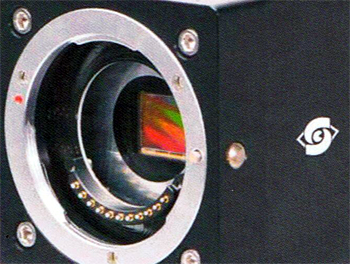
The German company SVS-Vistek (Seefeld, Germany) is developing a new range of cameras with native Micro Four Thirds mount. These are CCD “Tracer” industrial cameras equipped with sensors made by Truesense Imaging (Rochester, NY). Andreas Schaarschmidt (CEO of SVS-Vistek) said the new cameras will have full electronic zoom and aperture support like zoom and aperture. There will be both a Monochrome and Color version, with Global Shutter, 5.5µm pixels and a resolution of 2,048 x 2,048 and 2,048 x 1,088, respectively.
Source: Vision systems and entner-electronics.
37 Responses
Woooooh, only in m43 format ? Looks like m43 set of lenses is really appealing !
sensors made by Truesense Imaging (Rochester, NY)
This is Kodak know how?! Cool
Yep I think it is Kodak tech.
It is most likely a spin-off of Kodak.
Kodak itself just got a judge to okay ending all benefits for retirees. It is a very big and sad story here.
Niche product. Very specialized use.
Too good to be true… seriously.
I don’t think I understand the implication here. What does this mean for the system?
Thanks for asking exactly what i was thinking…
What does this mean for us?
It means nothing for ordinary users. CCD sensors with global shutters aren’t anything new. It’s not difficult to make one, the diffuclt part is making a good one for general use.
CCD does full frame capture compared to CMOS’s scanning capture. So, at the sensor level it does not create ‘rolling shutter’ effects. It’s credited for smoother video capture compared to CMOS.
For photography, the lack of focal plane shutter allows for much higher than 1/250 flash syncs.
For video, the 2MP version is more than 1080p.
aren’t all CCD sensors already “global shutter” ?
No, but quite a few are.
All CCD sensors are global shutter. There is no such thing as a rolling shutter CCD.
In actuality, there is no shutter at all (for both CMOS and CCD sensors). A “shutter” (in this context) is just a term used to describe how the sensor electronically captures light. The sensor itself captures light all at once (for a CCD) or by scanning top-to-bottom (for a CMOS). There is no shutter in front of the sensor. That’s just how they work.
A “shutter” is just a familiar term borrowed from film (celluloid) cameras, which use an actual (mechanical) shutter.
This cameras are for “professional machine vision” – for the production- industrie for example.
Important:
– there is a four thirts sensor from Kodak on the market and
– there are “full electronic zoom and aperture support” for MFT for erverybody available.
For me: The chances, that we will see more MFT-Stuff from very different manufacturers are increasing rapidly. The Blackmagic is already one of them.
There will be very specials things, as for astronomy, medicine, cinema etc.
And yes, I think the bloody amateur is also a winner. Think at the cheap chinese lenses with wide aperture. And: all this stuff can be usesd “creative” in some respect.
So: yes, this are very important news.
> For me: The chances, that we will see more MFT-Stuff from very different manufacturers are increasing rapidly. The Blackmagic is already one of them.
+1
> So: yes, this are very important news.
What also would be important is FourThirds consortium relaxing participation rules to include small manufacturers. Otherwise, all the specialized MF cams would remain sitting way too deep in their niches.
+1 The strength of MFT is, that it’s an open standard.
It can replace C-Mount ore M42.
Even a Lomo-like plastic-MFT-Cam is thinkable
Participation rules: Is that a problem? I’m not shure. Even Samyang is a “pirate” – they did’nt join the group for their 3,5 / 7,5mm.
MFT is not an open standard!
http://en.wikipedia.org/wiki/Micro_Four_Thirds_system
I believe neither that it is an open standard nor a closed standard since I’ve been shown no sources (as much as I love wikipedia, unless I can click the citation from wikipedia it doesn’t count)
1. Machine vision/industrial robotics apps have been using camera heads like this one for decades. CCD and global shutter. What’s the big deal here with his particular one, I am not getting it. This thing is NOT for shooting video clips with in the field, people.
2. Blackmagic Design’s Blackmagic Cinema Camera (BCC) does not even have a Micro 4/3 sized sensor, so the only thing they have got to do with M4/3 is that they may have a model with a M4/3 lens mount. Now, since there are gazillions of adapters already for M4/3, Blackmagic had not done anything here of any great interest to M4/3rd shooters in general.
If they only use the mount, it still means that M4/3’s lenses are being used & that can only help with the whole format & in turn help us with continued growth in the system & that will hopefully benefit us in the longer term with some other newer tech &/or lenses.
Never heard of this company (SVS-Vistek). Does anybody know this company? Are their products well known in the industry?
Vistek is a very well known supplier of industrial vision systems.
Interesting, but hardly practical. It’s a scientific camera for machine vision applications. The requirements from such devices are not necessarily related to what we perceive as “photography”. They are optimized for high tonal definition and high speed (thus the need for a global shutter), creating 12 and 16-bit B&W output, rather than high light sensitivity and wide DR.
The real significance of this for M43 camera users is that it’s yet another sign of confidence in the M43 system. Manufacturers like the fact that it was developed and is primarily supported by two independent companies, that a wide variety of lenses are available, and that it is popular. This makes it a stable platform that is likely to be around for quite some time, so they feel secure in developing products around it. And the more products there are, the more attractive the system becomes. It’s a very nice positive feedback loop.
You don’t need to buy or be interested in all the products. But the fact that they’re there speaks very well of the system as a whole.
The space programs of past years haven’t directly benefited us except with satelite comunications that we now enjoy & materials made for space use that is now used in a lot of everyday products, so the same can be applied here. It is just the fact that they are using the format & maybe existing lenses or newer ones, that the flow-on tech (even if they are using older tech in this) can eventually be seen in consumer products in some way or another. With the M4/3’s format, “the more, the merrier” is how I see it.
Good, if you like 4.2mp camera and 1:1 ratio…
and BW at that! I would atleast be interested to try one out 🙂
digital version of old 6×6 camera?
Finally! We all waited for the GH3 to have global shutter. Since it doesn’t, i was ready to sell all my MFT equipment. Now i have decided to keep it and get the Vistek canera with global shutter, but only if the camera has built-in IBIS (another point where Panny sucks!).
PS: j/k 🙂
But not unless in comes in pink!
This will be a low volume, High price camera. Its designed for scientists and instruments. So the color or BW models will be good. But there will be crazy noise at higher ISO, or the level we saw normally 6 years ago that now no one tolerates. Thinking ISO 100, 200 and 400 max!, this camera module will be very interesting. As its for Industrial use and the pixels are large the Exposure range (incorrectly called dynamic range) will be very high (like medium format sensors made by the same company), Also the color accuracy should be very good being CCD and not CMOS. But as I mentioned think of it as an ISO 100 only camera or even ISO 50.
Nice blog here! Also your website loads up very fast!
What web host are you using? Can I get your affiliate link
to your host? I wish my website loaded up as quickly as yours lol
Ahhh, advanced computer vision, I see… So, I assume it is one of those chips they were hunting for in Terminator. Great future for Micro Four Thirds indeed, if a bit sinister.
Wow, yes indeed, these machine vision/robotics cameras are indeed a TOTAL JOKE more often then not. Why are we even reading about these “cameras” here, I haven’t a clue.
Maybe because they are using the M4/3’s mount! We don’t need to be narrow minded in our knowledge & it is helpful to know there are other users of the format.
If m43 gets used as the industraial standard for all imaging outside of domestic cameras that means the format will be very strong, far more stable and sure footed for us day to day users! and it will mean some intresting lenses might be developed for it…. maybe totaly telecentric designs, mega wide angles, f0.75… etc etc
That would be the “poor man” Leica Monochrom !
Greetings from Los angeles! I’m bored to death at work so I decided to browse your site on my iphone during lunch break. I really like the info you present here and can’t wait
to take a look when I get home. I’m surprised at how fast your blog loaded on my cell phone .. I’m not even
using WIFI, just 3G .. Anyhow, fantastic blog!