









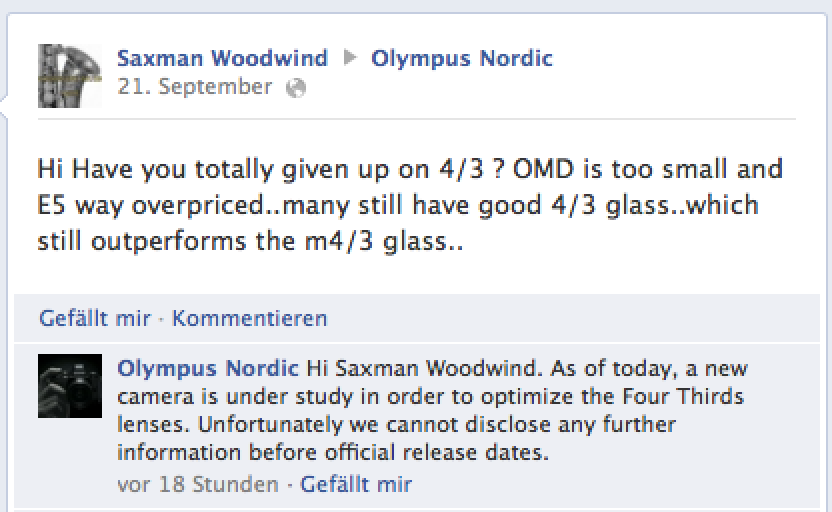
Olympus is also using social networks to reaffirm the Four Thirds commitment. Olympus Nordic (facebook) wrote that “As of today, a new camera is under study in order to optimize the Four Thirds lenses. Unfortunately we cannot disclose any further information before official release dates.”
Please note the subtitle info they gave us. They said “a” and not “a Four Thirds” camera is under study to optimize the Four Thirds lenses. So it could be also a MFT camera with full FT lens support?
87 Responses
we know, we know… just make sure it has spot metering linked to focus point with 100% coverage :-]
I think Olympus is very cognizant of the fact that they somewhat left their OM faithful high and dry and that they would not do a repeat of that only a short decade later. They have said that in the past and I hope that they keep their word. I have been on the fence about getting more 4/3 lenses, but with this statement, I think I am closer to being convinced of making a major purchase.
Oly has been studying this issue for years. They have failed to decide on a workable solution, and I have little hope to believe such a solution, the promised yet elusive “one beautiful system,” will materialize within a reasonable time frame or at all. Oly are stalling. Terada’s last interview was an insult with it’s non-committal and vague smoke and mirror(less) talk.
I believe Oly will end up producing CDAF-optimized m4/3 versions of at least some of the most desirable 4/3 lenses. Those will look good and work well on a future GH3-sized body. *ka-ching*
PS: I hope I’m wrong.
@TheEye
Oly has solutions it’s just about the right solution in a market that is in state of flux (which Oly, Panny, Sony and Fuji are reading well), Oly could have or could lay all the solutions on the table would you be able to pick the right one and put your money on it?
Terada has said what he can say, you are expecting a bit much of him if you were hoping he would say more (or anyone in a similar position to him)…
“I believe Oly will end up producing CDAF-optimized m4/3 versions of at least some of the most desirable 4/3 lenses. Those will look good and work well on a future GH3-sized body. *ka-ching*” probably true or an even better O-MD pro with the new technologies that Olympus are working on…
m4/3 is a do-over of 4/3. Apparently, Oly isn’t very good at market research, and they don’t come up with solutions in a timely manner for their old customers. While they study options and the market, the market has changed.
Oly also pushed their mid-of-the-line DSLR users towards m4/3, without making sure the 4/3 lenses would AF quickly. I am glad I didn’t buy a m4/3 body, because there is no solution that fits my wants and needs. Sure, Oly’s plan was that I’d have to buy a complete new system when switching to m4/3. Oh yeah, my flash woud have carried over. How generous.
It’s all about money and the lowest common denominator within a target group. Bah!
They were absolutely right to say that users of 4xx, 5xx and 6xx range should change to m43, these camera’s didn’t have speedy CAF anyway and as such they don’t miss out on anything but AF on the 43 lenses. New high grade lenses have been coming slowly but in the meantime Olympus issued thiose lenses that were not yet available in the 43 arena (except for the kit lenses ofcourse).
On 43 I missed a 50mm F1.8 and a fast 75/80mm, we now have those on m43. What’s missing are high grade 12-60 and 50-200 equiv.
But I haven’t got a doubt tat they will come also.
Pana took care of the 12-35 and 35-100 all be it a bit slower than the 43 counterparts.
In all I have no doubt the PDAF optimised 43 lenses will be fully usable in the future as well.
No, Oly were not right, because no Pen has the ergonomics of an E-xxx with grip. AF performance of 4/3 lenses on any Pen is not near the performance on an E-xxx. A performance downgrade is not acceptable in my book. Keep in mind I don’t even care (much) about continuous AF performance, but I want decent S-AF.
Oly telling 4/3 users to switch to m4/3 without offering at least matching performance was arrogant and impudent, and in my case it was enough to keep me from buying into m4/3.
No, the E-P1, 2 and 3 actually have better ergonomics then the E-xxx models if only because of having 2 control wheels, one of which is as well placed as the one on the E-xxx models, the other is somewhat less conveniently placed.
If adding a grip to an E-xxx makes handling better is a matter of opinion, you seem to think it does, I think it doesn’t except for the extra buttons and dial in portrait mode.
Lets see If they come up with something.
“under study” means nothing!
If olympus will not come up with a new camera for 4/3 or any good m4/3 solution I will sell all my stuff and buy fixed lens camera(s) in the future.
Actually, “We are studying” means “We are clueless” or “Go eff yourself.” 😛
They are still beating about the bush. Is it so monstrously difficult to just put the EM5 sensor and stabilization into a E-550/E-650?
Its not just the sensor and stabilizer, it needs completely new electronics. Not impossible, far from it, but ‘a bit’ more substantial then the picture you paint.
This costs money. Having it properly tested costs money, and then having production facilities adapted for it, and doing production runs and distribution costs a lot more money. All this has to be funded upfront.
Its not a matter of if it is technically possible, but of if it is financially sane.
The peephole that was the viewfinder for the E-4×0/E-5×0/E-6×0 series was too small and too dark.
They need something more like the E-1, which was fully functional and well-balanced with heavier lenses.
Those wanting a replacement for the E-5×0 should get a Panasonic G5.
Four Thirds is dead, M43 lives.
OK. It turns out financially sane, I buy E-550/E-650. It turns out otherwise, I buy Pentax K-5/Nikon D600 … I, the customer, have the freedom of my own financial & technological planning, Oly have their own freedom … Everything’s fine. 🙂
Sony already has sensors with PD built-in. Job done. All they have to do is build it.
There is no such thing as an image sensor fitted with phase-detection elements that would be even remotely adequate a substitute for the real, mirrorbox-located phase-detection AF of a DSLR. Not by Fujifilm, not by Canon, not by Sony.
So, at this point, the only possible solution for a mirrorless camera design with FT lenses would be an FT adapter with a translucent mirror, either a fixed one like the Sony SLT mirror, and given the state of affairs Olympus might even be able to make Sony manufacture it for them, or a translucent mirror that flips out of the way for photographic images, which would be even better.
Or an MSC equipped 1x ‘teleconverter’ adapter. CDAF focus in adapter, aperture control in lens or adapter. Could work for any lens…
Olympus has a patent on such a design actually.
@hubert bigend
I am a mFT guy though I also use FF Nikon and I can honestly say that with regards to AF the Nikon V1 system is a mile ahead of any other mirrorless even using the adapter with some big ole FF lenses including my 70-200VR2 and my 300mm F2.8.The results were damn good .
I have tried using some of the excellent Olympus HG/SHG lenses on the GF1,E-MP3 ,GH2 and now on the E-M5 and while the glass is great the AF is dog slow in comparison.
Don’t let brand bias convince you that Olympus have done all they can . I hope that for the loyal users still with FT that Olympus comes up with something. Though common sense would suggest it should be an improved mirrorles body , it makes no sense to design cameras for a dead system. I am sorry but that is business. Olympus DSLR sales were always down the ranks compared to the big boys and since the release of mFT FT has been bleeding users. So either make a high end mFT model with a compatible adapter hat allows for full AF of FT lenses or a limited edition { and no doubt super expensive} FT model
They are in the business of making money aren’t they ?
Completely true, I have no doubt that it ‘ll be a m43 camera that’s in the works that will use the 43 lenses.
As said 43 is dead.
It’s that flapping mirror which is dead end… not sensor format.
Hasn’t anyone noticed that there is no real double ups in the four thirds and micro four thirds lenses. Particularly when you consider the premium quality lenses..
We will soon have huge range of fantastic lenses on a micro four thirds body, all we need is to be patient, and to let the technology mature…
Personally I can’t wait to get a professional micro four thirds camera from Olympus… in the mean time I will be perfectly happy with my OM-D. 🙂
Quite right. I think patience is called for. 43 lenses work well on a 43 body, we all know the motors in these lenses require a PDAF solution to optimise them.
Long, fast telephoto lenses are usually used on moving subjects, and thus need PDAF optimised motors. This is why we don’t have this style of lens for m43, because it is a CDAF system. When they get a hybrid CDAF/PDAF system sorted, then we’ll get the faster telephotos for m43. I certainly wouldn’t shell out the big bucks for a CDAF 200/2.8!
I’m not an optical/electronic/image sensor engineer (is anyone here?), but I have noticed that Olympus doesn’t like to put out half-assed “solutions” . It will come. Personally, if I needed DSLR type AF performance, I’d buy a DSLR and the specific lens I needed, for now.
Not sure if on sensor PDAF is the answer, long term. Why not two systems in one body, and an automatic selector depending on the lens mounted? It must also be possible to calibrate the PDAF sensor using the CDAF system.
This is going to be the most comprehensive study ever!
Yeah, it already lasts for more than four years.
Same statement using different words again, but nothing concrete – as always. Do they realize they are at a loss as well, not only the customers?
I read this as ‘we’ll put phase detection on our Pro OMD later, which will also come with an adaptor.
A nowadays’ Four Thirds-optimised MFT camera has only advantages over a Four Thirds one.
More tears for 43 owners.
Pretty clear they are not working on a Four Thirds camera.
They say they are studying how to optimise Four Thirds lenses. But Four Thirds cameras already optimise Four Thirds lenses. So what’s to study, if it is a Four Thirds camera? Nothing. So it’s not a Four Thirds camera.
Which means they are studying how to optimise Four Thirds lenses for something else. Micro Four Thirds.
All the E-7 needs is an up to date sensor. Again, not much to study there. Just need to decide to do it.
The E-P5 will be released when they have better IBIS and in-built VF.
The E-M6 will be released when they can make it work with Four Thirds lenses.
The E-7 will be released when there’s a minor miracle at Olympus HQ.
To my mind the biggest problem of bringing an E-7 into the market is cost, it will be expensive due to what is now a small market place, the same would apply for an E-630 or even smaller body, Cost, cost, cost. I agree the relative development cost could be minimal, after all the E-5 & 620 bodies are good pieces of equipment, well designed with a very ergonomic layout.
Likewise the development of the E-M5 innards is complete, so all that is required there is to make one fit in the other, ok that will not be as straight forward as we would like but would be doable.
It is simply how many would sell in the market to make it a viable proposition to produce one of them.
+1. Well summed up.
> a new camera is under study
Just checked under my study – no new 43 camera is there. In fact – no cameras at all. There is nothing under my study – except the bunch of computer cables. 😐
Sarcasm? Humour? 🙂 Good one anyway!
Broader point was that we already know that E-7 is in works. The comment adds nothing new. Not even a E-650/E-700 hint.
There is a lot of new lenses in 4/3, but the system is near dead. How many users of E3 and E5 are alive? Most of them has changed system. Lenses for 4/3 are too big for micr43 standard. IMO it is wasting of resources.
Maybe there is a way to give micro43 many excellent zooms in one shot. There is many excellent primes now in micro43 and some primes will be in future (17/1.8, 43/1.2, 150/2.8). If there will be a body with fast AF with 4/3 zooms, the system will have wonderful zooms like 14-35/2, 35-100/2, 80-250/2.8, 14-54/2.8-3.5, 12-60/2.8-4, 50-200 f/2.8-3.5…
But is is wrong way. Such zooms are too big, too heavy. The better way will me make such adapter like for Sony NEX system (for Alfa lenses). And make two small zooms dedicated for micro43, like 14-54/2.8-4 and 50-200 f/4.
“There is a lot of new lenses in 4/3″
No there are not. No new 4/3 lens has been issued in a few years.
” but the system is near dead. How many users of E3 and E5 are alive?”
I am a lowly E-620 user, and I’m alive.
“Most of them has changed system.”
Do you have a source to back up your claim?
“Lenses for 4/3 are too big for micr43 standard. IMO it is wasting of resources.”
m4/3 bodies are too small with poor ergonomics and haptics for average size adult hands. m4/3 lenses are software-corrected.
if most of them changed system, they probably sold their cameras, so those have new owners but are still part of the 4/3 population hehehe
If you really look at the issue of how to implement this solution it is really quite complex. do they still try to preserve the optical pathway that will enhance viewing with rapid sequence shooting such as in sports? I think PD focusing will also perform faster than CD in this configuration. In doing this you still have to implement the focus micro adjustments which are a PITA (pain in the a**) to do and you still have to deal with producing an optical pathway and a mirror assembly. Now, have they been able to come up with a mirrorless PD solution whereby the sensor will do triple even quadruple duty in rapid sequence shooting? Think about it, the sensor will have to be able to focus, display an image on the EVF, capture the image, dump the information then be ready to focus the lens again and do this up to 9-10 fps at a shutter speed up to 1/8000 of a sec and have a shutter that has a life cycle of over 150k actuations. That is a tall order.
I am willing be patient so long as they promise not to drop the ball on 4/3 because, in my mind, bar none, olympus SHG/HG 4/3 lenses have no equal among their contemporaries when is comes to image quality, image quality at maximum aperture, build quality/weather proofness and size to weight performance. Yes there are some that seem to be outliers but as a whole, it is just a great system. It would be a shame if Olympus abandons this system. They put a lot of study into the 4/3 concept before they released it in 2003 and it took this long for sensor technology to catch up with their calculations. I think that if they persevere, they will be rewarded handsomely.
I got the confirmation at Photokina that a 43 camera was coming, however the representative could not tell me more.
Olympus must come with a clear statment, the Nikon D600 presentation desk was next to the Olympus stand. An E7 with the current sensor is a no-no. Why would I pay 2000 EUR if I can get the same quality with a 400 EUR pen or a full frame camera?
Either Olympus comes with something that is WAW and a reasonable price, or I sell my 7-14, 14-35, 35-100 and 25 and buy myself a nice full frame camera… that has a future!
The non doubling lens line ups have been mentioned, and the “one beautiful system” should start with a hybrid FT/mFT body,paying respect to FT’s ergonomics/size crossbred with mFT’s concept being mirrorless/OVF-less. An integrated but removeable flange extender being part of the body design while the solution for AF on FT lenses is not situated in this extender.Dimensions should be between the GH3 and the OM-D.
omg..i am being moderated
There is necessary micro43 body with possibility to connect with micro43 and 4/3 lenses (with fast AF). It will double range of lenses for this body. Body should be much smaller then Olymus E5, something like Panasonic GH3 size. E5 is such big as FF bodies. Pentax K5 is much smaller with bigger (APS) sensor. Ane new body may be be with OVH/EVF like in Sony Alfa.
If there is necessary adapter, it should be in body kit.
Four Third lenses are a valuable asset to Olympus even more so if they can all be made to work well on Micro Four Thirds bodies because:
1. no need for R&D into development into new lenses
2. they already have a good reputation
3. lower manufacturing costs ie no need for re-tooling etc
4. sometimes lenses can be too small
5. they still have some inventory
@itiswrong
“Lenses for 4/3 are too big for micr43 standard. IMO it is wasting of resources.” some of them are, it depends on the Four Thirds Lens and the Micro Four Thirds body eg the Olympus 8mm, Leica 25mm,Olympus 70-300mm and some zooms sit well on the O-MD and GH series….
Yes, and I’ve noticed similar subtle hints in earlier statements. While there may still be an E-7, who knows, it may well be that Olympus finally sees the need to do something to better integrate Four Thirds (lenses) within Micro Four Thirds (cameras), as no mirrorless system offers anything remotely like Four Thirds yet when it comes to lenses — at least not with stabilization of all lenses.
I wonder what comes out of it, and when.
My guess is it can only be a design, probably in the shape of an adapter, containing a translucent mirror that enables conventional phase detection AF within the mirror box – either a fixed one like Sony’s SLT mirror, or, even better, a movable one that flips out of the way at least for still photographs.
Oh, and there is no such thing as a “lens too big” for a small camera. Equip the OM-D with the nice battery grip and I’m quite sure not even the largest lens would be a problem — you’ll be holding the combination by holding the lens anyway.
I have a feeling it’ll be a MFT camera optimised for both FT and MFT lenses. A simple solution which addresses the needs of those owning 43 glass and those seeking a next iteration of MFT.
the solution is to make a 4/3rds camera . making a small camera so that my 50-200 breaks off when i pick it up is not a solution assholes.
Silly U, picking up that combination by the camera.
U also hold it two hands on camera?
We oldies have handled those small OM camera’s with even bigger lenses, we did that to support the lens and NOT the camera.
U rookie, U.
A 50-200 owner will most likely use two hands anyways.
More than likely using a tripod or monopod at the very least….
@ digifan cameras have come along way since moe , larry and curly. A big lens on a tiny camera would make a good comedy show.
I tend to agree with Francis.
– the main problem is how to implement a PDAF on sensor that is not primitive. But that depends on Sony’s good will.
– Alternatively a mirrored adapter: clumsy but possible.
– ‘Old’ lenses don’t have linear motors, and most 4/3 are not ‘CDAF compatible’. They can be the 7th marvel of the world, but they still be a disaster to AF.
Anybody remembers how the multithousand dollars 4/3 lenses backfocussed of frontfocussed, and needed accurate calibration? M4/3 does away with all that.
Therefore I argue that it’s mainly a matter of cost. If they can make a hybrid body for less than the price of an E-x they will, otherwise they will provide a less expensive mirrored adapter. Sony’s is around 400 $.
It would be far better if they announced that they can redesign 4/3 lenses for PDAF+CDAF, but can you imagine the cost?
There are many possible solutions, but no inexpensive one. So it’s not even true that those optical marvels can come for free as in Leica, where the lenses are MF.
Why redesign lenses? They need PDAF in the body (somehow) and then utilize both PDAF and CDAF. Best of both worlds!
Well, that shows how many or a few are innocent of the change of AF.
Mirrorless did it, so the main AF system is not a mirrored one.
Even the best 4/3 optics were not designed for CDAF.
Admin,
You are wrong in the title of this post. “Under study” is not equal to “Working on”…
The solution is simple:take a E-5 body, take a E-m5 technology and mix them, for top-grade owners is the better solution.
Making and hybrid camera that use both lenses…i don’t know if it is the right way.
Yep, the lens selection for a system like this will be AWESOME, with the fantastic primes of m4/3 and the terrific zoom of 4/3, but Oly must use Reflex viewfinder and i don’t know if is a praticable road for m4/3 lens.
Sony already has PDAF on sensor (NEX-6 for example) even tho its used only as AF aid if Im correct. Shouldnt be too hard for Olympus to improve that..
They should put e-m5 into e-30 body and do a hybrid 4/3 & m4/3 camera with PDAF for (4/3 optics) and CDAF. E-30 has great ergonomics but with e-m5 technology, sensor and weatherproof it can be good camera.
E-30 body is too small. I own the E-3 and E-5 and everytime I see an e-30 I think of it as a a toy. It just doesn’t feel solid.
Revival of four third system is not a smart move .
With almost every manufacturer thinking of their own compact fullframe , I don’t see the point to compete for four third . Even APS CMOS type cameras now having a hard time .
Agree or an E1 body which is so ergonomic will also work,can carry the E1 around all day with long zoom with little discomfort..hard to do with the m43 bodies now…the OM2-4 were good with a 300mm prime,but no AF so not as heavy as today..maybe Oly should do some limited SHG MF lens,with focus peaking in the cam..seems only way to make it smaller for now..with a fast aperture..
Agree..or use the E1 body which is ultra comfortable for long periods of use,or maybe Oly can make some limited SHG MF lenses(with focus peaking on bodies), as the OM2-4 with a 300mm prime was fine to use in the ‘old’ days, and not so big as today’s lenses.. I lived without AF for 30yrs and did alot of good work…
If your primary interest is for ‘tele shots’ there is a lot of point in having a smaller sensor. Not so small that diffraction will become a major issue even at relatively wide apertures, but it doesn’t have to be as big as some accidental amateur film format from a century ago either.
Oly want to say well we are not exactly sure how to make 4/3 lens work as fast as m4/3 lens in m4/3 body, but we dont want to release new 4/3 body either. We try to use adapter but it still work like the sluggish 4/3 to m4/3 adapter so currently our best answer would be we still studying it.
Full frame is good for WA or portrait work ,but who want to carry heavy! 600mm lenses around these days? Did that in my film days(was younger as well:)),but 4/3 for tele work is still a desirable solution for many I think..
+100
Actually, they have 2 answers at the moment:
Need it NOW? here is the E-5
Need it but not inmediately? Please give us some more time, we are studying the issue.
more from Nordic Oly…we are NOT forgotten!!!??
Dear Saxman. We are sorry but we cannot disclose any information about future products before their official release dates. But you can be assured that Four Thirds users are not forgotten and a new camera that optimizes the Four Thirds lenses is under study. Stay tuned and follow us here or on our websites – we will allways keep you updated with the latest info. Best regards, Olympus Nordic
I just hope someone will gag the trolls clamoring that m4/3 cameras should be “hefty” and “substantial” to match in size and weight their SUV. The OMD is already more or less the same size and weight with the film OMs and the Nikon FE/FM series, which no one, back then, dared to call “tiny toys”. It is humongously bigger than the Pentax 110, the Oly RC and the Rollei 35, let alone the Oly XA and the Minox 35. Smaller, much smaller, and with full manual controls (no multifunction Fn keys and diving into the menus for me, thank you very much), is the way to go – not just for m4/3 cameras but for ALL cameras this side of medium format. As for “high ISO” performance – methinks you are too young to remember the days when they were still called ASA and we considered ourselves lucky if we could get a roll @ 1600, push it at 6400 and chickpea-sized grain be damned…
> Smaller, much smaller, and with full manual controls (no multifunction Fn keys and diving into the menus for me, thank you very much) is the way to go
You must have hands the size of those of Asian child workers.
E-M5 is already too small even for those limited controls and that oversize TV screen.
Trying to compete only cell phones in size would be dead end for m4/3’s attempt to get bigger market share.
In case of your newspapers being dated fifty years ago while Canon and Nikon have had decrease in compact camera sales in last years their DSLRs have been selling very well.
And if you want tiniest camera sizes better compacts sure exceed 35mm film in sensitivity. Digital sensor’s resolution is way higher than films so even total image resolution might be even.
So, by implication, all the classics from the film days – the Leicas and the Nikons all the way to the F3/FM/FE, were toys for Asian child workers? They are the same size as the EM5, you know; and the rings and dials on them are the same size too, or smaller. And the compact rangefinders! How could they ever use them, I wonder! Was humanity hobbit-sized 30 years ago? How did we manage to set simultaneously focus (left hand thumb), aperture (left hand index,) speed (right hand thumb) and shutter/photometer (right hand index) and do everything as quickly and efficiently as modern autofocus (unless, that is, we were shooting formula 1 races)? Or is it just that the digital age behemoths with their lousy ergonomics, huge grips autofocus oriented viewfinders (when was the last time you saw a split screen/microprism combination? thank God for focus peaking!)and labyrinthine menus made us forget how to manipulate manual controls and what cameras used to look and weigh like? They have also made us forget how much better a small modern sensor (think of professional video sensors like alev or red) can be than film. We have the opportunity now to repeat the miracle of the first Leicas, from the 20ies (high IQ in our pocket) and send the behemoths to the dustbin of large format (good for some special tasks, useless for everything else). Now, if you fancy playing the weightlifter in your spare time, be my guest. Get a D800/600, your eyes will not regret it, only your back will. But please, please, do not send messages that deny us, who have been there, done that, got a sore back, left our SLRs in a cupboard, and believe that small is beautiful, the opportunity to get the products we need and crave for.
+1
While I think it is a very good thing that Panasonic also released a model that targets those who want a bigger camera, all the talk about how that is the only way to make an ergonomic camera is just ignorant.
It occurs to me that many people simply fail to understand the difference between THEIR preferences and facts, and consequently state their preferences as if those are facts that apply to all of humanity.
“You must have hands the size of those of Asian child workers.”
No mr. Esa, being almost 2m long, I also have big hands. Those big hands are absolutely no problem whatsoever when handling an E-M5. You simply lack proper technique for handling a smaller camera.
WTF i cant really wait… pls come to daddy by 2013 haha… anymegapix with good ISO and GOOD IQ… so that my 14-35 and 35-100 wont be a waste of money..
1. The covered up losses were from investments in unhealthy financial products and happened about a decade before the first E-system camera appeared, so no idea what you are talking about there.
2. In the market for consumer electronics (and that is where by far the largest part of the cameras gets sold, and not to ‘professionals’) real technical arguments don’t count, the best marketing counts. There are examples of that all over the tech industry
3. I suggest you go talk to someone who for example does birding or other nature photography where working distances are HUGE. They’ll tell you that a 300mm lens on 4/3 does in fact allow them to do what a 600mm lens on 135 format would (and don’t come with the equivalence argument because as shallow as possible DOF is actually UNdesirable in this case), and is about half as big and heavy. So no, it will most definitely not be as large as an ‘equivalent full frame’ system.
…
Four Third lenses are a valuable asset to Olympus even more so if they can all be made to work well on Micro Four Thirds bodies because:
1. no need for R&D into development into new lenses
2. they already have a good reputation
3. lower manufacturing costs ie no need for re-tooling etc
4. sometimes lenses can be too small
5. they still have some inventory
The lenses are indeed pretty fine, though too many are way too large and heavy and some are ridiculously expensive. I am surprised all you guys posting here who profess to be mFT fans don’t get it. The complete failure of FT compared to mFT { and remember all the covered up losses FT was an even bigger failure than we thought} .
The bottom line is if I want to carry lenses that are as large and heavy as FF options , I will get a D800 and all the benefits that go with it . FT is dead .Small is king, the market for SHG lenses was tiny at the peak of FT it wouldn’t even register as miniscule now the vast majority of guys who want these optics already have them . People are going mirrorless in droves for one reason, smaller.
Bart
New! 2 seconds ago | Reply
1. The covered up losses were from investments in unhealthy financial products and happened about a decade before the first E-system camera appeared, so no idea what you are talking about there.
2. In the market for consumer electronics (and that is where by far the largest part of the cameras gets sold, and not to ‘professionals’) real technical arguments don’t count, the best marketing counts. There are examples of that all over the tech industry
3. I suggest you go talk to someone who for example does birding or other nature photography where working distances are HUGE. They’ll tell you that a 300mm lens on 4/3 does in fact allow them to do what a 600mm lens on 135 format would (and don’t come with the equivalence argument because as shallow as possible DOF is actually UNdesirable in this case), and is about half as big and heavy. So no, it will most definitely not be as large as an ‘equivalent full frame’ system.
@bart you are deluding yourself all a FF user needs to get the same DOF and same AOV is a 2xTC the AF of all higher grade Nikon bodies even using a teleconvertor is better than Olympus FT ever was.One to watch is the 1″Nikon system the next gen will use a Sony sensor which as can be seen on the RX100 can deliver very decent results.
That 2.7 crop factor with fast AF { unlike Olympus} could be a real winner for the long range shooters.Especially when there are no shortage of fast lenses in the Nikon system an 85mm works as a 230mm , with the same DOF as an F1.9 mFT lens, a 135mm F2 lens works as a 364mm lens with the same DOF as an F2.8 lens on mFT.
You are a bit off on DOF because you (as so many) forget that different magnifications also change DOF, but thats a technicality.
Have you ever looked at the size and weight and cost of the Nikors that actually provide enough resolution for using a 2x tc? and then considered that you can do the same (use a 2x tc) on a fourthirds camera?
Is the 1″ concept even better for ‘tele shooters’? In some ways it is as your field of view gets even more narrow for a given focal length, but in others it isn’t. Pixel pitch on a 16mp 4/3″ sensor is already small enough that many lenses for larger formats barely or don’t provide enough resolution to actually make use of those 16mp. This problem only gets worse with smaller sensors. When looking at very good 135 format lenses, yeah, those will probably still do fine, but come with a significant price and weight penalty. Actually compact, light and somewhat more affordable lenses will have to be designed specifically for the much smaller image circle and much higher resolution requirements.
I’m not deluding myself, I’m actually using many different formats, from very small sensor compacts to 120 film currently. All those have their advantages, depending on your needs, and all are different compromises.
I don’t think Olympus is able to make anything pro in photography and never have been. The pro support services in place for Canon (CPS) and Nikon (NPS) users make sure it’s hard for anyone else to seriously compete with the big boys.
http://www.olympusamerica.com/cpg_section/oima_slr_ogps.asp
@Bart Olympus service centers are closing down in numbers there are several countries where your local Olympus support is now in another country. Olympus service for pro shooters is in a very poor state and if you look at the main reasons quoted by pros why the do not choose Olympus this is a biggie.
Having a website isn’t the same as a genuine worldwide pro service.
Correct, but that is a chicken and egg situation. Too few service centers and too few customers, which one came first?
5 years ago, they weren’t closing down, but opening them, but the ‘pro’ argument was the same.
Point is that such an organization still exists, as you point out, was bigger in the past, and from personal experience actually works pretty well. Hence the comment from Mark is simply not correct, especially because it claims they can’t and never were able to. There is at least historic proof of that being wrong.
The Olympus pro support set up is pitiful , though with maybe 1% of the worlds pro shooters its not all that surprising.
Yes, that was exactly my point. With a small market, its rather expensive to have service centers everywhere, but without those service centers everywhere it is more difficult to get a large market share in the professional market. So.. in practice that means 2 things:
– You’ll need a spare camera. Now, if you do events, weddings or such, you already need a spare camera anyway, but for some this will be a serious hurdle. If photography is your primary source of income, a spare camera is a must-have however. A service center around the corner doesn’t solve that unless they can provide you with a replacement within minutes while you are at some gig.
– You’ll have to deal with sending in, and receiving replacement and serviced products by mail or courier service instead of paying a visit to the service center, which at least increases turn-around time, and hassle.
I believe that the whole of Canada and the USA is now supported by one facility in New York
I bet the next Olympus camera will have the same hybrid sensor based phase detection AF from the latest Sony cameras, along with a Sony sensor.