









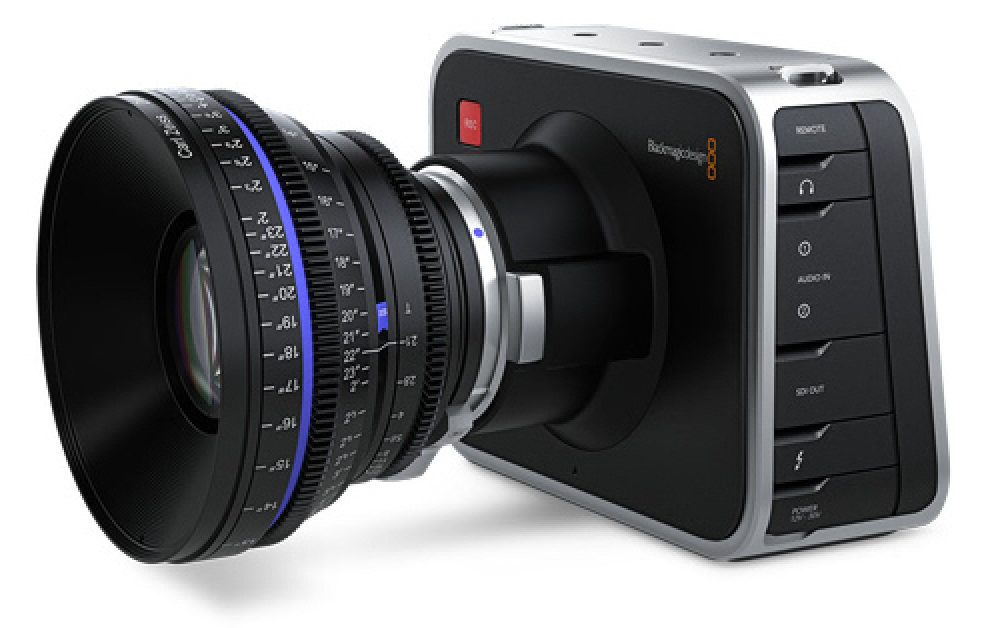
The current Blackmagic Cinema Camera EF model.
As you may know Blackmagic released a fantastic little camera that shoots in 12-bit RAW, ProRes and DNxHD Formats (Price and specs here at BHphoto). Until now the camera was available in EF and ZE Lens Mount but today Blackmagic issued a new statement saying that they will soon release a “second model of the Blackmagic Cinema Camera that features passive Micro Four Thirds lens (MFT) mount“. Passive means that there is no electronic control of the lens and you can use manual aperture and focus only.
Click the link below to read the full press release:
About Blackmagic Cinema Camera MFT
Blackmagic Cinema Camera includes a super wide 13 stops of dynamic range, large 2.5K sensor, a built in SSD recorder that has the bandwidth to capture open standard CinemaDNG RAW, Apple ProRes and Avid DNxHD files, a built in capacitive touch screen for direct metadata entry, standard jack audio connections, built in high speed Thunderbolt connection, 3 Gb/s SDI output, a refrigerated sensor for low noise, and is fully compatible with an even wider range of extremely high quality Micro Four Thirds mount lenses, plus other lenses such as PL mount lenses via common third party adapters.
Blackmagic Cinema Camera MFT also includes a full copy of DaVinci Resolve for color correction and Blackmagic UltraScope software for waveform monitoring. This means the user can simply plug into Thunderbolt laptop and run UltraScope to get full waveform monitoring scopes on set!
One of the most important features of the camera is its super wide dynamic range of 13 stops, allowing feature film quality images. Commonly people focus on more pixels, however often this just creates a higher resolution, but “video” looking images that still suffer from highlight and black clipping that limits details. Blackmagic Cinema Camera’s wide dynamic range eliminates this problem and provides film quality with dramatically more detail retained in black and whites in the image. Once the shoot is complete, the included DaVinci Resolve color correction software can be used to adjust images and take advantage of this extra range in the images. The high quality Micro Four Thirds lens compatibility also helps create sharp and cinematic images that look incredible.
To eliminate the damage that low bit depth and high compression video storage creates, Blackmagic Cinema Camera includes a fast SSD recorder. The built in SSD recorder can record the full sensor detail in 12 bit Log RAW files in the open standard CinemaDNG format on fast solid state disks. These files can be read by all high end video software. The full 2.5K sensor data is stored in the files completely uncompressed because the SSD has the speed to store video data at the required rate. This high quality file can then be color corrected on DaVinci Resolve for the same high quality result currently only possible on cameras costing tens of thousands of dollars.
Blackmagic Cinema Camera has been designed as the perfect companion to Apple Final Cut Pro X and Avid Media Composer NLE software. Unlike other cameras, which require the use of custom video file formats that are not compatible with popular NLE software, often making the post production process a nightmare, the Blackmagic Cinema Camera includes absolutely no custom video file formats, and every file type included is open standard. It records into CinemaDNG format for RAW files, Apple ProRes and Avid DNxHD for HD resolution files compatible with Apple Final Cut Pro X and Avid Media Composer.
The built in large LCD display makes focusing easy, and allows playback of captured files. Blackmagic Cinema Camera includes a built in microphone, as well as external jack based mic/line level balanced audio connections. When playing back recorded clips, a speaker is built in, and there is an included headphone socket, as well as embedded audio on the SDI output and Thunderbolt connection. The SDI output includes all camera data such as timecode, transport control, shutter angle, color temperature setting and ASA information overlaid in attractive antialiased fonts.
For easy metadata entry, the built in LCD features fast and responsive capacitive touch screen technology. When the user taps the display with a finger, a data entry window called the “slate” appears. This lets the user enter shot information just like typing on a smart phone. This data is then stored in the files and can be accessed by NLE software when editing content later. Metadata is compatible with popular software such as Apple Final Cut Pro X and DaVinci Resolve. All camera settings can be changed on this touch LCD, such as frame rate, shutter angle, color temperature, dynamic range, focus assist settings and more.
Blackmagic Cinema Camera includes an innovative industrial design built from solid machined aluminum metal which results in an attractive but rugged design. All of the camera, recorder and display have been shrunk down into a lightweight design that is very portable.
“One of the most common customer requests since announcing the original model of the Blackmagic Cinema Camera is other lens mounts,” said Grant Petty, CEO, Blackmagic Design. “We felt that Micro Four Thirds was a fantastic option and so we designed a second model with this mount. Only Micro Four Thirds lets cinematographers use a wide range of creative lenses, but it also easily adapts to other lens mounts such as PL mount, so the range of exciting lens options is virtually unlimited!”
Blackmagic Cinema Camera Key Features
- Blackmagic Cinema Camera MFT is identical to the Blackmagic Cinema Camera EF model.
- High resolution 2.5K sensor allows improved anti aliasing and reframing shots.
- Super wide 13 stops of dynamic range allows capture of increased details for feature film look.
- Built in SSD allows high bandwidth recording of RAW video and long duration compressed video.
- Open file formats compatible with popular NLE software such as CinemaDNG 12 bit RAW, Apple ProRes and Avid DNxHD. No custom file formats.
- Includes no custom connections. Standard jack mic/line audio in, BNC 3 Gb/s SDI out, headphone, high speed Thunderbolt I/O technology, LANC remote control and standard DC 12-30V power connection.
- Capacitive touch screen LCD for camera settings and “slate” metadata entry.
- Compatible with extremely high quality Micro Four Thirds lenses and other mounts via adapters.
- Supports 2.5K and 1080HD resolution capture in 23.98, 24, 25, 29.97 and 30 fps.
- Thunderbolt connection allows direct camera capture via included Media Express software and supports live waveform monitoring via the included Blackmagic UltraScope software.
- Includes a full copy of DaVinci Resolve 9.0 color grading software.
Availability and Price
Blackmagic Cinema Camera MFT will be available December 2012 for US$2,995 from Blackmagic Design resellers worldwide. The EF compatible lens mount model will be renamed as Blackmagic Cinema Camera EF so customers can differentiate the two models. Price for both models is the same, and customers can order each model depending on the lens mount they prefer.
Press Photography
Product photos of the Blackmagic Cinema Camera, and all other Blackmagic Design products, are available at www.blackmagicdesign.com/press/images.
About Blackmagic Design
Blackmagic Design creates the world’s highest quality video editing products, digital film cameras, color correctors, video converters, video monitoring, routers, live production switchers, disk recorders, waveform monitors and film restoration software for the feature film, post production and television broadcast industries. Blackmagic Design’s DeckLink capture cards launched a revolution in quality and affordability, while the company’s DaVinci Emmy™ award winning color correction products have dominated the television and film industry since 1984. Blackmagic Design continues ground breaking innovations including stereoscopic 3D and 4K workflows. Founded by world leading post production editors and engineers, Blackmagic Design has offices in the USA, UK, Japan, Singapore, and Australia. For more information, please check www.blackmagicdesign.com.
49 Responses
This system has so much potential, it just feels too unpolished though. Watched Philip Blooms 45 minute review of it today and it seems to have MANY flaws and strange decisions (Like no removable battery) and like PB said, this system with a Super 35 sensor could really take over.
Instead of PB I think that EOSHD is a better source, Reid has a better understanding overall and the designer of the BMCC talks about all that in a interview. This was never a camera made to have a battery, to have a internal one is a luxury, just for some occasions. None camera like this has a internal battery, all of them have big external batteries.
I also think it would be nice to have a S35 size sensor, even more because of the crop factor and the difficulty of getting wide angles, but in this model, they had other priorities.
I don’t think that there is any camera in this price point, to this market that can take over just because of the sensor size. The new Sony FF E-Mount camera will compete with this camera, but there is no other camera that has RAW, DR and post production software like Da Vinci like the BMCC has.
So it’s not like one is better or not, it really depends of what you want of them. But if they charged a little more for a S35 sized sensor, it would be a killer – but it would also kill this camera as well, I guess. A S35 sized sensor with higher frame rates, higher resolution, with a more versatile mount with mounts adapters for 5000~6000 would be interesting.
Love this. This is very reassuring considering I have invested in a number of m43 lenses and this will ensure that I have some options when it becomes time to get a new video camera. That will likely not be for another 3-4 years and by that time an AF 100A , AF200 and even AF100B will be available, if the discussion at dvxuser.com is to be believed. But more options is a great thing.
Christian
http://www.flickr.com/photos/purecinema
BMC or GH3? That is a question!
SRL NOKTOR 12mm f/1.6
Voigtländer 17,5mm and 25mm f/0.95
And all the PL lenses…
Waouuuu!
Now, just wait the tests GH3 and BMC.
The BMCC m43 model only supports _manual_ (non-electronic) m43 lenses, or adapted manual non-electronic lenses with other mounts.
For example, to the best of my knowledge, all Lumix lenses require power and camera communication, even in manual mode, for both aperture & focus. And with some of the newest ones, for zoom, too.
But otherwise, this announcement is great news for users of fully manual m43 lenses, or adapted fully manual lenses, including old Nikkor, Canon FD, and modern manual PL cine lenses.
Why do they release a MFT version?
Aren’t most MFT and FT lens’ aperture and focus electronically controlled?
I was just wondering myself? If most MFT lenses are electronically controlled, wouldn’t it be impossible to change focus and aperture?
@Robbie
“Why do they release a MFT version?
Aren’t most MFT and FT lens’ aperture and focus electronically controlled?”
The real question is why the hell they do not give full support of M43, taking to account that best M43 lenses are electronically controlled. M43 on BM is perfectly logical, since they will have less problem on the wide front, owing its large crop.
This camera is not aimed at photographers with AF lenses, but it’s the entry level to serious cinematography. There are some very nice mFT lenses on the market, made by Zeiss and others for example, that are fully manual and have no AF or other electronics because there is simply no need for that. These are the tools that now can be used on a BMCC, too.
Exactly. The AF100 is mainly aimed at filming in controlled environments: fiction, commercial, music videos..
Most my lenses are manual focus: Nokton 25mm, Zeiss ZF 18mm, SLR Magic 12mm, Samyang 7.5mm and 85mm..
Yup this seems right. FIrst I was confused but I get it. More for adaptors or the voigtlanders 17/25, not to put your fucking kit lens on it. (I just made a film with my E-PL1 and I used the kit lens a bit!)
Though there are good electronic MFT like the olly 75, hmm.
I hoped for a Sony NEX mount so I can share the FS100lens and adapters I already have. PL mount adapters, Metabones EOS adapter.. etc
Unless the GH3 is rather good, so we won’t need another camera.
Bernd
Do not understand why you advocate castration of choice by few manual m43 lenses only. Electronic contacts is not only about AF, but also aperture, btw.
How are you going to be using a Micro Four Thirds lens on a passive mount? No electrical contacts means no access to the change of focus and aperture.
You would need to connect the lens to a M43 camera, set the desired focus distance and aperture, and then remove the lens while the camera is powered to retain these settings. Then mount it to the “passive mount”.
wow blackmagic did it quite fast but with no electronic contacts it will be hard to use panny/oly m4/3 lenses..
Without electrical contacts you’d have no power to operate the power zoom on the X-lenses.
Everything else should work fine using the focus and zoom wheels.
Having no AF whatsoever to quickly set up shots is however an issue.
are you sure?
I think it is the same as when I use macro extender tubes with my panny 14-140mm
I can´t focus, I can´t change f-stop, I can only zoom , this is what it will be like with the passive m4/3 mount
as Antoine said,
this is weird that they announced it so soon and it´s almost usseles for m4/3 lenses with no manual aperture control, the gh3 is comming and if it will deliver good codec and DR it could take a lot of preorders from blackmagic
What do you mean you can’t focus? All the Lumix lenses I have used (14-42mm,14-45mm, 45-200mm, 100-300mm) have manual focus rings in addition to AF. I am puzzled that you seem to say the 14-140mm does not?
All those lenses have a manual focus ring indeed, but all of those are electronic, and will not function without a camera that can properly communicate with the lens.
Thanks for clarifying that! Yes, that is indeed a major stumbling point.
Have you considered changing aperture?
Well, I have no lenses without manual aperture control.
No, the Micro Four Thirds lenses are focus by wire, meaning that you must have the lens connected to a Micro Four Thirds camera for the focus ring to work. The focus ring does not move the focus, it is moved by the camera’s signals, either during the AF process, or based on input from the focus wheel in MF mode.
So no electical contacts means no focus on Panasonic lenses.
Manual focus lenses are of course no problem.
They just want to take GH3 users! That’s why they announce today the M4/3 BMC… before Panasonic with the new GH3 and the Photokina.
Good news : it means that the GH3 will be available soon before december.
for me it is just gh3 vs the bmcc now
let´s see if panny screws the codec or they will take my money
admin, any info about the codec? or is firmware still not final?
“Passive means that there is no electronic control of the lens and you can use manual aperture and focus only.”
What a moronic move…
“Commonly people focus on more pixels, however often this just creates a higher resolution, but “video” looking images that still suffer from highlight and black clipping that limits details.” AMEN
2x crop size or previous 2.7x crop?
THIS IS FUCKING BRILLIANT! BRAVO BLACK MAGIC DESIGN!
The advantage of µFT is that you can adapt almost every lens with an adapter. I assume the main goal wasn’t that you can use the Kit-Lens. Now almost the hole world of manual lenses can be used with this camera.
This isn’t just about MFT, its also about making it easy to adapt other lens-formats such as PL or Nikon.
Adapting lenses is easier with the Micro 4/3 than with the EOS mount because the Micro Four Thirds mount is much closer to the sensor and allows the space for adapters. Also it have been mentioned that the Micro 4/3 mount is passive for the time being, assuming that there are working on the electronic support as well.
I certainly hope electronic support is coming, otherwise they’re asking the same price for a passive mount as they do for the EF smart mount. In other words the same price for less advanced tech. m43 is inherently more adaptable, but that shouldn’t come at a price.
Igor
There is no contradiction in supporting the legacy mounts via adapters and providing full electronic control over all M43 lenses. I hope they will soon provide full support of M43 and perhaps even will shift to the M43 sized sensors in the near future.
Exactly. If anyone here is a GH1 or GH2 shooter you know that you have way more manual lens options from almost every manufacturer out there with adapters. No lens communication is irrelevant for filmmaking purposes as you would primarily use lenses with manual aperture rings (I have an older Leica/Panny Four Third 14-50mm lens that has manual aperture for example). So for those already invested in this kind of lens use it’s a relief to not be repurchasing lenss. As pointed out this is all because the m4/3 mount is closer to the sensor and allows more lenses to work with adapters. Of course the new crop factor throws things for a loop and some may still be buying a new lens for better wide angle (since m4/3 has less of a crop factor unless I’m mistaken). Very nice news indeed.
They should be done this when they first released the camera, instead of this stupid EF mount, with a supid distance from the sensor, that would open a new world of possibilities. Even Blackmagic was caught by Canon’s brand strenght…
They possible had the experience with the communication protocol of EF and still need to build up experience with the FT-lens-protocol. So it makes sense to first build the camera you CAN build.
Releasing a new camera without the ability to use AF, electronically control aperture and no metadata about what lens was mounted at what aperture and focal length would have been stupid.
I’ve been producing videos for the past 20 years and never see anyone using autofocus.
Possibly, but most fourthirds and micro fourthirds lenses focus by wire, and when the camera cannot drive the AF motor, that not only means it won’t support AF, it also won’t support manual focus for those lenses.
Ok, I understand the electronic thing (yes lens info is important), the market part, etc, etc… But that empty mirrorbox… arghhh.. no way for me. Maybe I’m biased… cause I don’t see myself buying these old chunky lenses, designed exclusively for photography.
micro fourthirds doesn’t need or have a mirror box. Additionally, if you use purely mechanical all manual lenses, you don’t need any communications between camera and lens.
But for the native micro fourthirds lenses, like the popular 14-140mm, the communications between camera and lens are needed simply for using manual focus and setting an aperture, because those things are controlled electronically even when using manual focus.
That said, this isn’t the kind of camera on which you’d use those small electronically controlled lenses much anyway I gather.
Look more closely.
Video pros use “auto” in one form or another fairly regularly. It’s OK if you don’t, that’s cool.
“Auto” lens features (focus, aperture, IS, zoom) have been used in professional productions for decades.
> # High resolution 2.5K sensor allows improved anti aliasing and reframing shots.
> # Super wide 13 stops of dynamic range allows capture of increased details for feature film look.
It seems to me that Sony has found another customer for the 43 sensor (as found in the E-M5).
Sure, all depends on your tasks. There is no contradiction in having more control and being “pro”.
Shame its passive so you can’t use the great Oly and Panny lenses unless you’re shooting wide open. It is a much better platform for adapted lenses than the EF mount though with the shorter registration distance, so Leica and Zeiss C/Y lenses will function better.
Wow. Looks like a great way to use about forty FD, MD, OM, K, and Pentax screw mount lenses I have! I’m thinking people buying this camera for the m43 mount aren’t buying it for the m43 lenses.
This is a smart move by Blackmagic. The EF lens mount was holding them back from a lot of great legacy glass – primarily PL and C-mount for filmmaking.
Going m43 makes sense because of the compatibility of the flange distance – it has nothing to do with the majority of (electrically controlled) m43 lenses. It doesn’t hurt that there are some nice manual m43 lenses for filmmaking – voigtlander 25/0.95, SLR Magic 12/1.6, etc., but they are definitely not (I repeat, *not*) interested in supporting something like the Panny 14-140. Which is a shame, because that means lenses like the 12-35/2.8 also won’t work, but that’s the breaks.
Nice to see a company that is responsive to feedback:
17 April I wrote “Gotta love what you are doing BUT …… On the next version place a large diameter mount close to the sensor, so adapters will be produced for all legacy SLR/DSLR lenses as well as for MILC lenses, such as the fantastic Voigtlander m43 Noktons, which I use for available light video on the GH2”
23 April I get the reply “Thanks for the feedback. Obviously we’ve got to commit to a set of specs to get out the door and that’s where we wanted to start. I think we got a lot right so far!
But we love getting feedback and look forward to an exciting future!
Blackmagic Design”
The m43 mount version is a smart move indeed.
FINE!
m43 mount is the first and right way they go and realistic.
then – i care that we have MANY DIFFERENT COMPANIES to build
CAMERAS… the BMC brings a bit more speed in this lowwater slomo
camrevollution – never forget the big players produce so much
for consumermarket, that something like fs700 would not reach us
now no c100, then in 3 months as c105 all with a pricetag between
2000-4000. that is it. and it also can happen taht other reactions
overcome – arri 2k/4k isabella – suddenly a body arround 6000 on
market 2013 and so on..
but now this BMC goes realistic.. so is it for you hard that in 8 months a BMC mk2 with a body modular build
-bigger moni and movable
-big movable electric unit
-the cam plate itselve
works.
maybe we have then somethink like my P+S SI-2K….
gh-3 will be fine
maybe in this huge pile of new CANONS we get a
twin digi5+
only 18 megpixi
new 2013 sensor with global shutter in a house
like c100- think they are not fully in coma yet…
and sensor and lenses
m43 ( pana / olymp)
aps-c( sony)(nikon)(canon)
is the costable side of the medal
and maybe we see a nice af 200
not forget the chinese empire ( cineraw35)
but we speake about 2000 dollars for body.
( BMC minus davinci..)
The BMCC is 2.3 crop. Tokina is not that interesting with no aperture control and slow f stop.
Is the SLR Magic 12mm 1.6 lens the only wide and fast lens that will work on the BMCC? The 14mm EF lens is f/2.8 only and PB’s recommendation of the 8mm sigma does not allow filters and it is way way slow for DOF for small sensor.
Does anyone know if the SLR Magic works with any wide angle adapters for an even wider view?