









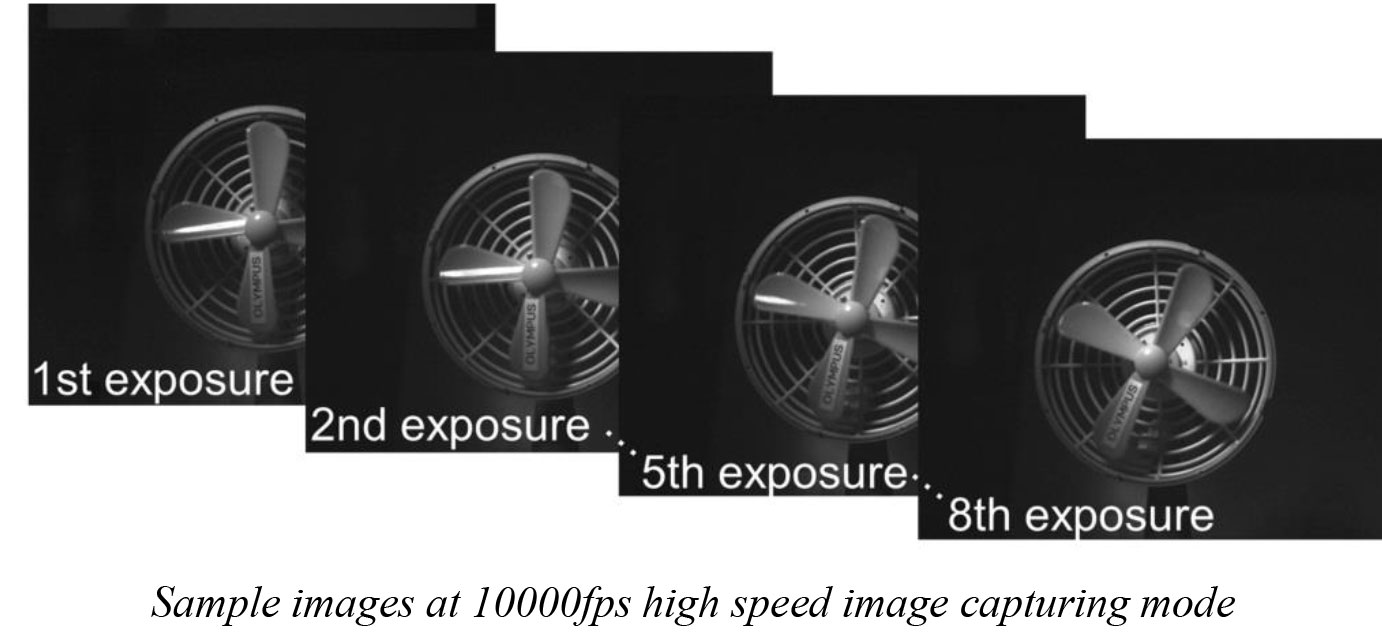
(Click to enlarge the image)
DC.watch posted new details about that crazy new Olympus 10,000 fps(!) sensor. The hell of a good news first: It’s a real Four Thirds size sensor! It has 16 megapixel and it’s 3D stacked CMOS design makes it able to get rid of the usual rolling shutter distortion on fast-moving objects. At 16MP it shoots 5fps but at 2MP resolution it shoots 10,000 fps!
Here is the official Sensor design and specs:

Reminder: Months ago VLSsymposium (PDF file here) unveiled the first info about the new 16MP 3D stacked Olympus sensor:
A 3D stacked CMOS Image Sensor with Global-shutter mode and high speed capturing mode:
The paper by Toru Kondo et al. from Olympus Corp. will describe a 16Mpixel 3D stacked CMOS image sensor with pixel level interconnections using 4 million micro bumps.The two semiconductor substrates are bonded by a 7.6um pitch micro-bump array, and the storage node array is comprised on the bottom substrate to improve parasitic light sensitivity (PLS). Both a 16Mpixel global-shutter mode with a -180dB PLS and 2Mpixel 10000fps high speed image capturing are achieved. (Paper C4-5, “A 3D stacked CMOS image sensor with 16Mpixel global-shutter mode and 2Mpixel 10000fps mode using 4 million interconnections,” Toru Kondo et al., Olympus Corp.)
44 Responses
I wonder if this sensor is for the new upcoming OMD-EM 1 II ,and if indeed it has the ability of the OMD-EM 5 II of high resolution shot’s handhelded at more then 1/60sec instead of on tripod ??
Yes but unfortunately it won’t be enough to survive in today’s growing digital photography age .
Have a look on your surroundings , I pretty sure you can easily have other brand of cameras that is much much promising than this one .
It’s sad to leave a favourite boat but sometime we have to if the boat is no longer relevant to a race .
Why not stop looking around, take the advantage of the camera and lenses you have and more importantly, take pictures ?
The grass always looks greener in the other paddock, until you get there!
What race are you talking about?
I thought it’s all about taking pictures?
I don’t think this would be going into the EM1m2, but rather a special-application high-speed (movie) camera. Some people here seem to forget Olympus is not just a photography company, they also have medical imaging for example. Ultra-high speed cameras could be a nice niche market, expanding their business outside stills cameras to sell sensors and mFT mount lenses to, but they’d have to improve their movie features know-how by a lot.
Oly has made high speed cameras for years, but last year they sold (or transferred as they say in their press release) iSpeed camera business to iX Cameras Ltd.
I checked again, and Olympus still manufactures the iSpeed cameras. iX
Cameras Ltd only takes care of camera service. And I Think that this new sensor is for iSpeed cameras.
My guess too. Oly has promised to make Hi-Res mode more useful – and useable hand-held – and that seems to be the answer.
But at SS 1/10000, it is very limited.
We’re going to need a bigger card…
Bigger card?
I would say a ssd…
The use of H.265 might help for video…
16MP in 2012 & still
16MP in 2015 / 16 ???
Multiple exposures again ???
Come on , Oly !
If this is what Oly going to come up , better save R&D ,
get the sensor straight away from Sony or Pana or Fuji .
Why, what’s your problem with 16 Mpx? And what multiple exposures are you talking about?
I hope you are aware that as you raise resolution, dynamic range and ISO noise generally suffer. See Canon 5DS. Olympus have already said in interviews that they will only raise the Mpx count if they can also improve or at least not degrade DR and ISO noise. And since they are already getting sensors from Sony and Panasonic (but not Fuji who don’t make 4/3″ sensors), I don’t really understand your last point either.
Not necessarily. the A7r is better in both DR & noise compared to the A7.
That also depends a lot on the tuning of the camera as well, e.g. where the unity gain was set and how much amplification is applied. Have a look here how the A7S gradually overtakes the A7R in DR as the ISO is raised:
http://www.dxomark.com/Cameras/Compare/Side-by-side/Sony-A7S-versus-Sony-A7R___949_917
That’s true. Granted, I never said anything about the A7s.
Don’t get mad, Yun is a bit delusional indeed.
Fuji don’t make sensors, anyway. They use the old Sony 16MP sensor and have their own color filter stay that they put on top.
OM-D E-M5 & OM-D E-M10: Sony sensor
OM-D E-M1: Panasonic sensor
BTW: The highest MP count of any Panasonic m43 camera are 16 MP as well. Fuji’s bigger APS-C sensor: again 16 MP. I must have missed something…
Olympus does not manufacture or develop any of their consumer camera sensors themselves. So what are you talking about? They don’t spend R&D on that stuff; this 10,000 fps thing is purely a lab study pointing out possible sensor developments in the mid-term future. And as already remarked more likely for industrial applications.
And what’s the competition anyways? Canon’s obsolete tech? Sony’s own excellent sensors crippled in their own cameras by that crappy 11+7 Bit RAW format (I own an A7R and know what I’m talking about)? Scaling the current 43 sensor technology to 135 format would mean a 64MP sensor. Wait can’t buy this one, next best thing would be Canon’s 5Ds which for sure has a reputation as the master of high ISO and superb DR. Ah wait again, native ISO 6,400 and DR, ouch.
For more pixels on a 43rds sensor the current 1″ technology could of course be scaled up but then high ISO and DR would definitely go out of the window. Seems you are just asking for something – a miracle(?) – that no manufacturer can currently offer. Progess more frequently than not happens to be much slower than wishful thinking.
If you think MFT is insufficient for your needs go and buy yourself a Nikon or Pentax. They are most likely the cameras to get the best possible overall quality out of the current sensor generation technology.
I can hardly wait for you to make your own sensor and show us how it’s done.
As wonderful as this sounds. I would much rather cleaner ISO and more dynamic range.
This is what a sensor is all about .
ISO performance & DR improvement .
Why is so hard for Oly to understand this ?
Well said!
Actually, the interesting thing about the paper and the specs is this: saturation well of 35k e. That compares to the E-M5II’s 27k e or so. If I’m reading the information correctly, this sensor has more potential dynamic range than the current ones in use.
But would you believe that this one is for consumer m4/3 and not for industrial applications? The readout rate of 5 fps would be lower than any continuous shooting ability of current Olympus models. Maybe the new dynamic range and other features can spin off into consumer chips
I guess it is more towards their industrial application camera solutions
It can’t be 10.000fps stills mode… it must be ultra slow-motion video…
10000fps = SS 1/10000.
8 exposures at SS 1/10000 combined = SS 1/1250.
Still not very useful, but not as useless.
I wonder is that has any connection to the E-M5/mk2 Hi-Res mode which also utilizes 8 exposures.
Don’t get too excited. As specified in the table, the HS capturing is limited to 8 frames only. Pretty useless for general HS capturing in real / lab / industrial life.
The technology is not there yet for lengthy 10K frames/sec capture in consumer cameras at 2M pix resolution. The bandwidth required at such specs from the sensor – to processing – to storage is too power hungry, big and expensive.
Interesting. With 5 fps readout at 16 MPx, I kinda doubt this is something they’d put in an MFT camera, that would mean horrible EVF black-outs. Unless there’s also some other mode that can read out whole sensor at higher frame rates?
And this apparently has an actual global shutter, unlike Sony’s new hyped sensors.
But what’s most interesting is that apparently Olympus does have some advanced sensor tech under wraps, and they are working on stuff like that. Something I was not aware of. The question is, when will this kind of tech actually reach consumer market products?
I don’t see the issue for 5FPS having blackout issues any more than DSLRs. Moreover with a global shutter the blackouts would be briefer than a DSLR and may be invisible.
What I want to know is if you can use flash with this global shutter. If so we will then have a silent shutter with full flash sync at all speeds.
Well, I’m not privy to actual technical details, so I won’t argue too much here. But my understanding is that if you can read full pixel data only 5 times per second, that means that the sensor is not capable of performing any live view/af functions for 200ms after the exposure is triggered. Because it’s busy reading out the data or doing some other stuff that I have no idea of. For DSLRs, this does not matter at all, since AF and viewfinder do not need sensor to do any work.
This is why viewfinder in D4s is usable at 10fps, but on E-M1, you have no live view at full burst speed (at least that’s what I heard from its users, not sure if v3.0 firmware changed that).
And this is why the 27fps readout speed for newest 4/3 sensor from Sony is so important. That would allow for full C-AF and live view at very high frame rates.
At least this is my understanding of those matters.
On mirrorless cameras that boast high frame rates there is no blackout as the finder just shows the last frame seen. With such high frame rates the brevity of most captures imposes only a slight inconvenience. I shoot an FZ-1000 at 15FPS and there is no blackout. No constant view either but it never is a problem.
in a DSLR, mirror travels much faster than 1/5 of second, you need about 12 fps in order to have comparable blackout.
Who is making BSI and/or stacked sensors at Full Frame, One-Inch, and smaller sizes, and is perfectly poised to fill in the middle, and already manufactures more FourThirds sensors than anyone else? Who says that 24mpx renders a better photo than 16mpx? The Digital Cinema picture is 8mpx. That makes for a huge print size. Too many mpx on a substrate makes the ISO noise increase. The reason APS-c chips do not shoot cleaner pictures than the FourThirds is precisely because a surface 1.5 times the size with 1.5 times as many pixels gets you the same pixel size. Personally, I would like more pixels, even though I have no immediate use for them, but NOT at the cost of a slightly noisier, low-light ISO characteristic. The whole point of the BSI technique is to reduce the portion of the surface wasted on non-optical circuitry so that more pixels may be the same optical size. Regular CMOS techniques devote only about 35% of the surface to optics. BSI changes all that. Stacked puts other interesting capabilities, like additional memory and more numeric converters below the surface so that things like global shutter, 4K, and high frame rates are possible. Shame on all you naysayers.
“APS-c chips do not shoot cleaner pictures than the FourThirds”
Yeah… sure… in your own mind…
At the same pixel density? No.
Look at size of APS-C vs 4/3, difference is very small. Reason why 4/3s are worse is usually manufacturing process and higher pixel density in order to keep up with megapixel race. Thats all.
By size the difference is around 0.5 EV. Tests confirm this value.
Manufacturing process has little effect on the total noise, because it’s mostly based on how much light the sensor absorbs.
Manufacturing can significantly affect colours and DR, so the results of how the camera uses the light information gathered.
The only significant change in noise to date was transition from CCD to CMOS, when we instantly got up to 2 EV.
Pixel density is not an issue in typical MFT/APS-C sensors.
It limits the performance of much smaller sensors in phones and compacts. And on the other hand: we’ve seen low MPx sensors (Sony a7S, Nikon D4s, Canon 1D) with great low light performance.
But these differences stem from often totally different designs. In other words: larger pixels make it possible to use different technology. It’s not just simple scaling of how much light can be gathered.
Well, at least one commentator has something correct and interesting to say. I am not sure the rest can do any math, read a chart, or talk turkey instead of trash.
370mm / 24,000,000 is 15.4 square microns.
332mm / 24,000,000 is 13.8.
225mm / 16,000,000 is 14.1.
864mm / 24,000,000 is 36.0, big jump to full frame.
864mm / 36,000,000 is 24.0
864mm / 42,500,000 is 20.3, BUT on stacked BSI… hmm…
Lots of crass opinion thinks APS-c is almost as good as full frame. If FourThirds is crap, APS-c would also have to be rated, crap. Since both are quite good, the current APS-c advantage has to be acknowledged as the higher pixel count, but NOT better noise characteristics. The math speaks.
Looks to me like the available surface available for a pixel on a FourThirds sensor sits squarely in APS-c territory, and both are far below full frame. Given a same process, Sony-sourced APS-c and a Sony-sourced FourThirds sensor with the respective pixel counts, you would expect the noise to be identical because the difference in the size of the photo-sites is trivially insignificant. That constitutes math, science, and manufacturing prowess. Think of the FourThirds as a crop on the same-process APS-c. Same noise.
@Admin The Camera Store TV team says the Leica Q is in cooperation with Panasonic (they claim the battery can be charged in a Panasonic charger), any info?
Super slo-mo for full HD video!
It’s not so much the number of frames that can be taken in a burst, but the fact that it could read all the lines simultaneously. That tech combined with the sensor shift ability would allow for the potential of hand held or at least a better hi-res shooting mode than what is currently found in the EM5 MK II.
For me, that is the great takeaway from all this, not the high speed shooting implementation. Progress is progress, even if it is slow.
Where does it say that it can only take 8 consecutive 2MP frames at 10,000fps?
I’ve been through the whole paper and that limit never shows up. Are you guys/gals spitting out that number just because you saw it in the illustration?
(edit) Ok, I found it: http://pc.watch.impress.co.jp/docs/news/event/20150619_707814.html