









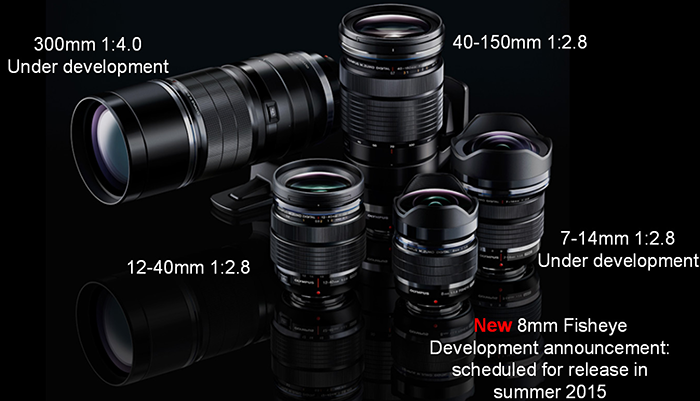
SLRgear (Click here) tested the new 8mm fisheye PRO lens from Olympus:
Images shot with the lens offer pleasing sharpness; corners are often out of focus in wide-aperture (ƒ/1.8) shots because of the subject distance, rather than characteristics of the lens. It doesn’t take much to get the full frame of a scene in focus – just back up and stop down a few aperture stops.
Mirrorlessons (Click here) posted the full M.Zuiko 7-14mm comparison with the Panasonic 7-14:
There isn’t a drastic difference concerning sharpness. The differences in perspective distortion are a question of taste. I would say that the Olympus lens can be a better choice for precise architectural compositions while I could recommend the Lumix version for landscapes. The M.Zuiko version has the obvious advantage of having a faster aperture, which can make all the difference on a m4/3s camera, especially when shooting indoors. It is also more versatile thanks to its closer focusing and bokeh capabilities and has a better resistance to flare.
Olympus Preorders:
7-14mm f/2.8 PRO lens: Amazon, Adorama, BHphoto, GetOlympus, WexUK, AmazonUK, AmazonDE,
8mm f/1.8 PRO lens: Amazon, Adorama, BHphoto, GetOlympus, WexUK, AmazonUK, AmazonDE,
Titanium E-M5II: Amazon, Adorama, BHphoto, GetOlympus, WexUK.
Accessories:
7-14mm Olympus LC-79 Lens Cap at BHphoto.
Olympus PPO-EP02 Dome Port for 8mm at BHphoto.
Olympus PPZR-EP05 Focus Gear for 8mm at BHphoto.
Olympus POSR-EP10 UW Anti-Reflecting Ring for 8mm at BHphoto.
33 Responses
That soft rendering of grass the M.Zuiko 7-14mm f/2.8 is reported to show is ugly, and it is something I’ve seen before, it has been found with the 12mm f/2 and 17mm f/1.8 M.Zuikos, too, and with these it is clearly a sign of limited optical resolution and/or limited micro-contrast. From the 17mm f/1.8 we know that it doesn’t resolve as well as the cheap Lumix 20mm f/1.7 and that it is not suited at all for use with the E-M5II’s 40 MP SHR mode, and the relatively cheap Samyang 12mm f/2 (while being a manual lens and thus not completely comparable) has shown better image quality than the M.Zuiko 12mm f/2 in tests. Could it be that if we want the best ultra-wide-angle IQ for Micro Four Thirds, we should stick with the Lumix 7-14mm f/4? Or maybe even the Four-Thirds-mount Zuiko Digital 7-14mm f/4?
IMHO the wide-angle situation for Micro Four Thirds is still in dire need of improvement. The Zuiko Digital 11-22mm f/2.8-3.5 I’m still using with my E-M1 is less than perfect, but even today I find none of the existing Micro Four Thirds options attractive enough to spend my money on, and if the 7-14/2.8 isn’t sharper than what we see in some of the sample photos of the linked review, it isn’t the solution, either.
7 mm prime!
I wonder how ofter you’d find a 7mm prime is too wide. At least with the 7-14 you get a choice.
I’d like to see one though.
interesting idea. As with most primes, it would have optimized sharpness and chromatic aberration, since it doesn’t have to try and deliver acceptable quality at multiple local lengths, only one. It could also achieve a bigger aperture. It could be cheaper!?
I think the soft grass in the corner is just out of focus. The panny probably focused closer. If the lens has poor corners then that is a serious problem. My 9-18 would be my most used lens if it were sharper. I use a 20mm most often but I prefer wider.
Yes , the only downside of the Lumix 7-14 F4 always on it’s slow aperture .
Even with latest m43 sensor , you can easily hit ISO 1600 in lighting not sufficient
environment .
That’s why I only rent the lens & never think of buying it .
Pana need to redo similar lens , this time with fast aperture & Leica certified to rival
Oly 7-14 F2.8 .
Personally, I would even prefer something like a 10-17mm f/2.8 (or f/2, if doable). Why do faster, more ambitious wide-angle zooms have to stop at 14mm, leaving us only cheaply-made, super-slow lenses like the 9-18mm f/4-5.6 which still cost substantial amounts of money? For me, 17mm is one of my most important focal lengths, and I would really like a wide-angle zoom to include it, too.
(Of course you could say there are excellent standard zooms like the Panasonic 12-35mm f/2.8 and the Olympus 12-40mm f/2.8 which do include 17mm, but I’m just not the standard zoom kind of guy. I even sold my excellent Zuiko Digital 14-54mm f/2.8-3.5 for lack of use while I was still shooting with Olympus DSLRs.)
I think you’ll find all Panasonic lenses are Leica designed, the only difference is the QC in the factory. The Panasonic 7-14 is made in Japan alongside the Panasonic-Leica lenses.
ISO1600 is a relatively slow speed for a current Panasonic back when they can shoot quite nicely at ISO16,000 if they have to. This high a speed is something I do have to use on the GH4 in dim light but would not even attempt on my E-M5ii.
we need 8-17.5mm F1.4, 12-35mm F1.4, 35-100mm F1.4 these three standard zoom lenses to get same dof control as FF!!!!!!!!!!!
Right, but we can’t beat physics, and if we’d insist on getting lenses to offer exactly the same that FF offers, we would also get the same or even slightly more size and weight to carry. I think the better way to get better DOF control is what Olympus seems to be developing right now, fast wide-angle primes with something like f/1.0.
Who is “we”? Don’t need too shallow dof, i actually think deeper dof of m43 as an advantage, on ff had to stop down all the time to get enough of subject in focus.
I frequently find myself shooting with a smaller aperture to get a deeper depth of field. Not everyone shoots portraits. The ugly gits around here would probably melt the sensor anyway. 😉
Well, way too many of horrible shallow dof examples out there, where barely one eye is in focus which makes people look like they have some kind of handicap. Certainly razor thin dof can be a good tool sometimes, but it’s far from always and not exactly easy to make it look good.
lol, have you used a fullframe camera before?
I’ve never got good results from a full frame camera. What would you expect from a cheap film compact though?
You do remember film, right?
If this is really what you need, then your best option is a FF system.
Do Olympus bodies correct distortion and chromatic aberation with Olympus lenses? I know Panasonic bodies do with Panasonic lenses.
It looks like the best way to get a true comparison would be to test both lenses on a body from a different brand. I guess that means a “Kodak” Pixpro S-1.
I’ve held off buying the Panasonic 7-14 for a long time in the hope that something better would come along. How do I choose between these two? The Zuiko looks to be a bit better but it’s also more expensive and heavier. I like the portability of M43 so I really can’t make up my mind.
I guess I’ll wait for a more comprehensive comparison. At least my money is accruing interest in the bank while I wait. 🙂
Both are very good glass which means little aberration/distortion to start with.
I have the Panasonic but not the Olympus, the latter is interesting but to get the higher speed they have to make the lens so much bigger, it’s only one stop.
Olympus do correct for Panasonic lenses if the lens is in the camera’s lookup table i.e. lens is older than the back or lens has been updated on the back, and vv for Panasonic backs.
The Panasonic lens is good enough to be used wide open and is a constant f/4, shallow DoF is more of a problem with a UWA than a benefit, bokeh just makes the whole scene just looks blurred and fuzzy.
Given the high ISO capability, the one stop difference in lens speed is not significant, the Panasonic can easily be used indoors under ambient light.
The Pana has several issues with flares in the image if the sun is in the right positions. The Oly seems to improve on this beeing a newer lens with optical coatings on the front element etc. The Pana 7-14 dates back to the begining og the M43 system and thus have no nano coatings on it.
The Pana 7-14 is the 4th M43 lens IIRC. Well overdue for a refresh.
Maybe they’ll drop the price now Oly has a rival. I won’t hold my breath waiting for that though.
9 to 18 also due for a refresh. I think all other olympus zooms have a newer body style now.
All M43 lenses/bodies correct for geometric distoritions (if supported by the lens – some like the 8 mm fisheye don’t). For vignetting and CA there is an entirely different matter it seems.
I love the idea of a fisheye’s geometric distortion being corrected by the body. That would be hilarious. 😀
It would be a reason for me to get the 8mm pro, but would need to be corrected in video too.
Beginning with TruePic VII (7) processor, Olympus bodies correct chromatic aberrations for Zuiko and Panasonic lenses. Under question, Olympus PR folk refused to answer about lenses from other consortium members as to whether their chromatics were corrected. A flat “no” would have been very clear. The feature debuted on the E-M1. The original E-M5 only had TruePic VI (6). The E-M10, E-M5 Mk II, and E-PL7 also have TruePic VII (7). My guess is that the inferred “maybe” depends on whether the optical measurements have been completed and Olympus paid.
I have six lenses already (Lumix and mZuiko) and I am delighted with the fun and photos they shoot on the OM-D. Every other day, I wonder whether or which PRO lens will be my first. My wallet hurts when I think about it, but the 40-150mm wins most days. I kinda say “neah” about the 12-40 because for two reasons. I would rather have an LX100 for the money, and I have three f1.8 primes already. (I thought I would use the 25mm quite a lot, but it turns out that the 17mm f1.8 is on the camera much more often. When I want bokeh, the 45mm goes on, mostly for portraits in the outdoors.)
Yes, I also have enough lenses to choose from, but the 17mm 1.8 often slides in front. Thanks for confirming I probably won’t need the 25mm 1.8.
I prefer the 25 best of all. Even though I have the 17, 25, and 45, I just got the 12 to 40 too. I figured I needed the weather sealing to match the em5ii and most of my shots are in this range anyway. I gained the wide end, which is the best performing of the zoom range, being sharpest wide open. I think I’ll go for 40 to 150 pro next as it eliminates the need for the 75, expands my range, and will give best dof control. Plus, in the meantime I can be hoping and waiting for a 9mm prime from olympus or Panasonic, even if it is slow.
Not sure the 40-150 wil totally eliminate the need for the 75mm.
About 25 or 17: i guess it depends on taste and shooting style preferences. I also like to take the 12 to the street. Yes, I ‘d probably also be able to enjoy the 25, but just don’t feel much need to go get it. A 9mm prime on the other hand, definitely.
Generally, I’m a manual prime shooter, but I picked up a 12-40mm to use as a daytime walkabout travel lens to cut down on lens changes and minimize my kit. That’s worked out very well while traveling in dusty Morocco!
I’m carrying 4 lenses: 7-14mm f4, 12-40mm, Voigtländer 17.5mm (for night shooting) and a lightly used 100-300mm (for some nature stuff).
The 12-40mm is quite good and I’m pleased with the results. The close focus and a bit extra range were the deciding factors over the 12-35mm. I had gone on a few trips and been frustrated by constantly swapping prime lenses… my girlfriend was frustrated by it too, NOT a good thing… so, it’s worked out well. My only wish would be more for more range. I’d love to see a 10-50mm.
Skipped the 75 huh.
Sure, but I’ve been using an adapted L mount Voigtländer 75mm f2.5 Color Heliar for several years. It’s a great little lens!
45 gets the most use out of me- then the 25mm. I sold the 9-18 but slightly regret it. I hope the regret subsides when I finally pony up for the 7-14mm. Sold the 75 as well- a bit to long for my needs. Hmm, maybe I’ll pick up that 17mm.