









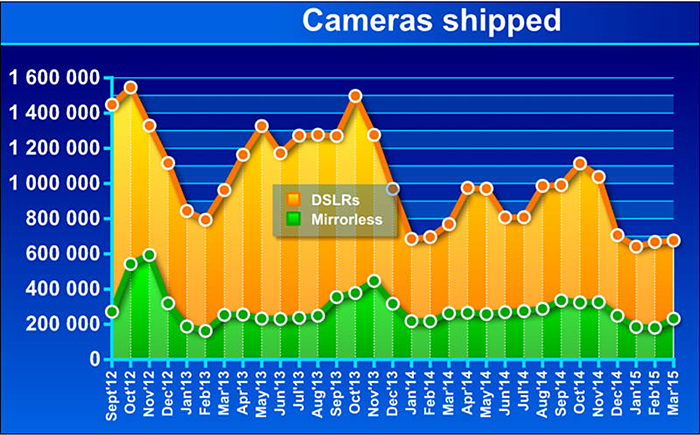
Graph via Personal View.
CIPA published the March digital camera shipment data. And things keep getting worse and worse or as Personal View writes it’s a “Decaying Skunk”. Compared to the already very bad sales of March 2014 we had 20% less cameras unit sold in March 2015. I guess this is also one of the reasons why companies are slowing down new camera release cycles and eventually announce only minor updated cameras with same sensor again and again. But that lack of innovation will again slow down sales…
Maybe companies should do the exact opposite….bring some exciting new kind of technologies! Easier said than done I guess…
75 Responses
I agree about the longer update cycles, but all companies have reused sensors for more than one generation and made only minor updates, just so they can release a new model year after year. If anything, the updates have been getting bigger on average (due to longer cycles).
As a photographer, right now, it’s a great time. I have a wonderful prime lens camera (iPhone 6+) in my pocket all the time, that I can also use as a computer, messenger, diary etc….and I have an ILC (E-M1) that is far more capable than I am for times when I need other focal lengths and capabilities.
Now I just need to focus on becoming a better phographer, because I surely can’t blame my tools.
In my opinion, the camera companies have done a fine job, and need to adjust to being part of a mature market.
can’t more agree. I don’t need better gears unless mine is going off, since my gears are far better than my capabilities. Even not so interested in more mpx on sensors.(I’m shooting in 8mpx-not 16mpx- currently) That said, I want new gears…
Dedicated cameras are dead, long live phone cameras!
Now release that E-7, god damn it, and stop with the micro nonsense.
Looking at the graph, things are not getting worse, sales are actually increasing slightly. They may be down compared to the same time last year but it’s the current trend that is important.
Uh, not really. The short term results get distorted whenever a new product ships. It’s only by analyzing the longer term that you can clearly see any trend.
Sadly, innovation will not reverse the declining trend. Further improvement of sensors, AF etc – even if significant – will not revolutionize photography. Currently there is absolutely no compelling reason for an enthusiastic amateur to replace her or his 2 years old camera. According to many, manufacturers should make an effort in improving in-camera workflow. However, most ILC users need a large screen for image selection and processing. Cameras will eventually gain WiFi connectivity to the web, but I doubt many will utilize it for immediate sharing. Using a smartphone or tablet as bridge is not an obstacle in my view. Indeed, it offers a much needed larger view of the files.
That said, I believe that camera sales could be recovered to some extent if photography were made a more engaging, less intimidating experience. Incorporating applications such as Instagram with the option to add custom filters designed by the user on a computer would perhaps help to achieve this (“user-defined art filters” if you will). In any case, some market research is required to understand public expectations.
In the last two months I bought a Sigma dp2Quattro, a dp3Quattro, an Em5markII and a cool Nikon 35ti (I admit this latter doesn’t count..)
Vain efforts to keep the market wealthy.. 😉
Planning on picking up the Fujifilm X-T1 this weekend if all goes well with some freelance I did. Can’t wait!
Did you get the Nikon 35ti for the looks or for making analog pictures?
I still have my analog gear, but it’s just there for the memories (Nikon F90, Contax T2).
The Nikon 35ti, Contax T2 and the Leica Minilux where a class of high quality compact cameras. It took quite a while until a digital follow up came out. I didn’t liked the Sigmas and finally bought the Panasonic GF1 with the 20mm pancake as digital replacement. This was such a convincing combination that I completely switched to MFT.
I’m not a collector, I bought it because I have found a perfect one from a collector (owner of my fav local photo store). I was looking for a Contax T3 but these are quite expensive (and it’s rare to find a late model with the double knob for the film). Lately I am planning to shoot some film, and perhaps jump into some pinhole medium format.
I was first curious to see the files from the dp2Quattro, and once I had it could not let it go. Had also a dp3Q instead. Different cameras that requires a different approach and not aimed at “run and gun” photographers. While m43 system can be described as a Swiss knife, Sigma dps are more specific tools, even with their limits, and images delivered can be jaw dropping.
Dp2Quattro huh? Can’t get rid of it huh? Hmm…go on….more info. please.
DpQuattros are simply amazing cameras, once you see the files there’s no turning back 🙂 they have some limits, as every system, but if you want to feel like Ansel Adams (ok, I’m exagerating but not that much) without carrying around heavy gear, that’s it.
The dp2Q is a great allrounder, being a 45mm equivalent.
The dp3Q is weird, being a 75mm equivalent (too “long” for normal use but sometimes not long enough).
They are crazy sharp, so sharp that sometimes you have to think twice before pixel peeping on a portrait you just take… 🙂
Lensrentals here I come.
Just some hint: set color to Natural, not on Standard as default. Standard color is too saturated in my opinion.
Shoot Fine JPeg + RAW, super fine jpegs are massive files but you can’t work on them at 100% on Sigma Photo Pro.
If you shoot from 200 iso and above, shoot monochrome: the blue layer sensor is the one capturing luminance.
They need only one camera with a slide in smartphone and sell the software/firmware update with different prices between functionality levels.There is very little point updating /wasting resources on yearly hardware update (especially when most of the internal/processing power is so inferior to most smartphone).
And with the smartphone in, They could add some specific cloud based processing functionality.
In fact, there are already Android OS-driven camera(and of course cellular connectivity as well) in the market. samsung galaxy NX, which had never attracted public interests.
Quite different than sliding your iphone in ( that has the connectivity (no need for additional sim, the apps like Adobe premiere/photoshop/lightroom/Revel, cloud storage)
I think only apple could pull off something like that – insert your iphone as a touchscreen.
But I doubt that the lightning connector could handle the data flow…
it s a USB2 (480Mbs) but Apple seems to move to usb-c (last macbook) which goes up to 10Gbs)
Sure, sales are on a slump, but Oly and Panasonic have kept this trend in check by releasing higher-end cameras with bigger margins (OMD/GH4/GMx). This doesn’t mean the end of system camera sales, rather the end of the consumer frenzy for DSLRs. ILCs have always been an enthusiast/Pro market. And the latest generation of mirrorless bodies is more than good enough for pro work (GH4/NX1/A7s in particular).
LOL Olympus and Panasonic have lost a fortune with mFT over the years if they didnt have other successful business intretsts to absorb the huge loses from the camera division Olympus cameras would be long gone.
Both companies use their mirrorless system as a staging ground for new tech development, so mid-term losses are fine. Panasonic runs a huge video camera business from consumer products all the way to top-tier, and it’s profited massively from M43 research (see the quantum leap in sensor size for their new DVX200, for instance), and Oly uses their mirrorless system for research and to boost their prestige as an optics maker. They may not be doing great (no one is, even Canon has admitted their profits are flatlining this year), but that’s fine.
Define “mid-term.” Five years? Ten years? Also, shareholders might be interested in your definition of “fine.”
Mid-term meaning “until the market trends settle”. Mirrorless is still settling into position. Also, as I said, M43 R&D supports much more than the stills cameras division. Panasonic and Olympus would lose more by bowing out of the market than from taking a little more heat.
Let’s see, 3.9m, 3.3m, 3.3m, and this year’s estimate of 3.2m. Is that “settled” to you?
I sincerely doubt that we’re going to see 4/3 sensors in Olympus’ medical devices. The crossover R&D really was mostly in the smaller compact cameras, if it was really there at all in terms of hardware. In terms of software (demosaic, etc.), you actually don’t need a hardware division to promote that, and the dirty secret of the Japanese companies is that they license a lot of software technology from others to put into their ASICs.
I doubt Olympus or Panasonic will bow out of the camera market, but it’s not for the reasons you think. It’s more a stubborn ego thing. It certainly isn’t an intelligent ROI decision on Olympus’ part. Even with double the sales they now have they can’t pay back the losses they’ve already made in the foreseeable future.
That’s not the end of it in the least. Sales are dropping, but M43 manufacturers are selling more expensive cameras with higher margins. It’s a smaller market, but a more important one. For instance, videographers are progressively turning towards stills/video hybrid cameras, and as Canon has announced they have no plans of releasing a 4K DSLR, the opportunity is wide open for Panasonic to leverage that market, even as DSLR market share is dropping.
Of course not. Olympus isn’t a sensor manufacturer. Their forte are lenses and IBIS. Panasonic makes sensors, and products like the DVX200 show the gains they’ve made from developing M4/3.
Don’t you think the prestige associated with the quality of their ILC division is enough to persevere? With a camera like the EM5 Mk II showcasing their lead in stabilization, high-resolution imaging, ruggedness and video quality, you could write off the money “lost” in its R&D as a marketing expenditure on a super tech demo for their more profitable ventures. Same way that Apple keeps the Macs around even though they are a minuscule component of their business.
Well, we’ll hear from Olympus soon, and if they remain as transparent on discussing m4/3 as they were last year, we’ll hear that their sales are flat, and that they lost another massive amount of money. If they stay true to form, for the fourth year in a row they’ll point a year forward and say “we’ll be profitable in cameras then.” I should point out that analysts that follow Olympus are now predicting LOWER m4/3 sales in the future.
As for “more expensive cameras,” well I call BS on the notion that this will save them. Take a look at the E-M5. Still in stock everywhere. Now selling for US$499. When a sale gets made at that price, what happens is that Olympus ends up taking an SG&A expense against what they originally booked as the sale price. So it’s more along the lines of “we’ll try to charge higher prices and see if we can sell them that way, but realistically, we’re probably still selling cameras in the typical DSLR consumer price range (US$500-1000) on average.”
More so than any other camera company, Olympus tends to over promise the future in terms of financials and under deliver. I don’t expect their latest financial results to be any different.
Panasonic, unfortunately, is not only opaque, but can disguise their m4/3 results with the pro video results. Hard to tell what is really happening with them.
As for ROI decisions, in Olympus’ case specifically, no I don’t think that the camera group has made a case for continued investment at the current levels. The actual ROI in terms of dollars is so massively negative it can’t ever be returned.
What you’re arguing is the case for “Goodwill.” Goodwill is one of the things most commonly written off by companies, as it rarely actually matches the value of what’s on the books. Indeed, that’s one of the things that got them caught in the fraud scandal: the Goodwill on the books didn’t seem to match any realistic payback, so people started questioning what those three companies were all about.
To some degree, Olympus’ camera group is a bit like Xerox PARC once was: a highly visible group doing very interesting and useful technical things, but the company unable to actually find a way to profit from them.
Ultimately, a businesses main goal is to stay in business. Continued large losses (now five years running) in one group that isn’t core to what they actually make money off of is the antithesis of that. Simply put, Olympus is in the same place they’ve been almost since they got out of film SLRs: unable to prove that the camera business is sustainable for them. It’s now more of an ego thing for them than a realistic business thing.
Being that they’re a Japanese company, they’ll convince themselves that “they’re in it for the long term.” Eventually something will happen in their main business again that will challenge their financials, and the pressure will be immense to lop off the camera group if it is still pulling negative numbers. And don’t think that there isn’t anything that could challenge their main business. In the US there’s growing likelihood that Olympus will end up in multiple suits and governmental action against their endoscopes retaining bacteria even after suggested cleaning.
Look, I like my E-M1 and lenses. It’s a great camera with it’s primary drawback being the UI, especially the dense and obtuse menus. I can deal with that. I’d love to see them succeed. But I’m also evidence based. Right now, there’s no evidence that they are succeeding in anything other than building some really interesting products.
If, as many of us now believe has a strong possibility of happening, the camera industry is headed all the way back down to the sales levels at the end of film, I don’t see how Olympus can continue to keep the camera group afloat. There just will never be a point where the profit pressure comes off.
So, when did the market trends in regard to film cameras settle?
Right, after they had shrank to about 0.1% of their peak sales.
I know you’re just trolling. But an interesting fact is that the main looser is Canon: while the other companies hardly lost income, Canon lost a whopping 1/3!
It’s in the bottom statistic if you follow the link to Vitaly, maybe time to change employer
Canon didn’t lose a rat shi*! Canon got huge peak in profits couple years ago in few months period, like 10x to profits. Now that peak is coming down back to same profit levels as last two decades has been going. The market speaks about DSLR losing ground and mirrorless going up is just statical lies about last couple years AFTER the peak happened.
After you shared your graph I can partially see this point. Either I lack intellectual access or Vitaliy’s graphs are only accessible by russian minds… I really struggle to read any trends out of them. The only trend I can see is that the year on loss in this quarter is only on Canon while the rest had a comparable income from camera sales.
I am not trolling I have been using mFT since it came out and love my set up. This doesnt change the fact that Olympus and Pansonic have lost a fortune with mFT. There is a rather major difference between good equipment and profitable equipment
Well you’re both right. The m4/3 camera manufacturers made substantial losses in the past and have now introduced higher margin models. If it’s enough, only time can tell
I think there was a momentary blip where ‘big’ cameras were more popular than they should have been. They were an in-thing. When I was a kid, most photos were taken on a compact camera, my old-man had a SLR but that was a specialist thing that only he used.
Smartphones have replaced the compact film-camera for most people, but it doesn’t fill the ‘big’ camera slot (which I’m including M43 in as big in this sense is really more ‘well-featured’). So why is there a decline given the market shouldn’t really be any different?
Probably because people aren’t spending their gadgets and gizmos fund on cameras but other things – tablets, expensive smartphones, netflix.
I think that the rise of the large { relativly speaking } 1″ sernsor compacts could seriously effect sales of DSLR’s or mirrorless ILC. Their image quality up to 800 ISO is pretty much on par with mFT. You have the chocie between truly compact pocket sized models like the RX100 series up to the almost do it all FZ1000 an excellent vacation, family event, camera with good image quality, very good 4k video fast response times etc.
Unless you are into very specific niches , true macro { though you can add filters to the FZ1000} , low light were you need very high ISO and/or specialist fast lenses and so on .There is not much these cameras can’t do . I used my FZ1000 for my last vacation and have excellent quality wall prints from it , heck I even have some 18×12″ prints taken from 4k stills with surprisingly good results.
The lust after ILCs is not necessarily result-driven these days. It’s about the experience, the comprehensive user control and the image projected by the photographer. Those things still count, though the days you needed a bulky setup to be satisfied with the output are over.
Not sure that is that much of a factor as there have been capable P&S cameras for awhile now that were good during their heyday as well (albeit, not as good as what is available today).
IQ was the not the only reason people chose DSLRs. Family bought them due to their faster AF so they could easily take images of them as they grew up. Families don’t need super fast AF for this. This is where the fixed camera need to continue to improve.
People bought DSLRs so as not to miss “the moment.” But that cuts multiple ways. Now that smartphones are carried always, you’re less likely to miss the moment than if you owned a DSLR that you only carry sometimes. Plus “the moment” now has a new component to it: how fast it is shared.
Look whole DSLR history and you see that DSLR sales got 2011 or something a 10x sales boost, and everything you see in these charts is just coming down from that peak back to normal decade old sales.
https://cdn.photographylife.com/wp-content/uploads/2015/04/cipa-data.jpg
Just look that, there is NOTHING wrong in camera sales than just that huge group of people entered to market because people got computers, Internet (broadband) got widely available and people learned how to get photographs (digital files) from camera to computer, edited little bit (resize, crop etc) and shared (emailed, myspace, facebook, twitter etc). Now that group of people are PERFECTLY HAPPY with their compact cameras, their DSLR. They are focusing to smartphones now, not because those are better, people just needs a phone and you most likely get a smartphone instead a dumb phone. You get camera that is good enough and you don’t need to buy/upgrade to new compact camera (the quality is already good enough on 2007 level PnS).
The mirrorless are there, but they are fighting against DSLR, that isn’t losing. Mirrorless is just the future by technological point of view (no mirror and prism slowing down focusing, obscuring view etc) and it will slowly be adapted by professionals who just need to be enlighten what are the benefits in mirrorless cameras and when they get the experience with them, they will swap to mirrorless from DSLR. Slowly but steady change it will be.
P’n’S cameras are still same category as smartphones, compact cameras (aka “bridge cameras” aka “super zooms”) are the other niche group that will stay as it is easy to use camera with long reach and acceptable image quality. Then it is DSLR/DSLM if wanting better.
Only very few photographer really gains any benefits from 36Mpix DSLR or 50Mpix, or even Olympus 64Mpix m4/3. Just like very few will benefit from 80Mpix medium format or 200Mpix medium format. Very niche product category, what gets “standardized” by just few pixel peepers who have brains and ego gone gaga.
Bring out the 300mm f/4 ……perhaps that will increase the amount of people that will buy the camera’s …..!
Sorry I really don’t care. I firmly believe that Mirrorsless IS the future if not the present. Graphs show trends effected by markets and marketing, not to mention manipulation of graphs themselves. They are generally made by people who want them to say what they say. In this case it could have been by a DSLR maker trying to dismiss Mirrorless or perhaps a 5th grader because thats’ what the graph looks like.
I am a pro footage who’s used everything out there beginning with the Nikon F in 1969, and I can say, I DON’T NEED MIRRORS in my cameras any more. I also really like smaller/lighter. We all know why sales are down, because for 99% of consumers their phones are more than enough camera for them.
This is a simple graph made by some guy at Personal View. What’s wrong with it?
How exactly does it “dismiss mirrorless”?
The data, however, comes from CIPA – a rather respected organization. You can download the numbers from their page and show us your idea of a “fair graph”…
it is really nice that you like mirrorless (clearly) and you don’t need a mirror, but why should we care…?
Actually, if you like mirrorless cameras mainly for the size and weight loss, you’re exactly the one who should worry about these facts.
You see – current MILC manufacturers decided to make the small form factor their key selling point, so today you think MILC are small and DSLR are big (correct observation). But in few years we will also have big mirrorless cameras – maybe even the top ones (1DX, D4 successors). There will always be a demand for such cameras, so they will exist. With or without a mirror – that’s hardly a difference if it won’t affect performance.
On the other hand, phones will become more and more attractive for people who today buy cameras like Panasonic GM1, Olympus PL7 and Nikon J4. Especially those who prefer primes.
ramble much?
While I agree with the idea that innovation is a thing that stimulates sales, I have not heard of any currently available technology that is not being thrown at the market. Please fill me in. The year to year analysis, however, overlooks the current trend lines which happily announce that mirrorless sales continue to make incremental percentage gains. The obvious reason is that the mirrorless innovation is a completely credible and affordable alternative to bulky, expensive cameras. The hole in the mirrorless story continues to be the lack of fast aperture, entry level zooms to compete with the fast apertures on RX100 and LX100 type, mirrorless AND mountless cameras, albeit together, they prove the strength of the innovative middle. The camera buyer has never had it this good.
Actually, no. Mirrorless lost ground to DSLRs in the CIPA numbers for the full quarter. Interestingly, the average price went up for mirrorless, down for DSLRs, though.
As for innovation, generally true innovations come in use patterns, not in technologies. True, a technology may enable a new use pattern, but it’s not the technology itself that’s the innovation. And that’s been my point about the camera companies: they’re still iterating the same use pattern. But it’s clear that smartphones changed the imaging use pattern completely. So whatever the opposite of innovation is, that’s what the camera companies are doing with new technologies ;~). Mirrorless itself is an example of that, and especially when you look at something like the Olympus cameras, what with their dense and indecipherable menus and controls.
In terms of image quality, I’d agree: the camera buyer never had it so good. The question then becomes: how many people actually need ultimate image quality?
So it was user habits that made Olympus innovate Live View, 5 axis IBIS, Live Time, Live Composite and more..? No, photographic innovations come from the cameramaker’s know-how and competition in the market. They do look at user trends of course, but the new camera features do not emerge from any user pattern.
Olympus will report their numbers shortly. m4/3 sales will be flat or down and the division will lose one heck of a lot of money (again).
You can make technical innovations all you want. The problem is that unless they engender some new user pattern, they don’t generally create sales. For the most part, the camera makers are iterating up the wrong tree. Your last line is telling, and exactly what the camera makers have been thinking: new camera features shouldn’t be due to paying attention to the user’s needs and desires. But that’s exactly wrong. If you don’t solve a significant problem for the majority of users and make things more convenient for them, you don’t win anything.
How’s that Betamax VCR you’ve got been holding up for you? ;~)
Cell phones have killed the camera market- plain and simple. Pros and enthusiasts will always want the better “high-end” cameras but everyone else is satisfied with their cell-phine cameras they always have in hand………the only company that can make a splash now in digital imagine is Apple- if they come out with a really nice camera- they could capture allot of sales- but otherwise the camera market is stagnanting.
I’m long time Canon shooter and started using M34 camera about 2 years ago due to the smaller body size (EM-1 with few primes). Love the system, everything is great except ISO performance. I really hope M43 can match APS-C from ISO 800 up.
m4/3 can match and get over APS-C up to ISO 3200 that is native, after that ANY ISO is just software boosted on ANY sensor (when it is over their native ISO).
Example E-M1 beats by 1.5-2 stops the Sony A7r in noise quality, so you get even 4 stops more light to be used for faster shutter speed than A7r gives. E-M1 vs D800e is a tie, you don’t notice difference until over ISO 6400 (so really ISO 3200) in low light, even ISO 8000 is so close that you don’t see the difference unless you write back of the print (talking about 40×40 size print here!) from which camera it came out.
So good the m4/3 truly is, and people really don’t get it because they don’t do large high quality prints where every problem will be visible.
I like my m43 gear but..
You need your eyes checked if you can’t tell the difference between 40×40 prints made from a D800 and E-M1 at any iso, let alone 8000.
I tend to agree.
I like M4/3, and I’ll say it lags in noise and DR only very slightly behind APS-C, but significantly and noticeably behind FF.
Not significantly enough for me to put up with the cost and size and weight of FF lenses, mind you…
I shoot RAW only, M43 ISO performance cannot convince me, even at ISO 800. I may get spoiled by full frame.
“E-M1 beats by 1.5-2 stops the Sony A7r ”
Is an absolutely ludicrous statement even for an mFT fan,
The A7r or D800 models have less noise at every single ISO setting .At the same
output size the 36MP sensor is way ahead in both lower noise and higher detail.
In low light scenarios the mFT camera falls even further behind here is a
comparison between RAW D800E VS RAW E-M1 both at 3200, of a shadow area of the
test shot. If you need to push shadows at all mFT becomes very poor
Nope. Olympus doesn’t even have a noise at all almost any ISO level. It has grain. (Noise is random R, G, B colors on pixels).
http://cdn3.mos.techradar.futurecdn.net//art/cameras/Olympus/OM-D%20E-M5%20Mark%20II/Lab%20charts/Olympus-OM-D-E-M5-II-signaltonoise-RAW-650-80.jpg
DXO standardized testing doesn’t lie (for those who are DXO fans).
Sorry to burst your “FF is superior!” reality distortion field, but real world samples (low light, bright light, bad light, good light -scenarios) the m4/3 produce SUPERIOR to ANY other format. Large or small prints on high quality printing!
http://cdn0.mos.techradar.futurecdn.net//art/cameras/Olympus/OM-D%20E-M5%20Mark%20II/Lab%20charts/Olympus-OM-D-E-M5-II-dynamicrange-RAW-650-80.jpg
“Our test laboratory is set up following DxO guidelines and images of the chart are assessed using the DxO Analyzer software to generate signal to noise ratio (SNR) and dynamic range values across a camera’s full sensitivity range – for both raw and JPEG images. If the software is not compatible with a camera’s raw files we convert them to TIFF format and analyse these images. We only compare files of the same format, JPEGs with JPEGs, raw with raw and TIFF with TIFF.”
http://www.dxo.com/us/image-quality
Sorry, m4/3 is SUPERIOR to any APS-C and almost ANY FF camera in noise and dynamic range!
Just as a matter of interest where did you get those results from Juurikas for they are seriously wrong . Your statements and presumably eyesight would be quite funny if you were joking sadly I think you believe it .
DXO and FF fans are so in denial….
Let me guess, you are using Techradar the most unreliable
testing site on the net with results that deviate so far from reality to be
utterly useless. I can only assume you are posting this for a bit of fun, otherwise you a vision problem and should get to an optician post haste
Wow, m43 really sucks
I’m sorry. You’re wrong. My Canon 6D beats my GH4, GX7 and my wife’s Olympus all day, any day at high ISOs. There simply isn’t a competition.
I use my GH4, my GX7 far more than my Canon though, since most of my shooting is NOT in high ISO territory.
lol oh dear you do suffer from fanboyitis , luckily those who have the gift of sight can see exactly what is better and FF wins handsdown. The E-m1 is not even the best of mFT at high ISO .
You are the suffering one, don’t worry you will get cured from FF fanboyitis once you start comparing cameras next to each other and doing high quality large prints (that people buy for few grands per unit from you).
SO… i just wait for the afordable 4k camera, 499,-$ is my Pricelimit, and i do not see
the 1inch-cameras floating the market, aps-c not ( Sony holds down not to spit into the
own big big Fs-7 river), in 4/3th we do not see the G7 ( the only alterntive to all is the
little LX100((( no audio in/ etc.))–and will fall to 600, 550….so this one..ma-y-b-e-e???
Smartphone-zunami on one side— 10 bit afordable BMC MINI on the ( for me bit expensive)
other side ( 1300-1250-1100–down and down..)–but nothing from Canon ( the fine aps-c
650 Photo-machine, the mashy moire under full-hd filmer..)Nikon- you get for less bucks
( 300) excelent d3300… and Samsung? NX-500 looks intersting–but–just wait for the typical
nx-zunami nx-3333 nx-555 so…
WHY SHOULD I BRING IN MY HARD WORKED MONY WHEN THEY KIK IN THE ASS??
hope they go down till dead… I DO NOT CARE NOT BY and wait… woulfhoound.
in meantime you have the economic “GEIZ_HALS-EFFECT” every month 5-12%
down..
In other words: 2016 maybe the year of afordable Cameras+ 4k+ and so on.
2015 is it not!
noby
It looks like more cameras were sold in March compared to February. But yeah, the middle class has been decimated in the US combined with the rise of cell phones- I predict far fewer higher end cameras sold a year from now, even though the planet’s population continues to explode. Hoping cell phones continue to see dramatic improvements in quality.
Not just cell phones. Photographers (like us) were buying a new camera model every year for a long time. Now that the higher-end mirrorless cameras (and their lens selection) have gotten so good, there’s no reason to purchase as often.
After owning several different PEN models and finally replacing them with an EM10 last year, I see no need to upgrade for at least a few years.
Digital cameras aren’t just a victim of cell phone cameras; they’re a victim of their own high-quality.
$499 limit for professional features, eh? Bit of cognitive dissonance?
Most of which was in the compact segment (nearly 30% lower). The interchangeable lens segment went down only 12% roughly. That’s still bad, but compared to last year, DSLR manufacturers must be breathing a sigh of relief (they lost 30% in 2014 while mirrorless actually gained year-over-year). So for DSLRs this is a recovery, relatively speaking.
Any camera manufacturer who isn’t (or hasn’t already) diversifying into other businesses will be history in another decade. I’m old enough to remember when SLRs were luxury items for most people. That time is coming again.
Huh? That was almost completely unintelligible.
One question answers this all- “How much do you need.” I mean, I’m seeing D750’s for 1500 bucks….EM5 for 500.00…….A7’s for 1k. You can have your cake and someone elses too at these prices. You want blinding focus speed- done (7DII, A77II…NX1)….even the worst mirror less provides more than enough performance for most consumers. I’m getting out of my EP5 what I couldn’t get out of my Full Frame 10 years ago- and the video is a throw in. You want to sell more gear? Bring us groundbreaking sensor tech.- not tweeks of existing tech.