









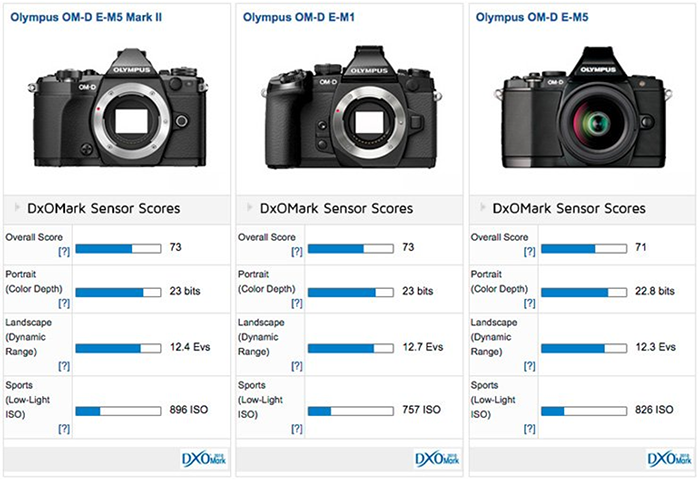
DxOmark (Click here) posted the full E-M5II sensor test:
The improvements to the EVF and LCD screen resolution, alongside more customizable controls, have updated the OM-D E-M5 Mark II to respond to the 2015 hybrid market. What’s more, with its retro styling, weather-resistant construction, and large range of interchangeable lenses, it looks likely to remain a big hit with Olympus enthusiasts. The 5-axis image stabilization system and 40Mp stitching mode will be handy for some shots too, but sticking with the similar, if not same, 16Mp four-thirds sensor from the Mark I means that the latest model doesn’t offer any real improvement to sensor image quality over its predecessor in the DxOMark Sensor Scores.
Reminder: First E-M5II leather case on eBay in [shoplink 52300 ebay]Full Black (Click here)[/shoplink] or in [shoplink 52301 ebay]Full Brown (Click here)[/shoplink].
E-M5II store links:
E-M5II in Black at Amazon, Adorama, BHphoto and GetOlympus.
E-M5II in Silver at Amazon, Adorama, BHphoto and GetOlympus.
E-M5II In Europe at AmazonUK, Jessops, WexUK, Namencolor.
125 Responses
No surprises there…..
Still better than all A-PSC cameras Canon has ever made.
Kind of funny. The second post is a lashing out at a company that has nothing to do with the article. Whatever makes you feel better I guess.
I think there should be a new website that scores photographers abilities to make an interesting photo instead of sensor scores. Now that would be interesting.
Why didn’t the “moderator” delete this post, clearly it’s trolling?
No, that’s a fact.
I strongly dislike DxOMark’s use of the word ‘hybrid’. Nowadays, a ‘hybrid camera’ is a camera that is intended to be used both as a stills camera and a video camera, and does both things very well, such as the Panasonic GH4 or Sony A7S.
But DxOMark still clings to the old meaning of the term, i.e. ‘hybrid camera’ is used as a synonym for mirrorless system camera.
When the first m4/3 cameras were launched back in 2008/09, some journalists called them ‘hybrid cameras’, because they were neither DSLRs nor compact cameras, but something inbetween. A DSLR without a mirror, or a compact camera with interchangeable lenses, depending on how you choose to look at it.
Nowadays, almost everyone calls them mirrorless cameras (MILC) or compact system cameras (CSC), but DxOMark still calls them ‘hybrid cameras’, even though everyone else reserve that term for stills/video hybrids. Confusing!
Especially when they advocate that retro styling is what the hybrid needs.
Just a little bit better than the OM-D E-M10
Same ColorDepth & DR as previous 3 years old EM5 .
I don’t get what is this EM5 2 is about .
No way it worth for an upgrade !
There is more to a camera than sensor performance. Features, handling, ergonomics, autofocus, metering, frame rate, image stabilization, battery life, EVF, and so on. There are many things that can be improved in a camera besides the image quality.
If you’re already happy with the image quality of the older model (and many of us are), then other improvements may be higher on the list of priorities.
That’s the point, he is not happy, so this crying baby attitude at every post. I don’t see Canon users complaining about sensors despite the complete lack of innovation.
You mean like how the Nikon D810 uses the D800 (2012) sensor and the D750 uses the D600 (2012) sensor.
Same for Fuji, Pentax et. al.
I guess you don’t get what any recent new camera is about then.
You are hilarious.
I’d like to have the new bigger EVF and the new articulated screen, the later is so good for macro when you are in portrait orientation and close to the floor ! but that not enough to make me spend money and replace my E-M5…
How does it feel to go through most of professional reviews that give E-M5II very good rating?
cry more, I’ll take their conclusion over a desperate troll anyday.
For me, the high res mode (work wonders in product photography let me tell you), wifi so i can use my cellphone or ipad when framing/taking the shot, tethering so I can use my laptop, mechanical shutter up to 8000 and fast silent electronic shutter for those moments where you want to go stealth really was more then enough for me to upgrade from e-m5 to e-m5II. Of course it would be great if high iso performance and/orDR was a bit improved, but I was really vary happy with my e-m5 IQ, and better IQ is not everything that makes people upgrade… just so you know (of course, a better sensor would never be a bad thing, just not the only important thing)…
Anything short of the theoretical organic sensor is just no good, eh?
I have a feeling that Yun still won’t be happy when, and if, the mythical organic sensor hits the market. He will read about something else being in development, and that will be the new saviour for him.
As always DXO is limited to the sensor performance.
They never write anything about the pleasure (or lack of) of using a camera.
Personally I find it quite boring, even for a talk with friends at the pub..
That’s because they test sensor performance, not cameras. It’s not a camera review site that is meant to guide consumer choices, it’s a tech site for people with a nerdy interest in hardware performance.
Yes,I know, and I’d like to see how many people buy their cameras based on DXO numbers. And what do they think after having used the purchased model.
As you write, these numbers are for nerdy people.
I love to talk about cameras and photography, but in this case it’s like talking about engines, their torque, rpm, and nothing else. And stating that a new car is better or not than the previous model.
No .
Sensor performance is extremely important for image quality measurement .
That’s why DXO is here to check & counter manufacturers from cheating consumers .
Of course , those camera manufacturers who have merit definitely will not fear DXO but
for those with no real innovations or breakthrough after years and years making cameras have to hide / hate DXO .
Most consumers don’t check the DxO site, in fact, most consumers don’t think about sensors at all when choosing a camera. Only a small subset of diehard camera enthusiasts and gearheads do so.
The curious thing is that despite the great scores (thus better performances) of existing cameras you are waiting for something better.
as I wrote below, sensor is just a part of the camera.
Try to shoot at a piano concert with a d810 or a a7r.
An then the most important thing: the eye behind the camera. Companies today do not care about your gear: almost everyone can get a sharp shot to be used on the web. They look for good photographers with good eye and a distinctive look.
Best camera to shoot a piano concert would no doubt be the A7s, clean high ISO and silence shutter.
Yes, but Sony a7 are cameras that Idon’t like to use. I don’t like how I feel them in my hands.
That’s my point: choosing a car only because it has a silent engine, or a great max torque, or has low CO2 emissions is silly.
First you need to know what you are going to do with a camera, and then start to look at the right tool.
Buying a m43 camera and craving for a magical organic sensor to emulate Ansel Adams is silly (I’m exagerating on purpose)
Buy a larger format camera and “be happy” with it. 🙂
But there is a unique spirit in M43 unlike other formats….we are just saying that if their sensor performance improves more (like they have done before too) then M43 cameras would be the best ever
Maybe just being happy is the point.
Every tool has limitations, its a matter of learning to work WITH a tool’s limitations and pushing boundaries. Complaining is just an excuse.
Yun, sensors are now so good that they’ve reached the stage that for many of us they are way down the list of important things.
As has been said by other people, the way a camera handles, the viewfinder, or features like electronic shutter, frame rates etc. are actually more important.
After all it doesn’t matter how good your sensor is if you can’t see the rear screen or EVF very well to frame your pictures correctly (for example)
Its the same as benchmarks for a phone or PC….It tells you how capable the sensor is….I know its boring but DXOmark just benchmarks cameras anyways, reviewing is an extra…..real life performance is paramount yes but numbers matter too
Reviewing is an extra. You said it. Therefore people should take DXO tests for what they are: bench tests that show the sensor performance and not the camera performance.
I am not criticising DXO, they do their work, but people who consider it the ultimate source to see if a camera is good or not.
yeah I agree with you…
Yes, these scores are for poeple who don’t want to deal with too much complexity. Dxo scores are like horsepower for cars. Easy to compare, but of limited relevance, if you really want to know what a car can do.
For a price twice lower, Sony-a6000 has a much higher score: http://www.dxomark.com/Reviews/Olympus-OM-D-E-M5-Mark-II-sensor-review-New-features-but-same-sensor-resolution/Comparison-2-Olympus-E-M5-Mark-II-vs-Sony-a6000-vs-Sony-A7R
“price twice lower”???????
Twice lower than $100 is
$100 – 2x $100= -$100
Get it?
So Sony is actually giving us money to clear the A6000 stocks? Sounds like a good deal to me!
http://www.dxomark.com/var/ezwebin_site/storage/images/media/images/em5ii_a6000_a7r_scores/115000-1-eng-US/em5ii_a6000_a7r_scores.jpg
The A7R should in theory have 4 times the ISO score, but it only has 3 times! Why cant they make a good FF sensor? 🙂
Everything else equal, yes, there should be a two stop difference between 4/3″ and FF sensors.
However, the 4/3″ sensors have a higher native ISO (no real ISO 100 setting is a hint), which means that the signal doesn’t need as much amplification for the higher ISO settings, giving them a slight benefit that allow them to punch above their weight. So there is nothing wrong with current FF sensors.
Well, measured base ISO on A7R is 73 and E-M5 Mark 2 is 96…
That difference is consistent with the ISO scores.
96/73 = 1.3
Compared to the A7R, we would expect the E-M5 II to get ISO 2746/4 = ISO 686.5, but factoring in the difference in base ISO give us 686.5 x 1.3 = 892.5
That’s pretty darn close to ISO 896.
Nice!
Now give me a sensor with base ISO at 200 🙂
The area ratio is 3.84 not 4.
Half the image circle diameter but 4:3 not 3:2 ratio.
Actually it does not, see my post above.
I used to do this test stuff for a living, good at it too.
By my reckoning using DXO’s figures, in low light the E-M5ii scores 3440 and the A7R scores 2746
Irrespective of sensor size.
That does not make the E-M5ii a better camera than the A7R, there are many other factors to consider, some of which I have mentioned elsewhere above.
Now multiply the E-M5ii low light score by 3.84 and re-work the overall to get a proper comparison (I can’t figure out what DXO do there, I’m good at maths and stats but they’re using black art or astrology to get the overall): we cannot compare the scores from DXO tests outside of the sensor format because their test methods are flawed.
Since 896×3.84=3440 I suggest it does rather better than the A7R in low light, which I know full well from using MFT in near darkness, no other systems work as well at night; the black cat in the coal hole at night during a power cut photo.
Actually I would not use the E-M5ii for that shot (cos it gets noisy) but have proven the GH4 can do it. So once the scores are normalised, the GH4 is pretty much level pegging with the wonderful A7R: these are all good cameras.
There is something very strange with dxo method. If a camera is already reaching 95 of 100 how will they do it when new sensor generation arrive. Sooner or later a camera will get a score of 100 so will it be the perfect camera for IQ? The end of the line? Even more intriguing is when you look at a test like steve huff did (no matter how he did it) where the EM1 is on par with the A7. How 73 equals to 95 in a real world test I can’t understand.
The DxO scoring system is open-ended, so it doesn’t end at 100. The score is a weighted sum of the three individual measurements (color depth, DR and ISO performance), and doesn’t have an upper limit.
No but sensor performance does and as sensors get closer to their theoretical limits, there will soon be no significant advantages to be gained. Then thankfully people can get over their sensor obsession and start evaluating cameras in a more rounded way. And Yun will no longer have anything to to complain about. ( I know, not going to happen)
100pts has already been broken by the RED Epic Dragon:
http://www.dxomark.com/Reviews/RED-Epic-Dragon-review-First-camera-to-break-the-100-point-DxOMark-sensor-score-barrier
100 isn’t the limit…..btw If you don’t know how he compared them then you probably didn’t read the article properly or have poor grasping skills lel
“100 isn’t the limit”
– that’s not what the blue bar indicates
“If you don’t know how he compared them then you probably didn’t read the article properly or have poor grasping skills lel”
– hey butthurt, tell me you’re joking.
If a sensor get the 100 score, I guess that they will just change their way to calculate in order to make the final score lower (for all the sensors of course), or allow the score to be more than 100. The final score is just a mathematical calculation based on the others scores, it’s not such a big deal to change that.
Steve Huff enjoys photography and is always enthusiastic. And because of the amount of cameras this guy own or has owned, you can trust him if he writes that a camera is responsive, feels great in the hands, or other ergonomics things. But from a technical point of view, and by that I mean comparing the abilities of different sensors to render a clean pictures, this guy is just the worst reviewer the earth has ever seen.
Just few examples :
– you don’t compare sensor abilities in jpeg. In that case you are comparing sensor + jpeg processing, so 2 parameters and not just one. He likes jpeg, he does jpeg for his comparisons most of the time, ok, whatever he wants, but nothing you can compare with DXO.
– Iso values are more or less cheated by the brands. You have to check if at the same iso value and the same aperture you’ve got the same shutter speed. He doesn’t care at all about that. Fuji and Olympus are the champions of this kind of trick. Look at the 2 cameras you are talking about : http://www.dxomark.com/Cameras/Compare/Side-by-side/Sony-A7S-versus-Olympus-OM-D-E-M1___949_909
–> basically, at 6400 isos from the manufacturer, the Oly iso is in reality 3800. It’s even worse for the EM5 II which is at 3200 in reality. One full stop of pure cheat… At 5400 instead of 6400, Sony is closer to the real value…
– Every images don’t fit well for a proper comparison : does the scene has a great dynamic to render? Some subtle colors? harsh shapes and flat areas? etc, etc
Steve Huff, he goes to his kitchen with the 2 cameras, he turns the light off, he put them in aperture priority mode at iso 3200, take a jpeg picture of the microwave, then publish them and call his article a “crazy comparison”, “real life comparison”, etc etc…
Looks like your butthurt and replying for him…
I wonder why they didn’t test the 64mpix stitching method.
“…to respond to the 2015 hybrid market” immediately followed by “…with its retro styling”, is the author saying that retro is how to respond to the hybrid market?
Olympus: have a look at Canon’s response to the hybrid market: XC10. No retro styling on this baby. Form follows function.
The XC10 is not a hybrid camera in the sense that DxO is using the term. It’s a fixed-lens camera. See my post below for an explanation.
I think any publishing organization should at least get the terms right.
Yes, I agree. Maybe it’s because DxO is French? Maybe ‘hybrid camera’ is used differently in France, and they just assumed that English usage is the same?
In the mid-to-late nineties, Canon used the term hybrid to describe the original Optura—because it was capable of video and photo.
An 18% increase in ISO score is pretty incredible! I always tell people to ignore the “overall score” — it’s very subjective, because different aspects of the sensor performance are important to different photographers. But the ISO score is important to basically everyone.
Will it be noticable?
I mean 100% is 1 stop right?
No, it will not be noticeable. “Completely physically imperceptible” is perhaps more accurate.
You forget that the ISO scale isn’t linear, but logarithmic. An improvement of one stop over the E-M1 would give ISO 1514. So ISO 896 is not that much of an improvement.
Also remember that DxO states that the error of margin in their measurements is 1/3 EV, which means that there might not be a real difference between those models at all.
Stops are logarithmic. The ISO scale we use is linear. A doubling of ISO (from say, 800 to 1600) represents a halving of light and a doubling of noise.
“Not that much” is relative. Over the past 5 years, ISO performance has only improved by .5 stops (a pace that is slowing), so relative to that, and considering it’s been only 18 months since the E-M1, it’s a pretty good jump.
Will the difference astound you? Certainly not. But Olympus deserves a pat on the back.
Just for the records, the 3yo Olympus E-PM2 achieved 932 ISO score.
I know you’ve used the E-M1, E-M10, and E-M5ii, at least briefly. I’m curious if you perceive a difference between them in terms of raw IQ? I figure jpeg processing might be fine tuned a little but I’ve been of the impression that raw sensor performance was very comparable and I’m not sure that small differences in DXO scores represent much more than sample to sample variation and the limitations of testing.
I urge you to ignore DxO lens scores, Tony. Low light as a basis strongly favours the sensor, which explains why larger sensors somehow always seem to induce better lensscores and how by a miracle the very same lens now is a better one with an updated sensor….I noted you use DxO lenstests and refer to them in your reviews. Much like theoverall DxO score they make zero sense.
DxO never claimed that a lens gets better with an updated sensor. DxO doesn’t measure lens performance on its own, but the combined lens+sensor performance. If one of those things gets increased resolution, then the combination of them will also yield increased resolution.
DxO’s method is actually very sound, since we always use lenses combined with sensors. We don’t use lenses on their own.
The DXO low light factors in the area of the sensor which means the 4/3 sensor score gets reduced by a factor of 3.84. When I was testing similar instruments this sort of thing was debated at length with the conclusion (at NPL/IRMF) that the detector/sensor area is irrelevant and only the frontal window matters; what the sensor sees i.e. the lens aperture in the case of a camera system.
You have to compare like with like; problem is DXO has established a standard test that is heavily biased in favour of larger sensors. Hence you should not compare camera systems outside of their sensor format with the DXO scores.
We’ve tested dozens and dozens of cameras, and with the exception of the a7S’s outrageously high score, every single ISO score measurement from DxOMark has been consistent with our testing. But yes, the ISO score keeps light per mm2 constant, not total light gathered, and that causes larger sensors to score better than smaller sensors.
It is, in fact, quite the opposite of incredible.
Going from ISO 826 to ISO 896 represents 0.09 stops difference.
I.e. 1/11th of a stop.
I.e. If before you were shooting at 1/50th of a second, now you can shoot at 1/54s. Mindblowing!
Of course, that’s taking their single-sample evaluation completely at face value. 1/11 EV is smaller than a statistical rounding error.
I don’t even know why DXO provides ISO scores to the nearest single numeral. They should round to the nearest 1/3EV and call it a day. But I guess they wouldn’t get nearly as much traffic and bickering from fanboys who need to eke out every last decimal place of ISO performance, even if they can’t perceive the difference with their own eyes.
Especially since, by their own admission, the error of margin is 1/3 EV. 1/11 EV is well within that margin and we shouldn’t expect any practical difference at all.
We mostly agree with each other-though I was comparing the E-M5 II to the E-M1 (as does the headline). Either way, it’s not going to change your photography, but your shutter speed would be jumping from 1/50th to 1/59th.
I’m impressed by the number because I’ve studied how sensor technology has improved over the years that digital cameras have existed, and it’s only about 1/2 stop every 5 years historically, but has slowed even further. So, compared to the 1.5 year old E-M1, this is a pretty impressive increase because it’s outpacing the overall improvement trend.
Mostly I wanted to make the point that it doesn’t simply “have the same score” as the E-M1–there’s a definite difference.
It’s within the margin of error. The 2012 released E-PM2 uses that same sensor and beats both on the ISO test on DXO:
http://www.dxomark.com/Cameras/Compare/Side-by-side/Olympus-OM-D-E-M5-Mark-II-versus-Olympus-PEN-E-PM2___1006_840
It doesn’t beat any historical trend, it’s the same sensor being tested multiple times and getting slightly different results.
Here you go, read up: http://en.wikipedia.org/wiki/Observational_error
And yet people have hard time to believe that it toke decade from DXO to rank Olympus E-1 DSLR and the sensor beated everything any format had until latest D800 line in just pure RAW engineering terms.
The DXO is still a joke that values are not comparable and doesn’t even hold the water in the real world tests. What makes them just good for argumenting in internet, but useless in real photography use where even m4/3 cameras since OM-D beats DSLR cameras because they make photography far more easier and possible.
Cameras should be bought, presented and reviewed by what you can do with them, not what some mystic company say they are.
The best mFT sensor ever made for sports!
As sports are dynamic and the dynamic range of the Gh4 is better, GH4 seems to be better at sports I think. But may be you mean chess??
The GH4 is still leader.
A stupid comment.
It depends on your requirements and personal preferences.
I’ve only owned one Panasonic mirrorless camera but found the menus confusing and wasn’t that keen on the Q menu. Maybe because I was used to Olympus.
I buy Panasonic lenses but tend to avoid the cameras as I want all my cameras to work the same way without having to deal with two interfaces.
In addition I’ve never (and I really mean never) shot video on any camera and have absolutely no interest in it. I don’t even know if it works on my cameras as I’ve never tried it.
Finally I prefer my cameras to be smaller than the GH3/GH4 size.
So, based on my preferences, in what way is the GH4 the leader ?
It may be for you but for others it may be a GM5 or E-P5 or E-M1 etc
OMG, I thought the discussion was very-very explicitly about DxO mark sensor score (74 is the currently highest score for MFT cameras, namely the GH4). I don’t mean that 74 should be necessary visibly better than 73, but based lonely on the score the GH4 is still leader, despite of the newer issues (GF7, E-M5II etc.)
According to DxO, their margin of error is 1/3 EV, and they say that 5 points in the final score corresponds to 1/3 EV. So any cameras that differ with 5 points or less, might not be different at all.
Apologies, I should have taken your comment in context.
There’s a lot more to a camera than it’s sensor. I have a Gh4 and the EVF has horrible optics, the body is weighted badly, the jpg engine is pretty bad, I hate the dial layout
Wow. You shouldn’t ever admit that you found Panny menus confusing. They’re they easiest in the industry
That’s like going full retard.
NEVER go full retard.
I use both makes and find the Panasonic menu system is by far the most logical and easiest to live with, they can also program sensible functions onto buttons such as exposure mode and focus mode, with Olympus you have to dive into the SCP. I can live with it but I’ve only been using Olympus menus since y2000 and I still do not understand their bloody-minded menus; sorry, I cannot think in japanese.
The GH4 is the best camera to use if you need to bash nails into gate posts. It is seriously robust. It needs to be that size to provide the space for the heat sink and quad processors and huge battery. The switch knob fell off the front of the E-M1; that sort of thing is a problem for me. It’s not all about IQ
I can get through three or even four batteries on the E-M5ii before the one in the GH4 gets tired. With the hand grip on the E-M5ii feels a little heavier than the GH4; neither are very big in reality. My GM1 (gone) was indeed tiny but did not have enough user-controls for my liking, that got replaced with my E-PL7 which is a lovely little camera.
On DR though the GH4 is way ahead and its (lack of) noise level means it can do silly-high ISO and its colours are more accurate (especially standard for lab work); Olympus may do glorious eyecandy colouration but they can’t do orange-yellow, I need accurate colours.
“I’ve only owned one Panasonic mirrorless camera but found the menus confusing and wasn’t that keen on the Q menu.”
This comment REEKS of an Olympus Fanboy.
If you find the Panasonic menu confusing, seek mental help.
Testify!
Mod, can you stop deleting every comment that you don’t like? What’s wrong with you.
I know right. Zeikon is worse than the trolls.
If you’re referring to the one you posted a few minutes ago under yet another name, I didn’t. Either the Admin did or it got caught in the troll filter. I would have though.
Administrative doesn’t like negative M43 talk, even if it’s the truth…
Interesting that you know the deleted comments are ‘the truth’ even though you haven’t seen them. You also may have noticed that the majority of your posts aren’t deleted even though they’re mostly negative (including the one above) so you may want to rethink your statement.
I’ll give you an example of one of your posts that didn’t.
Someone wrote that they thought the new Panny 30mm looked cheap. Short comment, no attack on Panasonic or anybody.
Your response was to carry on about your Oly 45mm, screaming about Oly and accusing the poster of ‘blind fanboyism’. Simply because he commented that he thought the new Panasonic lens design looked cheap.
Your response had nothing to do with the lens review or the comment. You took the opportunity as an excuse to express your well-known hatred of Olympus and accuse the poster.
Please explain how that was relevant to the topic.
Oh, you mean THIS comment from Ivan?
“Looks kinda ugly to me IMO TBH. Same cheap, Made in China, plasticky design as mZD60. Design crisis?”
AND I called him out, simply because I’m used to him badmouthing anything Panasonic. What does the Panna 30mm have to do with a much longer lens? What, they’re both black?
And yeah, I owned the cheap, easily dented Oly45mm. And what I said was the Truth. I’m not the only one here that complained about how cheap the plastic was. Even the focus ring is plastic! Everybody knows that a plastic focus ring is the first sign of a cheap (poor build quality, not IQ) lens.
“Who agrees that we should ban the term ‘fanboy’ and all it’s variations?
Just curious. I’m pretty sure nobody on here is a ‘boy’.”
WOW. Seriously? Hahaha! High Horse? -Get off.
Ban fanboy? Hahahahaahahahaahaha! We got ourselves a Napoleon!
Delete Away!
Yes, that response. The one that had nothing to do with the topic.
Sorry that you took my tongue in cheek comment seriously. If I did ban it, you’d never get anything through.
It didn’t have nothing to do with the topic. I simply replied to HIS Comment, not the topic.
I didn’t know I HAD to make a Comment in regards to the topic.. wow, we’re dealing with a communist-runned site here?
Springboarding off his (on topic) comment to bash Olympus wasn’t related to anything in that post. If you didn’t do it constantly I wouldn’t have bothered.
You have a short memory. I guess the times I’ve defended your comments don’t fit into your imaginary gulag.
I’m still fine with my original E-M5 and these results show there’s no real reason for me to upgrade.
I rather doubt the DXO DR mark on account of my E-M5ii blowing out very much earlier than my GH4, so much so that I have to adjust the gain curve (highlight/shadow) by +/-3EV to get close to what the GH4 can do flat. I have for some time now doubted the DXO test capability especially as they do use fudge factors and only test one example of each camera; sample size too small.
My professional business has been testing rather similar instruments for far longer than DXO have been in existence.
That does not make the E-M5ii a bad camera, just that it serves a different purpose for me like the E-PL7 does.
I suspect the E-PL7 DR may be better than that of the E-M5ii, its NR certainly is at high ISO. In this respect the E-PL7 is proving to be a better pocket camera than the E-M5ii, whereas the E-M5ii provides me with a second (B) stills camera to the GH4 when out using that.
The E-M5ii likes a lot of light. However the E-M5ii is not good with unstabilised legacy lenses because the focus peaking drops out when the shutter is half-pressed and a cable release disables all the function buttons on the back of the camera when inserted into the Ollie’s USB socket.
Blown highlights have more to do with the tone curve applied and exposure, than it has with raw DR, which is more related to shadow noise.
DxO measures so called ‘engineering DR’, which manifests itself as the ability to push the shadows. What you are talking about is not DR in a technical sense.
M43 LOL.
Same score, similar results, gimmicky high mp stills and ibis… yup, same old sensor.
“it looks likely to remain a big hit with Olympus enthusiasts.”
Couldn’t have said it better myself… The ONLY people buying this camera are Olympus faithful. Everyone else would either buy a FUJI X camera, Sony or wait and see what the next GX camera is all about.
There are too many better cameras for the price of the EM5 MkII, or even cheaper.
Give it 2 weeks… Watch admin post refurbished ones.. watch.
The usual nonsense from you. Look at the current mirrorless market share (Olympus 2nd after Sony, and Fuji / Panasonic far behind), and you know that the OM-D concept is very successful and convinces an increasing amount of new customers.
Well, if we look at this: http://petapixel.com/assets/uploads/2015/01/mirrorless.jpg
We see that Fujifilm and Sony are expanding their market share and are squeezing out Panasonic and Olympus.
So I’m not convinced of your statement.
Sony is still more vendor of electronic devices than a real photographic company. All their market share is made up of heavily discounted nexes. But I like increasing Fuji’s market share.
Complaining that Sony is gaining market share through heavy discounts does not discount the fact that Sony is gaining market share.
You might as well say Olympus is losing market share because its cameras are too expensive.
So, Olympus knows what needs to be done to gain market share a la Sony, but chooses not to.
“Real photographic company” vs “vendor of electronic devices?” OK, that ought to appease shareholders.
I’d be concerned with Panasonic’s failed strategy too. Customers seem to prefer Sony and Fuji over Pana fancy 4K.
What is this graph about?? Selling potatoes? Including compact cameras?
Keep copyright and link that source.
Yup, selling potatoes.
Yeah… That’s why 30 expert photo bloggers prefer Fujifilm XT-1, RIGHT?
http://www.mirrorlessons.com/2015/03/19/best-mirrorless-cameras-according-to-expert-photography-bloggers/
Funny how when admin added the link here, there were no comments on it… It was like the digital version of “crickets”.
But hey, keep hope alive.
They quote Ken Rockwell as an expert…credibility of the article went down the drain.
Micro Four Thirds is ahead Sony, Samsung, Fuji. It is worldwide leading system for mirrorless systemcameras. m43 has widest range of bodies and most lenses for choice.
mahler, you recommend looking at the numbers, but you provide no link.
Citation?
You’re just jealous Olympus has all the cool toys
Yeah, you’re right… “TOY”.
that’s why I shoot with something that isn’t one.
Sad that you refer to Olympus cameras as Toys.
My camera is far from a toy, but I do have fun With it.
Is this comment gonna get deleted too?
🙂
The jealous boy jumped out of hole when truth is told. So predictable lol
In my region I see people selling their fujis.
“same old sensor” yeah, look at Fuji, you see the same 16MP X-trans sensor so whats your point?
He didn’t.
I use both too, and like both for different reasons.
Panasonic menus are “almost” universally preferred in comparisons.
The OMD is better value for money for stills… I think I prefer it’s colour output, but I’m not 100% on this.
I find Panny’s menus horrible but like Olympus menus.
I suppose it depends on how you think and where you’re coming from.
My comment was unneccesarily rude though but I genuinely dislike my experience of the Panny menus on the G3. They may have changed since then but it does put me off their cameras a bit.
Panasonic’s menus are horrible, they are locked to certain modes to change certain settings, stupid stupid stupid
Jeez. Are we talking about a camera here ? Most people going crazy over camera x better than y know very little about photography in general. Take it easy people.
Three models, each capable of producing statistically identical output.
One model can be had for about a third of the price of another. Prices are way out of whack. It’s not surprising the very nice EM-5 II is languishing on retailer shelves. Product management really needs to get its act together and start pricing realistically.
Look at this …. em5 still a monster and was in iso 200 but the markII is great