









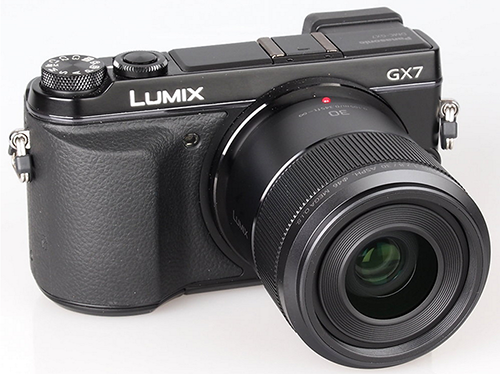
ePhotozine (Click here) posted the first full review of the new Panasonic 30mm macro lens. And it earned the highest “editor’s choice” award:
Who could ask for more than a reasonably priced lens that delivers excellent sharpness across the frame from maximum aperture, useful optical stabilisation and life size magnification at its closest focusing distance? Of course the compact size and light weight also help to make this lens one that will win over many admirers.
New Panasonic lens preorders:
Panasonic 42.5mm f/1.7 POWER O.I.S. Lens at Amazon, BHphoto and Adorama.
Panasonic MACRO 30mm f/2.8 MEGA O.I.S. Lens at Amazon, BHphoto and Adorama.
43 Responses
Would like to see tests on bokeh & vignetting etc. but I’ll probably get it anyway. Sample images don’t look bad.
bokeh has never been a good friend for our small m43 sensor.
the bokeh of F2.8 on m43 is like F6 on fullframe, forget about it…
kuso = (fake) m43 lover = Dont Cry For Me = stinking troll
As others might point out, “bokeh” should mean the quality of the out-of-focus rendering, not the amount of it compared to a faster or larger-sensor alternative. It is very relevant to see whether the OOF regions are pleasingly textured or harsh and unnatural.
I’ve seen some examples of super-fast cine lenses used to get the trendy OOF effect in front and behind a narrow in-focus region, but the result was very displeasing – made one’s eyes water. Like adding vinegar to lemonade to make it more tart – a poor technique.
The thing about bokeh on macros is the importance of it looking good at narrow apertures. Large apertures, which larger sensors grant access to, are useless in the macrophotography world.
That’s right.
I tend to shoot macros at f11 and f16 to increase DoF.
“our”? move on sucker…
I can’t complain about having that new choice. I am not sure it was the biggest hole to fill in the system, tho, but who knows how well it will sell…
not well, m43 is going downhill in recent years. Sony and Fuji have taken over. I hope Olympus will leave 43 and make another mount for a FF or APSC system.
As the X12-35/F2.8 is already excellent I fail to see tha need for a 30/F2.8 even if it offers macro focussing (30mm is not really long enough to get 1:1). No mention of keystoning which is a bit of a failing on the much faster Leica 25/F1.4 but which itself recycles used nearly-new for around £300.
Why another short focal length macro? What m43 is really lacking is a native longer focal length macro in the 100mm to 150mm range that can focus 1:1. Ever tried photographing insects with a 30mm?
While I’d much prefer a long macro too, it isn’t all about insects.
Of course it’s not all about insects, but that’s what the several shorter focal length m43 macro lenses that already exist are for – the macro that’s not about insects. Surely the point of new lenses is to fill the gaps that don’t exist and enable photography with the system that isn’t so easy with the tools we have at present – like insect macro photography.
No, but shooting with a long macro lens has definite advantages.
I use Nikon 105mm and 200mm macro lenses. While they’re great for shooting bugs, they work well for getting close-up shots of things I can’t get near to, or don’t want to. They also double as very sharp telephotos!
The M4/3 system needs another short macro like it needs another fisheye or 14-42mm
The 30mm => 60mm equivalent is a traditional and popular macro focal length. Others are ~100mm, ~150mm and ~200mm equivalent.
It is true that longer f.l. macro lenses allow greater working distance, but that’s not all there is to it. I think there are three main advantages of the shorter focal length:
1. More dramatic perspective of small objects. It’s not just about magnification. Generally (not just for macro), selecting the working distance to fit the intended final displayed-photo magnification and viewing distance is how to get the most immersive and pleasing result. Then the focal length (i.e. lens magnification) is chosen to make that intended photo, at that well-chosen working distance, fill your frame. This principle is obviously much less important if you are shooting flat subjects like coins, stamps or copy.
2. Ability to get extreme-macro (beyond 1:1 magnification) more easily with extension tubes (or bellows, though the latter are not too popular today). You need correspondingly longer extension to do that with long f.l. macro lenses, beyond what most extension tube sets may give.
3. Smaller carrying size of the lens and/or associated extension accessories.
I have nothing against a longer macro – I think my favorite one was a friend’s 100mm Macro-Elmar-R, gave super sharp and pleasing results, especially for objects bigger than, say, a 100mm macro lens.
The Olympus 60 mm macro is a 120 mm equivalent lens, so it fits perfectly in the 100-150 mm range so many want. Okay, it doesn’t have OIS, but neither does the Macro Elmar…
Yes it does
I think he meant that the Olympus 60mm macro doesn’t have OIS. This Panasonic 30mm, and the much more expensive 45mm PanaLeica Macro-Elmarit, do have OIS.
And the Olympus lens has some weather sealing – though I would still cover the camera & lens if sitting out in the rain for one of those bug-on-leaf-among-the-water-droplets shots.
What I meant was an actual 100mm-150mm not an equivalent focal length. Even the Olympus 60mm which I have is a bit short. What we need in m43 is the equivalent to a Nikkor 200mm micro or that micro zoom Nikon once made. Sure I’ve owned several 60mm macro lenses when shooting 35mm film, but they’re really pretty useless for shooting anything macro other than static subjects like flowers etc. Even using a 105mm micro Nikkor I’d often have to use it with a teleconverter to get the magnification needed with enough working distance. And that’s the crux of it, working distance. This isn’t merely to avoid frightening insects, it’s because most great macro is achieved with artificial light sources to get the necessary depth-of-field. A decent working distance is needed for the positioning of flash heads and the more distance you’ve got the more option you have for decent natural-looking lighting angles and quality of light.
What I find interesting is macro shooting is actually one of the m43 system’s potential strong points (due to the inherent greater depth-of-field at any given aperture) and yet there’s a dearth of specialist macro lenses and a load of copycat generalist short focal length macros that aren’t of much use to me – the longest being the Olympus 60mm (120mm equivalent) but with no option for using a teleconverter.
What I always say about the missing pieces from the M4/3 lens line up…
When you can’t find it native, ADAPT!
I have the Micro-Nikkor 200mm f4 IF (internal focus) AI-S macro. It’s a fantastic lens. Excellent image quality (very nice bokeh), nice features (integrated-retracting lens hood and solid tripod collar) and not crazy big (52mm filters, 800g).
I bought one of those Nikon 35-135mm f3.5~4.5 macro zooms back in the late 80s. It’s not the world’s best lens and has that rather odd integrated zoom/focus mechanism, but it was extremely versatile and coupled with my set of close-up lenses (Nikon 5T & 6T), great for macro work. I’ve used it on my M4/3 cameras a few times, but not extensively, and like the 200mm, really begs for a tripod.
Thanks for commenting. I agree you can adapt but then you do have a very specific piece of kit because you miss out on functionality like AF, OIS, programme metering and TTL flash metering for more generalist shooting with the same lens (none of these are very useful for macro except maybe OIS making focusing a little easier). It would be great to have a native m43 long focal length macro so it’s great at macro but also has these other advantages to make it good for other shooting, thereby keeping the weight low in our camera bags.
The Micro Nikkor zoom I mentioned was actually the 70-180mm f4.5-5.6 which was supposed to be an excellent lens and extremely versatile for macro shooting – you could quickly get multiple macro shot sizes without having to physically move the camera.
For shooting macro, the only thing in your list of any real use would be the flash thing.
Me? I shoot M mode, all manual, GITZO is my stabilizer. I only shoot in available light, so the flash is moot, too.
I’d already acknowledged this in my previous post by stating “none of these are very useful for macro except maybe OIS making focusing a little easier”. What I was stating though was it would be an advantage to have a lens that was good at macro but also had these other capabilities for other shooting too.
The other problem for macro shooting with an adapted lens is the need to do minutely fine final focus adjustments with the lens set at it’s shooting aperture, especially when shooting insects which tends to be handheld and using flash. The aperture is small when using flash and so if the ambient light is low, the live view image of the EVF will have a very slow refresh rate making the image step and be swirly. This makes it extremely difficult to focus or even frame. With a native lens you get to view at maximum aperture with the lens only stopping down as you take the shot – big advantage.
Hmmm what would you think about a compact 100mm OIS macro lens, sealed! and retractable!, startig at f4, so it would be a very compact?
“Who could ask for more than a reasonably priced lens that delivers
excellent sharpness across the frame from maximum aperture, useful
optical stabilisation and life size magnification at its closest
focusing distance? Of course the compact size and light weight also help
to make this lens one that will win over many admirers.”
—
A very distinguished and qualified resumee.
Kind of insignificant and off topic, but why is the focal length of this lens printed in white and not the typical yellow that Lumix and some Leica lenses are? The yellow lettering next to the red dot were becoming a somewhat iconic identifyer for me -would be sad to see it go.
because its a macro lens, the yellow color will distract the bugs.
Bugs can’t see yellow. They wouldn’t know how to pose for the “short” macro setup.
Some does, like jumping spiders can see 4 light spectrums while humans only three.
I am pretty impressed by the test photos ….perfect sharpnes …super contrast …I really like it
I have pana 25mm but this could be nice addition as I dont have any macro lens and I dont dont do isects …but details are my favourite subject …uf GAS again
If you like details, you should really try a FF camera, or even an APSC, way lots of details, you will be amused.
I am happy with m43 for now;)
Same sh*t my friend. Show exemples please.
Looks kinda ugly to me IMO TBH. Design crisis?
Yes, not very pretty and expensive, not worth for $399. Sony’s 30mm macro is cheaper, metallic design, around the same size and weight and covers a larger image circle!!! But yea, too late to switch system now.
Ephotozine: “The lens barrel is constructed from a mix of metal and high quality plastics, with a glossy finish and the bayonet is metal.”
Photoreview: “The supplied lens appeared to have been made from a combination of metal and high-quality polycarbonate since most of the barrel was cool to touch and it ends in a very solid metal mounting plate. Build quality was good on the whole.”
Fotosidan: “It features a sophisticated exterior design in metallic finish for the stylish appearance.”
“Made in China” -like, um EVERYTHING Olympus makes??
Y’mean, poor cheaply made, easily dented like the Olympus 45mm that I owned? -the same lens that I lost the flimsy bayonet 2 weeks in? And only in silver at the time?
Blind Fanboyism at its finest…. SAD.
The small m43 sensor is actually good for macro photography, because you get lots of DOF.
You get lots of DOF on larger sensors as well. You just need to stop down the lens.
I love small cameras, small lenses, and small sensors!!!
Really? you can do that?