


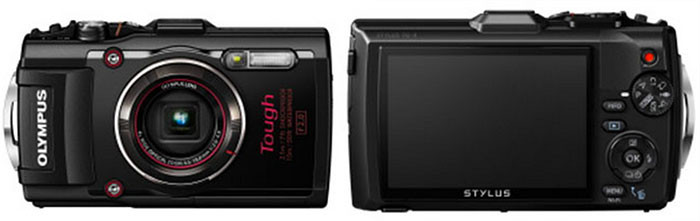
These are the first images of the long time rumored TG-4 compact camera. The camera will be announced within the next few days. And no, there is no new PEN or other MFT camera that will be announced along it 🙁
via Digicameinfo.







These are the first images of the long time rumored TG-4 compact camera. The camera will be announced within the next few days. And no, there is no new PEN or other MFT camera that will be announced along it 🙁
via Digicameinfo.
61 Responses
The 1970s called, they want their camera back…
If this camera had been around the 1970’s, it would have been “The Man who Fell to Earth”-ware mind boggling? … if you are going to diss the Tough, I think you failed with that analogy.
Nah, he means it’s 1970s style on the FUGLY scale.
Basically a non rumor…
everyones need traffic…lol
Wot? No EVF?
on a whaterproof cámera? are you kidding me?
Okay, it looks pretty much the same as my TG1.
So, what are the specs?
Does it have a 1″ sensor?
Will it finally shoot RAW? PLEASE?!?!?!?!?!!!! It’s 2015 ferchristsakes!
But, most importantly… Will it come in pretty colors?
The TG series have grown slightly fatter than the original TG-1. But the photo looks identical to TG-3, with the exception of the front writing (it’s now – gasp! – in red cursive).
All other “tough” cameras on the market received only very minor updates this past year, and it looks like Olympus did the same with the TG-4.
Panasonic, IIRC, added a couple new body color options for their TS-6.
Nikon added a shaped grip.
Fujifilm added some other tweak.
Olympus did the same thing.
Interesting that a such compact, tiny-sensored (1/2,5″) camera has aperture priority (A) mode but lacks shutter speed priority (S) mode – although you have not really much for playing with DOF/background blurring but shutter speed priority might be still useful for e.g. waterfall capturing.
I can tell you that working with the controls of the TG1 is a real pain.
Disable the flash, shut down the camera to conserve battery and the flash is active again when you turn it back on. I’ve ruined more than a few photos that way. Maddening.
The images are quite good for a JPEG only, smaller-censored P&S.
I’ve LOVE to see a waterproof LX1000!
Hmm, I don’t have that problem – mine remembers the flash setting just fine, at least in the “P” mode. With custom modes, of course, it’s whatever you set when you recorded the mode settings.
Waterproof LX100 is not going to happen, because the collapsible lens is impossible to waterproof.
Do a version based on internally focused/zoomed lens and waterproof lens. Yes, such a camera would be larger to store… but this is a trade-off. Hint to Olympus: sell it with a well designed small and tough carry case that comes with the camera.
Look at the size of the internally focused, internally zoomed lenses that come with the Nikon 1 AW. Then think how large a camera body has to be to fit such a lens inside.
Not just camera body. I was thinking of a lense tube attached to the camera.
Then I don’t understand what you are suggesting. How is it different from the Nikon AW (pictured below)?
The sensor is 1/2.3. But I agree with the rest of your post, controlling exposure is tricky. For example, if you want to take a moon shot, you have to turn on flash (with forced flash on, exposure won’t go below 1/100 sec).
I have the original TG-1, and I’d *love, love, LOVE* to have the A mode. As it is, the camera often prefers enabling the ND filter when it could’ve used shorter exposure, and there’s no way to override it.
An “S” mode would’ve been icing on the cake.
A mode has nothing to do with DoF on this camera, as the stop-down positions are exactly 1 and 4 stops, so look like ND filters. So this mode allows you to choose f/2.8 and f/8 instead of f/2 manually – a very useful ability, do’t you think?
Olympus really is making some weird decisions with this series. A premium model with faster lens but no RAW? A small sensor with A mode, but no S or M? Why?
It would also be nice if they borrowed a page from Pentax with their built in ring light around the lens.
The “tough” cameras are marketed to the type of audience that generally won’t use RAW. If you’re after image quality, get a Sony RX100 in a Meikon housing, or a Nikon AW1. The TG series is primarily designed for situations where photography is a secondary pursuit.
The manufacturer must weight the benefits of adding RAW (additional units sold) against expenses (in this case, primarily additional customer support time).
Also, adding RAW capacity will expose all the compromises of the optical system, making the camera look bad against the competitors (who don’t offer RAW) – causing bad publicity and actually *reducing* the number of units sold.
It’s quite likely that they did the math and found that adding RAW would actually reduce profits.
Maybe. But this is really a nice camera to have if you’re doing outdoorsy stuff in bad weather, etc.. I got my TG1 (upgrade from an Oly Stylus 1030SW) for occasional snorkeling trips and underwear shooting. It works really well, with good image quality, except for some interface issues.
The problem with waterproof housings is their size and price. The TG-series is small, light, easy to carry and work with and inexpensive. Perfect for casual or occasional use. But Why not have RAW? They’d sell more.
I’m pretty sure you meant “underwater shooting” 🙂
I got the TG-1 too, and love it (cracked the screen last year, so it’s no longer waterproof – if the rumor is true, I’m getting this one for sure). But if I want image quality, I get out of the water and set my DSLR on a tripod.
The Meikon housing I mentioned is $150-ish.
I don’t know what Olympus decision process was, but my guess is what I wrote above. Sure, some photo-enthusiast might buy a few more RAW-enabled tough cams. But on the other hand, customer service will get a lot of calls about the camera being sluggish, eating up huge amounts of memory space, and producing files you can’t post on Instagram.
[Edit: I meant this would happen if RAW mode was enabled by accident]
And, inevitably the same photo enthusiasts will look into those same RAW files with non-Olympus tools, and post the unprocessed results, which will look ugly – causing bad rep and reducing sales.
If he meant underwater shooting he could have edited the post. But, for now it stands as is – Jeff needs tough camera for underwear shooting.
I can guess that regular camera won’t last long because underwear owners don’t like them being photographed.
Or he could be posting from a mobile device with an autocomplete function.
… hmmm… you make sense 😛
I wouldn’t worry about some P&S shooter even finding the option to activate RAW. You can bet it would be buried somewhere deep in the menus where NO ONE could find it.
*I* am not worried. All I’m doing is speculating on what Olympus experts could have been thinking when deciding not to include RAW in the previous TG models.
I was told by Olympus staff at an Olympus event at my local store that the TG-4 was coming soon, that it would have RAW support (I didn’t ask about TG-4, I was looking at the E-M5 mark 2 and E-M1 during that event, but the sales guy knows I prefer weather sealed cameras and have a TG-2).
Why no RAW? Maybe because the tiny pixels in the 1/2.3″ sensor don’t need more that 12 bits per pixel JPEG provides, as there is noise in the lower bits of 8-bit luma channel even at base ISO? All they need to add is no noise reduction mode for you to see what really is going on.
There *are* legitimate reasons for wanting RAW capture aside from highlight and shadow recovery.
First off, it’s a matter of convenience. A lot of photographers have their entire image-handling workflow organized around RAW, so it’s a hassle for them to use the same software for all their cameras.
Another issue is controlling JPEG conversion parameters. I used to have an old Pentax rugged camera that allowed me to set contrast, saturation, sharpness, and noise redaction through the camera menus. With the TG series, that control is completely missing – all I can do is turn the “shadow assist” on and off.
Finally, there is white balance. It’s a lot easier to change WB of a RAW capture than that of JPEG.
“First off, it’s a matter of convenience. A lot of photographers have their entire image-handling workflow organized around RAW, so an inability to use the same software for all their cameras is a hassle for them .”
Just treat JPG as raw, what is the problem? I don’t know any software which can handle ORF and cannot handle JPG. Certainly Olympus Viewer 3 included with the camera works with Jpegs beautifully, and much faster than with ORFs.
“Another issue is controlling JPEG conversion parameters”
That is what I wrote. If they had the ability to set noise reduction and sharpening to any values (or at least disable them) as their higher-end cameras can, their Super-fine JPGs would be essentially a portable format of RAWs.
“Finally, there is white balance. It’s a lot easier to change WB of a RAW capture than that of JPEG.”
I cannot see why. It is exactly the same. Of course, RAWs from large-sensor cameras have more bits of color in them than JPG allows so they don’t break down as easily or as ugly, but remember, 1/2.3″ Bayer-filtered sensor divided into 16 million little pieces does not have anything beyond what is representable by JPG. You can always set WB to sunny to capture full spectrum, although AWB is always close enough and does not require a lot of correction.
“Just treat JPG as raw, what is the problem?”
Because that tool chain includes a raw converter, which applies their tweaks and modifications (usually, in batches of multiple images). A raw converter like Capture One Pro, Raw therapee, etc. etc. open RAW files.
It’s like you have your favorite set of screwdrivers, all nice and organized, and suddenly they bring you a box of nails, and you need to reach for that rusty hammer at the far end of the tool chest.
“If they had the ability to set noise reduction and sharpening to any values (or at least disable them)”
One major advantage of RAW is that it’s forgiving. You don’t *have* to get JPEG conversion parameters right when you’re taking the picture. You don’t *have* to remember to reset them when the scene changes.
(I actually prefer to get things right the first time – but a lot of people like the option of tweaking the sharpness afterwards).
“It’s a lot easier to change WB of a RAW capture than that of JPEG.”
I cannot see why. It is exactly the same”
Give it a try – take a JPEG with WB set to Sunny, open it in Olympus Viewer and change it to Fluorescent.
Applying white balance to an image is an irreversible operation, like sharpening.
“people like the option of tweaking the sharpness afterwards”
And JPEG allows that.
“Give it a try – take a JPEG with WB set to Sunny, open it in Olympus Viewer and change it to Fluorescent.”
I have changed WB of JPEGs many times. Sure, for large-sensor cameras RAWs are more tweakable, in small sensor cameras there are simply less information to begin with. Applying Sunny in camera should not lose any significant information as that is full spectrum lighting and everything should be captured.
“people like the option of tweaking the sharpness afterwards” – And JPEG allows that.
Sharpening is pretty much a one-way street, because once applied, it’s indistinguishable from small detail. Trying to reduce previously applied sharpening also removes the small detail.
“I have changed WB of JPEGs many times” – but can you do what I asked, specifically? Not just tweak colors by adjusting the sliders, but switch from Sunny to Fluorescent?
“Applying Sunny in camera should not lose any significant information” – Applying white balance is a transformation that maps some colors into other colors. Usually, it’s implemented by a matrix transform. If that matrix is non-inversible (which depends on the specific WB setting and on manufacturer’s choices), the transformation maps more than one original color into the same resulting color – and then there’s no way to guess what it was before.
Here’s an extreme example: Imagine that you took a custom WB measurement off a cyan-colored piece of paper, and then used that custom WB to take a JPEG. This should scale down greens and blues, giving grey objects a red cast. But red objects will stay red.
Now, when trying to restore WB back to Sunny, the program has no way to know which of the red objects were red originally and need to remain red, and which were grey and need to revert to grey.
Hey, lookie there – the mode wheel says “C1, C2”, “A”, “iAuto”, “SCN”, “Sports”, and “Underwater”! The second custom mode is back! Hurray!
The “ART” position is gone, good riddance!
And dedicated underwater position is VERY welcome on an underwater camera. 🙂
Somebody please but a 1″ sensor and a great UI/Controls into a little tough camera!
Highly unlikely, unless you mean with a FFL (non-zooming) lens.
Nikon 1 manages to even make it interchangeable. But from what I read in the Amazon reviews, the water proofing sounds a little iffy 🙂
Right, but look at the size of a Nikon 1 AW with a lens attached. No way it could fit into a PFD or swimming trunks pocket. When you said “tiny”, I thought you meant the size of TG series (which are already quite large for a tough cam).
How much would the RX100 need to grow to seal it? Agreed that the Nikon AW1 is too big to be in this class.
I can’t imagine that the small sensor holds up very well under water in lower light. But my own use case is more for rain, snow and cold than diving.
Tough cams and super zooms seem to be the last bastion of compact sensors. I’d imagine we’ll start seeing larger sensors show up in them in another generation or two.
When the RX100 is turned on, its collapsible lens extends by about as much as the camera is wide (image from imaging-resources.com).
Tough cams use a prism to fold the light path, so that the actual lens is positioned sideways inside the body.
The TG series do okay in low light, and much better than most other tough cams, due to the relatively fast lens and back-illuminated sensor.
I’d be surprised to see a tough cam with a sensor larger than 1/1.7″ until completely different technologies enter the marketplace (like lens arrays, flat optics, etc.).
Thanks for the info. I’m new to “tough cams” but am intrigued more and more as beach weather approaches and my old Kodak Playsport images look pretty shoddy looking back at them in Lightroom…
Based on my experience with TG-1, I’d certainly recommend the TG-4.
It’s not without its quirks, and the videos aren’t going to get any awards, but for still pictures its hard to beat, and its overall usability (responsiveness, battery life, low-light performance) is the best there is for a tough cam.
I am sure it can be done with a telescopic lens design and sensor placed horizontally at the bottom of the camera, after all the 1″-class sensor is only 8 mm high, so would fit into camera about 10mm deep, which is still compact enough for swimming trunks. Something like 8-30mm/2.8-4 lens for 1″, compact even if digital corrections of distortion and lateral CA are needed, would be great. If long end is 40mm, even better.
Again, not likely. Zoom lenses tend to be much “fatter” than primes, and full of glass. I haven’t seen any lens tube assembly for a 1″ sensor with a diameter under 40mm or so. And the optical diagrams don’t show any room for a prism or a mirror.
One possibility to do what you’re suggesting is what Sony did with their action cam (picture from BuyDig.com) – completely commit to a sideways-sitting lens:
I have seen Olympus 12-50/3.5-6.3 for 4/3″. With the exception of front element (which would be IN FRONT of the prism or mirror in the telescopic design), it is like a pen inside, each element has diameter of a few mm. In a built-in lens, there will not be a need to separate body, zoom and focus rings etc. And if you have seen linear motors, they look like needles.
SEL-asset-476776_source.jpg
In the diagram I found, it’s not just the front element – it’s one (or several) groups of elements, that together are about as long front-to-back as the front element is wide. In addition, the diagram only shows a single zoom and focus position.
Than again, I’d be ecstatic to be proven wrong on this one.
This lens is internal zoom and focus, it NEVER becomes any longer (and of course not any wider). Its longest FL is 50mm, for 1″-class sensor it would not need to be longer than 35mm (FL at the long end) to cover the same range.
Right. But in order for it to zoom and focus, lens groups have to move back and forth inside the lens assembly, so at least some of that empty space has to remain empty and can’t be taken up by a prism.
Sure, the design of telescopic lens is special. The point is, it fits into 10mm deep body if needed.
Hmm, you’ve got a point there. Based on that diagram, I’d say no way it could be 10mm, but a 30-40mm thick body might be possible. If (and that’s a big if) that prism or mirror can be worked into the design.
I don’t see why. The front group looks forward and might protrude a little (although at 30mm f/4 long end, the front element can be only about 8mm in diameter), the rest can be all little as you want if the front element has high refractive index (even in the m43 lens they look like about 5mm in diameter, tiny little jewels).
When I insert a mirror and scale it down to account for the smaler size of 1″ sensor, I get 30mm – and that’s without the housing, protective glass, etc:
Oh great. When I couldn’t fix the post and tried to delete it and start over, it merely becomes a “guest” post. Discus, fix your stuff!
When I insert a mirror and scale it down to account for the smaler size of 1″ sensor, I get 30mm – and that’s without the housing, protective glass, etc:
Note that in this “design”, the rear element of the front group can now only travel towards the front, the mirror collides with the area where the zoom motor would sit, and the travel for the front element of the bottom group is now limited by the mirror.
You should have put “long awaited” in the title and used exclamation points. After all, it was April 1st.
When is the tg4 coming out? Pls, tell me… thanks..
It’s been coming out “soon” since last November 🙂
Usually after the images leak out, the official announcement comes within a week or two.
Or it doesn’t 🙂
TG-1/2/3 all had become available in June, being announced about a month before.
No tilting screen from TG-850/860? NOOOOO!
I guess TG-860 stays a snorkeling champion with its tilting screen and 21mm-wide lens.
At least they have specifically added underwater mode on the mode dial, I always have to choose SCN and Fish2 mode on my TG-2 for underwater photography.