









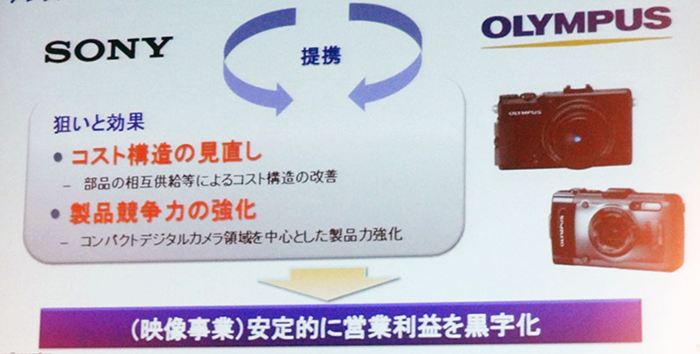
Reuters reports that Sony has sold 50% of their Olympus stakes. The company share Sony owns now dropped from 10% down to 5%. Sony said this will not affect the partnership with Olympus. But Sony needed the money to make new investments in their profitable sensor and Playstation business.
I don’t know what kind of effect this will have on the digital camera business of the two companies. So far we haven’t seen any major collaboration project so far. Even the A7II image stabilization system is completely different from the one used by the E-M5II…
57 Responses
Sony to Olympus: “All your base are belong to us!!!”
You mean: “All you’re base no longer belong to us.”
belongs…
Hey Stig nice avatar! great minds!
Thanks. Nice avatar. Mine isn’t a RAF roundell though 😉
You don’t get it. Google the phase.
No I don’t. Sony originally invested to partner with Olympus to enter its medical device market and force Olympus to buy its sensors and Olympus to share their technology. Olympus was Sony’s *itch.
Now Sony sold for profit and will use it to take over Olympus’ medical and camera market.
Sony states they will further use the money to invest back into camera and medical device market.
Sony was Olympus’ pimp, used Olympus, made a bunch of money, forced them to buy sensors from Sony and share tech, when they used them up, dumped them on the street, still have stock hanging over their head and will use the money to take over their money making corners that Olympus street walks. Olympus tried to go to another pimp, Panasonic. Sony in turn sold its stock to JPM, which means Olympus was just sold into slavery.
m43 is doomed…
My take from the disappointing E-M5ii released with the old sensor is that Olympus is getting the shaft from Sony and Panasonic, who are both holding their prime tech for their own products.
The EM-5 sensor at 3 years old still gives very, very good IQ at the ISOs I shoot. Version II adds astounding tools to the EM-5.
I get that. But it’s still a >3 year old sensor. Oly does good compensating with IBIS and life view. Development should be further along. I bet it is and Oly doesn’t have access.
The sensor in Sony’s body hasn’t changed much in the past 3 years either. The reality is that sensor tech is reaching a plateau.
Compare the a7s to the one in E-M5II… not a plateau at all, its like Mount Olympus looking at Mount Everest. I hate it when people say the E-M5II sensor is good enough… it sucks and its 3 years old. Yes, its good enough for you, but quit insinuating things aren’t much better on the Sony side. ISO 800 of my PEN looks the same as ISO 25600 on my A7s.
OMG… did you realize dumbass that you just made a comparison between a m43 sensor and a 24*36 sensor ? A sensor just four time bigger. Why not make a comparison with a pentax 645z. That doesn’t make any sense, and doesn’t indicate anything. You want a good comparison : take an image make with a sony a6000 and crop it to 4/3 ratio then compare to the same image done with the E-M5II. Guess what ? The reality is that tech sensor is reaching a plateau.
The world has moved on, size has nothing to do with it.
Please explain… Size have everything to do with it. Larger sensor, less noise, so that was what heimdall was pointing out: Why don’t you compare the sony full frame sensor to a large format sensor, and see witch is best? This will make as much sense as compering full frame to m43 (i.e. no sense). If the sensors was of the same generation, the larger sensor would still be better. But if you compare same size sensor, or similar (aps-c), from now OR three years back, the oly sensor is really quite good (its almost as good as my d7100, and frankly I think it is better then fuji, because I do not like the mushio foliage look and fake “noise-free” raw images (they apply noise reduction even if you set it to off).
(and just to make clear, I really like fuji, my Nikon and even the Sony when I tried it… Its possible to like and enjoy and think different brands are good… but in this field usually you just push one brand (a bit like mac VS PC, android VS iOS. I never understood why)
Calm down.
His point is that regardless of sensor size and ability, Sony in 1 year has improved their offerings with two additional sensors with different characteristics, while Olympus for one reason or another can only offer the same sensor one can get in a $150 EPM2.
Sony is making a strong argument to buy their products. Unless there is some movement in technology their is no choice but to jump ship for those of us who seek better resolution and ISO performance.
Much is riding on the GX8 and E-M1 mk2.
Try saying this on DPR’s mFT forum, prepare for a swarm of fanboys defending the 16MP sensor to the death and swearing Olympus is in no need of a new sensored E-M1 for at least another year or more. Meanwhile, Samsung is onto 28MP BSI APS-C sensors. Clock’s ticking.
We are aware that Samsung’s BSI was developed by Sony?
http://www.techradar.com/reviews/cameras-and-camcorders/cameras/digital-slrs-hybrids/olympus-om-d-e-m5-mark-ii-1284458/review/10
Be amazed how 4/3 sensor bests every other larger sensor, in DXO standards and in real world as well (rent cameras and check out, be amazedamazed by how amazing that 3-years old sensor really is!)
Where in my comment was I not calm? Strange comment…. I agree Sony has a great innovation in sensor-tech, just pointing out that comparing the IQ of a FF to m43, even if it was a new and improved m43 (that sadly do not exist, this I agree is a problem) would always be in favour of the FF. Bigger senor will almost all the time have better IQ. However, if you compare the 3 year old m43-sensor with a modern sensor of same size, or similar (like I said, aps-c for instance) it holds up well. Even though the E-M5II takes great pictures with an IQ that is (and will actually always be) good for most people (we have, in my humble opinion, reached a paint where improvements to sensor-tech will actually only matter for a few, since it is already so good), I of course understand the problem of marketing a new camera with a 3 year old sensor, even if it still is a good sensor. But seriously, I still take great pictures with my old Nikon 35mm film-camera, and with my old D200, and I will still take great images with those cams in 5 or 10 years, even if sensor tech have improved in modern offerings. Its a common misconception in forums like this that when new tech is available, old tech is suddenly worse then it was before, and totally obsolete 😀
Faster sensor less noise. Sensor size is irrelevant.
Check DXO based analytic about E-M5II sensor and it beats A7r, A6000 and so on in dynamic range, SNR etc. Iso 800 on OM-D is like ISO 200 on A7r.
Check tech radar reviews.
Check DXO based analytic about E-M5II sensor and it beats A7r, A6000 and so on in dynamic range, SNR etc. Iso 800 on OM-D is like ISO 200 on A7r.
Check tech radar reviews.
… and doesn’t look as nice as ISO25600 on a GH4
Much of the ability to run at high ISO is the ability to process the data faster. Which is where the latest developments have been.
We’ve moved on quite a bit since your E-P1, if the A7s looks as good as that at ISO800 then they’ve got their work cut out for them.
The E-M1 still has better IQ and higher DR than my E-M5ii, and its sensor is by Panasonic.
From Panasonic I doubt it, since their sensor sucks as much as 3 years old Sony sensor in term of IQ. It looks like Organic sensor is not ready as gx8 is postponed to late 2015.
Really?
Looking at the DR, NR and IQ on the E-M5ii with its Sony sensor, whilst it’s pretty good, I think Panasonic are onto a winner with their old sensor.
It would seem that for the organic sensor to reach product it will require 5-8 years further development.
“Sucks like a 3 year old sensor”, now that’s funny. The A6000 has the same DXO score as the D7000. That’s a 5 1/2 year old sensor for you. All Sony has done in 5 years is bump the megapixels. In that time Panasonic took the lead in M43 and own the best rated sensor, and organic sensor tech will be the first real sensor advancement in 6 years.
Well, your take is completely wrong.
People don’t seem to get it.
No company cares a damn about Olympus Imaging division. They’re only interested in the medical division.
Why would a company be interested in investing in a loss making Imaging business at a time when camera sales are falling like a stone.
Whereas Olympus are world leaders in their endoscopes and microscopes and with an ageing population in the First World it is a massive growth market.
Now the biggest individual shareholder in Olympus is the parent company of Nikon.
Modern endoscopes and microscopes are digital and both require sensors.
There are two huge companies that make sensors, Sony and Panasonic.
The parent of Nikon is Mitsubishi. Nikon’s sensors are made by Sony.
Like Olympus, Nikon’s main business is industrial, not cameras.
Nikon also use Toshiba sensors. Helps if you get your facts right.
I fancy that Toshiba were past tense.
Yes, Mitsubushi is now the biggest shareholder in Olympus (probably- I don’t have up to date figures ). There are also several big banks that have significant shareholdings.
This is perfectly normal in Japan and I expect all the big electronics companies will have crossholdings in each other.
Huge conglomerates like Fuji and Mitsubushi probably have shareholdings in hundreds of companies.
And I forgot to say that the only camera manufacturer that relies on cameras as the primary part of their business is Nikon.
They also make steppers for semi conductor manufacturing (which is in decline ) and spotting scopes/binoculars/prescription lenses and so forth which is a minor part of their business.
But the camera business is over 50% of their sales.
Nope, Nikon also do the industrial measurement systems stuff as their main money spinner.
“Why would a company be interested in investing in a loss making Imaging business at a time when camera sales are falling like a stone.”
Because Sony had problems of their own. They needed a demand for their sensors to support sales.
Part of the deal with Olympus was that Sony became the main sensor supplier.
It’s the pig hanging on the cow’s tail; there wouldn’t be a bigger medical division without the little imaging division.
You cannot do digital endoscopy without digital imaging and lenses.
Loadsmoney in medical but you need that imaging stuff to do it.
Ouch for Olympus. Will they be left behind for next gen?
Can you actually read?
They are already left behind. They have old sensors in new bodies, with updated ibis tech, that now Sony has in some way.
Olympus can’t afford to invest in new sensors, even if Sony had any. Olympus can’t afford it. I’d bet even the E-M1 MKII will sport an old sensor or maybe even be the GX7 sensor.
But the Olympus faithful will not care, they’re going to praise a new camera, with old sensors, -like they’re doing with the MKII now! Hahaha!
Dear Mr ALLICANDOISTALKCRAPENDLESSLY its time for your medication again. There isn’t a sensor on the planet that would be of any use to you, no matter its age, as you have yet to show a single photograph that makes your case. What exactly is your problem with Olympus ? If they are as bad as you make out why not post something to Steve Huff or Kirk Tuck , two fellow Americans who take the polar opposite view to you . Of course there are major differences between yourself and SH / KT, they are both intelligent , capable ‘,real photographers’ who show their work. You on the other hand are neither, and repeatedly prove yourself to be nothing but a ‘dumbass’ to coin an apt American term.
They could do far worse than to use a Panasonic sensor. Sony are having financials and Panasonic are currently the leading developers of sensors with the organic a few years up the road.
Panasonic sensors in the GH4 and the E-M1 have 13+EV DR like full FF cameras: Nikon are using ‘old’ Sony sensors as are Pentax and do not have that DR and low noise. Canon do not make sensors neither, they have them made by Sony too but Sony are CMOS whilst Panasonic are LMOS which have less stray electrons (less noise). Leica have now decided to use a custom CMOS from some little dutch company, which is like one step forwards and two or three volte face to the rear, weird when they’re chums with Panasonic; no wonder they’re so expensive.
My E-M5ii is a lovely little camera but it is so not up to what my GH4 can do. I didn’t go for the E-M1 ‘cos a knob fell off the front of it when I got it and it went back, GH4 was ordered sight-unseen based on GH3 demo and has proven to be the right choice, long term future proof as a tool.
I guess this is a april’s fool’s joke, not a very funny one.
Sony has IBIS, they have sensors -they don’t need Olympus
they probably got the IBIS tech from Olympus and said, eh. we’re out of here.
It can’t be a coincidence. Olympus sent engineers over to “collaborate” with Sony regarding camera technologies (including IBIS) 2 months before the announced investment in Olympus by Sony. Olympus engineers went back to Olympus at the end of 2014 just before the A7II with IBIS came out. Fast forward a couple months, and Sony decides that now is the best time to cash out.
Hello it uses a totally different system which even Sony says they developed themselves.
Can we take our conspiracy hats off?
a) Sony collaborated with Olympus’ Medical Imaging division -which was their main interest.
b) Olympus buys sensors from Sony’s Devices division, which is different than Sony’s Imaging division. In such organization such as Sony, I wouldn’t be surprised to see competition between the divisions for resources, profit allocation, etc etc.
c) A7 MkII IBIS is different than the Olympus’ implementation. Don’t forget Sony had IBIS (just not 5-axis ones) before, same with Pentax. It isn’t rocket science to figure out the basic principles behind Olympus or Pentax implementations and then develop your solution on-top of them.
d) Sony is in a pretty bad financial position in general, they are selling their offices, laying off people, etc. Selling stock in 3rd-party companies is a natural next move if they need to free more capital.
Even Panasonic has had sensor stabilisation with the GX7
Sony has seen a huge amount of their net worth collapse (now about 1/5 the worth of Panasonic) but given their size, they only raised a paltry sum by selling off 6% of Olympus.
In comparison Olympus, medical division and all, is a tiny company, as is Leitz/Leica for that matter
Pentax (Ricoh) has IBIS, and Sony sensors
I always thought Olympus jumped ship to Sony too soon, their best camera still has a Panasonic sensor (because Sony couldn’t make it).
Companies buy things like sensors not because they’re better but because they’re cheaper.
Nope.
E-M1 is built around a Panasonic sensor, because Olympus wanted to design it with their on-sensor PDAF.
Sony is rarely manufacturing sensors designed by the clients (they did that for Nikon a while ago).
Furthermore, I don’t think they’ve ever sold a sensor with PDAF to another camera manufacturer (they made some for phones – including the iPhone 6). So they let (yes, they LET!) Olympus design a sensor and ask MFT colleague to make it for one model. 😛
That is essentially what I said Piotr. No offence mate. Probably a language barrier thing.
Couldn’t means could not or can’t, sometimes it simply means won’t and is used as polite way to indicate an outright refusal.
Olympus wanted PDAF and Sony can’t or won’t do that (as they had for the E-M5) but Panasonic (a much larger company than Sony) can it seems, plus they had a history of supplying Olympus with sensors in the past after Kodak left the scene. Plus Panasonic may have had a vested interest in developing a PDAF sensor since they too made four thirds cameras with PDAF lenses at one time. May have had something prototype up their sleeves all along. Such as one for the iPhone.
It beggars the question whether the E-M1 or the E-M5 went into development first before Sony got their fingers into the pie. MFT colleagues is a polite euphemism for deadly enemy? You do know why Zeiss won’t make lenses of MFT? – because Leitz/Leica are involved with MFT, their love for Leica it goes as far as ostracising Zeiss Industrial employees who buy Panasonic cameras; daft. Ostracising means stretching their neck and burying their head in a bucket of hot sand, not.
Ultimately I suspect choice of sensor make boils down to component costing, the bean counting accountants as usual.
Dunno why but Disqus singed me in as guest above.
Btw Olympus cannot design sensors, they’re just not in that business, all they can do is ask for what they need.
I don’t think that is correct.
Olympus doesn’t manufacture sensors, but I’m sure they could design them if they wanted. It’s a matter of employing few experts in this field – nothing Olympus couldn’t do.
Nikon did many designs on their own (usually very good ones) and these are quite similar companies (albeit Nikon definitely has more semiconductor experience).
Well… “can’t” used to imply a reason other than free will. 🙂
– you can’t, because you don’t know how to,
– you can’t, because something (external) makes it impossible.
I would not say “I can’t” do something because I don’t want to and that’s exactly what’s happening here. Sony doesn’t want to make sensors with PDAF for other camera manufacturers, because they don’t want to loose an important advantage. 🙂
As for the lack of Zeiss MFT lenses – I have no idea (and I don’t care).
The cooperation between Sony and Zeiss is very serious. Maybe they can’t (:)), because Sony paid them not to? 😀
Or maybe they don’t, because it is simply too expensive. You know: they would have to develop new optical designs and setup a new production line. And Zeiss is not a big company, they can’t afford to make something that won’t make a profit.
That is the main problem with MFT today.
Good FF optics for DSLRs (=> large register) are a lifetime investment because of the mirrorless revolution with all the focusing aids.
And that’s something that might convince MFT owners to pay $1000 for a ZEISS ZF/ZE/ZA/ZM lens.
On the other hand, MFT lenses are not a great investment at all, so you have to be really determined to pay $1000.
Sony needs the cash to build more sensors! I don’t see how this affects Olympus.
No, Sony need the cash to play with their Playstations.
Sony needs cash?
Probably
Sony is worth something like $18bn and Panasonic nearly $100bn
They used to be about the same size.