









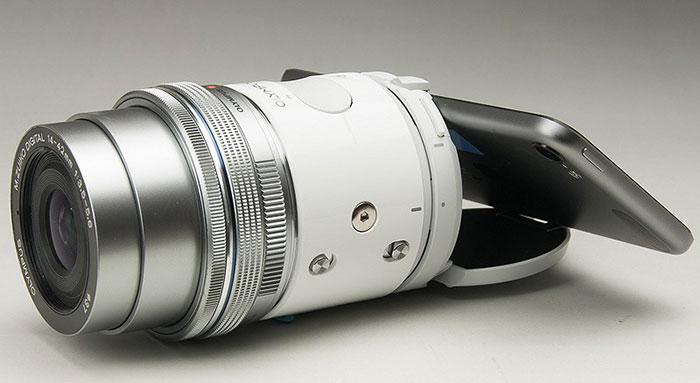
Dpreview interviewed Mr.Haruo Ogawa from Olympus. And those are some of the most interesting info:
1) 40MP High Res mode: “We did receive requests from studio photographers who needed higher resolution. Because of the size of the sensor, we didn’t go in the direction of higher pixel count, so to meet the demands of those photographers we developed 40MP high-res shot mode using pixel shift. ”
2) About the new High Megapixel war: “We will gradually increase pixel count in the future, while maintaining picture quality.”
3) About a new “handheld” High Resolution mode: “Yes this is technically possible in the future.”
4) About the future lens roadmap: “Our priority first of all is the pro and premium series of lenses for enthusiast and professional photographers. We also want to add some more reasonably-priced lenses for entry-level users, similar to the 45mm F1.8 – we’re looking into this now. ”
5) About the number of PRO’s using Olympus gear: “I don’t have exact numbers but after launching the OM-D the number has increased, especially in the documentary field. Documentary photographers tend to use their cameras in tough environments.”
6) About the MFT Air camera: “we’ll see how Japanese customers react, and that will help us decide whether or not to expand sales into other markets.”
7) About 4K Olympus cameras: “4K movie places a large burden on the image processor, so there are tradeoffs. This time we prioritized image stabilization, but in the future, when processor performance increases we can provide both.”
Your thoughts on those answers?
168 Responses
Can someone name a single pro that uses Olympus, that isn’t also paid/comped by Olympus? I’m not being facetious, just curious.
There are professionals using Olympus. I am one of them. Not got paid anything from Oly. And there are lots of professionals switched from 35mm to MFT as well.
(In USA you are considered professional photographer if IRS see that 51% of your income comes from photography, otherwise it is just that you make your living with it).
Me for example. I am not paid by Olympus. And do you know all payrolls of all the “paid” photographers? (sorry for my bad english)
Can any of you name someone other than yourself, with a website? Again, please forgive me for asking, I’m just looking for good work with m43.
My website is still on construction and will be some kind of blog, I have some random stuff on flickr, http://www.flickr.com/marcosartoriphoto
Just check the 43rumors group on flickr, where some of us readers add their photos.
Or look for an m43 camera again on Flickr.
Very nice work, thanks for sharing.
Thanks for visiting!
Love your photos. Nicely done.
Derrick Story is a pro. http://www.thedigitalstory.com/
Thom Hogan use M43 alongside his Nikons: http://www.sansmirror.com/articles/thoms-m43-bag.html
Thanks for sharing those links.
Forgot Frederick van Johnson
http://frederickvan.com/gallery/ or http://thisweekinphoto.com/author/frederick/
If you’re really just looking for good work, there’s tons of high quality amateur photography around the web. mu-43.com has lots, though I guess it takes some sifting.
Me! Started pro career with Canon after using different brands as an amateur.
Started with digital with the not so pro’s Fuji S6900 and S602Z. Followed by Canon DSLR’s 10D etc. in 2004 switched to 43rds. Now Fully on m43.
It should be clear that the pr S6900 days was analog 35mm.
Cool, got a website?
If a pro is someone gaining money doing photography, count me in.
No, I was hoping major publication, salaried work, but if you were a stringer for something like the NYT, and got paid, I would love to hear about it.
Well, I have done estate photography, worked at important events and festivals, on the red carpet, some food photography.
I’m not a “paparazzo” and I’ll never be 🙂
Now that Oly is putting out more pro-quality glass, you’ll probably see more famous photographers start to use the system. What I’m curious about is whether any big name photographers at all aren’t on some manufacturer’s payroll, or at least comped their equipment so they continue to advertise for them.
http://andre-arthur.com/
http://gallamartyna.com/
Check out LIndsay Dobson’s website:
http://lindsaydobsonphotography.com
The OM-D line screams 150-450mm f/2.8 zoom (minimum is f/4, but f/2.8 is the optimal)
(It is for professionals, pocket camera users don’t need to even look at it but can stick to their 12-45mm range).
The few more megapixels doesn’t help, but if the sensor has new technology, that is the what makes difference. But if the quality stay same but few megapixels gets more, it is just marketing.
And 4K is not needed (this is written on 4K display) but it is nice to have for those who stick camera on tripod and want to do panning and cropping in video editor instead in camera. It is easy way to avoid too narrow depth of field by using wide angle fast lens, then doing a crop in post and get subject in focus without resulting to use high ISO.
I am not looking for more MP’s..I am looking for less noise and more dynamic range. It’s time, now. 🙂
no-pixel image sensor.wait for hundred year 🙂
that mean no border of pixel,all area absorb light.
High & High ,quantum efficiency.
I think it’s called digital film. Haven’t seen this name for some years.
Why absolutely nobody has the courage to ask about opportunities of implementing DFD in either Olympus lenses or cameras?
no surprise , oly do since announce em5II they want more pixel to high res,
unfortunately they(oly) had no sensor factory.
but what panny do,still release 16mp as same ,so boring ,no develop ,no inspire,
oly said it right high megapixel , while maintaining(control) picture quality.
Olympus need to get the dynamic range up and the noise levels down to what Panasonic are already providing long before anyone can think of increasing the pixel count, they also need to fix their colour rendition so it’s more accurate.
What are you talking about? Olympus, at least according to DxOMark, has the best sensor scores in m43. Neither am I aware of problems with colours.
What faeces is this you speak? E-M5/II have a superb Sony sensor and the E-M1 has a Panasonic sensor which is most likely a variant of the GH4/GX7 sensor with some PDAF pixels added. Can I recommend spending some time with the Dpreview studio photo comparison tool?
http://www.dpreview.com/reviews/image-comparison?attr18=daylight&attr13_0=oly_em1&attr13_1=panasonic_dmcgx7&attr13_2=panasonic_dmcgh4&attr13_3=oly_em5ii&attr15_0=raw&attr15_1=raw&attr15_2=raw&attr15_3=raw&attr16_0=6400&attr16_1=6400&attr16_2=6400&attr16_3=6400&attr126_3=normal&normalization=full&widget=1&x=-0.3773009899985997&y=-0.7416787253694582
Why absolutely nobody has the courage for asking about opportunities of implementing DFD in either Olympus lenses or cameras?
no,that is Auto Focus war. 🙂
Is it subject to a patent?
Nikon D5500 provides a superior quality with 24mpx and costs less than a EM5 II. 4K is the present, not the future; and 4K requires more than 12,8mpx in 16: 9 (MFT 16:9 = 12.8Mpx). Future MFT devices should provide at least 20Mpx
If I wanted to do video the D5500 would be at the bottom of my choises.
I see totally no benefit whotsoever in an APS-C DSLR video rig.
People who buy that are amateurs per se.
According to Wikipedia, 4K is 8 or 9MP, depending on which standard you go with. 12.8 still has room. The issue is processing speed, buffering, heat, and everything else associated with pushing that much data through at a constant framerate and pro-level compression and quality. It’s only the present for early adopters, it’s still the (near) future for consumers.
http://en.wikipedia.org/wiki/4K_resolution
So how do you film 4K with that Nikon D5500?
Lash four of them together in an array and stitch!
The EM5 slays the Nikon D5500 in actual use; the D5500 has only 5 fps max frames per secound, 1/4000 shutter max, 1/200 max flash sync, no weather sealing, no metal body construction, no IBIS… keep your boat anchor
Don’t quite understand how 4K requires more than 12.8MP?
Cinema 4K (i.e. the highest res 4K) is 4096 x 2160 = 8.8MP.
Regular UHD is 3840 x 2160 = 8.3MP.
You correct, it doesn’t. Cinema 4K requires a 12.5MP 4:3 ratio sensor.
Unless you plan to have the sensor use more than 1:1, 12 MP is plenty. What they do now is usually crop out 8.8MP from the 12MP to keep 1:1 pixel mapping. This is better than resizing, as it introduces artifacts.
If they want 2:1 Pixel mapping for 4K, they would have to go all the way to 33MP to achieve that. (This would not introduce artifacts obviously, but for m43 it seems far off, plus unless they really optimize the size of gaps between each pixel, it will cost some in low light capability).
I press the red dot button on my camera 10 times a year, 5 times by mistake, 2 times for fiddling the camera.
These are mostly good answers – it really does seem like they listen to their customer base, but won’t make stupid decisions based on marketing and hype. Gradually increasing the pixel count without losing quality, but making neat tricks possible like the sensor shift thing is smart – anyone who truly and honestly _needs_ 50+ MP right now should be shooting medium format (possibly full frame), and won’t be happy with the IQ or tradeoffs of stuffing that into a smaller sensor. Also good to hear about them focusing on pro quality lenses but also thinking entry level. The only thing I take issue with is basing the desire for the AIR on the Japanese market. Market research tools are super high tech now – they should be able to get a sense of whether it would sell in the US or EU and roll it out now before everyone has a competitor.
unfortunately they(oly) had no sensor factory.
but why no info from panny.
or they want 16mp only. T_T
This is an Olympus interview at DPReview – Oly doesn’t talk about Panny and vice-versa 😉
A lower pixel count is one of the tradeoffs of a smaller sensor. I don’t see the point in putting more MP in a sensor at the cost of reducing the quality – that’s just catering to marketing. If they do have a breakthrough in tech and are able to offer the same or better quality with more MP, then sure – no reason not to. I haven’t once wished for more MP in my MFT gear – I’d much rather have less noise at higher ISOs and a bit more DR would be nice, but that’s much harder to do when overstuffing the sensor with MP.
I agree, I haven’t needed more megapixels since moving on from 8 Mp sensors.
In all honesty, I want Panasonic to go back to a updated 12mp sensor. I think the 16mp is too noisy in low light.
I’d be happy with that too, but at 4000×2150 max in 16×9, some sort of stretching or cropping would have to occur to reach the 4096×2160 Digital Cinema 4K standard. They could use an oversized multi-aspect sensor like they had in the GH2 – that could keep it effectively 12MP in any aspect ratio and satisfy both standards for 4K video.
Sounds like a plan. Panasonic, make it happen.
I agree. Panasonic GH5 should be 12.5MP = 4096×3072 sensor.
Native 1:1 Cinema 4K resolution with no crop factor 4096×2160.
Would give better low light and Dynamic range.
i guess GH4S or GX4K(stabilizer) ,or panny had least of camera models,
unlike Sony they play with many models,Mad pixel as A7R and excel ISO as A7S.
why i talk about panny ,because on-date sensor to olympus body,
from panny and sony ,i guess sony m4/3 was on-stock sensor (old order) but panny 4/3 sensor (new order).
olympus want more increase pixel ? then who care,
they(oly) can not produce image sensor ,
i repeat , they(oly) can not produce image sensor
i repeat , they(oly) can not produce image sensor
i repeat , they(oly) can not produce image sensor
why you don’t read and analyze ?
today if they(oly) talk about image sensor that is mean panny,
useless talk about sony sensor on October,2011,
useless talk about kodak sensor on E-series SLR.
Ok, so Panasonic is making all the sensors. I’m sure Oly still has a say in the specs they request, and have agreed with Panasonic to slowly ramp up the pixel count instead of doing something stupid like making a 50MP 4/3 sensor just to compete on a marketing specs level.
yeah ,18mp on April and 22-26mp end the year.
seem good
no stupid method,guy guy
real, more many pixel had weak image quality because of pixel-problem(search),what is composite of one pixel,then if we made high pixel that make something grow but photosite had smaller size.
QE will be bad ratio.
making mad high mega-pixel is not stupid ,
but manufacture was stupid .
The trend make small and smaller(like microchip/processor/GPU) and better quality.But why made image sensor with smaller pixel had bad image quality.
that … result .. is All sensor-made company was stupid.
next 10 year,or 20 year ,if future company made ideal image sensor,
resolution as human retina,they will said why old -age sensor company was stupid.
Sorry ,hard to read,hope you understand 🙂
I get it – I meant stupid like upping the pixel count while lowering quality. If they can do it while keeping the quality the same or better, go for it – that makes everyone happy.
Image stabilisation is good but dynamic range and noise need improving before the pixel count can be increased.
It’s not like they will increase it to 28 MP or anything like that. We’ll probably see a very modest increase, so that marketing will have something to boast about (18 or 20 is bigger than 16 after all, but that’s still less than 10% increase in resolution).
Such a small increase in pixel count means that it can actually perform better on the pixel by pixel level. It’s like the jump from 12 to 16. Not only do we have more pixels now, all other parameters are better as well. I think it’s sensible to expect similar thing to happen with next jump.
Ummm… math much?
18 MP is a 12.5% increase in resolution over 16 MP, and 20 MP is a 25% increase. So both of those options are over a 10% bump in resolution.
Honestly, I’d rather see a lower base ISO (100 rather than 200), with improvements to dynamic range. The current sensors are quite good up to 3200.
Entirely depends on how you calculate it, no? 18MP is a 6.5% increase in the linear dimensions of the file:
4608 * 3456 = 16MP
(4608*1.065) * (3456*1.065) = 18MP
Very good no 4 articles ( future lens road )
Let’s speed up the lenses production especially 12mm & 50mm F1.0 .
As for pixels count increment , better leave it to Pana to do it .
…but the current olympus sensor in the EM-1 and EM5 II iARE the best MFT sensors for still photography…so why would you say that?
Pan Boi.
No they’re not.
Just because Olympus Over sharpens its Jpegs and RAWs, doesn’t mean that they have the best sensors. If they’re so good, where’s the clean files after iso 1600, where’s the 4K video?
You know there’s a panasonic sensor in the e-m1, don’t you?
Yeah, your point??
Well, just a bit worried you were saying something bad about panasonic.
Wrong. 4K is not part of still photography.
Where is the M4/3 sensor that has obviously better IQ after ISO 1600 than Olympus? Don’t see any. Saying sensors in Olympus camera are better than its competitors’ would be incorrect, but that’s not what Sid said.
Then check where the EM1 sensor come from .
Yawn.
We should see Panasonic bump up to 18Mp in their next generation, as there is a camcorder coming with 18Mp 4/3 sensor very soon from Panasonic. That will end up in Oly cameras, or maybe a 20 Mp Sony sensor instead.
Reading about that 18mp-sensor makes me hopeful that panasonic could become a serious sensor production competitor for sony.
Sounds good and sensible. I don’t care about more megapixels or 4k. The main thing is improving performance within the current resolution – DR, noise, lower base ISO, better video quality, fast global e-shutter and so on. More Premium and Pro lenses sounds great, and standard lenses like the 45, 25 – Great! No one need more kit lenses, slow superzooms and stuff like that.
Reasonable answers. But I’d still like a “pro” Pen 🙂
Pro pen would need a good evf and with that there’s very little difference in size to the e-m5(II)
Bodies are already the same size. My EP5 and EM1 are very close.
except no ugly hump.
I don’t mind a smaller screen. Seldom use it.
No Pro without a viewfinder.
Agreed. I’d want it integrated, like an A6000 or GX7.
“Because of the size of the sensor, we didn’t go in the direction of higher pixel count”
Then he says…
“We will gradually increase pixel count in the future, while maintaining picture quality.”
Lol, WHUT??
What’s next? They’re going full frame?
They are saying that as the sensor technology improves, they can keep increasing the pixel count on the same size. If you compare a current sensor with one the same size that was developed 5-6 years earlier, they all have better light sensitivity, dynamic range etc.
The 16mp has been out for how long now? And just how much of an improvement has there been? I believe anything over 16 is going to be a noise disaster for M43. There hasn’t been that much of an improvement so far anyways. So less so, that Olympus is still using old sony sensors.
You don’t see most APS-C sized sensors going past 24MP (similar density to 16MP on Four-Thirds), do you?
They could use new Sony sensors and they still wouldn’t have much of an improvement.
The 1″ Sony RX100 III has a 20.2MP sensor. Thanks to backlit cmos, it seems to almost match a m43 sensor in low light capability. I think Pana/Sony just need to start manufacturing aps-c and m43 with similar technology. I wouldn’t mind a second camera that is just for well lit use either. If my Lumia 1020 can have a 42MP sensor that works well in good lighting, it would be nice to have a landscape specific camera for m43.
The ‘backlit’ technology is used to improve small sensors (with small pixels). It just doesn’t have the same advantage as the sensor (pixel size) gets larger.
yes,you ‘re right.
Because of the size of the sensor ? NO ,they lie
They should concentrate on decreasing noise especially at higher ISOs rather than megapixels. I don’t think Olympus makes their own sensors anyway so they probably have little say in what they “focus” on in the future sensor-wise
Why do you say things like this? You are perfectly well aware of the geomembrane sensor that will be in the E-M1 II which will deliver both lower noise and higher dynamic range.
By reading that I guess they gave the specs for the E-M1 successor! Higher resolution (maybe 18MP), the hand-held High-res Mode, and 4k! And I think these are good features to convince people to upgrade to a successor of the E-M1!
18MP = 5000 x 3750 => with sensor shift 10.000 x 7500 75Mpixel not bad
width=18mm/height=13.8
Ok responses, except for 4K. Is Olympus saying they are using inferior image processors to Panasonic? They don’t have any better picture than Panasonic, yet Panasonic manages 4K. Even action cams can do 4K these days. EM-1 even has internal testing firmware with 4K options (or alternatively some very early version of next camera in same housing).
I would love to get a camera with 4K AND 5-axis IBIS!
Would love that too, though I’m still not sure if 4K is gimmick or not 🙂 Olympus means their image processors are not fast enough to handle 4K and 5-axis IBIS at the same time, so perhaps that’s why neither Panasonic nor Olympus can put both in their camera.
It’s not a gimmick 🙂 If you plan to output only 1080p – these are advantages you will see right away:
1. If you downsize 4K material to 1080p in post, the quality will improve compared to if you record it in 1080p. The GH4 when used this way, can go toe-to-toe with any 1080p camera/camcorder, regardless of price. In no particular order..
2. It allows you to reframe in post, if you are a bit off.
3. It allows you to punch in. Often used in interviews to get close-ups.
4. It allows you to zoom in, if you feel the need for a zoom effect.
5. It simulates increasing your focal length if you need longer reach than your lens can (though some cameras have functionality for 1080p where you go to a 1:1 pixel crop as well).
6. If you have ever seen the staggered punch in, for effect (quickly jump in multiple times), that is a useful effect to have sometimes for drama.
7. It allows you room to do post production stabilization in software if required.
Sound good, gotta try out when I have the chance.
Olympus were contractually restrained by Panasonic from providing 4K in the E-M1.
Especially as that sensor (without the phase detect pixels) was also used in the GH4 too.
The predominating explanation is that 4K video generates a lot of heat from the sensor, and it’s harder to dissipate that heat when you’re attached to a movable platform for IBIS (which needs to be absolutely as lightweight as possible to minimize momentum), as opposed to a big metallic heatsink on the GH4.
It could be, though I think the Liveview would be equally hard on the sensor in terms of temperature, and Olympus seems to manage just fine.
In any case, I’d personally be happy with say a 15 minute limit for IBIS, and maybe just engage on Record. I think Panasonic’s priority is making a rock solid camera though.
I think the answer from Olympus was that both the stabilizer and the 4 K have high demands on the processor and that they opted to direct the available processing speed toward optimizing the stabilization system. When processor speed increases, they will be able to manage both.
My thoughts are they are holding back. It’s been 3 years since the OMD-EM5 released. We got an incremental upgrade. If teh Em-1 is going to be incremental too I don’t think it will sell well. Frankly, I doubt the 5II will sell very well.
I don’t want more megapixels than my E-M1, 16MP is really plenty. I’d rather Oly focus on significantly better Noise performance at Low-ISO, and better High-ISO performance if possible, and better Dynamic Range.
I want more MP… At least 22MP would be nice!
How much paper are you using to print?
My clients sometimes demand prints up to A1/A0 and larger and yours?
I’m conflicted, my priority would be the best resolution that fits 4K neatly in there, but for photos, it would be great to have a bit more resolution. However notice that going from 16 to 22 MP won’t be very drastic if you think about cropping. At 36MP it starts to be very noticeable, but of course, a m43 sensor is probably not ready for that kind of resolution yet. (Technically they could, my Lumia 1020 cell has 42MP processor, but it doesn’t work well in poorly lit conditions)
Time for someone to pipe up re the mythical “organic sensor”
That would be from Yun. Where is Yun? 😉
Answers seem reasonable for future direction but how about some basic fixes like having the 2 second timer and keystone adjustments work with exposure bracketing. I could care less about 4K or any video in my camera for that matter. I like the new lenses their coming out with but they take so long.
The comment about sensor pixels and development is a bit of a fib. Oly does not make sensors. They are beholden to Panasonic and Sony who sell competing cameras. That is why their new flagship has a 3+ year old sensor, and that is why they developed sensor shift high res.
Olympus can design its own sensors, that gets then produced by second party. That is known fact.
Olympus has used Kodak, Sony and Panasonic to produce its sensors so far. No reason why it could not even choose someone else like FUji!
The sensor pixels isn’t odd. The studio photographers wish something like 36Mpix or such. And to that race Olympus doesn’t go with 110 size sensor. Instead they did the sensor shift that gave them the wanted resolution, while sticking the current great sensors.
Fuji doesn’t make their own large sensors, either. X-Trans is a different colour filter array on top of an old Sony APS-C sensor.
Yes. Notice how their last refreshes have old sensors. They are hostage too.
They can daydream up anything they want. Panny and Sony still have make it for them. Considering the em5ii is such a leap sideways in 95% of what it produces we have to assume one of the following:
1. Tech for a better sensor is not there yet.
2. Panny and Sony are deliberate in controlling the flow of tech to market, and Oly is a spectator.
3. Oly made a cost decision to use an old cheaper sensor because they believe their ancillary features are gold.
4. some engineer(s) came up with some good ideas, and they decided to go with that and add some innovative tech. that doesn’t prove/disprove anything about what is NOT in the camera – such as a new sensor.
it might be around the corner (EM2 – less than a year from now?) – but it wasn’t to be for this release.
FujiFilm designs and makes the filter, and Sony produces the sensor without the Bayer pattern filter. FujiFilm applies the X-Trans filter to the sensor.
I think they should make the PEN series like a poor man’s Leica. Keep the beautiful shape and size, add an EVF, add the two top wheels, etc. I would love to have a camera like that. Can’t afford a Leica, but that would be a close 2nd.
If you want EVF, then get E-M5 or E-M10.
By my opinion (and agree partially to you), PEN line should have 2 models.
1) Pro line like E-P5
2) Consumer line like E-PL7.
The Pro line should have two dials, 2×2 switch and 2-3 custom buttons. Flip screen and then AP2 port for VF-4. Then there should be possible to get VF-1 for 17mm and 25mm. That would make many happy. So it would be the “Leica” level from Olympus, keep it still below 600€. And really focus to its high end features primarily for single frame mode (so no really need to have more than 3-5fps), video should be good too.
Make the body from stainless steel, rubber and other cool stuff. Make it look like the first digital PEN.
The consumer line would be with the screen like now in E-PL7, two dials and 2 custom buttons. By default designed for Point and Shoot users. Be small as possible (closer to GM1/5 line on Panasonic). And be cheap. It can have one generation older sensor.
Pen has no rangefinder mechanism in it.. Perhaps you are referring to its rectangular shape?
Something like FujiFilm has already done with the X-Pro1?
OR the Lumix GX7, that you can get for a steal?
It sounds like Panasonic will have a new sensor in a camera at NAB. Hopefully, it will be the first of the next generation M43 sensors, with GX8, EM2, Pro Pen, Trip D and GH5 to follow.
Can’t wait to see what they do with the GH5, do I suppose that is going to be announced at next years NAB at the earliest.
A year sounds about right. First consumer level 8K internal? Could be!
Unlikely. 8K is about 32MP. That will be very tricky indeed.
A year is probably WAY too aggressive. But it will come, and my money would be on Panny to be the first to deliver it. 🙂 Maybe two years
I’d settle for 4K 60P, 1080P120 and 720P240 🙂
ProRes and Raw output would be good.
Dual SD cards would be nice..
Support of different aspect ratios like 1:1 and 4:3 in 4K at more framerates (i.e. 24P and 60P if they support 4K in 60P that is). Good for anamorphic lenses..
A cheaper way of connecting xlr’s…
The Panny hype will keep the camcorder (dressed as a camera) in 3rd place sales (waaaaaay behind Olympus & Sony).
Too bad you haven’t bothered looking into the benefits of recording in 4K (especially when you output to 1080p)…
1. If you downsize 4K material to 1080p in post, the quality will improve compared to if you record it in 1080p. The GH4 when used this way, can go toe-to-toe with any 1080p camera/camcorder, regardless of price. In no particular order..
2. It allows you to reframe in post, if you are a bit off.
3. It allows you to punch in. Often used in interviews to get close-ups.
4. It allows you to zoom in, if you feel the need for a zoom effect.
5. It simulates increasing your focal length if you need longer reach than your lens can (though some cameras have functionality for 1080p where you go to a 1:1 pixel crop as well).
6. If you have ever seen the staggered punch in, for effect (quickly jump in multiple times), that is a useful effect to have sometimes for drama.
7. It allows you room to do post production stabilization in software if required.
Nothing what you indicated applies to photography. Consumers realized this and Panasonic cameras with 4k DID NOT help sales. That’s because over 90% of the target buyers desire IMPROVED photography. 10% (if at all, that wants 4k on a camera) will not profit the company.
Olympus & Sony surged in sales without the 4k hype.
Panasonic is hanging itself on 4K features and vapor ware partnership, with Fuji, on the organic sensor.
A trend that is sadly repeated.
given the amount of unsubstantiated claims in your message, I guess you’re not very interested in facts.
if you don’t like panasonic, ignore them.
I for one think it’s great that pana and oly (and blackmagic) have a very different focus, while being in one compatible system. from 100% stills to 100% video and anywhere in between – m43 is offering a very broad range of options, more than any other system I dare say.
I just picked up a G6 at a steal…
-Specifically for Video.
Saying a photographer isn’t interested in video and 4K is just Dumb. Most competition is looking or already have 4K in their cameras.
Sony, Samsung and Panasonic have them, Nikon and Canon are exploring options.
Where are these Olympus “surging” sales you speak of? You have links? Where are the links to these outlandish percentages you speak of?
And you talk about Trends? How about the Trend that Olympus mgnt always claim their camera division will turn a profit, only to find out the division LOST money?
Yet 4K is actually relevant.
But hey, hate harder.
I find it dumb when people of the P and O camp mudslinging each other. Both are of the M43 consortium, and can develop individually to cater to different needs.
Not sure what your point is. Panasonic clearly understands that if given the choice between the name of Panasonic and Olympus when buying a still camera, Olympus has an advantage with their history (just like Nikon and Canon gets a lot of customers purely based on market recognition). Therefore they focused on also getting hybrid shooters and video shooters. This has been very successful, but of course, this is still a smaller market than those primarily interested in photography. Panasonic is definitely seeing their strategy paying off though.
They should probably take classes, if they want improved photography.
Panny hype 4k to help create content to play on the TVs they make. Full_Name’s reasons however are entirely valid – they were confirmed by a pro videographer friend of mine.
Um, don’t you mean Sony and SAMSUNG?
http://www.amazon.com/gp/bestsellers/electronics/3109924011/ref=pd_zg_hrsr_e_1_4_last
On top of that, the GF6 is ranked higher than the EM5mkII.
Waaaaaay behind, indeed….
Let’s face it.
The 16Mp sensor was great when it came out, but compared to today’s sensors, it’s simply out of date…
Sensor technology is moving forward, they can probably up it pretty soon. Panasonic’s new camcorder appears to have 18MP, though in theory, they could be using an APS-C sensor and crop it, like the new JVC camcorders, I suppose.
Many M4/3 lenses cover APS-C anyway, so it wouldn’t be a bad way for them to go about it. I’m sure even still the corners would be nearly as good as most of the APS-C E-mount lenses…
Would be interesting to know how much each sense could cover. If almost all of them cover either APS-C or close to it, maybe a slightly bigger chip in the future could be doable, without too much controversy.. (I think it wouldn’t matter too much if their old cheapest kit lenses would not work great, as kit lenses are often sold with the camera anyway)
That’s sort of not true. Best APS-C sensor when the EM-5 came out was the D7000’s, rated at 80 in DXOMark. Today’s best sensor is the D7100’s, rated at a whopping… 83. The “amazing A6000” scores the same as the D7000, which is almost 5 1/2 years old now, and has over a stop less DR at base ISO than that “ancient” sensor. There’s been almost no real advancement in sensor IQ in the last 5 years, only hype and a bump in megapixels. And M43 has never been about groundbreaking IQ anyways…
16MP on (micro) Four-Thirds is similar pixel density to APS-C at 24MP.
Nikon seems to be using slightly revised 24MP sensors but more important, they’re using improved image processors. Olympus image quality improved going from TruePIC VI to TruePIC VII, and Nikon is seeing similar improvements as they’ve replaced the Expeed 3 processor.
Today’s sensors are only incrementally better, and until APS-C shifts upward, we’re not going to see (micro) Four-Thirds shift higher, either. (Samsung’s NX1 and NX500 are using a 28MP sensor but no one else is going there.)
They’re behind the curve on IQ. IQ ain’t everything, but it’s most things.
Megapixels: This one is a competitive issue. In order to sell cameras, Olympus will have to find a way to up the pixel count without lowering IQ. Sony is working on carbon nanotubes, Panasonic and Fuji are working on carbon something else. Nikon says somebody is working on graphene. A revolution awaits, particularly in space bounded by APS-C and one-inch, if the feats can be managed. In the meantime, 16 megapixels is twice enough for 4K and way more than plenty for good size print media. We might get a bump to 18 megapixels on current technology. It is a hard sell when you lag on the megapixels. Sensor Shift: wait and see how fast it can get. How fast is fast-enough? Lens Roadmap: Enough said, agreed. My vote for next affordable prime is 34mm. Professionals Using: The system has credibility. If it meets your requirements, use it, and buy twice as many lenses for less money. Air Camera: A gimmick for the home market? 4K: Ambivalent. I would rather they market a dedicated, top-shelf video camera, and include basic features in OM-D cameras. If lack of 4K slows stills-camera sells, get on it before it is too late.
carbon base wait less time,
graphene wait for 10 year.
Olympus seems to be standing still on IQ, while others such as Samsung and Sony are offering significant improvement. I downloaded some Samsung RAW files and was amazed by the new sensor 28MP IQ.
The Olympus is effectively a 14MP camera, since my output is 3:2 ratio images.
Sony a7ii gives 24MP full frame 3:2, plus IBIS and Zeiss native lenses, in a package as compact as EM1 with equivalent performing lens.
Would I buy Olympus today if I was moving from DSLR? Probably not.
I am tired of listening the same boring and tiredsome stuff everyday. First, if you like Sony, I think you should buy it.
2nd. I dont care if you shoot 3:2 and you get 14MP. Probably you read somewhere how to do the conversion and its cool to post it.
3rd. Life its too short to suffer like that. Do yourself a big favor. Sell everything, buy Sony and It would be one less message needed to be skiped.
Sony cameras aren’t there yet, and the lossy RAW means I wouldn’t buy for stills.
The GH4 is the best camera I’ve ever owned and am committed to m43, especially for video. But the small sensor size means they will always be behind the curve on IQ.
Having said that, the MP race won’t go on forever because lens resolving will max out. The latest 50MP FF needs the finest Zeiss Otus and a tripod to resolve. Nikon/Canon zoom lenses won’t resolve more then 16MP, especially when they’re a few months old and have fine dust on the optics.
Let’s see what Panasonic announce in April regarding their new sensor.
If the sole measure of IQ is megapixels, I would agree that Sony and Samsung have higher IQ. Comparing FourThirds against Full Frame is not fair, however, because nobody complains about APS-C vs Full Frame and the fact is, at the price of great lenses, Olympus IQ is just as good as any APS-C out there, excepting perhaps the Fuji, and I think they are cheating on noise reduction with RAW to give the impression that there is less of a gap between APS-C and Full Frame. At the price point, the Nikon and Canon lenses do not out-resolve the mZuiko lenses, so the 24 megapixel sensor goes to waste. I doubt these entry level shooters are printing large enough to figure out that the sharpness they got on discount is not actually delivered. Sony is going a better job on the 24-megapixel lens/sensor sell and they cost more. To the contrary point, ISO performance is the critical basis for IQ comparison, and the 3200 ISO performance on the FourThirds is just as good as any APS-C. The megapixel race is partly a gimmick. It takes very expensive lenses, and you might just as well empty the bank and get a Full Frame if you can afford the lenses that get the job done well.
But if you’re shooting at “3200 ISO” on FourThirds, couldn’t you be shooting 6400 ISO on an APS-C, with the same IQ (forgetting resolution), but faster shutter?
That’s still the thing keeping me with APS-C. The lowlight advantage is there. Yeah, the advantage may be lost somewhat due to packing 24 million pixels on the APS-C sensor. But if we’re talking equivalent MP sensors…
I am sure you know, few don’t, but it is not the size of the sensor but the size of each pixel that correlates most closely to ISO performance. The 24MP APS-C Sony sensor and the 16MP FourThirds Sony sensor have same-size pixels and perform the same, no surprise. My own feeling is that excellent ISO 6400 performance is only available on the Full Frame, which is kind of funny, because professional full framers like to use the low ISOs as often as possible. In the square millimeter category, 864, 370, 225 and 116 are multiples of 2.3, 1.6, and 1.9, which doesn’t leave much argument for a high-density APS-C having a deeper ISO than a lower-density FourThirds. Full Frame wins the whole show in low light, and there are no runners up. The way it plays right now, APS-C and FourThirds are tied for third place. My opinion is largely based on the noise panels over at DpReview.
Agree that sums it up as far as sensors go.
Panasonic and Oly have to work much harder because they are hampered by the smaller sensor. They need a breakthrough in sensor tech to get folks excited.
Agree MP is a gimmick and 16 is Enough for most work, apart from huge gallery prints.
But my main clients design studio want 24MP minimum even though they never need more than 12MP. So forced to use Nikon.
For me I’d like GH4/EM1 to introduce 2 versions – a 12MP awesome low light, and a 24MP pixel peep version (assuming m43 sensor tech can go to 24MP in the future)
How large do you print?
Not that large at all. But client want bigger files because their other photographers send huge files and they pixel peep, so still need to use Nikon for them.
But they’ve actually never printed or needed a file bigger than16MP.
I’d be much happier to use m43 than Nikon for all the obvious reasons; EVF, lightweight, compact etc etc.
Since the D750 and D7200, I’m thinking about going to Nikon for a newer dSLR. Sure, my GH4 does video really well and the E-M1’s face recognition is good for quick portraits, but for a lot of sports work, micro Four-Thirds is not as reliable as I’d like. The other evening, I was trying to get a photo at a skate park, and the E-M1 just would not respond and I got nothing. The E-5 and E-1 never acted that way.
I can still pull out my ZD 14-35mm f/2.0 and 35-100mm f/2.0 but lugging them around a skate park isn’t an advantage.
Those mentioning that IQ doesn’t equate to MPs are obviously correct. But I agree with you that m4/3 sensor resolution is beginning to become a weak point.
The price of the Pana GX7 is finally down to where I’m looking to get one…but those Sony APS-c sensors keep me looking back to an A6000. I accept that for most shots both cameras will give the same result. But I’ve gotten lazy at framing shots, and often don’t have any lens but the kit with me, so I crop a good amount. And when I do print 16×20″ isn’t large for me. That’s cutting it close with a 16mp sensor and liberal cropping. (Or at least it feels as such.)
As a somewhat sophisticated camera buyer, but a casual shooter, my opinion probably isn’t useful or in-line with more serious photographers. But as part of a large consumer segment of potential m4/3 buyers, my concern should be a concerning to Panasonic and Olympus.
Agree. GH4 and EM5ii are the best cameras on the market imo – apart from the now becoming marginal IQ. They need a boost in sensor tech – better DR and low light, and a boost in MP. Personally I’m happy with 16MP but clients are getting use to 24MP – 30MP so that’s what they expect.
I haven’t seen “significant improvement” on IQ in the past 4 years’ cameras
“Olympus’s forthcoming 300mm F4 lens offers a focal length equivalent to 600mm. Although not as fast as a 600mm F4 would be for full-frame, it’s highly portable by comparison.” ¿Not as fast? ¿How not as fast? In terms of speed shooting, a F4 in M43 is exactly as fast as a FF F4, what changes is the DOF, which is the double. Then how can say the editor that is slower? Where are the technical data to say that? Unbelievable. Besides, because this double DOF in M43 in comparison to FF at the same F, refraction beyond F11 is not a problem for users of M43, since they are shooting F22 equivalent when close to 11. Amazing and absolutely unprofessional the FF defense that makes the editor using data that are not real and half-truths along the interview and at the end of the article…
DPReview was so negative against Four-Thirds and Olympus that when the E-3 was available to be tested, they didn’t get one.
I noticed in one of their previews that they mentioned something about the 16MP sensor that “we don’t know that they can increase the pixel count past this” or some such, even though they didn’t say the same thing about the equivalent pixel density 24MP APS-C sensors.
old-school theory .
they think pixel – area ratio only.
new science ,want new material can produce ultimate sensor,
you can put uncountable pixel on your image sensor but loss-less image quality.
“reasonably-priced lenses for entry-level users, similar to the 45mm F1.8” … sounds very good to me. Everbody loves the 45mm F1.8!
interest,
olympus had predict AF plan may like DFD,
EM1 will be first and last PDAF M4/3 camera.
DFD is great on panny lens and use still continue AF,but they don’t had M.Zuiko lens data.
DFD on video focus was disappoint ,Dual Pixel look much better,NX1 video pdaf look bit better than GH4.
useless PDAF to M4/3 lens(on-date).
how to work?
solution :
1.oly & panny share lens data.
2.oly adopt predict-AF like DFD.
or
3.panny & oly develop PDAF lens on new series. and they plus pdaf-pixel on new image sensor.
🙂
“It’s clear that the processing challenge in general is one reason why Olympus has yet to add a 4K video mode to its OM-D lineup, too”
Shouldn’t the E-M1 have enough processing power to handle 4k? What about 2k or 3k? Higher fps and bit rates for 1080. I believe it’s already been tested in beta firmware and no one reported heat problems.
Idea for Olympus, add a heat sink plate behind the sensor and when 4k or higher mode is enabled, 5 Axis is disabled and the sensor magnetically attaches to a heat sink that moves forward and sits behind the sensor. Add “Cinema” lenses I mentioned before that have OIS. Problem solved. Hmm or just get a GH4 or GH5.
Glad to see OLY admit they need to work on something I said in an earlier entry: “we’d like to improve AF speed and precision”. I think this is in addition to FW 3.0 for E-M1.