









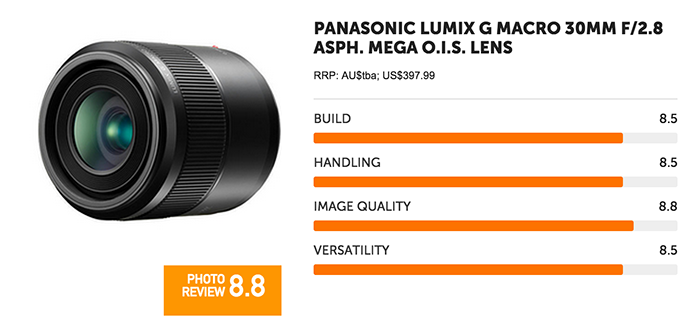
The lens rating from Photoreview.
The brand new Panasonic Macro 30mm f/2.8 lens has been tested at Photoreview (Click here):
Our Imatest tests showed the review lens was capable of exceeding expectations for the sensors of both the cameras we used for our tests: the Panasonic DMC-GH4 and the Olympus OM-D E-M1. Slightly higher resolutions were achieved with the E-M1 so we have based our test reports on images from that camera.
There was no evidence of coloured fringing in any test shots. Vignetting (corner darkening) was very well controlled and barely visible at the widest aperture setting. Rectilinear distortion was also effectively negligible.
Panasonic’s Lumix G Macro 30mm f/2.8 ASPH. MEGA O.I.S. lens is a welcome addition to the specialised close-up lenses available for M4/3 cameras. Offering the shortest focal length of the trio, it is likely to be the most affordably priced if US prices are any guide.
New Panasonic lens preorders:
Panasonic 42.5mm f/1.7 POWER O.I.S. Lens at Amazon, BHphoto and Adorama.
Panasonic MACRO 30mm f/2.8 MEGA O.I.S. Lens at Amazon, BHphoto and Adorama.
27 Responses
why would i buy a 30mm macro?
oh wait that´s 60mm equivalent with the tiny m43 sensors….. ok but for macro 90-100mm is already a bit short.
i bet they will sell a dozend or so….
I was expecting this to be less expensive. While it costs less than the Olympus 60mm the difference is not enough to make up for the reduced working distance. Hopefully the price will fall quite a bit after it has been out for a while. I am happy with my 60 and no matter how good it is optically would not want a macro lens this short.
I always take initial MSRPs with a grain of salt. They often drop at least 10-20% within just a few months. Given that I can’t see the demand for this lens being extreme, I expect that in a year it will be $300.
PL 45 still sells at $900 at BH/Adorama…
a little red dot is probably partially responsible for that.
not to say it’s not justified – it’s my goto lens for many things – macro, portrait, but also general purpose – with some effort it can be a great allrounder – and I’m always pleased with what I get out of it.
I can only trust your word on it, as well as my experience with the PL25 and the PL15.
I might be incorrect here, I’m no macro photographer but I heard that shorter focal lengths are more suited for food macro photography?
Yes, and still life too.
Good luck in trying to catch a living insect with a short focal macro lens. 🙂
Because you eat insects??
Longer focal lengths visually compress an object’s depth, shorter don’t, and longer focal lengths show less background, shorter more. That rule is just as valid for macro photography as it is for general photography, and it is valid even for insects – if you can get close enough. That’s why the ZD 35mm f/3.5 used to be on my list of things to get for my Four Thirds DSLR, although I didn’t actually buy one yet – it might very well be a Lumix 35/2.8 instead now, in addition to my ZD 50mm f/2.
Focal lengths does NOT compress anything. It is the image plane distance to subject that change perspective. Very basic geometry and ABC in Art. Only some idiotic photographers and videographers believe that focal length change perspective.
Focal Length does only one thing, it change the magnification. 15mm is half of the magnification of the 30mm. 100mm magnifies two times more than 50mm.
If you want to have subject same size on frame and you use 50mm at 2m distance but you want to use 100mm instead, then you need move back 2m so you are 4m distance from the subject. Now you have exactly same subject magnification, but because distance changes, your perspective is now different. Because subject magnification ratio is same, you have difficulties to notice that the perspective change is by distance change, not by focal length. Just by taking photo with 100mm from 2m distance would not do anything, it would be same thing as using 50mm and then cropping the image by factor of 2.
The magnification is as well known as “cropping” in post process, hence the name “crop sensor” or “crop format” when using 135 format as using same native lens means you get same effect as in dark room by cropping the image before exposure, without moving enlarger distance. Nothing else changes but you get just smaller print. Same thing as taking scissors and cutting a finished print to smaller size, cropping it.
The depth of field doesn’t change by changing magnification, as long the subject size on the frame stay same. Hence f/2.8 is always f/2.8 on the format, regardless of the focal length.
In macro photography at 135 format many preferred 100mm or 120mm or even 150mm macro. It was possible to get more distance to subject without pushing lens just couple centimeter distance. A 50mm macro on 135 format was already such that you were just like a 5cm distance from the subject, disturbing it.
Olympus 60mm macro is even more tighter, but has still same close distance, why many would like to see a 150mm macro from Olympus (or anyone to 4/3 format) to get the same benefits like on 135 format, but still two times larger magnification, allowing even tighter framing.
Just to repeat: Focal Length change does nothing to perspective, if you keep camera on tripod and you change focal length, you just change magnification and you will always have identical perspective. If you use same focal length and you move camera, you have different perspective and different magnification.
He’s not saying that is what is actually happening, he’s saying that visually it looks more compressed. I’m taking that to mean: take a 50mm lens and fill the frame with a head and shoulders composition, then take a 100mm lens and create the same composition with the same f-stop. The background will look different… more enlarged with less in it on the 100mm lens.
As I already explained, it isn’t the focal length, it is the camera distance.
Take a empty slide and move it back and worth front of your eye. That is what your lens focal length difference does.
Now move back and worth keeping slide same distance from your eye, suddenly the perspective changes and it is visually more pleasing or less pleasing.
When you find your distance and camera angle, then you choose your focal length to crop the view.
Damn. It was on film time so much easier to get people learn photography because there was not liars around claiming stupid things that focal length changes perspective making it more flattering or not, or that smaller film receives less light and other BS.
Sorry to object again, but smaller film does receive less light, all other parameters unchanged. People who cannot distinguish brightness from amount of light, i.e. number of photons, would do themselves a favor by being more humble in how they address others…
The thing is… when you are actually out taking photos, you don’t plan shots by saying crap like: I’ll just take portraits with this 35mm and make sure they are far enough away that I could then crop the image to make it look exactly like a portrait shot at 85mm. No… you determine that you are going to shoot portraits that day, and you grab your lens based on its focal length first, then you work with its physical distance from the subject. No photographer worth his salt is constantly doing heavy crops of wide-angle images to make a portrait instead of just using a lens that already does this for you, and also gives you better control over perceived DoF.
Completely beside the point. Focal lengths do change perspective – because they make you change distance and position to keep the field of view the same for an object that’s significantly closer than infinity. While that’s not always applicable for non-macro photography, it is applicable sufficiently often, and for macro photography it is quite the rule.
Focal length does not change perspective. YOU do. You move camera, You choose new perspective.
When young people learn to stop lying that focal length change perspective, new photographers learning curve comes down a lot when they know how they move is the reason.
It is same thing in art and everything else, photography is exactly same thing, but some people lie claiming perspective is changed by focal length.
Of course it is I who changes things – by choosing object, position, camera, lens, focal length, aperture, shutter speed, ISO, whatever. Who else? The Holy Ghost?
It is utter nonsense to talk about perspective in photography without accounting for field of view. Of course focal length itself doesn’t change perspective, but any photographer has to change focal length to change perspective without changing field of view – which is what’s relevant here, not your theoretical smartypantsery.
Cant wait to see the 42.5 f1.7 review. Pretty hot on that lens.
its nice for food,flowers & details …i like it!
Guess I’ll be holding onto my M43 lenses yet.. Just picked up a G6 for a steal: http://www.amazon.com/dp/B00EDN0PF0/ref=sr_ph?ie=UTF8&qid=1426783237&sr=1&keywords=LUMIX+G6
This camera is Tiny! Panasonic, make the GH4 this small.
Never asked for it. Don’t want it.
they didn’t make it for you princess.
Happy Birthday!
I’m sure they’ll cancel it now.
zzzzzzzzzzzzzzzzzzz……….
Looking forward to the 42.5mm. That one I’m sure I want VERY bad.