







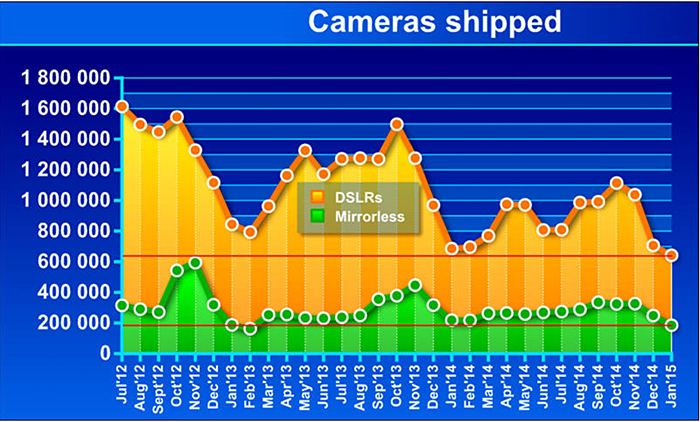
If you hoped that unlike 2014 the new year 2015 would stop the dropping system camera sales you were wrong. As you can see from that chart published by Personal View both DSLR and Mirrorless sales dropped in January 2015. The data is based on Japanese company shipment numbers (Source CIPA).

106 Responses
Almost every product sells less in January than in Christmas, that’s normal… What I see in that stats is more or less the same sales on January compared to same month past years, at least for mirrorless. Being in the middle of a economy crisis that affects the whole world this stability for me this is good news instead bad ones, imho.
Agree. It looks like mirrorless is steady. Which is okay in a market that is generally falling.
Whether sales are at sustainable levels is a different question.
With the continuing decline in DSLR shipments the big two will be starting to lose some of their competitive advantage of economies of scale and the ability to have their cameras in every retailer and store front.
I expect some retrenchment from them as they will find their current business models slowly becoming unsustainable if current trends continue.
It does not “look like” mirrorless is steady. The full set of numbers I have access to says mirrorless unit sales are down year-to-year, but price per sale is up (e.g. higher end cameras being sold). But what none of the numbers tell you is the discounting thing that’s going on, because that comes off of overall SG&A expenses, not something that we can track in the camera division of companies. It’s the Japanese companies’ way of hiding really bad news. Olympus SG&A expenses are still nearly 50% if we’re reading the numbers right. Canon’s and Nikon’s are going up, too.
I realize the interwebs like to say mirrorless shipments are “steady,” and I guess that’s true if “steady” means they have declined by two thirds since their peak. That’s some steady.
The interesting takeaway from this graph is that both categories are right about where they were last year to date. In a strange way that’s sort of encouraging…
> mirrorless shipments […] declined by two thirds since their peak.
If you are proponent of the DSLRs, you really do not want to talk about the peak vs. current of the DSLR sales.
The point is: mirrorless are still (slowly) gaining acceptance in the market, while DSLRs are losing it. “Slowly gaining” beats “losing it” any day.
Otherwise, my hypothesis was always that mirrorless wouldn’t survive unscathed the demise/reinvention of the DSLRs. Simple examples. Many retailers carry cameras because they still provide good sales volumes. But if the sales would decline beyond certain point, more and more retailers would find it cumbersome to deal with the cameras (and the photographers) and would stop selling them. Lesser retail presence would put pressure on the whole camera sector.
I think some of the manufacturers will eventually choose to sell their products through a select few internet stores only. Imagine the cost savings with a drastically downsized distribution network! That will offset some of the loss they are making because of lower sales in the declining market.
That would be an excellent idea. Eliminate distribution organizations and retailers would easily save them close to 50%, so they can cut costs by 25% to consumers. It’s a daring move, but since some of the vendors have little retail mindshare anyway it might not be a bad approach for marginal players.
Nope. The standard discount to stores is 15%. Some bigger stores and volume purchases with cash can get to 20% discount. So selling direct is not going to net them 50%. Moreover, there will be additional costs to doing so. Just how good is the customer service at ANY Japanese camera company? ;~)
That said, I’ve predicted for some time that at least one of the camera companies will attempt this. The two most likely candidates are Pentax and Olympus. Olympus has been offering as high as 6% in affiliate program revenues to some sites lately. So 15 minus 6 minus whatever increased costs they have (say 5%), means a 4% point increase in margin. That’s significant, but it isn’t going to make Olympus profitable.
The mirrorless religion is a strange one. No one ever claimed DSLR sales are steady. It’s the mirrorlessites who claim mirrorless sales are steady.
But somehow to point out a flaw in mirrorlessism means that one must love DSLRs and hate mirrorless.
Sorry, my friend, this isn’t a football match. Going by the graph, the percentage decline of mirrorless sales from their peak is somewhat more of a decline than that of DSLRs from their peak.
But that’s not what’s important. The hard truth is that somehow despite it all DSLRs are profitable, despite the precipitous decline. And mirrorless are not profitable.
For mirrorless to not be profitable year after year, their shareholders have to at least look to the future, which means looking for growth. The growth is not there and the profits are not there. Without a chance for growth, and hence without a chance for profits, sooner or later the mirrorless shareholders will be out for blood, despite the inane interweb claim that Japanese companies and shareholders somehow don’t care about profits.
Long term, the photographic hobby is in a tailspin. It will be a battle of attrition. The mirrorless vendors have already pulled out of markets where they failed- Sony pulling out of DSLRs for the most part, Olympus pulling out of DSLRs, Fuji pulling out of DSLRs. Yes, Japanese vendors DO pull out of unprofitable segments where they don’t see a potential for growth.
“It’s the mirrorlessites who claim mirrorless sales are steady.”
If you make a trend line over the last three years, you would see that mirrorless sales are flat aka steady.
“But somehow to point out a flaw in mirrorlessism means that one must love DSLRs and hate mirrorless.”
Honestly, outside DSLR conservative forums I haven’t encountered much of that. On some DSLR forum, even a simple mention that mirrorless camera can take images, can start flames “how dare you suggest that DSLRs are dying!”.
The “love DSLRs and hate mirrorless” comes most definitely from DSLR circles, because most mirrorless owners are at least ex-DSLR owners, while majority have both.
“Without a chance for growth, and hence without a chance for profits, sooner or later the mirrorless shareholders will be out for blood […]”
I see where you are coming from. If only camera industry had functioned by the US-style capitalism rules. But it is not. Counterpoint: there are very very few US camera companies. Even Europe has more of them.
Take the Olympus or Sigma or Fuji for example. Camera business for them is a small niche, barely influencing the bottom line. Especially for Olympus, it is the signature business. They are not going to stop making cameras – if only for the marketing purposes. They are seen in the market as “camera manufacturer” and it would devalue the brand to do otherwise.
Doesn’t change the fact that mirrorless sales are declining. That the decline is slower than in the DSLR world does not make it “steady”. Loosing 20% of sales in 2 years is not steady by any stretch of imagination.
You compare new technology with an establish technology. And you try to apply the same trend analysis to both. That just doesn’t make sense.
What does that have to do with anything? If I sell 20% less cameras this year, than I did two years ago, I’m not “slowly gaining” anything. If anything, I’m “slowly loosing”. Sure, “slowly loosing” is better than “quickly loosing” (DSLR sales declined 35% in the same period), but it’s still loosing.
If 20% sales decline is “going steady” for you, than you might as well call 35% decline in DSLR sales the same way. And all is good and rosy, right?
The trend is glaringly obvious here. Camera sales are dropping. All camera sales. Every year, less cameras are sold, no matter what type of cameras you look at. If you find it comforting that mirrorless lost only 20% in the same period that compact cameras lost 60%, that’s fine. Just don’t lie to yourself, that this somehow means growth.
Mirrorless cameras haven’t declined by two thirds since their peak,
You cannot compare different months as sales are cyclical with big increases (in shipments) a couple of months before holiday seasons.
Compare similar months in each of the last several years and they are fairly steady. There will be some outliers which can happen because of new product releases but the broad picture is that they are steady.
And the general trend for DSLRs is downwards albeit the trend is less steep than it was previously.
Peak mirrorless shipments: 600k
Latest mirrorless shipments: 200k
That, my friend, is a 2/3 decline from peak, spin it how you like. I understand to the arithmetic-challenged that somehow shipments are nevertheless steady, and that 600k = 200k.
That’s like saying Xmas cards sales have fallen off a cliff because January sales are tiny compared to December.
Compare month to equivalent month across the years. That’s why they produce graphs. So you can see the trends and not pick the highest month (which was an outlier) and compare it with one of the lowest months (January any year).
Anyone with half an ounce of common sense can see that the sales are steady for mirrorless and down around 30% for DSLRs.
Unfortunately common sense is not very common.
Sorry, I already commented on year over year shipments, which as I said from Jan 14 to Jan 15 are the same for BOTH mirrorless and DSLR.
However, also from the graph there is a huge drop from the highest peak to the lowest trough across all varieties, but for what it’s worth as a percentage the drop from peak to trough for mirrorless is a little bigger than the drop for DSLR.
I have no dog in this hunt, owning both types. Some mirrorless types seem to have a real Denial thing going, however.
I’m still not sure how you’re interpreting the figures. If we take the last three January figures for example, mirrorless is a little bit down on last year and a little bit higher than two years ago.
In fact they’ve been pretty consistent over the last two years, the only difference being that there wasn’t a large peak pre Christmas 2014 like there was pre Christmas 2013.
Look at the DSLR figures and you can see that nearly every month in 2014 the shipments were down on 2013 and likewise 2013 to 2014.
If you go to the CIPA site you can see that mirrorless shipments (from Japan) in 2014 were 99.5% in units and 112.5% in value compared to 2013 and DSLR shipments were 76.1% in units and 84.1% in value..
You can compare earlier years yourself if you wish.
http://www.cipa.jp/stats/documents/e/d-2014_e.pdf
Where do you get those numbers from? There’s no separate mirrorless data for earlier years than 2012 that I know of. But if you can point us to them, that’d be great.
From what we do know:
– 2014: 3.28 million cameras shipped
– 2012: 3.95 million cameras shipped
Which is what? 20% or so decline? Hardly 2/3.
BTW, this pretty much puts to rest the “mirrorless sales are steady” mantra. They are not steady, they just fall down from lower levels at a slower pace.
From the graph at the top of the page, which after all is the subject of this discussion. Nov ’12 peak, Jan ’15 trough.
But those are completely different months, comparing them is utterly useless. Sales don’t work this way.
PersonalView should include the trend lines into the graphs.
Most plotting packages include it already. But just in case:
http://math.stackexchange.com/questions/204020/what-is-the-equation-used-to-calculate-a-linear-trendline
They say they’re getting their data from CIPA, but it doesn’t correlate with what I’m seeing in CIPA’s annaul month-by-month production data: http://www.cipa.jp/stats/documents/e/d-2014_e.pdf
Based on that, DSLR production fell to 76% of last year’s while mirrorless held steady world-wide, DSLR fell to 65% of last year in Europe and 75% of last year in the US while mirrorless grew 8% of last year in Europe and 18.5% of last year in the US. Encoraging for mirrorless and hopefully mFT as part of it.
CIPA reports both production and shipment numbers. The graph is about shipments. And it’s the worldwide data.
The document you linked to reports the total numbers for 2014, not the monthly numbers. Look at the documents for each month, and you’ll see that it fits with the graph.
http://www.cipa.jp/stats/dc_e.html
Manufacturers need to stop holding back camera features phones are so good now many people don’t see the advantages..perhaps because they are just not enough advantages
Even then, convenience trumps features. Only people who are semi-serious about photography actually use the features and drag cameras and lenses with them. It’s too late trying to sell system cameras to the masses – maybe something like a GoPro or drone camera would find its niche but that’s it. Current sales are driven mostly by enthusiast and their number and upgrade cycle are more or less constant.
Maybe because it was christmas and the chart shows shipped cameras, and also last year we didn’t have any shipments to the store I work at?
Maybe because there is no reason to buy a new camera body every 1 or 2 years…
Why would it not fall? There is nothing new in the market!!! Olympus is still using the same old sensor for a new camera with new gimmicks. No reason to update. Panasonic has nothing new (oh wait, they have a useless selfie camera…). Fuji has nothing new. Nikon and Canon just don’t care. Sony seems to not want to launch the A7000 but did launch the A7II which is the only truely interesting new product in the mirrorless market.
So the A7II is not “still using the same old sensor for a new camera with new gimmicks”? Prejudice? I guess anything FF is just so interesting!
Sony’s sensor is like 1,5 year, Olympus is at least 3 years old, and no, in-body stabilization for a FF is not gimmicks. FYI I shoot M43, but if Sony (ever) puts out an interesting A7000 I will be jumping ship!
Cameras selling is seasonal. Looks at the curve of the two past years : after the Christmas feasts, there is always a plunge. There are high in summer and for Christmas. I find the flat curve of mirrorless sales before Christmas much more worrying. Although it may perhaps partially have something to do with the few new models issued during that period.
Well, you have year to year numbers as well. And they are as pessimistic as the rest. Mirrorless sales are shrinking, so are DSLR sales. It looks pretty bleak for all involved.
Mirrorless sales didn’t grow, but at least Oly and Pany improved their situation by switching to sell higher-end models. Sony just went full firesale mode with the A6000.
Can we actually tell with any degree of certainty that this strategy worked?
Agree on the Sony, with aggressive pricing, they actually managed to switch places with Olympus in just two years (so much for Olympus’ promises to finally stop bleeding money). So, firesale pricing that might be, but it obviously works, in terms of gaining market share.
I would say that the difference between shipments in those October, November and December periods are more telling than the January month. January is always a low month based on the chart but there is a big decline in those fall/winter months from historical levels. But nothing new has been introduced so that could explain it
So the big question is: will mirrorless eventually eat away the DSLR market?
Nope. Smartphones will eat away both. Eventually DSLRs will be mostly used by professionals. Mirrorless will be pros and enthuiasts.
The original year over year data:
http://www.cipa.jp/stats/documents/e/d-2014_e.pdf
shows the world wide values on the left
Interesting ist that:
1. Numbers are going more down than revenue. (revenue per camera is going up)
2. SLR is down 15%-25% of last years values (revenue, numbers)
3. Mirrorless is stable in numbers of cameras
4. Mirrorless is up 6% (shipment) 12% (production) compared to last years revenue
5. Largest growth for Mirrorless is in the Americas (up 44%)
Over all it seems that mirrorless is holding position in a shrinking market and gains marketshare. On the other hand, mirrorless is not Oly and Pana only like a few years ago. The numbers are not telling how the marketshare of MFT is developing.
The whole DSLR vs mirrorless thing is an artificial construct that is basically obsolete. As though the viewing system is the most important distinguishing factor.
What this all REALL comes to is Canon+Nikon vs Everybody Else. Or it means the Profitable Camera Companies vs the Unprofitable. After all, simply DSLR vs Mirrorless doesn’t mean much to Samsung if 65% of mirrorless just means Sony… not if Samsung’s goal is not to so much to make Mirrorless the Established Religion as it is to displace Sony in the marketplace.
I know of no other industry that breaks out numbers like this. It would be akin to automobile reports of SUVs vs non-SUVs, or something equally arbitrary.
Anyhow, just my opinion, guys.
The auto industry reports numbers in the US, and by model number every month. And that’s sales, not shipments. They don’t report shipments generally, though there are sources to see current inventory.
Cars have to be registered, taxed, insured etc by law. There’s a very long audit trail for them.
And not many people import their car from Hong Kong or China and if they do they have to register it and raise lots of paper work.
Unless you’re suggesting it becomes compulsory by law for everyone who buys a camera to register it as the owner (worldwide ? ) I don’t see how you can get accurate sales figures.
I’m nor suggesting anything. The OP said he knows of no other industry that reports numbers like CIPA does. I do. Several, as a matter of fact. I used the auto industry in my response because he mentioned it specifically.
If you don’t think that accurate sales figures exist, then you’re seriously underestimating how much private information is available on transactions, though it is generally congregated to follow law and protect individual identity. Thing is, that data is FOR SALE, not given away freely.
Cars as an example need license plates in almost all countries which means there is a registration authority that knows how many and which cars receive new registration. And it normally knows how many of those were registration of new cars. Not every country will release those data but the vast majority will do (with varying degrees of detail).
Another example is cellphones where the network providers know how many phones are connecting to their networks.
Well this is shipments not sales. What this could be saying is that camera makers are finally focusing on profitability. Rather than overproducing cameras and selling them at fire sale prices later they are now lowering their production numbers and taking the “risk” that demand outstrips supply. This could mean that we don’t see price declines as dramatically as we have in the past.
I wouldn’t expect to see the shipment number spike up until a new sensor with real updates is released. Until then a camera manufacturer should not be expecting any significant increase in sales.
Sales numbers are also down. Way down. Perhaps more than shipments. As far as I can tell, at least in the US and Europe the camera companies are still overbuilding to demand.
Apple knows how many people will buy the 16gb iPhone, and how many want 64gb of the same model, and these guys cant figure it out how much demand is there for a single differentiated model
Apple has strong control over its distribution channels to the point where they can (and do) perform hourly reallocation in the manufacturing channel. They’re a strong example of a company that has very tight and Web-based integration of data from the retail channel all the way to the supplier chain. You can thank Tim Cook for that.
NikonUSA, for example–which remember is a subsidiary of a subsidiary–has no centralized database that does that. Instead, they survey dealers weekly on what they’ve sold, getting both incorrect and incomplete data in doing so. On top of that, you have a corporate philosophy that has long promoted channel stuffing as opposed to demand-driven production. In short, they got what they deserved when the sales momentum turned. Not that Nikon is unique in this. Some of the Japanese companies are slightly better, some worse. Who is the Japanese Tim Cook?
IF we look at purely the technical chart for both sales groups we see that in Jan 2015 BOTH groups were testing new lows for shipments….now there is always a led to lag relationship in charts like this but…..both groups are trending downward strongly. Mirrorless testing the old lows of 2013 and DSLR breakng the old lows of 2014….this is more reflective of the entire market being very weak. Now I just returned from an assignment in Geneva and was shooting with the Apple iphone 6 for video and stills as this was a press event. Video was great, simple and the stills the same. I had my DSLR with me and it almost did not get used for stills.
What Iam saying is we need to over lay sales or shipment data for smart phones like Apple or Samsung high end models. Apple 6 has “IS” and it made a great difference in final output.
Uploading on the fly…again a no brain’r I see mirrorless as pushing prices higher and that will stall sales there….DSLR is again behind the curve for delivering any value added reason to by a new model kit. Things look bleak for camera companies in general.
I just spent the weekend with a 10 architects who were away for a long weekend celebrating my sister’s birthday. It was an interesting location and we were staying in an architect designed house. They are allaged around 30 with money to spend. I was the only person there with a camera that wasn’t in a phone. They all took plenty of photos and they all used iphones and other smart phones. They were sharing them via social media. The pics looked fine on phones but poor on my larger computer screen, but it seems that a lot of this generation of designers, aesthetes that have money to burn are just not interested in anything more than iphone photos.
No wonder the sales are sliding.
It wouldn’t suprise me if they carried on dropping.
of course if apple were to release a standalone camera, they would probably all buy it 😉
Apple already has a stand-alone camera, it’s called the iPhone. They don’t need a stand-alone camera platform. If you listened to reports from Apple, their priority is improving the camera system and I believe is their number one priority for new models as the number one camera in the world is the iPhone.
This is what the camera industry fears especially when they see people using iPads to take photos and what you stated about the younger crowd. The convergence market is 4k and higher video and rugged go anywhere devices like the GoPro, etc. Stablization ranks in there IQ ranks higher.
Yes, that is what the camera industry fears. Apple and Samsung alone can essentially wipe them out. However, they seem PARALYZED with fear. I’m not seeing them respond to what the users want.
Agree but also they are trying to have their cake and eat it too dripping out advancements and don’t know where the market is headed. Like MP3 consumers knew and record companies were hanging on to tradition.
Like the DPreview interview with Olympus, consumers don’t have to understand the technology but know when something doesn’t look right ‘video’.
And that’s the crazy thing! I mean, I own a Galaxy Note 4. I L-O-V-E this phone! But I use it with my XE2. I shoot with the Fuji, and shoot pics to my phone for instagram, fb, etc…
On top of that, I can edit photos on the XE2, then send them to my Note4, BUT it needs to be faster. The phone needs to be an extension of the camera. Apps need to think quicker, move faster. Because we all know, a REAL camera
IQ out performs a smartphone one any day of the week.
-smaller.
-cheaper.
-editable in camera.
-fast, seamless connection to smartphones and PC’s.
Yes that is a cultur change. For decades photography needed a photo-camera. Now a smartphone is enough. It can serve the major needs to share photos witz relatives an friends.
The remaining customer group are foto enthusiasts. The number of these people is dropping! So companies have less customers. And the remaining customers shall spend more money in photography and by more expensive Pro-cameras with bigger sensors.
When I go on a trip with my architect friends they all bring their Nikon Dx000 or Canon Rebel with 18-55 or 18-105 lens.
To them a DSLR is a DSLR end of story. Little do they know you can get the same IQ from an RX100.
Sorry, no. You can’t get the same IQ from a Sony RX100 as a DX/APS DSLR. Not at base ISO, not at high ISO. And let’s not talk focus. That said I own and like the RX100, but it isn’t what you say it is.
Not the same .. better 🙂
http://www.digimanie.cz/recenze-zrcadlovka-vs-kompakt-canon-eos-1200d-s-18-55mm-vs-sony-rx100/5957
The last big foto session for my 10 year old Nikon D70 was a Friend who was building a House. He always take pictures with his phone but for the pictures in the house, he borrowed the D70, with a 12-24 Lens, and a big Nikon flash. With this equipment, he could much better document how the house was build and where to find cables and stuff in the walls.
Even that old “iron” was producing so much better pictures under difficult conditions, that the phone couldn’t compete at all.
Mixing flash and natural light, heaving a pretty good wide angle lens and a viewfinder is a completely different league.
I’m sure, your architects know what they need if necessary.
There was a survey in I think it was Finland concerning what is most important in one’s life:
1. Smartphone
2. nice partner
3. nice job
Smartphone is THE toy of this century: child, adult, sex, rich, poor, religion does not matter. The smartphone is the only thing we all have in common – and we all love it!
Why would that worry A consumer? Sure a company might be worried but how many cameras are bought doesn’t make a difference to me. Hard times means more competition and the companies will hopefully have to try harder to improve on last year’s model instead of relying on a large consumer base to suck up whatever craps they push out.
People seem to forget we went through this before in the 90’s. That isn’t exactly what happened then, and it won’t happen this time, either.
Why indeed should it worry a consumer that their lens purchases (and to a lesser degree camera purchases) loose most of their value as no new camera bodies are released for their system, as it happened with Olympus, Contax and Leica (or most MF systems: Bronica, Contax, Rollei, Pentax 6×7, Hasselblad V and 20x series, Mamiya RZ6x7)?
If you buy well, you shouldn’t worry about the re-sale value of your gear, just how much enjoyment you will get out of it. And those are all film systems.
Contax, Leica, Rollei and Hasselblad V & 20x each had a digital body or back (you can still buy digital backs for the two Hasselblad (6×6) systems but those backs are really afterthoughts, they are updated much more rarely than the backs for other systems and are all cropped systems, at best they reach 90% of 6×4.5).
But digital or film doesn’t matter. When a system is discontinued, your equipment looses value. Of course if by ‘buy well’ you mean don’t buy systems that get discontinued in the future …
dweller88…. i was on roads with my “old” Lamborghini Gallardo… and jet… surroundet
from all sides big 2000 kilo SuV- ( how to you say to Bratwurst in english? maybe sea-cow..:)
so for 30 minutes could not realy move, and then was a bit dangerous to rebreath…
they do not see you… in this big high fish-aquarious-4-wheel-city-farmer-cars..
the marketing says the people jump ( body-smartphone-gadgets… = slave 3.0)
and the other thing is, if we see a 1inch sensor and fine minioptics in the thin thin
tampoo with monitor and the may be posibiliti to make a call use the telephone in
REALTIME ( 1900 marconi the idea to comunictate in realtime over 1000 miles..)
but..now.. send a 1980ties messnger 3 corner information ( sit on the toilet..) 🙂
so in 4, 5 years a camera will be the same expensive thing we would see in 1877
if we would made a p h o t o from nerdisch general custer ( he did not know the
mathematics of paraboloit catastrophes and..okay..:)
and third is the last attack from china– the 4k aps-d 4/3 1 inch armade of nobutget.
” waht is the sound of breaking necks— dow jones canon nikon samsung fujji…..”
another is that:
the 30 agede hipstis do not know anything behind the natural timeline
…this is.. 1 9 8 5…..oh my good i am old… upss. did sseee the googel egg, sry
car in last second… bella rabiata.. but fine.. oh..the konserve-fish inside ( hipsti)
looks a bit afraid, the v10 in my car is abit… wooooooooooooooooooooooooooorrrrr
blodyy real lifffffffffffffffffffffffe.. bromm sprotz……
Are you one of those few people paying money to take a rocket to mars?
and last… cameras are hard in progress not to get down.. was in chile with
stoneaged d5mk2 and ( 3kilo over 15.000 fts is to much weight..)–but
this damed thing does not want to fall in pices…
Besides smartphones and stagnant technology, I have a more mundane theory.
Everything than can be photographed, has been photographed, thousands of times over. Photos have become so ubiquitous that your pictures of flowers or mountains are simply not going to interest anyone, probably not even yourself, anymore. Whatever unique thing you go out and photograph, someone else already did it, posted it online, and a thousand other people already saw it. With very, very few exceptions, people are simply not wowed by photographs anymore.
I noticed this when I watched people as they looked at online photo albums. They simply flicked though each image, spending maybe a half a second on each.
True…but consider this….we still have a massive shortage of cat pictures online. This ALONE is enough to keep the barrage of new system cameras afloat for another decade.
That was the same argument from 30 years ago. Back when polaroids were popular, people were saying there was no more use for SLRs because every photo that could be taken was already taken. The only exception was “personal” photos, which is where polaroids fit in.
I do agree to a large extent – I think there is a huge issue still and that is since everything is digital now – hardly no family pictures end up on paper – most all extremely valuable family images etc end up on some laptop and in many cases it gets lost or stolen or the hard drive crashes – and all lost – so in the old days of film when folks printed out everything they where better off in many ways –
Now hardly no one goes to a portrait studio photographer – which is a shame – and well worth it – now just lots of low quality selfies and poorly composed and lit images on hard drives with no organization – and big % gets lost –
yes folks now days just do not appreciate photography the way they should –
So I agree that has to do with sales a bit – cell phones also – but also high prices on system cameras – folks do not bother buying the small compacts anymore a they now the quality is not much better than their phones – then they do not want a Canon Rebel DSLR due to bulk and size but would like a system camera but not that much selection under $500 – and very very few lenses under $500 – so no interest – I think if the OMD-EM10 was $499 with kit lens it might get many potential Rebel buyers to get it instead –
Poor quality snapshots have been with us since the earliest days of photography. The difference is, as you stated, very few are printed anymore, so there will be no shoebox filled with photos to discover in the attic 20-30 years from now, just stuff stored on phones or ‘in the cloud’ that will simply disappear when we pass on. I agree, it’s a shame.
When Sith return, different will story be. Much to photograph when new Force War begins.
Why would other people look at your pictures.
Or even worse, look through yet another online set of “street photography,” as though random furtive photos of strangers walking along- and only unthreatening strangers at that, being women and old people and bums- the same set that can be taken tomorrow and the next day and the next. The lack of composition or focus or interest is supposed to be a plus, because street.
You tried it, but decided it’s not your cup of tea, right?
I think price on M43 gear is a contributor – Canon and Nikon primarly are still pumping out $500 DSLR’s around $500 with a kit lens – sales on the Sony A6000 have been strong – I think most beginners and new buyers would pick system cameras once they where shown the advantages – particularly the size – but there has not been much selection for $500 with a lit lens – except the simpler Panasonic and Oly’s and older gear for example – a great starting camera would be the Olympus OMD-Em10 but the body only is $600 – the old EM5 is likewise $600
the Sony A6000 is around $700 – the nice Panasonic GX7 is $800 – so I think a lot of folks will say I will live with the extra bulk / size and get a Canon Rebel T5 for $399 with lens – APS-C sensor – then for $100 they buy the nifty fifty – and they are still way under $500 –
I really think Sony – Panasonic and Olympus have to lower prices a bit – yes old timers and more advanced users will fork out the extra cash as they really appreciate the advantages –
So why now should Canon and Nikon jump into system cameras when they are still selling these Rebel type DSLR’s just fine – Fuji is a bit of a class of its own – they cater to the purists –
but when the price of the NEX6 came down and the A6000 they really started selling well –
for the longest time Sony was still selling the NEX7 for over $1000 while the much much better A6000 was selling for $799 both with same kit lens – just crazy – the NEX7 should have been a $500-600 camera long time ago – yes cell phones play a small part with their better cameras but price on system cameras just has to come down a bit –
Yes the Sony RX100m3 is nice but $800 !! while the Canon Revel T5 sells for $399 and is APS-C vs 1 inch sensor – given that the sensor is one of the most expense item in the body –
just does not make sense – the RX100 me should be a $500 item –
Consumers may be saying they will live with the extra bulk of DSLRs because of price, but they are also saying they’ll live with DSLRs because of greater and cheaper lens choices new and used, superior all around performance, superior autofocus, longer battery life, real life viewing not rendered via a little TV, lenses that are optically corrected and not deliberately uncorrected to save costs and only corrected in software, and the knowledge that the vendor is viable and likely to be around for some time to come.
If Mirrorless sales are dropping, you can best Believe M43 is dropping even more in the mirrorless segment, While Sony, Fuji and Samsung (in the States) are taking the forefront. PRICE is really killing M43 as well as Size is no longer a key attribute for M43.
Sony now has Ibis, whether its better than Olympus’s own is debatable, but it’s still there. So is 4K. I think Price and the Seamless integration between smartphones are major factors. Yes, you can take better pics with mirrorless, but getting it to your smartphone needs to be instantaneous.
Lens size is no longer a factor as well, unless you’re Panasonic, making an even smaller M43 line-up, which I think is very smart. Show the REAL benefit of M43: Make it even smaller than everyone else. Can you Imagine a GH4 in a G6-sized Body? -WITH IBIS? That would be a Killer camera for videographers!
And MARKETING. Marketing is also Key.
Sorry but lens size still matters. If you compare a full frame lens with equivalent m43 it’s a huge difference. There is no way with current tech to make full frame lenses much smaller. If you want to have two constant f2.8 lenses (24-70mm & 70-200mm) the difference in weight is massive compare to the m43 equivalent. As fo small m43 bodies, there’s a pretty big range to choose from. From the large GH4 and E-M1 to the tiny GM1 and GM5. I do agree pricing is too high for m43 when budget DSLRs cost hundreds less.
Lens size obviously doesn’t matter to most consumers…
Lens size obviously matters to most m43 consumers. What’s the point in Sony producing the A7 series when you have to stick huge lenses on it?
Quality? ;~)
Oh Thom.
Size matters to most m43 consumers — a very specific segment that somehow became extremely size and weight obsessed. To the general camera buyer, it’s hardly a factor.
That’s why so many people are turning to their camera phones. Because they don’t care about the weight and size of camera / sarcasm/
yes but to be fair the smaller aperture m4/3 lenses as they get closer to the equivelance of a full frame do increase in size…as well as price.
Compared to FF the difference is visible.
But we should compare to APS-C and here the difference is much less striking.
Panasonic is doing the right thing with GM and the electric pancakes. Personally I’m not a huge fan of focus-by-wire and I hate power zooms. But you can’t argue with this:
http://camerasize.com/compact/#570.397,521.332,580.111,ha,t
Olympus as before makes a system around a small sensor and very good lenses, but both are almost in the FF price range. Why? 😮
Not directly. You referred to equivalent but meant the same f-stop.
It just the other way round. Sony is dropping in Japan and Olympus is rizing!
m43 is the leading System in mirrorless Sector all over the world. They have the biggest market share.
So what are you talking about??
I believe many now are content with the camera they have and iterations of cameras are not interesting to buy. Take the EM5: OK, the EM1, EM10 and EM5mkII are better cameras but not that much better. Why waste money on the latest iteration? Go some place photogenic or buy another lens instead!
And how much do we need to bother? I do not own a m43 system any more, but it has everything now: small cameras, bigger cameras, cheap lenses, expensive lenses, zooms, primes, heavy lenses, light lenses, long zoom coming. Great! As it is! Much better than, say, Nikon APS-C DSLR lens assortment. No wide angle primes there.
Oh – what about tilt/shift lenses? Nothing yet on the m43 horizon.
Since DSLR sales dropped about 30% from 12/2013 to 12/2014 and this chart shows them flat, somebody is smoking something they aren’t sharing.
So what are you smoking on? This is a chart of shipments not sales…
So you think they sell more than they ship?
Worldwide DSLR shipments dropped 27% from 969,500 in Dec 2013 to 706,635 in Dec 2014, and that’s reflected in the chart above. You misread the chart somehow, the dot for Dec 2013 is placed right below the 1,000,000 mark.
This is silly stats. I already have all the cameras I want for now or have time to use. Instead I buy lenses.
The state of the photo market would be much better described by including statistics on lens sales. Just about all the lenses I have cost about as much or more than the matching cameras. The number of lens is many times camera sales… at least for the enthusiast market.
… then there is the question of whether a company makes more profit on a camera or a lens.
CIPA reports data for lenses too, and lens shipments are declining at about the same rate as camera shipments. In fact, the ratio of lenses to cameras has been stable at about 1.5:1 for many years (the ratio is likely higher if we exclude entry-level buyers).
The argument that you already have the cameras you want is irrelevant. At any given time, there will always be those like you, and there will always be others who will be looking to buy a new camera. All consumers aren’t synchronized in their upgrade cycles.
The state of the photo market really isn’t very encouraging, and that picture isn’t changed by including the data for lenses. If less people are buying cameras, then less people will be buying lenses too.
Not necessarily. Cheap DSLR and mirrorless are a relatively recent invention. Thus one should check for growth parts of the cycle and stabilization parts. Meaning that initially the shipments may hve been high as people uptook newly available technology and now are stabilizing.
You have to do a full and proper analysis to prove that smart phones are not just correlated with adjustments to the cycles of new camera tech.
Personally I would be quite happy with slower pace of camera releases… after all, I do not need to change my equipment every 2 or 3 years.
Ooooooh camera sales are still dropping! Still dropping! Doom is upon us!! Of course, you completely ignore that sales go up in the middle and are in the same place at the end, meaning that the market is completely stable. But facts aren’t what we report here on 43rumours. Quick, somebody filed a patent… post it as sure-fire lens to be produced within the next month!
“But facts aren’t what we report here on 43rumours”
If it’s a known fact, then it’s per definition not a rumour.
Also, regarding the camera market: it really IS declining, and very dramatically too. Mirrorless have been basically flat for a couple of years, DSLRs are slowly declining, and compact cameras are steeply declining. As a result of this, the camera market as a whole is also declining. The CIPA data backs this up.
It doesn’t take a genius to figure out the reason for this. As Craig points out further up this thread, dedicated cameras are losing the war against mobile devices. The camera market will eventually settle and become stable, but it will be a much smaller niche market than it has been for the past 15 years, mostly catering to enthusiasts and professionals.
No wonder, no true innovation for a long time. Still no ISO 100 or lower for MfT, still 16 MP. I’ll be getting a good old T2i for my telephoto needs. With the 135l costs me about as much as the Oly 75mm. Haha.
People aren’t buying cameras because the ISO doesn’t go lower than 100 or the resolution isn’t >16MP? All they do is share photos on Facebook or Instagram — more resolution isn’t a problem and I can’t imagine they ever need to go lower than ISO 100.
The fact is that smartphones are easier and people always have them around. If they want low DOF shots, they probably have an older digital camera that can provide it, but they generally don’t use it because it’s more of a hassle.
More people are taking photographs than ever these days. We live in a world where you no longer need a “camera” to take a photograph.
All this chart shows is that camera manufacturers are fighting for those individuals who choose to do so with a camera. It misses the point that people don’t need or want a camera to take a photo and have abandoned or never adapted these devices in favor of phones or tablets. It is a classic example of winning the battle but losing the war.