









[shoplink 52097 ebay]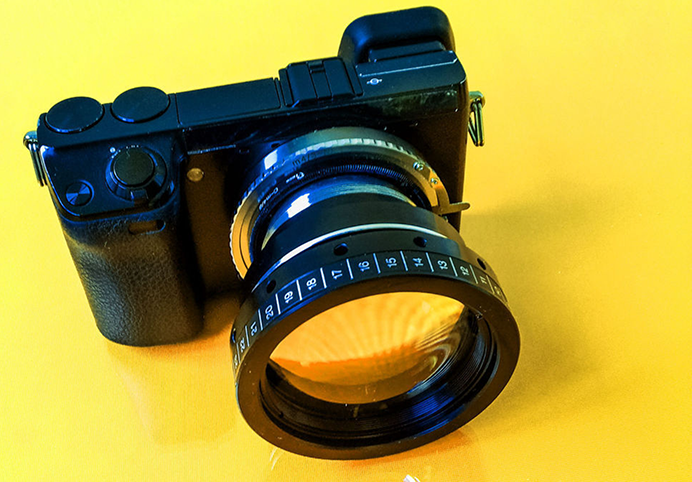 [/shoplink]
One of our reader found that Rayxar 42mm f/0.75 lens that has been modified to have a native Micro Four Thirds mount. It’s for sale on [shoplink 52097 ebay]eBay Germany (Click here)[/shoplink]. The picture on top shows it adapter on a Sony NEX camera via E-mount to MFT-mount adapter.
The German text says:
Vom Fachmann wurde in einem One-Off-Auftrag passgenau ein Micro Four Thirds-Bajonett angesetzt. Damit ist das Objektiv direkt an jeder MFT-Kamera einsetzbar (shortly translated: An expert person modified the mount to make it native MFT).
This is now officially the fastest native Micro Four Thirds mount lens you can buy!
28 Responses
This ir originally C-Mount?
Probably originally for some sort of scientific instrument like an X-ray machine.
I would be surprised if it even has a focussing helicoid, or is able to achieve infinity focus.
Any of these ultra-fast adapted lenses that I’ve seen have typically only been able to produce blurry macro photos.
My question is because probably in M4/3 and E-Monut dont cover the sensor and can vignettig.
I think it covers much more than m43 sensor area.
some C-mounts do actually cover 4/3″
Yep – a quick googling says this is the lens of an x-ray machine, with no focusing or aperture controls. With the rear lens element in place, It’s such a close fit that you can only use e-shutter; and that way it only does macro. With that lens element removed, the focus distance is about 2m, and with it reversed, it gets sort-of infinity. That is some hardcore manual focusing 😀
I think it’s so funny when people cover up camera brand names with tape. FYI it looks even worse and nobody cares what kind of camera you have. Get over it.
Sometimes when you have the lastest new toy ppl easily bother you and come asking useless questions about it. That is the reasoning behind it all to do it.
When I want DOF this shallow, I think I’ll just stick with my slower, but infinitely more usable, fast 35mm lenses on my A7. I have a slight feeling that an FD 85L will surpass this lens wide open.
Isn’t calling this “native” bit of a stretch? 😛
It was adapted for m4/3, but by no means designed for it.
More BS from ‘Ale’
This listing (181689135208) has been removed, or this item is not available.
Please check that you’ve entered the correct item number
Listings that have ended 90 or more days ago will not be available for viewing.
zzzzzzzzzzzzzzzzzzzzzzzzzzzzzz
A beautiful lens, but the link seems to be broken.
I found it works on mobile devices for some reason…
So, basically an 85mm f1.4………….not exactly rare, quite common in the real world in fact
You forgot the 70cm maximum focus, that’s the “special feature” of the lens. Crap like this is definately not interesting for 43rumors and only clickbait for another sponsored eBay-link.
Exactlly, thats why I don’t use 35mm sensor because it always has 2 stop light loss because larger area. With 4/3 all light can be focused to sensor and gain 2 stop mroe light!
wth non-BSI sensors, f/0.75 provides only marginally more light than f/0.95 (which already suffers heavily from pixel vignetting)
Not sure about the difference between 0.95 and 0.75, but I think people interested in these lenses actually appreciate this kind of suffering.
It’s the same difference as that between a f/1.9 and a f/1.5 lens, or, more common, a f/1.8 and a f/1.4 lens, which is 2/3 of a stop which I wouldn’t call marginal. And I know that while I used to be quite happy most of the time with the amount of background blur the Summilux D 25mm f/1.4 produced, nowadays I often wish there was more blur to get out of the M.Zuiko 25mm f/1.8 (a lens which I do like very much nonetheless because of its sharpness)…
Only numerically. Except A7S sensor with thick pixels, or BSI sensors, increasing f-stop to extreme doesn’t raise T-stop to the same degree
http://luminous-landscape.com/an-open-letter-to-the-major-camera-manufacturers/
Right, that’s true for brightness, but brightness is not the only reason which may make someone want such a fast lens – and DOF is determined on F-stop, not T-stop.
Otherwise good but that has been known for far before 2010 when that article has been written. And that light loss has been told by manufacturers like Olympus very early when they designed 4/3 sensor. That light loss is one reason why 135 format is dead on digital era.
Example: http://four-thirds.org/en/fourthirds/index.html
It is very well told what is the problem. And that problem is very well know as well for everyone who have basic photography knowledge, that everyone gains when using pinhole cameras. But many doesn’t have basic knowledge of photography and then they believe idiotic claims about “you need to multiply aperture based sensor crop” and blaa blaa blaa. Because they have never really worked with a real camera in its most basic principles.
Pretty cool. Found this link: http://oldlens.com/delftrayxar50f075.html
Can someone please put another picture of the lens in the article. I don’t want to see an ugly Sony camera. Have to eat lunch and now my appetite is gone.
check http://www.ebay.de/itm/181682338715?ssPageName=STRK:MESELX:IT&_trksid=p3984.m1555.l2649
The listing has been taken down so no decent pictures to view.
This is an old lens so assume completely manual. A lot of these lenses are M42 screw (or M42 under their original mount adaptor) which is very easy to adapt to MFT with or without an extension tube to adjust the (mirrorless) back focus distance.
It’s a fast lens but is it a good lens. Some of these old things are just three pieces of mediocre glass with a big hole making for a small f-number.
De Oude Delft Rayxar are industrial grade lenses from the 1960’s, a number have been converted to fit MFT. Example review – http://marchill.org/apollo/index.php/news/158-de-oude-delft-rayxar-e50-0-75-lens