









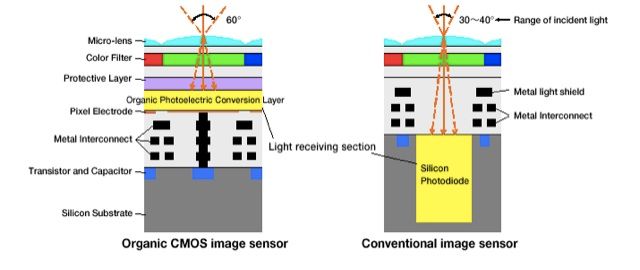
A “source” at DChome reports that Panasonic is in charge of production of the new organic sensor while Fuji will offer the full technology knowledge in exchange. But we still don’t know when the first organic sensor will find their way in Mass Production MFT cameras…
Reminder:
On paper the new Organic sensor has the following advantages over conventional sensors:
1) it has only 1/6 of the thickness of the current sensors
2) Increased Dynamic range of 88dB
3) 1,2 ISO stops more sensitive
4) range of incident angles of 60 degrees, efficiently utilizing light entering at an angle for faithful color reproduction with no color mixing. It also gives greater flexibility in lens designs, facilitating the reduction of overall camera size.
The full press release can be found here: 43rumors.com/hot-news-panasonic-and-fuji-developed-the-first-organic-sensor/
—
For sources: Sources can send me anonymous info at 43rumors@gmail.com (create a fake gmail account) or via contact form you see on the right sidebar. Thanks!
To get notified on all upcoming news and rumors be sure to subscribe on 43rumors here:
RSS feed: http://www.43rumors.com/feed/
Facebook: https://www.facebook.com/43rumors
Twitter: https://twitter.com/43rumors
GooglePlus: https://plus.google.com/+43rumors/posts
Rumors classification explained (FT= FourThirds):
FT1=1-20% chance the rumor is correct
FT2=21-40% chance the rumor is correct
FT3=41-60% chance the rumor is correct
FT4=61-80% chance the rumor is correct
FT5=81-99% chance the rumor is correct
101 Responses
Cool!
I’m sorry, but cheerful and positive responses are generally frowned upon. You need to show inventiveness in concocting grounds to criticise. You get extra style points for stating imaginative extremely narrow use cases that renders the announcement unsatisfactory for you ‘special’ needs. Bonus points can be gained by suggesting what the manufacturer really should have done instead.
So the photodiode is 1/6 of the thickness, sensor being as thick as previously.
Pixels Dynamic Range is improved to 88dB (or by 88dB?).
Exposure range gains 1.2 stops so we get 14 stops in future as now we have 12.7-13 stops exposure range (deepest shadows and brightest highlights captured in single exposure).
Allows higher angle light transmission, while the current lenses allows telecentric designs already where light hits sub-pixels directly.
We get to grow capacitators making sensor capable over 70% quantum efficiency (m4/3 being around 65-70% and FF being around 55-60%) that can be raised easily with thicker photodiodes.
88 dB translates to 14,66 DR stops, better even than Nikon D810’s DR.
I can’t wait for this technology to see the daylight.
Yes .
Definitely .
Stop wasting $$$$ on CMOS cameras , let’s wait for this Organic tech to take it’s place .
I will definitely buy Gh5 when arrives, with organic sensor or without. 🙂
Olympus will probably still be the better M43 stills camera for the most part but lag behind in other areas as we have today, namely ‘video’ IQ.
Video continues to be an issue for OLY and I think they are underestimating its future importance.
I don’t care about Olympus, Panasonic produces equally good if not, more detailed pictures.
I’m very interested in better 4K, in good and low light. Olympus is totally out of the question, they’ve prove that not even in 2015 Full HD can look decent.
I’m loving my Foveon camera in these days 🙂
PRECISELY. I have the 3 Merrills… and am thinking whether it makes sense to also get the SD1 Merrill (I can get it new for just under $1000).
I can’t say, it depends on your photography. 🙂
I had my dp2 Quattro since a month, and its colors, details and 3D rendering are stunning. I’m looking forward to buy the dp3 also, and waiting for the Sigma loupe to shoot it under bright light.
These are not cameras for everyone, and definetly they are not swiss knives as m43 cameras: you nee to slow down while taking the photo, and once you are back home and can look at the files on a good screen, you can only smile and pixel peep in search for details you didn’t notice when taking the picture.
Now, can you imagine a three layers Foveon Organic sensor?!
I can imagine a 3 layer organic sensor… I had the same thoughts 🙂 If the overheating problem is solved. I just hope that Sigma goes back to equal number of pixels in each layer. I am not keen on Quattro.
I am still learning with the Merrills and have played with the DP2 and DP3. All landscapes.
I was comparing the results between my older K5 II s and the DP3 M, same sea scape out my kitchen window, and thought at one time, damn the Pentax is close in sharpness to the Merrill RAW… in the next minute I realised that I was looking at automatically processed and sharpened Pentax image in DxO LOL 😛 … not enough coffee on the day.
The other thing I found is that now I just want to use the Merrills 😀 I lost interest in other cameras… aside from specialised uses as with m43. For what I want to do, I’d be happy with the Merrills for ever.
I am learning so I do not know fully yet what my photography will be… I guess I will get the SD1M… if I can part with the money in a few months.
http://semiengineering.com/still-waiting-for-iii-v-chips/
How do you get 14.66 stops?
I calculate like this: log₂(10^(88/10))=29.23, which is absurdly high (and ~2x your value, which means I missed an important 2 somewhere, but can’t see where).
Simple math, 6dB is one stop. 88/6 = 14,(6).
dB is a relative measure of power. Since sensors convert light into electrical current and power is proportional to current squared you should have used log₂(10^(88/20))
Good news .
Since the production is confirmed , likely make it’s debut in 2016 .
Better wait for this sensor for upgrading .
The end of CMOS era is not far from now on !
Not really, the CMOS names implies the analog signal in converted into digital directly on pixel level, the photo absorbing material can be inorganic or organic, this does not change the CMOS architecture.
CMOS’s association typically refers to memory chip (part of computer)
CMOS on 1975,old and bad efficiency, today computer chip producer make fast on-board or on-chip use advance material that very better than CMOS,
(google is your friend).
in case CMOS refer memory because operate like memory ,keep/store & access ,image sensor absorb light as same as store to memory,
* why do not conversation to advance micro-electronic producer??? they had far better solution.
A CMOS imaging chip is a type of active pixel sensor made using the CMOS
semiconductor process. Extra circuitry next to each photo sensor
converts the light energy to a voltage. Additional circuitry on the chip
may be included to convert the voltage to digital data.
http://en.wikipedia.org/wiki/Image_sensor
that is adaptation.
relate history eprom (not sure) read light to reset config/setting on computer board,fiber – optic about sender and receiver,ignore to sender but receive had light sensor may begin of digital image sensor on FILM -age. 🙂
What I said above does not contradict the CMOS definition, the light absorbing material can change but the CMOS structure can remain the same.
CMOS is versatile chip.
This could be the technology that fuels a revival of camera sales.
And the production of UWA primes…
wonder if tele’s could also be made smaller?
Engineering departments measure dynamic range differently than DXO and usually publish higher numbers. Do not expect to see 14.8 stops of DR when this sensor is tested. They also do not publish a list of the disadvantages of new technology in a press release.
We will need to see these in real cameras to know how they will perform. My guess is the change will be similar to the change from CCD to CMOS. Better, but evolutionary instead of revolutionary. And for years to come many will go on and on about how they like they old CMOS sensors better.
Sounds promising but I am would not delay any purchasing decisions in hope of radically improved performance.
In some ways CCD is still better than CMOS. Most astronomical cameras use CCD’s for a reason.
I just can’t get excited by this sort of thing anymore. I have an E-M1 these days, an E-PL1 before that, some 8MP Panasonic bridge camera before that. Before digital came along I had an Olympus ‘”bridge” 35mm SLR, and a little Rollei A110 before that.
Maybe I’m not demanding or sensitive enough, but I have big prints on my wall from all those cameras. And they all look perfectly fine to me…..
… well those who want to, can go back to cave painting… after all I served the ancients just fine 😀
I still cave paint.
Good for you… but this is not a reason to abandon advances in tech.
I can still get excited by it, because I love new tech/camera’s etc. But I’m very happy as well with the results I get from 16-18MP camera’s, whether they’re m43, APS-C or FF.
“It also gives greater flexibility in lens designs, facilitating the reduction of overall camera size.”
Does this mean they will remake all the lenses for the new sensor, or make a new m43 Mark II system?
There would be little gain in doing that. And those lenses would perform much worse on traditional sensors, so that doesn’t make much sense. Unless they would be willing to throw existing users under the bus.
Another side effect of allowing for increased angles of incident light means that old manual lenses that were designed for film, should perform better on such sensor.
Crazy thought here, but could it not mean they could actually have the sensor size increase a bit and still no vignetting on existing lenses?
Or the opposite, if the sensor is supposed to gather light at 60 degrees, then you would have to move closer to the centre of the image circle for the pixels to get light at all those angles…result would then be earlier signs of vignetting?
This sounds like there will only be two users in this organic sensor, Fuji and Panasonic.
Does this mean Panasonic develops a APS-C system? Because even if they develop a Four Thirds Sensor, It won’t be as good as the APS-C sized one, but defiantly the best Four Thirds sensor.
That Leaves Olympus on the Outside. At least they still have Sony.
Panasonic will never produce an APS-C still photo camera, but I can definitely see them making a Super35 cine camera.
You mean like the Varicam 35? http://pro-av.panasonic.net/en/varicam/35/
Way to go, Nostradamus!
Actually more like the next generation AF100 camera, which is rumored to be revealed at NAB 2015 in a few weeks.
yes,sensor dimension =
width:less than Aps-c,
height:more than Aps-c
More like the JVC cameras that were introduced recently as being micro Four-Thirds compatible.
No, I mean like the next generation of the Panasonic AF100. ( most of us are not going to have the $40K+ to spend on a Varicam 35 )
no,something wrong ,panny never (ever) produce APS-C sensor,
but they produce super35 sensor(a bit bigger than APS-C) with res ~ 4K(4096 x 2048).
fuji need APS-C organic sensor,???
it will be ,panny produce APS-C sensor with very-expensive cost that sell to FujiFilm.
(yeah,panny want quick profit)
And Leica, when Panasonic buys them and begins mass producing them with organic FF sensors at $2700. Hey I can dream…
Panasonic created a separate company for their sensor production, only 50% owned by them. It operates as a separate entity.
And they will sell to anybody that wants to pay the price whether it be Canon, Nikon, Olympus, (new) Kodak or Apple.
Isn’t Panasonic rumored to have a camera with a great new sensor (high DR, no noise at ISO 100,000, more rez, etc) coming at NAB in a few weeks? Could this be the first organic?
Yes.
Could be, but doesn’t need to. We’ll see.
I think it’s not a photo camera.
The rumor called it both and speculated on a $2-3K price tag. Sure sounds like the organic. But NAB implies strong video focus, so who knows. Even Canon is said to have a compelling 4K GH4 competitor. Should be a good show
That price means nothing. AF100 is almost $3000 now, and that’s few years old camera. So $3K for its successor is not a surprise, and looks like a bargain.
And I doubt you need organic sensor to significantly improve IQ from the original AF100. Even Panasonic made significant improvements in their sensors during those years.
IMHO, the chances of this having organic sensor are slim to none. And frankly, I think organic sensor is overhyped by sites like this and by the time it hits consumer market, some people here will be severely disappointed. This won’t be a revolution some imagine it will be.
You could be right, but I prefer to dream the organic sensor dream a little longer
It’s the AG-AF100/105 replacement supposedly.
no-organic ,still had many patents which used on new 18mp
i have no idea.
1) The technology isn’t even in production level yet.
2) Given that camera read like a fanboy’s wishlist, I’m not going to be placing any stock in that rumour.
The press release and the data is almost two years old. New is the rumor, that panasonic will be in charge of the production.
We don’t know prices, resolution or size of the first mass production sensors.
The might be very small smart phone sensors, they might be expensive and coming in small numbers for the first years, they might be slow and for stills only.
We don’t know that.
I think, it’s a bit early to declare everything else obsolete.
At the moment it is still all pie in the sky, no one has any idea how this ‘still’ mythical sensor will perform
“Organic” always means small life time(1-3 years). Especially in bright UV rays. New marketing “trick” for stimulate camera sales. Look what happens with OLED displays in time. I don’t want “organic” sensor, Sony’s BSI cmos are quite good enough for me. And more – i think that Sony’s BSI cmos is a best sensors, with them(in my E-M5) i can shoot astrophoto at last.
The Sony sensors in Olympus cameras are not BSI.
BTW, I use my E-M10 for astrophotography as well. I was also using the old E-PL1 for that, and it was a major pain compared to current generation sensors.
If that would be the case, no one would buy products with organic sensors after 1-3 years.
Rubbish.
Can I mix this with my organic cereal?
I don’t think it is Mueslix compatible
I’m skeptical to Organic sensors. I had an Epson projector with an organic lcd panel. It started deteriorating within 3 years, and I found it is a common problem. When I got a new projector, they had gone away from the organic panel – and this one seems much more durable.
Of course, maybe fine for the camera industry – they would love to see us switch cameras every couple of years!
Organic LCD technology is NOT the same as organic sensor technology, so there’s NO correlation here.
Actually there is. The organic part is the consern how it will last in cameras. Just like with OLED, how it will last. Example E-M1 and E-M5 II and VF-4 displays are OLED, expected lifetime is 3-4 years until it is 50% dimmer. Rendering the camera… useless.
A similar technology is used for these “organic sensors”, but it isn’t brighntened but it is just collecting photons etc. But expected lifetime can be limited, instead like 10-20 years with current tech.
I think that figure of 3-4 years was for TVs with OLED tech as it was several years ago, involving many hours of use per day. A camera is going to see a tiny fraction of the use of a TV on average so the lifespan of the screen is probably several decades in reality.
I have an OLED screen phone that is 5 years old. No problem with the screen brightness or colours that I have noticed.
With an OLED projector panel or with an OLED camera display you are subjecting the OLED panel to long durations of high intensity light, which is never going to happen with an organic camera sensor. ( unless you plan on photographing the sun on a continual basis for most of your day )
To me this sounds like worrying about a problem that does not exist.
There may not be a direct correlation because it’s different technology, but I believe that there is a problem with the lifetime of the sensor that they’re working to solve. Plasma (charged gas) TVs used to fade and be useless after a few years, but those are much more reliable now.
If the hype surrounding the organic is true and it really is as superior as the specs would imply, Panasonic would dominate “small” format with M43 and Fuji would be uncontested in APSC.
But would Panasonic’s Leica relationship come into play?
If the organic tech can scale up to FF, it would give Leica the tech to justify their price tag, not just the user experience, build quality and design. But Leica seems to be hurting. Maybe Panasonic will buy them and return them to a mass produced, but still premium brand.
Imagine a FF organic sensor packing Leica priced like a Sony A7x, but with Panasonic quality control and distribution. Yes please…
Leica’s glory days are over. They will be niche-market toys for well-heeled fuddy-duddies until they die out and join the rest of the non-Asian camera makers who couldn’t survive the transition to digital. Well, unless you count Apple.
yeah,BSI is good on date image sensor but on Chinese-advance electronic
they announce TSI image sensor (Thought – Silicon illuminate) that will be next generation,
for Sony look good they still good today,but i don’t see new generation image sensor ,they use only BSI-CMOS/CMOS about curve material still CMOS.
they had no-multi layer today,no-organic today.
if this becames true…it will shut the mouth of FF trolls !
…at least till this technology is sold to FF gigants
Seeing as how we have not heard any new rumors regarding the alleged new Panasonic cameras coming out in a month my guess is that this production is in regards to a prototype and not a finished product. Seems like we’ll be seeing cameras still rolling out the old sensor tech for 2015.
Well, there was the AF100 successor rumor not long ago and the specs of the rumored sensor would fit the specs of a organic sensor, so there is still a chance of that.
Not a lot is known about organic sensors but one piece I read claims that the quoted 88dB dynamic range does not improve when enlarging the pixel size. If true organic sensors will never scale up to full frame, they will outright kill full frame once and for all.
I think that piece compared it to BSI – and by extension the tech Samsung used on their new NX sensor – which stands out in a higher pixel density more than with bigger pixel area, but that doens’t mean it can’t be used, after all, they are producing now 50MP FF cameras, so I don’t think a tech like that would kill FF.
That’s right but the megapixel race is starting to hit hard limits with the latest crop of 36+MP cameras. The enormous file size, lens sharpness and the need for a tripod to take blurless photos are pushing that segment into a niche. If 50MP arrives on m43 and APC with organic sensors (which will be an overkill) I doubt that we will ever see 200MP on full frame.
But then again Nokia’s Pureview uses large megapixel sensors and successfully combines 4 pixels into 1 for improved performance, maybe similar tech will make it’s way to full frame organic sensors.
Well, I don’t think any of that is going to happen any time soon, so part of those issues will be solved by then, soon enough there will be bigger memory cards, faster buffer, etc. But anyway, that wasn’t my point exactly, I was just saying that FF won’t be killed like that. More MP is not for everybody, there are some types of photography that uses that but that’s not a real need, even more for Micro4/3. With Panasonic focusing on 4K video, until we see 8K video for the Tokyo Olympics, Panasonic won’t push for 30+ MP anyway, it would hurt video quality. But even that is uncertain, they may go for 8K but 4K is not even a thing now, I wonder about 8K. I think that before going berserk with MP, they should focus on global shutter, this could take out the last mechanic part, the shutter. Electronic shutter with global shutter would work pretty well, not just that but no rolling shutter for video too.
I, personally, hope we don’t see M43 cameras with ~50MP sensors until 8K video becomes at least somewhat mainstream. There are just too many reasons why that would be bad (low light sensitivity and DR first among them) for me to even begin to list here.
The really interesting question (if the organic sensor comes out soon and performs decent) : Would Panasonic (be allowed to) sell it to Olympus?
Or would it be: Panasonic (with PanaFuji Sensor) vs. Olympus (with Sony owning ~10% of them it would make sense moving to their sensors)
in the APS-C market it would be FujiPana vs Sony vs Samsung
would be great to see some pressure on Sony, recently a lot of interesting companies have pulled out of sensor production (or at least no more image sensors für consumer cameras)
Is there any news about the use of micro color splitter together with the organic sensor?
i not sure,no-organic release and that is micro-color-splitter because panny had several patents ,we look back to olympus technical in Ireland ,he said Geo-Membrane what is meaning?
It seems that a lot of people are misled by the word “organic”, creating several misinterpretation as if it’s a living things or something. Were there organic-based tech that didn’t last as long as it should? Yes, but not because it was organic, but because it was a tech that wasn’t matured, just like several non-organic tech that didn’t last as long as it should had. Let’s not create fallacies here.
“It’s organic so it will spoil and can’t last long enough” type of thing. “Organic” is just a chemical definition of some carbon-based things, it doesn’t really mean it’s a tech that will fade away within a few years, there are plenty of organic-based tech that can last long.
Ultimately, no camera manufacturer would put a sensor that stops working after just a few years, let’s not waste any more time on such nonsense.
You are wrong, and right.
It isn’t living, it is specific kind, just like OLED.
And camera manufacturers use organic tech in cameras like Olympus in EVF that is OLED display, that has weakness in brightness and color reproduction weakening overtime.
Is it a huge problem? Not. Is it a consern? Yes, as it depends your time to use camera, keep EVF up.
That is one reason why you don’t see OLED displays and televisions as their lifetime is terrible, but they are used about 4h a day, so 1-2 years time isn’t a problem if brightness and colors are 30-50% weaker then.
that “After 1,000 hours the blue luminance degraded by 12%, the red by 7% and the green by 8%.”[67] In particular, blue OLEDs historically have had a lifetime of around 14,000 hours to half original brightness (five years at 8 hours a day) when used for flat-panel displays. This is lower than the typical lifetime of LCD, LED or PDP technology. Each currently is rated for about 25,000–40,000 hours to half brightness, depending on manufacturer and model.
So radically improved after 2008 in best case scenarios.(not so long ago).
Actually, 6+ years is 3+ generations of improvements. Take a look at the Samsung OLED phones and you will see that OLED doesn’t have to mean short life spans. I use my Note 2 (2+ years old now) FAR more than my camera and it is still almost as bright today as it was when I bought it. The Note 4 displays (2 generations newer) are FAR better than that on my Note 2.
Also, it is very easy to put a UV filter over the sensor to eliminate that source of deterioration.
Early LCD TVs were notorious for their (relatively) short lifespans. They were bad about fading. However, only 15 years later, no one would complain about them now. As the technology matures, so will the lifetimes improve.
Besides, I cannot see many people using their cameras to record over 1000 hours of video a year. And if you are shooting that much, you will probably replace your camera at least every two years to get the best available camera tech anyway.
So, even today’s organic tech lifespan is longer than the electronics in the camera are likely to last, so, IMO, it is a moot point.
I am not wrong, you said exactly what I said it shouldn’t be done, take one organic tech and generalize it as if any organic tech necessarily means short life cycle, which is not true. Just because Oly’s OLED is flawed should we simply conclude that an organic sensor won’t work properly? No, That doesn’t make any sense, or would you say that a sensor is a reversed display?
Basically, it enables lower vignetting with very fast (especially wide angle) lenses, especially for mirrorless and rangefinder cameras with rear element close to the sensor. Any other advantages?
Telecentric lens design does that already, check it how it works. That is one benefit to use 4/3 sensor. (But for sometime it isn’t used anymore)
Telecentricity (or rather, near-telecebtricity) was a requirement for the original four/thirds lenses.
In reality, all it meant that the sensor was smaller than the distance from the rearmost lens element. It was the property of the mount, not the sensor.
The micro four/thirds mount lenses are not near-telecentric.
The modern sensors use offset microlenses to reduce vignetting of fast lenses.
“The modern sensors use offset microlenses to reduce vignetting of fast lenses.”
Yet it is still there. All 24/1.4 vignette like crazy even on DSLRs with long mounts. Even the new Sigma 24/1.4 Art.
There’s more than one reason for vignetting. The offset microlenses can only reduce (not necessarily eliminate) the vignetting caused by the sensor’s narrow field of view. They won’t do anything for the vignetting caused by the lens itself.
Remember, most ultra-fast lenses had vignetting on film as well.
I agree, they did. Modern sensors just add a little of their own, and those organic should be adding less, judging by the picture above. I doubt it would be much better than BSI with microlenses, but then Panasonic does not seem to have BSI tech.
telecentric lens design is just a marketing gag – no such thing.
NEAR-telecentric lens design however is useful for the use with digital sensor and that is why it can be found on many new lens designs. Nothing unique to µFT or FT, they just promoted it
Wouldn’t also reduce defraction?
No, at least not for large sensors.
So, Fuji owns the full technology knowledge and Panasonic produces it? I’m quite surprised because some fanboys keep bragging about Panasonic sensor hence my wrong idea that Panasonic has the technology in its sleeve. The truth is Panasonic is replaceable by either Sony or Samsung in the partnership… Fuji is the only player that can’t be replaced.
There’s a lot of manufacturing expertise that is developed in the course of producing a chip like this. It isn’t like another manufacturer can just take over fabrication over the chip in a day.