


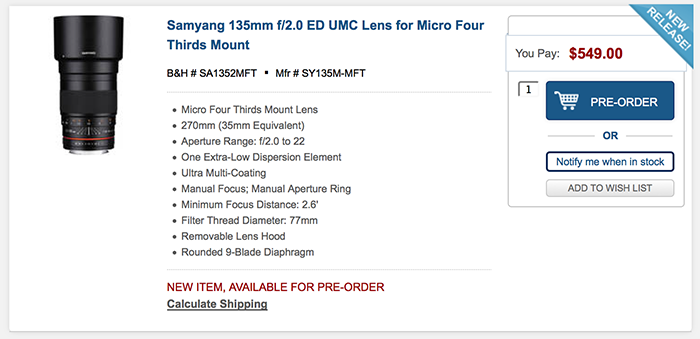
You can now preorder the new Samyang 135mm f/2.0 MFT lens at BHphoto (Click here). And there is also the t/2.2 Cine version (Click here).







You can now preorder the new Samyang 135mm f/2.0 MFT lens at BHphoto (Click here). And there is also the t/2.2 Cine version (Click here).
16 Responses
price seem to be interesting. But APSC lens for m4/3..
This is a full-frame lens. This is why it nearly weighs as much as the Oly 40-150 f/2.8 (over twice the weight of the Oly 75mm f/1.8)!
Well, it’s also twice the focal length, even when mounted on MFT, so that makes sense.
So you get a 270mm equivalent, not at 150mm equivalent as with the 75/1.8.
Yes, that is true. I’m coming at this from full-frame land where a 70-200 f/2.8 is typically nearly twice the size/weight of the 135mm f/2. So I’m assuming that a native m4/3 135 f/2 would weight significantly less than their 40-150 f/2.8. For example if the 75mm is 300g and the 40-150 is 880g then I’d guess the 135mm should be around 600g (not the 815g that this new Samyang is).
No, not really. If they make a significantly smaller 135/2, it won’t be because of the smaller image circle. The front element still has to be nearly 70 mm across (135 / 2), and the length a little less than 135 mm. It is that simple.
Thanks for the snarky response, but it actually isn’t that simple since the aperture is not directly related to the diameter of the front element. As one example I can think of offhand, the sigma 120-300 f/2.8 has a filter size of 105mm while 300/2.8 = 107.
Aperture IS directly related to the diameter of the front element for a particular f-stop. F-stops are the ratio between focal length and physical aperture size. For the same f-stop and focal length, there is a minimum aperture size, which drives the minimum front element size. That is why you can not get a 135mm f2.0 front lens element to be smaller than 70mm unless you purposely vignette much of the corners.
Ok, please explain my example of the Sigma lens (which has the exact same amount of vignetting as the Canon 300mm f/2.8). Or better yet, how about the Pentax 300mm f/4 for 645 (larger imaging circle than ‘full frame’) which has a 67mm filter thread?
In complex lens designs with multiple elements in multiple groups the front element doesn’t determine what the aperture can be.
If you’re concerned about the size weight for MFT, understand you’re not using all of it’s potential (image circle) hence wasted size/weight.
If you want to utilize more, get a nikon or canon version and use a speed booster adapter to make it a 100mm F1.4 effective lens.
It’s a much better idea to buy a Nikon or Pentax etc. version of this lens and use it on both Nikon or Pentax etc. AND on mFT, with an adapter. I have a Pentax K-30, will get the Pentax version. Will have ~200mm f2.0 on Pentax and 270mm f.2.0 on FT or mFT. Not bad. But will check the reviews first.
Yes genius, check the reviews. And don’t forget corner sharpness wide open! But then, why so much fuss about a 270mm F4? With no autofocus?
Rather expensive for a manual telephoto.
480 euros for a f/2 is not expensive
It’s the cheapest ~270mm (35mm equiv) f2.0 lens available. The next cheapest lens (manual or AF) is more than 2X as much. Even old legacy manual lens are more expensive.
Unfortunately almost unusable, at least the no-filmmaker version, unless you use it in a studio, where focusing speed is not critical. But 270 mm eqv. is far too long for studio. That’s why this lens might be just OK for FF, but certainly not for MFT.
if you’re buying legacy manuals you can get cheaper.
I have both a Spiratone 135mm F1.8 and Vivitar 135mm F2.3 that were cheaper. These are Full Frame options, so they work well on a focal reducer. That said, I like samyang options because their optics are very good and “modern” for the price.
Edit – I see this lens comes in other mounts too, so that’s awesome.