









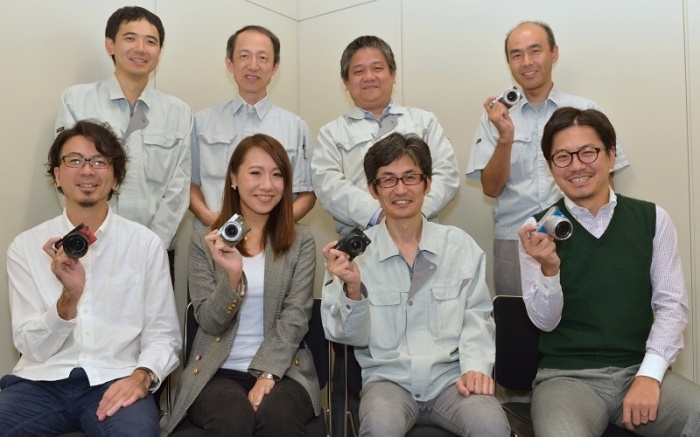
Image courtesy: DC.watch
DC.watch interviewed the Panasonic team responsible for the GM line development. Here are some of the info they shared:
– Orange GM1 sold more than expected. Green Gm5 will be sold in Asia only. Red Gm cameras are attractive for the female photographers group.
– Panasonic acknowledges people also wants a new GF camera.
– 4K recording on GM5 is not possible because the camera would have to be larger and also power consumption would overheat the circuitry.
– With current technology 4K can fit only in a camera as small as the LX100
– we will “endeavor” to make a GX7 successor 🙂
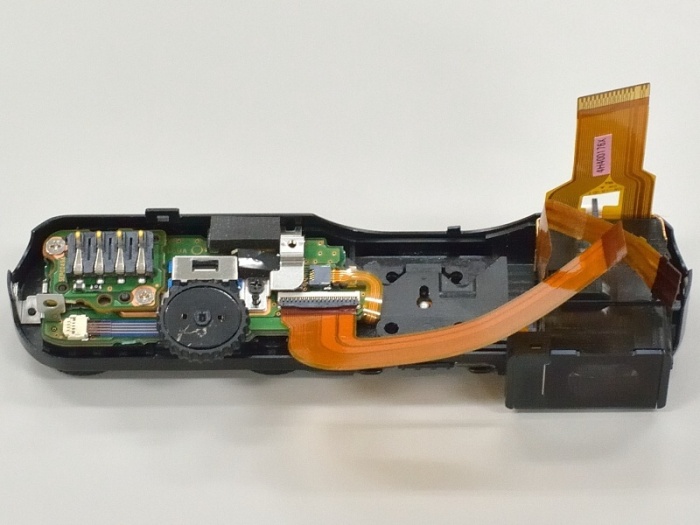
Image below shows the EVF module of the GM5:
88 Responses
Wow: Breaking News: a new camera might be possible! Now get back to work.
Yes, but a GX8 would be awesome if they could fix its flaws. Namely, more ergonomic design, weather sealing, mic and headphone jack, and a larger improved EVF. Of course 4k video would come standard.
Also IBIS in video mode
Haha, yes, that might be the most important possible update of them all!
if you didn’t know, GX line was under evaluation just like the G and GF line cuz GM and GH line is more appealing to the market at this point. So ya this may not be a breaking news, but it’s at least good to those GX line fans.
Someone gets it, a recording resolution doesn’t overheat sensor but power consumption heats other electronics and battery overheats as well.
That’s why even GoPro can have a 4k recording in plastic waterproof casing that only problem is to limit temperatures where shooting long times (desert vs water)
What , a new successor for GX7 is possible only ?
Is a must make camera .
Make sure it really can stand up although it’s hard in 2015 facing top guns such as a7000 , a9 & X pro 2 so better wait for something really ground breaking to arrive before go for it .
I completely agree.
m4/3 has the richest lens ecosystem available.
Fantastic prime lenses incredible zoom lens with pro quality. Olympus and Panasonic have to make sure that the new cameras stay competitive and commit themselves to the latest technology and design.
Let’s wait & see .
The EM5 m2 is already a failure if all the rumors ( the old 16 MP sensor ) is right .
Turn for Pana to impress .
Put that 88dB sensor into GX7 successor & everybody will have a very good time .
I don’t think the sucessor to the GX line will be competing with the a9 or X pro 2 as they are likely much higher in price point. The A7000 on the other hand, and lets not forget Samsung will be releasing a successor to their smaller NX lineup with all the same features as the NX1 with an EVF. That will be quite a camera.
Is not just about price point but about latest tech to keep up with the pace .
For example , a7000 definitely will feature all the best for APSC from Sony , the upcoming EM5 successor is already out if all the rumors ( same 16 MP sensor ) is true .
GX7 successor need to feature that 88dB sensor to stay competitive or at least worth of upgrade .
I expect around 1.5 stops over current GX7 improvement overall in image quality will do .
Perhaps you can tell us where Olympus (and Panasonic) can find that more competitive sensor given that there have been no real advances in sensor technology for a few year ?
Perhaps Santa Clause will deliver it to them.
Or maybe Sony or Samsung if they’re willing to get a brand new sensor designed exclusively for them which will be marginally better than their existing sensors.
Then perhaps you can make a business case where the extra costs for the sensor plus imaging pipeline plus raw developer costs can be absorbed while keeping the camera at an affordable price so that geeks can boast that they’ve got an extra few pixels and an 1/8th stop improvement in low light performance.
Whom of this guys should I shoot for my GX7 to limit exposure in video P mode to 1/50 and not allowing to go up to 1/25? Biggest bummer for me. GH2 was fine in this respect BTW.
How about Constant Preview stops working at shutter speeds above 1/1000th?
The reason why the GM is more succeed than GX mainly due to less rivals to compete against it .
The design is another lovely master pieces from Pana’s expertise to triumph it further .
So I have no doubt it is much popular than the GX .
The key here is that if camera semiconductor fabrication technology could keep up pace with mainstream semiconductors (currently 14 nanometer half-pitch for cpu and memory chips, expected to move to 10 nm in 2016) speed and heat dissipation problems would disappear. We could finally have 16bit (minimum) processors (I believe that currently only cinematographic cameras and PhaseOne offer that), global shutter, 4-8K video, etc, and no penalty in terms of battery life either.
Unfortunately, the camera industry does not seem to be able to afford the switch to the new technology.
They always say “We will evaluate a successor to X”, simply to keep your hopes up (and invested in the system). This is useless info. At least Panasonic isn’t as bad as Olympus who periodically remind us that “fullframe is a possibility for the future”.
Everyone, who cares about smallness and lighter weight, which is probably the majority, doesn’t care about “Fullframe”. However, Panasonic is sometimes going too far with some trends like miniaturization and emphasis on video.
Olympus said they didn’t discount the possibility of larger sensors if the lenses could be made smaller.
That’s a bit like me saying that I would consider travelling to Mars on holiday if somebody invents cheap, affordable and comfortable space travel.
It may be possible at some time in the future but don’t hold your breath.
They’ve learnt never to say never as it will be twisted and distorted on the web and ten years down the line somebody will dig up an article. For an example look at the ’12mp is all most people need’ quote
Cue the discussion of the mythical “organic sensor.”
To me, Panasonic has a very strange camera body policy: it has the biggest m4/3 body and the smallest. In between, there are no clear statements, if there is any successor of the semi current models planned. For me, the GMx series is simply too small, and the GM5 has an awful view finder. The GH4 is too fat and I have no need for the 4K stuff.
Additionally, there is no clear strategy about, which image stabilization technology is going to be developed further. Up to now, we have seen only the GX7 as a try with IBIS, despite the fact that Panasonic still has quite a bit of non OIS lenses in its lens portfolio. And there is no clear message that the GX7 concept will have a successor. The G line with the G6 as its last incarnation stands for a middle sized and priced DSLR style camera, which to many is still a very attractive option (as the GH2 was). The GH4 is too pricey and fat for those, who prefer DSLR form over rangefinder brick. As it seems, the Gx line is dead.
Compare that to Olympus: all cameras have the same high quality sensor, now with a working shutter shock preventing system (which the anticipated E-M5 II certainly will have too). The line up is quite well stepped: rangefinder: E-PL7 – E-P5, DSLR shape: E-M10 – E-M5 II – E-M1. For all cameras a high quality view finder is available, at least as an option. All models have a state of the art IBIS.
To me it is clear that video and over miniaturization has a tribute on the camera line up: too small bodies prevent IBIS and 4K and it seems that the is no room in between at Panasonic for this very bipolar strategy.
GX7 is still current. It is not 1 year model line like G and GF used to be – GX1 was released in 2011, GX7 in 2013. GX7 is of course what m43 cameras should be in terms of size and features, GM and its special line of zooms is a distraction.
Where can I build you a statue?
Considering that m43 (and mirrorless in general) has very few lines drawn between the product lines, the “strange” camera body policy is simply a level of freedom to implement pretty much any body they want. I personally do not mind, since there were always Pana bodies which I liked. Meaning that even if they deviate, I still like the direction they are going to.
Otherwise, spot on with IBIS and EFCS. Pana needs the EFCS too. The pure e-shutter has too many limitations and is a non-starter indoors with 50Hz mains (aka: the whole world minus Asia and North America).
P.S. The Oly line-up is not so finalized to me. I still do not like E-M5/E-M10 ergonomics. I still do not like the hump of the OMDs. They need PEN with EVF, a-la GX7.
To me, by contrast, it’s the Olympus strategy that looks strange (what is the point of the PL7?); it’s the GM series that make sense. I hope Panasonic will keep on improving it and will resist the temptation of replacing with one more middle level dslr sized camera, just to please a few American customers (who will be still buying entry level Canicons instead).
The E-PL7 is there to appeal to a certain group of people who select cameras based on their looks and ability to take selfies. I am sure it is selling very well in Asia.
The E-PL7 is at least usable in terms of size and haptics. It is the smallest camera, for which a decent (actually excellent) view finder is available. The GM5 finder is a joke.
I bet the GM5 SMOKES the EPL7 in sales.
You make some good points. But imo Olympus does the opposite in making 3 OMD cameras that give essentially the same end result and similar form factor, one true mid sized rangefinder (E-P5, which the Gx7 rips on imo), and then a bunch of smallish, awkward cameras (E-PL and E-PM) fitted to their shitty kit lens which makes it as big as their the EM1 as far as real portability.
At least with Panny and the GM series, compact is a totally addressed with the kit lens. They also have two lenses specifically sized and manufactured to fit on these cameras (Leica 15 and 35-100 f/4).
You make some good points. But imo Olympus does the opposite in making 3 OMD cameras that give essentially the same end result and similar form factor, one true mid sized rangefinder (E-P5, which the Gx7 rips on imo), and then a bunch of smallish, awkward cameras (E-PL and E-PM) fitted to their horribly bulky kit lens which makes it as big as their the EM1 as far as real portability.
At least with Panny and the GM series, compactness is a totally addressed with the kit lens. They also have two lenses specifically sized and manufactured to fit on these cameras (Leica 15 and 35-100 f/4).
“Compare that to Olympus: all cameras have the same high quality sensor,” . . .
That is NOT a true statement. Sorry to burst your pompous bubble, but the Olympus E-M1 uses a Panasonic sensor while the E-M5 uses a Sony Sensor.
Not exactly the same sensor.
You are splitting hairs. Both sensors deliver the same image quality. That is what counts.
Sorry, but the EPL-7 fills literally no niche in their lineup that the EM-10 doesn’t already cover. While I agree the GM line is way too small and fiddly for me, it definitely fills a niche for those that want something that small yet powerful and flexible.
How about better EVF via VF-4 rather than the built-in EVF on E-M10.
Sure but that evf is like $300. So now you paid much more than an em10. That money would be put to use better on lenses. Plus that evf is really bulky.
Olympus Fanboy Post of the Month….
In his perfect world, Panasonic would only make Batteries.
Here’s some reality, Panasonic is making a PROFIT with thier camera division, while Olympus is still LOSING money with thier camera division.
Guess which company is more relevant in M43? Guess which one’s lenses sell better?
Hard to swallow, huh?
Olympus troll to the max. So Panasonic having both the smallest and largest M43 camera is a bad thing?
Sorry to burst your Olympus bubble but I just sold all my Olympus junk and switched to Panasonic because they make better cameras.
” 4K recording on GM5 is not possible because the camera would have to be larger and also power consumption would overheat the circuitry.– With current technology 4K can fit only in a camera as small as the LX100″
Right, all those smartphones with 4k must be huge. Or maybe it is time to repurpose all those ancient 45nm factories for sensors and use processors made on old 32nm, oldish 22nm or better yet modern 14nm process.
Sure, lets shrink the sensor to smartphone size. 4k is way more important than sensor size.
What size of sensor has to do with ability of a video codec IN THE PROCESSOR?
The codec is not the issue. For 4k video you need to readout most of the sensor at a high FPS (min 24). Even the Panasonic CM1 smartphone with 1″ sensor supports 4k, but can only do 15fps so not very useful. The same sensor in the larger FZ1000 can support the higher frame rates as it has the larger body required to dissipate the heat.
Sensor readout is a MINOR source of heat compared to codec, which in motion compensation stage alone pushes HUNDREDS OF TIMES more data than sensor readout itself (it is the same data, but processed from 16×16=256 to 32×32=1024 times depending on a window size). Size of the sensor matters, but mostly because those bigger sensors are made on ancient junky technologies (except the one in Samsung NX1, where the tech is simply old). Does your phone overheats when you look at it? Meanwhile, it pushes all that data to a MUCH MUCH bigger circuit which is your LCD or OLED screen compared to even FF sensor, let alone 17x13mm of 4/3 sensor.
The bitrate on the best 4K phones (Sony z3 @ 55 mbps) is only half that of the LX100 at 100 Mbps.
So yes, I’m sure Panasonic could do it if they were willing to compromise quality to the point that it looked like 1080p…
It is COMPRESSED bitrate. Higher compression is actually harder to do. Uncompressed (raw) bitrate is about the same.
That is simply not true in 90% of the situations.
Higher h.264 profiles are indeed harder and more power hungry to implement, but that’s not always the case.
Lower bitrates (at the same encoding profile) just mean more information is discarded, so there is no different power print from that.
What you can question is if Panasonic’s h.264 profiles are higher than most smartphones, which since the GH3 is indeed the case.
If you preserve resolution, you don’t just “discard” information, 1st you have to find what information you preserve and what you discard. Given the same input stream and the same codec/level, higher bitrates are only harder on writing susbsystem, which is a minor thing in terms of power consumption compared to, say, motion compensation, which only depends on resolution (which is the same 4k) and window size (where higher window size produces both higher power consumption and LOWER average bitrate).
The motion compensation is independent of the final bitrate. It’s precision (and power demands) are determined by the h.264 Profile.
Compression is the final process that takes on texture blocks and motion compensation vectors and reduces it’s precision in order to fit them into a certain bitrate.
Most of the hardwork and the power consumption was already done before this stage. In an overly simplified way, when you reach this point, what the codec is doing is deciding whether it should divide all block values by 2 or by 4 and trashing the remainder (which in playback will be reconstructed by multiplying them back by 2 or 4) and thus saving 1 or 2 bits per block value.
So, no, bitrate has no significant effect on power except as you correctly mentioned on the writing subsystem. It is how complex the motion compensation works (and again this depends on the h.264 profile) that significantly determines the power needs.
But it is motion compensation which takes most processing power (and electrical power) during video compression, not reducing precision of some bits of info.
Yes. I see now that we are tuned on this. That’s why I was questioning why you said “It is COMPRESSED bitrate. Higher compression is actually harder to do”.
When you said “Higher compression” you meant a higher profile but it sounded like just higher compression.
Seasons greetings! 😉
Yep… the die size for today’s digital sensors and processors are ridiculous. I think many sensors are still fabbed on 65nm tech. They should just take the Moto G’s processor and use that to process the images and video as I’m sure its more than capable of this and its gotta be pretty dang cheap since the phone is under $200 off contract. That processor is on a 28nm die.
It is worse that that, especially among large sensors. Only THE BEST Samsung sensors are fabbed on 65nm, Sony and Toshiba use 180nm, Canon still uses 25 y/o 500nm tech for their sensors. Processors range from 65nm to 45nm, only Samsung uses better tech in a few of their cameras. If not for strong brand loyalties and lens collections, this whole stodgy Japanese industry would be easy to destroy with some proper tech.
This interview was also posted on DPR 4/3 forum but the translation from Japanese was very hard to follow. We seem to think that Pany should be producing just what we in the US want yet those sales are much less than the Asian market for which Pany is producing where the GM1 is doing well indeed when you combine all the various colored models all together and also not surprising to note the GF may be continued as also a good seller while the G6, GX7, and GH4 rarely registering in the top 80 sales in Japan.
What I make from this interview is there is likely to be a new a GX camera based on the body of the LX100. Makes sense as has a full sized LCD screen, larger EVF, 4K, and more capable shutter yet smaller body size than GX7. Would be nice if they could include a small inbody flash however small that would be. A new GF model might be based on the GM1 innards only with a tilt LCD and hotshoe.
For those clamoring that the GM1 and GM5 are way too small take a look at the GM5 and lens review combos posted yesterday on 43rumors on the comparative alternatives as the small GM appears to be a very good match and fit to the many small lenses available for m4/3.
Problem is not the dimension (that’s why we buy that camera) but the lack of manual controls
It’s still kinda hard to implement as much buttons & dials on a GM5 body as on a D800, don’t you think ? By the way, which manual controls do you miss on a GM5 body ? (==> Leica ergonomics rule !)
you do realize that the sony rx100 has a far superior interface than this little mess, right? I miss at least a dial, for aperture/speed selection at the same time. No matter how good the sensor is, if i need seconds to manually change settings
As far as I know, GM5 has a dial and fn1/fn2 buttons. GM1 not, however.
The GM5 camera is one you can have with you all the time for impromptu shots for travel and already has the most essential manual controls. If I started to think about what optimum shutter speed, aperture, ISO, etc to use with each picture I would probably miss the opportunity to get at least two thirds of the pictures I take. These days with very good intelligent auto programs the camera in most cases probably better and certainly faster than you can be. The most important part of getting a good picture is in the composition and pressing the shutter or actually taking the picture in the first place. You can preset the ISO range, or minimum shutter speed. Manual controls are more important when taking stationary landscape scenes or in SLR days when all one had was 100 or 400 ISO film but less so these days with very good high ISO performance and IS. With travel photography and wildlife one is often moving in a vehicle and only a split second to catch a smile or candid shot or fleeting animal.
The camera doesn’t know how much depth of field is appropriate or what aperture is sharpest on your lens. It also doesn’t know if you need fast shutter speed to stop motion or if you want motion blur.
In fact I have the impression that with this camera Panasonic is telling me that manual cameras are something from the past, and I don’t need them. Luckily there are other camera makers that, while giving me options for auto-everything controls, also allow me to take pictures without a computer interpreting the pics I want to take and taking them in my place. RX100, LX100, and many other small cameras out there give you the freedom to choose. As good as it is, I am not going to buy an expensive camera like the Gm5, with such serious limitations. Waiting for a gmx with more dials and buttons where they belong.
Having used my GX7 for over a year, coming from a GH2, I find it a bit too small. The LX100 is even smaller.
If it were just a bit wider and taller, allowing for a slightly more substantial grip along with a few more external controls And a larger 3:2 aspect ratio LVF, it could be close to perfect.
I think i may have to get a 2nd G6.. an allmost perfect minature DSLR style.. i was hoping for a new model with GH4 sensor.. but it sounds like a no no. I really dont need a GH4 brick.
Yeah the physical shape/size of the G6 fits perfectly in my hand with any lens on it. It is much more ergonomic than the GX7 rangefinder camera which feels more like a Sony to me. Oly’s EM-1 is also right up there in terms of physical ergonomics and fit.
I agree. The G5 is most handy (don’t have a G6), very comfortable to use. The GX7 not so much and can be quite awkward at times. The GM1 is very fiddly and tricky to use.
The GH4 however is like a G5 on steroids and is noticeably bulkier but is very well balanced in the hand. It is not tiring to use. The E-M1 felt flimsy and fragile, the little switch knob on the front fell off in my hand when I tested a demo, but the GH4 feels like you can hammer nails in with it.
The E-PL7 I find easier to shoot with than the GX7 but ergonomics-wise, of dear, that bizarre Olympus menu system. And you have to dive into a menu to change metering mode, it can’t be put on a button. To change anything around quickly on an Ollie is a nightmare, on a Panny it is prod, prod, done. Ergonomics.
Seems to me that the G6 and GX7 overlap in size, if not in features, but is there enough of a market for both? If not, can you merge the two lines? Then which is better, dslr shape, or brick with flippy evf? Or could you get enough efficiency with same innards in two different boxes?
The GX7 is marginally bigger than the G5 – it is actually easier to pocket my G5 than her GX7. And far easier to pocket the GM1 or E-PL7.
I don’t know, GoProHero4 is doing pretty good 4k@30p despite size/bitrates etc…
Have you seen the woobly POS video that comes out of them?
Sensor size isn’t even close.
Need the GM with in-body stabilization before 4K video anyway. 4K eats up too much memory, fast storage needs a few more years to get cheaper.
Why? The GX7 is noisier than it could be if it didn’t have body stabilisation. Most Panasonic MFT lenses have OIS optical stabilisation which is 5-axis (and those that don’t are too short to need stabilisation).
Why do want the camera to shoot itself in the foot?
I love it; “possile” is an awesome word. Not sure what it means but it should be integrated into the English language 😀 😉
newbie?
Shameful negligence by admin is nothing new. Someone who cares about what he posts on his own blog makes sure it’s not utter gobbledigook.
GM7 aka mini GX7
Please Panasonic, please… Give me a Fixed-Lens, fast 20mm prime camera.. PLEASE. weather sealed and compact with L-1 looks. It’ll be my everyday carry shooter.
Buy the LX100 and keep it set to 20mm.
Keeping a zoom lens at a certain focal length?
So, every time I turn on the camera, I have to adjust it to 20mm? Or from sleep? That’s just stupidity at its finest. Where’s the sense in that?
Some cameras have a setting to remember the focal length at shutdown. Does the LX100?
I still wouldn’t buy one. It just defeats the purpose of a prime lens. Simplicity in shooting is what I want.
You are displaying character traits that go some way to explaining why you are always such a complete díck.
I’m flattered…. Really.
Wait, no I’m not. But if you wish to stoop to low, sub human standards by name calling, then be my guest.
Exactly!!!!!!!!!!!!!!!! 20mm or 25mm perfect!
The girl is pretty, the geeks a lot less so, and the electronic board looks lousy. Can we move on now?
Presuming this is really what was said, which is doubtful in itself, “we will “endeavor” to make a GX7 successor,” does not mean a GX7 successor is merely possible. It means they will be working hard on making a GX7 successor.
Why do I doubt the word “endeavor” or its equivalent was really used? Usually a sucecessor model comes out when the previous model is phased out. A product line that is dropped intermittenlty confuses the consumer and is a turn-off.
Essentially, it’s all just horse cookies and we may just as well read tea leaves.
Just throwing this out there, but I am betting the Gx8, if it comes, will have the first major m43 sensor upgrade in years across both Panny and Oly cameras. I say this because besides a few minor oddities, the Gx7 goes head to head with every Oly model out there and apparently still lacks sales volume. There is no point in refreshing without a feature that trounces the competition. And the only thing that can set it apart at this point is sensor performance.
Wrong. LX100 style control and will sell like hot bread
Wrong. Sliced bread at room temperature outsells hot bread by magnitude.
GM1 can take 40 frames per second only for 1 second, or… or 10 fps for unlimited time with the highest resolution and finest jpgs – each jpg is around 3.5MB, so the camera can handle 35MB each second and that is 280mbps, while the video codec gives only 24mbps using avchd. Ok, I’m not saying the camera could handle 280mbps, but 100mbps rather yes, and 50mbps definitely yes! The film quality would be much better, then!