









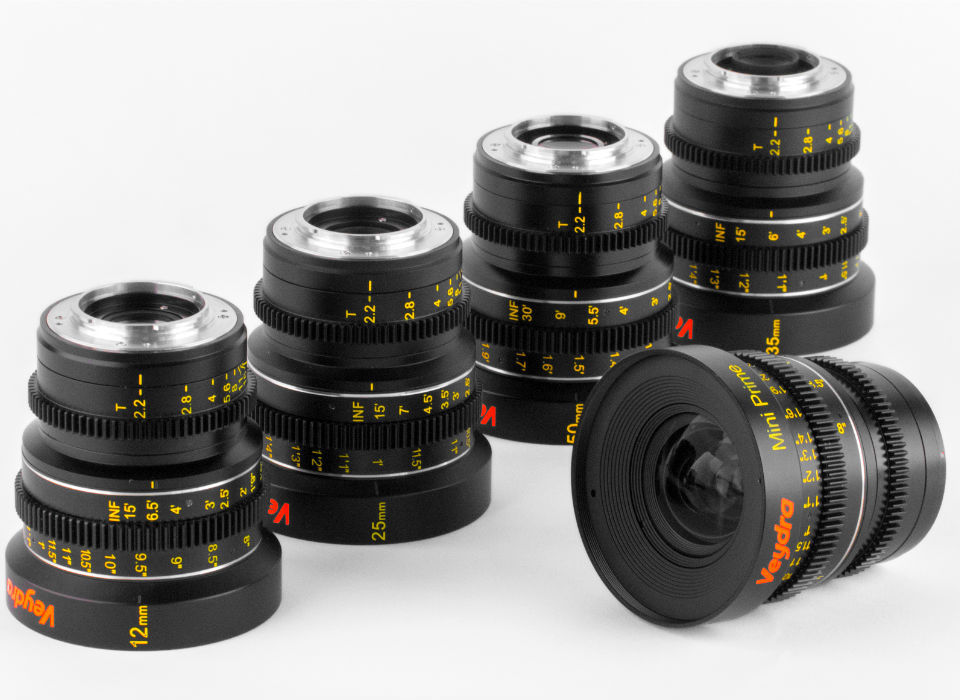
ProVideocoaltition (Click here) is the first site testing the new Veydra MFT Cine lenses:
If I had to describe Veydras in one pithy phrase, I’d say, “scaled-down Ultra Primes for micro four thirds cameras”. They’re sharp, rectilinear, and clean: good, workmanlike optics with no nasty surprises.
They aren’t the fastest lenses available, but they also avoid the soft, soapy renderings you get WFO on lenses like Super Speeds, Rokinon T1.5s, and Nokton f/0.95s: you can shoot these puppies wide open and intercut them with T5.6 shots from the same lenses and not worry about a substantial change in the look.
Official Veydra website: http://www.veydra.com/
47 Responses
I think the size of these apertures is fine (bigger is always nicer, as the soapy look described goes away right about f2 on the alternatives out there), it’s the cost that makes this a no-go. These lenses are very much over-priced, especially when compared to the legacy MF options available.
But “legacy MF lenses” are not what they compete against. Those Veydra lenses are dedicated cine lenses which are designed to satisfy the needs of professional filmmakers, and existing lenses for that purpose are three or four times as expensive (e.g. the Zeiss CP series). From the website: “Purpose built for cinema acquisition applications, all Veydra lenses feature constant volume focus, 0.8 cinema pitch gears on the iris/focus rings, constant T-Stop, and common front diameter for quick lens changes in a production environment.” Where such features are needed, not even the (pseudo) “cine” versions of existing photo lenses by manufacturers like Samyang are a satisfactory option.
I don’t agree, but if they are as sharp as my Leica lenses, or the 75mm Olympus, I will definitely consider buying one.
For cinematography it isn’t just about sharpness…. some lenses are selected because they’re *not* sharp (though this won’t be the case in this instance).
As cine lenses care a lot about many other areas which are totally irrelevant to photographers, such as breathing. You’ll notice this while filming! But of course it can’t be seen in a photo.
Right, but if they aren’t sharp then first of all they will have other problems and second they will never, ever be sharp. They can also be sharp and be bad at other things, but the latest top quality lenses are, in fact, good at everything and that’s why I use them. I have 60 legacy lenses from Leica, Nikkor, Rokkor, Voigtlander, Schneider, Rollei, Series One, and a few Russian one that I can’t spell, that all have a “special” look, but they are rarely used because modern lenses are just better.
You might have missed my point, they’ll be sharp, but sharpness won’t be the primary quality they’ll be aiming for.
After all sharp on 1080 (or even 4K) is not the same as sharp on the new 40 megapixel Olympus camera.
If you shoot a lot of video, you will appreciate that sharp is not just resolution, and also that many videographers, particularly those in the competitive marketplaces, use seriously sharp lenses. Not everyone needs coroner-to-corner sharp, but many do. I do. However, once you have the primes in hand, you are welcome to do a carefully controlled comparison, and then we can all see for ourselves. If you don’t have the top primes, you can rent them from LensRentals.
No one in the right mind would buy a set of primes without the benefit of such tests, or firsthand experience, so you would be helping people out.
Realistically, don’t they only need to provide about 8 Mpx of resolution to be consider super sharp for video? I mean FullHD video is like 2 megapixels, you don’t need a Nicticron or Oly 75 to make those 2 megapixels look good. And there’s a lot more to a good cine lens than sharpness.
And the requirements put before a cine lens are quite o lot different than for a normal lens for stills. That’s why there are specially designed cine lenses on the market. And those lenses tend to be very, very expensive, the Zeiss CP are $4000 and up for example (hence the appearance of low-cost adapted photography lenses, like the Samyangs).
Your the winner.
You are the only one who posted here (besides me, and possibly another that I missed) that understands these are ‘4K Lens’ for 4K Video (or 4K Photography, if you have an 8 MP Sensor on your Camera).
They are ‘limited’ to 4K, smaller, non PL, and made by low priced labor.
That is why they are low cost, because they are designed to be low cost (and, apparently, reasonably good).
The only way a Movie Studio is going to let a Cinematographer use one of these Lenses is to simulate the Cam view from some hack (not a “Cinematographer”, or broke) filming on a DSLR Rig.
If you want to learn filming or attempt to teach yourself Cinematography, for a low cost, then these Lenses are likely perfect; and certainly affordable.
Great that they scored 3x the Funding with a bit more than a hundred Backers. They seem like ‘fairly great’ Lenses for what little they cost.
No, they need to give that extra magic, whether it is micro textures, the nanocoating, the quality of all of the above. You can see it, you can feel it, you can taste it. Quality.
Don’t try to tell these pigs what speciality is in these new cinema lenses as those pigs ain’t professional, or even skilled videographers but just a wannabe ones that doesn’t understand about quality and pro tools requirements.
I am a photographer and even I know the high quality and design in those lenses, while I would never ever buy one at all. And for me they are dirty cheap too!
High five to a photographer who also understands a bit of what it like from the cinematographer perspective too! 😀 🙂
Have you seen the price of a CP.2 lens?
No?
Well then no wonder you don’t realise what an amazing bargain these lenses could be!
Right, but I for one would never put this kind of money on that tiny sensor. M43 is dying because it is overpriced.
Dying? Are you on drugs?
As in the zoo, don’t feed the animals. Here, don’t feed the trolls.
dying? ha! yeah right…
m4/3 has the broadest and most wide ranging support of any mount system!
I’m almost starting to lose track of how many camera manufacturers
there are now with cameras in the pipeline with a micro four thirds
mount! 😀
(Panasonic, Olympus, Kodak, JVC, Blackmagic Design, apertus°, and
now…. fps1000 too! And that is just the camera manufacturers, many
many more accessories/lenses/etc manufacturers too)
As I’ve often said m4/3 is the most robust and best camera system, it
has so much more support behind it than any other mount.
I new Hydra is going to take over the world someday.
Better than Voightlanders? Lel 😀
Superexpensive $hit for crazy videographers, no sane photographer would buy 900USD f/2 MFT prime with manual focus only, if it wouldn’t be Zeiss or Schneider lens. And ‘landers are super-crispey at f/2, even if slightly more expesive, so..
No clue .. as usual the comments here.
Those lenses are made for pro’s, all have the same dimensions and can be fitted to a reel/rig without readjustment of focus ans aperture gears.
I’m a pro and I will, as a pro, buy a more expensive and faster lens with edge to edge sharpness and the option of optical correction in software plus numerous other goodies. Also, the Rokinons are not soft and soapy, that’s rubbish.
But are you a pro who works on a film set?
Or are you a wedding videographer or doco filmmaker?? etc
Or maybe even none of those and you’re a filmmaker?
Then of course these wouldn’t be right for you.
clearly he’s not a pro who works on a filmset. I admit I wouldn’t buy these lenses for myself. But I do have a “colleague” that works in the industry and I know the rigs he works with. These lenses are exactly what they would use. He told me that extreme shallow dof is only used when scenes are very static because action can’t be followed if the dof is to shallow.
That’s why I know these comments here are from amateur photographers who know ziltch about moviemaking!
Wrong.
Don’t do weddings, sorry.
Exactly as you said, NO PHOTOGRAPHER would ever buy a CINEMA LENSES!
Do you see the point?
These are not for photographers but for cinematographers and so on Panasonic GH4 owners will get only these because they don’t care about photography!
Olympus OM-D owners doesn’t get these because they are photographers.
Clear win win situation to all.
a photographer who doesnt care about videography? sure lots of them.
But a video/film maker who doesnt care about photography? very unlikely
Photographers are usually the masters of light and responsible to most movies lighting and immersion.
Videographers task is just to shoot what director of photography tells, from what camera angle and using what exposure values etc.
Video and film making is totally different from photography, its about motion and different camera angles than photography.
That’s why example Christopher Nolan has a own photographer who is responsible to all lighting and camera angles and if he is sick is goes to another project, Nolan hits halt to own movie until his #1 man gets back.
That is how things goes in advertising world and movie world, photographers are the kings for immersion and lighting, but videographers knows how to operate and handle videocameras and process the footage.
As I said, I am not interested about videography but for photography but i work for movie industry.
Videographers has usually hard time to master photography, other than snapping from here and there some of the photos. The difference is like a painter and photographer has.
Actually, in the film industry, the proper terms are “cinematographer” (director of photography) and “cameraman”, rather than “photographer” and videographer”. And the camera angle is determined by the director (in french “regisseur”), not the cinematogrpher; although the cinematographer is also responsible for choosing the right lenses for giving the right “look”. For a period feel, for example, he might choose to use a set of old lenses, that were actually used by the film industry at the time.
I find it still ridiculous to say that a videographer is less in his skills as a general claim. You need to differ the type of user too.
I think you are confusing the term “Photographer” for “Director of Photography(DP, DoP)” A DP is a cinematographer who directs other cinematographers and the lighting arrangement of the film. They are not stills photographers.
I would also argue that a DP has more on his plate than an average stills photographer who is only responsible for lighting a single image. A DP has to light a scene that works from mutiple angles and with motion in it. Both subject motion and camera motion. That motion may even be the light itself in cases where there is fire light or car headlights moving in the background or a shot of actors walking down a hallway under lights that brigthen and dim as they walk under them. Plus make the light look natural, as if it is coming from light source objects in the scene.
So I would technically put a DP above a stills photographer in terms of stillset. Even when you have high end photographers doing commercial shoots where they have an entire crew seting up a scene and doing make-up and everything, they still don’t have to deal with things like camera motion. I’m not saying these photographers have an easier job or that they aren’t highly skilled, Just that they have one less dimension they have to worry about.
A film maker who uses the same camera for videography as he does for photography?
Doesn’t exist.
with fimmaker i assume someone wo is making cinema or nature documentary for instance.
Gah, yet another person who doesn’t understand how life is on a film set :-/
Believe me, these improvements which the lens makes is very worthwhile!
If I was operating at a bit higher budget level and did more of that kind of work (at the moment, film is more like a hobby for me, my bread and butter is corporate/events/weddings/etc) then I’d be all over these!!!
David there are many people here wo dont understand anything then just reading specs and maybe some reviews. sad case. But I admit i know little about the stuff on a fimset.
Yup, is just about respecting each other’s skillsets 🙂
If you don’t have them, and haven’t tried them, why would you want them?
Just the same as there are many other lenses (and cameras, etc) which I also don’t have, but I know I’d like to have them.
Because I can read and use my eyes and head to work out for myself what they are.
No sane photographer would buy this expensive stuff and slap it on that tiny sensor.
Only missing a 7mm f2 for now…
yep, a 7mm F2 would rock the M43 world.
Seems like a totally successful kickstarter. I expect many cineographers will be very happy to grab this set.
To all those who don’t understand why this Kickstarter project was so very successful:
It is because they’re not for your uses. These lenses are competing against the likes of CP.2 lenses, they’re meant to be a budget alternative to those kinds of cine lenses.
Look up the prices of even just one CP.2 lens, then you’ll see what an incredible bargain these lenses are! I wish I could rationalise and budget getting a set myself! They’re amazing. Instead I’m sticking with my set of Nikon F lenses with a focal reducer (it is the ultra frugal way…. ).
It’s about being constant. Yes Voightlander F.95 lens series are ultra fast, Oly 75mm is very sharp – but each lens has it own character , from sharpness, micro-contrast to color rendering ..etc, when you edit them together, there is change of look, and you don’t want that. You only want to change the focal length, not changing the look and adding additional work in post.
It’s not just about constant, that’s just one factor. Constantly average is just about the worst.
I’m glad to see some cine lenses that are not US$5000, if they’re as great as Zeiss lenses.
I’m just starting with the GH4, but I’d hope for consistent choices when I get to more involved projects. I would imagine rental fees would be so good that you could rent all of the lenses at once, for the price of just one Zeiss lens.
Can’t wait to try these on my GH4 and BMPCC.