









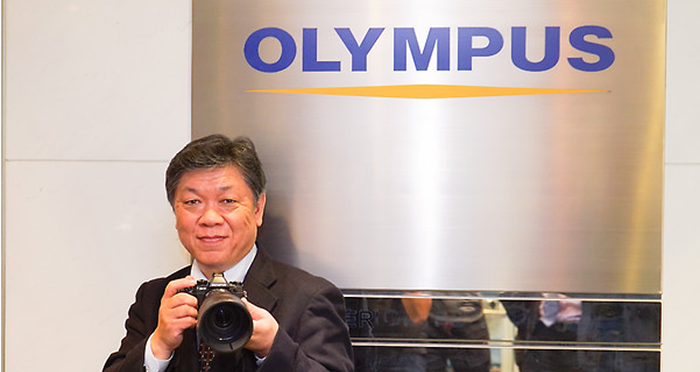
DC.view posted am interview with Olympus. The highly interesting info have been translated by one of our readers:
1) PRO lenses, being weather-sealed and compact in size and weight, are designed to improve corner IQ by incorporating their microscope technology.
2) Sony’s (5 axis) technology is used on bigger sensors so we figure that the whole mechanism should be bigger as well. And its effect might be limited due to insufficient space for the mechanism to move. We think Olympus’s has better stabilization capability, especially at telephoto ends.
3) Future plans for in-body features? Improved 5-axis stabilization, among others. It’s still not perfect and we hope to improve that.
4) Any plan to design F2 constant aperture zooms? We aim to do faster lenses, but size and weight are our concern.
5) Any plan for a non-interchangeable lens camera with a 4/3 sensor? We don’t have a definite plan, but we don’t rule out the possibility.
6) Will Olympus stay in the 4/3 realm? As long as size and weight can stay compact without giving up IQ, it does not necessarily have to be 4/3 sensors. If there’s a way to keep the lenses small for larger sensors, we will not hesitate to do that.
So what do you think of those points?
207 Responses
What? No plans for m4/3 cameras with included helicopter propellers? I mean what is that! They changed their mind from yesterday to today… 🙂
1) Sounds promising. I just wish weather sealing is not only going to be a PRO feature
2) We think so too
3) Nice!
4) Size and weight are also my top priorities
5) You’ll be too late to the party. A costly mistake
6) I’ll stay with m43 but this is still very exciting
Not much substance in the “many new info” though :/
no question about the possibility of increasing the native resolution of m43 sensors in the future (like 20mpx)? 40mpx does not answer the question
I like the idea of prioritizing lens size over sensor size. Olympus understands the needs of most photographers rather than their fantasies (in contrast to e.g. Sony). The way forward will be the so called ‘organic’ sensors, which might allow for simpler, smaller optics. However, this discussion will only become relevant in the distant future. In the meantime those small, sharp and fast primes are keeping me happy.
How many does know that E-M1 Signal-To-Noise ratio is 11% better than Sony A7/A7II when same depth of field and shutter speed is required?
E-M1 has as well 7% higher pixel saturation point when same exposure is required.
And if people would compare different formats correctly, by making a real world prints, they would not see any weakness in m4/3 vs “Full Frame”.
Can you explain your statement about Signal-To-Noise ratio and about pixel saturation? I have an EM1 and allways though that FF sensor was better than m4/3 in every situation. Regards.
It is a technical (elecrronics) benefit in the Panasonic Sensor the E-M1 use.
But the thing is as I said, when the depth of field and shutter speed are required to be same (ie. Group photo where both faces needs to be sharp, both are moving so you need to freeze the movement) then that means E-M1 can have a 2-stops lower ISO and it gives the 11% benefit for same enlargement (final print size being same, instead 1/4th of the Sony A7).
The dynamic range (=Signal-to-Noise-ratio) is a tricky thing as it is all about electronics, not about lenses or sensor size. It is about individual pixel technical characteristics.
And then it is about magnification ratio to final print. Like if we do 24×18 print, then we need to enlarge a m4/3 photo two times more than 35mm photo, even if both are 16Mpix. And that enlargement ratio causes the difference to image quality, including the noise looking two times worse on smaller format. While digital photo has resolution and resolution isn’t a physical by its dimensions, we can compare both format 16Mpix photos on screen at, 100% enlargement, but we don’t remember that we are actually comparing at that moment a photos that really are two different sizes. So the 35mm should be viewed as 100% enlargement and m4/3 should be viewed as 50% enlargement.
And you will find that same ISO (ie. 400) looks same.
With a larger format camera, we can always pull a larger enlargement with same image quality than smaller sensor.
Even when digital photo doesn’t have a physical size, they can’t be compared in physical size being identical (on screen or from print) if photo is taken in different formats.
Same thing is with cropping, we shouldn’t crop a image to smaller size and then print it as big as the un-cropped version is printed.
I couldn’t find the article now that compared those two cameras among others, but the fact is that Olympus designed 4/3 sensor from real life reasons, those being that almost all photographs with 35mm sensor are taken with aperture 5.6 or smaller by professionals because they need eboug depth of field. And Olympus designed 4/3 sensor size such that photographer gets the deeper depth of field as required (and have way to get shallower if wanted) without sacrificing light amount, giving more light to photographers that 35mm format got. That is huge benefit as 4/3 sensor camera gives two stops faster shutter speed for same ISO and depth of field, or two stops lower ISO for same depth of field and same shutter speed. Or two stops further flash distance or two times weaker flashes, or two times more flashes from flash.
The 4/3 sensor has more benefits than 35mm sensor. People should just ignore 35mm fanatics as they only try to talk trash from ISO quality like they could always shoot wide open (soft edges, unsharp center at worst situation), high shutter speed and base ISO. While in reality they are almost always getting two stops less light for their need and that makes to them harder to get more good photos.
Like go to sports game and with m4/3 camera you can have a 1-stop faster shutter speed AND 1-stop lower ISO OR 1-stop smaller aperture to give more depth of field (to improve focusing with telephoto lenses!).
And no one will care that you have 1-stop difference in noise, especially when photos are about 6×4″ size on smartphone, news paper or display.
Thanks for your quick reply. I am happy with my Oly, but I allways try to learn more about technollogy I use. Merry Xmas.
Keeping me very happy!
if they would go for a larger sensor and can afford to develop a new line of lenses for it, they better go for a MF sensor, entering another market with prob more posibilities.
I say Olympus should do this!
Make it as 6×7 medium format and new line of lenses to it! Like make six lens for it!¨
28mm
35mm
56mm
90mm
150mm
210mm
Olympus would never need to make any more lenses!
Combine the m4/3 developer cube Olympus is making so the MD-D could be just a cube that you build then with holders, viewers (same accessory port as PEN/OMD so VF-2/3/4 can be attached) and rear displays (by default comes without) and so on.
Just wifi fore tablets and Olympus would have amazing system for landscape photographers!
Why to sit behind camera with touch screen or small screen anyways, when you could be there with laptop, 7-10″ tablet or smartphone?
If that system could even allow m4/3 lenses to be mounted with a adapter and camera turns to m4/3 compatibility mode it would be a camera to have in camera bag for any m4/3 shooter!
Olympus would have three lines
PEN (EP-5, EPL-7)
OM-D (E-M1, E-M5, E-M10)
MD-D (E-D1)
16Mpix for m4/3 (more than enough, in future possible 24-28)
50-80Mpix for medium format.
And no one would come and say “but the “Full frame” is better” when Olympus medium format would be lighter, smaller and anyways better for professionals!
My Pentax MF cam is awesome but if I could get one from Olympus with Olympus quality style lenses I’d drop 10k € without hesitation on it.
Maybe even more…
What’s wrong with Pentax optics? AFAIK those lenses are excellent.
I like the focusing to mft. Also smal sensors will get better (less noise and higher resolution).
4) Any plan to design F2 constant aperture zooms? We aim to do faster lenses, but size and weight are our concern.
That is what *I* do keep problem with Olympus, they focus way too much to make small and light lenses to m4/3.
Like they could have made the 300mm with f/2.8 but they don’t because they are afraid that some people rejects the size and weight. SO WHAT!? Most people don’t need 300mm! Professionals and enthusiast do for wildlife and sport! Think about it, a 300mm f/2.8 in E-M1 like body! You get 4.2 degree field of view with f/2.8 light gathering and depth of field of 300mm! Throw a 1.4x teleconverter and you have 3 degree field of view with light gathering of f/4!
Please please please Olympus do not reject the m4/3 system power because some people want small and light travel camera with few small primes between 12-45mm! They are not there ever buying a medium telephoto lenses to their cameras as they consider anything over 10cm longer or 300g heavier as “full frame” level gear.
There is not any reason to make lenses like your 35-100mm f/2 from 4/3! Sure it weights more and is bigger but many are ready to pay for that extra stop! Make it f/1.4 and you have people dying to get it! No matter of size or weight (optimize it!).
There are people who whine about anything that doesn’t fit to their small bag, and then there are those who need to succeed in their $1500 one-of-the-time job!
The problem is they already went the route you are asking for. It failed. That’s how they got forced into m43 after their DSLR’s were discontinued. And forget the weight/size, the SHG lenses were expensive.
With m43, they’ve been timid at first. But they’re coming around slowly, finding a middle way. For most people, the 12-40 f2.8 is enough and they sell a bunch of those and OMDs along with it. M43 keeps on going.
I’m not against Olympus pushing things a bit farther, but it seems safer to start with one or two primes first and not charge 2000+ bucks for them.
4/3 bodies were smaller and lighter, but not enough!
Lenses were not the problem, HG/SHG were top-notch and offered features no 35mm had. Like 35-100mm f/2.
They needed to get the body smaller and doing so they didn’t get much benefits to make smaller lenses as sensor size is still same. They just dropped the faster lens manufacturing primarily. That they could now return to do just couple ones to promote m4/3.
43 DSLRs started as a pro system.
Do not confuse what you would like and what would sell for Olympus
It’s a hard sale to start a system with a smaller sensor, overcompensate with oversized lenses that cost an arm and a leg and you fail at showing any real advantage to current FF
systems.
The advantage is when you place a smaller lens on the smaller body. This does not however mean I wouldn’t want to use large lenses AS WELL.
One body, all situations covered, and for pany/olympus one system all markets covered.
This has to be the most realistic and cost effective solution. Rather than starting new sensor formats. Heck they already made the lenses in the past.
I’d love to see the 35-100mm f2 lens return. It’s a bread and butter lens for working pro’s in larger formats and I’d be happy to pay what Canon / Nikon charge for their 70-200 f2.8 zooms (I own the Nikon and use it a lot!).
I’ve seen it written over and over “that would be to big, m43rds is about being small!”… Well yes, but I’d like it to be capable of being as small as it already is, AND capable of better subject isolation when you want it to be, REGARDLESS OF SIZE (as per the previous 35-100f2).
Making the Omd 1 or Gh4 a camera far more versatile.
Working pro’s would be quite excited, and it would allay all the I need full frame talk comfortably.
2nd up I’d bring back the 12-35mm f2, but I feel this is slightly less needed in my personal experience.
In fact I dream of a 35-100mm f1.8 🙂
Then for you it is the 40-150mm Pro as smaller, same light transmission, sharper, lighter and even 50% better reach.
I would take as well a good f2 zoom even if it would mean 40-150mm f2 being 25mm larger by diameter.
Sorry but the 40-150mm doesn’t give me the subject isolation. Even a 35-100 f2 wouldn’t match a ff 70-200mm f2.8 in this aspect but would be “good enough”. A 35-100mm f1.8 even better whilst still in the same ballpark in size as the ff lens.
Focus on what you got Olympus don’t pull a Sony!! All we need is faster glass and one or two generations of sensor improvements. Bsi sensor then go with a organic sensor or whatever Sony’s got cooked up then.
Exactly .
Another 1.5 stop improving from GX7 sensor in image quality is more than sufficient to triumph over APSC .
have they thought about investing and developing their own sensor? Why rely on Sony, Panasonic. Make it yourself and keep improving the sensor and keep m43.
they could design it themselves and let it make by Sony maybe…the way they did for the E-1 (Kodak made)
You know that is not going to happen for Oly because it involve huge R&D especially starting from the bottom base .
Even Panasonic have to work with Fuji for Organic project .
Better concentrate on Optic .
Hey..,there are current rumors that even Canon may use a Sony sensor in their upcoming FF cameras.
I doubt that Oly will be making their own sensors…but like Uli says…maybe design their own and have Sony implement.
I continue to greatly enjoy my E-P5 paired with OM and PEN-F manual lenses. For top range cameras, a taller sensor that enabled square format pics without loss of resolution would be very nice.
+ for a taller/square sensor
A square sensor would also enable near “full” resolution circular pics that might become a hallmark of 4/3rds. Not to mention an easy way to better participate in the marketing-driven Megapixel competition.
yes you right…If only it was a fact that prev 6×6 users would go MFT, then such sensor would surely happen
Could it still be micro 4/3rds then? Or micro 4/4ths? micro 3/3rds?
i dont think the name of the system refers to the ratio, just coincedence
Wow , finally open up for your sensor topic .
Ok , tell me more the advantages of such sensor if it ever been made ?
haha its just a personal preference Yun, i like the framing in a square format for female person photography. And I love deadcenter portaits. while 4:3 is still ok for such in landscape format, I had problems with it in 3:2 ratio. a square sensor would mean no need for turning the body for such sessions(i do portrait orientation 90% of the time) and as stated before, makes better use of a sensor within the circle image. So its a rather specific wish which would prob never happen.
I don’t know about such theory .
All my portrait works done in 3:2 ratio
its not a theory , i said its what format in ratio i prefer…ofcourse portraits in 3:2 work too , never said that its less in that format
Many of my pics [city life] can be summed up by what happens in a square in the middle. However, you do lose context, but it often still looks good. Conversely, I have a really hard time framing square natively – so I’m trying to go where the challenge is. Also, as Ulli says, old 6×6 pics can be very inspiring. And if you ever can look through the ground glass of a Rolleiflex, you’ll know what I mean.
square sensor and 2x anamorphic olympus lenses that are desqueezed in camera!!!
(dream scenario)
This really sucks if they pull resources from micro 43 to develop a larger sensor format, we already have fuji covered on the apsc and Sony going full stride with full frame. I moved over from a larger sensor format to micro 43 because of the size. You have a partner in micro 43 Panasonic what if they decide to switch to a new format.
Olympus wouldn’t abandon the m4/3. They have been supporting 4/3 format from the start, but just revised the mount, hence the name “m4/3” instead making a new one with new sensor. They still use same sensor size that matters.
If something, olympus should do 6×7 medium format that doesn’t compete with m4/3 by size, speed, weight, features.
I am more than happy that olympus made the 4/3 as it was great system. The time just was not correct but their mind was.
+1, if they kept goin with that format ,it would prob be in a mirrorless FT version without decreasing the flange distance,like Pentax did (K-01 ?)
Meh, its much ado about nothing really. They say “sure we’d go with a different format, if we can make the lenses smaller for it.” We all know making a FF lens library chock full of compact and lightweight lenses is even harder than making an organic m43’s sensor. Because at least the sensor exists in the lab… those smaller lenses are nowhere to be found.
Smaller lenses nowhere to be found? Have you not heard of Leica?
#7: If the full-plate Daguerreotype format becomes popular again, would Olympus consider making a camera in that size? We don’t have a definite plan, but we don’t rule out the possibility.
#8: If elephants could fly, would Olympus design cameras for them to use? As long as we did not give up IQ, we would not hesitate to do that.
Lather, rinse, repeat…
There are excellent small FF lenses, even small MF lenses. How about starting with a fixed lens 40mm FF camera? See for example the CV Ultron 40mm for DSLRs or the Leica/Zeiss/Voigtlander M mount lenses. If Olympus goes larger format, maybe even larger than FF to set apart from the mainstream, Olympus MUST keep the excellent handling, fast AF, built quality and everything else that shines on the E-M1 and makes it so special. I strongly believe that if Olympus had a FF mirrorless system kind of the OM-Ds, nobody would rave about the Sony A7x line since Oly’s OM-D cameras just are overall so much better. Olympus made a real transition to digital, while CaNikon still sells analog cameras with implemented sensors. Without in-depth experience with Pana and Sony, my impression from testing the mentioned cameras is, that Olympus has the best real digital cameras today.
Olympus has the benefit in:
– AF speed
– Camera size (body + lens)
– Display (size, touch screen, swivel)
– Build (material)
– Design (buttons layout, dials positioning)
– EVF (no one cares OVF anymore once used E-M1 EVF)
– Required depth of field (FF users should check their library, rarely photos are taken wide open, instead they are most often f5.6 or over).
I have hard time to believe no one else has made same kind dials as olympus with E-M1. With other cameras you need to move fingers to rotate dials and then you miss the moment as either your grip was loose or you didn’t have time to release shutter. Combined E-M1 with 2×2 dial and you never miss a shot because you were adjusting camera to get required settings. Using a canon or sony rear dial is a pain, using a their or nikon front dial is as well a pain. All others cameras are today like designed to be used in A/S/P modes instead in M mode. You don’t have time to adjust “Canikony” cameras as the design is so bad that you lose moments or they are ackward to use. Not with E-M1 (reason I didn’t get E-M5 as it has same problems).
Thanks for that detailed description, could not have said it better. CaNikon think they just do not need to bother while Olympus needs to fight for their position in the market. That might contribute to the quality of the OM-Ds.
The quality of OM-D comes when you focus to something and you don’t do compromises. Like look Panasonic, they focus to video while they leave photographers to hang on old obsolete designs and options.
Olympus has been only one now to radically change the body design (as mentioned) by the dials position and 2×2 leveler that isn’t same thing as a 2 extra buttons.
Canon and Nikon are out of the game by design. Just look at photographers using those cameras! They take a shot, lower camera and look the rear LCD how does the photo look. Then they try to interprete the histograms to see are they now ETTR or not.
They do adjustments and same thing repeats.
Olympus is like fighter pilot having a HUD (Heads Up Display) and HMS (helmet mounted system) while Canon, Nikon and even Sony is like fighter pilot having a HDD (Heads Down Display), always looking down and line of sight is lost to target.
Canon, Nikon and even Sony users have custom to trust the automation, from autofocus areas to exposure. Olympus users can focus to subject, the composition and let the autofocus focus where wanted while seeing everything how image comes.
Someone say 32ms is a too long delay in EVF, well it isn’t. A avarage person reaction time is about 240-260ms and fasters get around 150ms. I got to 140-160ms.
http://www.humanbenchmark.com/tests/reactiontime/
Now go and take E-M1 front of mirror and look trough EVF and wave hand etc. You really don’t spot the delay at all.
Turn EVF refreshrate to fast (16ms) and if someone could spot now the difference, that person is a miracle, but that doesn’t even help the avarage reaction time.
Now, reaction time when finger is doing something back of the camera, off from the trigger or in worst case, lowered down while looking the LCD?
ps. I like that CaNikoNy!
Quite the oposite, I think I very rarely shoot my Nikon 70-200mm f2.8 at a smaller aperture than f4.0. Mostly f3.3 or 2.8. I usually shoot my Pany Nocticron at f1.2, love it totally, but struggle with the idea of dropping the ff system as the m43rds 35-100/140mm lenses just don’t provide enough subject isolation for me. And no, “move closer” is not always possible due to fleeting moments.
I love that the system is portable, now let’s make it more powerful
I am also holding my Canon 6D but for the romance… don’t you think that the Nocticron serves you well IF you want small DOF, and otherwise the small lenses on the small body will be enough for everything else? I see that you are a zoom-shooter while I own the Zuiko 12/17/75 primes and for small DOF the CV Nokton 0.95 25mm. Latter is a ridiculously good lens: sharp @0.95 on farther distances, close up abilities from 17cm and dangerously sharp from f2.8 – I mean, what do we want more than that?! And the 75 gives nice bokeh too. FF is still valuable, if somebody is after a certain style whatever that might be – but for me, I see no stringent technical need for my FF anymore.
I also own the Oly 75mm f1.8 and as most other that use it would probably agree on two main things, it’s fantastic and it’s not overly versatile when shooting subjects you dot have control over.
There’s a reason the 70-200mm lens in FF format is SO popular, it’s versitile, and can handle far more transient situations due to the zoom, and isolate.
I guess I’m talking event, dance, sport, wedding photography situations.
Ok, I see. Thats not what I do and I do not say FF is obsolete at all. I am just amazed how close m43 got and what Oly achieved with its small cameras and lenses.
Telephones are much closer to M43 than M43 to ff. Even older FF, yes. Sorry…
maybe a 35-100mm f2 is needed :).
Thats why the soon-to-come 40-150mm is so awesome!
This seems like a very critical time for imaging divisions. companies seem like they are in a mad scramble to make something work and stay afloat. The larger sensor idea gets people in a tizzy but if that allows the company to draw in new customers then I am all for it. There was a poll on this rumor site that resulted in a large majority wanting a larger sensor so it isn’t like it is unwarranted. Just because it is offered doesn’t mean one has to buy it. Plenty of companies offer multiple formats. it may actually create more of a user base because the person has more options available from one company regarding size etc. If there are a ton of pizza shops in a neighborhood and they are all offering pepperoni except your business you won’t be selling as many pizzas as your competitor.
What is my major concern is new sensor technology. Id like to know something about that, but not a word about it in the interview 🙁
maybe something like that previous 12/16/18/24 bit evolution in CD players and a sudden change to the 1-bit dacs in the ’80’s. Maybe we are the beginning of a 1MPixel technique which captures the whole image in one element 🙂
Because Oly is not making sensor .
No point they bring out such question .
Want to know further about m4/3 sensors , Pana is the one to direct the question to .
I know that. But I want to know what new sensor Olympus is going to use regardless who is making it.
Likely from Pana again .
Because of that special relationship they have build & common goal they have .
Sure but what kind of sensor and when its going to happen. These are questions that should have been asked. And surely Olympus knows what new sensor tech they are going to implement from Pana because of that special relationship they have build & common goal they have. Get it ?
I think the larger sensor is just vapour. People forget that 24×36 has its set of problems. Edges are mostly so and so, lenses are never sharp full open is they are fast, and they tend to be uselessly expensive.
Also if the trend towards video goes on remeber that tomorrow a still might simply be one frame extracted from video, therefore small frame makes more sense.
Instead Oly is exploring composite images that allow a jump in resolution *if needed*
But they will think all over that disadvantages until organic sensors (angle for light) or concave sensors will improve that aspects.
I believe, Sony has designed a too small A7 in regard of futur developments. You don.t change a format too often. And today Sony’s is to small.
“lenses are never sharp full open, if they are fast”
Go ask the photographer toting a Canon 6D and the EF 85mm f1.2 L how sharp that combo is.
Retail price: $2,099. Its a serious lens, but you pay serious money for it. And the corners are significantly less sharp (although still good) than the center until f/8.
Its all horses for courses. I think of µ4/3’s as a Mongol pony vs the European Warhorse of FF.
But the “Mongol pony” will soon get a full range of ~$1500 priced lenses, so we can compare them to Nikon’s f/2.8 series.
Also by the end of 2015 we might get a FF with 40+ MPx in E-M1 price range. And the pixel will still be bigger than in 16 MPx MFT sensor.
Seriously… there are MANY advantages of MFT cameras, but amount of detail (optical sharpness combined with sensor resolution) is clearly not one of them. 🙂
You’re missing the point of the analogy. Mongol ponies are small, tough, and maneuverable. Warhorses are large and powerful. Both have advantages and disadvantages in different situations.
Extremely soft anywhere but in the dead center. Corners are a complete nightmare. You need to stop down to f/5.6 to get sharp across frame results with the 85L.
If I’m doing portraits, why would I want sharpness across the frame? The image below was shot with 5DMKII and EF 85mm f1.2 L @ f1.4.
When I need to get sharpness across the frame, I turn to my trusty E-M5.
Wow the bokeh looks quite harsh to me. Almost like a zoom lens. I would expect more from such an expensive lens. But nice picture though.
Keep in mind that distance plays a big role in how the background is rendered.
Sorry, you talk too much photography for the audience. These are the sort of geeks who spend Sat night on the PC shooting their keyboard and comparing corner sharpness.
I understand, it’s more about the equipment than the art.
…and name calling and criticizing others without ever showing their amazing art.
Right “Harry”?
We will or will not, may or may not, can or cannot. Usual answers one wonders why they ask the questions 🙂
M43rds is a superb, modern format, modern from the entire lens suite to the core of the camera. It is growing and diverse. Will they make a new mount? Quite possibly once there is no kore opportunity to grow in this one, but that will be a few years from today.
MFT stands in the future for Medium Format Transition 🙂
That would be great. A mirrorless medium format camera! mFT for portability and MFT for ultimate quality
You summed up so much marketing gibberish in so little space. Why don’t you tale a basic photo course? It’s a great hobby.
Oh “Harry” back to stealing names again?
When are you we going to finally get to see your art? Everyone wants to learn from the master.
Shhhh.
“tale a basic photo course”… I guess I could, it would be a story of learning and wonder… Would you like to be my first reader?
Just stick APS-C sensor in. 20/1.7, 45/1.8, 75/1.8, and Sigma DN lenses already cover APS-C, and users get multiaspect sensor for those which don’t.
And dare you say how do they have IBIS for that APS-C that would require 5mm more for each direction?
EXACTLY!
People again requesting a APS-C sensor that E-M1 sensor already beats hands down, and throw away the best IBIS(/IS) on markets!
But you could as well decide betrween IBIS and autocrop / multi aspect or IBIS of and no crop. Seems doable.
EM-1 sensor certainly does not beat APS-C sensors, not even APS-C sensors from 2011…
Not all, but some. T5i is the (in)famous example.
Seriously, people should stop comparing everything to Canon’s 5-year old APS-C. This is the oldest and worst sensor in this segment currently in mass production. And we already hear that Canon might switch to Sony sensors as well.
We already know that E-M5 succesor will most likely use the same sensor. I wonder how well will it perform in 2 years compared to then modern Canon’s. 😀
Wait until next year? The largest consumer camera company in the world is now the Chicago Cubs?
Biggest or not, their goal is to make a profit. And they do, unlike some other manufacturers in the business… There even exists a possibility, that they are big actually because they make money (and have been making for decades – at least most of the time).
If you look around, you’ll notice most sensors “live” for 3-5 years. That’s because sensor development and setting up a production line is rather expensive.
I find it funny that Canon uses the same lens for around 5 years and is widely criticized.
But MFT companies – Olympus and Panasonic – use sensors for similar periods and are considered innovative and modern. 😀
I’ve even seen comments like: “it’s good that Oly is not getting into MP war and keeps improving the sensor”. 😀
12 MP FT Panasonic: ~4.5 years
16 MP FT Sony: 3 years + (if M5m2 also has it: possibly 5-6)
Actually the most frequently updated sensors are the APS-C ones. First of all: they are the best selling ones. Second: currently they are designed/manufactured by at least 5 companies – not 2 (MFT) or 3 (FF). And that makes a difference.
No need to be defensive.
You’ll notice I didn’t criticize Canon, I merely pointed out that the original poster was incorrect about EM-1 vs. APS-C sensors.
And I’m glad you know what ‘Wait until next year” means.
Easy prediction: the Oly will be seriously inferior, as it is now – unless they go down before.
You could learn so much with a T5i… What a pity you are not interested in photography, it’s a great hobby.
And here I was marveling at so many comments without a single troll. Oh well.
Apologizing for canikon on the Sony boards taking most of your time these days?
how old does the aps-c sensor have to be before this is true?
Any Canon, I guess. Nikon probably 3-5 years old
Any APS-C except Fuji own. E-M1 gets on par with Small Format, beating even “Half-Frame” by doing so.
It’s been shown time and time again that the entry-level D5100 sensor (from 2011) beats the EM1 sensor… it is almost like a religious cult around here sometimes…
I still maintain that Olympus should leverage the maturity of m4/3 to bring FF to those who want it or require it—or even to those that don’t know they need it.
Uh, how? The physical demands of a larger sensor require a complete redesign, even rethinking, of everything that Olympus does with µ4/3’s. Given Olympus’ financial realities, it makes no sense. As I said in an earlier thread, its like telling Nikon and Canon to switch to MF equipment in 1970.
IMHO, there are far more people who use 135 format who don’t need it than there are people who don’t know that they do.
When Olympus finally entered the Digital market, they could have made a Me-Too APS-C/DX camera. Instead they invented the unique 4/3. I don’t expect a D810 clone in Olympus’ future.
I liked their response to what they doing in the near future. They want to improve focus speed and image detail along with improving IBIS. These are all critical for the longer PRO lenses they are introducing.
Olympus will never use FF sensors, all their lenses are designed for 4/3 ot m4/3 system. Anyone who needs FF can use another camera maker.
The statements imply otherwise. If it fits their strategy, they will do FF. Good thing they are open-minded, unlike some people…
They didn’t say they will abandon their current Full-Frame and jump to Small Format, but they can take ANY larger than their current Full-Frame sensor. Like how about a 36x32mm? Or how about a 40×30?
Oh man, imagine if Olympus came out with a sensor just slightly larger than 24×36, and in 4/3 ratio. 24×36 fags would be crying about their tiny baby sensor!
Fuji seems pretty willing to abandon a lens mount
Olympus isn’t nearly as desperate as Fuji.
To much competition in that space if you ask me. We know Canon and Nikon will inevitably respond with a FF mirror less option. I don’t see Olympus being able to compete in that space.
Lets just hope that Canikon waits to release their 24×36 mirrorless until everyone has dumped their DSLRs and already invested in another mirrorless system.
1) Why do you want Canon and Nikon to fail? You think camera business would be better without them? Grow up.
2) Professionals and wealthy enthusiast can switch systems easily. New users choose cameras randomly or based on some reviews. If C&N get into the mirrorless world late, but with a very good products, they will sell a lot.
BTW:
From what I’ve seen in interviews with people from Olympus, I’d guess that O. will return to mirrors (or move to a larger sensor) before Nikon and Canon make a full switch to mirrorless. 🙂
They do quite well with the MFT, but they are aware of the limits. And of Samsung who has chosen an APS-C and can (at any moment) make a huge campaign to dominate the low-mid segment (they really have a lot of money). However, I’d be really surprised if they did that. 🙂
They won’t return to mirrors – there’s no justification for doing so.
There is one very good reason – making money. Mirrorless sell very well in Asia, not so good in Europe and rather poorly in US. A bigger camera would be more popular.
Let’s hope you grow a brain…
Lots of differing opinions on this, but I think Full Frame is a Dying Dinosaur. During the 1950s, ’60s and ’70s there was a BIG downhill shift from 4×5 Film to Medium Format Film to 35mm film. I think that we are at another tipping-point, and that M4/3 and 1″ will become the new standards, with a few still using MFD. Sure, some will continue to shoot Full Frame, sorta like some people still continue to shoot 4×5 Film.
Can’t disagree with that. I have the A7 and EP5. Honestly, outside of dynamic range the EP5 is right in line and as an all around camera…more feature rich. The differences are just simply not all that great. If Olympus could get say 14.5 stops of DR and clean…CLEAN ISO up till 1k what else do you want? I think they should just stick with the format, offer up a bunch of .95’s and push for higher sensor tech.
I’d sell every bit of camera gadgets I own for a medium format 4/3 sensor.
Here ya go, MF, 4×3 aspect ratio:
http://www.ricoh-imaging.co.uk/en/medium-format-digital/PENTAX-645-Z.html
645Z is one sexy beast. Now add 5 axis IS, sensor shift megapixel boost.
I have the 645Z and its awesome. Would love to have Oly features in it, though.
While a larger sensor would be nice, it would effectively destroy M4/3, if they took it to the level that it would need to be taken to (new mount, new bodies, new lenses).
Therefore, I believe, in my humble opinion, that keeping with the current sensor size, designing FAST, sharp, as small as possible glass is the best option. Sticking with in body IS and improving it will help keep the cost and size of lenses down. I want to see a 12-35 f/2 zoom lens. Even today, I lust strongly for the 14-35 f/2, despite its size. I’d also like to see Olympus come out with a sharp, autofocus 25mm f/1.2 or f/1.0, a better 17 or 17.5mm, maybe at f/1.4 or f/1.6. The Nocticron covers the 42.5mm range, but is quite expensive and not sealed. The key here is to have fast glass that is significantly cheaper than the 24×36 equivalent, to help offset the differences in DoF. Difficult to do.
Improvements in sensor tech are really needed, but since Olympus doesn’t design sensors, they can’t do much there. Panasonic and Sony need to step up to the plate. Panasonic has a clear reason to produce a much better M4/3 sensor and share it with Olympus. If Olympus does well in the M4/3 market, that expands Panasonic’s potential market as well. Sony may be more hesitant, as they have APS-C and 24×36 markets to protect. Olympus’ sensor shift to increase megapixels is a step in the right direction. Stills shooters, especially tripod shooters, will love it.
I would like better ISO performance, and cheap fast(er) glass!
But I love my E-M1 and it is serving me extremely well.
Sony, similar to Samsung and other big companies got different divisions under the Sony name and often these divisions fight for resources, market share at all means necessary. The sensor producing division is different than the camera production division. Their sensors division won’t risk potential sales in order to boost the sales of another division.
I think Olympus doesn’t produces sensors themselves, but they still have a say in the design and tweking of sensors.
I also love my E-M1 and I hope to get an E-M5 II, but a tiny bit better ISO performance and faster/better glass would be nice. I wouldn’t mind f/2.0 zooms in the sizes of the Canonikon f/2.8 sizes.
Ah, I forgot how divided Sony actually is, thanks for reminding me.
Then yeah, Sony’s sensor division has no reason not to spit out a mega sensor for M4/3. But at the same time, they would also develop it for APS-C and 24×36 too.
I think cost and yield is part of the issue. Sony seems to be very successful manufacturing their BSI 1″ sensor (which is still state of the art), probably due to its small size. Samsung must have done some technically magic to get sufficient yield rates for their APS-C sized sensor. Or maybe they haven’t, which is why it is still such an expensive camera.
M4/3 is in between those two in size. The trouble with scaling is that the cost of an APS-C sensor is more than twice than of an M4/3 sensor, and more than 4x that of a 1″ sensor, since you can fit more of the smaller sensors on the wafer around defects, improving your yield rate. The problem is not just wafer area, but contiguous perfect wafer area.
Telephones have already destroyed m43…
I suspect that if they use larger sensors, it will be in a “compact camera” format.
I wonder if it is possible to increase size *somewhat* and still have most existing lenses fit.
some mft primes can cover APS-C
Would you happen to know which, I wonder if I own any 😉
Especially the 45/f.1.8 covers a bigger size than needed for m4/3
think so too, it has the biggest circle I think
That’s why it is so good optically (despite low price). Lenses’ borders (usually not very sharp, with vignette and CA) are outside the sensor area.
That said, new PRO lenses are rather big, so maybe Olympus is already preparing for a jump to the more popular APS-C.
You can look for some pictures made with DX lenses on Nikon FX bodies. 17-55/2.8 is known to give decent results in the upper half of the range. New 35/1.8 produces some hard vignette, but the crops would still be much bigger than when using the standard 1.5x crop mode.
And of course the gap between APS-C and FF is huge compared to MFT vs APS-C.
I think it would be very reasonable for manufacturers to use an APS-C sensor and M4/3 mount, assuming the price was similar.
Olympus clearly can do that. Most lenses will work on APS-C rather nice. And OM-D bodies are big enough to house a larger sensor, so not much redesigning would be needed (IBIS is the main problem).
Getting a sensor is a different matter. Olympus is dependent on Sony. Sony’s main selling point in small mirrorless is the bigger sensor and lower noise. Would they want to get a new competitor?
It’s a similar story with Sony and Nikon. Sony gives Nikon the best sensors available, but for some unknown reason Nikon is not switching to APS-C mirrorless (even though they have everything needed).
Nikon 1 is based on poor chips from Aptina, even though 1″ Sony sensors are far superior. Sony sells them to Canon (but only for compact cameras).
Conclusion:
Sony may be limiting sensor supply only to products which don’t harm their sales in key segments.
“Lloyd Chambers created a sort of a camera obscura to make a more accurate measure of the image circle of FT and MFT lenses. As you may know Four Thirds sensor have a diagonal of 21,6mm while APS-C sensors have a diagonal of 28,2mm. The question is if current FT and MFT lenses would cover a larger than FT sensor. He first tested the superb 14-35mm f/2.0 FT zoom lens. Wide open the lens has a circle of 26mm which increases up to 32mm on the tele end.
He also tested some MFT lenses:
Panasonic 25/1.4 has a 27mm image circle
Panasonic 45/2.8 macro has a 25mm image circle
Olympus 45/1.8 ED has a 31mm image circle
Olympus 75/1.8 ED has a 29mm image circle”
Fascinating, thank you very much for the information!
yes interesting too 🙂
I’m aware of this but the 45mm is without ED & that’s why it can’t match the 75mm in resolution & sharpness .
the 75 is more expensive so its good it can show a bit more….the 45 is good, i was just converting a file…most shots wideopen already do very well, I dont need the sharpest lens.
Nice to see some hard facts, I’m so fed up of people bandying round arguments for all sorts of things without knowing the facts. Decisions based on poor information are poor decisions.
No necessary to go APSC size sensor .
Appoint Sony to design & make the m4/3 sensor , this is much better option .
Look at the 20 MP 1″ sensor , so good comparing to the size of m4/3 sensor . If such tech brought into 4/3 sensor size , the imaging would be even amazing .
Yun I dont believe that sensor is as good..it looks much worse in Dpreviews comparing tool, so I wonder, based on what do you find this BSI stuff that good??
I think he means relative to its size.
It’s not a full stop behind M4/3, despite being half the size, so it’s overall sensor efficiency is better.
A new BSI M4/3 sensor with ~20MP based on the same technology as the Sony 1″ sensor would be competitive with any current APS-C sensor, excepting probably the Samsung 28MP sensor in the NX1.
i jusy say what i see i the comparison tool, looking at e-m5 raw iso 800, the noise looks still a bit better then the BSI raw iso 400.(damn i never thought i would compare noise as you wont see it in scaled images-as everyone should know-)
Noise is not the efficient way to measure a sensor’s image quality , it is more on ISO performance . Bigger sensor usually excel in this aspect .
Is the DR & Color depth are 2 main elements to determine the quality of a sensor .
okay so you can live with noise…just tell me why you find DR and depth of color that important. It seems you can actually live with the current sensors for a few more years, but on the other hand you are dying to see the new sensors. Is this just because you are a geek head? I can find another explanation 🙂
Because for me , only this 2 elements , m4/3 sensor need to improve a lot to remain competitive against those big black beasts .
its obvious when they improve the competition will improve too. unless they can come up with some protected patented technology or algorythm.
Where have you learned this stuff? Are you a photographer at all? Why do you need to spam the forum with all this nonsense?
Attached below is the sample from the 1″ sensor for your ref .
I see a lot of noise reduction and not much detail in that.
Clean
lol what does it proof Yun??? A 400×300 sample…..are you drunk? lol Just check the comparison tool. It is just that I dont believe that any new stuff will brinf real better results. Ok what I have seen from the Fuji X-T1 looks much better in noise. Somehow I can still live with the results I have from older cameras. Maybe because I dont care too much about noise(I mean if its there its there).
That was one of the 1″ sensor debut pic back to 2 years ago .
but what does the photo proof.
Decent image quality that never been seen in past time’s compact era .
Of course , if EM5 is your first m4/3 camera , you will not aware because that is m4/3 turning point
hmm
LOL THIS COULD BE A CELL PHONE PIC, WHAT ARE WE SUPPOSED TO BE SEEING??????
Image quality .
Show me if any of cell phone pics that can match the DR & color depth of the pic .
I do not think those terms mean what you think they mean….
My clients don’t pay me to shoot DPReviews comparing tool. If their product looks good on the printed page (300 DPI for catalogs, magazine ads) that’s all they care about. Also DxO scores mean nothing, it’s results that pay my wages.
If I made large prints for “landscape” or “fine art” sales, it may be a different story. But I’d have to run MY OWN tests to find out. When Reputation and Money is on the line, don’t rely on Other Peoples tests, to make Your Decisions.
itd not a matter of rely, but being able to see what value a test can give.
For my kind of photography, noise is not really an issue, but we just had a talk about a sensor. I have no repuation to lose and no money to gain with my passion(thats what it is for me, an emotional involved thing which i only do for myself). Btw 300 dpi is kinda high for a mag unless its an expensive mag such as the japanese mags are capable of. OK Blurb mags does print in 300 dpi, which is good as long as you interpolate your photos when necessary, and use the right quality paper.
Its pretty darned good at low ISO up to 800 it competes well with m43’s. Not bad for a sensor with more, smaller pixels and like 30-40% less sensor area.
as i said you dont seem to care for noise, but now i think you dont look at the pics. you are comparing the raw samples i hope.
That will only work with new sensor technology, that is more comparable to old silver films. Your normal digital CMOS today has an angle of 30 degrees for light in. You can imagine, if you go to close to a sensor with a too small lens, the angles for light won’t fit. Like in A7 :-). It is explained here in point 4: http://www.four-thirds.org/en/special/microftmerit/merit2.html
My guess, Sony designed A7, full frame with e-mount, for future developments of sensor technology.
Or simply because marketing requires that they have “Full-Frame” and smaller body than others….. There is reason why Sony doesn’t have many f2.8 objectives as they would be so big that A7 would feel a toy.
make the f1 and f.95 lenses already. it’s in demand.
You are right .
I intend to have it as well .
i hear people with the cash talking 🙂
It is very difficult to build big telecentric F 0.95 lenses fast enough in AF. You have to move a lot of glas.
So better take the noktons we allready have.
I’d love a 50mm 0.95, even if it was fairly large by m43 standards (say, as big as the Canon 50/1.4). But I would need reasonable AF (P20 speed), and it would need to be as sharp as the PL25 wide open, and not the Nokton. Not even sure if that’s do-able, but if it is, I’d sure be interested!
Lots of words, very little actual information.
Now I’m thinking, what about a full frame fixed lens camera? That might make more sense…a bunch of one off’s for those looking to scratch that itch.
It’s called an RX1.
Nailed it~=)
Enough of the talk where is the 300mm f4.0 lens. Before Olympus comes out with another camera they should get there lens to the market. If they want to capture the sports shooter they better get moving before some EM-1 owners jump ship.
Will some of you ever learn (including many so-called “expert” reviewers)? There is no such thing as a m43 sensor, It doesn’t exist. There is only the 43 sensor. Sheesh!
relax you know we know that…no need to check if we use the right terms.
If “We” know that, then there would not be need to “check” if “we” use right terms as “we” would be using the right terms instead wrong ones like “we” do now.
The purpose of language is communication. Was there something in the term ‘m43 sensor’ that you found confusing?
Yes, m4/3 is a mount, 4/3 is the sensor.
It is a *4/3″ type* size sensor, used today normally in m4/3 mount bodies.
It’s the story of Frankenstein. Beaten by our own success.
What I mean is, as m43 has improved, it has become a viable options for Pros. But, Pros are happy to pay much more, and carry much more weight. So the original qualities that attracted the Enthusiasts (cheap, compact) are now less critical to the product line.
Hopefully Olympus can continue to deliver on both fronts; larger, more expensive and heavy super high quality pro gear, and lighter, cheaper high quality gear for the enthusiasts.
I’m really disappointed Olympus isn’t actively working on a Tough fixed-lens m43 compact; I think it would sell very well.
Olympus’ optical engineers are the best in the business, apart from a handful of select boutique european houses – but Olympus’ managers are a parody of bad, old world corporate dinosaurs.
Yea, they never do rule it out. And never make it either. Reminds me Pentax full-frame camera, which is “in making since 2003” or so..
Im for Super4/3 format, which would be 44x33mm. Heard Sony is making these. Sounds “pro” enough to me. 🙂
” If there’s a way to keep the lenses small for larger sensors, we will not hesitate to do that.”
Gee, for ten years you have failed to keep the lenses small for smaller sensors! Maybe you are the wrong company to make that claim, hah.
As for larger sensor cameras, I predict that when Olympus large-sensor cameras are released, they will have a Sony lens mount. They might even look like Sony cameras. (oops, now I’ve started a rumour!)
There is no sensor technology available to build small lenses. All sony e-mount cameras suffer from heavy loss of corner resolution. If organis sensor or convex sensors work, engineers can develop smaler lenses. It is all about physics… quite simple.
No matter the tech, a larger sensor requires a larger aperture (iris) to get as dense light as the smaller with smaller aperture. Larger aperture means a longer focal length, that means larger and heavier objective. A research technologies allows to make simpler lenses, improving optical quality but not to remove the large sensor = large lenses = large objectives problem.
“Sony’s (5 axis) technology is used on bigger sensors so we figure that
the whole mechanism should be bigger as well. And its effect might be
limited due to insufficient space for the mechanism to move. We think
Olympus’s has better stabilization capability, especially at telephoto
ends.”
But doesn’t the appearance of 5-axis in a Sony camera prove that the technology was developed by Sony from the start? It makes sense, because Sony is really the only camera manufacturer capable of that kind of R&D. They just let Olympus use it first, just like they have let Nikon use some of their sensors before using them themselves.
Olympus say between the lines in other words: “Sony’s 5-achsis stabilization cannot be that effektive due to limited space in a too small body.”
No it doesn’t prove that, only in your fantasy.
Doesn’t the appearance of wheels in a Porsche car prove that Porsche invented the wheel?
Larger sensor? Difficult to see. Always in motion is the future.
It would be nice if Olympus put a full frame sensor in an OM-D like body. Of course this would require a new mount (perhaps their own, perhaps “sharing” the e-mount, or better yet a co-development with Panasonic akin to the m43 philosophy). Make an adapter to put on the new full frame camera for m43 lenses with full communication and autofocus. This would be fantastic, because the photographer could have the best of both worlds- full frame glass for when shallow depth of field and to use the entire sensor in low light situations, and m43 glass when reducing size and weight are priorities. Keep IBIS, add 4k, more fps options and a better bitrate for video and you pretty much have the ultimate camera. Olympus already does fantastic with stills cameras, would be totally stoked if they went full frame.
A7 is not suitable under 28mm without vignetting and loss of corner sharpness. Olympus will not produce an e-mount like camera until new sensors for such low flange back are produced.
How about a camera with a OM mount? Bring a legacy Zuiko objectives back to life…. Just joking.
Crop 1 4:3 sensor please!
Is this Olympus’ way of saying “we’re stuck at 16 Megapixels and don’t know what to do”? Incrementally improving dynamic range and light sensitivity is not enough, I guess. Still waiting for that quantum leap in sensor tech 🙂 I firmly believe in the size of the current sensor, just needs a higher density. They need to start looking at nanotech maybe?!
Multi aspect sensor please, current mount can handle it easily!
Mark this comment —> Olympus will join Sony FE mount in future!
Don’t think so. There can be a more optimal FF mirrorless mount than FE.
Why should we care? If we don’t like the m43 sensor size, then we should just use a different system. Building cams with larger sensors means all new lenses, and starting from scratch. I am not excited that Oly or Panny are (reportedly on a rumors site) looking at larger sensors. If I wanted larger sensored cameras, there are already a number of choices for that.
I like the m43 trade-off, and frankly find the current sensor tech pretty good. A bit more DR is always nice, a bit more clean higher ISO, but I can work with what I have.
I’d like a miracle in flash design, lol. A smaller tilt/swivel head with a higher flash rating and more battery life (the FL-600R is big on my GX7), but I don’t think that will happen. A 12-35 f/2.0 zoom would be nice. Nothing against the 2.8 options, but 2.0 would be great. I’d love to see Panny improve their jpg engine. A GX8 with a better EVF. Maybe a Panasonic 20mm 1.7 III with faster AF, but still a pancake (if that’s even possible). That’s about all I can think of. Really. That’s it.
If I wanted FF sensor, the Sony a7 line is right there. You can say there are only a few good lenses (and I agree), but here’s one thing for certain — right now the Sony FF lenses are a lot better than the AF Panny and Oly FF lenses!
Better move quickly, telephones are already eating m43’s breakfast…
You already said that below “Harry”.
The prodigal troll returns.
This is bad news. He says “non-interchangeable lens camera with a 4/3 sensor? We don’t have a definite plan…” So, digital Trip35 will not have 4/3 sensor????