








Last year Panasonic and Fuji made a surprising (and big) buzz with their joint organic sensor development. But since then we didn’t hear anything new about it. Now Fujirumors got word from their sources that the Panasonic-Fuji developed organic sensor still has some issues like “too much battery drain & problems to find a proper processor” and “too much heat being generated“.

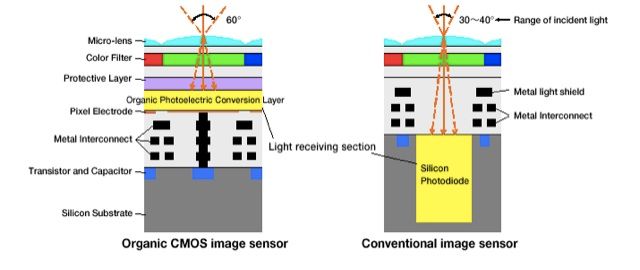
On paper the new Organic sensor has the following advantages over conventional sensors:
1) it has only 1/6 of the thickness of the current sensors
2) Increased Dynamic range of 88dB
3) 1,2 ISO stops more sensitive
4) range of incident angles of 60 degrees, efficiently utilizing light entering at an angle for faithful color reproduction with no color mixing. It also gives greater flexibility in lens designs, facilitating the reduction of overall camera size.
Now let’s see when this sensor is coming for real. Hopefully we don’t have to wait too much time 🙁
The full press release can be found here: 43rumors.com/hot-news-panasonic-and-fuji-developed-the-first-organic-sensor/
—
For sources: Sources can send me anonymous info at 43rumors@gmail.com (create a fake gmail account) or via contact form you see on the right sidebar. Thanks!
For readers: Don’t miss any news. Join our group on facebook and follow our tweets.
Rumors classification explained (FT= FourThirds):
FT1=1-20% chance the rumor is correct
FT2=21-40% chance the rumor is correct
FT3=41-60% chance the rumor is correct
FT4=61-80% chance the rumor is correct
FT5=81-99% chance the rumor is correct
67 Responses
I’m pretty sure sensors can’t be sensible.
you go help them then
actually this one is full of sensible… sensible heat that is.
bad news for Yun then.
No .
It still got 12 months for GX7 successor to take the place means more than sufficient time to fix out drain battery & overheat issue .
Ever the optimist. This tech will be in the lab baking for at least 2 years before we see it in a camera.
Yun already volunteered for prototype testing
It’s always my pleasure to do so .
No .
It’s paving it’s way to
X Pro2
Another issue with this sensor is it’s size 😀
*running away*
… or advantage…
You have to laugh when they tout ‘thinness’ as an advantage, as if the ‘thickness’ of existing sensors was causing problems for current cameras.
I would say we are some years away from anything reaching the market.
I think the thinness might also help to bring the incident angle to 60 degrees, which allows for less demanding lens designs. Who knows maybe the DR increase may also be achieved because of this. 4 advantages in 1?
Exactly. The A7 is a camera that could use that kind of technology. It’s got some problems with internal reflection between sensor stack layers. That’s severe enough to show up in photos. And that is probably a big problem for designers of FE lenses.
Well, it had. A7s and A7II already got rid of that problems
i think every reducing in size of an electronics component helps in the shallow space of a body.
Heat disipation is probably the bigger benefit.
maybe? i dont think a sensor which generates more heat is not really we are waiting for, so they will try to reduce the power drain asap hopefully
If this heats they just have to put a fan in the camera 😀
“1,2 times more sensitive” means only 20% more sensitive…
I believe the most important is the increased range of incident angle !
Of course it would be great also to not need exposure bracketing anymore !
A fan blows air AND dust around as well as using battery power.
Plus in a weather sealed camera you may be limited in the amount of cooler air that can enter so you end up blowing around hot air with little gain.
Finally heat on the sensor may be causing noise issues and may take time to cool down with a fan. Are you prepared to switch your camera on and wait five minutes before taking a low light photograph ?
I think the suggestion of the fan was a joke… 😀
yes but some people love to start a disussion before they read it all.
Of course I was joking 😀
Sorry, should have read it more carefully. I’m so used to seeing daft suggestions on here… 🙂
Admin did not express himself clear enough, in the original paper is written 1,2 times more sensitivity which translates in 1,2 ISO stops cleaner images:
http://www.fujifilm.com/news/n130611.html
Not a fan, but a Peltier cell!
The problem is that it raises power consumption
1.2 times as sensitive means 20% more sensitive, 1.2 times more sensitive means 120% more sensitive.
battery drain…runs hot…and cannot find a proper processor…that is 3 large obstacles…and all for 1.2 times more sensitive…it is an improvement but is it that significant…
it has more then just one advantage, but yeah, still have to see how much it works out to be in practical use.
How about a clean & clear imaging at ISO 6400 with F2.8 ?
Or over 1.5 stop improvement compare with GX7 sensor ?
6400 is good for concerts and pubs, but i dont spend much time there for my photography(yes i try to give very subjective opinion, since thats the fashion here anyway) I get it all by always shooting wide open at 1.8 or less.
Sometimes a long optimized process like cmos sensors reaches physical limitations and you can only get better with a different technology. But that also means you could need a lot of time to optimize the new processing.
I’d say the bigger advantage is the angle of light for the corners. A breakthrough would enable larger sensors with smaller lenses.
1.2 times is not 1.2 times because it’s a logarithmic scale.
The biggest advantage of this design would be the increased incident light angle. Surely older lenses which are presently considered incompatible with digital (like true Biogons) would get a new life and future optics can be made significantly smaller and simpler. For this reason alone the organic sensor merits further R&D until eventually it is ready for market.
Yes, I concur. The incident light angle is a major problem, especially for UWAs. And new lenses can be made smaller. I wonder how long it’s going to take, and if the lack of a new sensor in the E-M5 II can be a hint about the timeframe.
Seems it still has a lot of problems, but Jap. engineers can be true geniuses. Possibly you also need to invest in new factory machines to get the thinness and the required materials behaviour.
It also tells us that m4/3 is definitely a winning format, perhaps The winning one of the decade.
Exactly. I would love a compact Contax T3 type digital camera, instead we have to get the Sony RX1 with its large telecentric lens instead.
I thought the biggest advantage of the organic design was better DR.
They have claimed they have managed to increase the well capacity by 4 fold. If they also manage to significantly drop the readout noise, this will be enormous because you will be abble push the shadows a lot farther.
Now the dynamic range is around -65dB at any sensor, there isn’t any difference in dynamic range as the technology level is identical regardless the sensor size.
But -88dB results just over 1EV wider exposure range (1 EV is doubling or halfing the exposure) so it is that +1.2 EV to it. It is no where near four fold. A -10dB is doubling or halfing the value, now the new sensor in research is just -12dB improvement to current ones. And that is that additional 1.2 EV exposure range as pixel dynamic range is able to detect with higher percentage of the photons hitting it.
+1 EV for exposure range isn’t really much, after all we have about 13 EV exposure range already in cameras like E-M1 and GH4 and that means we can capture almost everything from sun circle on clear sky to deepest shadow in scenery. Difference between 13 EV and 14 EV exposure range is actually negligent. Even difference between 13 EV and 16 EV is negligent in most situations, but when it comes to low light performance and photographer can use one stop lower ISO or bring shadows up in post process (requires over 12-bit image) it can be big.
But now example Olympus E-M1 has 13 EV exposure range, capability to recover -5 EV shadows or even 4 EV highlights, totaling over 22 EV exposure range, and that is HUGE. Add there one EV for normal exposure range and it means nothing. But if you can get +2 EV to both shadow and highlight recovery and there is huge benefit.
But resulting photos will be FLAT. They are near grey without contrast. Sharpness and Contrast will suffer and people need to shoot with JPEG+RAW all the time as the preview will be so bad looking from the RAW.
Each photo will require much more post production to get it look somewhat good, so it will be easier and better to shoot just JPEG than play around with RAW. The RAW will become a burden (it already is with E-M1, the files are 3-4 EV stops too flat!) and it will be hard to tell what the colors really should look like.
Thanks for the report, but
-65dB-(-88dB) = 23dB
Isn’t that over 4 fold?
Electronically yes but we are talking then from exposure range that is lower.
What brings the problem when people mix pixel dynamic range meaning same as sensor exposure range. As dynamic range means only what is the detection range of single pixel if it is bombarded with 1000 photons. But when 1000 pixels are bombarded with 1000 photons the exposure range can be much much lower than the dynamic range of individual pixel.
Ie. People say “This cool sensor has dynamic range of 13 stops!” means nothing as dynamic range is only about single individual pixel capacity to meter anything between 0 and X amount of photons. While exposure range is dependent from electronics (or chemicals) AFTER the pixels building a more complex metering system.
Why real value what photographers want to know, is what is the exposure range of the sensor (or film). Like when they set studio lights, they use lighting meter to get darkest exposure value for given ISO and then brightest exposure value for same ISO. Then they can calculate that the exposure range to cover the photo is X EV stops.
They can get result like “gee, this is 7.1/2 stops scenery” and they know their camera can capture 13 EV stop exposure range so they are 5.5 stops safe for correct exposure (!= ETTR) when doing using middle value. The individual pixel dynamic range can be double of that or even just half of that but still camera can get correctly exposed photo.
That is the figure that impress me too .
Whether it is practical in reality ,
We need to wait & see .
The 4/3 (and m4/3) was designed to be a telecentric. Meaning that the light will hit the pixels directly from the rear lens. There ain’t need to do microlens ro huge suffer from bad corner sharpness or heavy vignetting.
While m4/3 sensor gets densier light than larger sensors, it helps a lot in optics design to make them smaller and sensor design to avoid photons leak.
At least we know the status of this organic tech . Let them soft up the remaining problems before this ground breaking sensor make it’s debut in GX line
yunm lets hope the advantages are not within the pixelpeeping range and regarding the wider dynamic range, since the look a wide range mostly results in low contrast in normal taken photos, we will make it more pop, so we end up using less DR in the end as usual, unles we maintain the more analogue looks.
Ouch! The sky is falling! We’re doomed to take bad pictures… 🙂
OK Its time to get serious and break out the graphene!
if the thickness is only 1/6 of a current sensor, it seems likely they can solve the heat issue by making the back thicker with a heat sink to wick heat away. Obviously its more complicated than that, but I think that part is solvable. The processor side should be trivial as we already have ridiculous processing capabilities in phones. Cost for that processing and battery drain are likely the biggest technological hurdles.
i suggest a passive watercooling system, where the fluids go thru a hollow magnesium frame( dam you, you organic sensor lol)
I think they need to make the camera a little bit larger to support a bigger battery and cooling system for the sensor and processor. I can’t wait for this technology to see the day light.
I dont think that wont please the crowds.
Meh… I know I’m an army of one, but I’d be quite happy if Oly made the EM-10’s grip the size it is once you put the add-on grip. That way, they can make the battery bigger 🙂
imo that defeats the purpose of the HLD-6 nd the compactness of an em-10 when you need it. You know these add ons can be found rather cheap. you can opt for using the grip only when you dont need the battery module.
As far as I know, HLD-6 wont work with E-M10. You have to use ECG-1 instead, which sadly doesn’t provide extra battery power 🙁
But I agree with you: E-M10 is quite pocketable with a small lens, I really appreciate this.
oh the hld-6 is not compatible? thx for telling…i will check it
Absolutely. The E-M10 is unusable without the grip but really awesome with it. Adding that little bit of grip to increase the battery would be a smart move. As it is it alwyays requires way too much fidgeting when you replace the battery or the sd-card while you have a sling or tripod mounted.
I don’t think you are the only one in your army, though I am in the other army. I prefer using a perfect fit hand strap. The camera can’t drop, I hardly need to use any force to hold it, all buttons are within finger reach. It really solved the small size issue for me. The only thing is, I had to make the strap myself.
You see there are other people feeling the same way. Yes ,4/3 system is nice to be small, but sometimes big is also nice, especially on the top of the line cameras. I have absolutely no problem with a bigger and better whether sealed GH5 with 38 Mp and 8K recording at 2000$.
bigger then the GH4? I have the impression you want everything bigger both physical and in specs.
Of course I want this, who doesn’t?
“Of course I want this, who doesn’t?”
Me,
I stopped extending my Nikon gear because I realized I wasn’t using the best and most expensive parts enough. It was not possible to take the best lenses to the most important situations. The result was, that I didn’t switch from Nikon APSC to Nikon FF.
Today I’m takinge more and better pictures with m43.
I’m expecting a “GH5” to be better than my GH3 and the GH4 but I hope not at the price of more weight and size.
Even if they increse the weight and size of GH5 compared to Gh4 to help dissipate the heat better, it will still remain small and light in comparison to Nikon DX or FX cameras, of this I’m quite sure.
You are right. DSLR equipment is still much larger and there is room to grow but it don’t have to.
I think every camera is a compromis. You have parameters like weight, size, handling, iq, price and improving one of them leads to trade offs on others. I also think that the size of the GH3/4 is not caused by the needs of the technical equipment. It’s that big to improve handling and usabillity. It should be possible to fit even improved hardware in to the same size and later in smaller cameras like the GM5 or the LX100.
For me, the GH3/4 it kind of the upper limit and a larger GH5 would need lots of improvements to make me go there.
Agree, the Gh4 was (is) a big success, I hope Panasonic learned some things and bring a super Gh5 on the market. If a camera is very good, people will buy it.
ehm I would suggest an E-3 or E-5 body for you. Wishing for an even bigger then GH4 sounds kinda unrealistic, though I hope for you your wish comes true.
I have no need for E-3 or E-5, I own several GH4’s and look forward to the next pro Panasonic cameras for video work. Though I’ve spent some time with E-5 from a friend and it feels very good in hands, I like the size and hand grip very much.
I have no problem in a little bigger than GH4, the weight is the nasty factor.
I assume you have bigger hands, which might be in conflict with the smaller sizes. My luck is that i have female size hands.