








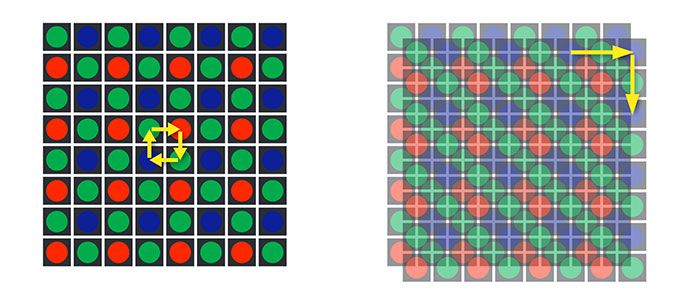
The Pixel shift tech from the Hasselblad H5D-200c. Something similar is coming from Olympus.
An anonymous source sent me a precious info that I luckily could confirm via one of my best trusted sources. So here is the big news:
The new Olympus camera coming during the first week of February will be called Olympus E-M5II (or E-M5 Mark II). And the big new feature of the camera is “sensor shift” shooting. The camera has a 16 Megapixel sensor that can shoot up to 40 Megapixel by shifting the sensor (in up to 8 frames of single shots).
The sources didn’t explain me in very detail how it works but my guess is that it works in a similar way of the Hasselblad H5D-200c. Hasselblad (Pdf file here) describes the tech in that way:
High precision piezo-electrical actuators control movements of the sensor in ½ and in one pixel increments. By combining six shots, offset by a combination of both ½ pixel increments and one pixel increments, the colors, Red, Green and Blue of each point are obtained with a double resolution in both the X and Y directions. The result is an astonishing 200Mpixel full color image with no artifacts, such as moiré.
The Bayer Mosaic filter pattern covers the pixels of the sensor. Moving the sensor in one pixel increments between shots, allows for the exact R, G, B values to be captured in every pixel. The multiple captures are then assembled to deliver the correct colors and ultimate definition of detail. Adding captures, each offset by a ½ pixel sensor movement, creates space for extending the sensor resolution from 50Mpix to 200Mpix. The outstanding definition of color and detail is maintained

—
For sources: Sources can send me anonymous info at 43rumors@gmail.com (create a fake gmail account) or via contact form you see on the right sidebar. Thanks!
For readers: Don’t miss any news. Join our group on facebook and follow our tweets.
Rumors classification explained (FT= FourThirds):
FT1=1-20% chance the rumor is correct
FT2=21-40% chance the rumor is correct
FT3=41-60% chance the rumor is correct
FT4=61-80% chance the rumor is correct
FT5=81-99% chance the rumor is correct
311 Responses
like some phones 50megapixel image? soft soft soft
A phone is probably not something to draw parallels from. If Hasselblad can make it work, I see no reason why Olympus couldn’t. On the other hand, if Hasselblad images are soft, then Olympus runs the same risk. I have no experience with Hasselblad image quality.
Not the same.
smartphones with high MPs are a mix of “big (for a phone)” sensors and high pixel density. The trick of the Em6 is creating a composite image, like a panorama, but within miliseconds.
EM-5 II. Can people please stop with the 6 already?
E-M6 is better sounding than any stupid Mk II or II etc.
If someone wants to use “Mark” something, then why not just slap a two digit year behind the model?
OM-D E-M5-12
OM-D E-M5-15
Here, here!
Mark 2, Mark 3… when I hear of conversation with those wording it sounds like kids fighting over things like my dad is stronger than yours.
I would certainly prefer a more “true” higher resolution sensor. Even it means only going from 16 to 20 or so.
We must keep in mind that there are only a handful of lenses that can out-resolve the current 16MP sensor, so going to 20MP might not be that big of an advantage for the majority of users. If this sensor shift thing works as advertised, the resolution will not be limited by the lens.
My Zuiko 50mm f2, 14-35 f2 and 75mm f1.8 are ready for those 40 MP photos!
So is 40-150mm Pro that match with 75mm f1.8 😉
LOL…. some people think that pixels are evil, but this method somehow cheats lens resolution…
There are indications that higher sensor resolution improves image quality even with lenses which are only “pretty good.” There are a lot of arguments that the sensor needs to out-resolve the lens by at least 2 to 1 for best image quality, and some argue for as high as 8 to 1. Of course in real world use we will not know the optimum number until we pass it.
I’m afraid a 40 MP image created with sensor shift technology needs exactly the same optical resolution as a conventionally made 40 MP image on a hypothetical true 40 MP sensor of the same size.
But actually most lenses will profit from such a resolution, even if they cannot perfectly satisfy it wide open and across the whole frame.
You may be right, I’m not familiar how the image composition works with sensor shift. I originally figured that it basically takes 8 individual 16MP shots and the rest is up to the processor. In that case I don’t get how the lens would affect the resolution, as each recorded image is still only 16MP.
The thing is, while for each of the 8 recorded images by itself 16 MP is what needs to be resolved by the lens, more optical resolution is needed for those 8 images to be different from each other, which is what is needed for a 40 MP combined image to actually show more detail than a normal 16 MP image can show.
Come to think of it, you are most certainly right. The lens doesn’t move, so it needs to be able to resolve each possible position of the sensor to even benefit from image stabilization. That means pretty much every lens in the lineup can benefit from this tech. Pretty cool, very interested to see the reviews. E-M1 mkII will then also get this feature in a year or two, so they have time to tweak it further.
The images are different because the color filtered pixels shift position.
20mp can be achieved with ease and the results will be good with today’s tech. But MFT producers and Fuji seem to be stuck to 16mp…
Excellent idea!
This rumor is more credible than the Sony electronic color filter- rumor. However, this would apply for stills only and would work properly with electronic shutter only. I can’t imagine something like that would work with vibrations caused by mechanics.
Well maybe Sony actually will move the whole sensor too.
that rumor was a hoax.
It’s called super-resolution. Many phones already have it.
http://en.wikipedia.org/wiki/Superresolution
and you don’t actually need pixel-shifting sensor to do that 😀
And you can have it now it you consider it learning more complex PP tools.
Which phones? How can you do it now?
e.g. Photo Acute.
I looked at their website, not exactly cutting edge is it, supports a handful of Nokia phones for 2005. Any better examples than that or should I take your posts with a pinch of salt going forward?
Is that it?
Sounds good to me, but I hope that we still get a new sensor that has better high ISO performance.
Wow.. 40 megapixels .
Multiple captures to form an ultimate image .
Resolution increase for sure .
But it still the old 16 MP sensor ?
How about DR ???
ISO performance ???
It seens to me , the Pana-Fuji Organic project is much promising than this one .
Organic sensor is only vapor so far. Noone has seen anything about it.
That’s because they’re still growing it.
Ha, Ha, yeah, from human retina stem cell.
That’s the point: it’s not ready yet. And as far as I have seen so far, it was only mentioned in a couple of rumors. And promised to be the holy grail of sensors.
I’m not sceptical about it, but I find strange that some people keep waiting for it, as if current sensors are crappy.
If in need of a different output, photography world has a lot of systems to choose from, each one with its pros and cons.
We’re never happy..
What we have? I mean what we really do have as photographers? We have all kind fancy camera bodies, objectives, memory cards, computers, software etc. We can all choose what we buy and use.
But what we can’t do, is freeze the time (okay, long exposure is little bit like that, slamming X period of time to one photo). We can only choose where we are at the given time.
So lets take a look of example soon coming dad/mother, should she/he wait next gen camera or save money to little better camera, or go to store and buy the camera that has good price and fits the need?
When a house is in fire, first thing people do after making sure that their childrends and pets are out, is that their photo albums are safe.
They don’t care about cameras. They don’t care if their 2000€ objective is going to melt on shelf or their 6500€ camera body is going to be pile of coal and iron.
There is no reason to wait next gen technology to come, no sane reason at all. If you can’t buy it today, you are going to miss the next day wedding photos.
And WHEN the next gen technology hits the markets, you have time to sell your current camera for good price and get a new one. As someone will be happy to buy it off from you for fair price, someone who doesn’t care about the next gen technology, who doesn’t need the next gen technology.
We can be very happy if we just remember few basic things in life, “Latest toys doesn’t make true friends….”
I’m sorry but the only thing I understand and agree is your last sentence.
I have never taken into consideration a burning house, but personally, if the house is on fire I would never go back risking my life for an object.. I think my wife would prefer to have a husband..
Then, still concerning the photographs to be saved from fire, I think that I would be quite sad, but after all 99% of them are stored in some hard disks, 1% is printed, and that 1% are the pictures that actually “exist”: how often do we look back in search of old photos in our hard discs?
It’s off topic but an interesting discussion.
(And now I see a good reason to have a Cloud space where to keep some memories)
About wether buying or not buying the new gear (or toy): personally I got rid of my G.A.S. just asking myself “do I really need it? Will itadd something to my passion or work?”. If the answer is no, then I skip it.
I had a temptation with the last Sony a7II, for example, but at the end ofthe day it would add nothing (except an increase in IQ almost useless for my works) to my passion.
And that’s why I’d rather buy a Monochrom instead, with its absurd price, crappy lcd screen, “limited” in its use, no AF, no IBIS: because it’s a completely different shooting experience.
So, the new-mom/dad should ask herself/himself: do I need it? Or am I able to work/have fun with the gear I already have?
You didn’t ever see doesn’t mean the others don’t too.
World is a lot bigger than you can dream of.
Can you please link a page where I can see something about it?
You want to wait for true sensor revolution or go ahead with this
EM5 m2 multiple capturing tech , the decision is yours .
So far it it seems that this new tech is the best thing you can see in February, when the camera will be shown.
There is nothing at all about the organic sensor Fuji/Panasonic are developping. One might guess it could see the light 😉 on XPro2, second quarter 2015, being a Fuji high end camera, but as you wrote, you can decide wether buying this Em5 mark II or wait some other month to see what happens. Or as I probably will do, skip this simply because I don’t need it.
Or it may never be commercially viable. It may have too high a manufacturing failure rate, not be capable of mass production at reasonable cost or many other potential issues. Foveon was going to be the holy grail of sensors and attracted comments like Yun’s
Acutally I am fine with a 40MPixel can with current ISO and DR performance..DR of my GH4 is really good, ISO is good too. For landscapes I mostly miss details (a bit).
Any innovation is welcome as long as the results justify the increase in price.
For me this sounds pretty amazing even if there will only be a benefit for landscape photography… but maybe Olympus will suprise us and it works with moving Formula 1 cars 😉
Even if it’s just a gimmick like HDR – if it works in certain situations – put it in the EM5II please!
Hm, Kit Lens Olympus M.ZUIKO DIGITAL ED 12-50mm f3.5-6.3 EZ, that comes with the M5 is rated by Dxo with max 10 Mpx. The Olympus M.ZUIKO DIGITAL ED 12-40mm F2.8 PRO with 18 Mpx maximum.
Hope there will a mode for extended dynamic range too.
Take the dxomark tests with a grain of salt. They state that most lenses have the best IQ wide open…which it’s not true…we all know that for best IQ you have to stop down with at least one or two stops. Also the other reviews show that.
Their lens rating is largely based on the sensor behind it.
What makes those ratings not-optical ratings but sensor ratings.
DXO does test one variable (optics) by choosing and using multiple other variables (different sensors, chart boards, weather of the day and moon position to sun) and then claim that one variable is accurately metered as is.
Then you have large group of people taunting results over Internet “Echo Chamber” and mess is up.
DXO is as valid as opinion from a dog next to you. 🙂
+1 for extended dynamic range
With 8 frames per single shot, maybe they are able to “fake” that as well. As long as the results are good I’m fine with it.
That shouldn’t matter with this should it as you’re not trying to get 40mp in one shot, so most lenses should be adequate, in the centre at least.
DxO figure is 100% unreliable. Period.
Ask ANY decent Statistician to see those figure and they’ll drop to the floor.
As a person who takes a lot of landscapes I love this idea
Don’t you think stitched panoramas give much more resolution?
Well, the lesser tme spent in PP, the better. At least to me.
bit depth doesn’t really increase with sub-sampling drizzling usually gives you 2x resolution – so in the case of 16Mp would go to 64Mp.
40Mp is a little strange as it’s not an even number off the base sensor size.
but – this still has a lot of back end processing power required. motion blur, ghosting,etc all have to be taking into account.
This is different. Stitched panoramas give more resolution because there are many pictures of a landscape (for examples) – from one corner to the other. Let’s say, ten pictures in all. As far as I get it here, in this case we are talking about filling up the empty spaces in color terms etc, of one particular shot – of one picture of those ten in the landscape above.
First – the legacy Bayer-based sensor has only half resolution. The 36 MP picture, in fact, is the 18 MP data on steroid. Lots of steroid.
Second – color bit depth. The sub-pixel sampling has n-times depth than the single exposed data. Best FF dSLR has 14 bits CBD. But subpixel sampling, even it 12 bits CBD, the final result will be 12*n bits.
Sub pixel sampling is used for a very long, long time in Microscope Camera. Even before H4D. Ask any researchers or lab guys or astronomers.
And where Olympus is big name? Among researchers, white-coats and astronomers (and those who need high speed or 4k video cameras).
Many believe that Olympus only makes consumer, semi-pro and pro photography cameras for stores…
12*n ? bulls%%t. at best, 12 + log2(n)
stiching will still give you a larger FOV, thus usually more pixels and more control over the process.
There is limits to this technology as motion blur, ghosting effects,etc are all significantly possible. and also what is the output? raw? jpg?
however that being said – this could be a game changer – no need to go to full frame MILC to get large resolutions for landscape, and still have fast fps for normal / sport / motion photography with defacto 16mp.
compact 40Mp or so in m43’s format? sign me up. but the lenses have to be there too as they still have to resolve down to the 40MP – and not the 16Mp.
Possibly, but this gives the flexibility to crop how I want, and if it’s one click all the better.
Wow, if I take a HDR with 5 brackets shots with this 40mp mode, I have to click at least 40 times for each pic. It will be worst if I try to stitch 5 HDR pics into a panoramic.
I assume it would be multi-shot with one shutter depress and happen behind the scenes. there would be a lot of heavy lifting in the background though doing the math. hard to see it handling shot to shot times more than a few fps in this mode – and even then that would be impressive.
This kind of Oly tech can’t do much improvement in DR & ISO if the sensor remain the same .
Only a new generation sensor that can guarantee true light gathering in the sensor , resulting significant improvement in image quality such as the GX7 sensor .
You’re wrong; if an image is produced out of eight real shots, it is being produced from eight times the amount of gathered light. Real, true light. The image probably won’t be full eight times as good, and it doesn’t get full eight times as many pixels, either, but I’d suspect at 40 MP made from eight shifted images the per-pixel image quality will still become even better than that of a normal 16 MP image.
How is the GX7 sensor significantly better than the E-M5 and E-M1 sensors, by the way?
We will see later once samples are available to judge .
Btw I comparing the GX7 sensor against it’s predecessor , the GX1 to give an example EM5 Successor to EM5 . If really need to compare , I feel the GX7 sensor should edge EM5 & stay comparable with EM1 .
You are absolutely wrong.
Quality of signal is measured as Signal to Noise (S/N) ratio.
The SUM of eight-time sub-exposured signal is not better than ONE exposure. But between each subexposure, the pixel is reset (it has to be!). Each subexposure will create only 1/8 of noise.
Mathematics of Mother Nature said that if you sum 8 noise signal together .. if it pure (random, white, blahblahblah) .. each will cancel each others. Though not completely annihilated, the sum total is less than one long exposure noise.
Result? One strong signal to One weakened signal .. that IMPROVEMENT
Go back read textbooks, the SNR will be same as one long exposure.
Nokia introduced oversampling for the 40 Mp camera in the Lumia 1020. You might like to read their paper on it: http://i.nokia.com/blob/view/-/2723846/data/1/-/Lumia1020-whitepaper.pdf
Interesting. It requires a new image processor, right?
That’s indeed one of the most exciting questions here. I for one would surely welcome a firmware update with that feature for my E-M1…
Yes…and when you bought the Yugo the manufacturer was obligated to turn it into a Porsche two years later. LOL!
What is wrong with you that you mistake “I would welcome” for thinking they were “obligated” to something? And so you do know that sensor-shift is really not software-implementable in cameras which already have hardware to do sophisticated sensor-shift stabilization? How do you know?
You are correct. IF the feature is programmable to IBIS and image processing can be programmed to “stitch” photos together, it is possible firmware update. But typically image processors are designed for specific encoding and decoding (crunch large data in high speed) and they are not reprogrammable.
Whah.
Will these resulting images be JPGs or RAWs? if JPGs, we lose out but may be the two images are captured in raw and can be reunited in post…
I am not amazed by this, I wondered about sensorshifing to be used this way a long time ago and like OP says: probably less nice for fast action..But for landscapes it is great possibly.
For those who think high ISO won’t get better. It will be a lot better than having a 40 MPixel mFT cam with current tech. Secondly: downsizing it will even out the noise. Love this idea!
Landscape yes, and studio. These are two big slices of the cake for professional photographers.
Exactly.
Too often people talk how camera need to have good C-AF for sports and wildlife, while very VERY few professional photographer really requires anything like that.
By Professional fee, you can be shooting at side of football field (the soccer…. real football) whole game time and get from couple hundreds euros to few thousand euros depending your shot and game. Or you can be in studio shooting products like example bottles and you get few thousand euros from each shot.
There seems to be some kind “penis complex” with sports photographers, as they have all the fancy new cameras, long objectives and talks about AF speed and accuracy etc.
While then there are photographers who are given few million euros payment and few million euros budged on that to shoot few photos. Or given a hundred thousand euros budged to do fashion shoot in couple hours where every minute costs hundreds of euros.
And then there are those who do Youtube videos, sell their book by marketing it on every youtube video and use fancy technical terms they don’t even know what they mean. (Those who can’t, teach others).
“Too often people talk how camera need to have good C-AF for sports and wildlife, while very VERY few professional photographer really requires anything like that.”
I shifted to the E-M1 from the E-M5 specifically for the improved CAF, because it’s something I use all the time in my sports photos. It’s not really about the “fancy new cameras” but about better taking the shots you need/want.
Things like AF speed are important in sports, because unlike in studio shooting you can’t ask the players to reset and redo the play. The action happens only once and you need to capture that.
The Hasselblad does it with RAW.
DR and ISO dammit.. -_-
Yea exactly. What most users want is clean image with high DR. Neither of these is present in any m4/3 unless you enjoy merging exposures.
Funny thing is, it wouldnt be that hard to make HDR with RAW output.. Especially if they can do this.
The Dynamic Range is the value of the noise and Exposure Range is the value of… what it say, how many EV stops you can capture with single capture.
If you are a electronic engineer, you care about Dynamic Range. It is metered value of the individual pixel in laboratory.
If you are a photographer, you care only about Exposure Range. It is metered value for captured scenery.
To meter dynamic range, you use values like decibels, photos and electrons.
To meter exposure range, you use the Stop values.
For dynamic range values you need oscilloscope and other fancy laboratory gear.
For exposure range you need a light meter.
So many “photographer” talks about dynamic range, but they never show that they have electronic laboratory metering devices to show it. Instead they flash light meter or spot meter feature in camera.
Claiming that Dynamic Range is same thing as Exposure Range has caused countless of debates about digital cameras sensors while basically no one in those debates has devices to meter those things.
i always more interested in the headroom in raw files
So can we hope the E-M5 II will have really fast e-shutter? Or will taking those eight shots last half a second?
Good question! While it still would be a great feature even if those eight exposures would take half a second.
Can you turn it off and just shoot normal 16mp images
I would bet you can. This sounds like a feature for static objects which is nice to have in some situations, but you don’t want to use all the time.
Nor your computers hard disc drive.
Mine are fine with it. Don’t know about you, but a couple 4TB disks for less than €140 a piece seems like a small investment well worth it.
The euro sign is placed AFTER the sum 😉 140€ 😉
But you are right, the HDD isn’t going anywhere as SSD is too fragile technology to store anything important or use for data that is being written often. Sure we can calculate that for 5 years the SSD will wear with 10-20GB daily writing amounts… but the price of gigabyte isn’t at all close of those sizes.
And the SSD problem is that when single NAND chip goes winky, the drive is dead. While with HDD, dead blocks can be recovered, data can be organized and read out and even if the circuitboard of the HDD gets damaged, you can buy a identical series HDD and swap the board and get access. Even when having damages from fire, high G droppings etc, HDD is much more safer bet.
Copy a same data to HDD and SSD, throw both drives to oven to 200 degrees Celsius, in water bucket for few minutes and then send them to data recovery corporation to retrieve the data. You get results that the HDD has much higher success recovering data than the SSD.
Challenges in Solid State Drive Recovery
The challenges of data recovery from Flash media including SSDs can include:
– Proprietary data organization
– Address line complexity (microprocessor communication routes)
– Flash memory chip density (number of Flash chip configurations within an array)
– Implementation of customized wear-leveling algorithms
– Error Correction Code variables
– Encryption and Encoding variations
(from Kroll Ontrack)
With HDD it is very very simple compared to SSD. All what you basically need is a readhead and lots of data can be recovered even if the HDD disks are fragmented or bent.
And when it comes to user own tasks like backups and recover, HDD is safe bet. You get block level access to data and its easy.
Throw a few HDD in RAID 0 (dublicated, identical writing speed but read speed is *x where x is the amount of disks) or Raid 10 (1+0) that does duplication and simultaneous random access.
Use a modern filesystems like ZFS or Btrfs+LVM and its very easy to do backups, rolls etc.
Get a external HDD dock station that does cloning too and your data is off-site physically only accessible by you.
The cameras dual-card slots doesn’t ensure data backup as single writing error or malfunction renders both cards dead. Cards itself doesn’t just die without signs.
Just make backups. Hard drives can fatally crash too. There is no reason to use SSD for everything right now. I have a few in my music studio and it changed the way I make music – almost no waiting for instruments to load now. (although for stroing photos it is a bit of a waste for now)
Macbook Pro Retina.
And what the display resolution has to do with the storage devices?
I have calibrated 10bit 4k display with full sRGB gamut but that doesn’t affect at all how I do backups (on-site, off-site, physically separated without Internet connection. Time to transfer 6 terabytes of photos and video per month to safe location, over 100km distance, in a safe bunker, is just one hour away.)
And the display turns “retina” when viewed further than 56cm (22″) (my common viewing distance is 75cm).
But display has nothing to do with backup plans.
I was referring to them having only SSDs, and AFAIK, there have not been any endemic problems show up.
Olympus and Sony probably have exchanged tips in IBIS and sensor technology… just guessing. This sounds similar to the goal of sony APCS.
Olympus moved the IBIS technology to different department before Sony stock exchange was done, to keep Sony away from Olympus IBIS technology with Sonys 10% share power.
And first reviews about Sony A7II IBIS capability is that it is much worse than OM-D line cameras has, more like a 1-2 stops. But it is just “butt feeling” from reviewers.
did you see the video showing the A7II jittering in the display with IBIS turned on? I could see in some cases it making it worse.
can you say please where the 1st A7II reviews are?
Top of this page, check the Sony Rumors and you can find from there embedded Youtube videos.
thank you.
Olympus will sell their technology to any company that is willing to pay for it.
They make more money that way.
In the same way Sony sells sensors to any rival company.
This 10% Sony stake in Olympus has nothing whatsoever to do with their photography business and everything to do with their medical imaging business,
I doubt that Sony’s imaging head had any input at all into the decision to buy 10% of Olympus
Photography obsessed people on here forget that for most of these companies (Nikon excepted) the photography business just isn’t that important.
It is a very good information but I hope that DXO will implement this technology to avoid the problem of X-trans compatibility.
DXO could implement the X-trans but they don’t because it would reveal that their testing is very flawed and doesn’t have any metrics for comparison.
Agreed. Xtrans involves some noise reduction at demosiacing probably making it difficult for DxO to deliver results – and if they did would yes, show that they haven’t been comparing apples to apples between vendors since the dawn of time. so they’d rather ignore it like it doesn’t exist.
X-trans is the same old Sony sensors as every other camera except the Bayer filter is replaced by an X-trans filter.
The X-trans filter requires far more complicated de-mosaicing than Bayer, including that it already applies noise reduction on the de-mosaicing level. That’s why it’s very difficult to compare based on RAW.
But apart from a different noise reduction pipeline which involves less noise at the expense of less detail, you can expect very similar results between X-trans and the regular Sony sensors.
At least it has a switch for it, though it sounds cool, esp for advertsing this camera. E-m5II or mkII ?. New strategy in naming upgraded Olympus camera models?
works for canon
In which market? 🙂
There are better than military “Mark” variation: http://www.olympus-global.com/en/corc/history/camera/om/
Even military use today letters like A, B, C, D as it is simpler in English.
Soviet/Russia use letters of first word and the word is literally “upgrade, second, modernization” etc.
So for example western side model variants can be like F-15C but it isn’t same between exported models and there is even added info like “Block E” or “Block III”.
While Soviet/Russia style is like “Su-30MKI” what is easy to understand as it is Su-27 familys second generation, M = Modernized, Export and I = India.
Olympus has similar as Japanese usually had:
Olympus OM-1(n), OM-2(n) and OM-2nSP (Spot/Program)
This could very well be OM-D E-M5s (s = shift)
Once you open the reading, it is very easy to remember and know what variant is what. Instead if using a western “simple” style, it is very difficulty as you need to remember each ones specs.
Olympus E-M5 GoldStar would sound better
Maybe like fuji X100s – second, X100t – third ?
Interesting idea, which may give high resolution without sacrificing image quality. Ideally, I guess one should have electronic/global shutter? BUT it puts a heavy demand on the accuracy of shifting the sensor sideways/up-down: this shift needs to be 1/2 pixel I guess in order to e.g. double the precision in one direction? 1/2 pixel is 17.3 mm/3200 = 5.4 micro meter. If the accuracy has to be within, say 5% of this, that implies an accuracy of 0.27 micro meter…
The IBIS and Gyro in Olympus cameras is already more accurate than needed.
The question really is that how quickly can next image be captured?
The claimed next gen Sony sensor (false data etc was in one) it would have a global shutter feature.
This is of course great feature if it is possible to come by Olympus for studio and landscape photographers, or even some portrait photographers with continues light.
After you have taken a 5-10 second exposure portraits with Large Format camera, you know what you can do with couple second exposure times.
But lets just forget the sports or flying birds with continues autofocus? 😉
so should I dump my E-M1 now while prices are still high?
Is your Em1 suddenly taking awful pictures? 🙂
It’s wise to wait a bit before decide what to do .
It still got pretty of time .
I’m curious why this wouldn’t be in the E-M1 replacement first, granted I’ve just been passingly watching Olympus – but isn’t the E-M1 the flagship? and M5 considered “under” that?
Yes, but the E-M1 is only one year old, while the E-M5 has been around for nearly three years. So the E-M5 will be the first that needs a replacement, if it so does, and, commercially, Olympus would be rather ill-advised to not use what they can to make it a competitive camera on the market, even if it means competing with their own flagship model.
yeah good point. it’s only been a year for the M1? feels longer :p
Granted superrezzing works in select cases and scenarios and not even all landscape scenarios – but if this is certainly coming, I can’t see me using anything other than this body for the next 5+ years and not needing anything else. this would have me switching to Olympus faster than can you can say E-M5II
Still they will be different cameras. Probably the E-M5 will retain a smaller body/grip than the E-M1 has and lower FPS.
It isn’t “new” for companies testing new technologies in their mid-tier models before the flagship one arrives.
E-M10 is better than the E-M5 in many ways, and its entry level. Features from the E-M5II will undoubtably migrate into the E-M1 in the fullness of time.
you sound like a gearhead
not really, it’s just I bought the E-M1 because it did PDAF so I could use 4/3 glass, I would prefer to have the smaller E-M5 body style. In fact I just bought an E-PM2 to use as a small 2nd body for when I wanted something that fit in a jacket pocket.
So if the E-M5 II comes out with PDAF and this new feature I honestly wonder if it would be a better fit for me and would consider selling my E-M1 and the E-PM2.
isnt a two body solution more ideal like you have now? ofcouse we have no idea yet about all specs of the new e-m5. But your E-M1 is surely a much better camera build-wise then a E-M5 class. and prob a better match with heavier FT lenses too. Which FT lenses do you have? Just curious 🙂
yes and no… a smaller single body which focuses all my lenses would be the ideal solution. Right now I have the 4/3 9-18, 14-54 MkII, and 70-300, but I am also actively shopping for a 50-200. I have a couple of MFT primes as well as some manual focus Hexanons
nice selection. which hexanons do you use?
the Konica 40 f1.8, 50 f1.8 and 57 f1.4. I most/use like the 50 f1.8. I also have a Sigma Super-Wide Macro 24mm f2.8 that is a lot of fun to use as well and was reasonably inexpensive compared to other 35mm film sub-28mm lenses. I’ve also used a few russian lenses, the Jupiter 8 and Tair 300mm Brussels Grand Prix, I sold those off to fund another purchase but do miss the Jupiter 8 quite a bit
interesting , but i am only familar a bit with the 57mm, always wanted to get that lens, untill a journalist offered his CV 50mm f/1.1 for a decent price, long time ago.
Pentax K-3 have something related, but thats geared towards anti aliasing, not gearing up file resolution.
em5 II will stay sharp like the em5 <3
If you want this type of sharpness in a single shot you can already get that with sigma’s foveon sensors but they are not as good at higher iso’s.
This seems like a good comprimise giving you extra sharpness when needed but at the cost of needing more frames, I always said pentax should have done this a long time ago.
This isn’t going to help me with birds or wildlife. At this point, the ONLY thing I want to see in this camera is a more advanced PDAF implementation. That forthcoming 300mm F/4 is going to be of limited use, too, if it’s attached to a camera with mediocre CAF.
I’m full with you: I just bought into FT because of Wildlife. And the ED 300/2.8 is focusing with the E-M1 NOT good enough, that I’m not considering to jump ship or at least to buy into a 2. System. However the high Resolution is also highly appreciated for Landscape
The four thirds crop factor suits wildlife but we have no M43 extra-long prime lenses and nothing at all past 300mm, where’s my 450/F4?.
Your 300/F2.8 is 4/3 not M43 and barely operates on M43 Cameras. They were not designed for CDAF and the Ollie work around is a bit of a bodge. Probably best used in manual focus?
Problem with switching to APS-C for wildlife (probably Pentax) is the extra long lenses will cost an arm and a leg and a kidney. That or the super-zoom and I haul out the FZ200 which yes, can be goaded into 1200mm at f2.8
Being heavily invested in M43, I’ll stick.
I am not so sure of the benefit. It will likely be movement sensitive so for static subjects only. The most likely scenarios would be for landscape but this technique could only be shot in JPEG where DR will be limiting.
So you gain in resolution but no longer have the ability to pull up the shadows. This seems quite limiting to me.
Why should this be possible in JPEG only? Do you think the 200 MP Hasselblad, too, outputs its 200 MP images only in JPEG?
No, but I’m betting that Hasselblad costs a whole hell of a lot more than the likely $999 body only price of this EM5II.
It isn’t just with JPEG. It would be only processed via Olympus software if wanted to get the RAW recompressed. Final image can be just JPEG to save time.
Of course some processing would have to be going on before saving the RAW file, but that’s what is being done with the RAW data in the camera anyway, and all that can happen easily before a JPEG is made out of it.
The Hassleblad does 8-bit TIFF
Maybe, but it does RAW, too. From dpreview:
Depends on how the computation works. You don’t necessarily need to shoot 6 full exposures if the photosites are overlapping. You could maybe get away 1/6 the shutter speed for each exposure, giving you the same total shutter speed. I’m not sure, though…I’m skeptical, but we’ll see.
Yes if you can stop the wind pushing the leaves about.
Good News for landscape fotographers wihout moving subjects.
Let’s see, if the FT ED 7-14/F4.0 is able to resolve that Resolution in the edges.
Hopfully the E-M5 Mark II will have native ISO 50 on board.
And I’m wondering, if the 40MP are really comparable with a Nikon D810.
If this rumors is really true, I gess we can see several high Resolution Cameras from other manufactures next year….
You won’t be able to shoot RAW with this enabled. So DR will be limiting compared to native solutions like the D810.
Are you sure about RAW not possible? I mean: at least the 6 single pics?
It could be done if it is processed in Olympus dedicated Raw conversion software. Certainly not Lightroom though. Only worry there is Olympus software is not exactly fast at the best of times leave alone processing something that big.
the output would look no different than a normal RAW file, albeit at a higher resolution. there’s not a reason in the world why LR couldn’t read it in. just like LR can read in canon sRAW formats.
At least OV3 doesn’t turn pictures mauve.
So you claim this is just one of the new Art filters?
Process in camera and produce a 16-bit TIFF. Done and done.
yes/no .. the D810 can do it in one shot. where this would take 6 shots to compute the resolution – it’s not going to be as good – but it would be close. and depends on what the output is as well – ie: is it 40Mp 16 bit TIFF output?
6 RAW shots…..
Only if Olympus’s Software is able to combine them into one image. LR won’t support it
No, here is the tech
http://www.hasselbladukstore.co.uk/h5d-200ms-no-lens/
They are 8-bit TIFF and it must be held on a tripod with an utterly motionless subject, so be prepared to have your portrait subjects stuffed and mounted: it’s a fancy HDR.
Personally I’d like to see greater bit depth and greater dynamic range, both of which are doable. More pixels doesn’t mean better.
That is hassy’s implementation of the technology that existed way before this was even implemented on cameras – as a matter of fact, deepskystacker as been using this technology for astrophotography for I think now 6+ years or more?
hubble even longer?
and you need image shifting, IBIS micro movement guarantees some, however, you most certainly do not need this rock solid, utterly motionless ability – as photoacute that implements the same technology and shows how ghosting can be removed by software, and golly gee – that was at least 4+ years old there too.
8 tiff? is simply the output method chosen by hassy – and again has nothing to do with the mathematical implementation of drizzle / superresolution.
Couple this with a native WA tilt-shift lens and you would have a sweet combo for portable architecture photography. The other good thing about this is that m43 will be able to do larger prints (galleries or archival purposes), at least for static subjects.
Better they would use this feature for simulating AA filter like Pentax. Have serious doubts regarding this high resolution.
I think it sounds impressive if this can be used when needed.
The proof of the pudding is in the eating. Let us refrain from speculations and wait until we have an actual product to evaluate. Somehow, thow, I doubt if this will be merely a gimmick. Only companies that flood the market with heaps of indistinguishable consumer products can afford to use the strategy of packing them with gimmicks to attract attention. For Olympus, putting a gimmick into a core product sounds like suicide; I cannot believe it could happen, it does not make sense.
LOL, I thought that speculating was what this site was all about. WIthout that we just wait for DPR and DXO and no need for this site.
Lol you can’t cheat the laws of physics! Just moving the sensor around does NOT change the number of photo sites on the sensor, or their physical properties, and it certainly does NOT change the light hitting the sensor. Everything stays the same, so resolution and colour information is the same. This is a MARKETING HOAX designed to fool people who have no understanding of basic maths and physics! Don’t believe the hype!
That’s probably what ppl buying the Hasselblad H5D-200c thinks of course…
Actually they’re probably thinking £35,000 !!!
I’d probably need to go and lie down in the darkroom …
I agree. This camera will be DoA, just like its tiny sensor competitor, the Sony HX50.
really? Hubble and NASA say hello.
So does math and science say hello.
Some people just have hard time to understand simple geometry.
Not if Olympus have got in bed with Sony/Hassleblad.
With this method, you ARE acquiring more light! It is essentially increasing the overall exposure time (acquisition time) without the detrimental effects of blur by having several exposures at different times rather than one long one. At the same time gaining resolution by moving sensor around for each acquisition. Maybe your post was meant to be funny?
You’re wrong, too.
Ha ha. Good one professor!
You seem to overlook that microshifting the sensor is only one part of the process, the second part is taking another real shot after each movement, up to eight times altogether. Thus we have eight real exposures to combine, all showing just slightly different images, and summed up eight times the amount of light a normal exposure gets. That’s how it’s done, and, by the way, the Hasselblad perfectly proves that it really works.
No, you’re wrong. The Hasselblad doesn’t work. Please educate yourself.
Link, please.
Will it work exclusively by software like a program I knew, Photoacute, which did HDR next to Mpx doubling by interpolating two images? Or say will it piggyback on Ibis, and take two images while the sensor moves?
If it is v. fast, it could be still useful for moving subjects, so everything will depend from implementation.
If it’s spotless it will be another argument for those who argue that small sensor is no limit and that FF belongs to the past, the film past.
BTW I am very curious about the new camera shape. I am getting really bored by the small dSLR FF, especially if it must hide so much science. Can’t’ Oly invent something more futuristic and streamlined?
I would rate this rumor as FT3 level, that would be high on my level. As we should as well remember, 4k was FT5 rumor for next firmware. And when it didn’t come up, people got angry and few might have mashed their cameras on the wall losing all their strength doing so.
So lets just keep fun with the rumor and not take it too serious, right?
4k was an FT4, and that was rather explicitly stated that admin had a hard time believing the rumor despite the quality of the source. And it turns out the rumor WAS true, it WAS tested on E-M1 bodies but not implemented in the firmware update for whatever reason.
The technique is called superresolution and has ben used scientifically since many years. There are many forms to do superresolution, one of them is through pixel shifting. Here is a technical paper for a non-mechanical way to do pixel shifting, just to show that this is a common subject in image processing
http://www.ncbi.nlm.nih.gov/pubmed/20052225
There are many technical and scientific articles about superresolution on the web.
Personally I have worked in superresolution for medical images and astronomical images. The technique is excellent for enhancing resolution and reducing noise due to multiple sampling. If Olympus is able to control the movement of the sensor with sub-pixel precision, which I think they are, the results will be really great.
You put it in a much clearer way. I as indeed wondering, since IBIS already shift the sensor, if they could catch two images on the fly instead of one, and add them for superresolution. I suppose that an electronic shutter could do it easier.
It’s a trick but it works very well. In Photoacute the camera had to be very stable, and the subject static, like in HDR. But those were early times.
This implies that they have achived a superfast full sensor readout (even if rolling).
Eitherway this is good news for video too! 🙂
If it actually works as promised, it’s a game changer
For me who shoots a lot of paintings, having rich raw file with little or no moiré would finally be an incitative to upgrade over my GH2.
…and for all the talk about sensor and the drool over latest tech and lenses, and maybe a bit off topic, the biggest upgrade I ever made for shooting my paintings was to buy a polarizing filter. Don’t get me wrong, I am extremely looking forward to see what Olympus will come out with. Guess it was just a self reminder to know better before relying on the next sensor 🙂
I’ve played with super-res for shooting artwork, and it works well.
I like Sony’s implementation better, where it shifts the color filters across the sensor, and not the sensor as a whole. Sure you don’t get 40MP images, but you would get 16MP images that look like Foveon images (no Bayer interpolation).
Regardless, what WILL be interesting is being able to test our m43’s lenses at higher MP to see how really sharp they are.
where can I read about Sony’s implementation?
It’s the APCS (not to be confused with APS-C) tech that was revealed a while ago. No commercial sensors forthcoming, as far as we know, though, and it looks heavily targeted at video (only 5MP).
http://image-sensors-world.blogspot.com/2014/11/rumor-sony-to-introduce-active-pixel.html
oh that one, need to reread it again, thank you.
Well, since this is multiple exposures, this doesn’t require the lens to resolve any more detail than it would previously. So that’s a plus.
If this can produce RAW files, that’s great. If it just makes 40MP JPEGs, I’ll be a lot more disappointed, unless there’s exposure bracketing and computation built in to that image stitching to increase dynamic range as well as resolution.
drizzle aka superresolution requires that the optics out-resolves the imager.
You may be correct, but in this case if the translation is 1 full pixel for each exposure, you should be able to achieve better “real” resolution simply because there’s no need for demosaicing at that point, since each pixel will have all of the colour array subpixels overlaid.
I might be wrong, though!
sony’s implementation does not superrez – it simply does a trick to make it fovean like. assuming that’s not a complete hoax. sar claims they saw patents, but oddly enough never linked them.
Right but… if you look at the sony documentation, you’ll notice that their solution happens MUCH faster than any shutter speed, so it only really has to take one slap of the shutter to get it to work. This means it will likely be seemless in use, whereas this tech will likely not work well with much other than landscapes/still life.
in theory – let’s assume that wasn’t a hoax. conventional thinking is that you would still have motion blur / artifacting because the entire image is not taking place in one shot. regardless on how fast it is – you still have the total time required. the sony solution made a lot of sense for video, but little sense for stills and requires a lot more heavy lifting than this does and the capture of 1000’s of raw files and processing them into a super fovean like raw? believe it when we see it. odds are it’s on chip processing with no ghosting support. not only that, but the moving bayer filter array has to be insanely accurate in each movement. while in this case, it doesn’t have to be .. the mathematics work if it’s off by a 1/5th of a pixel,etc.
the sony solution just also gives you more color per pixel, it doesn’t increase the pixel density. in theory there is an equivalence, but this also allows for both – improvement on color, micro contrast and noise and also improvement on resolution.
That medical technology expertise is paying off for photographers.
Hah- I know right?
If you shift the pixels 4 times one full pixel with a Bayer filter you will get a foveon sharpness effect with each pixel getting red, green and blue info with green being doubled. this takes the demosaicing process out getting rid of the need for a anti-aliasing filter and making the image much sharper. 8 images would be shifting 4 times 1/2 of a pixel and 4 times 1 pixel that if it worked correctly should give a much sharper picture then a 40 mp shot from a conventional camera. It would be like a foveon sensor with 32 million pixels and we know how sharp foveon with 14 million pixels is. (dp2). The if is any amount of Shake would compromise the picture and probably will be only good on a tripod.
Assuming you were able to eliminate the demosaicing process, you can still get aliasing as that’s an effect of signal sampling, not something associated with debayering.
I wonder if we can choose how many photos we make for the super resolution ? Could we choose for less then 40mp mode? something like a 30mp mode?
Why not?! Maybe 4 frames per shot are quick enough for moving objects!
would be cool yes, I was thinking if I could try it with posing people who dont move much anyway. people in full body shots could benefit i guess.
Admin says: ” 16 Megapixel sensor that can shoot UP TO 40 Megapixel”
Maybe it’s even dependend on the shutterspeed.
Switch the function on and the faster the shutterspeed gets, the more frames/pixels it shoots… sorry, just dreaming!
No full frame sensor? It shall be destroyed!
Hopefully Olympus enables an electronic shutter! which seems necessary to achieve this sensor shift without shutter shock! Global shutter is the futur!
I’m no engineer but that’s my thought. I can’t see this working with a mechanical shutter unless the camera is locked on a tripod. Strikes me that hand held movements between mechanical shutter movements would otherwise make this unfeasible. My guess is that there will be some restrictions on shutter speeds at which this feature is available. Certainly an interesting rumor. If Oly can pull this off this could be a terrific landscape, architecture, product camera.
For the E-M5 mark II, Olympus needs to implement the same EVF as on the EM1, phase detection capacity for m34 lens as Sony A6000, and at least an electronic shutter. Only with these improvements is a Mark II worthwile to replace the EM5!
Why on earth do you think phase detection is better than contrast: PDAF is actually the slower focussing system now.
Wrong. Phase is faster but Contrast is more accurate.
Also Tracking my friend, the PDAF will track better and faster
That’s the real advantage. In terms of initial acquisition, neither one is inherently better at this point in time.
It is the ONLY advantage of PDAF, and it is why it gets added to higher end mirrorless cameras. CDAF is already capable of ridiculously fast and accurate single point AF even in low light… its just the tracking AF that needs improvement hence, adding PDAF.
why pdaf,look back on Sony NEX first NEX T model had pdaf and had only 2 lens
support they told any lens will released new firmware but many lens do not support pdaf, that good the true they (sony) told,
about M4/3 and pdaf on EM1 support only 4/3 lens but someone think it all support
M4/3 lens too,No Drunk or Dream please do not lie here we know M4/3 such as F constant 2.8 has big,sharp & fast but still CDAF lens ,PRO series not mean PDAF lens.
PDAF lens must build something different ,complex and i sure M4/3 build for CDAF
and panny use DFD lens calculate defocus because it support exist M4/3 lens unnecessary to make new lumix G lens series for DFD.
Sounds like a cool photography feature for studio/landscape work. I’m just hoping the MK2 delivers 25p 😉
So Olympus gets pixel shift and Sony/Hassleblad gets 5-axis?
Slight fly in the ointment is that Hasselblad/Zeiss and Leica absolutely hate each other.
Olympus have had pixel shift for years in their microscope cameras. S probably not from Sony or Hasselblad
Sounds the same as the CellPhone Camera in the “Oppo Find 7” (13 MP Sensor -> 50 MP Image) :
http://global.oppo.com/products/find7/#find7-camera
Not the same. This technic requires the sensor to be moved physically to each direction and take a shot.
What Oppo 7 and ALL other smartphone camers do is that they simply take multiple shot in same position and then stack them as one.
And there is the problem that hand shakes and cause each shot to be little different by angle etc, causing blur.
A great explanation is here: https://www.youtube.com/watch?v=raw3-TPGUUA
This Article about the Olympus E-M5II seems to say that “you hold the Camera perfectly still and it moves the Sensor precisely a half pixel, 6 times, then it stitches those Images together. It can extend the Sensor resolution from 50 MP to 200 MP”.
The Oppo Find Cameras, that utilize ‘pixel shift stitching’ (there are a few), seems to operate by “you hold the Camera, not exactly or perfectly still, then after holding it “still” you shift the Camera (and, presumably the Camera shifts it’s Sensor to stabilize the Shot; not ALL of Oppo’s Secrets are revealed), it take 10 pictures and trys to find 4 to stitch together.
The resulting Images are offered at 50 MP (and RAW, if desired).
.
The Video notes that the Oppo Find 7a does not produce Images as good as the Nokia 1020 (41 MP Sensor).
So, if you are saying that the E-M5II and the Oppo Find Phones are not identical in all respects then I’d agree. While the 2 Algorithms accept different input and likely produces different results that does not make the technique (idea / Patent) any different.
One Camera “shifts for you”, the other “un-shifts for you”, then the Data from that is processed in a similar manner. While it may turn out that the Oppo is not as good as the Oly, the Sensor size plays a role in the results also.
One of the key differences is that the Oppo does not have a sensor floating in a magnetic field like Olympus IBIS. So it can not physically move it’s sensor like Olympus is able to do with IBIS.
That is what I said.
The Oly will move to steady the Camera, then it will move a bit more (a half Pixel worth), then it will take one Shot, etc.
The Oppo probably (but since they do not say much about their technique there is some guesswork involved by any of the rest of us not privy to all the details available to you) ONLY moves it’s Sensor (and no where near as much, nor is the Sensor as great, etc.) to try to get Shots that are to be chosen for it’s use.
You might have mentioned that each weighs a different amount, that affects the ability to hold it in your hand and the ability of the Device to provide Stabilized Shots.
Are the prices to be the same, how about where you buy it, or on which day; will those also be different.
.
It is like saying the Oly has IBIS, and so does the Sony a7II; and it’s not the same.
Well they both have IBIS and are the same, OR, you plan on buying them on different days (or the internal mechanism is different), thus they are not the same. I got it.
Do not think I am confused about which is expected to produce a better result. I appreciate the Article, and like that both Devices have the Feature.
Both are ‘in-Body Sensor resolution multipliers’ — or whatever you wish to call it. The “same”, or alternately no Atom is the same as any other Atom and thus NOTHING is the same as anything. I got it.
I think we picked it to bits pretty good, about the only thing that can screw us up now is if both Mfgs. decide to go with the SAME 3rd Party System in both of their Devices. AND they won’t be “the same” because the engraving of the Serial Numbers on each one will make each one weigh a different amount.
They should use Quantum Technology and only make two so the same Atom can be used in each and they can be the same … o^O
I don’t think that it will really combine ” shutter shots” to make one image. If they made it possible to just move the sensor 4 or 6 times in a few milliseconds, then it could very well be just one “shot”.
Also, I don’t really see it as a resolution multiplier. The current situation (Foveon excluded) nowadays is that we’re getting fooled by Bayer “megapixels” while it’s really just a sort of interpolated image.
I think this technique just uses individual subpixels to make a pixel in the way it should be(RGB).
If they should call if 40 or so megapixels is another question, however compared to current Bayer sensors it is probably very reasonable.
No lets see how it works in practice and what the downsides are.
Here is a simple example that is two years old. If you own an iPhone you need this App and nothing else.
http://petapixel.com/2012/12/28/cycloramic-rotates-your-iphone-in-360-degrees-using-only-its-vibrate-feature/
It uses the Phone’s Vibrate to spin the Phone and records a Panoramic Video that can be made into a Photo. That is (sort of) “Sensor Shake” to move the Sensor and create a higher resolution Image.
.
It will come down to:
1. The Sensor (GIGO).
2. The power of the Processor (to do the calculations within a period of time that people will accept and not criticize).
3. The Algorithm used (a more advanced Algorithm that has better input from a better Sensor running on a faster Processor gives the best result).
Things we (or at least I) do not know is:
1. whether or not the Oppo happens to achieve a 1/2 pixel shift, (by the not so slim chance of your hand moving), and thus work ‘equally’ (the “way” it works happens to be the “same”).
OR
2. If the Oppo can not locate enough Images out of 10 Shots to achieve a 1/2 pixel shift does it use shift of a larger amount (or ‘poorly chosen Shots’).
Any other Cameras that have mechanical IBIS and “Sensor Shift Stabilization” can have their Firmware modified to “get the Camera to hold still” (same Software as it has already) and then shift the Senor a minute amount while taking “Burst Mode” Shots.
That would be “new” for _that_ Camera since it would require a Firmware Update.
The “idea” would not be “new” as the Apple iPhone used a technique similar enough to be “the same” idea, of course the “Apple iPhone” is not the “same” as the “Olympus E-M5II” (and we know which will look better).
The iPhone App does not so much “shake” as it does “pan” (a ‘one way shake?’ / a “half a shake?” ).
The idea seems to be the same indeed, however I don’t see how a phone vibrator can reliably shift a sub-pixel in horizontal or vertical direction.
So lets see how this is going to work out. Could be a very interesting option to have. 🙂
I don’t understand if I take a show of 1/200, how long would it take to take a picture? Will there be 6 shots of 1/200 or the sensor will move 6 times within 1/200 seconds?
There will be six shots. How long it will take, though, is a question we don’t have an authoritative answer to yet. If nothing else changes from the E-M5/E-M1, we would have to expect maybe something along the lines of half a second, similar to the E-M1s several multi-shot features. Only if they’d manage to get a completely new sensor with a fully electronic shutter (global shutter) the process might become be significantly faster.
6 shots, each at 1/200. Each picture would still need to attain the same exposure.
Sounds like a gimmick to me.
I hope Sony doesn’t pull similar nonsense on their A9.
Its a bit gimmicky. The technique is referred to as “super resolution”, and has been used in scientific imaging, especially astronomy and microscopy, for years. I presume that Olympus is familiar with the technique from medical imaging.
One interesting thing about it is that it can be used to reduce noise while increasing resolution. This would allow for running at two stops higher sensitivity while (potentially) losing no noise performance and maintaining the same overall shutter speed.
An extreme version of this is a single pixel camera that uses compressed sensing. An application is where the cost of a single pixel sensor is expensive, like an infrared detector or some other tech (not cheap like digital camera sensors). See:
http://dsp.rice.edu/cscamera
I too come from the medical imaging community, where compressed sensing is reducing MRI scan time by an order of magnitude. See:
http://www.ncbi.nlm.nih.gov/pubmed/17969013
For me and my product photography, this would pretty much guarantee me purchasing the camera. Guaranteed. :)… Of course I could also do it in post 😀
BUT if they combine the RAW files in camera using their live composite technology style, I would be the first on the planet to pre-order
I bet you wont…. be first!
I have just pre-ordered it but asking my camera store guy to put my name down on a rumor 😀
You need to learn the basics first, then you can buy more toys.
You need to learn to stand up for yourself and not copy other people’s names, right harrydicktom?
Why so afraid?
True, but surely not because it does what can easily be done with RAW data of a couple of shots that needs to be combined.
Actually, I’ve been doing a ‘simple’ version of this for a long time: Just do a multi-shot panorama (or even 4-square), stitch them together, and you’ve got 40+ megapixels. For example, this vertical stitch is 24 MP, taken with an E-PL5.
http://qamera.smugmug.com/Places/Sedona/i-pqXrMcN/0/X3/Untitled_Panorama1-X3.jpg
Beautiful!
very nice! but stitching is different, it gives prob more detail right?
In a sense. Imagine each photo is 16 megapixels and if you stitch 4 photos exactly without having to crop or overlap (not realistic, mind you), then you’ll end up with one photo that is 64 megapixels.
I love stitching, but it is a totally different ball game. To me its a convenient poor men’s ultra wide angle, sometimes with nasty post process work to get the distorsion corrected.
This -if it turns out to be for real- is about having far more resolution as well as less if any moiré within a same frame.
You probably already know this, but the distortion comes from using an ultra-wide lens, or from moving the camera away from a three-axis perpendicular positioning, with respect to the subject. Using a lens that is at least 20mm will minimize distortion.
I know to a certain extent.
I shoot overly wide panoramas which I crop and rescale to fit ratios of the canvas I paint on. Since my painting style is not ultra realist, the distorsions that are unacceptable on photos are sometimes charming on paintings.
Sounds cool! I’d love to see some of your work.
I generally don’t do self promotion here, its a gear forum after all, but since you ask : http://www.jvgauthier.com
Great!
Well done Qamera!
I think the EM5II also needs a very fast (electronic) shutter or a built in ND filter. Olympus’s upcoming 7-14 mm f2.8 doesn’t appear to accept ND filters and the large aperture is the selling point of that lens.
Any updates on the release date of the 7-14 mm admin? A kit offering with the EM5II plus 7-14mm would be awesome.
I don’t understand. In what context are you using a 7mm lens at f2.8 where you’d want an ND filter? The benefits of that aperture seem to be entirely about low-light photography. You cannot get meaningful DOF control with a 7mm lens, no matter how large your aperture (unless you’re focussing inches in front of you).
ND filters are routinely used in landscape photography. And he’s probably not interesting in f/2.8 per se, its just that’s what the lens has.
For the 7-14 I’d use 4″x6″ filters anyway, as graduated ND filters are of more interest.
ND filters are used when you want to have shutter open longer times (long exposure times) or when the scenery is so bright that you have hit max shutter speed and smallest aperture before for wanted print size the circle of confusion starts hitting.
And usually the ND filter is just gradient one and about 1-3 stops.
But today people don’t use gradient ND filters so often because it is simply easier to bracket the shot for HDR and get much better results that way. Still ND filter has meaningful place but not so often.
I have, 3, 10, 14 and 21 stop ND filters (14 and 21 stop are self made) just to get very long exposure times on bright sunlight.
How did you make the 14/21 stop filters? Stacking existing ones?
If he’s not interested in the f/2.8 aperture, why would he mention the large aperture? Why not just use the Panasonic 7-14? Or the existing Oly 9-18?
ND filters let you get long exposures for special effects (usually water), but you’ll very rarely be at f2.8 for those kinds of shots. Usually you want max DOF before diffraction limiting kicks in, more like f/5.6 or f/8…
I dunno, just seems like a weird use case for the lens if you don’t want to use it handheld in lower-light conditions. Save your money and get the slower versions…
I would gladly buy an updated weather sealed version of the 9 to 18 mm at its current asking price. The version now is due for an update and seems overpriced to me.
Long exposures with an ultrawide on waterfalls and streams to blur the water are pretty common. 0.25 seconds to 1 second exposure at F/5.6 to F/11 works for that effect but you will be using a tripod. I have often used a cokin 4″ x 6″ filter by just holding it in front of the lens; often there is no other way to use a ND and a polarizer on an ultrawide lens without vignetting. You could even mount one of those filters to the lens with a rubber band.
Because people are used to naming lenses in such a way.
There is only one 75mm, but many of us will still call it 75/1.8.
Besides the convention, this is also a habit from older and better developed systems. E.g. Canon has made many 50mm primes over the years.
Currently there are 4 in production with different f-number: 1.2, 1.4, 1.8 and 2.5. These are hugely different lenses, so a “Canon 50” would not be enough.
At some point Olympus will try to make f/1.4 lenses and people who started photography with MFT will make the same habit.
Some people have hard time to understand that shorter the focal length, deeper the depth of field with same aperture.
I would gladly take a prime 7mm with f/1.0 so I could use super wide angle more on low light situations.
Good point at 7mm, but what about the far end of the zoom? I actually doubt I will use the 7mm end as much as a more modest 9 to 10mm. I had the 9 to 18 mm and used it at the extreme ranges for convenience since that gave me ultra wide and normal without having to change lenses. I see the same use here.
He didn’t say he’ll use it at f/2.8. He said it’s a f/2.8 lens.
It’s not about DoF, but light and sharpness. On FF you still get very sharp images at f/11. With smaller sensors you might want to stay under f/8. Often you’ll get better results with f/5.6+ND than f/8.
Anyway… landscape shooters still often use 10-stop ND. It’s a huge problem if a landscape lens doesn’t accept filters. Just look how many people make DIY adapters for Nikon 14-24/2.8. 🙂
Were you planning to use the zoom lens exclusively at 7mm?
Can’t freeze water in landscape scenes without an ND filter. Even if you tried to shoot at F22 the shutter would not be slow enough.
You mean the opposite of freeze water – you want the smooth cotton candy water, no?
In that case, why not set your lens at f4 or f5.6 where it’s sharpest (before diffraction kicks in), use an ND filter, and buy a cheaper lens and not the f2.8 UWA?
The weather sealing, as raised below, is a good reason, however.
Are you suggesting that he buy a smaller aperture lens for photos he wants to use an ND filter on and the f/2.8 lens for lower light photography? I dunno man, if I’m going to drop a grand or so on a “pro” m4/3 lens, I think I’m going to want it to do both.
Anytime you shoot video you need it.
It’s an interesting technology but when using bayer pattern the filter pattern is 50% green, 25% red and 25% blue so how many times you have to move the color array to get 100% green 100% red and 100% blue?
You need 4 readouts for that.
But you only need two readouts to get 100% Green + 50% Red + 50% Blue.
Plus, JPEG does that colour subsampling on it’s own…
So I guess they have to optimize the color pattern according to this new sensor shift tech but Sony is not going to manufacture a different sensor different to the imx109. Plus it has PDAF so my guess is that E-M5 mark ii will sport the sensor made by Panasonic for the E-M1.
why accept JPEG,
JPEG was loos format but lazy photographer always use,
i wait to JPEG 9.1 that has 12bit color encoding
I’m not saying you should use JPEG (personally I never use it except for archives).
What I’m saying is that color subsampling is one of the most frequent forms of lossy compression and thus, that it’s effects go unnoticed by most people, so the gains from full color sampling aren’t going to be critical in anyway.
What you get from oversampling the green channel (to 400%) though is probably much more significant (mostly in spatial resolution) than what you get from having full 100% Red and Blue color samples.
So… just the same old ancient 16mp sensor but with magic juju?
Do yourself a favor, Olympus. If this is your direction, start out with anything but the same 16mp.
its unknown with what sensor it goes so better wait
The difference in these Hasselblad shots are far from ground breaking, IMO.
Shows how good those MF shots really are in studio work. Our 43 might see more drastic difference, though. Cant wait to see.
The big question is will this work in direct ORF output??
I do NOT want to be limited to Olympus viewer in combining 8 ORFs into one…
I value my youth.
The big question is: how little do you know about photography? Why don’t you learn some before you post?
Hit a nerve?
What insulted you so I wonder…
A negative comment about Olympus ORF editing software, the fact that there is little perceivable difference in the crops Hasselblad provided, or that I hope to see a more useful benefit from m43 sensors with “just” 16MP and this tech?
Whatever it was I will be sure to take your advice, I just hope you will to.
It sure comes across like you need to follow your own advice maybe even more.
I personally welcome higher resolution however we get as a low ISO predominately landscape and architecture photographer it could work for me. But I prefer to wait on actual products though rumors are fun at times. You are right about Oly viewer not fun software to use
That little thumbnail-sized thing is shaking now! Still no luck for the poor photog, it appears that C & N are really unbeatable. What a pity, I really wanted to buy a crippled system for only twice the price…
Hey, I am gay all right, but you need to respect my gayness.
Sorry mate, nothing against you poofs here, it’s just the marketng that cracks me up. My little feeble hands cannot support that much weight you see.
No respect for you! Come back one year!
omg another sienfeld fan!! loved that show 🙂
Poor Harrydicktom is recruiting under other’s names again.
Next he’s going to ask you back to his place to show you his etchings. Sorry, not etchings, amazing full frame photos. Keep your clothes on.
Right ‘Harry’? Or “Djck” or “Tom”?
Still mad ‘Harry’?
Here’s an enlarged comparison I cropped out of that PDF for better viewing. Like everyone else I worry how much this may complicate the workflow, because I’ll probably be using this *all of the time* for tripodded shooting. Such a feature at its best would greatly elevate the versatility of Micro Four Thirds.
Great point Renzu, it would take the pressure of more megapixels for many many applications.
But that difference is still _almost_ negligent….
Difference can look HUGE, but that is very HUGE crop from original file.
Not that it is helping to get closer to 64Mpix level that brakes the quality to be noticeable, but the 40Mpix is already so huge file that in normal photography (pro or amateur) it isn’t required more likely. There are few who WILL enjoy and get benefits from it but they more likely already are shooting with Medium Format at least 40-80Mpix.
But carrying such cameras is pain, but for great photos you usually need to carry huge flashes (smaller sensor gathers more light for depth of field, allowing to use smaller flashes or less powerful or longer battery lifetime).
Impressive, a big improvement not only in details but also in micro contrast. Thanks for doing it. Let’s see how it works in real life usage.
We’ve been shooting multi capture Hasselblad V-Series Imacon backs for a decade. Literally. These backs are not better for simply having bigger files. They are better as a source for cleaner files.
And with Hassies at least they only work for still life (static) use.
If you add the 5 axis stabilization I’m going to be very curious how that might change the existing paradigm.
Genius to even try. Good job Rumor mongers.
Lots of fun to follow.
As for the barrage of pithy know nothing blather on this thread words truly elude me.
interesting topics always attracts so many names i have never seen before( besides the nicknames made out of nonsense ), the “blather” happens with every thread here, dont blame it on size.
Ulli.
No kidding! I love these “future” toys sites but there sure is no filter. None.
But like a mob anywhere I guess it goes with that territory.
Best.
PS. Are you on LinkedIn or Facelessbook?
Jim, maybe its true thats the mobs keeps the traffic alive here, i dont know…anyway, i am more active here sometimes, then on my facebook, which is kind of dead alot of times, just check on my name ulli burer or here:
https://www.facebook.com/UlliMan
I enjoy my EM-5 specifically because I don’t have to mess around with it like I do my other systems, it’s a great little travel camera for that reason. I’m sure some people will find this useful, but for those of us using m4/3 as a second or third system, this is the ultimate yawner. If I want to take a high resolution photo, I have much better options than dicking around with sensor shifting on a mid-range m4/3 camera. For example, you can a 36MP A7r for like $1700 these days.
Think I’ll wait to see an actual product and results before forming a meaningful opinion.
yeah and what lens are you going to shoot your 36MP image with on your A7r that will do that 36MP justice> a Zeiss around $2000?
Sploosh!
Still 16? They are done.
If this brings more dynamic range, and higher color depth than why not.
Will you be printing A2 that you need more or do need it to crop your photos?
If you never use tele, or always drag your full lens collection with you even in good light – it is just you.
yeah if it’s true,
OMD has advance tech in camera again(like first em5)
and panny will develop new image sensor again,may they ready but do not talk..
This is a very interesting idea. I do think the administer might be wrong in suggesting it is based on Bayer filter technology. Combined the shift with shifting filters or other items will lead to incredible performance eventually.
With that said the current 16 Meg sensor is very good. I do not know why some posters here are saying otherwise. Size wise the 43 sensor is only about 10% smaller in height (the critical dimension for prints) then APC.
As for the 43 camera systems not being good, I think for actual use and versatility, they are exceptional, the only system I think is better in that regard is the Nixon FX. M43 does video better then dslrs too.
Flash
The current 16mp sensor is low res compared to other formats { typical APS is now at 24mp the NX1 is 28mp}, with poor high ISO and even at low ISO shadow noise is a real issue. Compared to the most common APS sensor size { Nikon,Sony,Pentax, Fuji,Samsung} mFT is 25% smaller in width . Why would one dimension height be critical ? The most common display ratios are 16×9 and 3×2 ratio remains the most common print.
Panasonic does video better so far Olympus video has been pretty woeful whatever way you swing it mFT has exactly one advantage size and looking how close the Sony 1″ sensor gets to even the best mFT up to 800 ISO ,1″ could well become the winner in the long run if size is all that matters.
Video and stills for monitors are very low resolution. Even with new high resolution screens. Olympus should up their video codex to be at least as good as the current Panasonic, if they do not have a panny body for video. My experience in video is mostly gaffing the lighting, but from that perspective smaller then 35mm is better in not needing as much light for many shots.
Prints that need the best resolution are preferred less then the 3 2 ratio; I know soon magazines will take anything, but some require square or 43 ratio; if I have a good 3 2 it seems they want less of a ratio and request a chop or another image., I know extreme large prints such as billboards and busses use wider format but in practice you do not generally need more then even 12 Meg image. I guess is you stand away from it.
Don’t get me wrong, a better sensor would be nice, and thus shift will might do that eventually. If not their will be other breakthrough developments coming. So it will be down to good glass and human engineering in which size is rst.
Nice, a necessary feature to help position the camera in the pro market. Great for people who own the top of the line Olympus lenses (eg 75mm) and also shoot under studio conditions.
It’s probably overkill for most people though.
Unbelievable….!!! Dpreview actually posted news on this!!! they very very seldom post rumoured news!! and they mentioned your website! cheers!!!!
…So?
In the end, it’s just a rumour… and dpreview should not post any rumours at all in my eyes… too often it ends with a big disappointment.
Unless DPR already has the camera but are under NDA. This rumor allows them to post aboui it. Just like they knew the EM5 was out of production and posted the “rumor”.
This is a very interesting development and I was wondering when somebody if anyone would do it. It’s not too hard to think in terms of a general idea though I see even people who love m4/3rds having misconceptions about what this is.
Done right this would effectively give Foveon-like data acquisition with potential for more resolution (not just per pixel accuity/data). Would be good to know what are the limits on shutter speed and objects moving.
I wish they did an electronic shutter option to shoot silently- if they do that and combine it with this, I may go back to Olympus/m43rds.
Awesome Feature, wish my D800 had this!!
Wishlist: multi-layer 16MP sensor (like Foveon), PLUS optional sensor shift feature. Would give the incredible color and resolution like the Sigma Quattro delivers, while still keeping the size, handling, and lenses of MFT.
This would be a pretty big advancement for m43 sensors that would push resolution higher. If Olympus is able to process the frames quickly enough to achieve near instantaneous pixel shift, this would be usable even for slower action shots. With 5 axis IBIS and this pixel shift technology, higher resolution with deeper DOF and lower light performance would be possible. It’s a pretty exciting time to be a m43 user.
Lol, photoshop actin can do the same, just load it from http://www.pstip
This is mature technology. Jenoptik (they owned Sinar at one time) was doing this, about ten years ago, for their MFD backs. No reason that Olympus can’t do it with a M4/3 sensor today.
It will be great for those of us who shoot Table-Top product, Architecture, and Landscape, not so much for Birders.
What do you think, would this technology work also when using flashes? Flash duration is pretty short, x/1000 of a second or so.
Sick. So basically, it’s a fancy form of in camera stitching- bought time! Man, this would be a serious game changer. What else could you want? Better ISO and DR, but I find Olympus offers plenty as it stands for all but the most extreme cases. This would definetly be a game changer.
Focus Stacking?
I would like to see this feature implemented as focus stacking (moving the sensor forward and backward), would be very useful for macro work, or as fast focus bracketing.