









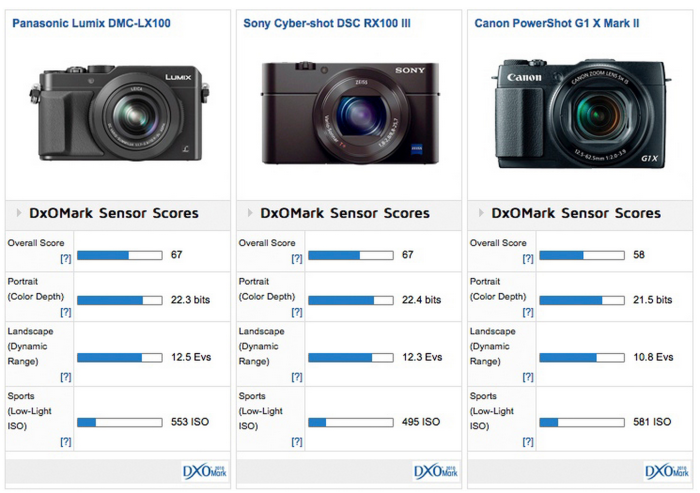
DxOmark (Click here) published the full Panasonic LX100 sensor test:
Adopting a larger sensor than the lens can cover offers advantages in lens size and speed, but the trade-off is somewhat reduced sensor performance, particularly in respect to low-light capabilities. For all that, it’s still no worse than rival offerings, given that neither the Sony Cyber-shot RX100 III nor the Canon Power-Shot G1 X Mark II fare any better in low light. If that’s a restriction for your type of photography, larger sensor compacts such as the APS-C Ricoh GR and particularly the full-frame Sony DSC-RX1/1Rhave better performance, but there are tradeoffs, not the least being the daunting premium price for the Sony.
Panasonic LX100 store links:
LX100 in USA at Amazon, Adorama, BHphoto. Europe at WexUK.
LX100 in Europe at WexUK, Wex Germany, Amazon Germany, Amazon France, Amazon UK,
LX100 in Asia at Digitalrev, Amazon Japan.
60 Responses
Cannot understand why no recent Panasonic camera with 4/3 sensor is able to meet or exceed the GH4’s sensor performance. Both LX100 and GM5 have significantly lower points.
I suspect that the key would be the very efficient sensor cooling system which lacks both the smaller cameras but not the GH4.
No idea regarding the GM5, but the actually used sensor area of the LX100 is significantly smaller than Four Thirds. And then DxO is not a trustworthy source, however scientific they try to appear. Their ISO measurements, which they base some other findings on, too, are fundamentally flawed.
a crop factor between 2.0 and 2.2 is significant?
The camera’s electronics package that processes the signals from the sensor makes a large difference in the end result, and this is the main reason why the GH4 produces better quality still and video images.
How much i love M43 because of my tiny hands….its clear that Sony is the winner. Same points but the Sony is so much smaller. I hope M43 is cooking something great for the next release because at this moment they are at the bottom of the food chain. APSC and FF have superb image quality but they are just to big and heavy for my tiny hands and weak body. M43 is obligated to create something good for al us M43 users with weak body. We will and unfortunately must deal with lesser quality in the end.
I can’t quite follow here. Firstly, the LX100 is not a Micro Four Thirds product, the actually used sensor size is smaller than that, the “crop factor” for the lens is 2.2, not 2.0. Secondly, yes, because of physics, quality differences between sensor formats are to be expected, but the size difference between MFT and APS-C is much smaller than the size difference between APS-C and FF. Currently available 16 MP MFT cameras do offer roughly the same image quality as the best currently available 24 MP APS-C cameras, as most tests keep showing, except for the pixel count difference which isn’t as huge in practice as the numbers suggest. 24 MP is only 1.22x the resolution in line pairs per image height of 16 MP. Nothing to get too excited about, IMHO.
By the way, I expect to use my E-M1 for years to come and I have no fears at all about feeling limited by image quality. Since the era of current 16 MP sensors, that’s the least problem (M)FT has. I would only wish for more and better quality lenses, as mature as the MFT lens lineup seems to be if looked at superficially.
Yes, I was surprised that the LX-100 wasn’t better than the 1″ sensor of the Sony apart from the low light, high ISO score. But then I guess I shouldn’t be really since my FZ1000 is pretty close to my Olympus OM-10 at lower ISO’s and there is very little quality difference between the two cameras output.
So should 4/3 sensors be ‘better’? Can they be better? And does the smaller ‘footprint’ of m4/3 compensate for the smaller sensor compared to APS-C? My only thought on this is that the Sony 1″ sensor currently in the RX100 series, RX-10 and FZ1000 is astonishingly good at low(er) ISO’s and I’m selling lots of pictures for high-end large-scale reproduction taken with the FZ1000.
Maybe Panasonic and Olympus should come up with an interchangeable lens system based on the 1″ sensor. They could probably do it better than the Nikon 1 system (which did have promise but seems to have stalled) and they could probably do it cheaper.
Hey soundimageplus, don’t answer this re tard. He is just a lifeless troll with a weak tiny brain.
I would rather use an LX-100 than a RX-100. But that doesn’t mean that the 1″ Sony sensor in that camera isn’t a good one, it is. I use cameras from my smartphone to ‘full-frame’ and the differences are less than many like to make out. I have no allegiance to any brand or indeed any format and I’m currently using 2 x Sony FE, 2 x Fuji X, Nikon Df, Leica T, Olympus OM-D E-M10, Sigma DP2 Quattro, Panasonic FZ1000 and Nokia 1020 and Blackberry Q10 phones. I sell pictures taken with each and use whichever one I think works for me on any particular day.
Are they all as good as each other? No they aren’t. Does it matter? Well sometimes it does and sometimes it doesn’t. I test each camera and lens I use thoroughly to see what it will do well and what it struggles with. But ultimately it’s down to me to create something with each piece of gear I use.
Each of us is different, each of us has different needs and preferences. DxO attempt to come some kind of objective assessment to give us what hopefully are some useful measurements. Whether they succeed or not is open to question, because of their methodology, but it is useful that someone attempts to do this.
Mr Burger may be a troll, he may be a Sony fanboy, but the DxO figures indicate that the sensor in the LX-100 is only marginally better than the 1″ sensor for high ISO’s. That doesn’t mean that the LX-100 isn’t a fine camera in it’s own right and will create great images. It IS possible to look at results like this and go ‘Hmmm…thats interesting’ and leave it at that. Because camera / lens combinations are more than basic comparative measurements. Cameras have ‘character’ which is more than just the sum of their respective specs. and we can use that ‘character’ to help us to create images that we like. And one camera may suit us better than another.
Also, there is the issue with DxO tests that apparently (and I have no direct evidence for this other than an analysis from someone who knows a lot more about sensor testing than me) that DxO compare one sensor against another by reducing all comparison files to 8MP, which gives a somewhat ‘skewed’ result. If that is true then at full resolution the results may be somewhat different. However, since DxO are the only ones who do this exhaustive testing, we have to assume that there is some use in their findings, though it needs to be seen for what it is.
I repeat that I’m VERY impressed with the Sony 1″ sensor in the RX100 and FZ1000 and it does beg the question that if that if it is possible to get that quality from a sensor smaller than the m4/3, can we expect those benefits to come to m4/3? Is it possible, for example to produce an 18MP or 20MP 4/3 sensor? and still retain decent high ISO performance? I suspect it may be and certainly since the days I first used a Panasonic G1 image quality has improved noticeably for m4/3.
This somewhat long reply is to indicate that the issues around sensor performance and comparison are not simple or defined in bold strokes. And surely we can discuss those issues in a mature way. I’m not sure that throwing insults around helps that process much though.
I see Mr Burger do it in a mature way… he he
Just remember, the sensor tech in the Sony is MUCH newer than what is in the LX100. This is sort of how it goes, not all the time but most of the time: Given the exact same tech, a larger sensor will have better IQ than a smaller one.
Don’t you think this is a bit obvious? Try a bit more subtlety next time.
Please stop trolling.
Hey tiny brain, the RX100 seems to be a better choice for you. Get one, go out and shoot. Then go back to SAR where is your place as a Sony fanboy.
Funny, I opened the measurments tab and what I found was that LX100 is consistently better than RX100 in every category. Go figure.
the main advantage the RX100 has over the LX100 is that it is significantly smaller and POCKETABLE. It’s in another class and shouldn’t be compared. Anyone can make a better camera LARGER. The RX100 is for those that want the best quality in a pocket camera.
Yep, I totally agree. I don’t think those cameras are in the same segment. Or rather, they are on the opposite extremes of the “premium compact” segment. The usability, handling and ergonomics are very different. Both great cameras, thought.
My comment was just referring to the fact that dxo final numbers are kinda weird in the way that a sensor that consistently performs better in all measurements, does not get a better final score. They probably factor in the resolution in the final equation. But with dxo marks, it’s far more useful to check out actual measurements than rely on the final score.
totally agree
Meh, I find it hard to believe people will drop $1,000 on either of these cameras and actually shove them in their jeans pockets. They will more likely end up in a jacket, or a small bag, which either of these cameras could be fine for. Only the Sony could actually fit in your pants pocket, but I doubt there are that many people that would actually do this to that camera often in practice.
On technical level, LX100 should win over the RX100.
In practice, downsampling the images from RX100, reduces the IQ gap. And the pocketability of course goes to RX100.
To me personally, it is at least 50% handling which is a highly subjective metric. I simply never liked how these Sony cameras handle. The new UI of A6000/etc might be a different story (the old Alphas definitely handled very well, while NEX UI was a horrendous mistake), but the RX100 series have the same P&S/NEX inspired polish and also have the same slight operational lag in handling as many other Sony cameras. Though as far as I have seen from the reviews, RX100 has the lag only occasionally, compared to some worst-case SLT cameras of the past which had it every time you press any button or turn any dial.
Why go figure? DR at base ISO is very similar as can be seen in the measurement tabs, ditto for colour depth. So, why is it surprising that the DR and colour depth scores (which are defined as their values at base IS) are very similar?
And the same (18%) SNR is reached very close ISO values for both cameras. So, why is it surprising that the low light score (which for theses sensors is in effect the maximum ISO where the 18% SNR still is 30 db) is almost the same for both camera? (http://www.dxomark.com/About/Sensor-scores/Use-Case-Scores)
Two out of three of the DxO scores are about the performance at base ISO, and the other one in effect turned into a measurement of quantum efficiency. Thus read noise at any setting other than base ISO doesn’t enter into the final scores anymore. The only way to rectify that last point is to re-define the low light score but that would mean that all historical scores would have to change as well.
And there is no guarantee that a new score wouldn’t become less useful in the future in a similar manner. There simply is no hard and fast rule how we as humans value noise in the mid-tones vs in the dark tones. But that doesn’t stop people from declaring that camera A is x stops better than camera B and the same people then turn around and declare it a heresy that DxO is valuing sensor performance using numerical values based on stops.
For Low Light, the LX100 looks better to me :
https://www.youtube.com/watch?v=0SDApspXoKc
Who would have thunk it. The 1 inch sensor will probably be the last sensor standing in the end. It’s a sensor food chain in reverse. Smaller eating the bigger ones from the bottom up.
The history of consumer photography has always been toward “smaller but good enough”. Glass plates to sheet film to smaller sheet film to roll film to digital. Companies banking on bigger being more profitable are swimming upstream.
To that end, the Panaleica CM-1 android phone is interesting, to say the least.
Also interesting is Google’s Project Ara. If one could make the lens unit modular, and take it with you from upgrade to upgrade, all of the sudden you might see some high end, interesting and interchangeable glass on a 1″ sensored cell phone.
“Magic comes with a price, Dearie!”
If I was taking a trip abroad, this category of camera would be a consideration—I’ve done toting an arsenal of equipment in the past and it takes away from the whole experience.
ISO performance, although important, would not be my trigger—focal range would be more important to me. The Canon PowerShot Pro1 comes to mind with a focal range that would fall in my wheel-house. But neighter the Panasonic nor the Sony provide a compelling argument for me to part with my money.
If I had to make a choice, it would be the Sony for the flip-out screen.
Does anyone else find the writing on Dxomark incomprehensible?
More than that, even where I understand what they write, I find they prove that they’re doing several things fundamentally wrong, like the way they’re measuring ISO (it’s definitely not what we set and expect to get as ISO from our cameras) or that they define 8 MP as their standard and declare that everything above that should not be counted as image quality improvement.
Yeah definately the rx100 ISO score should be much higher. Lol. Let it go man.
I did definitely neither say nor mean that, man.
I guess the irony was lost. I know, your saying the lx100 has better bla bla. But if you discredit the source than it is a doubled edged sword. Which was my point.
Actually, I didn’t say the LX100 was better, either. All I’m saying is that there are good reasons not to trust DxOMark figures, regardless whether they are high or low for a specific camera. dpreview and similar sites are, while none of them ever could be the be-all-end-all of camera tests, better sources for reliable results IMHO.
I guess we agree that with more light, image quality increases. Thus, for a given scene, a larger exposure (eg, longer shutter speed for given f-stop) improves the IQ and lower exposure decreases IQ. Of course, for a given ISO setting, we cannot exposure more beyond a point where relevant areas of the image are blown.
Now, when we want to compare two cameras in a light-limited situation (ie, above base ISO), to be fair, both sensors have to receive the same amount of light (ie, same test scene, same lighting, same shutter speed, same t-stop).
And that is what DxO is doing. It is measuring IQ (SNR, DR, etc.) for each camera ISO setting and plot it over the maximum exposure possible for each camera without blowing highlights. But instead of labelling the x-axis as exposure (numbers for which people are not familiar with) they label it with an ISO value where a white surface would be just below clipping.
At least we now understand one part of DxOMark scores – an advantage of 57 in ISO plus an advantage of 0.2 in DR = a disadvantage of 0.1 in colour depth. I’m sure it says mountains – but mostly about how DxOMark scores are manufactured… sorry, so carefully crafted.
The final scores are rather meaningless, unless there’s a big difference there. The actual measurements are much more interesting. And once you look at them, it becomes clear that the sensor in LX100 performs better than the 1-inch sensor from RX100 (not a huge difference thought, and higher resolution of the smaller one does give it a boost).
Having said that, the 1-inch Sony sensor is at the moment the best in its class, no doubt about that. And its about time we have another step up in performance of 4/3 sensors. So I’m hoping the next camera from Panasonic will raise the bar a bit.
> advantage of 0.2 in DR = a disadvantage of 0.1 in colour depth.
The numbers are meaningless, since DxO doesn’t publish the deviation/margin of error of their tests.
For many of the tests, difference of 5% is still within the margin of error, meaning that the results are identical. Or the test is inconclusive and the testing methodology has to be changed to reduce the error to make the difference apparent.
But since DxO doesn’t publish the margin of error of their tests – no data on deviation – it is really impossible to judge the difference of 0.2 points.
It’s funny because in some real life comparisons I can see almost a stop of difference, while in DxOMark there are none basically.
If I were to accumulate the progress made from camera to camera according to such visual judgements measured in stops, current cameras would have to be at least ten stops better than they were ten years ago.
Matched by 1 inch sensors, LOL! RIP m4/3!
Ahead of Canon’s APSC’s… LOL!!!
You know that m43 is a camera mount, not a sensor size?
Your consistent and unbiased reporting is impressive. How did it stack up against your T5i?
Report back ASAP.
This isn’t even M4/3, though. It’s got a 2.2x crop factor in order to cram in more lens…
anyone that has had a change to use the RX100m3 and the LX100 will say that the IQ is better from the LX100 – I have both – in great light it is harder to see much of a difference but when light not as good it becomes clear – very clear in JPG – Sony images more processed
It is crazy to only go by what DXo scores on 3 aspects and only of the sensor – there is more to a camera and lens than that – DXo can be used a guide along with other things –
Interestingly the Canon G7X also gets a better score – or higher then the RX100m3 yet many claim that it is the same sensor – regardless – I do also have the G7X and my take is that in still the images are very close to the RX100m3 –
but there are key differences, the RX100m3 has an EVF but the Canon has a longer focal range and a bit faster lens and Touch LCD – but it is clear to me that the LX100 has better IQ especially in lower light
DxO is good for the ones who rely much on numbers so its easy to understand its a popular source as reference. if really needed for me, i would prefer pixelpeeping reading in Dpreview.
The problem is that the DxO low light score was designed (ie, the formula by which they are calculated) at a time when read noise was significantly higher. With current sensors, improvements in read noise do not improve the low light score anymore, as it is defined as the maximum ISO where read noise (aka DR) is below a certain level AND 18% SNR is above a certain level. A sensor can have any improvements in read noise if it doesn’t also increase the 18% SNR, the DxO low score won’t improve.
You might see the above at as a reason to dismiss DxO but it is precisely thanks to the DxO data that I can explain why the LX100 seems to fare better in low light than the RX100III. Those that criticise DxO scores don’t criticise them for the way they are designed, they criticise them because they don’t understand how they are calculated.
The take home for me is that sensor technology is advancing very rapidly. Noticeable advances are occurring within 12 months
This is bad news for us, because m43 seems stuck on a three year sensor upgrade track
5 years ago you could get away with no significant improvement in your sensor for three years, and get away with image processing and camera body advances.
If the E-M6 has essentially same sensor as E-M1, it won’t go down well.
The EM-6 must have a multi-aspect 24MP sensor,I hate the pictures in 4/3 format.
The EM-2 (New EM-1) 24MP.
Well I like the 4:3 ratio, and often end up cropping down to 1:1. It seems we’re at an impasse of opinion, aren’t we?
Agreed. I shoot mostly at 4:3, but sometimes for fun I’ll shoot 3:2, 16:9 and 1:1. Regardless, I agree that the Em-5II needs a new sensor, if not higher MP, then it will need a stop extra ISO performance, 0.5 EV DR or more, and better color/tonality.
Definitely needs a new sensor, ideally BSI to put it at a comparable tech level as the over-performing Sony 1″.
(Re: aspect ratios, I’ll even sometimes crop down to 21:9 for a really cinematic look. Crazy, I know! That said, I still think that M4/3’s efficient 4:3 usage of its image circle is one of the formats greatest strengths.)
Is the Sony brown??
Shiiit brown to be more specific.
DXO needs to revisit the way that they describe scores. While the LX100 is definitely an underperformer in the sensor department compared to the BSI 1″ in the Sony, when you look at the measurements tab, the LX100 has between 0.5-1 stop of better dynamic range and colour sensitivity than the RX100 at almost all ISOs except base and up to about ISO 3200.
The noise performance doesn’t surprise me, since downsampling the Sony’s extra pixels and its better quantum efficiency should definitely give it similar noise performance. The difference in crop factor is only 2.7 crop vs. 2.2…
A better way for them to describe their scores would be to use a little calculus and take the integral (i.e. the “area under the curve” at all ISOs), rather than simply using base ISO performance. That figure is kind of meaningless, and caters to a very specific audience. The integral would give a much better approximation of overall performance and flexibility.
I hope that Olympus gets a BSI for the EM-5 Mk. 2, or some similar sensor upgrade. Given that it’s available for both 1″ (Sony) and also APS-C (Samsung), it seems very feasible, and should significantly improve performance and allow higher resolutions as well.
Base ISO performance is important, there are enough people that put a camera at base ISO and leave it there for a significant part of their image taking, simply trying to get as much IQ out of whatever they carry with them.
And the most important thing it is not to put an integral over all ISO settings but as to put read noise (aka DR) above base ISO back into the equation. Right now the Sports score effectively is given by 18% SNR which is very similar for both cameras. How to that in a robust way, I don’t know.
No really… there aren’t that many people that do this. Those that DO do this are professional studio photographers that are not looking for an LX100, RX100iii or any m43’s camera as their new go to studio camera. They are looking for those cameras as their take anywhere camera, something they will likely use at any ISO up to 3200 just as much as base ISO. MOST people using cameras sit at base ISO very rarely, and thus, Turbofrog’s solution seems like a more accurate scoring representation of the vast majority of potential customers for these devices.
That setting is for the category landscape. For landscape I would always use ISO 100 and maybe use a tripod if it’s getting shaky
If you’re using ISO 100 and a tripod, then DR doesn’t matter, since you can do bracketed exposures and tone-map it afterward. For that matter, resolution and SNR aren’t very important either, since you can stitch photographs together as well. All of that is more work, but if you’re serious about landscape, it’s not much more.
Landscape: Tripod, 50ISO, two second timer every time.
I agree with Turbofrog!