









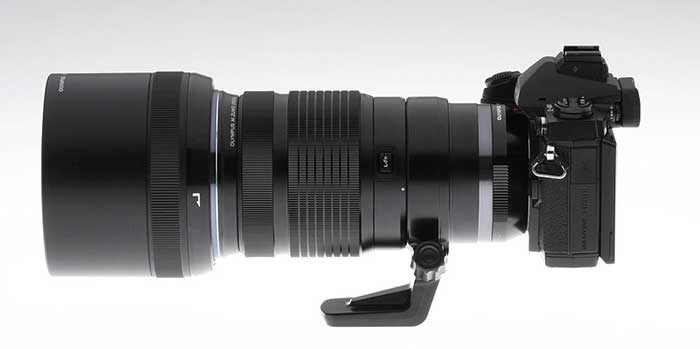
Image courtesy: SLRgear.
SLRgear (Click here) tested the new Olympus 40-150mm PRO lens and writes:
Olympus is making a big splash with the new Olympus 40-150mm ƒ/2.8 Pro lens. No longer are professional and enthusiast photographers beholden to their large, heavy DSLR telephoto zooms if they want a tele lens with bright apertures, rugged weather-sealed build quality and compatibility with teleconverters. Not only are images tack sharp and the build quality outstanding, but the size and weight is also refreshingly light for such a lens. The Olympus lens measures up at around 6.3 long and weighs just a bit over 2 lbs (with hood and tripod collar attached), whereas a comparable 70-200mm ƒ/2.8 DSLR lens, such as the Canon 70-200mm ƒ/2.8 Non-IS lens is 7.6 inches long and weighs almost 3 lbs. (for the IS Mk II version, you tip the scales at about 3.3 lbs.).
For Micro Four Thirds shooters, the 80-300mm-equivalent focal length range on the 40-150mm ƒ/2.8 is tremendously versatile, and when you factor in the addition of a 1.4x TC, it makes this lens quite a powerful and flexible, shoot-almost-anything lens. From portraits with nice, out of focus backgrounds, to sports and even wildlife, the 40-150mm ƒ/2.8 is able to “reach” all of these subjects, for the most part. And the fact that it’s a fixed ƒ/2.8 lens makes it great not only in lower light shooting but also for increased subject isolation (and we found the bokeh on this lens to be very nice as well). In short, if you want the best, premium telephoto zoom lens for Micro Four Thirds currently available, this is the one.
BestMirrorlessCameraReviews (Click here) made an in-depth comparison between the new Olympus 40-150mm f/2.8 and the Panasonic 35-100mm f/2.8:
The M.Zuiko 40-150mm is the more interesting option in terms of image quality and performance. The 50mm of extra reach can prove very useful in different situations such as event work or portraiture. The MC-14 teleconverter is also an extra accessory that makes this lens even more interesting. I also prefer its bokeh rendering.
40-150mm f/2.8 PRO lens at Amazon, Adorama, Bhphoto, GetOlympus. In Europe at Wex UK, Technikdirekt and Amazon. In Asia at Digitalrev.
163 Responses
Comparisons, comparisons. Of course a 70-200/2.8 for APS-C is larger and heavier – it has to, as it gathers 2/3 EV more light…
So tedious.
Yes, they have to compare it with an 80-300/5.6
Or 50-188/3.5 on APS-C. Unfortunately it doesn’t seem that Canon/Nikon/Sony produce such a lens (at least none with a constant aperture).
The trolls never mention APS-C because multiplying by 1.5 is too complex for their cropped brain.
Sure, don’t forget that because of crop factor your have to multipy weight by 2…
Hey, it’s friday after all…
What nonsense. Are you people still peddling these false equivalencies?
Just ignore them. They only post here because we respond. Just let them post then click the ‘Flag as Inappropriate’ button. Let Admin sort it out.
That won’t help. Admin is the one posting this crap in the first place.
m43-people are lost in fantasy-land.
Good advice – I’m going to start doing that now.
Tell that to our fauxtographers and dishonest sellers…
70-200 for APS-C is a different focal length, much narrower on the wide side.
But it also spreads that gathered light over a larger surface area on the sensor with more mega pixels so its the same…
Whats your point?
Oh yes shallow DOF is everything in photography.
BTW this is my attempt in equivalence irony…
It does not ‘spread’ or do anything at all !
OMG…
OMG!
It doesn’t?
Do you have brain damage ?
Another source;
http://fourthirds-user.com/2011/04/apertures_and_micro_four_thirds.php
Those of us that have used 35mm ‘full frame’ film cameras are familiar with camera settings used back then. f/8 was quite a sensible aperture to use for general purpose snapping, for example. You might stop down to f/11 or f/16 to expand the depth of field, etc. So how do aperture settings on Four Thirds relate to settings on full frame cameras? First of all you need to deal with the cropping factor. If you are using a 50mm focal length on Four Thirds, that means a 100mm focal length for the same field of view on a full frame camera.
To match the depth of field of an aperture used on a full frame camera with a Four Thirds camera, simply halve the full frame aperture number. So, f/8 would give you the same depth of field as f/4 on a Four Thirds camera with a lens that has the same field of view. Here are some examples:
Full frame 100mm f/16 would equate to Four Thirds 50mm f/8.
Full frame 300mm f/11 would equate to Four Thirds 150mm f/5.6.
Full frame 28mm f/8 would equate to Four Thirds 14mm f/4.
No, it doesn’t have to, it’s stretching the concept of EV to the point where it breaks (using it as a constant physical notion, when it’s really a relative dimensionless concept), in my opinion it’s misguided and confusing for some people (I have no doubt that you perfectly understand what you mean, we discussed that enough, I once again disagree on how you express it by re-purposing concepts only vaguely related to what you wish to express).
In case I wasn’t clear, yes, the APS-C lens needs to gather more light for the same result but no, expressing it in EV is wrong (efficient for people understanding the limits of that usage, confusing for the rest).
The comparison here was interesting as it shows the lumix to be a similar performer in the stills, In the video, the IBIS at oly’s 150mm was doing its job better then the GH4 does at the lumix’s 100mm.
I won’t buy it unless I’m able to hammer nails with it as well. No hammering= no buy.
I’m pretty sure you actually could ^^
OMG… Idiots…
Stupidity knows no boundaries…
“… whereas a comparable 70-200mm ƒ/2.8 DSLR lens, such as the Canon 70-200mm ƒ/2.8 Non-IS lens is 7.6 inches long and weighs almost 3 lbs.”
I am getting so fed up with this utter nonsense…
If Olympus would made it a true f2.8 lens and not a f5.6 lens, it would more or less weigh the same ! Are they so incredibly stupid that they think Canon is unable to make a f5.6 lens with the same size and weight ?
Apparently the intellectual skills of m43-people shrank along with their sensor-size !
Why are they capable of admitting the 2x focal length, compared to FF, but not the 4x ISO and the 2x Aperture ?
Hey man, welcome in fantasy-land. No standards, no definitions, no practice nor theory, just fantasy.
I’m so happy with my m43 camera and all the 2x f/X.X lenses I’ve bought over the years … It’s really a waste of time to discuss all this nonsense. 🙂
they just think they discovered something or are more smart then others.
Nah, they just think it’s the camera that makes a good picture… That sharpness and shallow DoF are what makes it good.
Reminds me of something I read the other day :
“Amateurs worry about gear, pros worry about money, masters only care about light; Me ? I only take pictures”.
I was waiting for that trite line. Are you an amateur? A pro? A master?
Me, I’m just taking pictures… with whatever I need or want, I don’t give a damn about brand, format size, it’s just a damn tool.
It is a f/2.8 you nitwit, it just has a depth of field equivalent to f/5.6, aperture equivalence doesn’t translate when it comes to exposure.
Besides, the 2 stops advantage of FF over 4/3 should be translated either as aperture (for the few people to whom it makes sense in practice) or ISO, NOT both at the same, which would make your maths somewhat… lacking.
Basically, you are the ignorant gearhead with little to no photographic practice masturbating over his own gear’s advantage on paper rather than concentrating on whether or not his gear fits his actual needs and competence.
Whoa tone it down fanboy, problems facing the truth?
Oh, please demonstrate how you can count a 2 stops difference by stacking it fully in terms of both ISO and aperture, let me see the maths, I’m sure that will win you both the Nobel in Physics and the Fields Medal.
Just try, fanboy…
4 x 1/4th is 1. It’s that simple.
Wait, is that supposed to be humourous or serious, I can’t quite figure it and wonder if I should laugh or have pity…
Another source says the same;
http://fourthirds-user.com/2011/04/apertures_and_micro_four_thirds.php
Those of us that have used 35mm ‘full frame’ film cameras are familiar with camera settings used back then. f/8 was quite a sensible aperture to use for general purpose snapping, for example. You might stop down to f/11 or f/16 to expand the depth of field, etc. So how do aperture settings on Four Thirds relate to settings on full frame cameras? First of all you need to deal with the cropping factor. If you are using a 50mm focal length on Four Thirds, that means a 100mm focal length for the same field of view on a full frame camera.
To match the depth of field of an aperture used on a full frame camera with a Four Thirds camera, simply halve the full frame aperture number. So, f/8 would give you the same depth of field as f/4 on a Four Thirds camera with a lens that has the same field of view. Here are some examples:
Full frame 100mm f/16 would equate to Four Thirds 50mm f/8.
Full frame 300mm f/11 would equate to Four Thirds 150mm f/5.6.
Full frame 28mm f/8 would equate to Four Thirds 14mm f/4.
“Stupidity knows no boundaries…”
You certainly proved that with your post.
5 Likes for someone who does not know anything about physics.
Keep it up ! Cheer for yourself. Ignorance is bliss !
Tell us how it is f5.6 other than DoF? Exposure times/ISO are the same across the formats. For example, a properly exposed shot on a FF camera at f2.8 1/100sec and ISO 400 would be just as properly exposed on an m43’s camera at f2.8 1/100sec and ISO 400. So please, explain why, other than DoF and some nebulous idea about light gathering that has no bearing on actual exposure times, should we call foul and determine its an f5.6 lens instead of f2.8?
Not right, equivalent exposures would be
FF at f2.8 1/100sec and ISO 400 =
m43 at f2.8 1/100sec and ISO 100
Nope, that’s not the same exposure, but please, don’t trust me, take a picture with both at these parameters and verify if they have the same exposure (hint : one of these pictures will be over/under-exposed compared to the other), or use this handy calculator ( http://www.endoflow.com/exposure/ ).
The real difference in this theoretical situation is that for the same exposure at the same parameters :
– The FF camera will have thinner DoF.
– The 4/3 camera will exhibit the same noise as the FF would at 2 stop higher ISO.
Where some people disagree is what to consider “equivalent”, some consider equivalent output, others only equivalent exposure, which gives us :
Eq. Exposure : FF f/2.8 1/100s ISO 100 = 4/3 f/2.8 1/100s ISO 100
– 4/3 displays more noise and has more DoF.
Eq. Output : FF f5.6 1/100s ISO 400 = 4/3 f2.8 1/100s ISO 100
– There you have the same amount of noise, the same DoF and deal with movement in the same way, the maths make it so that in theory they are the exact same image.
To some people Eq. Exposure is all that matters, you can bet these people have used manual cameras for some time and probably still do, to others Eq. Output is all that counts, you can wager these guys haven’t touched a manual camera for ages, if ever.
Who’s right ? Both, they just have different priorities and needs.
Another source;
http://fourthirds-user.com/2011/04/apertures_and_micro_four_thirds.php
Those of us that have used 35mm ‘full frame’ film cameras are familiar with camera settings used back then. f/8 was quite a sensible aperture to use for general purpose snapping, for example. You might stop down to f/11 or f/16 to expand the depth of field, etc. So how do aperture settings on Four Thirds relate to settings on full frame cameras? First of all you need to deal with the cropping factor. If you are using a 50mm focal length on Four Thirds, that means a 100mm focal length for the same field of view on a full frame camera.
To match the depth of field of an aperture used on a full frame camera with a Four Thirds camera, simply halve the full frame aperture number. So, f/8 would give you the same depth of field as f/4 on a Four Thirds camera with a lens that has the same field of view. Here are some examples:
Full frame 100mm f/16 would equate to Four Thirds 50mm f/8.
Full frame 300mm f/11 would equate to Four Thirds 150mm f/5.6.
Full frame 28mm f/8 would equate to Four Thirds 14mm f/4.
You quote text from a “SLR Gear” review and blame “m43 people” for it. That makes sense…
Why all the cheers…..its just a 80-300mm 5.6 zoom with decent output. The fangirl/boys over here think that Oly had broken the laws of physics. If this makes them happy i am happy for them.
Flagged as Inappropriate.
Read Above
Actually a FF lens will never be exactly a M 4/3 lens in terms of light gathering and DOF at the same time. Example! Olympus
40-150mm ƒ/2.8 would be equal to a FF lens that has DOF at aperture 5.6
but light gathering at 2.8. See how that will never be possible? making
them completely different lenses? ?
There is still a very minor
adv on FF due to larger sensor size when in high iso all else been equal
meaning a m4/3 sensor at 2.8 iso800 will not be as clean as FF 2.8(and
some how 5.6 DOf) lens. But the advantage is very pixel peeping. Now
you need to weight that against size advantage and what not on the m43.
So m43 can be perfect for those who want fast lenses but with deep dof.
Now if you want both fast and shallow but don’t care about size, go FF.
Think of m43 as trading Dof for size but not speed.
Lol………”advantage is very pixel peeping”.
i think you’re in need of some glasses.
Well, keep pixel peeping enjoy. But before you name call and make such subjective comment, ask yourself how much you crop and how large do you print? and adjust according in terms of resolution.
He knows all this.
I print A4 and up. Even then i see some big difference in the format. But its not only about crop and print. Its about how clean the images are. From iso 800 and up M43 does not look that good. Further more those images from M43 often look very digital. And at these prices and sizes M43 is becoming somewhat of a joke. They should target the lower end of the market. M43 just can not compete with APSC or FF. You Pay APSC or FF prices but you are stuck with a small sensor and all its downsides. But M43 is a fun system. My daughters (8 and 10) like the EM1 and EM5 with small lenses. Its a good point and shoot system for them which is also particularly firm.
If the entire experience of practicing photography only boils down to just its critical IQ at 100% crops, then you are absolutely right. My EM-10 or any other m43’s camera does not compare with a D810 or an A7R in that regard at all. Just like my Thinkpad Yoga doesn’t compare to the raw processing power of my custom built desktop gaming rig. But it does give me enough processing power for using the Adobe suite, and it gives me the flexibility of being easy to carry and I can draw directly on the screen. The analogy also works with m43’s and FF. I can carry a small and light setup, and have features that add to the shooting experience (ie: EVF is more WYSIWYG than an OVF, tiltable touchscreen allows more creative freedom, smaller size means it goes with me everywhere). Again, it isn’t as powerful in terms of raw IQ, but most of the time I don’t need that extra power. Nor do most enthusiasts.
Well said!
Still telling craps about your 2 imaginary daughters little Shenkie ? 🙂
your daughters 8-10 uses the e-m1? I don’t think that is good for their wrist even with small lenses. And honestly you don’t sound like your over 20.
The noise difference with ff is 2 stops, even at low ISO. Fast and small sensor don’t go together, sadly.
The noise difference is about a stop. Check the DPR studio shots.
So much hair splitting, as if it made a world of difference in a field review…
You’re right of course. But I was surprised as I was looking at the differences on DPR last night.
After being swarned all this time by equivalency holy crusaders, it’s sometimes refreshing to have a critical look at some “facts” that are too often preached without further investigations.
…but you can’t have a discussion with harrassing mosquitoes…
Okay, I guess 1 stop means a lot to some guys.
2 stops + 4x magnification factor…
you sure? maybe it is 10!
Nope, the theoretical advantage of FF over 4/3, due to the size of the medium, is of 2 stops (1.96 actually).
In practice however, that gap is either lower (E-M1 vs Canon) or higher (E-M1 vs A7s).
You should NEVER confuse the two things, the concepts are hard enough to grasp for most people.
A sensor is something different then a camera. When I put my f1.4 prime on my OM-D it’s stabilized.
Stop mixing everything and wonder why trolls have so much fun arguing with you guys, it’s almost painful…
You are the one talking about stops….who cares about stops in relation to sensor size. Is it somehow important when I press the shutter? What is important to know is what a camera/lens combination can do and what not.
My, my, you’re as sharp as FF trolls, aren’t you ?
‘FF trolls’ ? So, everybody who recognizes FF as the golden rule is a troll… I have an even better idea; call everyone who has a different opinion a troll !
There is no golden rule? Even if there was, the highest quality right now is Medium Format Digital, not 35mm… http://www.bhphotovideo.com/c/product/1078381-REG/hasselblad_3013708_h5d_200c_ms_digital_camera.html
FF as the golden rule ? Your FF sensor is a piece of crap compared to my 6×6 etc…, it’s an amateur’s toy, grow up you nitwit, not everyone discovered photography on 1/2.3″ compacts and this think that 35mm is somehow the king of formats.
Mark, you talk exactly about point B, eoso listed above.
Maybe, but IBIS/IS is not some software trickery.
Also I don’t agree with his “theoretical” point of view(although it’s theoretically true 🙂 ) as a reaction on c_henry’s post. The DPR studio shot just demonstrate that’s is more like 1 stop, maximum 1.5 stop then 2 stops. Who cares that it should not theoretically be true due to sheer sensor size.
FF absolutely has 2 stop advantage, but not allways.What about when you need that greater DOF (in low light)?
Fine, let’s call it a difference rather than an advantage (and I entirely agree with you, I’m more about MORE DoF than less), it doesn’t change the reality of that physical difference one bit.
Also consider that the FF system will be able to stop down (and up the ISO to keep the same exposure), get the same DoF and end up, all electronics etc… being equal, with the same IQ/SNR as the smaller system.
My point exactly – not ALLWAYS 2 stops.
A) When comparing formats, all other parameters being equal, it’s ALWAYS 2 stops.
B) When comparing real world camera outputs, it is not, why ? Because all other parameters are different too.
The problem is that trolls conflate both and negate B by claiming A as a justification and retort that claiming B means denying A, which would be true if, and only if, you were comparing cameras with everything equal except for the sensor size, which simply NEVER happens.
It’s all based on the fact that we are juggling with two reference frames and different conceptual levels and consider them as unified, which they are not.
The concept may hard enough to grasp, but you’ll get it… There may be 2x more light falling onto a 35 sensor vs a M43 sensor, but the 35mm sensor is also 2x the size.
For example, when you shoot with medium format, it is being exposed to 1.6x the light of a 35mm sensor, but the exposure amount is remaining the same because the light is being exposed over 1.6x the area. Thus it may have more resolution, but it does not have a 1.6 stop advantage over 35mm. Simple!
From a sensor standpoint, the only inherent advantage that FF has over M43 is the larger space between pixels, allowing for less heat building before becoming noisy. This is obviously a technological limit that will vary over time and development.
THOSE ARE TWO DIFFERENT THINGS, stop confusing two issues (or learn to read).
And yes,your confusion is my damn fault for expressing that advantage in term of EV (the same fault I regularly attribute to Hubertus) when it’s not really a useful unit for expressing the difference, however I simply do why, because no one bothered to have a better suited unit for expressing that (why, because photographic units never cared about what happened at the sensitive surface level beyond exposure considerations).
I hereby propose to call it NV (Noise value), calculated exactly the same way as EV, but applying ONLY to theoretical noise level at sensor level for theoretical, identical sensors of varying sizes (and thus different size photosites).
So yes, FF has no EV advantage over 4/3, it however has a 2 NV advantage over it, happier now ?
Four times the size, four times the light. Larger space between pixels? Don’t understand what you mean. Light sensitive area is most important, as shot noise is dominant over most of the exposure range, read noise amounts to about 5-10 e-, only. For me, I use FF for e.th. with shorter focal lengths (size and weight penalty no issue for me for this range and I have lots of great and affordable lenses). Beyond 200mm equivalent m43 is great for me (80-400/4-5.6 would provide me with more separation, but it is more expensive and a lot heavier and doesn’t have the minimum focus distance of the OLY. If I were a professional wildlife shooter, I would nevertheless immediately go for a 400/2.8, for example. Pictures of mammals or birds with better subject to background separation would be a better selling point imo. But for my use, the 40-150 is great and sufficient. But compared to my D810 and D610, even when stopping down to match DOF, I still get more details and less noise with the FF cameras. m43 got over the point of sufficiency and is capable of delivering, when used correctly.
+1
welcome you just joined the club of much ado about nutting
why else would I be on this site
Maybe that will work in… Disneyland ?
I wouldn’t call this advantage minor and not pixel-peeping at all. If I need to boost shadows on my OMD and my FF the difference is large, for example. Whenever I use the EM1, I try to stay at ISO800 and below all the time.
It already is a beast on its own, its near macro capabilities makes it very tempting for me!
Me too! What a lens. Good price too.
These lies and legends (beside a terrible price / quality ratio) really keep me off this system.
Flagged as Inappropriate.
I flagged you as inappropriate (for your sheer stupidity).
Flagged as Inappropriate.
Same… Desperate, are you?
Why you feel the need to share these terribly boring things with the rest of us is beyond me.
Many things seem to be beyond you…
Are you just hanging out here, waiting for new opportunities to say stupid things about a system you don’t even like?
I guess now we know why you bother – you’re a loser with nothing better to do. 🙂
I enjoy annoying nerds. Is it bad?
Don’t be modest. I’m sure everyone finds you annoying.
Good! Inferior people should know their place.
‘Inferior people’ ? You should be banned for life from this forum ?
You’re one of them and should be banned from life.
🙂
Olympus sales just went up 20 percent.
The article boasts this lens having an extra reach of 50mm over the Panasonic 35-100 as a selling feature. It made me consider my four thirds 50-200 as an even more superior lens; having another 50mm over this new zuiko and still having the option of my 1.4 and 2x tc to compliment the 50-200!
If I had to choose between the Panasonic 35-100 or the new zuiko 40-150, I think I’d go for the zuiko. Sure, it’s a lil bigger but it does have a closer focusing distance, combined with the extra reach- the image samples I’ve seen makes it a really flexible tool.
For now I’ll stick with my 50-200 (which I really enjoy using) Maybe when the 40-150 goes on sale I’ll make the purchase..
There should be a rule on this forum – every comment to include also one photo taken by commentator. Let us see what can you do with your equipment – and how much relevance that comment has 🙂
Btw I don’t understand why people who are sure that their 2.8 is better than mft 2.8 have peculiar need to prove that over and over again to others (and as it seems to themselves). My FF, APS-C and MFT all have their purpose, strenghts and weeknesses.
I still enjoy my 99 dollar Olympus 40-150…in good light stop it down just a tad and it makes pretty nice images…I am sure the 2.8 version will be great for shooting action but that picture with the lens hood attached just looks obscene
“that picture with the lens hood attached just looks obscene”
Dunnit? Can’t wait to get mine!
We need to get rid of guest posts. If you would have to sign in, it would be easier to get rid of the Trolls.
You mean, getting rid of those who speak the truth ?
Good one.
I want the 300mm F4. This lens looks great but it is not long enough. Already have the Pana 35-100mm & 100-300mm. Love the reach at 250-300 but the quality is not quite there yet.
+1
So 100-300 for GH4 yes or no?
I have GH4 & E M1. Use it mostly on E M1 as the IBIS looks to be a slight bit better than the Lens IS on the GH4. The end image may be the same, but it is easier to frame the shot on the E M1 do to the very stable view in the viewfinder. Would just like a long lens that ups the quality a bit.
Agree. The 300/4 sounds great. But it will be expensive. 2.5k+ I’ll guess. Just like this f/2.8 zoom here it’ll be designed to deliver to the next-generation m43 sensor with 20+ MP, and that’s a very high pixel density. Those who think all you need is a current 300/4 design, like nikon’s or canon’s, add m43 mount, change drive for CAF -done, they are quite a bit off.
We should stop referring to lens focal lengths and move to FOV (Field of View) angle ranges. This whole FF vs. M4/3 debates are silly. I use both. I own more than a dozen lenses in each system. There are places and times where FF is what I need (high resolution/low noise), and others where M4/3 is great (will not be printing, at least not large, size/portability is important).
This site’s troll problem is certainly quite a bit worse than similar rumor diets dedicated to other systems. Part of it is that folks keep feeding the trolls. I’m sure I’ve done it, too, but it’s really a bad idea.
The great majority of people here agree with you.
Focal length is a optical characteristics of objective that tells magnification, while sensor size tells angle of view and ratio.
Depth of field is calculated with three values:
1) Focal Length (magnification)
2) Aperture (aperture blades opening size to focal length, designed to follow inverted square law)
3) Distance from imagine plane to subject
Sensor size doesn’t change magnification, but angle of view by cropping a square part from the imagine circle. It does same thing as crop tool in image editor or scissors for printed photo.
To know the angle of view for framing purposes, you need to know focal length and then sensor size.
If you are familiar to different angle of views with specific sensor size and focal lengths, you ‘see’ that before you raise a camera on eye. 35mm film was most popular on film era. On digital era APS-C is most popular on system cameras. And many see as different focal lengths on those cameras.
Just like it is repeated, 85mm for portraits, 50mm is normal, 35mm is wide, 28mm is ultra wide, 135mm is telephoto etc.
That repeat was required when photographers moved from medium format (standard) to small format (35mm) so they knew what to use and when.
If you are agnostic for focal lengths, there is no problem to work. You don’t anymore do any calculations as you know what you get with what focal length.
But some people who don’t understand digital technology and optics, they claim you need to factor aperture too like you can factor the angle of view. And they are the cause for problems as they lie or spread misinformation.
Have anyone told you that you’re tedious and boring? Well, I’m sorry, but you are.
Of course everybody could get along fine. However, this site has a unique feature: here is where the most incredible things happen and physics boundaries are reinvented. Sellers abuse this free site with goofy marketing. Brand fans are fabulously incompetent. This draws “trolls” like honey draws bees, and I cannot blame them because they actually bring things into perspective. They debunk some of the most extreme fibs and even add some jokes.
I’d say that, as long as the myths and lies persist, we need “trolls” to make the site worth reading.
Flagged as Inappropriate.
Have you done a photoshoot with a M43 camera? I shoot with Micro 4/3, APS-C, 35mm “Full Frame” and Medium Format. The Micro 4/3 system is completely competitive against rival systems and offers a huge amount of versatility and quality in a small, pocket-able size. Yes, the equivalent depth of field is half that of 35mm and yes the field of view is half of 35mm’s; but Micro 4/3 is undoubtedly a professional camera system that can yield incredible results. If resolution and shallow depth of field is the only thing that matters your photography, then you should be looking into medium or large format, rather than trolling 43rumors.com. You can start your journey here: http://www.bhphotovideo.com/find/Product_Resources/largeformat1.jsp
I understand your post fully and agree that a bigger sensor has more potential. But the m43 system as a whole compensates for the smaller sensor and other physical disadvantages. The system is convincing and this is somebody saying heavily invested in FF and once a die hard OVF/mirrorslap defender. If we talk about physics there might be another mistake in understanding the system: We still think in analog terms where film emulsion was the same for all formats, therefore larger formats had clear IQ advantages over smaller ones. Today we talk digital. I am not an engineer but digital miniaturization might have greater potential than film emulsion. But long talk short: try it. I started with a E-M10 to get something smaller along my FF and I am surprised – in my case – the m43 takes pictures of equal quality, certainly from a photographic point and with irrelevant differences from a technical point of view, latter in favor of m43 in certain situations and in favor of FF in other rare situations but mainly without relevant differences. Still, I hold my FF DSLR, I like the mechanics, handling and the klick-klack of the mirror.
I generally agree as I have both systems too. However I believe that the m43 systems are now providing superb IQ in large prints too. My clients rarely order anything larger than 20×30 thus m43 works superbly. Particularly since focus is more frequently perfect as opposed to my Canons.
Of course everybody could get along fine. However, this site has a unique feature: here is where the most incredible things happen and physics boundaries are reinvented. Sellers abuse this free site with goofy marketing. Brand fans are fabulously incompetent. This draws “trolls” like honey draws bees, and I cannot blame them because they actually bring things into perspective. They debunk some of the most extreme fibs and even add some jokes.
I’d say that, as long as the myths and lies persist, we need “trolls” to make the site worth reading.
And yet you seem to always be around this site. Like flies buzzing around… you know. You like to eat it, we assume?
Trying to be witty without having the brains? Hint: you practically wrote this site is dung. Sad boy shot his foot.
Reply to EVERYONE!! This discussion was going on 2 years ago on this site, same arguments on both sides, maybe different people but im not so sure! Let’s agree to disagree 🙂
Im sure this won’t happen but its worth a try as im sure its very boring
This lens had the shills out in force!!
A ff f5.6 lens on any canon ff camera will have less detail, less dynamic range and poorer color reproduction compared to this lens.
It is simple physics, the lower the light intensity, and greater the sensor gain the worse the age looks.
This applies well to the aging canon sensor tech and even to the em2 vs the Nikon d4. Have a look at dxo, their data shows this to be true, as do DPR image comparisons.
Iso is not a cute for a slow lens.
Really, haven’t you talked enough rubbish? Are you 12 or what?
He is right, kid.
I know I am right… The fact that a3 year old is so much better at this must be confusing for an adult 😉
Actually… I am 3. Amazing how I know so much more than you on this subject.
go and try, then talk again
You got us used to dumb but you are besting yourself here…
Well I am glad you and I can enjoy a bit of stupid. I guess it must make you feel better that they are people as dumb as you and I in the world… But at least I try and look smart, you should try it out too!
Look who speaks of shills… Are you 12 already?
You know what I find quite disturbing? How often the trolls here imagine others as small children.
Screw all the trolls…I would love to own this lens, the 1.4x and possibly the 300mm that is coming down the road…this system keeps getting better and better!!!
yup,.i bet they’re to envy with M43 system, less than ten years but the Glass most of them is unbelievably TOP NOTCH, compared to the older system , like Nikon or Canon [ FF +APSC], they must to dig more deeper pocket to buy some high Quality Glass , but the size of most High End glass on a full frame is far more heavy compare to M43 glass
Simple explanations can be found all over the net…
So, if I shoot a portrait with a Micro 4/3 camera and a 25mm f/1.4 lens, and I shoot it at f/1.4. The field of view, depth of field and amount of background blur will be the same as if I’d shot the image at the same spot with a full frame camera, and a 50mm lens at f/2.8. Since Micro 4/3 has a crop factor of 2: 25mm x 2 = 50mm lens for the same field of view, and f/(1.4 x 2)= f/2.8 for the same depth of field. Similarly, 25mm/1.4 = 17.9mm aperture size and 50mm/2.8 = 17.9mm aperture size (so same amount of background blur at the same focus distance).
Simple people can be found all over the net as well 🙂
Yes, except that the damn exposure won’t be the same, which was your initial claim…
And however you use it, legitimately or not, F-numbers represent exposure, not depth of field or SNR on medium.
Another source;
http://fourthirds-user.com/2011/04/apertures_and_micro_four_thirds.php
Those of us that have used 35mm ‘full frame’ film cameras are familiar with camera settings used back then. f/8 was quite a sensible aperture to use for general purpose snapping, for example. You might stop down to f/11 or f/16 to expand the depth of field, etc. So how do aperture settings on Four Thirds relate to settings on full frame cameras? First of all you need to deal with the cropping factor. If you are using a 50mm focal length on Four Thirds, that means a 100mm focal length for the same field of view on a full frame camera.
To match the depth of field of an aperture used on a full frame camera with a Four Thirds camera, simply halve the full frame aperture number. So, f/8 would give you the same depth of field as f/4 on a Four Thirds camera with a lens that has the same field of view. Here are some examples:
Full frame 100mm f/16 would equate to Four Thirds 50mm f/8.
Full frame 300mm f/11 would equate to Four Thirds 150mm f/5.6.
Full frame 28mm f/8 would equate to Four Thirds 14mm f/4.
And when you bump the iso by 2 stops because of the lower light intensity on the ff system you get worse dr and noise from canon, and about the same performance from a $5000 d4 as a $500 epm2 🙂
No free lunch. ISO is not a cure all for a slow lens and actually leaves the 6d user with less than m43rds performance.
but one must see it to believe….
I am quite amazed from my e-m10/17mm comparing to my 6D/35IS, differences are visible sometimes, once in favor of m43 once in favor of FF
IF m43 sensors improve, say eg. a 16MP real pixel layer-sensor, then FF has barely arguments to exist except for special purposes.
It is beneficial to photographer that we have so much choice. I was just shooting a 6d with 24 to 70 mark 1 alongside my em5 and the results were so close it didnt matter. In good light we are spoilt for choice, as it gets darker one starts considering options and trade offs.
M43rds users can grab a fast vl prime for shallow dof or extreme low light, and ff users can carry a slower lens for some size savings… there is not inherant better ina system, just priorities.
bollox…
F/8.0 was not chosen for exposure reasons, but for depth of field (and sharpness) ones…
Guess what, that’s exactly what we’ve been telling you all along, idiot, you get the same DoF at f/4.0 on 4/3, with the benefit of being able to have shorter exposure time (or you can shoot at f/8.0 and get the benefit of an even greater DoF), guess what, you never were a 35mm film shooter, many of us actually were, so we know why f/8.0 was “magical”.
Were you a 35 mm shooter? And you haven’t learned the basics yet? You must be pretty dumb.
To which part of my comment you do take exception ?
1) That f/8.0 was about DoF and sharpness ?
2) That you get the same DoF at f/4.0 on m4/3 as at f/8.0 on 35mm for a given field of view ?
3) That at the same ISO, shutter speed, field of view, a FF at f/8.0 and a m4/3 at f/4.0 will not have the same exposure ?
Oh, please elaborate and demonstrate, I’m sure we all can benefit from your great knowledge and experience. 🙂
You wrote a few stupid things, but not stupider than most. You ignore ISO difference and magnification factor, for example, like many other m43 trolls. But the highlight are your poor manners, and make you look like a pointless shill.
I am also sure most could benefit from my knowledgeand experience, if they only were smart enough. And you? Are you smart enough?
Do point out WHAT are the stupid things and WHY they are stupid, please…
I explain my position at length, am not averse to correct my position if I were indeed wrong, or my sentences when it’s obvious I somehow fumbled my sentence, so far you have just insulted me and others without ever giving precise points on which we were wrong and why we were so except vague evocation of concepts without demonstrating how they would work or that you yourself have any grasp of them…
Please, show me wrong…
Let me make it easy for you :
– I do not contest that, everything else being equal, 35mm format has an about 2 EV of SNR advantage over 4/3.
– I do not approve the idea that you can stack “magnification factor” over that advantage for the reason that it’s just 2 ways of expressing the same physical fact.
– I ignore ISO differences for two reasons 1) because in a theoretical camera it’s yet another way to express the same physical fact and 2) in a real world it’s more dependent upon the sensor (and supporting electronics) technology than being intrinsic to the form factor.
– I refute the idea that you can make a broad claim when comparing cameras based only on the comparison of formats because in cameras, everything differs, so despite a format advantage, a 6 years old FF camera will never be as good as a current top of the line 4/3 model, however better the format is when everything else is equal (do you start to see a pattern ?).
This lens has really got me interested in m43 now. Only thing i find annoying is the amount of amateur FF trolls on this rumours site. It’s obvious these Mr “I have a big camera system” are wanna be photographers or trolls. I have never seen so many people upset to the point where they seriously must be bored and obviously don’t spend enough time taking good photos. For the canon trolling users please go to the canon website and wait for another 5 day countdown for a revolutionary announcement 😛
Yep. I rarely post anything but sometimes peruse the comments. They really are amazing. Comments about newly released cameras on dpreview are also pretty “amusing.” Looks like a really great lens.
Yep it’s a serious problem. If the only people who come to the site are the FF trolls, then how’s Admin going to run the site? He depends on m43 users using the links. No m43 users = no revenue.
When I saw a friend of mine with a MFT (Oly EM10), I saw the future. Naturally, I had to one up him and get a EM1. After shedding my Canon 5DmkII and L series glass, I jumped in both feet and have not regretted it since. I cannot wait to buy this lens!
Great lens, but we need a sports/action capable body that can match a 1d or 7d. Until then, I’ll keep my DSLR kit alongside my m43 outfit.
Looks like a worthwile addition to my camera bag. I pondered over the FT 50-200 SWD but that would limit sensible use to the E-M1 only. The 40-150 plus the converter range of 56-210 at f4 might actually turn out as the better choice. But I’d still like to see a side by side comparison of the 40-150 vs. the 50-200 on the E-M1, lots of talk about that on the web but haven’t found a serious test so far.
And now I’m keeping my fingers crossed for Oly’s 7-14 Pro that it optically matches the 12-40’s and 40-150’s quality.
I think the following thought is originally due to thom hogan, but I’ll expand it a bit here: one has to wonder how much resources olympus’ camera division has left for R&D after this expensive scandal settlement. Not only the three EM-x cameras but also all four of these Pro-lenses may be something that got initiated in better days. The practical question is, will olympus be able to follow up with next-generation OM-Ds that can really take advantage of these high-res lenses? And provide continuous AF to make the long lenses worthwhile? The key weakness of m43 is not the sensor size, as some trolls would like to have it, but the financial status of the camera divisions of the two major players. Well, it doesn’t look much different for the other mirrorless systems, either.
Olympus has themselves commented that the camera division is an important r&d arm for their medical division which is doing well.
But more importantly, look at the activity from both payers over the last few years, lenses bodies etc. I would imagine the added support from third parties also bodes well for the system as a whole.
Since I’m invested in m43, I hope you’re right. But still, the original point was that what we are seeing NOW is not reflecting current R&D, but past.
I can see how advanced R&D would be shared between the (poor) camera division and the (relatively rich) medical one. But when it comes to device-level development, not sure there’s much to share.
Hey Sebastian, while r&d is costly it is a drop in the ocean compared to manufacturing and storing distributing and advertising high end lenses.
Believe me, these lenses actually showing up is a very good sign.
Hogan is getting to be a real windbag and keeps regurgitating his Casandra-like warning that the end-is-nigh.
I wonder does he wear placards front and back and march up and down at photographic trade fairs shouting wildly at everyone that diaster will soon be upon them?
Nice answer. I gave one too but admin just cut it. Weird choices with all these trolls around…
I see your point, and it doesn’t look like the world is ending very soon, but I also see Hogan’s basic premise, which is that the overall market is shrinking, and we have more players than before, which means consolidation will happen.
He’s a real doomsayer, I have to say. Not much fun at parties, I expect. Everything in cameras look bleak to him, and he’s angry when the camera companies don’t follow his counsel. Maybe they should have given Kodak to him so that we can all see if he can walk the talk.