









One of the remaining BIG advantages of DSLR camera over Mirrorless cameras is that you can frame your images through an optical viewfinder. It’s simply more “connecting” than watching through an electronic viewfinder. Well, it looks like Panasonic will soon eliminate that last DSLR advantage!
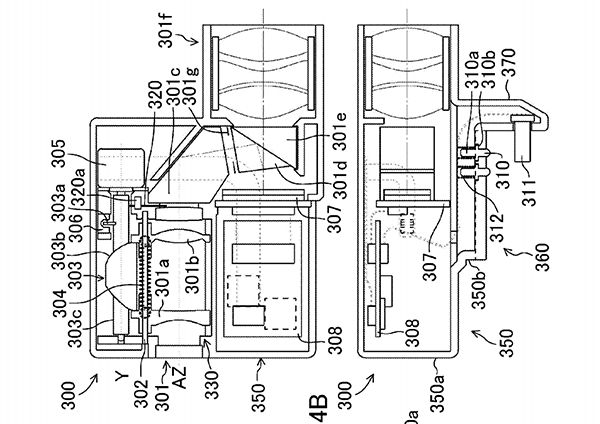
The image on top is quite complex but the idea behind it is simple: Panasonic patented an optical viewfinder which actually changes focal length in sync with any Micro Four Thirds lens! For example the optical viewfinder shows an 20mm focal length when you sue it along the 20mm pancake or 42,5mm focal length when you use the Leica Nocticron. And it obvisouly would also sync with any zoom lens too! It would become the first universal useable and variable optical viewfinder for any current digital mirrorless system. And it basically woudl do a similar job of an Optical viewfinder you usually have on a DSLR:
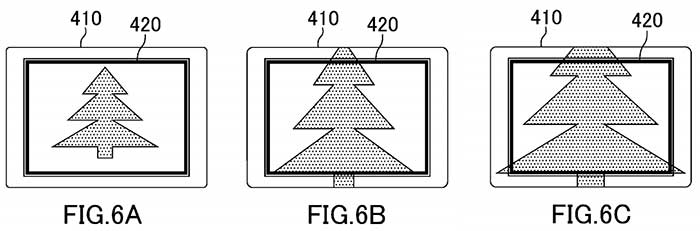
Like you see th optical viewfinder zooms into the subject just like a real zoom lens. The official technical presentation from Panasonic says:
An optical viewfinder is configured to be attached to a camera body with an interchangeable lens. The optical viewfinder includes: a Keplerian viewfinder optical system 301 including a scalable objective lens group 330; a stepping motor 305 configured to drive the objective lens group 330 along an optical axis; and a control circuit configured to control driving of the stepping motor 305 based on a result of detection by a PI 306. When a variable focal length lens (an interchangeable lens) is attached to a camera body, the control circuit controls driving of the stepping motor 305 in accordance with a focal length of the variable focal length lens and displays at least a photographing frame on an EVF panel 307.
I love that!
[poll id=”255″]
Note: Please be nice and link back to 43rumors if you repost that news. I spent half a day to find that patent 🙂
101 Responses
Electronic is future but Optical have to advance as well . Put them together in a camera like Fuji X100 did & let us decide what & when to use for each viewfinder . I don’t really care about Pana eliminating DSLR advantage what I want to see is to outclass them in image quality with advance sensor tech & ultra fast Leica optics .
It’s is still not through the lens, and hence this will lead to a parallaxe problem, at most at short focal distances.And you will have to adapt the DOF also.
No solution for me at least.
Regards
Wow, a zoom viewfinder! Nobody had ever thought of that before… except Nikon, Kyocera (Contax), Cosina, scads of point-and-shoot camera makers… in principle this one looks almost exactly like the Contax G1 and G2 viewfinders except for incorporation of (presumably) an LCD to superimpose the frame lines. That might make framing more precise, and would allow superimposed data, so it would be a worthwhile improvement — although I suspect most users still would prefer an EVF.
The big problem with Keplerian viewfinders like this one is that to keep the size down, the objective (front) lens has to be small, which results in a somewhat dim viewfinder image.
Fuji’s point and shoot
Also Canon’s G series, regardless of the optical viewfinder quality
> 5. The optical viewfinder of claim 1, wherein the optical viewfinder is configured to be attached to a general-purpose hot shoe of the camera body.
Seems like it will be an automatic version of Cosina’s variable external viewfinder, so there’s no size constraint about trying to fit it into the camera.
Also…
> 8. The optical viewfinder of claim 1, wherein electric power and a video signal for use in the display device are received through an electric contact except a communication contact for an external flash device and an X contact terminal.
So this will work like x100’s hybrid OVF, only attached externally.
Focus speed and accuracy in video or while moving is the only issue I have remaining with mirrorless. The viewfinders now are fine.
Look, I’ve never really understood the so-called “advantage” of seeing a completely different image than the one the camera’s actual sensor is seeing. It’s not your eye taking the picture. The EVF will give you a far better idea of what the image will be like – color, exposure, and even shutter-speed preview and aperture preview are possible. I call the mirror a disadvantage, though I might agree that EVF still has a little way to go before it’s as good as it should be.
I don’t look through a viewfinder to get a preview of what the image will be like. I look through it to compose and frame the image, and that is much easier if I see a direct, optical representation of reality. I feel connected to the subject in a way that I don’t when using an EVF.
“Feel connected”is a really vague term. I’ve used optical viewfinders and never felt any “connection” that I can’t find using an EVF. The “framing” is also a strange thing to mention, since I’m not seeing a cropped image in my viewfinder, I’m seeing the image I’m capturing, so the framing is pretty much perfect. I won’t argue that truly seeing your subject with your own eye is better, but seeing the exact photo you are about to take is, IMHO, better.
Basically, it’s a subjective thing and a matter of preference.
Yeah, I never shoot with one eye closed like many do. Always I’m looking through the viewfinder (VF) with my right eye and my left keeps track of movement of the “bigger” environment, so you can anticipate the action etc.
The optical viewfinder needs to go the way of the dodo, there’s absolutely no advantage of it anymore, the VF on the E-M1 is already very good, maybe if they make it even more responsible and a little higher resolution that it would be perfect.
Like you, I want to see a preview of the final result, also in dark environment the optical VF is handicapped, one can’t even frame decently anymore when an EVF can still show you the scene.
agreed, I also keep one eye open if I’m filming movement. I have a defect in my left eye that prevents me from seeing fine detail, but motion and surroundings are still visible.
I prefer EVF since the first time I used it on MFT. Can dig the WYSIWYG experience..last time i did 2 shoots on a borrowed dslr….its a step backwards imo
Sharing a secret move with you .
Sometime a LCD screen works better than EVF especially in framing a model .
I did perform several brilliant shots using such method .
Although the models herself feel that is unprofessional move with such method of shooting , I don’t really mind .
It’s simple here , use EVF if I need it & LCD if I have to .
sounds like a public secret, but imo framing in a good EVF is more focused, but for certain situations I agree that the LCD gives better results
Agree with both.The only real problem using an LCD is stability. Keeping the cam close to or even touching your face gives extra stability which you cant have when using an LCD. On the other hand if using a tripod or stabilise the cam on a surface then using LCD its most of the times better!
LCD for still shooting comes into action here for unusual POV situation, otherwise its common for me while doing video pictorials…stabilising is no issue when IBIS is present
Well, to be honest using the “LCD” is exactly how a studio photographer would shoot his models 20 to 30 years back. At that time they mostly used medium format camera’s and used the top screen (ground glass) to focus and frame shooting at waist level.
SLR’s were cheap so the shift was made to SLR where you had to look throogh the VF at eye level, so it was born out of a necessity not of preference due to cost.
Today you could go back to waistlevel shooting without much adoo, actually seeing what the image will be like and even have more control over the subject being in focus.
At the end of the day, optical just isn’t as useful overall as electronic is. Sure, EVF’s may not be up to the snuff that the remaining purists demand but, just like with film cameras, the tech will advance and even those detractors will get on board.
This patent is a waste of time. Pack an absolute crapton of PPI in an EVF (like the new Nexus 6… 6 inch 1440P screen), make sure the screen displays at least 90% of AdobeRGB, give it an insane refresh rate and make that magnification even higher. I want that EVF to look like I’m looking at an IMAX screen.
I could not want to anymore use a Olympus OM camera because the viewfinder is just too big. Impossible to see well all corners at once, so damn big it was.
Sure I could take even little larger that E-M1 offers but not so much, maybe just 10-15% bigger.
Haha I need to find someone with an old OM camera to see that 😉
its true, they’re absolutely massive, however I adore them.
Its like a magic prism box, the viewfinder appears bigger than the hump it’s inside.
Olympus OM a massive camera? Since when? They were one of the smallest film SLRs made.
He’s talking about the viewfinder. It’s significantly bigger than any FF dSLR produced today – magnification of 0.92x for an OM1, 0.84 for an OM4.
The problem is that all those pixels use a lot of power. Which means a larger (and different ) battery or a shorter number of frames per charge.
That’s one of the reasons why the Nexus 6 uses a 3,200 mah battery
If you go with a larger battery it increases the size and weight of the camera.
Anyway, I expect that resolution will increase in the next generation of screens that will probably appear next year.
Probably in the new Canon mirrorless camera system as they have a big optical user base to win over.
In five years time we’ll wonder why people didn’t like using EVFs as we use our virtually lag free 4k screens in our cameras.
And the
Right, but a Nexus 6 is also powering a screen that is 5+ inches… this will likely just be 1-1.25 inches, wouldn’t require as much backlighting either (since your eye is pressed up against it).
Actually they’re smaller than that. I think the Epson 2.36 million dot one is half an inch.
But they must have a significant affect or mirrorless cameras wouldn’t have so much shorter battery life than small dSLRs
Well, mirrorless camera are running video all the time for the live view, so sensor also drains power from the battery
It has an effect for sure, but what has the biggest effect are these factors:
1) the battery capacities for most small mirrorless cameras are already less than a larger DSLR (for example: my D7000 battery is 1900mah whereas my EM-10 is 1150mah) and
2) People shoot with the LCD screen, not just the EVF. This has a much bigger effect on battery life.
How old is this patent?
None of the current Panasonic M43 have a suitable accessory shoe and only two (GM1 and GF6) have no EVF.
Often the techs will invent something clever, patent it and shelve it for future use or simply to stop the competitors going there.
I think this one to be of academic interest only.
I don’t expect that thing to be made, if at all, as a separate accessory, it will rather be included in a future camera.
I’m not sure what the point of integrating it would be, it certainly takes up more space than either sequential-based or progressive-based EVFs, it’s mechanically more complex, it’s more limited (you can’t scale the zoom to fit all possible lenses without taking up more space or losing in quality), probably at least as expensive as sequential-based EVFs and probably consumes as much energy, if not more (because it has to move physical elements).
It makes no economic sense whatsoever, and very little technical sense.
I’d rather they focus on getting rid once and for all of sequential-based EVFs, I do understand many people don’t care and that they offer advantages in term of electric consumption, space required and cost, but I find them barely usable and consider any modern camera using them as having no VF at all (GX7, LX100, GM5, on the other hand the G6, GH3/4 and FZ1000 all use progressive-based EVF – because they use larger, central VF, rather than compact, corner located ones).
Why bother? It’s not TTL, so you still have to worry about parallax, framing issues, lack of feedback on focus, etc.
I don’t see how this is much different than the OVF I have in my ancient compact Canon SD1000. If you want an OVF that bad, there are a lot of good options.
Did you read the patent? It actually corrects for parallax, has a 100% view, and has active focus point overlays like a DSLR. The main difference between this and your Canon SD1000 besides the technical advancements is that it is an add on accessory. You aren’t forced to buy it with your camera.
No, I didn’t read the actual patent. The fact that it’s an add on is pretty interesting, actually. Not something that I think I’d want, but an interesting approach.
Maybe Fuji should license this and derive an electronically coupled rangefinder viewfinder? 🙂
What’s the point ? It’s not TTL, it’s just a glorified, zoomable rangefinder viewfinder (for that matter, it’s what was used on all zoom compacts in the 80’s through 90’s), nothing really new or useful, it’s significantly less useful than either true SLR OVF or EVF, while being mechanically more complex than either.
Well, first of all, this one is removeable. The zooms on your compact are built into the camera. This one allows you to choose between using a OVF or an EVF or just removing all viewfinders altogether. it also corrects for parallax.
Honestly, I see the only real stronghold of DSLRs over mirrorless cameras being in continuous autofocus. DSLRs are still better at it, despite on-sensor PDAF. But I think it will only be a couple years before that bridge is crossed as well.
After that, it’s simply a matter of price. A lot of the affordable lenses in the Nikon or Canon catalogue had their R&D done in the 90s, and have long, long since been paid off. Any of their modern lenses are much more comparable in price to current mirrorless offerings.
That bridge could be stepped already, as the DSLR does the continues AF in “clever” way, that is that system starts focusing and calculates quickly the subject movement direction and speed to camera. Then they simply estimate the subject location and distance continually bases to few frames and need to so very small correctiong everytime.
Now they simply don’t seem to do any calculations at all with CDAF.
But I have been shooting fast and slow moving subjects with E-M1 and I get 90% keeper rate.
And I mean FAST moving subjects. From rally (160-180kmh) where subject jump behind hill suddenly to fighters (350-1100kmh) flying close range (even just few dozen meters) and kids running around and towars to sports where football players (for some idiots it is “soccer”) run far and close zig zag and sports like triple jump or basket ball.
The most required skill is to know the sport, read the game and anticipate the situations. Then you can get great shots just with single frame too if wanted.
Wild life I have left others, but I know that skill is similar requirement and you don’t need continues AF if you know the subject and terrain.
Sure it gives some situations good help but not so important as some people claim.
There is reason why I bought 40-150mm f/2.8 and will buy coming 300mm f/4 as they offer highest quality for those focal lengths and light density while offering even faster focus speeds than DSLR can give.
Decades ago i owned a 35mm film pocket camera (it was full-frame and not a half-frame) and it had rangefinder that was optically zoomable depending the zoom level user selects via leveler.
So nothing new with this actually.
Except that would have been rather primitive to what this Pana design is.
This would look cool on a retro cam. No more.
Those who can not handle an EVF, well, it is their loss.
Slow news day?
No friends you can talk with? 🙂
Exactly .
We as photographers are not at war with DSLR’s, only the manufacturers who no longer make DSLR’s are. And this war will never have a definite end. DSLR’s will always have either longer battery life or more accurate viewfinder, depending on which mirrorless viewfinder implementation we are comparing with.
DSLRs actually have LESS accurate viewfinders. Most DSLRs don’t even have a 100% viewfinder, which means you don’t see the exact crop that you are taking. Mirrorless camera viewfinders show you exactly what your image will be. Things like focus, white balance, color, DoF, lens flare, highlights, shadows, etc…are all represented on a Mirrorless camera’s viewfinder but aren’t on a DSLR.
I use both and don’t find OVF as less accurate. Indeed, I switch off exposure preview most of the time. For macro work (large aperture), flash or in dim light I see mostly noise in the EVF otherwise. Focus magnification is the thing I use most. But as my eyes are still very good, I prefer OVF. If you photograph a lot, it shouldn’t be a problem to not have exposure preview if you are not a beginner. All better DSLR indicate exposure quite nicely in the OVF anyway.
He said depending on which implementation, so EVF has worse battery life and this OVF will be less accurate, not so difficult to understand now is it? But thank you for your lesson on EVFs as nobody knew until you pointed it out.
I’ll never go back to an optical viewfinder. EVF’s are better in nearly every way for me, especially for video.
I enjoy EM1’s electronic view finder. It’s big, I like the color creator and WYSIWYG feature of EVF.
Though good news for optical viewfinder guys.
The hybrid viewfinder on Fuji’s X100 and XPro cameras is one of their most popular features. The latest version on the X100t marries an electronic overlay in the lower right corner that provides a closeup view of the focus area. It is very clever. I still prefer a modern, high quality EVF, but having both options is appealing and currently, a differentiator for Fuji.
Panny is on a roll. First they added aperture rings. Then integrated, left side EVFs. Then the awesome LX100 controls. Now this. Panasonic seems very focused on handling and user experience, and is right on target. I can’t wait for an LX100 styled GX8!
GX8 would be awesome, I hope they release a body next year.
Panny is kickin a**. Love that they are pushing forward and creating more stuff. Puts the pressure on competition and more innovation happens.
coming from a olympus fanboy nice……I really appreciate when oly and pana fanboys agree with each company’s pros and cons, coz finally its good for MFT in general…..we may have our own preferences which is also important but in the end MFT needs to grow on the whole….nowadays oly and pana seem to be going different ways which really depresses me…..hope they bring their sync back
Agreed. I never understand why there are fanboys for Oly vs Panny at all instead of just M43 fans who prioritize size and feel that the sensor size, lens size and cost advantage vs full frame is just the right balance. I love being able to buy bodies from two major manufacturers and great lenses from both of those as well as third party options.
Two minor manufacturers would be more correct.
I like how the Oly Camera looks, 5 axis stabilization, the Oly colors and high optical quality lens.
In the end, you don’t prefer a brand and I do. I do have Pany 25mm f1.4 and it’s awesome and I do like competition which Pany creates which in turns helps everyone in the m43 innovating.
I may buy a body of pant if they come with decent IBIS.
I own 2 Oly cameras and love the IBIS and overall performance more than the looks or controls. I find OM style and controls acceptable, but not extraordinary. The latest Panasonic offerings (LX100, GM5, 42.5 and 15mm) have the style and controls I like (and are killing it in 4K, which is the future). They have definitely stolen some thunder from my Fuji envy. 🙂
But that Oly 40-150 is likely my next purchase.
I also hope they don’t abandon the GX line. Doesn’t matter if OVF or EVF, it definitely needs to be bigger!
Still, as with any rangefinder/zoomfinder implementation, it only makes sense for a very, very limited range of focal lengths. Between 24-85mm or so. Anything outside that, it’s basically useless.
Nice for a fixed-focal length camera, not very useful for an interchangeable lens camera. This is a huge part of why SLRs became popular, because people could use telephoto lenses…
Historically, yes. But it seems like a modern patent would account for zooms. Even if not, I’d be interested if it covered wide to short tele in the conventional stops (18, 24, 28, 35, 50, 90, 135), or even a subset. We’d need to see the rest of the camera, of course.
But it would be great as a hybrid viewfinder on a LX100m2. 🙂
That’s only because that is how it is currently implemented. Essentially, what Fuji has done is put a zoom lens in the OVF, but with a limited range. They could expand the range.
But for how long will this novelty factor be able to pull customers? Once Canon and Nikon start with EVF, the OVF will slowly become a thing of the past anyway.
Not if Canon and Nikon introduce hybrid viewfinders, too.
But I must agree: as EVFs get better and better – to the point that they are effectively indistinguishable from the clarity of an OVF – the OVF will go away; it will just become an unnecessary and complicated manufacturing expense at that point.
I prefer the EVF to the OVF solution. Therefore no, I’m not interested in this kind of viewfinder. The hybrid vf on Fuji x100t is really nice though.
Another advantage of the EVF is the preview of the last shot taken: it’s just a blink but frees the user from chimping the screen.
I don’t understand how this is different that what Fuji does now, at least within certain focal lengths.
Fuji doesn’t have a synced optical viewfinder that changes with interchangeable lens. On the XE-1, you have frame marks. The OVF view doesn’t actually change. OVFs on compacts like the X10 or the older cameras from the 1990s and older do not sync with interchangeable lens. Some don’t even sync with their own built in zoom lens. They have independent lens and ovf motors that don’t talk to each other.
The X-E1 has an EVF. Only the X-Pro1 has what I am referring to. But the OVF on the X-Pro1 does sync with interchangeable lenses. Not only does it adjusts the framelines for the lens attached (and works with zooms), but it also has lenses within the OVF that change the magnification through the finder. E.g., when you attach the 18mm, it uses the “wide” lens. When you attach the 35mm, it uses a different lens within the OVF to magnify the view. The current OVF in the X-Pro1 only has these two settings, wide, and “normal/tele.” But the next iteration could could have more lenses, or perhaps a different solution.
I hope they don’t implement this. Seems clunky, complicated, expensive, and pointless.
Hard to make that call without actually using it though. 🙂
Fuji has implemented some pretty good optical viewfinders with digital overlays
Fuji Xpro1: the hybrid finder doesn’t work with manual lenses, so basically meaningless. And the new one (rangefinder simulation) on x100t is on a fixed lens camera with AF..nice idea though.
Ha, maybe Fuji has bought the patent or they even outsourced the work to Pana for the X-Pro2. That would be funny.
All older filmbased compacts with zoom also had zoomviewfinder, and you can get this in a digicam like Canon G16 today, or a Fuji X20. These wievfinders are trashed in all reviews as small, inaccurate (typically show around 80% of the image) and even if Panasonic improved on some of the shortcomings you’d still get parallaxproblems and poor image quality at tele. Try to make a zoom viewfinder that will cover 7-300mm, the current MFT-range…
You speak the thruth man. Pana should stay with EVF and focus on improving IQ in low light for instance
Well, for this patent, parallax is fully corrected, it has a larger than 100% view, and it can cover beyond the 7-300mm range that you requested. To top it all off, you can remove it when you don’t want the extra size/weight. The main drawback would be extra drain on your battery (although an external EVF would do the same too).
Yawn….
Contax did this long, long, long ago with the G Series Film Rangefinders and it was considered at best mediocre. On a Micro Four Turds camera it will be absolutely abysmal. Panasonic should just chuck this mount and join the rest of the world as APC-C is the minimum
Why not medium format? Apsc and ff are so tiny…
I would welcome a Medium Format rangefinder. Something like the Bronica 645RF or Mamiya 7 would be great. Hell even if it were a fixed lens like the older Fuji MF film point and shoots like the GS645 or the GA645Zi. Unlike the vast majority of deluded fauxtographers on these sites I would be willing, hell I would be throwing my wallet at the register of the local camera store to pay in the $6K-$8K range for such a camera. Pentax could do it. Fuji or Phase could as well, but I think they would charge closer to $12K-$15k.
why not 2×3 meters?
Actually, one of the strengths of mirrorless camera systems is “what you see is what you get” – you see what the sensor sees, how the sensor sees it, and when you press the shutter button the camera just records that. In particular how the camera is choosing to meter the scene (how bright it looks) based on the metering setting (whole scene, center weighted, or spot) plus the effects of exposure compensation. With a mirrorless camera, you change these settings and the image in front of your eye changes in real time. The photographer is always directly connected to the sensor’s view of the world. And that kind of realtime feedback loop not only makes learning photography – even/especially full manual mode (in natural light) – much easier, it helps seasoned photographers nail the shot.
Not so with DSLRs, where there’s always a disconnect between what the human eye sees through the viewfinder and how the sensor is going to record that image. Exposure compensation is just a tiny little dot on a tiny little line along the bottom of the image, and changing it (or the metering mode) doesn’t affect the view through the OVF one bit. When I’m tutoring new-ish photographers, I do much of my training using the live view of their DSLR, and usually tell people to do everything though live view for a few weeks after the class. Then after the understand the exposure triangle, they can go back to looking through the OVF and then learn to intuit their camera’s metering in their head along with constantly “chimping” to see what the sensor actually recorded.
Its a new thing and as every innovation it should be applaused. But besides that i think its a move to the wrong direction. EVFs slowly but steadily win more supporters (including me) and guess why. Because they are BETTER. You can do alot of things with an EVF which with an optical VF you just cant. Actually this new type of OVF looses all the advantages of an EVF while its clearly inferior from a classic OVF on a DSLR…. A “hole in the sand” we use to say where i come from about things like that…
Vari-focal finder is not something new, this is a more advanced version though. The key point is to have good integration with the camera. Imagine a mirrorless ILC with such optical finder, the screen can be turned off and lots of battery can be saved for more shots.
This looks like a over complicated downgrade from an SLR. Not really usefull.
It looks like it will use a lot of power, draining the battery just like and electronic viewfinder. Of course, once the zoom is done, perhaps it will stop using power. But the lack of power drain when not actually taking photos is certainly a big advantage with DSLR that would remain.
I just don’t see the point. Are Panasonic trying to tell us that what we see through an EVF is not what the lens sees???
Well what you see on an EVF is not what the lens sees but what the sensor interprets in a digital form from the lens. This is one of the reasons why EVFs are better than OVFs in DSLRs (where you see what the lens sees).
I rather the X-T1 EVF.
FUJI will be bankrupt soon, so not a good longterm choice.
Not really sure how this is different from what Fuji is doing, and before anyone gets too excited either way, remember that the vast majority of patents never see the light of day.
Not a fan of hybrid viewfinders. It’s what turned me off the Fuji X100 — I found the viewfinder (which many others raved about and love) incredibly annoying and fiddly. Oddly, I liked the X10 viewfinder better. I think the best arrangement is a compromise: fully optical viewfinder, with electronic viewing only on the LCD screen. The Leica M does this and I prefer it.
I had a variable vf on my Konica 1994 and liked it a lot.
But today, only large evf make sense to me. As it is an accessory only, I don’t mind. 🙂
This is intriguing — I would really like to try it out. It’s not clear, though, how the viewfinder learns what lens is on the camera. I suspect for most camera-lens combinations, the means of informing the VF what lens is mounted would have to be included in new models going forward. Otherwise, I suppose this variable OVF would have to provide some means of entering that information.
Whatever is needed, I don’t doubt Panasonic can make it work well. However, I shudder at the thought of what it’s likely to cost. If it’s up around the price of a good new camera, it’s more likely to be a niche item than a mass-market success.
The lens focal length is currently reported to the electronics, zoom or prime. A path to pass this signal to an external (add on) viewfinder is just some additional tracks and wires. For built in it would be a bit like a rangefinder (maybe even focus feedback to the electronics from real RF viewfinders) or simply the hump with an opening at the front. Lens might get in the way. Personally I don’t like the idea and would not buy. But for some it may be just what they wanted. Imagine a GX7 with a real RF viewfinder that shows the correct aspect for the lens and also reports the focus back to the electronics.
Hey. That would even even work with manual lenses, Primes not zooms.
Why don’t they add mirror to m43? The lenses have long enough backfocus to fit a mirror.
That would be nice if we wanted a dslr. But we don’t want old fashioned obsolete bits in our m34 cameras. Its a bit like wanting a cork in a wine bottle. Old fashioned, nice in its day and not very bright, though hard to kill is some areas. Wine is far more as the maker intended with a screwtop. Also less rejections and strange smells.
Mirrors are a bit like that. Old hat, out of date, to complicated and the reason they were invented has gone away into history, though some still like to live in the past.
first throw out the mirror, and then everyone asks to implement some feature of DSLRs in a mirrorless body. silly.
nobody I know is asking for that old nonsense tech.
perhaps you’d also like a roll of film to replace the sensor?
Olympus PEN F awaits you.
I remember ( 🙂 ) how manual focus used to work in the old days (ie before autofocus slrs were born) – it was mostly through a split screen or split screen/microprism combination, if you ask; I also remember that framing and focusing used to be distinct concepts. How are you supposed to focus through this new ovf? Because if this viewfinder is for framing only (I see nothing about manual focusing in the claims or the description), I cannot see the point of it (yet – because Panasonic may still have more tricks in her sleeve).
This adapter would be nice… if it was made, then nothing would stop me from buying mFT body 🙂