









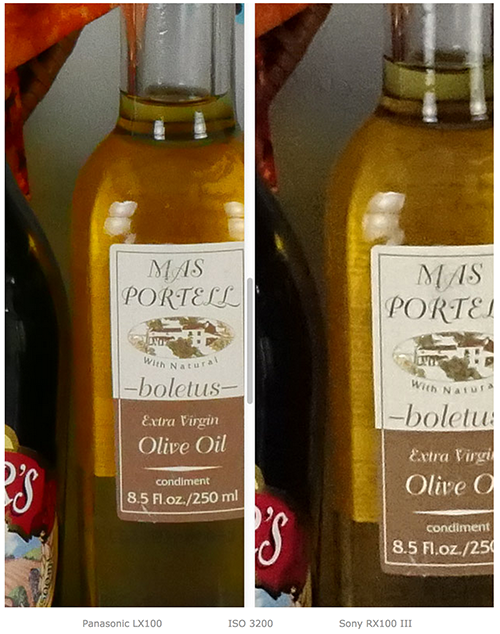
Imaging Resource added the LX100 studio image samples to their Comparometer. And finally you can play with it to see how it compares against all other high-end compact cameras. And ePhotozine also posted a set of image samples. And it looks like firts Japanese stores are having the LX100 on display (Flickr).
LX100 preorders at Amazon, Adorama, BHphoto. Europe at WexUK and Wex Germany. in Asia at Amazon Japan.
99 Responses
Now we have a killer.
Nice… Only a blind man is unable to see that the Sony-bottle is much larger so i don’t understand what they are comparing here.
There is a huge difference of definition : the RX100 MKIII sensor is a 20 Mpix, the LX100 sensor is a 12 Mpix. Hence the difference in size with these two 100% crop.
That’s not fair, is it ?
If you can’t compare CA and overall quality (sharpness, noise, filtering) from these 2 pics, the only blind man is you.
Please upsample the LX100 pic to 20mp, OR downsample the RX100M3 pic to 12mp – THEN compare.
That’s not fair at all. Downsampling does not cause degradation and upsampling does !
Just crop the same bloody area !!
How will that solve the problem? to diplay at the same size you will still need to upsample/downsample
I would say downsampling is the fairest way to compare it. If you crop the same area, then the higher resolution camera almost always wins. I.e. if you take a 10MP full frame picture and a 20MP point and shoot image and do a 100% pixel view crop of the 20MP image, the 12MP image would undoubtedly look worse because the pixels will be as big as your screen (figuratively speaking).
Panasonic is mushy- noise reduction being applied here?
actually I thought the sony looked mushy, look at the definition in the text.
No significant difference, especially if compared at same size. LX100 is certainly impressive piece of tech, but i would not get it only for better high iso. I actually like iq of sony more, especially since i’m mostly shooting at base iso and use tripod often.
Is it so hard to compare the SAME INFORMATION ?
These are different crops !
Why don’t they take the lenses into account as well ?
It’s not the lenses, it’s the pixel count. They should be down-res’ing the RX100 to 13MP to match the LX100.
That’s not fair. The pixels are in better shape after downsampling then before.
Just crop the same area !
If i take a picture with a FF camera and one with a GH4 of the same subject, why, in the name of whoever, should i use a different crop ? WHY ?
…but that doesn’t make sense at all. Literally what you’re saying is that they should move back with the RX100 so that they’re shooting the empty walls all around their comparison, and then crop that all out so that you get the RX100’s “native pixels” that would make up the same image as the lower resolution LX100?
That’s not only difficult and fiddly to actually accomplish, but literally no one would ever shoot that way.
Downres’ing is a perfectly acceptable – and in fact, the only fair – way to do the comparison. Any manufacturer that provides a higher resolution sensor obviously knows the inherent advantages that you can get from downsampling. Witness the Lumia 1020, with 41MP that is *designed* to be used at 8MP.
You don’t step back with a 50mm prime on your body to reframe ?
How would you organize a comparison between a LX100 and a Hasselblad ?
I think you misunderstand the fundamental premise here. If one of your cameras has more pixels than the other, you’re going to get a bigger image even if the framing is exactly the same.
As far as the Hasselblad vs LX100, I’d simply use whatever lens that would get me about a 50mm equivalent on the Hassy (an 80mm), and then put the LX100 into the middle of the zoom range at the same FOV. Put both cameras in the same spot so that the frame is identical, take two pictures, and then downsample the 40MP Hasselblad to match the pixel dimensions of the LX100. Pretty straightforward stuff.
Come, let’s make the same picture.
You with your Hasselblad and i with my LX100.
Lets print both in A4 and compare the prints.
Huh, what are you saying ? Your picture is bigger than mine ?
If we print both at 300dpi, mine will be 4x bigger than yours.
If we print both at A4, we’re doing literally exactly the same thing as downres’ing the Hasselblad to the same size as the LX100.
Interesting. Why would the number of pixels change the image size, assuming the light-sensitive areas are the same?
Eh? Because your computer monitor displays every pixel the same size. That’s how it works.
The DPI of your monitor doesn’t change – it’s like a printed page. If you have a 20MP image, it’s displaying 20 million pixels in a grid that make up the image. If display 12 million pixels instead, and all those pixels are the same size, that grid is obviously going to have to be smaller, no?
I don’t think I’m understanding your question, or there was a misinterpretation previously, because this stuff is really, really straightforward.
After downloading the two at ISO 6400 and downsizing the RX100 to the same (horizontal) dimension, I’d say that the LX100 has slightly more aggressive noise reduction, but the RX100 overdoes it on the sharpening and produces worse artifacts as a result. So the LX100 looks a bit smoother, but also more natural.
It’s probably about as much of an improvement as you’d expect, given the sensor size – maybe 0.5 stops for the LX100? Not a massive difference, regardless.
That said, I don’t understand why Imaging Resource always drops the ball by using JPEG comparisons? They are worse than useless for someone who shoots RAW. All we learn is the default processing parameters that different manufacturers like to apply.
The image quality here wouldn’t convince me to buy an LX100. If anything, it would be the handling that would do it. And that’s directly in competition with the size advantage that the RX100 and Canon G7X (a better option than the Sony, I’d say) both offer.
Anyone shooting in JPEG should be banned for LIFE from using any kind of imaging-device !
Hahah, well now that’s just crazy. Lots of people don’t care.
But the people who are looking at Imaging Resource more than likely do care about the RAW input, so sites like that should cater to their audience.
JPEGS have gotten pretty good over the past few years. I only shoot in RAW but sometimes I take a walk on the wild side. It’s not to bad.
Imaging resource does show raw files.
They definitely do not. Here’s the text from IR’s Comparometer, right on the sidebar.
“These images are JPEGs straight from the camera, and were taken under carefully-controlled conditions…”
DPReview does RAW, which is why their image comparison tool is more useful.
I mean, you can download full-size RAW images from Imaging Resource, but that’s not nearly as handy as just having a 100% crop on the page for comparison. It’s annoying, is what it is.
http://www.imaging-resource.com/PRODS/panasonic-lx100/panasonic-lx100A.HTM
click on Samples. They’re there. You’ll just need to wait for a new Lightroom update to handle them.
It still would be much more helpful if, like DPReview, they used RAW for their website comparison tool, rather than requiring you to download some full sized RAWs. JPEGs just don’t really tell you very much about the actual capabilities of the sensor and lens.
What do you think you would be looking at if you think you were looking at RAW samples? You cannot see RAW data only JPEG or tiff conversions. Who decides which converter is valid. Adobe have a poor record of late.
With the exception of Fuji X-Trans files, Adobe is pretty well rounded, and at this point the closest thing we’ve got to a universal standard in terms of RAW conversions. But whatever, I don’t care if it’s Adobe. Use Capture One. Use SilkyPix. It doesn’t matter to me, as long as it’s the same one. Or heck, even the “best” converter for the various different files, as chosen by fiat or consensus.
Really, I just want to see what the native noise characteristics are like. Just open it, save that as a TIFF, or export it as a JPEG at Quality 12, and leave it at that.
As it is, with various levels of noise reduction, sharpening, masking, and saturation adjustments coming out of the in-camera JPEGs, it’s more like a comparison of how Panasonic thinks people want their photos to look vs. how Sony thinks people want their photos to look. It’s so far from the RAW output as to be useless.
Japanese language only menu on LX100?
Just the ones being sold in Japan
really hate this as I wanted to pick one up there during my trip to Japan, my GH4 is a Japanese one, still looking for a solution to change to English.
Very good performance, on par with GH4, a little bit less resolution, but who cares?
I do. In case i need to CROP !
Then the LX100 is not for you. Buy some other camera. Stop whining. Duh. Does your mum tell you what undies to wear in the morning, too?
Agree.
Lx 100 sucks! To big and clumsy.
Go trolling somewhere else, Panasonic LX 100 is the best compact camera ever made!
It is not pocketable unless you are wearing a circus tent with huge pockets. Its just same old m 43 sensor. So why buy it? If you want pocketable go for RX100 if you m 43 sensor buy one with interchangeble lenses. It will be as pocketable as LX100
The sensor is better than any Sony or Canon APSC’s out there so the image quality is very good. About the size is very small especial considering it’s sensor size and lens. Most of us consider it very pocketable.
Go trolling somewhere else, this camera rocks!
The LX100 is not for me, no that is true.
I fancy the GM5 more as a second (pocket) camera than the LX100.
It doesn’t have a fixed lens and a touchscreen.
Then go buy the GM5 or whatever you want. We here are interested in the little marvel called LX 100.
Depends on your approach. I prefer getting the composition right the first time around. The habit of taking pictures with the intention of cropping often leads to poor compositional choices. Ming Thein has a good article on the subject: http://blog.mingthein.com/2013/01/21/why-cropping-is-bad/
Totally agree!
Ming Thein has a good article on most everything! He’s a fantastic educator and his images are spectacular. Thanks for the pointer to this one. I had not read it yet.
I’m cropping all the time. M43 is great for this. I prefer 3:2 or 16:10 and taking the picture in M43 first gives the chance to cut something away at the top or the bottom. I tend to have a lot of sky and ground in the raw pictures and I decide later what has to go away.
Typically while taking pictures in Streets or with buildings I concentrate to keep the angle of view horizontal so I don’t have convergin lines. Most of the time, there is to much ground in the first place that is going away. M43 and crop is kind of a shift lens in this case.
The wast majority of people don’t really need or care for more than 8-10 MP, I’m one of them. If you aren’t satisfied with what this camera has to offer, buy something else!
I fancy the GM5 more as a second (pocket) camera than the LX100.
It doesn’t have a fixed lens and a touchscreen.
AND 18MP.
Sorry I must repeat myself but:
Go buy the GM5 or whatever you want. If you found an 18 Mpix version of the standard 16 Mpix, even better! :))
We here are interested in the little marvel called LX 100!
Oh, that’s right… You ARE a true pixel-peeper !
LOL and this comment relates to the other by how?
No he is not…..and Eno i am surprised youre at M43 forum and not trying to look stupid at the Sony forum like the last couple of days. You are a sad person.
The only thing sad is you trolling.
“Hey man… You need to crop that man in half !
Huh… Why ?
Because your sensor is bigger than mine ! Don’t you get it ?”
what I do get is that with 9 posts in under an hour repeatng the same boring thing means only that you are a troll with no real grasp of what photography is about.
YAWN!
Viezevure our resident troll is getting some tough competiton these days.
So, according to you photography is about pixel-peeping ?
Where do you live, in a dark and grey spec-cave ?
That repy doesn’t even make sense to my comment!!
Honestly, you could down-rez that Sony image and it still won’t be as clean as the LX100 at these high ISOs. This is the advantage of a larger sensor with less pixels as Sony themselves have already proven with the A7s.
You can resize to any Mpix the Sony one, it still looks like crap, it has a horrible blotchy water painting jpeg engine. And I forgot to mention, a smaller sensor 🙂
Like always.. smaller the sensor, worse the picture quality.
Yes but there must also be a good proportion between the size of the camera and size of the sensor+lens. I think LX 100 is ideal in this regard!
To me, the most exciting parts of the LX100 are the controls, focus system, 4K, and rangefinder style.
As amazing as that tiny, fast Leica lens is, I’d love to see this exact camera with interchangeable lenses at the same price for the body.
LX8GX8?GX8?
Yes, thanks.
GX8, not LX8.
It is no more a ‘rangefinder style’ than it is an ‘instamatic style.’ Google images of ‘instamatic.’
The point is:
* it isn’t faux SLR (no hump)
* it has great functionality
* I’d like an interchangeable lens version
Do you disagree?
the moral of the story is “don’t use small sensors at 3200iso. Also why compare a large 4/3rds sensor to a teensy sony sensor. I mean why not compare the LX100 vs the Sony RX1?
If you compare the sony rx100iii vs the LX100 at normal isos like 400 and down I’m sure the results would have been more interesting.
The 1″ sensor isn’t that much smaller than the FT sensor – the difference in size between FT and 1″ is about the same as the difference between APS-C and FT at 1.35 and 1.33 crop, respectively. Actually, the difference is even smaller for the 1″ and LX100 at 1.29x.
Yeah. The logarithmic nature of F-numbers is a surprisingly strong equalizer in terms of modern sensors. That “teensy” 1″ sensor provides only 1 stop less light than a 4/3″ sensor, which provides just 2/3 stops less less than an APS-C sensor, which proves just 1 1/3 stops less light than a FF sensor, which provides just 2/3 stops less light than digital medium format…
Bigger sensors matter, but once you get up to a good modern 1″ sensor like the Sony unit, it becomes a lot less important…
Huh? An aperture of f/2.8 passes the same amount of light, no matter the format.
In the old days when you used a hand-held incident light meter, you set the film speed and then measured the light. For a given light level, you then had the exact aperture/shutter speed ratio for 35mm, 6x6cm, 8×10 inches…
In short, other than for small light losses from things like different lens surface coatings, when it comes to passing light f/2.8 is f/2.8, period.
Yeah, of course it is. I never said that it wasn’t.
However, signal-to-noise ratio is fundamentally related to the total number of photons from your subject that hit your sensor (given sensors of the same generation). That’s the sum of the light intensity (denoted by the aperture) multiplied by the surface area of the sensor.
Anyway, talking in stops is the easiest short-hand for explaining that relationship. If you want to get into a debate about equivalence, I’d rather just link you to an article from DPReview and save my patience.
The LX100 does not use the full circle within the mft format.
Because all of them fall into high end compact camera category .
So does the RX1, as whensly mentioned.
LOL
“Categories” are based more on price range than what sort of camera they are.
The sony is zoomed in MORE than the panasonic is, first make them the same zoom then we are talking.
At high ISO, the RX100 still has more noise. In case of LX100, you can still make out the details, but in RX100, noise has already eaten them.
(Sadly, it seems that the G7X gives up even sooner than the RX100. At low ISO, sensors appear to be almost identical. But as ISO increases, the G7X looses badly to the RX100.)
IQ-wise, I’d say they (RX100 vs LX100) are close match, with only slight advantage to the LX100.
Sony while I admit to being a big fan of panasonic, seems to have the edge in sensor low noise tech. I just wanted to point out that the sony image is more zoomed in than the panasonic.
M43 fangirls/boys are so funny and so proud at the moment for their “Big” but yet still small M43 sensor in the LX100. It seems now that size does matter……….But the girls and boys comparing an oversized point and shoot with a real small size point and shoot trying to make it look good. Its the same when you compare APSC with M43. APSC will always be better even when the APSC is just as small or even smaller. The LX100 is nice but to big to compare with the RX100. Better of buying an A6000 for less money hand have much better results at almost the same size. Or go for the real pocketable camera like the RX100.
But we are fanboys so all your advise here is wasted. But thanks for your consideration anyways.
🙂
There are no bad sensor sizes, just sensors who’s technological day has not yet come.
Sony makes a damn good 1″ sensor. It’s pretty much good enough for most users. The Aptina sensors used in the Nikon 1s? Not so much.
4/3″ sensors have been “good enough” since they hit 16MP, notably with the Sony version.
APS-C sensors have been good enough since the D300 or the Canon 60D or so.
Full-frame digital has always been more than good enough, starting with the Alpha 900, or the slightly smaller Canon 1Ds.
This is all just opinion, but no one’s denying sensor size matters. Otherwise, we would be using Pentax Qs instead of 4/3. Stop constructing a persecution complex to justify your antisocial behaviour.
FF fangirls/boys are so funny and so proud at the moment for their ,,Big,, yet still small FF sensor. Medium format is sooo much better is not even funny. Full frame is not capable of producing good iq photos, the sensor is too damn small. Oh, and it is doomed to dissapear, now that medium format is taking over. Sensor size matters so this seem logical to me. Not my logic, but FF fanboys logic.
If the Sony wasn’t a bit of a mess, you might have a valid point. I have tried to like the RX100 series, but even on the newest version, the control dial feels sloppy and less than fully responsive and autofocus is not exactly quick. The inability to charge a battery outside of the camera is also just stupid. There is more to a camera than just sensor size and although I have yet to see or touch the LX100, it is almost certainly going to be a better camera than the RX100. So while I like a lot of Sony products, the RX100 is still very much a work in progress that cannot quite figure out what it wants to be while the LX100 is likely to be a very satisfactory camera for people who take pictures as compared to people who just sit around measuring their, uh, sensor size.
The SONYFANBOY idiot strikes again… hahahahahahahahahahaha… P A T H E T I C
your kidding yourself – go check out the ahm ‘ real life examples on dpreview’ and get back to me.. some of those shots are P A T H E T I C, by some, i mean A L L the shots. .. . fanboys.. sighs.. calling this Viezevure user a IDIOT just because he pointed out a true fact ? look at the side by side for yourself instead of just mouthing off like some fanboy troll …
“APSC will always be better” – yes, by trend, with an advantage of something between 1/3 and 1/2 of an EV, because that’s what the sensor area difference amounts to physically. Which is so little, though, that image quality differences between different sensors of the same size, between different technologies easily become more significant than the purely sensor-size-caused image quality difference.
Things were different back when Four Thirds sensors were made by Kodak, or the first generations of Panasonic sensors – they were not only smaller than APS-C, but technologically less advanced, too, causing a visible image quality disadvantage. These days, Four Thirds sensors are roughly on par with APS-C sensors. Although Four Thirds needs to catch up a bit in terms of megapixel resolution, after their 16 MP sensors have been around for quite some time now, but that will of course happen sooner or later.
By the way, I generally don’t like big-sensor compact cameras and I’m not interested at all in the LX100, but facts have to stay facts.
Now this is only out-of-camera jpeg and I pretty much exclusively shoot raw, but for me (shooting mostly around ISO400) the quality of either the LX100, G7X or RX100 is sufficient.
So for me this will come down to features, and it is not going to be easy. Each camera has features I really like: The “retro” controls on the LX100 and its EFV, the zoom range and weight of the G7X and the USB battery charging, weight and EFV of the RX100III
O/T. I’m surprised that nobody yet noticed that Pana LX100 and Sony RX100 in Asia have effectively the same name…
P.S. The real loser of the IQ comparison is the G7X. After you have seen the LX100 vs. RX100 images, try the G7X vs RX100. Sad.
Ok, I have to admit…. my beloved sony lost this one… by a big margin btw… 🙁
try vs Panasonic LX100 vs Panasonic FZ1000 – winner FZ1000 by texture in cloth samples,
vs Nikon V3 – winner LX100 by a long shot
vs Nikon J4 – winner LX100 big time here.. strange eh ?
vs Apple iPhone 4S – lols.. just for fun, just to see how bad a phone is..
vs Canon G1 X Mark II – slightest edge to canon, not enough to sway me though
vs Canon G7X – winner by a large margin canon G7X – by a longer shot then the FZ1000 even
vs Sony A6000 – Sony clear winner.. as we expected.
vs Sony RX100 III – rx100 by slightest margin – not worth losing sleep over (I own the rx100mk1)
vs Fujifilm X100S – X100s – but so slight not worth the worry – either is equal or like 2% better
having said all that, the wide angle shots on dpreview as very very bad.. the lower corners with the grass for example, eek.. really bad. i’m just hoping they will improve on that in firmware or something cos.. dam! it’s some very ugly crap right there..
Yes because everyone always shoots at ISO 3200 and crops at 100%???
IMHO, I don’t always shoot beyond ISO 800. 1600 would be my maximum.