









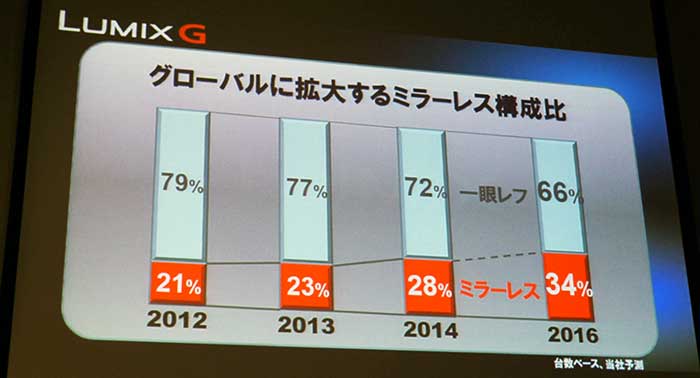
How does Panasonic see the future mirrorless market? At an event in Japan Panasonic projected that slide showing that by end of 2016 mirrorless cameras should increase up to 34% of the overall system camera market (via MirrorlessRumors). DSLR will still keep 66% of the market.
One more news: Cipa published the August shipment data and you can see the nice graphs as usual at Personal-View. There is no big news but mirrorless keeps growing slowly.
40 Responses
Please share Panasonic’s predictions for each of the last 7 years, so that we can assess the pattern of accuracy (if any) of its past predictions, and then make some inferences around the present one.
Ok. Read here: http://www.bloomberg.com/news/2014-06-02/sony-misses-targets-as-panasonic-beats-chart-of-the-day.html
You’re making the mistake of comparing financial guidance for a huge conglomerate with predictions for a product within a division. While I’d tend to agree that Panasonic doesn’t have as bad a history of predicting huge gains that never showed up for a product, you only have to go back a few years to find that they predicted mirrorless sales for them to be higher than they currently are. At least in this case they didn’t say “Panasonic’s mirrorless share” ;~).
As I’ve noted above and elsewhere, I actually think their forecast is wrong. By 2016 way more than 34% of the ILC sales will be mirrorless cameras. Indeed, I expect 2015 to exceed that number.
Another (less-optimistic) view of the same data:
http://www.sansmirror.com/newsviews/which-chart-is-right.html
In a nutshell, TH’s argument is that
” just moving functionality and IQ from DSLR to mirrorless and making the
camera somewhat smaller and lighter won’t resurrect the camera
business. The pond is drying up for interchangeable lens cameras for a
reason, and it doesn’t have to do with whether the camera has a mirror
in it or not.”
Reasonably correct, but with a few caveats:
1. Historically, the market for system cameras was never big and the lifecycle of products was really long. The market boom that accompanied the switch to digital is a historical anomaly, not a long term pattern. With the advent of digital (and the introduction of new mounts that went along with it), advanced users felt compelled to change bodies relatively often, to keep up with technological change, and they had to build a new lens collection from scratch. Currently improvements in sensor technology are incremental and the majority of advanced users have already built their lens collection. So, the market is going back to normal.
2. In this shrinking market, mirrorless cameras have have proven to be more resilient. There is no mystery in this – this is a less mature market. If I were a Canikon user, I would already have all the lenses I need, and a good enough camera body. By contrast, I already plan to buy two more lenses for my GM1 next year and, while I do not plan to get a GM5, I expect that I will upgrade when the next model hits the market (but I do not expect to keep on doing that for the rest of my natural life, so, yes, the current relative resilience of mirroless will not last for ever).
3. The best part of the DSLR market share is probably taken by entry level models with kit lens. This is not a market that is likely to withstand for long the assault of premium fixed lens cameras, or entry level mirrorless, as the price differential is bound to shrink (if not disappear altogether) and perceptions change (fast in Asia, more slowly in Europe, probably considerably more slowly in the US, but they still do change).
1. Not exactly. The DSLR “boom” lines up nicely with the “autofocus SLR” boom, though over a shorter period of time, so it’s a repeat. As I’ve written repeatedly, it’s household saturation that puts the lid on system cameras. We reached a slightly higher level with DSLRs than SLRs, but only slightly higher, before peaking. You’re arguing that “normal” is that the camera market goes long periods of time before finding the next engine of growth, and that growth actually goes negative that time lasts so long. That’s not normal in the tech business.
2. To my knowledge, only Fujifilm and Sony have shown consistent growth in mirrorless sales, and Fujifilm is a low volume maker. There is an argument made by some camera market analysts that it’s actually the size/weight that has propelled mirrorless, and really only the size/weight differential. One analyst believes that if you sample mirrorless users you’ll find that they’re heavily dominated by former DSLR users. It’s not price (high), lenses (fewer), or performance (lower on key factors like focus still) that’s driving mirrorless sales, after all.
3. Correct. And that’s why I think Panasonic’s 2016 forecast is way wrong. Both Canon and Nikon will have shifted their low-end DSLRs to mirrorless by then, I believe. The mirrorless “share” of ILC should be higher than Panasonic predicts, but their portion of it may be lower.
yes, with some glosses:
1. (i) Market saturation is the result of technological maturity (consumers
consider their camera “good enough”); mind you – I may be a poor judge
of all that, as I gave the autofocus revolution a skip and stuck to my
Nikon FE2 until the 2xxx years. (ii) Technology cycles used to be longer before the digital era. Cameras probably also tended to be relatively more expensive and ownership of an slr or a decent rangefinder rarer. However, there is no guarantee that digital technology will improve forever at the current pace and long periods of technological standstill, particularly when they coincide with a general economic downturn, may result in a vicious spiral of deep cuts in R&D, coupled with increasing prices, until the market stabilizes at the low volume/high price levels that we have seen in the past, when photography was an upper middle class hobby. I am not saying that this will happen (after all the notorious organic sensor is already being touted as the next revolution, although it is not clear that everyone in the sector is going to profit equally from it), in fact I consider more likely some kind of intermediate scenario, between your relative optimism (emphasis on relative) and the catastrophic scenario.
2) Considering that I am a GM1 user I could hardly disagree. But my point was merely that precisely for this reason there is no market saturation (in the mirrorless segment) yet: We are still building our systems and up until this year technological improvements were way more than incremental.
3) Who knows? It depends not only on bodies (and, in the case of Nikon1 sensors; it seems that the penalty for uber-fast hybrid autofocus is lower IQ and higher noise than the Sony/Panny 1″ quasi-competitors), but also on how soon Canikon can build a decent system of native mirrorless lenses (and sell them at the right price). It also depends on how soon Panafuji will bring to the market the rumored organic sensor and whether that will prove to be a flop, or a niche (like the Foveon), or a game changer. If the latter, all bets are off.
Any way, it seems (to me) that there is a consensus that neither entry level DSLRs nor cheap point-and-shoots (the kind that can be easily replaced by a smartphone) has a future. So, disagreements seem (again, to me) to be only on points of detail).
I agree, the same pattern happened in the sixties and seventies.
In the 1960s mass manufacturing of SLRs made them affordable (though expensive ) for the ‘ordinary person’. They were predominantly mechanical devices with selenium meters or occasionally CDS meters which required a battery.
Then in the mid 1970s electronics in cameras became more common and it started another boom with automatic modes and electronic shutters (Canon AE1, AT1, A1 Pentax ME, Olympus OM2 , Nikon FE etc).
That levelled off a bit and then autofocus came along in the mid 1980s and the cycle started again.
And like you, I also skipped the AF part of that ‘revolution’ and stuck to my OM cameras until the mid 2000s.
I specially agree with point 3… TH ignores that the mirrorless makers have been extremely attentive of enthusiasts, and have carved their own market. DSLR offerings for anyone who hasn’t been willing to put down $3000+ for a FF pro body have always felt a little insulting. Plastic rubbish bodies with gimped features, awful APS-C lens lineup, no innovation in form factors.
Realy?
And where is the afordable G7 ( 4k, good specs) 499,-€…i supose to get in
2014 = NOW?
First rule of buziness = IF THE CUSTOMER MUST WAIT HE IS GONE!
2014-no
2015-no/?
2016-no/no/not
Why so angry? Panasonic never said they we’re going to release a g7 with 4k video in 2014. I would love a g7 with gh4 specs(without weather sealing), but to be honest…that would make no sense for panasonic as they will sell less gh4’s.
You are right .
So just get the GH4 as G7 replacement otherwise write to Pana to conduct “make to order” request .
Be ready to pay premier price for it .
I think I see such thing happen before & is on Canon high grade lens .
Not if they won’t come up with a set of good, long focal length, lenses.
An announcement of a useless 30mm macro and a 150mm 2.8 that is 3 years overdue, does not bode well for Panasonic !
And what do these charts mean ? They don’t mean or promise anything.
They presented charts like these, called a ‘lens-roadmap’, with a 150mm f2.8 on it, over three years ago. Where is it ?
Charts like these are rubbish.
Calm down .
I suspect Pana is working with even faster aperture , F2.0 instead of F2.8 in 150mm FL .
Let’s wait & see .
So if a company’s promises don’t come through, we can simply infer it’s for our own good.
These numbers are nothing out of the ordinary given
a) how much the DSLR market has collapsed and
b) keeping earlier predictions by analyst companies such as IDC in mind. The bigger questions are these: how will the overall market develop? And: is Panasonic referring to units sold or money made?
Market share, have you heard about it?
Market share is only quarterly counted number, it doesn’t reflect the TRUE market share.
Example: Today I buy 15 fish and two bananas. You buy 5 fish and 7 bananas.
The market share is 20 : 8
Tomorrow I buy a 5 fish and 5 bananas. You buy a 1 fish and 5 bananas.
The market share is 6 : 10
Then day after tomorrow the market share is marked again based that day sales, not by sales what it is.
And that is the thing. Everything is calculated as each sale is consumable and it can’t be preserved for longer period. Like with fish and bananas, you don’t eat them anymore two weeks after buying them. With cameras, you are still using them 3-5 years from day you bought them.
Still the market share is calculated in quarters based sales, not based what is on the market. That’s why the market share statics are lies as easily can be given a believe new product is selling better than previous ones, when new one has been on market just for 2 years and sale rate is calculated from last quarter, while older product has been on market 15 years and calculated as well from last quarter.
The market share should be the total, how many products has been sold to that day from the start. Then give sale figures of the sale rates.
they conveniently skipped the 2015
LOL…I love my 4/3 gear…but…what else would Panasonic possible predict? It’s meaningless. LOL!
You have Olympus only, right?
no…have panny lenses and am eying a GM5…(who knows…)…have owned panny bodies in the past..(just got a E-M1 from South Korea Sat. (it ROCKS…I shoot still only….)
That is like me saying “I am going to have great photos when I go out and shoot today” ….its meaningless!!!!! LOL!!!!…. ***
If an outside agency had posted this info…it might mean a “little” more! 🙂
***well…maybe not!
https://www.flickr.com/photos/bowne/15271008480/in/photostream/lightbox
Well at least Panasonic predictions are closer to reality than Olympus. Year after year, they brag about how they’ll make a profit, yet year after year, it gets worse for them.
I wonder who they’ll beg money from next?
Olympus are profitable and Panasonic are profitable this year, though they weren’t last year and had to do some surgery on their business.
Both are losing money on their camera businesses.
Companies that are worthless can’t get money from investors.
Olympus had them queuing up to invest.
I wonder how much begging Panasonic had to do to divest themselves of 51% of their sensor business.
No one. Their medical division is profitable. Extremely profitable. In fact, it’s more profitable by itself than Nikon’s entire imaging division.
Olympus absorbs the imaging losses against medical’s profits. It’s counterintuitive, but then Japanese accounting practices typically are. 😉
It’s only logical that mirrorless will be sold more in future, technology is improving, choice getting bigger. If the global shutter finally appears in cheap mirrorless it will be yet another strong push.
So if technology is improving, choice getting better, then the exact same argument can be made that it’s only logical that more DSLRs and compact cameras will be sold in the future.
So many angry readers
Is 34% a good number?
Well it’s higher than 28% this year :-).
For mirrorless (as a whole) to gain market share (and acceptance ) is a good thing.
If Panasonic is not part of that and Sony, for example, is winning all the new business then it’s good for Sony but bad for Panasonic
Gaining market share if the market continues to shrink is good and bad. Good that your part of the market is doing better than some competitors part of the market.
Bad that you may be selling less each year despite your share of the market growing.
The tide is turning.
This is about world wide numbers except north america:
http://www.photoindustrie-verband.de/artikel/Photo-market-world-Trading-Up-possible
(DSLR down 23%, Mirrorless up 8% in value over the first 6 month in 2014)
Unfortunately the rest is in German.
http://www.heise.de/foto/meldung/Deutscher-Kameramarkt-in-Zahlen-Weniger-DSLR-mehr-Spiegellose-2390238.html
Here are several additinal studies from the german GfK (a market research company).
http://www.gfk.com/de/news-und-events/presse/pressemitteilungen/Seiten/default.aspx
So to summarise: The German market related to photography amounts to 20 billion Euros in 2014. Cameras share about 1.45 billion of the cake (down from 1,73 billion in 2012, mostly due to rip off of the compact camera segment). The number of sold DSLRs were reduced from 1,01 to 0.95 million from 2013 to 2014 (reason: longer period of usage for each model). Total share of MILCs about 30% (from 230000 to 310000 within the same period as above. The value of the sold MILCs increased from 710 to 720 million Euros). Overall, the market in Germany, combining MILCs and DSLRs didn’t change in total over the last three years (slight growth), contrary to what is seen in other countries.
What that chart does not show is how much the system camera market is gonna shrink in the same period. It is still very plausible that Panasonic’s prediction will come true, and at the same time, the sales of mirrorless cameras will be down. It’s already pretty much like that at the moment. DSLR sales are declining, and mirrorless stays flat.
I wonder who will be leading mirrorless sales in 2016. Any predictions? I haven’t made the switch yet to a smaller system but am planning on doing so at some point.
Probably Olympus followed closely by Sony and Fujifilm.
http://photobyandrei.wordpress.com/
Almost certainly Canon, closely followed by Sony and Nikon.
When Canon release a fully fledged mirrorless system next year people will flock to buy it and their previous criticism of mirrorless cameras will magically spirited away by the magic name of Canon on the front.
Not just Canon … but the Canikon duopoly. Once they enter mirrorless in a serious way, the order of things will change over night.
Sony has over 50% of the mirrorless market today; it absolutely dominates. There is nothing to suggest anyone else has the dollars or product or customer base to overthrow them.
Olympus has about 4% of the interchangeable lens camera market today. Fuji likely less.
And end that SLR relic in 21st century. Those who wish to have their camera big and bulky as a matter of fashion still can do that without actual mirror and pentaprism.