









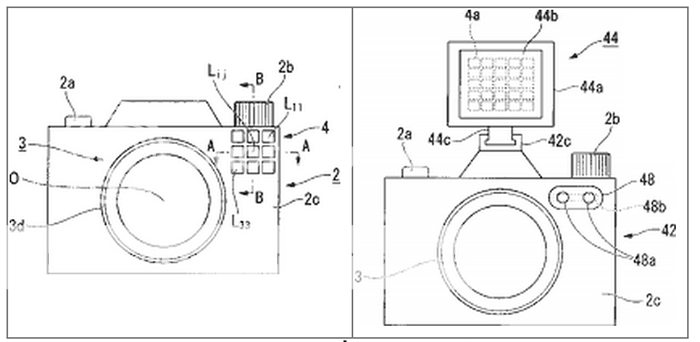
Well, everything today is going to use more and more LED lights (like your Car for example). And a brand new published Olympus patent discloses a camera using LED light as flash for both, integrated and external use. I guess we will see such a LED light in an Olympus camera pretty soon…
Source: Egami
21 Responses
Why not? I am starting to use LED house lights now & they are great.
Of course, I’m not questioning it as it will be another step in the future use of cameras. But, laptops & smart phones have been using them for selfie lighting for a while.
Unfortunately, even so called white LEDs have very narrow bands in the spectrum they output and so are often not very good at rendering the full spectrum of colours. You see themsometimes quote a CRI (colour rendering Index) number. A good one might be 85% which means it will only render that proportion of the colours sunlight or a xenon flash will.
The two-tone flash Apple uses is an attempt to address this issue and it does a pretty good job from the limited examples i have seen.
No doubt Olympus will address this and find a solution.
I have just posted a shipment of LED bulbs back to China. They were supposed to be ‘warm’ but had an unacceptable greenish tint.
And what is the upsides of led flashes, if any?
Apart from the obvious lower power consumption – heat development, smaller/lighter and waterproof macro flashes?!
Waht donknizi said — plus, multiple uses for one part (flash plus video light plus focus assist) allows for camera simplification. If they went above and beyond what Apple does on the iPhone, they could build a flash that duplicates the ambient light temperature (more green if there’s overhead fluorescent lighting, warmer for outdoors / incandescent lighting). This would reduce (maybe avoid) a lot of post-processing meant to deal with mixed lighting sources.
ok fair enough. Worth investing in R&D to work around the short comings.
As far as I am concerned, skip the LED’s already and give us a new dynamic sensor to make this format truly shine!!!
A step towards improving video capabilities, no doubt. Continuous lighting is applicable to stills too, of course, and this mentions flash. Are there LED units capable of flash quantity/quality output? I haven’t seen any.
Not yet, but it is still early days in that area really. I haven’t used any of the LED bank units to know what they’re like, but do you remember all the noise over one company (in the USA) taking out a copyright on LED units?
This could possibly be related to what Mr Terrada said in this interview (in French) : http://www.focus-numerique.com/test-1767/interview-toshiyuki-terada-olympus-e-m1-presentation-caracteristiques-1.html
That is to say, they are very interested in the iPhone 5s’ flash and think it’s a worthy area of development, mainly to preserve as best as possible the ambiance colour balance.
As far as I’m concerned I’ve always been a little puzzled that it’s a smartphone company, not a well-established camera company that found a solution to the decades-old problem of using gel filters… I suppose this is just one more example to demonstrate that camera manufacturers may have excellent engineering skills, but they’re badly lacking design ones.
LEDs have only in the past 3 years achieved the 2 things necessary to put them on a real camera: sufficient brightness without substantial power drain, and ability to change color.
Also, like most actual innovations, Android did it first. I remember vividly when I got my OG Droid, all the iPhone users saying, “Why would you need a flash on a phone camera?” and “LEDs can’t make sufficient light to bother.” But like most Android innovations (notifications, size, OTA updates, data sharing between apps, background apps, and now NFC), camera flash is now integral to the iPhone. And it was nice of Motorola to develop LED tech that retains color temp for them.
The fact that a company files a particular patent does not necessarily mean that the company will be introducing the idea in their product, or if they do intend to market it when they will do so.
True, for now.
But I ‘m all in favor of a patent law forcing a company to make where they register(ed) the patent for, or else the patent will be void.
Who cares? I have never really liked the m4/3 system, and no innovations can change that.
The weather is nice today
You’re looking at the wrong website.
Who cares what you think? You better tell someone who cares!
They’ll probably GET a patent on this, but they shouldn’t. At least not in the U.S. US patent law says ideas must be new, or substantial improvements, and non-obvious. Cameras have had built-in flashes for decades, and the use of LEDs for flashes is commonplace. Combine those is an obvious improvement.
Except the US patent law approved a patent for LED panels for one company, to the outcry from many at the time (a couple of years ago now, I think).
The US patent law is the worst, and the execution of it facilitates no innovation at all. The proof is the many Apple vs Samsung lawsuits about software patents that are so obvious and trivial it ain’t funny anymore.