









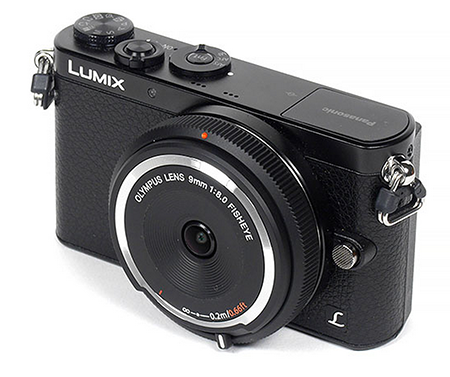
Image courtesy: Photozone
Photozone tested the 9mm lens-cap:
Honestly, it isn’t quite a bad as you might think. The center performance is actually pretty decent. The borders are Okayish whereas the corners are very soft. Lateral CAs are significant but not terrible either. There’s some vignetting but honestly this isn’t anything you’d complain about in a fisheye lens. Compared to conventional lenses, the contrast is somewhat reduced especially in the corners. However, on the positive side it is pretty resistant against flare which is rather surprising.
SLRgear tested the 14-42mm pancake zom:
The Olympus 14-42mm ƒ/3.5-5.6 EZ ED M.Zuiko Digital lens is a well-executed lens. It achieves what appears to be a goal for the smallest size possible, as well as adding in new functions (power zoom) and improving on its optical properties as well.
11 Responses
Are you celebrating our Labor Day, admin? 😉 “souble”? 😉
I’m constantly amazed at how a (UK or US English) simple spell and grammar checker is not used on this site.
i quite like this 9mm, and you can defish very easy with LR ( in raw) using sigma 10mm profile
and by the way, this lens is pretty resistant, mine just got a nice trip in the washing machine, at 50*C 😉
and as I already mentioned, this review is wrong on one point, it s not a 18mm FF, but a 9mm FF ( even a bit less, 140 degrees)
The relationship between AOV and focal length (for a given sensor size) is, mainly for WA lenses, dependent on the projection method. A fisheye with focal length X will always have a much wider AOV than a rectilinear lens with focal length X.
The focal length is approximated by the magnification in the centre of the frame. Take a fisheye lens image and de-fish it to create a rectilinear image, doing this noticeably reduces the AOV while keeping things in the centre (and thus the magnification in the centre) pretty much the same.
For an example, take the rectilinear Nikon lens 15 mm f/3.5. It has a diagonal AOV of 110º, the 16 mm f/2.8 fisheye lens however has a diagonal AOV of 180º (http://www.photosynthesis.co.nz/nikon/lenses.html#Fisheye).
Man, when I look at that lens I think, “Really Olympus… that lens element is the same size as the one on my phone. You couldn’t just double the lens element size and make it a fixed F4?”
Me, I wonder why we don’t see more third party chinese cheapo clones…
Because the lens then also would have to be at least double thick and no longer would be a body cap lens. Just doubling the front lens diameter would only gain about one stop.
Look at the Samyang/Rokinon 7.5mm f/3.5 lens if you want a fisheye lens with f/4 aperature.
The 9mm has exceeded my expectations, I find it sharp enough in the centre and a lot of fun to use, just wish this focussing lever was a little stiffer.
I like getting drunk, then doing close up portraits of people, with the flash near blinding them because of the F8 aperture…happy times…
photozone cracks me up. It must be very popular with m43 fauxtographers…